$2000 Home: Cocreating in the Bengal Delta

$2000 Home: Cocreating in the Bengal Delta

$2000 Home: Cocreating in the Bengal Delta
Instructor
Marina Tabassum

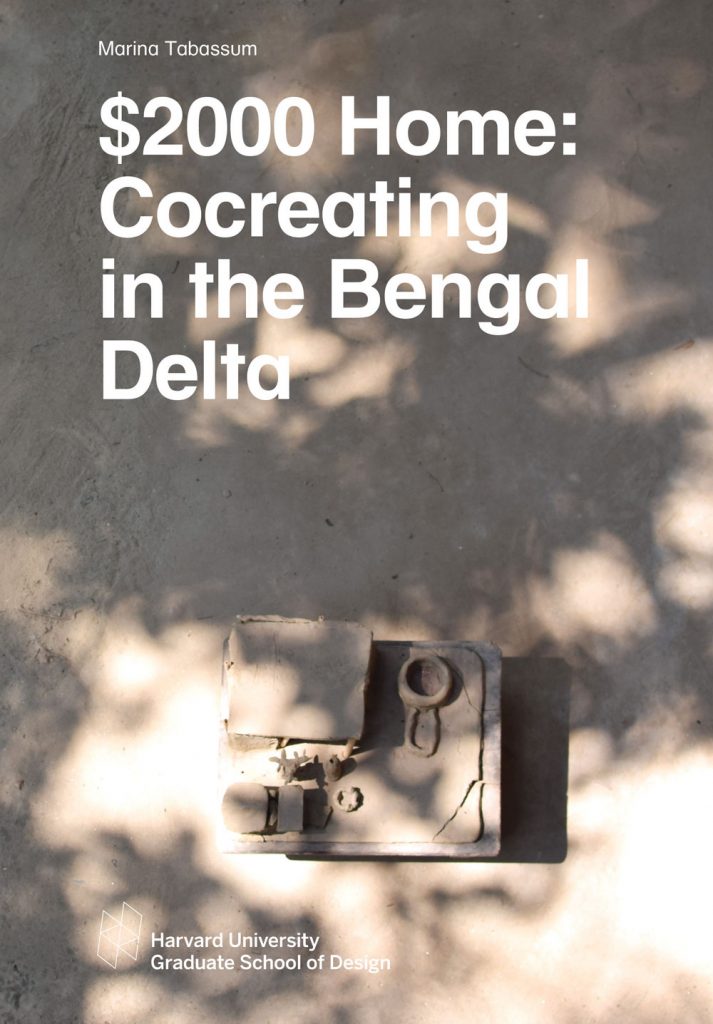
The Bengal Delta is defined by the fluidity and chemistry of land and water. As the confluence of the mighty rivers Padma and Jamuna, the fragile soft soil of the delta is in constant flux.

This area is home to the 150 million people of Bangladesh.

Their lives tell stories of negotiation, adaptation, and appropriation. In Marina Tabassum’s fall 2017 design studio, Harvard GSD students encountered five such stories after meeting families living in Taherpur and Modonpur, two villages located in the Jessore district in southern Bangladesh. $2000 Home: Cocreating in the Bengal Delta features proposals for domestic spaces, designed specifically for one of the five families.

Pursuing architecture in such a landscape requires understanding impermanence and embracing informality. The act of architecture becomes a search for innovative and creative ways of defining life with minimal means that goes beyond space and form.

$2000 Home: Cocreating in the Bengal Delta is a Studio Report from the Fall 2017 semester at the Harvard University Graduate School of Design. Published by the Harvard University Graduate School of Design, forthcoming Winter 2019. Instructed by Marina Tabassum Series design by Zak Jensen & Laura Grey; report design by Mahmuda Alam 136 pages, softcover, 17 x 24.5 cm ISBN 978-1-934510-72-8 Soon available for purchase from the Frances Loeb Library and Amazon.com

New Geographies 08: Island

New Geographies 08: Island

"Island," New Geographies 8
Issue
8
Edited by Daniel Daou and Pablo Pérez­-Ramos “Everything is connected to everything else” is the un­official slogan of our times. But is it really, and, if so, is it desirable? New Geographies 08 explores the geo philo­sophic notion of boundaries, and, in so doing, proposes new limits for the island master metaphor, bolsters the agency of design in an entangled world, and suggests the basis for a reinvigorated universalism. Marc Shell and Stefania Staniscia elaborate on “Islandology” and “Islandness.” Robin MacKay and MAP Office provide a timeline and an atlas of islands as lab­oratories for empirical and thought experiments. Cary Wolfe and Timothy Morton debate whether the world is more like an archipelago or an iceberg. Nina Samuel and Stefan Helmreich discuss the implications of rendering islands visible or invisible. Anita Berrizbeitia, Stan Allen, and Douglas Spencer ponder form and pro­cess. Formlessfinder, Roland Snooks, and Neyran Turan explore islandness in design. Kees Lokman and Susan Herrington, Alexander Felson, and Milica Topalovic provide examples of islands as cross­scalar tools from gardens to cities to territories. Joyce Hsiang and Bimal Mendis, Roi Salgueiro Barrio, Hashim Sarkis, and Rania Ghosn and El Hadi Jazairy speculate on potential new limits of the island metaphor. Featuring work by: Tania Álvarez Zaldívar, Neeraj Bhatia, Andrea Branzi, Edward Burtynsky, Luis Callejas, Gilles Clement, DOGMA, Olafur Eliasson, Yona Friedman, Walter Herfst, Rem Koolhaas and Madelon Vriesendorp, Gabriel Kozlowski, Israel López Balán, Emma McNally, Jamie Mills, Mary Oliver, Piet Oudolf, Stephen Petegorsky, Bas Princen, Charles Ross, Rudi Sebastian, George Steinmetz, John Stephens, and Keith Tyson. Published by the Harvard University Graduate School of Design, Fall 2016; distributed by Harvard University Press and for sale on Amazon.  

New Geographies 07: Geographies of Information

New Geographies 07: Geographies of Information

Issue
7
Edited by Ali Fard and Taraneh Meshkani Digital information and data flows permeate every aspect of our society. Within this context, design extensively avails itself of the technological bounty of advanced digital tools. Yet beyond these tools, the fluidity of digital information and the seemingly immaterial nature of communication dominate most discussions. Understanding the contemporary networks of information and communication as inherently geographic, Geographies of Information attempts to realign design’s relationship to information and communication technologies (ICTs) by expounding on their multiscalar complexities and contextual intricacies. From the impact of digital social media on political action and the rise of predictive technologies in speculative real estate to new ways of mapping temporal conditions of a site and the evolving role of information in how designers see, understand, and act on space, ICTs exert critical influence. This issue of New Geographies examines the forms, imprints, places, and territories of ICTs through spatially grounded and nuanced accounts of the hybrid conditions that ICTs generate, the scales at which they operate, and how this production of space is manifested in both advanced and emerging economies. Published by the Harvard University Graduate School of Design, Fall 2015; distributed by Harvard University Press and for sale on Amazon.

New Geographies 06: Grounding Metabolism

New Geographies 06: Grounding Metabolism

Issue
6
Edited by Daniel Ibañez and Nikos Katsikis New Geographies 06: Grounding Metabolism aims to trace alternative, synthetic routes to design through a more elaborate understanding of the relation between models and concepts of urban metabolism and the formal, physical, and material engraving of metabolic processes across scales. The design disciplines have always recognized the potential within a critical understanding of urban metabolism to shape spatial strategies, from Patrick Geddes’s Valley Section to the megastructures of the Japanese Metabolists. Confined to the regional scale historically, today’s generalized urbanization is characterized by an unprecedented complexity and planetary upscaling of metabolic relations. Most contemporary discussions of metabolism have failed to integrate formal, spatial, and material attributes. Technoscientific approaches have been limited to a performative interpretation of flows, while more theoretical attempts to interrogate the sociopolitical embeddedness of metabolic processes have largely ignored their formal spatial registration. Within this context, the design disciplines—fascinated by the fluidity of metabolic processes—have privileged notions of elasticity without regard for the often sclerotic quality of landscapes and infrastructures. The issue addresses the challenges associated with the planetary dimension of contemporary metabolic processes, offers a critical examination of the long lineage of historical discussions and schemes on urban metabolism from the design disciplines and places them in parallel with a set of contemporary projects and interventions that open up new approaches for design. The issue features contributions by: 
Jason W. Moore, Erle C. Ellis, Peter Baccini. Timothy W. Luke, Roi Salgueiro Barrio, Aanya Chugh & Maynard León, Sabine Barles, Matthew Gandy, Volker M. Welter, Hadas A. Steiner, Ken Tadashi Oshima, Douglas Spencer, Felipe Correa & Tomás Folch, Rahul Mehrotra & Felipe Vera, Paola Viganò, Rania Ghosn & El Hadi Jazairy, Reinier de Graaf, Vicente Guallart, Philippe Rahm, Kiel Moe, Pierre Bélanger, Daniel Daou & Pablo Pérez Ramos.

New Geographies is the journal of Design, Agency, Territory founded, edited, and produced by doctoral candidates in the New Geographies Lab at the Harvard University Graduate School of Design. Supported by the Graham Foundation for Advanced Studies in the Fine Arts and the Aga Khan Program at the Harvard University Graduate School of Design.

Published by the Harvard Graduate School of Design, Fall 2014; available through Harvard University Press.

Landscapes of Development: The Impact of Modernization Discourses on the Physical Environment of the Eastern Mediterranean

Landscapes of Development: The Impact of Modernization Discourses on the Physical Environment of the Eastern Mediterranean

This book examines the impact of development policies and politics on the physical environment of the Eastern Mediterranean, a region defined here not as a rigid geographical area but as a larger cultural context. Since the end of World War II, the drive toward development, whether advanced by international institutions (United Nations, World Bank) or national governments, has encapsulated dreams of progress and emancipation that were intertwined with processes of reconstruction, decolonization, and nation-building, as well as transnational agendas for socioeconomic restructuring (capitalist or otherwise) and larger postwar/cold war power politics. In physical terms, the drive toward development has been responsible for the rapid growth of metropolitan centers, the radical restructuring of rural landscapes, and the proliferation of dams, irrigation systems, and other infrastructures. Eight essays examine formal manifestations of development, placing the spotlight on urban and rural development schemes, housing projects, and agro-landscapes and dams from Israel to Turkey, and from Greece to Syria. These contributions are all grounded in new scholarly research, employing a variety of critical tools that span the disciplines of architecture/landscape/planning history, anthropology, sociology, and geography, to situate built works within the larger sociopolitical context that influenced their design and implementation, and to reflect on their social, cultural, and environmental impact. This book was published in conjunction with the Aga Khan Program for Islamic Architecture. Edited by Panayiota Pyla Harvard Graduate School of Design, 2013

The Superlative City: Dubai and the Urban Condition in the Early Twenty-First Century

The Superlative City: Dubai and the Urban Condition in the Early Twenty-First Century

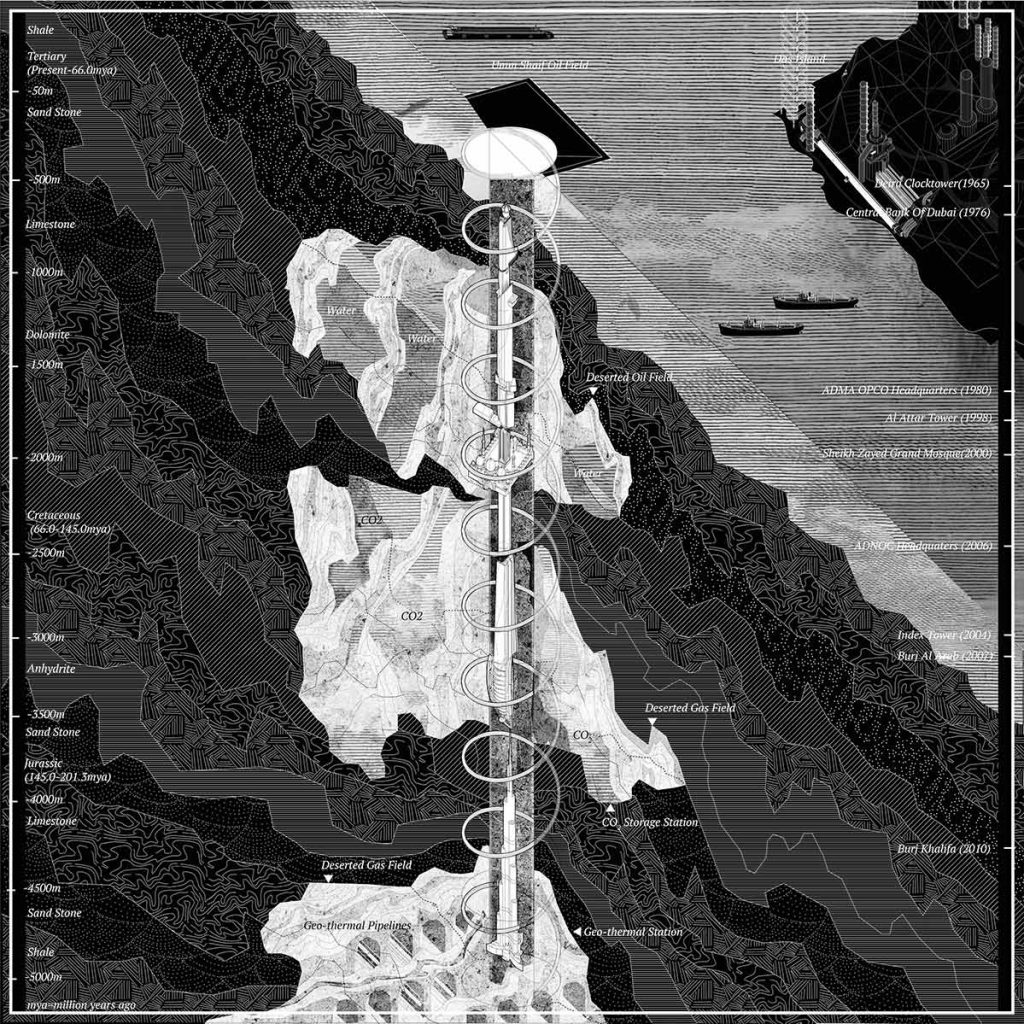
In the first decade of the twenty-first century, the Persian Gulf city of Dubai has exploded from the Arabian sands onto the world stage. Oil wealth, land rent, and so-called informal economic practices have blanketed the urbanscape with enormous enclaved developments attracting a global elite, while the economy runs on a huge army of migrant workers from the labor-exporting countries of the Indian Ocean and Eurasian regions. The speed and aesthetic brashness with which the city has developed have left both scholarly and journalistic observers baffled and reaching for facile stereotypes with which to capture its city’s identity and significance to the history of urban planning, architecture, social theory, and capitalism. In The Superlative City, contributors from the Harvard University Graduate School of Design and colleagues from the United Arab Emirates, the United States, the Middle East, and Western Europe offer more sober analyses, situating Dubai’s urbanism in its contexts of architecture, urban planning and design, and historical and cultural processes. Remarkable aspects of Dubai, such as the size and theming of real-estate projects and the speed of urbanization, are de-exoticized. Planning tactics and strategies are explained. The visually arresting aspects of architecture are critiqued, but also placed within a holistic view of the city that takes in the less sensational elements, such as worker camps and informal urban spaces. This book was published in conjunction with The Aga Khan Program for Islamic Architecture. Edited by Ahmed Kanna Harvard Graduate School of Design, August 2013

New Geographies 05: The Mediterranean

New Geographies 05: The Mediterranean

Issue
5
Edited by Antonio Petrov Most literature on the Mediterranean in relation to architecture and urbanism has focused on the idea of the Mediterranean city and its history, but the spatial aspect also merits attention. This region, at the intersection of three continents, is one of the most important areas on earth–culturally, politically, and ecologically. New Geographies 5 aims to recast “the Mediterranean” as a contemporary phenomenon and spatialize its formation as a larger geographic entity in the twenty-first century. Contributors from a variety of disciplines challenge conventional boundaries between cities and hinterlands, and dismantle prevailing geographic, spatial, and cultural meanings. This volume recovers the Mediterranean as a model for global interaction and critically examines how the migration of complex architectural and urban formations, micro-geographies, new infrastructures, and demographic flows revise geopolitical boundaries and actively reshape cities, regions, and hinterlands beyond recognized cultural and geopolitical contours. Moreover, the collected writings aspire to activate critical questions about the formation of regions and address philosophical, cross-cultural, and interfaith relationships, preservation, cultural identity, trade, and geopolitics—all elements that influence the geographic. Published by the Harvard Graduate School of Design, May 2013; available through Harvard University Press.

New Geographies 04: Scales of the Earth

New Geographies 04: Scales of the Earth

Issue
4
Edited by El Hadi Jazairy The first Apollo images of the Earth produced a perspective enabling humanity to act on Earth and its nature as if it controlled it from “outside.” The recent developments of satellite technologies have had a significant impact on the modes of representation as well as the conceptions of geography and space. This new “geography from above”—the home, the city, entire territories, the Earth itself, the Moon, Mars, and beyond—redefine our environment, subjectivities, and practices. With such tools at hand, architects conceive of the geographic as a possible scale, site of intervention, and design approach. The scale of vision, viewpoint, and qualification of space made possible by satellite imagery reframes contemporary debates on design, agency, and territory. Volume 4 of New Geographies features articles and projects that critically address the relationship of space with such modes of representation. What are the characteristics of such an integrated elevated vision, and what geographical knowledge does it bring forth? How is such an analytical space to be subsequently interpreted and experienced? What are the cultural, political, and environmental repercussions of a vision celebrated as objective and universalist? What new global issues and debates do such scales of vision raise, and how do such visualizations of the Earth-as-home intersect with concerns of ecology and calls for global awareness? Published by the Harvard University Graduate School of Design, 2011; available through Harvard University Press.

Desert Tourism: Tracing the Fragile Edges of Development

Desert Tourism: Tracing the Fragile Edges of Development

pubcov_desert_tourismDeserts are becoming increasingly popular tourist destinations. However, the growth of this tourism niche raises particular challenges, jeopardizing their fragile ecosystems and straining scarce resources. Paradoxically, the increasing popularity of desert tourism is undermining the very essence of the allure of these places. In developing countries, the consequences are even more drastic, as local populations live in dire conditions with few resources and insufficient infrastructure, rarely benefiting from tourism’s economic effects. This book seeks to analyze the relationship between tourism and the sustainable development of those territories, addressing issues raised by architecture, landscape design, and planning. Following a historical perspective, Susan Miller, Claude Prelorenzo, Neil Levine, and Aziza Chaouni show how the imaginaire of the desert was invented by movie directors, writers, and architects. Virginie Lefebvre, Alessandra Ponte, and Kazys Varnelis explore traces of previous conflicts that transformed deserts, from war to peace, into touristic destinations and places for experimentation. Finally, an analysis of contemporary conditions helps to measure the challenges still to be faced: Vincent Battesti tackles the ethnocultural landscapes of the oasis, Chris Johnson the preservation of deserts and impacts on local communities, and Gini Lee the use of deserts as creative places for artists. Available through Harvard University Press. Edited by Virginie Picon-Lefebvre with Aziza Chaouni Harvard University Graduate School of Design

New Geographies 03: Urbanisms of Color

New Geographies 03: Urbanisms of Color

Issue
3
Edited by Gareth Doherty Color is a ubiquitous yet essential part of the city, creating and shaping urban form. Who can forget the whites of modernist Brasilia? The greens of historic Cairo? The rosy reds of Petra? The terracottas of South America’s shantytowns? The color cacophonies of Times Square and Shinjuku? Colors have a presence over and beyond the objects—buildings, spaces, billboards, artifacts, and people—that make up the city. Not only does color give meaning to cities, cities give meaning to color. Whether carefully coordinated, clashing, or an expression of materials, color is a powerful cultural, economic, and political force in cities. Yet discussions on the city do not usually focus much on color, perhaps because urban colors are too often understood as being beyond any one authority or taste, or are simply dismissed as cosmetic, naïve, or intangible. Volume 3 of New Geographies brings together artists and designers, anthropologists, geographers, historians, and philosophers with the aim of challenging the status quo and exploring the potency, the interaction, and the neglected design possibilities of color at the scale of the city. Published by the Harvard University Graduate School of Design, 2011; available through Harvard University Press.