Harvard Design Magazine 52: Instruments of Service

Harvard Design Magazine 52: Instruments of Service

Construction Design Drawing
Event Location

Frances Loeb Library Lobby

Date & Time
Free and open to the public
Contributors
Elizabeth Bowie Christoforetti
Jacob Reidel
00:00
00:00

Event Description

Join Guest Editors Elizabeth Bowie Christoforetti and Jacob Reidel in a discussion about Harvard Design Magazine #52: Instruments of Service. At a moment when “design” has become everything—and hence nothing—Issue 52 examines the hidden mechanics and visible output of design practice in order to track the shifting role of designers in society and to gauge the capacity of designers to effect change in a world of mounting crises.

The issue poses a simple question: What do architects actually make and how is this changing?

Issue 52’s exploration is grounded in architecture. In days gone by, architecture was seen as the “mother art” (Frank Lloyd Wright) and as “the ultimate goal of all creative activity” (Walter Gropius’s introduction to his Bauhaus Manifesto), but over the past century it has lost its purchase on such sweeping and grandiose claims to creative primacy and world-building. At the same time, however, architecture remains a ubiquitous point of reference for a wide range of disciplines, practices, and protagonists that influence the design of the things we use and the environments we inhabit—including fields not only directly related to architecture such as landscape architecture, urban planning, and urban design, but also fashion, industrial design, graphic design, and digital design.

The issue’s title, Instruments of Service, carries a double meaning. As defined in standard American Institute of Architects contracts, “Instruments of Service are representations, in any medium of expression now known or later developed, of the tangible and intangible creative work performed by the Architect and the Architect’s consultants under their respective professional services agreements. Instruments of Service may include, without limitation, studies, surveys, models, sketches, drawings, specifications, and other similar materials.” Instruments of service are the instruction manuals that architects—and other designers—make so that others can make something. They define the architect’s relationships with labor, construction, clients, and society. And these relationships—along with the agency of architectural practice—are changing as a growing number of external pressures force instruments of service to change.

Architects and designers can also be seen as instruments of service to society, responsive to a continually shifting set of values. At a fundamental level, the designer’s job is to imagine and articulate a better future. In a time of crisis and competing value systems—market returns, cultural relevance, environmental response, social equity, automation—the role of the designer in society is ever more important and increasingly accountable to divergent interests that call into question the raison d’être of design practice itself.

In the end, what we make is inextricably tied to why and for whom we make it.

Speakers

Headshot of Elizabeth Bowie Christoforetti

Elizabeth Bowie Christoforetti is assistant professor in practice of architecture at the Harvard Graduate School of Design and the founder and director of Supernormal, a design studio based in Cambridge, MA. Her research, practice, and teaching focus on changing definitions and modes of design practice in the built environment. Her work explores emerging theories, methods, and the technological building blocks that enable design practice to confront the overlapping and conflicting imperatives of our time: the climate crisis, artificial intelligence, and market-driven urbanism.

Headshot of Jacob Seidel

Jacob Reidel examines and advances the purpose, value, and potential of architectural practice. His work—spanning practice, research, publication, and teaching—is grounded in the conviction that while architecture and the people who create physical spaces have existed for millennia, the practice and the profession of architecture are comparatively new and unstable frameworks, subject to reconsideration and redesign. He is assistant professor in practice of architecture at the Harvard Graduate School of Design, a licensed architect in New York where he co-chairs the AIA New York Future of Practice Committee, and is co-founder and editor of CLOG.


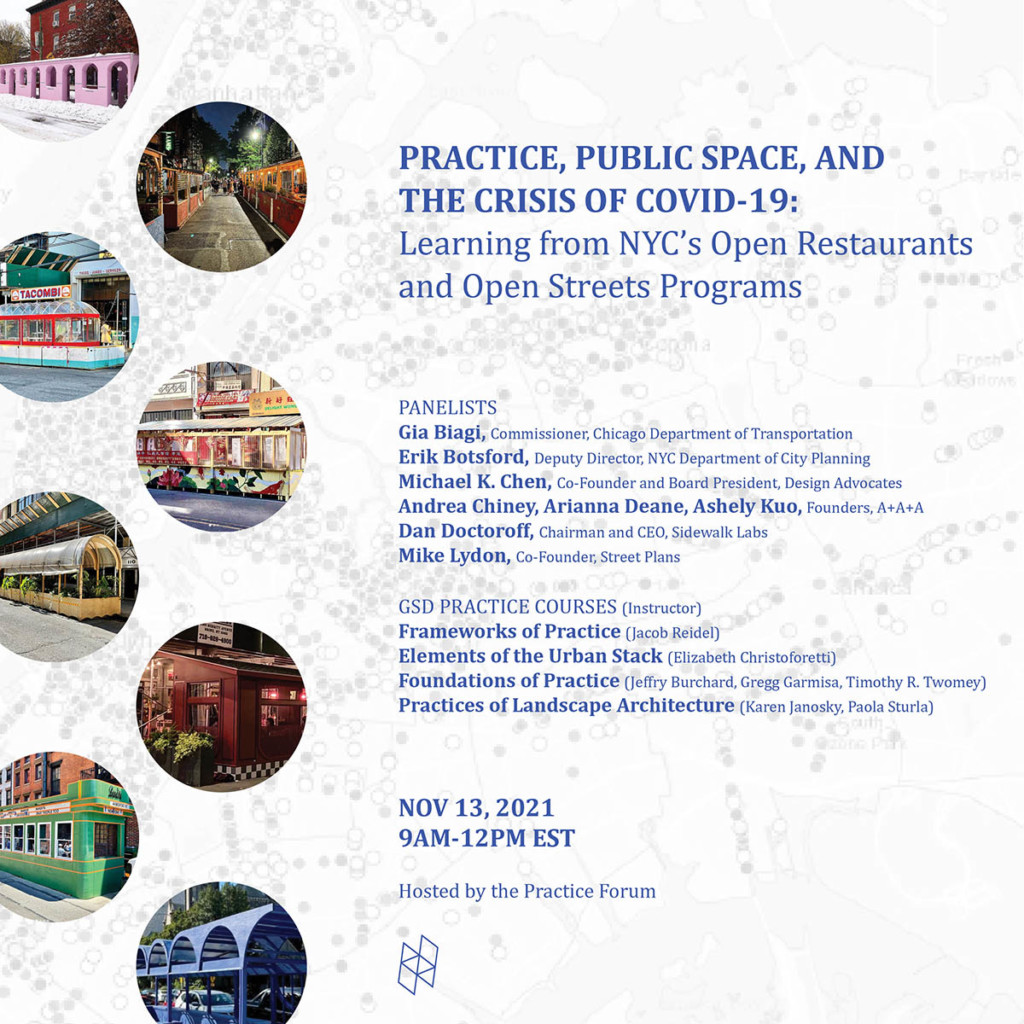
2021 Practice Plenary – Practice, Public Space, and the Crisis of COVID-19: Learning from NYC’s Open Restaurants and Open Streets Programs

2021 Practice Plenary – Practice, Public Space, and the Crisis of COVID-19: Learning from NYC’s Open Restaurants and Open Streets Programs

Poster with small images from New York City in circles, and blue text advertising the Practice Plenary event.
Event Location

GUND Gund 510

Date & Time
Free and open to the public
Fall 2021 GSD Practice Plenary – Practice, Public Space, and the Crisis of COVID-19
00:00
00:00

Event Description

Beginning in late 2019 communities throughout the world began to enter lockdowns in response to the COVID-19 pandemic. Our understanding of the virus was changing daily, and professional expertise was sought to guide countless day-to-day decisions big and small. Professions with expertise in public health, epidemiology, medicine, and other scientific domains had a clear and vital role to play. The contribution of the architecture, landscape, and spatial design professions, however, was perhaps less obvious.

In the early months of the pandemic designers used their fabrication capacity to manufacturer small batches of PPE and were consulted for numerous op-eds, white papers, and design proposals concerning, for example, how to make workplaces safe for occupancy. By the summer of 2020 it was becoming increasingly apparent that with the adoption of remote-working and without an effective vaccine, most offices would remain closed and empty for many, many months to come. However, as the northern hemisphere entered its first pandemic summer, many communities began to experiment with moving indoor activities outdoors, where the risk of virus transmission was dramatically lower. This significant relocation of life from indoors to outdoors demanded new types of spaces and structures – a shift which (at least in theory) overlapped with the expertise of the architecture, landscape architecture, and other spatial design professions.

In New York City, the “Open Restaurants” and “Open Streets” programs were launched. The former allowed dining establishments to repurpose sidewalks and on-street parking for their businesses, while the latter allowed residents to repurpose entire streets for recreational use. Intended to be temporary and in many respects developed in real time, these two programs represented a radical rethinking of public space. And while the initial Open Restaurant and Open Street projects were largely informal and lightweight, over time — and as local temperatures began to plummet — the Open Restaurant structures/parklets/coronashacks/steeteries/streateries/whateveryoucallthem became increasingly robust, formal, and building-like. As of November 2021, there are more than12,000 Open Restaurants and 360 Open Streets registered with the city. And so effective and popular have these programs become that New York City Mayor Bill de Blasio initiated the process of making them permanent, despite a host of unresolved questions ranging from regulatory and operational concerns to broader issues of equity and access to public space.

So how did the architectural profession participate in this unprecedented wave of building across New York City (and beyond)? Open Restaurants and Open Streets – representing essentially thousands of new buildings and parks — have transformed the streetscape of the city. They have also demonstrated the ways in which the architecture and landscape architecture professions — and the myriad rules, regulations, and city agencies that up until now have governed building and public space in one of the world’s global capitals — have and have not been able to meaningfully participate in the response to the global crisis of COVID-19.

Now that many communities are beginning to move into the next stages of reopening — and now that it is becoming increasingly likely that Open Streets, Open Restaurants, and many similar programs around the United States and the world may become permanent in one form or another – the GSD Practice Forum is bringing together students, practitioners, and policy makers to assess how the design professions showed up in the response to COVID-19. Using NYC’s Open Restaurants/Streets Programs as our case study, we will seek to understand how spatial design professionals found ways to meaningfully engage in their communities’ response to the COVID-19 crisis, sometimes operating in traditional, official capacities while at other times operating outside the bounds of professional practice. Ultimately, our collective aim is to uncover lessons that can guide how the discipline, profession, and practice of architecture must evolve to address the current and future crises our world will face.

Hosted by the GSD Practice Forum.

Speakers

Michael K. Chen , Co-Founder and Board President, Design Advocates .

Mike Lydon, Co-Founder, Street Plans

Andrea Chiney, Arianna Deane, Ashely Kuo, Founders A+A+A

Erik Botsford, Deputy Director, NYC Department of City Planning

Gia Biagi , Commissioner, Chicago Department of Transportation

Dan Doctoroff , Chairman and CEO, Sidewalk Labs

Participating Courses

Elements of the Urban Stack (taught by Elizabeth Christoforetti)

Frameworks of Practice (taught by Jacob Reidel)

Foundations of Practice (taught by Jeffry Burchard, Gregg Garmisa, Timothy R. Twomey)

Practices of Landscape Architecture (taught by Karen Janosky and Paola Sturla)

Schedule

9:00-9:10 Introduction and Opening Remarks

9:10-9:25 Presentation from PRO-7445, Elements of Urban Stack

9:25-9:40 Michael K. Chen, Co-Founder and Board President, Design Advocates

9:40-9:55 Mike Lydon, Co-Founder, Street Plans

9:55-10:10 Presentation from PRO-7408, Frameworks of Practice

10:10-10:25 Andrea Chiney, Arianna Deane, Ashely Kuo, Founders A+A+A

Break

10:30-10:45 Erik Botsford, Deputy Director, NYC Department of City Planning

10:45-11:00 Gia Biagi, Commissioner, Chicago Department of Transportation

11:00-11:15 Dan Doctoroff, Chairman and CEO, Sidewalk Labs

Break

11:20-11:40 Roundtable & Response

Speaker Bios

Michael K. Chen, Co-Founder and Board President, Design Advocates

Michael Chen is principal of Michael K. Chen Architecture, based in New York City. MKCA’s growing body of work is recognized for a commitment to craft, collaboration, and civic engagement, and has been widely featured in national and international publications and exhibitions.

In March of 2020, Michael co-founded Design Advocates, a network of independent architecture and design firms collaborating on pro-bono projects, research, and advocacy serving communities of need. D/A’s work has concentrated on improving safety, physical distancing, and mechanical systems of indoor spaces; and the safety, availability, and design of outdoor spaces to ensure that all communities have equitable access to essential services and public space. Design Advocates has grown to encompass 250 firms and volunteers at work on over 100 projects and initiatives.

Mike Lydon, Co-Founder, Street Plans

Mike Lydon is co-founder of Street Plans, an urban planning, design, and research-advocacy firm based in Miami and New York City. Mike is an internationally recognized planner, writer, speaker, and advocate for livable cities. With Tony Garcia, Mike is the recipient of the 2017 Seaside Prize and co-author of Tactical Urbanism: Short-Term Action for Long-Term Change, which was honored by Planetizen as one of the top planning books of the past decade. The same website named Mike as one of the top 100 urbanists of all time in 2018. Most recently, Mike co-authored NACTO’s Streets for Pandemic Response and Recovery Guide and published the Streets for Voting Guide with the Center for Tech and Civic Life.  Mike lives in Brooklyn, NY with his wife and two sons. He encourages you to trade four wheels for two.

Andrea Chiney, Arianna Deane, Ashely Kuo, Founders A+A+A

A+A+A is a women-led studio and design consultancy. Their work explores creative solutions for the built environment with a focus on community driven design processes. With a passion for creative engagement with the public, their practice employs a grassroots approach to tackle spatial justice issues. As facilitators, the studio designs thought provoking and playful additions to the urban landscape.  Their multifaceted approach has been applied to engagements from New York City’s Chinatown and Queens, to South Florida. Past collaborators and clients have included the Coalition of Immokalee Workers, Think!Chinatown, Center for Court Innovation, Youth Design Center, Urbane Development, and the Queens Museum.

Erik Botsford, Deputy Director, NYC Department of City Planning

Erik Botsford is the Deputy Director for Manhattan planning at the New York City Department of City Planning. He works together with a group of 20 urban planners and designers charged with planning for the growth, resiliency, and equity of the Borough of Manhattan. Erik has been with DCP for 18 years, where he has managed major initiatives such as the neighborhood rezoning plans for West Chelsea, East Harlem, and now SoHo/NoHo. He has long had a keen interest in the innovative use of public space, having served as City Planning’s representative in the design and development of the High Line and as manager of the overhaul of the City’s regulations related to Privately-owned Public Spaces such as plazas, atriums, and arcades. Erik lives in Brooklyn with his husband, two children, and goldendoodle.

Gia Biagi, Commissioner, Chicago Department of Transportation

Gia Biagi is an urban planner and designer with experience in the private and public sectors who was appointed Commissioner of the Chicago Department of Transportation (CDOT) by Mayor Lori E. Lightfoot in December 2019. The Mayor charged Biagi with implementing a vision for a transportation system that prioritizes equity and mobility and works to lower the economic and environmental burden of transportation on residents and communities.

As Commissioner of CDOT, she oversees the department responsible for Chicago’s roadways and bridges, sidewalks and bike lanes, traffic signals and signage, streetlights, the permitting of activities in the public right-of-way, the citywide bike share system, and policies focused on complete streets, climate adaptation, and new mobility. Her current work includes development of the City’s new Strategic Plan for Transportation and implementation of Mayor Lightfoot’s“ Chicago Works” capital improvement infrastructure program.

Before answering Mayor Lightfoot’s call to return to public service, Biagi was a Principal at Studio Gang Architects. At Studio Gang,her work centered on how to move toward equity, mutuality, and positive change in cities by working with a range of partners including community-based organizations, cultural institutions, developers, government, and other public and private groups and individuals.

Prior to joining Studio Gang, Biagi spent more than a decade in public service at the Chicago Park District in roles that included Director of Planning and Development and Chief of Staff.

Dan Doctoroff, Chairman and CEO, Sidewalk Labs

Dan Doctoroff is the Chairman and CEO of Sidewalk Labs, the urban innovation company that seeks to radically improve quality of life in cities for all. Prior to founding Sidewalk Labs, Dan was President and Chief Executive Officer of Bloomberg L.P., the leading provider of news and information to the global financial community, until December 2014. Dan also served as Deputy Mayor for Economic Development and Rebuilding for New York City, leading the city’s economic resurgence and the reversal of its fiscal crisis after 9/11 through a five-borough economic development strategy. He also oversaw the creation of PlanNYC, New York’s pathbreaking sustainability plan.

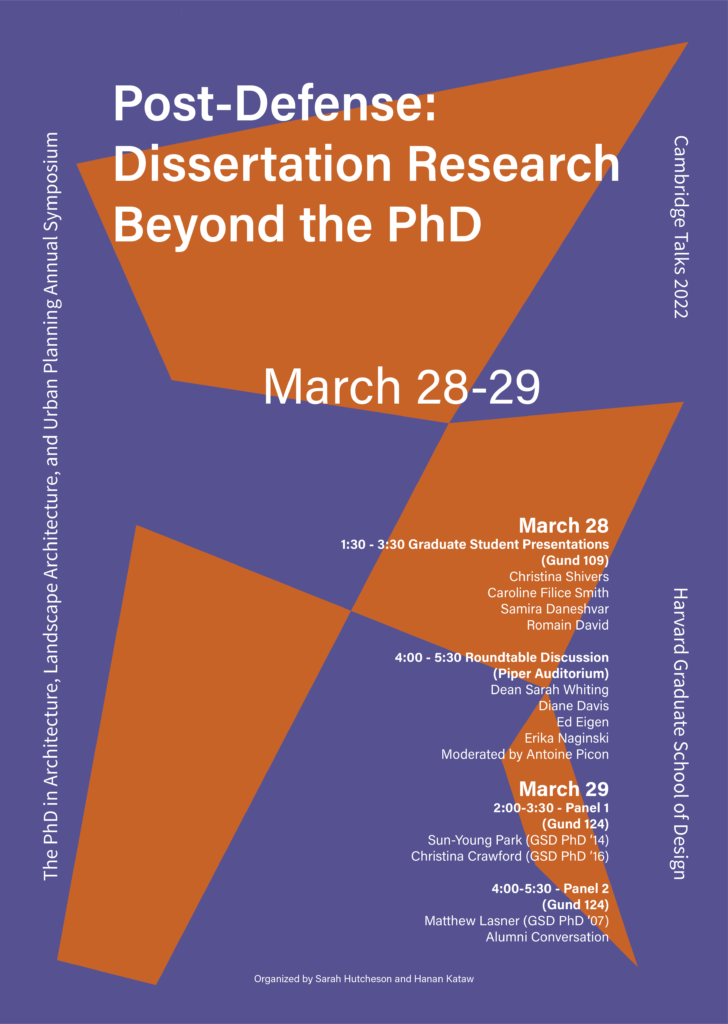
Post-Defense: Dissertation Research Beyond the PhD

Cambridge Talks

Post-Defense: Dissertation Research Beyond the PhD

Purple and orange poster with white text advertising the Cambridge Talks event.
Dates
Gund 109
Gund 109
Piper Auditorium
Gund 124
Open to the Harvard University community only

Event Description

In “Post-Defense: Dissertation Research Beyond the PhD” the PhD program in Architecture, Landscape Architecture, and Urban Planning takes a wide look at the topics and trajectories of PhD work at the GSD. Through presentations, roundtable and informal discussions, this year’s Cambridge Talks asks faculty, students, and alumni to reflect on the various stages of doctoral research and its afterlives beyond the PhD.

This event is open to HUID-holders in-person, and is open to the public via Zoom. Please use this link to register via Zoom .

Schedule

Day 1 – March 28:

1:30 – 3:30 Graduate Student Presentations (Gund 109)

This session brings together four PhD students who will describe aspects of their doctoral work

4:00 – 5:30 Round Table Discussion (Piper)

This faculty conversation will reflect on the history, evolution, and impact of the PhD program at the GSD

Day 2 – March 29:

The speakers’ sessions will explore key publications and their intellectual development from pre to post PhD

2:00-3:30 – Panel 1 (Gund 124)

4:00-5:30 – Panel 2 (Gund 124)

Speakers

Sun-Young Park is an Associate Professor in the Department of History and Art History at George Mason University. She is a scholar of 19th-century France who studies the intersections of architectural, urban, and medical history. She is the author of Ideals of the Body: Architecture, Urbanism, and Hygiene in Postrevolutionary Paris (published by the University of Pittsburgh Press in 2018), and is currently working on a new book project titled The Architecture of Disability in Modern France. Sun-Young received a BA from Princeton University, and an MArch and PhD from Harvard University. Her work has been supported by the American Council of Learned Societies, National Endowment for the Humanities, Graham Foundation, and Society of Architectural Historians, among others.

Christina E. Crawford is an architectural and urban historian, a trained architect, and assistant professor of architectural history at Emory University, whose research focuses on the transnational exchange of ideas about housing and urban form in the twentieth century. Her research and publications have been supported by the American Council of Learned Societies, the Getty Foundation, the Graham Foundation, and the College Art Association, among other institutions. She is the author of Spatial Revolution: Architecture and Planning in the Early Soviet Union (Cornell University Press, 2022), and co-editor of Detroit-Moscow-Detroit: An Architecture for Industrialization, 1917-1945 (MIT Press, 2023). Christina’s new research explores interwar exchanges of housing expertise between the US and Europe, using Atlanta as a primary node. She serves on the board of the Society of Historians of Eastern European, Eurasian and Russian Art and Architecture.

Matt Lasner is associate professor of urban studies and planning at Hunter College, where he teaches courses on U.S. and global urbanism, housing, and the built environment. He has written widely on the culture, politics, and design of twentieth-century U.S. housing. He is author of the award-winning High Life: Condo Living in the Suburban Century, a history of co-ops, condominiums, and townhouse complexes in New York, D.C., Chicago, Miami, and L.A., and co-editor of Affordable Housing in New York: The People, Places, and Policies That Transformed a City. He is currently writing two books: “Apartment: Making Homes Together in Postwar America,” about private multifamily housing, and “The Communitarians: Bay Area Architects and the Quest to Rehouse America,” about progressive community planning. He is also a founding editor of the Web journal PLATFORM. In addition to his PhD in architecture, he holds a master’s degree in urban and regional planning studies from the London School of Economics.

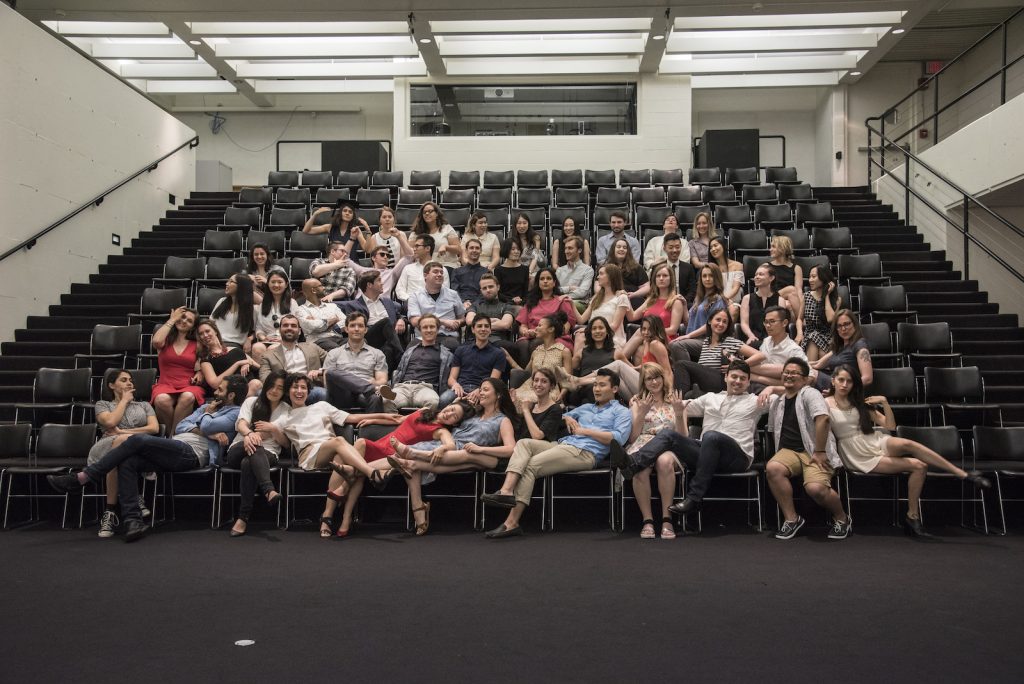
Class Day 2017: Awards Ceremony and Address

Class Day 2017: Awards Ceremony and Address

Class Day 2016
Event Location

Gund Backyard

Date & Time
Free and open to the public

The Harvard Graduate School of Design’s 2017 Class Day activities will be held on Wednesday, May 24, 2017. Class Day activities at the GSD include class photos and ceremony rehearsal for graduates, the Awards Ceremony and Class Day Address, and a reception for graduates and their guests.

The Class Day Awards Ceremony and Address will take place from 3:00 p.m. to 5:00 p.m. on Wednesday, May 24, in the Gund Hall Backyard.

Schedule Overview

Please visit the GSD’s Commencement page for more information about Commencement week activities. You may also wish to view the university-wide Commencement site.

Katherine Farley

Katherine Farley (MArch ’76)

The GSD has named Katherine Farley (MArch ’76) its 2017 Class Day speaker. Farley recently retired as Senior Managing Director of Tishman Speyer, responsible for their Brazil and China businesses and Global Corporate Marketing, after a 32-year career at the company. She currently serves as Chairman of Lincoln Center for the Performing Arts. She has been involved at Lincoln Center since 1999, having served on the New York Philharmonic Orchestra Board from 1999 to 2005 and on the Lincoln Center Theater Board from 2002 to 2005. She was Chairman of the Lincoln Center Redevelopment Project from 2006 to 2010, a $1.2-billion comprehensive renovation of the campus.

Farley is a Co-Chair of the International Rescue Committee, a nonprofit organization that focuses on emergency relief and resettlement of refugees, after having served on their Board of Trustees from 1998 to 2009 and their Board of Overseers from 2009 to 2015. She also serves as a Trustee of The Rockefeller University and The Andrew J. Mellon Foundation. She served on the Board of Trustees of Brown University from 2004 to 2010, the Board of the Alvin Ailey American Dance Theater from 2001 to 2010, and the Board of the Lang Lang International Music Foundation from 2012 to 2016. She also served as a Member of The Nature Conservancy’s Latin America Conservation Council from 2011 to 2014.

Farley was Vice President of the Board of Directors of the Brearley School in New York City from 1999 to 2007 and is Chairman Emerita of Women In Need. She received her BA from Brown University and a Master’s Degree in Architecture from the GSD.