Provisionally Invisible: Depicting the Margins of the Known
Yara Saqfalhait (MDes ’19)
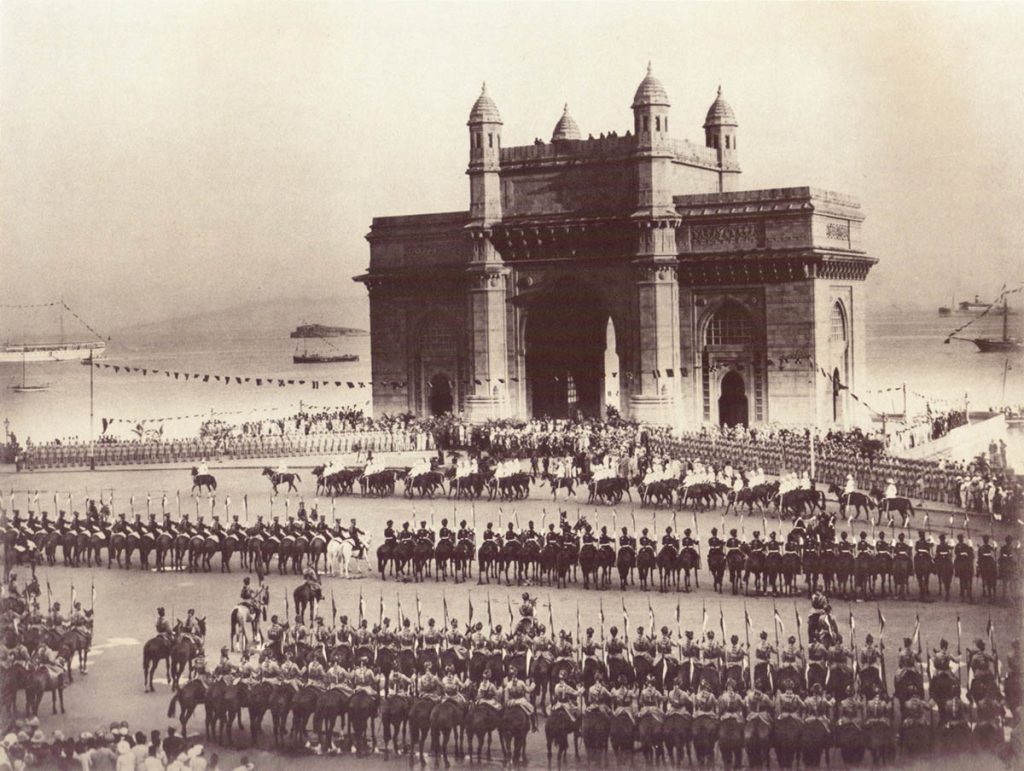
In his preface to the second volume of Mundus Subterraneus (1665), a 17thcentury two-volume atlas of the subterranean world, Athanasius Kircher promises his readers to make the most profound depths of the Earth visible ‘by means of a sharp penetration of the eyes’1. Consequently, the following pages of the book are populated by lavishly illustrated depictions of natural phenomena that range from volcanic eruptions to underground springs and channels, in addition to machines and instruments that replicate natural processes which could not be directly observed otherwise, like the formation of metals and magnetic attraction. The German scholar’s work was cast by some of his later biographers as an anachronism amidst the rising scientific empiricism of the 17thcentury, mainly due to the speculative nature of its claims and the irreproducibility of its experiments.
This thesis seeks to investigate the function of the pictorial representations employed by Kircher in Mundus Subterraneus, in relation to the changing intellectual and institutional contexts, ways of seeing, belief systems, forms of knowledge, scientific practices and colonial expansion of mid-seventeenth century Europe. Looking first at the wider economy of images circulating through the works of naturalists in seventeenth century Europe, this thesis provides a reading of Kircher’s illustrations against the backdrop of the epistemological status of scientific images of their time. It turns next to considering Kircher’s investigation of the subterranean world – and other realms that reside beyond and below the threshold of unaided human vision – in light of the transformation of the relationship between vision and cognition instigated by the introduction of optical instruments like the telescope and the microscope at the beginning of the seventeenth century, and the ensuing change in the conception of scientific fact, evidence and explanation. Changes within which Mundus Subterraneuswas deeply embedded, and it is in connection to which that its ambitions and shortcomings should be considered.
1Kircher, Athanasius. Mundus Subterraneus, in XII Libros Digestus. Vol.II, 1st ed. Amsterdam: Joannem Janssonium & Elizium Wegerstraten, 1665, p. ii.
Dwelling + Ground: Terraformed Housing for Port-Au-Prince
Belle Verwaay (MArch I ’18)
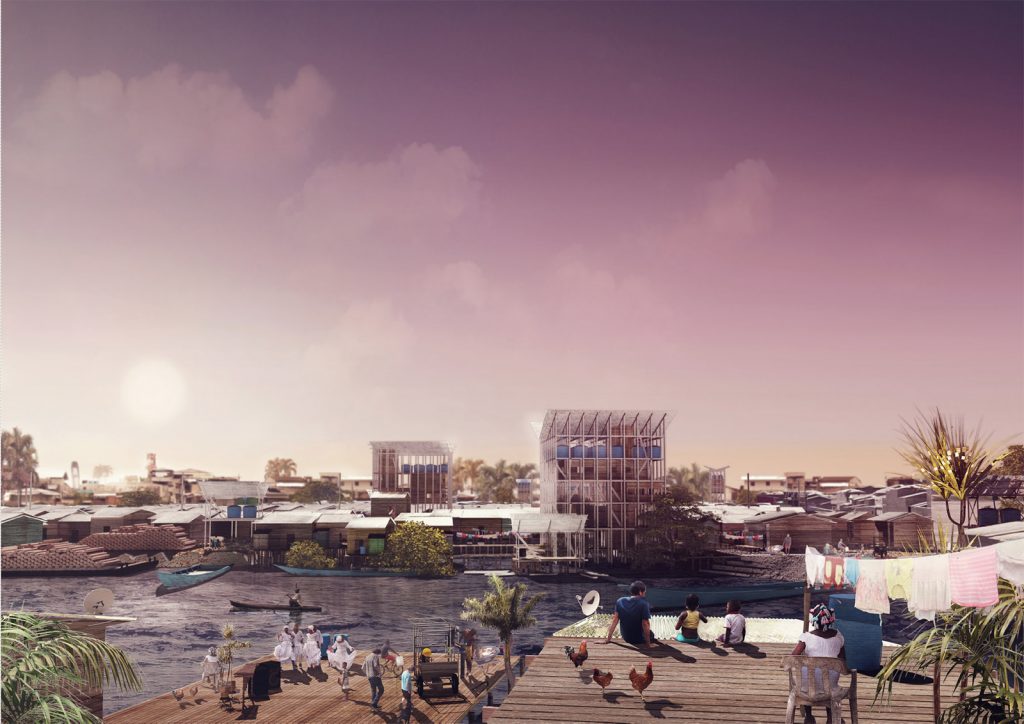
This housing design, sited in Port-au-Prince, studies the relationship between dwelling and landscape by reimagining the ground as civic surface that has the capacity to provide for diversity, freedom of choice, and well-being in the living environment.
Cultural practices in Haiti have deterred vernacular architecture from expanding vertically.
Due to the cultural and spiritual significance of the ground and the economic dependency of access and exposure to terrafirma, urban dwellers have turned to the single-story dwelling unit as the dominant housing type. Recent laws legitimizing the co-ownership of property hope to stimulate vertical growth to accommodate the country’s rapid and unprecedented urbanization. However, urban dwellers are unlikely to adopt high-rise housing typologies to resolve the city’s severe housing crisis as it undermines the role of the civic surface in their daily lives.
This produces a productive challenge for architects: can we densify urban housing to meet the demands of our growing urban populations while still providing every urban dweller their own “front door”? For Port-au-Prince, an innovative shaping of the groundscape and dwelling unit is necessary to address housing needs and allow for densification of the urban fabric to occur. Historically, urban densification has often resulted in vertical growth and the abandonment of the ground plane. This proposal aims to marry the two: densification and allegiance to terrafirma, in order to improve the dweller’s quality of living and freedom of choice in the city.
By understanding the role of the ground plane in the quality of urban life, we are better suited to design dwelling space that responds to both interior and exterior pressures, thereby potentially reconfiguring the very DNA of the city. The potential lies in developing cities, like Port-au-Prince, that face massive inevitable densification whereby the institutional norms of planning have failed. Through such cases, we are challenged to develop new types that better serve and have the potential to reimagine urban dwelling.

The new, multiplied ground plane produces intimate buffer spaces throughout the site: shaded spaces that could welcome a domino game during the day, or a study session at night.
Tirana Freescape: Reconstructing Socialist Space
William Baumgardner (MLA I ’18)
Tirana, Albania is a city where voices are silenced and identity remains opaque. Through a tumultuous and dark history, the political landscape inherent to public trust has been fractured. How then can the public realm be reconceived to better express the voices of the individual and the collective? This thesis explores how cultural forms of identity, memory, and voice, as found in Albanian textiles can be interpreted at the urban scale. The recently completed master plan the city is implementing does little to recognize public space and the landscape of the capital city while allocating new “poly center” developments. Grounding the thesis in one of these “poly centers,” a derelict textile factory built at the inception of the Communist regime, cultural memory is interpreted, extracted, and manifested in a multi-faceted urban development which aims to operate as a business incubator, housing and public space, community agriculture, and transit-oriented development. By excavating history through the processes of soil remediation, new forms of labor, and community development, the project aspires to reposition the city’s history. Like the textiles that have prevailed in the country for centuries, each thread, each pattern, serves a purpose and frames a larger whole. Unlocking this memory and restructuring its texture will inform the shape of a liberated public realm, one that is vocal and free.

From Pipeline to Platform: Imagining Innovation in the Rust Belt
Alex Yuen (MAUD ’18)
How do we build upon our economic successes while ensuring that no community is left behind? The project brings together two major contemporary urban phenomena that are not exclusive to the United States, but nevertheless extremely influential in modern American society. The first is the development of areas known as Rust Belts; former industrial centers that have undergone gradual economic decline associated with shifting market trends and manufacturing processes. The second phenomenon is the emergence of Innovation Centers, where economies are driven not by the physical output of material, but rather by the development and accumulation of knowledge. Within the American context, these two conditions come to exemplify two extremes of economic viability and success.
A new development for innovation is proposed within the city of Akron, Ohio. With a rich history tire and rubber manufacturing, Akron’s urban genesis was originally tied to manufacturing and innovation. As one of the fastest growing cities in the country in the 1920’s, Akron epitomized the early connection between urbanization and innovation. After decades of industrial decline, the city has recently developed an eco-system of innovation in polymer research and development that includes over two thousand related companies located in the area and Akron is widely considered to be the polymer capital of the world.
This thesis asserts that innovation should, once again, be urban. The project imagines a new habitat for this ecosystem while simultaneously proposing a refreshed model for the North American innovation campus that rethinks pressing issues of openness, flexibility, sustainability, and relationship to its physical and social context.
The design project posits that neither the isolated headquarter campus nor acupunctural situated incubator can adequately resolve the spacial or contextual requirements of the modern innovation hub or the cities that are home to them. Rather, a new development for innovation in the Rust Belt takes advantage of the available land, but also emphasizes certain concentrated densities. The project is a necessary hybrid, accommodating the social interaction that is promoted by the mat, but allowing for the accumulation of vertical programmatic specificity.
The mat elements, or platform, support a sense of industrial flaneur, where innovators and creators are encouraged to move throughout the different labs and production facilities. Imagined as a collection of spaces that aggregate due to the economic and research advantages of clustering, these elements utilize one of the most resilient industrial types, and Akron staple, the hangar, for its structural and financial efficiency.
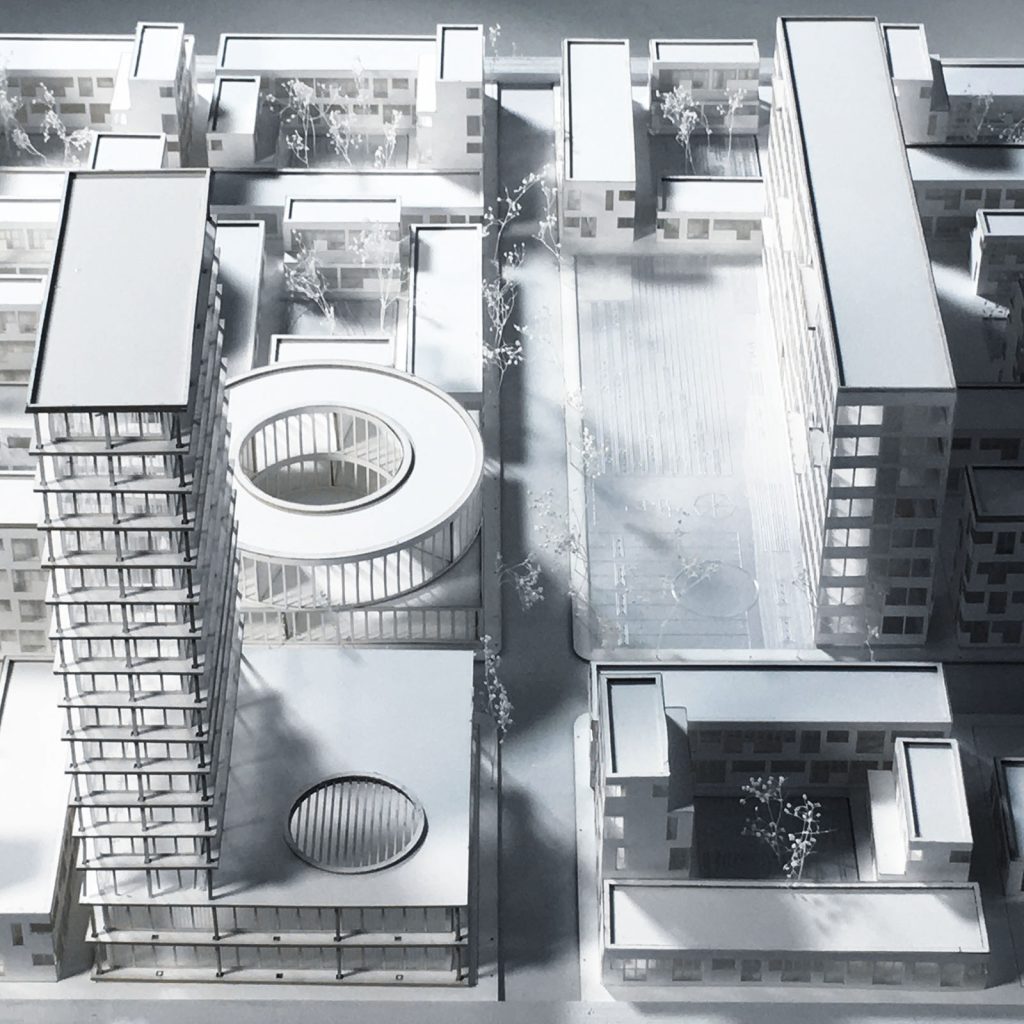
Established upon the platform is a second ground which remediates the current brownfield site into a public free space. Towers and slabs emerge from the platform, providing space for both isolated research to occur as well as housing for a floating population of locals and new arrivals, simultaneously refreshing and strengthening Akron’s wavering real estate market. Wary of potential aesthetic obsolescence, the project maintains a balance between landscape and strategically implemented built form that establishes a discernable image of urbanity for the polymer industry and Akron at large.
Redefining the State-Society Interface: Learning from Ghana’s Ministry of Inner City & Zongo Development
Colleen Brady (MUP ’18)
Global trends focusing on accountability and community participation have led many governments to address marginalized populations previously left behind by urban development. This paper examines how governments engage with socio-spatially marginalized populations through the policies and programs they adopt, focusing on the “state society interface” where government priorities and marginalized communities interact. It focuses on a case study of Ghana’s newly created Ministry of Inner City and Zongo Development (MICZD), an emerging government initiative that is engaging with a marginalized community. The MICZD’s stated objective is to improve the social and infrastructural development of zongos, or “stranger’s quarters,” which have historically housed northern Hausa migrants and over time have become associated with slum-like conditions.
Building on the literature on state-society engagement, community participation, and urban citizenship in the global South, the study draws on 38 interviews with government stakeholders, community-based organizations, and local leaders as well as on 4 focus groups with zongo residents. The results reveal several key findings related to this effort of state-society engagement. First, the MICZD’s engagement with zongos is broadly perceived as politically motivated. These political motives are viewed negatively by some participants and positively by others. Second, while the MICZD has achieved some legal and administrative milestones, engaging zongo communities to some extent thus far, this timeline is perceived very differently depending on who is asked. Third, while there is agreement by MICZD and residents that zongos’ needs are central to the Ministry’s work, these actors differ in the degree to which they prioritize physical versus social improvements. Finally, the Ministry’s approach is understood as novel in several ways, but, perhaps as a result, different groups have varied visions of what it would look like for MICZD to be successful. Considering some of these challenges, the paper identifies two potential paths toward more productive and empowering state-society engagement – creating continuous engagement platforms and counterbalancing powers – and proposes how lessons from the case of the MICZD can serve as a learning opportunity for governments engaging with marginalized populations worldwide.
Not so skin deep: vernacularism in XL
Ziwei Song (MArch II ’18)
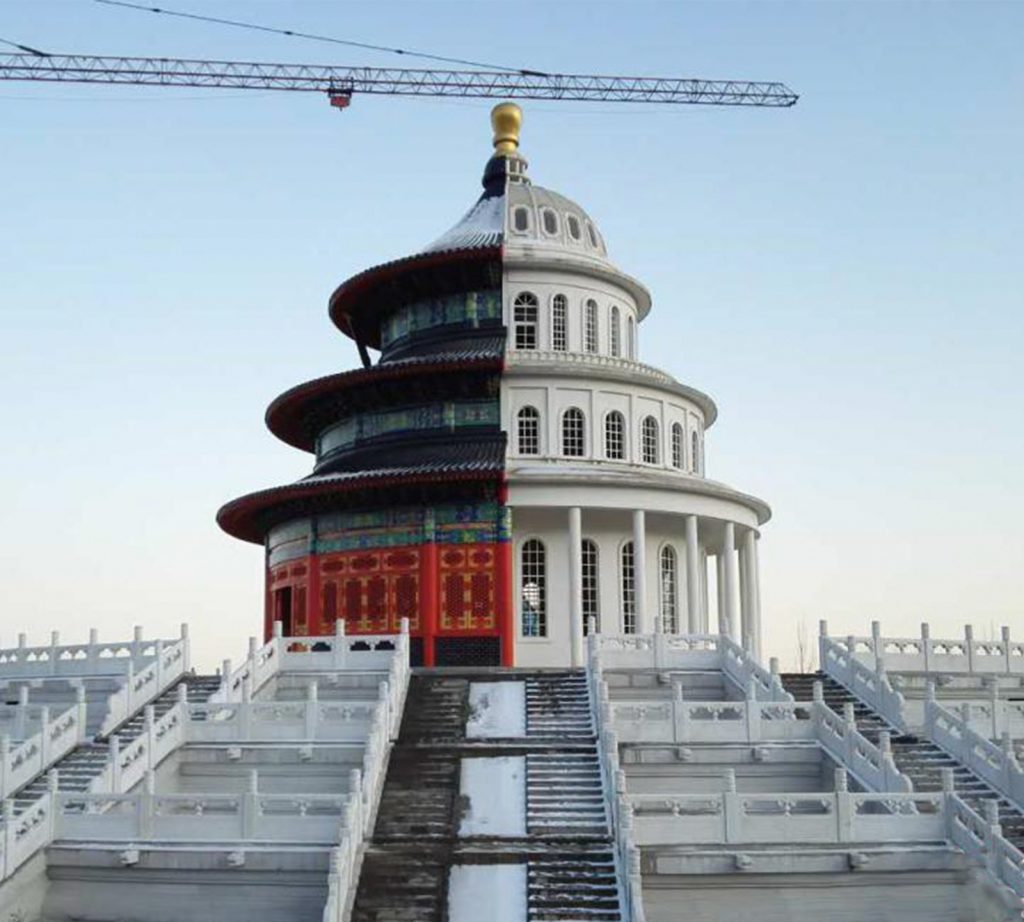
The thesis re-approaches typical developer project in China, and explores the capacity of vernacular image to make effective space in relationship to sequence, perception, exposure and events. The project has its test site in Chongqing, a very typical second tier city in China proliferating with developer projects. Those developers are building XL project either as the “decorated shed”, that uses vernacular roof as the toppers to superficially communicate the culture and completely pursues efficiency, or as) or as the “duck”, which wraps the whole building in the cultural icon and distorts the program to fit its iconic form. Both modes are not only skin deep in communicating the image culture about city and place, but also skin deep in constructing meaningful, comfortable living space. Isn’t there an alternative way of building XL project that goes beyond the skin deep of image culture and woven into the experience of space? The thesis therefore turns to the vernacular cultural roots where developers borrow those cultural icons. The design experiments the capacity of vernacular image to choreograph and make space, replacing the “decorated shed ” and the “duck” mode of the global developer today. It brings the vernacular sensibility of spatial richness to re-approach developer tower scale, altering the horizontal expansion of traditional courtyard into the expanded exploration in vertical living under the challenge of densification. Through this shift in scale, The vernacularism in XL tower addresses three folds of need: the developer’s need for efficient and repeatable floor plates, city’s need of expressing culture and identity, as well as the resident’s need of rich, comfortable, expanded spatial experience that connects them to nature, neighbors, and the active social lives.
Different from skin tower residential tower project that disconnects experience from image culture, those vernacular residential types are great examples introducing the thickness, richness and expansive threshold into the space. The image of roof profiles, garden wall, are associated with place and culture, but at the same time choreograph your experience, organize the program, orchestrate exposure and movement. The thesis extracted the enriched use of those elements, and experimenting them in XL to transform the experience of typical developer high-rise. Specifically, it takes the roof profile, which guides your view to outer threshold , organizes circulatory flow to exterior and differentiates different types of living space. When transforming tower XL, it sweeps up to floor above when needing higher ceiling for social space and two-storey space. The gable wall confining neighbor boundary in vernacular root protects privacy and prohibits unnecessary communication between unit and collective space. The garden wall provides this spatial buffer in certain residential component such as bedroom and working. As to how to construct XL from smaller unit, the design also looks at vernacular typology of temple and guild hall that deploys smaller units to construct a range of scales from small private units to mid scale social chamber to large scale civic space.
Eventually the thesis is imagining this vernacularism in XL tower in the Chongqing river scape, as a projected future of developer tower of decorated sheds together with the new proposal. The project, not longer skin deep, tries to integrate culturally significant image to construct coherent, vibrant and active spatial experience. The roof profile, gable wall and garden wall weaves with each other and meanwhile imagines a new typology of brining multifamily housing with active social mid scale collective space. The final design of the tower builds both on spatial flow of vernacular dwelling that supports flexible, adaptive living components and the viable footprint of developer tower plan. The tower alters the conventionally introverted core to four sides, freeing the central space to collective social space known as the event court. The event court houses various types of social program ranging from theater, foot court, co-working space, sports court, gallery, sculpture garden to urban forest, key to the formation of mini community. It also tries to dissolve the notion of the unit that bounds and confines the living footprint—one family is not only one unit, but enjoys the rich opportunity vertically to eat breakfast on roofscape, to view the unobstructed urbanscape and the active social chamber in the event court.
Turnpike Metabolism: Reconstituting National Infrastructure Through Landscape
Ernest Haines (MLA I ’18)
When one thinks of national infrastructure, the interstate highway system immediately comes to mind. Nearly fifty thousand miles in length, planned and constructed for over half a century, it is the largest contiguous landscape in the United States of America. However, in its current state, the highway disproportionately produces the landscape rather than vice versa. This thesis proposes a set of systems and methods that allow the landscape to actively push back upon and define the way infrastructures are developed in the United States by making landscape formation, composition, and metabolism primary drivers.

As the issue of “crumbling infrastructure” continues to become more relevant in the face of global instability, there is a priority to rehabilitate our nation’s infrastructure. A proposed consortium leverages the responsibilities and interests of existing government agencies by locating their operations in research stations across the country. These stations collect data, experiment on the ground, and develop standards and guidelines to be used nationally. Research Station #25, in New Jersey’s Meadowlands, is the primary focus of the thesis. Through this site, Turnpike Metabolism explores the ways an active feedback loop between sensing, design, construction, use, degradation, and replacement redefine infrastructural metabolism both locally and nationally in the United States.
Wild: Manhattanism Unhinged
Seok Min Yeo (MLA I ’18)
The Manhattan Grid and its ability to absorb manic heterogeneity emancipates each block into an island of its own identity and ideology, inspiring architectural ecstasy. Conceptual alternatives by the likes of Ferris, Hood,Superstudio,Koolhaas & Vriesendorp, and Tschumi contribute to the island as a cultural ideology and a theorem: Manhattanism
The podium – a straight extrusion of the existing formal logic of the grid – is the datum of reliability that act as a stage for expressions above. Here I posit, that the space in between the podiums, The Street – is the largest contiguous public realm of the island, and it has been neglected from this conversation.
This investigation begins from Ferriss’ “The Metropolis of Tomorrow,” a series of atmospheric charcoal renders produced in 1929, which Koolhaas dubs as the “womb” of Manhattanism. Ferriss’ renders were an imagination of the impact of 1916 Zoning Resolution, which introduced the Sky Exposure Plane and Height District to provide “light and air”to the streets as a public health concern in a growing metropolis. What if this moment played out differently, what if there was an alternative womb that conceived the street not as a constrained two dimensional infrastructure to let light into, but as a three dimensional public realm to be designed?
The three laboratories investigate the parameters built in the key zoning apparatus that govern the form of the buildings – 1916 Sky Exposure Plane in particular – and started to unhinge them in order to expand and thicken the streets. The investigations posit the street and its composition as the catalyst, the public as the agent, and the built form and the expanded public realm as the bi-product. Through the experiments, I seek to challenge the normative understandings of the street as a linear two dimensional element, the horizontal and vertical delineation between the public and the private realm/ownership and the boundaries and negotiations between various stakeholders – the users, designers, and regulatory agencies.
Client ID : NSyuO-fJxYI4DTUf7zWa-osilclb5E7-qmEzyjuu
Tanuja Mishra (MDes ’17)
In this installation, I have alienated myself from my work and looked at it from the eyes of Artificial Intelligence (AI). The resultant artwork has been developed in collaboration with the algorithm, where I’ve allowed it to generate insights on my work. In turn, I’ve used those insights to further re-interpret the work. My relationship with AI has developed over time, starting from a place of fear and paranoia and growing into an alliance of conditional acceptance, negotiation and occasional empathy.
I’ve chosen four artifacts from my body of work; a photograph taken from a pinhole camera, an abstract ceramic sculpture, a fragment of a process-based sculpture and pieces of electronics and related components from my prototyping tool-kit. The artifacts have been chosen to highlight the inadequacies in the predictive models inbuilt within AI. These discrepancies bring forth a dissonance between what is perceived directly by looking at the artifact versus what is perceived through the mediation of AI.

A fragment of a process-based sculpture
The viewer is instructed to access the installation through the interface of the smartphone. The voice of the algorithm is coupled with animated visual expressions to convey AI’s understanding of the artifact. The visual expression incorporates fragments of a woman’s body to reflect not only my own frame as a woman artist but also the experiences of AI that is learning from an internet replete with images of women’s bodies.
Ark, a Plural Whole
Konstantinos Chatzaras (MArch I ’17)
Accepting pluralism as a contemporary zeitgeist and the city as its inherent expression, a model that escapes from pure historical continuity should be studied. Athens therefore serves as the battleground where this pluralism is most evident; it is a polis that incubates substantial history filled with ruptures rather than continuities, conquerors rather than interchanging rulers, and a massive shock produced by modernity due to the lack of resistance as such that was employed in other historic cities. The tragedy of histories and styles sets the stage for a peculiar dance between Classical, Roman, Byzantine, Renaissance, Ottoman, Neoclassical, and modern cultures, all performing in the same play. This combination blurs the sense of time and space: periods that were once sequential have become simultaneous. Iconographies that have remained pure invade each other.