In Pursuit of Equitable Development: Lessons from Washington, Detroit, and Boston

In Pursuit of Equitable Development: Lessons from Washington, Detroit, and Boston

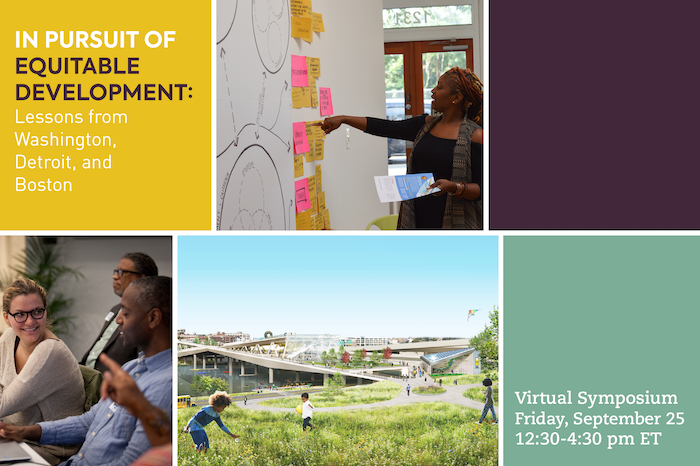
A grid of three color blocks (yellow, purple, green) and three images. On the yellow color block is the text "In Pursuit of Equitable Development: Lessons from Washington, Detroit, and Boston." One image shoes a person pointing to Post-It notes on a board, another shows a group of people in a meeting, and a third shows people playin in a large park. On the green color block is text reading "Virtual Symposium, Friday, September 25, 12:30-4:30 pm ET."
Event Location

Virtual Event Space

Date & Time
Open to the public, but requires registration

The GSD is pleased to present a series of talks and webinars broadcast to our audiences via Zoom.

*This lecture will be ONLINE ONLY. For security reasons, virtual attendees must register. Scroll down to find complete instructions for how to register.

Event Description

Equitable development, a relatively new concept in planning and community development, aims to help low-income neighborhoods and communities of color become places that provide economic opportunities, affordable living, and cultural expression for all residents. It is built on the principle that current residents will play a central role in shaping the projects, programs, and policies that affect them and their community. 

However lofty its goals, achieving equitable development is complicated and challenging, particularly in this time of social and economic turmoil. In this half-day virtual symposium, leading practitioners and scholars from three cities, Washington, DC, Detroit, and Boston, will explore efforts to bring equitable development to their communities and outline how they are responding to current challenges. The presentations and discussions will help students, scholars, community leaders, public officials, and others identify innovative strategies and successful approaches to advancing social justice in low-income neighborhoods and communities of color. 

Join the conversation on Twitter with #EquitableDevelopment .

Co-sponsored by the Joint Center for Housing Studiesthe GSD Department of Urban Planning and Designand the Loeb Fellowship

View the symposium agenda here.

Speakers will include: 

How to Join

Register to attend the lecture here . Once you have registered, you will be provided with a link to join the lecture via Zoom. This link will also be emailed to you.

The event will also be live streamed to the GSD’s YouTube page . Only viewers who are attending the lecture via Zoom will be able to submit questions for the Q+A.

Live captioning will be provided during this event. After the event has ended, a transcript will be available upon request.

Emmanuel Pratt, “[Re]Constructing Real Estate: The Question of Value”

Rachel Dorothy Tanur Memorial Lecture

Emmanuel Pratt, “[Re]Constructing Real Estate: The Question of Value”

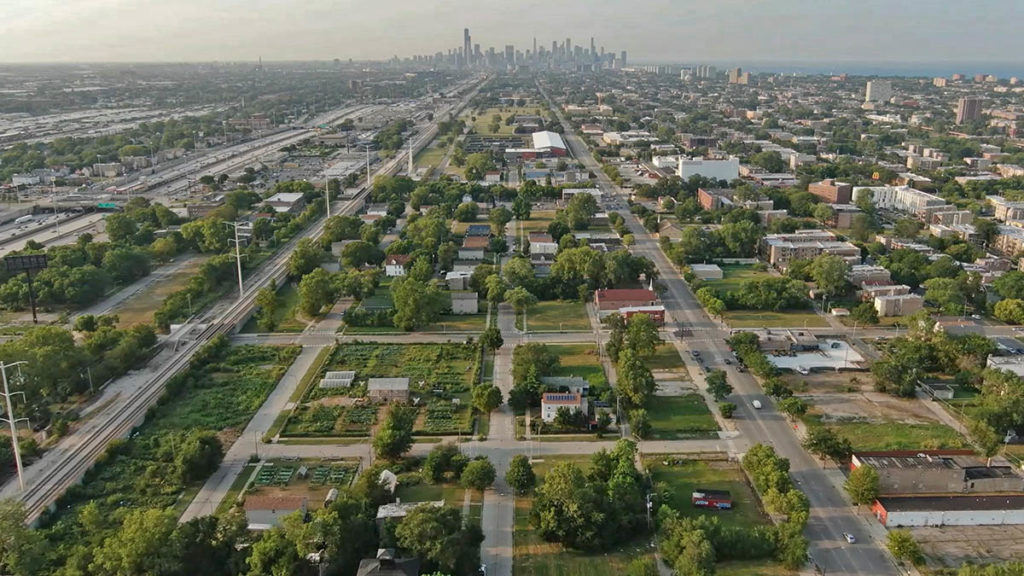
Aerial view of Chicago's South Side.
Event Location

Virtual Event Space

Date & Time
Open to the public, but requires registration
Rachel Dorothy Tanur Memorial Lecture: Emmanuel Pratt, “ReConstructing Real Estate: The Question of Value”
00:00
00:00

The GSD is pleased to present a series of talks and webinars broadcast to our audiences via Zoom.

*This lecture will be ONLINE ONLY. For security reasons, virtual attendees must register. Scroll down to find complete instructions for how to register.

Event Description

Sweet Water Foundation (SWF) is a community-rooted, nonprofit organization that practices Regenerative Neighborhood Development to create safe and inspiring spaces and curates healthy, intergenerational communities transforming the ecology of so-called ”blighted” neighborhoods. Utilizing a unique blend of urban design, urban agriculture, carpentry, art, and STE(A+)M focused education, the primary objective of SWF’s work is the continued healing of the neighborhood, its land and its people, and re-rooting of the community through a unique intersection across education, agriculture, arts, culture, and housing.

Since 2014, SWF has created a series of urban acupuncture inspired installations that actively re-story and re-construct a neighborhood located at the nexus of Englewood and Washington Park, two African American communities directly impacted by redlining and long standing histories of municipal disinvestment. SWF’s headquarters site has become a dynamic, living campus now known as “The Commonwealth.” The Commonwealth spans four contiguous city blocks and includes more than three acres of urban farmland, open community gardens, a carpentry workshop, two formerly foreclosed homes transformed into live-work-learn spaces, and a timber frame barn that serves as a pavilion for a wide variety of community gatherings for public programming.

For this event with the GSD, Emmanuel will contextualize the historical degeneration vs regeneration of The Commonwealth to present date, lead viewers on a virtual site visit, and share some upcoming developments emerging across a network of value-based partners.

Screenshot of Emmanuel Pratt giving a presentation on Zoom. Pratt is visible in a small window on the top right. The presentation shows a list of the values of his organization, Sweet Water Foundation.
Screenshot of Emmanuel Pratt giving a presentation on Zoom. Pratt is visible in a small window on the bottom left. The presentation shows a person wearing a hat and waving, and above them is the text "There GROWS the neighborhood."
Screenshot of Emmanuel Pratt giving a presentation on Zoom. Pratt is visible in a small window on the top right. The presentation shows a map of racial demographics in different areas in Chicago,

Speaker

Headshot of Emmanuel Pratt, who wears a black jacket and black beanie.

Emmanuel Pratt, LF ‘17, received a BArch (1999) from Cornell University and an MSAUD (Master of Science in Architecture and Urban Design, 2003) from Columbia University. From 2011 to 2019, Pratt served as the director of aquaponics at Chicago State University, and he was the Charles Moore Visiting Professor at the Taubman College of Architecture and Urban Planning at the University of Michigan until 2019. In 2016, he was named a Loeb Fellow at the Harvard University Graduate School of Design. Currently, Pratt is co-founder and executive director of the Sweet Water Foundation in Chicago and visiting lecturer in the Environmental and Urban Studies Program at the University of Chicago.

Follow the Sweet Water Foundation on Twitter.

How to Join

Register to attend the lecture here . Once you have registered, you will be provided with a link to join the lecture via Zoom. This link will also be emailed to you.

The event will also be live streamed to the GSD’s YouTube page . Only viewers who are attending the lecture via Zoom will be able to submit questions for the Q+A. If you would like to submit questions for the speaker in advance of the event, please click here .

Live captioning will be provided during this event. After the event has ended, a transcript will be available upon request.

Seth Denizen, “Thinking Through Soil: Case Study from the Mezquital Valley”

Kiley Fellow Lecture

Seth Denizen, “Thinking Through Soil: Case Study from the Mezquital Valley”

A detailed black and white drawing of soil from a landfill, consisting of many objects piled together.
Event Location

Virtual Event Space

Date & Time
Open to the public, but requires registration
Kiley Fellow Lecture: Seth Denizen, “Thinking Through Soil: Case Study from the Mezquital Valley”
00:00
00:00

The GSD is pleased to present a series of talks and webinars broadcast to our audiences via Zoom.

*This lecture will be ONLINE ONLY. For security reasons, virtual attendees must register. Scroll down to find complete instructions for how to register.

Event Description

Almost 200,000 acres of land in the fertile Mezquital Valley are irrigated with the untreated sewage of Mexico City. Every drop of rain, urban runoff, industrial effluent, and sewage in Mexico City is sent to the Mezquital Valley through a 60 kilometer pipe. Soils in this valley have been continuously irrigated with urban wastewater since 1901, longer than any other soil in the world. The capacity of these soils to produce conditions in which agriculture can be practiced safely and produce healthy crops depends on a complex negotiation between soil chemistry, farming practices, public policy, land management, and the urban design of Mexico City. Without this wastewater, the Mezquital Valley would be a desert, as it falls into the UN’s  “drylands” climate category, where rates of evapotranspiration exceed precipitation. Currently, more than 40% of the Earth’s surface is classified as “drylands.” In the context of a warming planet, the world simply cannot afford for urban wastewater reuse to fail. Water is scarce, and food security is fragile. In this context, the question becomes: what would the city look like if it needed to produce a fertile agricultural soil from its waste? What would the farm look like if it better anticipated its material connection to the bodies of 20 million people and the effluent of urban life?

Screenshot from a presentation on Zoom by Seth Denizen. An older woman stands on a street that has cracked and moved as a result of an earthquake. Seth Denizen appears in a small window in the top right corner.
Screenshot from a presentation on Zoom by Seth Denizen. His presentation shows 8 different drawings of plants by Indigenous (top 4 drawings) and Spanish (bottom 4 drawings) people. Seth Denizen appears in a small window in the top right corner.

Speaker

Seth Denizen is a researcher and design practitioner trained in landscape architecture and human geography. He has received design awards from the SOM Foundation, Urban Edge Awards, and Bauhaus Dessau Foundation (2013), while also publishing widely on art and design with the Asia Art Archive, LEAP International Art Magazine of Contemporary China, Volume, Fulcrum, among others. He is currently a member of the editorial board of Scapegoat Journal: Architecture/Landscape/Political Economy . Collaborations include scientific research on Hong Kong’s urban microbiome, as well as art exhibitions in the Blackwood Gallery (Toronto), The Kunsthal (Netherlands), and Para/Site Art Space (Hong Kong). After teaching Landscape Architecture at the University of Hong Kong and the University of Virginia, Seth recently completed a PhD in Geography at the University of California Berkeley. His doctoral research investigates the vertical geopolitics of urban soil in Mexico City, where he is working with geologists and soil scientists to characterize the material complexities and political forces that shape the distribution of geological risk in Mexico’s urban periphery.

Follow Seth Denizen on Twitter .

How to Join

Register to attend the lecture here . Once you have registered, you will be provided with a link to join the lecture via Zoom. This link will also be emailed to you.

The event will also be live streamed to the GSD’s YouTube page . Only viewers who are attending the lecture via Zoom will be able to submit questions for the Q+A.

Live captioning will be provided during this event. After the event has ended, a transcript will be available upon request.

Nasser Rabbat, “History’s Currency: The Afterlife of al-Maqrizi’s Khitat”

Aga Khan Program Lecture

Nasser Rabbat, “History’s Currency: The Afterlife of al-Maqrizi’s Khitat”

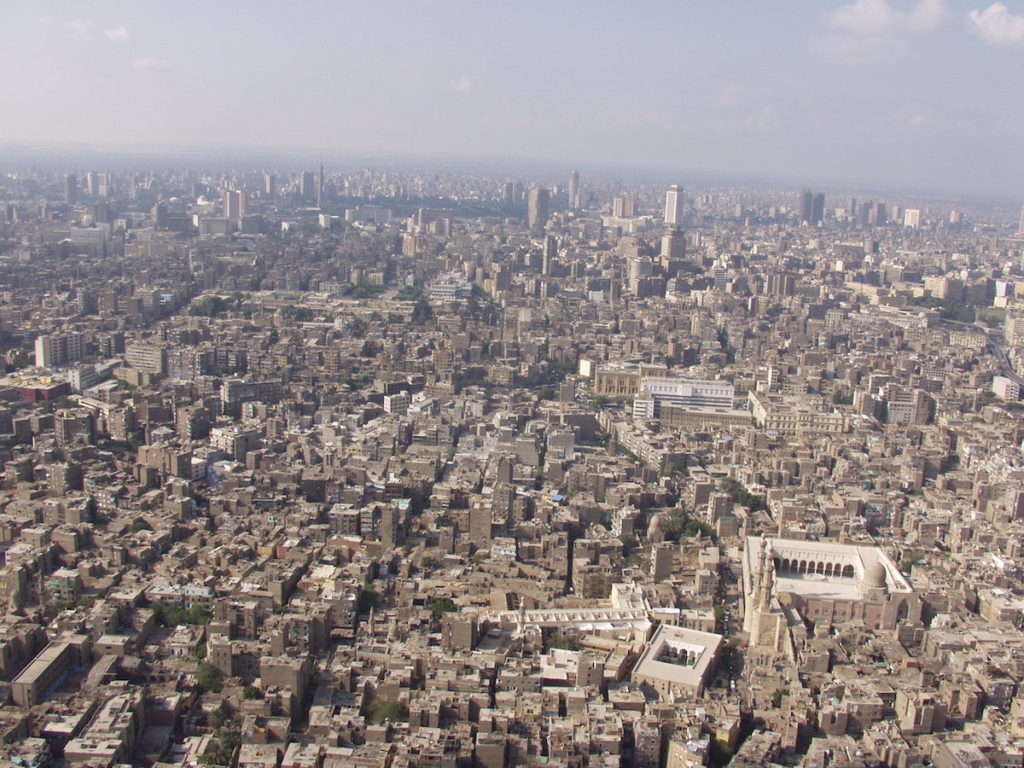
Aerial view of the city of Cairo, Egypt.
OLYMPUS DIGITAL CAMERA
Event Location

Virtual Event Space

Date & Time
Open to the public, but requires registration

The GSD is pleased to present a series of talks and webinars broadcast to our audiences via Zoom.

*This lecture will be ONLINE ONLY. For security reasons, virtual attendees must register. Scroll down to find complete instructions for how to register.

Event Description

This lecture offers a reading of the stages of modernity in Egypt through a medieval lens. It explores how a leading urban history book, al-Maqrizi’s Khitat (written 1415-42), came to absorb and articulate the country’s encounters with colonialism, modernization, Orientalism, historical academicism, nationalism, pan-Arabism, and authoritarian capitalism. Appropriated by the Savants of the French Occupation (1798-1801) in their monumental Description de l’Égypte, the Khitat became the go-to source for anyone studying Cairo. ‘Ali Mubarak, an engineer/minister who Haussmannized Cairo in the 1860s, used it to write his own paean to the remodeled city. K. A. C. Creswell, a British officer turned Orientalist architectural historian, relied on it to anchor his pioneering architectural history of Egypt. Egyptian nationalist historians deployed it as their authenticating native referent. Novelists and poets, like Gamal al-Ghitani and Naguib Surur, assimilated it as a voice of the undying spirit of Egypt and a parable of resistance to corruption and oppression. Eventually, the book acquired a transhistorical sheen that embodied the epistemic and political changes in Egypt from the early 19th century to the present.

Screenshot of a presentation by Nasser Rabbat on Zoom. Rabbat is visible on the right side of the image. The presentation shows archival images of Cairo, Egypt.
Screenshot of a presentation by Nasser Rabbat on Zoom. Rabbat is visible on the right side of the image. The presentation shows two books with narratives about architecture, in Arabic.

Speaker

Headshot of Nasser Rabbat, who wears a blue blazer, collared shirt, purple lanyard, and glasses.

Nasser Rabbat , RF ’12, is the Aga Khan Professor and the Director of the Aga Khan Program for Islamic Architecture at MIT . His interests include the history and historiography of Islamic architecture, medieval urbanism, modern Arab history, contemporary Arab art, and post-colonial criticism. He has published several books, most recently ‘Imarat al-Mudun al-Mayyita: Nahwa Qira’a Jadida lil-Tarikh al-Suri (The Architecture of the Dead Cities: Toward a New Interpretation of the History of Syria) (2018) and an online book, The Destruction of Cultural Heritage: From Napoléon to ISIS , co-edited with Pamela Karimi (2016).

Prof. Rabbat worked as an architect in Los Angeles and Damascus and held academic and research appointments in Cairo, Granada, Rome, Paris, Abu Dhabi, Munich, and Bonn. He regularly contributes to Arabic newspapers, serves on the boards of various organizations and consults with international design firms on projects in the Islamic World. In recent years, he began researching and publishing on immigration, refugees, heritage conservation, and destruction and reconstruction.

Follow Nasser Rabbat on Twitter.

How to Join

Register to attend the lecture here. Once you have registered, you will be provided with a link to join the lecture via Zoom. This link will also be emailed to you.

The event will also be live streamed to the GSD’s YouTube page . Only viewers who are attending the lecture via Zoom will be able to submit questions for the Q+A. If you would like to submit questions for the speaker in advance of the event, please click here .

Live captioning will be provided during this event.

Linda Shi, “Green Infrastructure Beyond Flood Risk Reduction”

Linda Shi, “Green Infrastructure Beyond Flood Risk Reduction”

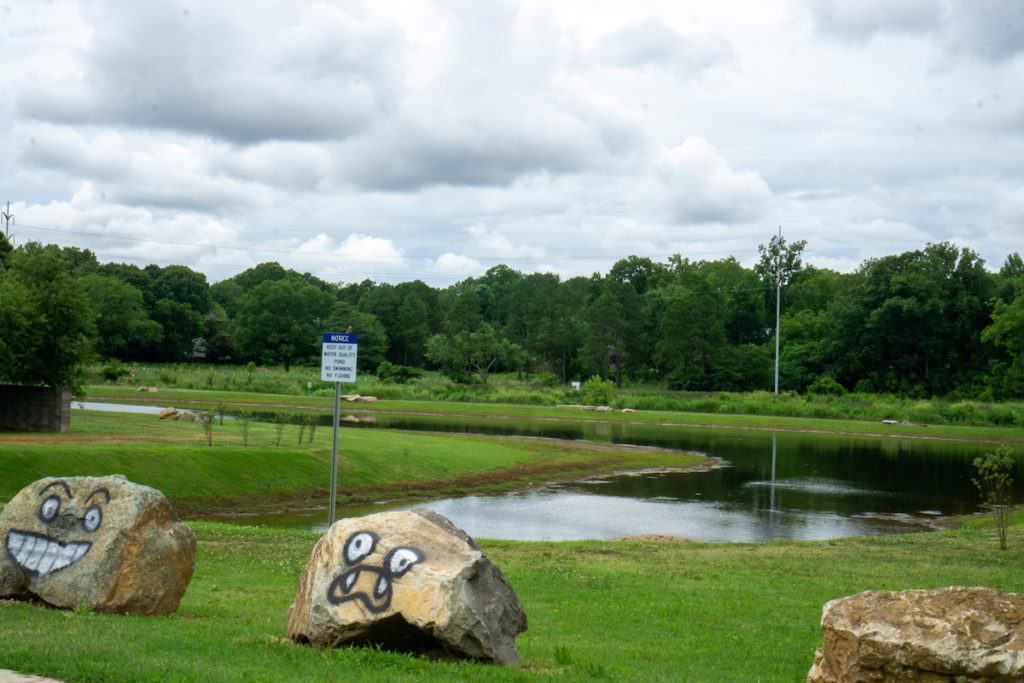
A river runs through a landscape, with greenery behind it and a cloudy sky. In front of the river are two rocks with spray painted faces.
Event Location

Virtual Event Space

Date & Time
Open to the public, but requires registration
Linda Shi, “Green Infrastructure Beyond Flood Risk Reduction”
00:00
00:00

The GSD is pleased to present a series of talks and webinars broadcast to our audiences via Zoom.

*This lecture will be ONLINE ONLY. For security reasons, virtual attendees must register. Scroll down to find complete instructions for how to register.

Event Description

This lecture explores whether it is possible to achieve both social justice and environmental sustainability in efforts to mitigate urban flood risk. The expanding scale of urban flooding under climate change has renewed interest in large-scale restoration projects that make room for water in metro centers. However, ecologically functioning green infrastructure – unleashed rivers, sprawling wetlands – is inconsistent with the current governance landscape of fragmented local governments seeking to maximize local land values and minimize affordable housing. Moreover, even smaller-scale urban greening projects have resulted in gentrification, suggesting that larger-scale green infrastructure projects will produce still more racist, classist, and exclusionary development. The design imagination for new ecological landscapes has far outpaced a reimagination of the institutional and governance arrangements needed to enable nature-based solutions that advance social justice and ecological sustainability under climate change. This lecture provides an introduction to U.S. development practices implicated by these transitional landscapes, suggests future directions such as urban food production and regional governance, and invites conversation about ways to bridge traditional disciplinary silos in creating racially just, ecologically sustainable, and fiscally functioning cities.

This lecture is based on a recently-published publicly-accessible publication:

Shi, L. (2020). Beyond flood risk reduction: How can green infrastructure advance both social justice and regional impact? Socio-Ecological Practice Research.

Screenshot of a window from a public event on Zoom. Linda Shi appears in a small rectangle on the top right, and the larger frame shows her slideshow. The slide shows headlines about climate gentrification.
Screenshot of a window from a public event on Zoom. Linda Shi appears in a small rectangle on the top right, and the larger frame shows her slideshow. Two images are show: one an area shot of green space, and the other of tired floodlands.

Speaker

Linda Shi , MUP ’08, is Assistant Professor in the Department of City and Regional Planning at Cornell University . Her research concerns how to plan for urban climate adaptation in ways that improve environmental sustainability and social justice. She assesses how aspects of urban land governance – including the fiscalization of land use, property rights regimes, and metropolitan regional institutions – shape climate vulnerability and adaptation responses. An urban environmental planner by training, Shi has worked for AECOM , the Institute for International Urban Development , and the Rocky Mountain Institute , and consulted for the World Bank and American Institute of Architects on projects and research in the U.S., Asia, Latin America, and Africa. Shi received a Ph.D. in urban and regional planning from MIT’s Department of Urban Studies and Planning, a master’s in urban planning from Harvard Graduate School of Design, and a bachelor’s and master’s in environmental management from Yale / Yale School of Forestry and Environmental Studies.

Follow Linda Shi on Twitter and Instagram.

How to Join

Register to attend the lecture here . Once you have registered, you will be provided with a link to join the lecture via Zoom. This link will also be emailed to you.

The event will also be live streamed to the GSD’s YouTube page . Only viewers who are attending the lecture via Zoom will be able to submit questions for the Q+A.

Live captioning will be provided during this event. After the event has ended, a transcript will be available upon request.

Aimi Hamraie, “Critical Access Studies”

Aimi Hamraie, “Critical Access Studies”

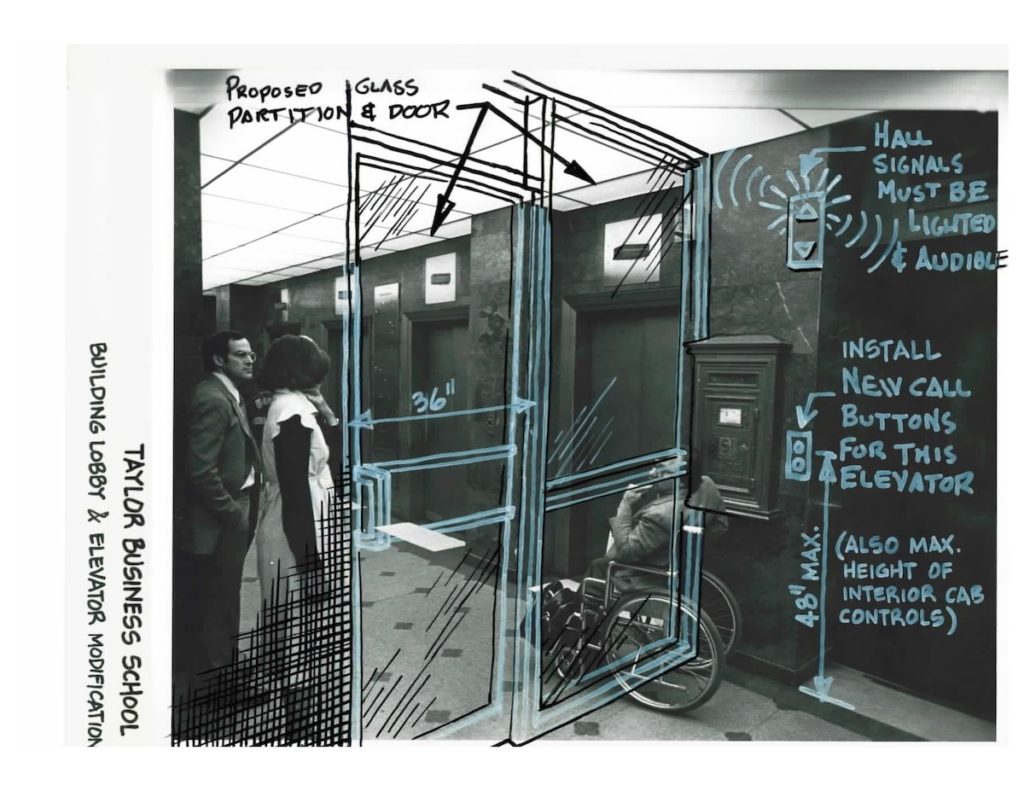
A marked-up photograph of a building lobby for the Taylor Business school, showing architect Ronald Mace (a white man wheelchair user) and two people standing—a man and a woman in front of elevators. The image has been marked with blue pen to indicate specifications for a glass partition, door, and callbox (“lighted and audible”).
Suggested retrofits for the Taylor School of Business drawn directly on photos of door thresholds, sidewalks, and a lobby (where Mace himself appears in the photo, ca. 1978). Ronald L. Mace Papers, MC 00260, Special Collections Research Center, North Carolina State University Libraries, Raleigh, N.C.
Event Location

Virtual Event Space

Date & Time
Open to the public, but requires registration
Aimi Hamraie, “Critical Access Studies”
00:00
00:00

The GSD is pleased to present a series of talks and webinars broadcast to our audiences via Zoom.

*This lecture will be ONLINE ONLY. For security reasons, virtual attendees must register. Scroll down to find complete instructions for how to register.

Event Description

Thirty years after the passage of the Americans With Disabilities Act, much of the built environment remains inaccessible to disabled people. Accordingly, the vast majority of research and writing on accessibility seeks to convince the unconvinced of the value of inclusion. This field, which I term “Access Studies,” would benefit from greater engagement with the concepts, practices, and political commitments of critical disability studies. In this talk, I will discuss the emerging field of “Critical Access Studies,” which engages with the methodologies, epistemologies, and political commitments of accessibility from the perspectives of Disability Justice and disability culture. Using historical and contemporary examples, I will illustrate the difference that critical perspectives on disability—including intersectional perspectives—can make for architects seeking to understand design with, by, and for disabled people.

Screenshot of Aimi Hamraie presenting on Zoom. Hamraie is visible on the right side of the image. The presentation shows images of disabled soldiers and housewives of the 1950s and 60s.
Screenshot of Aimi Hamraie presenting on Zoom. Hamraie is visible on the right side of the image. The presentation shows an image of a book called "Design for Independent Living" and a photograph from a protest.
Screenshot of Aimi Hamraie presenting on Zoom. Hamraie is visible on the right side of the image. The presentation shows three examples of depictions of disabled users from the 1970s and 80s.

Speaker

Aimi Hamraie, an olive-skinned west Asian non-binary person with short, dark curly hair and rectangular glasses smiles slightly at the camera. They wear a blue shirt, blue and green plaid blazer, and stand in front of a blurred green background.

Aimi Hamraie is Associate Professor of Medicine, Health, & Society and American Studies at Vanderbilt University, where they direct the Critical Design Lab . Hamraie is author of Building Access: Universal Design and the Politics of Disability (University of Minnesota Press, 2017) and host of the Contra* podcast  on disability, design justice, and the lifeworld. Their interdisciplinary research spans critical disability studies, science and technology studies, critical design and urbanism, critical race theory, and the environmental humanities.

Follow Aimi Hamraie on Twitter.

How to Join

Register to attend the lecture here . Once you have registered, you will be provided with a link to join the lecture via Zoom. This link will also be emailed to you.

The event will also be live streamed to the GSD’s YouTube page . Only viewers who are attending the lecture via Zoom will be able to submit questions for the Q+A. If you would like to submit questions for the speaker in advance of the event, please click here .

Live captioning will be provided during this event. A transcript will be available roughly two weeks after the event, upon request.

Metahaven, “Inhabitant”

Metahaven, “Inhabitant”

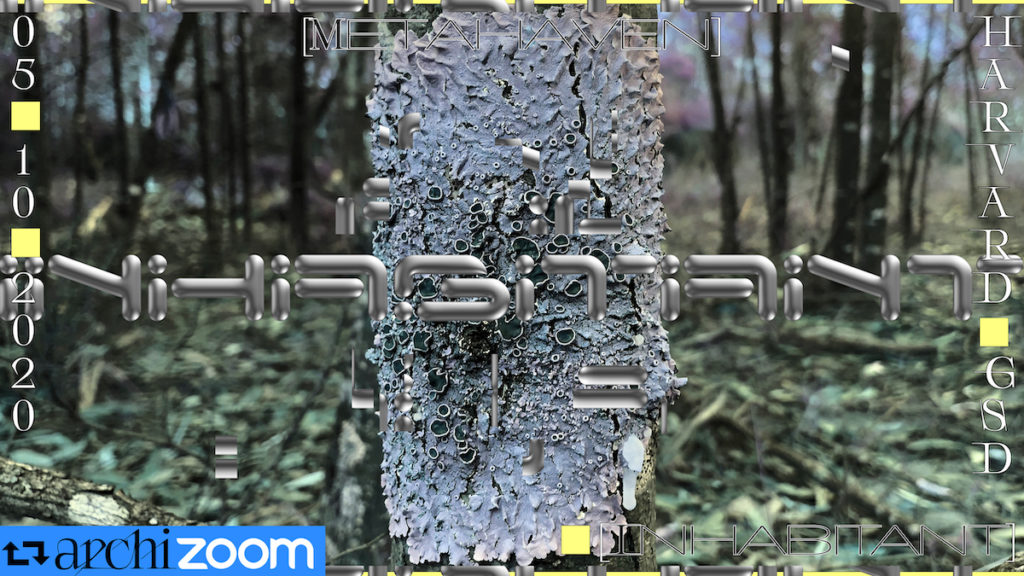
Fungus growing on a tree, overlaid with the text "Inhabitant," advertising Metahaven's upcoming talk at the Graduate School of Design.
Event Location

Virtual Event Space

Date & Time
Open to the public, but requires registration
Metahaven, “Inhabitant”
00:00
00:00

The GSD is pleased to present a series of talks and webinars broadcast to our audiences via Zoom.

*This lecture will be ONLINE ONLY. For security reasons, virtual attendees must register. Scroll down to find complete instructions for how to register.

Event Description

Last April, we went out on bicycles and followed the blossoms. From street to street we crisscrossed, trailing the path of their colors.

As foxes, wolves, and deer took to the cities, parts of a world in lockdown gave in to a silent dream.

The skies were empty. Emails skirted across the planet like tiny comets of kindness. Skype rituals and Zoom exchanges took place against the backdrop of private rooms: a world, at once more intimate and more distant, made itself available as live TV, replacing the physical meeting, supplanting social life with an audiovisual simulacrum.

We had a brief window of time to take notice of the recent past, in which our senses had seemed to have become paralyzed by cascading urgencies. How could we respond to the imperative of being in the now, of inhabiting the present? Can a work absorb the moment in time of its making without becoming like the news?

Inhabitant is about this question and how it has informed our work in filmmaking, art, and design. Referring to processes of sensing and inhabiting as practiced by non-human-species such as mushrooms and lichens, we will reference the work of Anna Tsing and Jennifer Gabrys, among others. In doing so, Inhabitant will explore affinities between sensing and cinematic capture.

Follow Metahaven on Twitter , Instagram , or Tumblr .

Screenshot of a presentation by Metahaven on Zoom. Metahaven is visible on the right side of the screen. The presentation shows white text on a black background.
Screenshot of a presentation by Metahaven on Zoom. Metahaven is visible on the right side of the screen. The presentation shows an image from the television show Game of Thrones, in which a disposable coffee cup is sitting on the table, circled in red.

Speaker

The work of Metahaven consists of filmmaking, writing, and design. Films by Metahaven include The Sprawl (Propaganda about Propaganda) (2015), Information Skies (2016, nominated for the 2017 European Film Awards), Hometown (2018), Eurasia (Questions on Happiness) (2018), and Chaos Theory (2020, forthcoming). Recent publications include PSYOP: An Anthology (Koenig Books, London, 2018), and Digital Tarkovsky (Strelka Press, Moscow, 2018). In the long essay Digital Tarkovsky, Metahaven identify online experience as a slow, cinematic proceeding, projecting the textures and motifs of Andrei Tarkovsky as a deeper artifice of digital aesthetics and filmmaking.

How to Join

Register to attend the lecture here . Once you have registered, you will be provided with a link to join the lecture via Zoom. This link will also be emailed to you.

The event will also be live streamed to the GSD’s YouTube page . Only viewers who are attending the lecture via Zoom will be able to submit questions for the Q+A. If you would like to submit questions for the speaker in advance of the event, please click here .

Live captioning will be provided during this event. After the event has ended, a transcript will be available upon request.

Loeb Lecture: Edgar Pieterse

Loeb Lecture: Edgar Pieterse

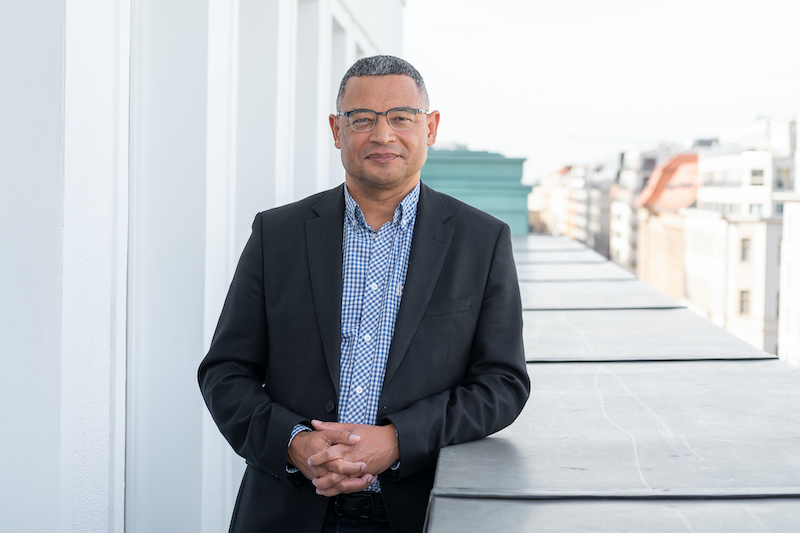
Edgar Pieterse, wearing glasses, a blue shirt, and a black blazer, stands with is hands clasped together, leaning on a ledge on the balcony of a large building.
Dtl., Berlin, Robert Bosch Academy, Richard von Weizsaecker Forum, 8.10.2018
Event Location

Virtual Event Space

Date & Time
Open to the public, but requires registration
Loeb Lecture: Edgar Pieterse
00:00
00:00

The GSD is pleased to present a series of talks and webinars broadcast to our audiences via Zoom.

*This lecture will be ONLINE ONLY. For security reasons, virtual attendees must register. Scroll down to find complete instructions for how to register.

Event Description

African cities are confronted by large youthful labour markets with limited prospects of formal industrial employment, on the one hand, and rapid physical expansion without the resources to address the massive infrastructural requirements to support people and economies, on the other. These daunting challenges are compounded by the impacts of the climate crisis and other forms of acute environmental risk. This confluence calls for situated innovations to reimagine and redesign investments in sustainable infrastructures that are simultaneously low-carbon, labour-intensive and geared towards placemaking and civic empowerment. In theory, the precepts and instruments of design, digital platforms, circular economy and an entrenched repair and maintenance disposition can all contribute to the realisation of sustainable infrastructures and well-being. However, as always, the devil will be in the institutional, cultural and metabolic dynamics of specific cities. Intentional interdisciplinary work is called for to explore these potentialities, which implies new kinds of city-based institutions that promote experimentation, learning and testing. While the African city demands this kind of institutional milieu, similar innovations can be generative in all urban settings. Edgar Pieterse’s Loeb Lecture will reference various African cities but converge on a specific site in Cape Town where wild and improbable plans are afoot to instantiate an imagined experimental space.

Screenshot of a presentation by Edgar Pieterse on Zoom. Pieterse is visible is on the right side of the screen. The presentation shows an illustration of an urban area with the title "Energy."
Screenshot of a presentation by Edgar Pieterse on Zoom. Pieterse is visible is on the right side of the screen. The presentation has a dark background with a faded image of microbes, with white text overlaid.

Speaker

Edgar Pieterse holds the NRF South African Research Chair in Urban Policy and is founding director of the African Centre for Cities (ACC) at the University of Cape Town. His research and teaching gravitate around urban development politics, everyday culture, publics, radical social economies, responsive design and adaptive governance systems. He publishes different kinds of text, curates’ exhibitions, as well as difficult conversations about pressing urban problems. He collaborates with former Loeb Fellow, Tau Tavengwa to produce Cityscapes —an international occasional magazine/platform on urbanism in the global South. He is widely published and his most recent book is, New Urban Worlds (with AbdouMaliq Simone). Current research is focussed on a major exhibition on complexity and urban futures that will be mounted in 2022, as well as exploratory work on radical social enterprises that seeks to define alternative modalities of service delivery in African cities. Finally, Edgar is working on an institutional framework to promote city-level innovation ecosystems in Africa that will promote the localisation of sustainable infrastructure and job creation in low-income contexts. He serves on various editorial boards of academic journals and research advisory boards of leading research centres:, e.g. Indian Institute for Human Settlements (Bangalore), LSE Cities (London), and Pathways to Sustainability – Utrecht University. In the African context, he has been active in the growth of two key pan-African knowledge networks: Association of African Planning Schools (57 schools in 18 countries) and the African Urban Research Initiative (18 institutions in 16 countries); both are anchored in the African Centre for Cities.

Follow Edgar Pieterse on Twitter.

How to Join

Register to attend the lecture here . Once you have registered, you will be provided with a link to join the lecture via Zoom. This link will also be emailed to you.

The event will also be live streamed to the GSD’s YouTube page . Only viewers who are attending the lecture via Zoom will be able to submit questions for the Q+A. If you would like to submit questions for the speaker in advance of the event, please click here .

Live captioning will be provided during this event. A transcript will be available roughly two weeks after the event, upon request.

Black Reconstruction Collective, “Black Reconstruction”

Carl M. Sapers Ethics in Practice Lecture

Black Reconstruction Collective, “Black Reconstruction”

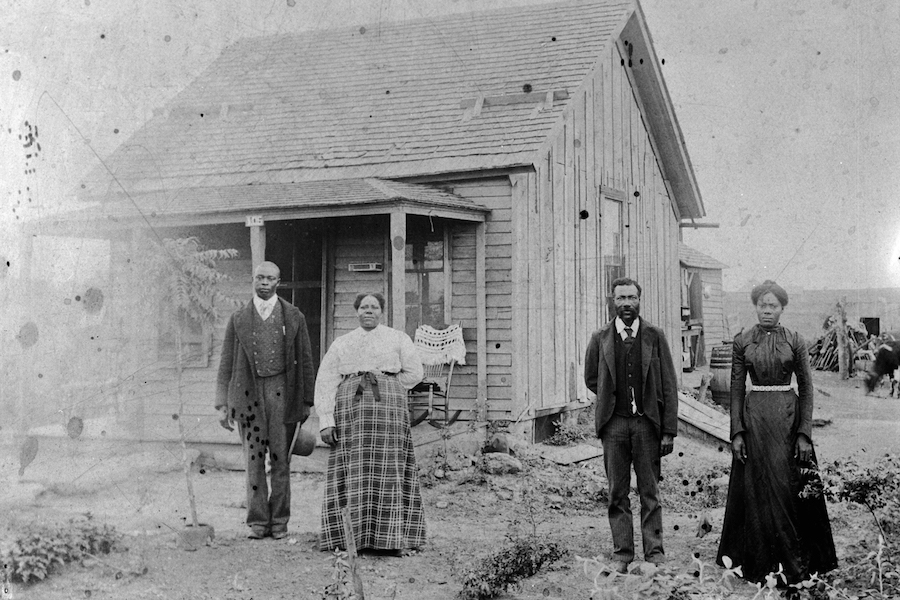
The image is black and white. Two couples stand outside of a small wood-paneled building. Both men are wearing dark-colored suits and both women are wearing long skirts, one plaid and one black, and long sleeved tops, one white and one black.
Event Location

Virtual Event Space

Date & Time
Open to the public, but requires registration

The GSD is pleased to present a series of talks and webinars broadcast to our audiences via Zoom.

*This lecture will be ONLINE ONLY. For security reasons, virtual attendees must register. Scroll down to find complete instructions for how to register.

Event Description

Ten Responses to One Question: What does it mean to imagine Black Reconstruction today?

After this lecture, respondents from the African American Student Union (AASU) at the GSD and AfricaGSD will join members of the Black Reconstruction Collective for a discussion and Q&A.

Screenshot of Caleb Negash presenting on Zoom. Negash is visible in the top right corner. The presentation shows a faded image of a small house, with the text "You think [black] is just one color, but it ain't..."
Screenshot from a panel discussion on Zoom featuring members of the GSD African American Student Union and AfricaGSD, with members of the Black Reconstruction Collective. There are 13 Zoom windows visible, with one person in each window.

Speaker

The Black Reconstruction Collective (BRC) provides funding, design, and intellectual support to the ongoing and incomplete project of emancipation for the African Diaspora. The BRC is committed to multi-scalar and multi-disciplinary work dedicated to dismantling systemic white supremacy and hegemonic whiteness within art, design, and academia. Founded by a group of Black architects, artists, designers, and scholars, the BRC aims to amplify knowledge production and spatial practices by individuals and organizations that further the reconstruction project.

The BRC engages the public through an annual process of reviewing proposals and providing critical and financial support to projects that have been selected by the committee. This work will manifest in built commissions, research funding, exhibitions, events, and publications, that will collectively imagine transformations to the built environment in the Black Radical Tradition.

How to Join

Register to attend the lecture here . Once you have registered, you will be provided with a link to join the lecture via Zoom. This link will also be emailed to you.

The event will also be live streamed to the GSD’s YouTube page . Only viewers who are attending the lecture via Zoom will be able to submit questions for the Q+A. If you would like to submit questions for the speaker in advance of the event, please click here .

This is a live event only. Live captioning will be provided during this event. A transcript will be available roughly two weeks after the event, upon request.

Our Common Purpose: Voting by Design with Danielle Allen, Michael Murphy, and Sarah Whiting

Our Common Purpose: Voting by Design with Danielle Allen, Michael Murphy, and Sarah Whiting

Two headshots placed side-by-side. The headshot on the left shows Michael Murphy, who has short brown hair and wears a green button-up shirt and a black coat. On the right is a headshot of Danielle Allen, who has short brown hair and wear a silver necklace with a dark blue shirt and sweater.
(c) Laura Rose (right)
Event Location

Virtual Event Space

Date & Time
Open to the public, but requires registration
Our Common Purpose: Voting by Design with Danielle Allen, Michael Murphy, and Sarah Whiting
00:00
00:00

The GSD is pleased to present a series of talks and webinars broadcast to our audiences via Zoom.

*This lecture will be ONLINE ONLY. For security reasons, virtual attendees must register. Scroll down to find complete instructions for how to register.

Event Description

Danielle Allen, James Bryant Conant University Professor at Harvard University and Director of Harvard’s Edmond J. Safra Center for Ethics , will come together with Michael Murphy, Founding Principal and Executive Director of MASS Design Group,  and Dean Sarah Whiting for a conversation about the 2020 American Academy of Arts & Sciences report, Our Common Purpose . They will discuss voting as both a civic issue and a design issue.

Our Common Purpose: Reinventing American Democracy for the 21st Century is a project of the American Academy of Arts & Sciences.

Screenshot from Zoom showing three windows. In the top left is Danielle Allen. In the top right is Sarah Whiting. And at the bottom is Michael Murphy.

Speakers

Danielle Allen , James Bryant Conant University Professor at Harvard University, and Director of Harvard’s Edmond J. Safra Center for Ethics , is a political theorist who has published broadly in democratic theory, political sociology, and the history of political thought. Widely known for her work on justice and citizenship in both ancient Athens and modern America, Allen is the author of The World of Prometheus: The Politics of Punishing in Democratic Athens (2000), Talking to Strangers: Anxieties of Citizenship since Brown vs. the Board of Education (2004), Why Plato Wrote (2010), Our Declaration: A Reading of the Declaration of Independence in Defense of Equality (2014), Education and Equality (2016), and Cuz: The Life and Times of Michael A. (2017). She is the co-editor of the award-winning Education, Justice, and Democracy (2013, with Rob Reich) and From Voice to Influence: Understanding Citizenship in the Digital Age (2015, with Jennifer Light). She is a former Chair of the Mellon Foundation Board, past Chair of the Pulitzer Prize Board, and a member of the American Academy of Arts and Sciences and the American Philosophical Society. Follow Danielle Allen on Twitter .

Michael Murphy is the Founding Principal and Executive Director of MASS Design Group , an interdisciplinary architecture and design collective. As a designer, writer, and teacher, his work investigates the social and political consequences of the built world. MASS’s work has been published in over a thousand publications, from the New York Times, Domus, the Washington Post, to Log. MASS was awarded the 2017 Cooper Hewitt National Design Award, the 2018 Arts and Letters Award, and the 2020 Wall Street Journal’s Innovator of the year award. Michael has taught at the Harvard Graduate School of Design, The University of Michigan, and Columbia University, MIT and Cornell. Michael is from Poughkeepsie, NY, and holds a Master of Architecture from Harvard Graduate School of Design and a Bachelor of Arts from the University of Chicago.

Sarah M. Whiting, Dean and Josep Lluís Sert Professor of Architecture, joined the GSD as Dean in July 2019. She is a design principal and co-founder of WW Architecture, and served as the Dean of Rice University’s School of Architecture from 2010 to 2019. [more]

How to Join

Register to attend the lecture here . Once you have registered, you will be provided with a link to join the lecture via Zoom. This link will also be emailed to you.

The event will also be live streamed to the GSD’s YouTube page . Only viewers who are attending the lecture via Zoom will be able to submit questions for the Q+A. If you would like to submit questions for the speakers in advance of the event, please click here .

Live captioning will be provided during this event. After the event has ended, a transcript will be available upon request.