Whispered Stories: Le Corbusier in Chandigarh

Whispered Stories: Le Corbusier in Chandigarh

Palace of Assembly in Chandigarh
The Palace of Assembly, completed in 1962, is part of the Capitol Complex that Le Corbusier designed in Chandigarh. © F.L.C. / ADAGP, Paris / Artists Rights Society (ARS), New York 2025.

In 1950, the Indian government commissioned Swiss-French architect Le Corbusier to design the city of Chandigarh. The project is often seen as marking a new era of modern architecture in South Asia. Records housed in the Frances Loeb Library at the GSD reveal the challenges of the monumental project as well as its influence and legacy. This semester, Graduate School of Design students Rishita Sen (MArch II 2025) and Neha Harish (MArch II 2025) organized a conversation on India’s rich history in modernist architecture, inspired by the Le Corbusier collection in the Frances Loeb Library Archives and Le Corbusier’s design of Chandigharh.

Rahul Mehrotra speaks with students
Rahul Mehrotra (left) speaks with students around archival materials. Photo: South Asia GSD

In collaboration with Rahul Mehrotra, John T. Dunlop Professor in Housing and Urbanization, and Ines Zalduendo , Special Collections Curator, the group met one evening to view historic objects and share stories that Mehrotra gathered as a result of his proximity to Le Corbusier’s community in India. The gathering is part of a series of “Archives Parties” that Zalduendo offers to the GSD community in collaboration with professors, student groups, and others interested in focusing on a particular theme or subject within the library’s collections.

“We represent a group of South Asian nations at the GSD,” said Sen, “and, because Neha and I are both so familiar with how modernism came to India, we wanted to pay homage to what we know, while setting the stage for future conversations focused on a range of South Asian nations and themes.”

Regal Movie Theater in Mumbai
The Regal Movie Theater, at Colaba Causeway in Mumbai, was built in 1933 by Franmji Sidhwa. Photo: Maggie Janik

The story of modernism in India starts with its independence from Britain in 1947, when the nation embraced the opportunity to define its identity through architecture and design. While “revivalists” attempted to reinvigorate older forms of Indian architecture to signify this new moment, Jawaharlal Nehru, the nation’s first prime minister, “embraced modernism as the appropriate vehicle for representing India’s future agenda,” writes Mehrotra in Architecture in India Since 1990. Modernism was free of associations with the British Empire and symbolized the pluralistic nation’s desire to be “progressive” and globally connected. Earlier in the century, Art Deco had become popular, introducing the use of reinforced concrete by the Maharajas, explained Mehrotra, and aligning Art Deco with opulence. At the same time, starting in about 1915, Gandhi constructed ashrams with a an aesthetic that grew out of frugality, creating an association between modernism and Gandhi’s ethics of  “minimalism,” and the ethos of today’s environmentalism and sustainability.

In 1950, Nehru commissioned Le Corbusier to design Chandigarh, setting in motion the country’s nascent development program and national identity under the era’s premise that, writes Mehrotra, “architects could shape the form not only of the physical environment but of social life.” A culture could be determined by its design.

student flips through book on table
One of the attendees studies materials from the Le Corbusier collection. Photo: South Asia GSD

At the Frances Loeb Library Archives, Harish, Sen, Mehrotra, and Zalduendo gathered with staff, faculty, and students to discuss a range of objects from the university archives as well as Mehrotra’s personal collection. Mehrotra noted how refreshing it was to be able to speak conversationally about these histories, within the context of the typically more formal archives at an institution.

“We were interested in engaging with oral histories,” said Harish, “which have been reiterated over the years.”

Jaqueline Tyrwhitt's pictures from India
One of many photographs by Jaqueline Tyrwhitt  in the France Loeb Library’s collections, from her trip to Delhi, India (“facing Diwan-i-Am”). Photo: GSD History Collection, Academic Affairs, courtesy of Frances Loeb Library, Harvard University Graduate School of Design.

“Having grown up in Bombay,” said Mehrotra, “and having known architects who worked in that time, I heard many stories about who went to receive Corbusier at the airport when he travelled from Paris to make his connections to Delhi, or for his projects in Ahmedabad, etc.. Also how in his stays in Mumbai, Doshi and Correa walked with him on Juhu Beach, discussing architecture.” Some of the “whispered accounts” that circulated in the community between Le Corbusier and other architects and contractors in India from the 1950s to 1970s were evident in letters Mehrotra shared. In one, from Le Corbusier to the Indian government, the architect stridently requests an overdue payment. “Everyone believes that Le Corbu received incredible patronage in India,” said Mehrotra, “but, in fact, it was an uphill task, and, as was evident in the letter I shared, the man was going to go bankrupt.”

In other correspondence, notes Harish, “we saw the concept of jugaad,” a Hindi word meaning “make do with what you have,” as Le Corbusier had to “mend and mold the concrete every step of the way. Once he’d had this experience with the concrete looking so handcrafted in India, he could never replicate it anywhere else.” Le Corbusier used concrete for the construction of Harvard’s Carpenter Center , the only building he designed in North America , completed in 1963.

Mehrotra’s revised and updated Bombay Deco (Pictor Publishing), written with the late Sharada Dwivedi, was released in December 2024, and speaks to the history of Art Deco in India. In 2018, Mumbai’s collection of Art Deco buildings, the second largest in the world, was named a UNESCO World Heritage site. Le Corbusier’s use of concrete in Chandigarh rose out of that Art Deco tradition in Mumbai.

archives with Le Corbusier materials
The image of Le Corbusier, on the archive’s  back wall, appears to be watching over his collection. Photo: South Asia GSD

“Art Deco resulted in the creation of a whole industry that could produce reinforced concrete,” Mehrotra explained. “So, for Le Corbusier, the technology developed over 30 years. If Art Deco hadn’t happened [in Mumbai], and we weren’t using reinforced concrete, he couldn’t have built Chandigarh—because that’s the material he knew.”

The group also discussed Le Corbusier’s relationship with other key figures, including his cousin Pierre Jeanneret, who collaborated with him on building Chandigarh. Jeanneret and Le Corbusier had practiced together in France for over a decade, until 1937, and then, alongside the couple Maxwell Fry and Jane Drew, reunited to design and construct Chandigarh.

Finally, the group celebrated the role that British urban planner Jacqueline Tyrwhitt played in developing architectural projects and discourse in South Asia in the 1940s and ’50s. Trywhitt worked with urban planner Patrick Geddes, editing Patrick Geddes in India, published in 1947, and was a United Nations technical assistance advisor to India and member of the 6th Congrès Internationaux d’Architecture Moderne (CIAM) in 1947. She served as a professor at the GSD from 1955 to 1969, and, as Dean Sarah Whiting explained, “helped establish and fortify the urban design program in its founding years.” An urban design lectureship named in her honor continues to support visiting scholars at the GSD today.

The Future of Tourism: Can the pandemic change how we visit popular sites, for the better? 

The Future of Tourism: Can the pandemic change how we visit popular sites, for the better? 

Date
Dec. 14, 2021
Author
Matthew Allen
Rendering of a building wrapped around a tree in a forest.
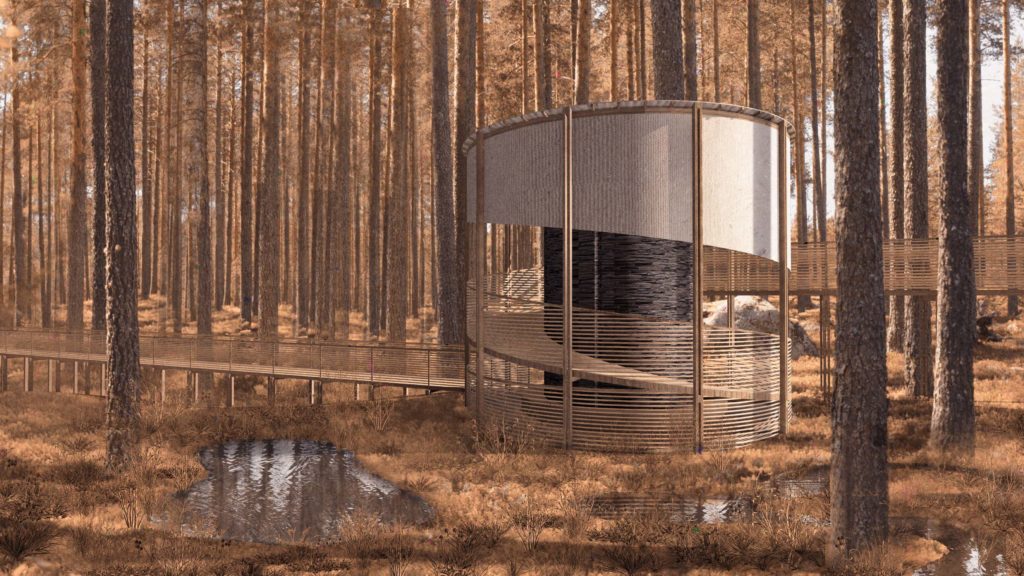
Oonagh Davis’s (MArch II ’23) proposal for the option studio “Between Wilderness and Civilization,” led by Toshiko Mori, seeks to inspire residents of Piscataquis County and hikers from the Appalachian Trail through engagement with bird life local to Maine. Shown here is a rendering of a bird watching pavilion.

Many of us have spent the past months yearning to travel, but we’ve also had time to reflect on our collective travel habits. Businesses won’t be eager to resume flying after successfully shifting meetings online, and that will be a good thing when it comes to carbon emissions. As for leisure travel, increased engagement with our local environs will probably have led many of us to question what tourism is for. If the global tourist economy is going to ratchet back into high gear, how can it be done more sustainably, with greater understanding of cultural diversity, and with fewer negative impacts on sought-after sites? This semester at the Harvard GSD, studios in architecture and urban planning led by Toshiko Mori, Lyndon Neri and Rossana Hu, and Daniel D’Oca explored these questions both directly and indirectly. All four professors are wary of tourism even as they acknowledge its seemingly inextricable role in so many aspects of our lives.

I caught up with Lyndon Neri and Rossana Hu via videoconference in Shanghai, where they’ve been for most of the pandemic. Neri and Hu are the John C. Portman Design Critics in Architecture and co-founders of Shanghai-based Neri&Hu . Like most of us, their travel has been significantly curtailed these past months, and what tourism they’ve engaged in has been mainly within China. Hu observes that, with few options for traveling abroad, “People are just restless, so they’ve started traveling inland to visit cultural landmarks. I feel like everyone I know in Shanghai has gone this past year to Jingdezhen, the ceramics town.” Neri also notes “a conscious effort to travel within China and understand all the great places in this country.”

Tourism within China has been facilitated by a boom in infrastructure development, much of it built as part of the so-called Belt and Road Initiative that began in 2013. (The “belt” refers to the Silk Road Economic Belt and “road” to the 21st Century Maritime Silk Road—these are the land-based and sea-based parts of the initiative.) Transportation infrastructure of all types has been rapidly modernized. “The extension of major roadways has meant that places that would have taken you days to get there now take hours,” Neri says. “Before the train that takes 40 minutes from Shanghai to Hangzhou, it used to take three-and-a-half hours by car.” This increase in speed has “definitely increased tourism to places that would not have been easily accessible.”

How do you bring about an authentic connection to culture? How do you bring people together rather than isolating everyone? How do you prevent experience from being entirely commercialized?

Photo of Rossana Hu

A particular type of cultural tourism in China has grown dramatically as a result of this intensification of speed and accessibility. Imagine staged scenes of farmers leading cattle across picturesque bridges—with rows of tourists lined up in the right spot to catch the perfect photo. Neri describes how “developers have picked up on the idea that if you add culture to a common itinerary for tourists, it adds value.” This cold economic logic raises questions: “How do you bring about an authentic connection to culture?” Hu asks. “How do you bring people together rather than isolating everyone? How do you prevent experience from being entirely commercialized?”

Neri and Hu’s studio, “De/constructing Cultural Tourism,” looks at these questions as the impetus to exploring ways of creating more meaningful engagement with tourist sites. The problem they pose begins with John Ruskin, the 19th-century architecture theorist and philosopher of travel. Neri recites a famous Ruskin quote, which acts as a riddle: “I would rather teach drawing that my pupils may learn to love nature, than teach the looking at nature that they may learn to draw.” Neri explains that, “For Ruskin, drawing is the catalyst to seeing and understanding the things around us. In Ruskin’s argument, when we see something beautiful, our natural tendency is to want to possess it. But if we don’t understand it, the possession is meaningless.” Generating such understanding is difficult, Hu says: “The state of our contemporary reality involves taking out your iPhone to photograph something rather than sitting there and spending the time to sketch out a building. Nobody really writes in journals anymore. They just take films of themselves that go into the cloud, and they never have time to look at them again.”

The studio’s two locations are UNESCO-listed heritage sites, Ping Yao and the Mogao Caves at Dunhuang. The latter is a Buddhist sanctuary first constructed in 366 AD and located at a strategic point along the Silk Road, and the former is an “exceptionally well-preserved example of a traditional Han Chinese city, founded in the 14th century.” [1] These are among the most visited tourist sites in China, and thus are more likely to become checkboxes on itineraries than places for thoughtful engagement.

Rendering of two people in a dark room lit from above.
This kezhan proposed by Sia Chen (MArch I AP ’23) is influenced by the caravanserai, a traditional form of living on the silk road. A central gathering sand stepwell serves as a therapeutic center for both travelers and locals.

The studio focuses on a particular building type, the kezhan, or travelers’ rest stop. Neri describes one elaborate architectural form that serves as a precedent: “The typology of the caravanserai from the Middle East actually came to China along the Silk Road and became a different form,” he says. “It’s a city in itself. It’s usually round, very much like the famous Tulou in Fujian province, except much bigger. There are buildings inside—it’s a bazaar—and there’s always a hotel component. It’s a place where people come in and not only are they resting, but they’re also trading. It’s also a place of business, a safe environment.” Taking time is a key aspect of the architecture. “The longer you’re there, the more you come to know the inner circle of who’s actually in charge of the place,” Neri says. “It’s not just about fast transactions. It’s about layering. It’s also about hierarchy and vertical relationships. People sleep above and do their commercial activities on the ground floor.” The external orientation is equally nuanced. “Ultimately, our goal is for you to understand all the things around it,” Hu says. “There’s a lot of architectural strategy that students can use: framing views, staging interactions, opening up the layers of culture.”

Neri and Hu’s studio may ultimately provoke more questions than it answers. “The best part of the studio is that no one is traveling, so everyone is itchy to embark on that first trip after things open up,” Hu says. “The studio is like a rest stop for the students as well.”

Daniel D’Oca’s studio, “Highways Revisited,” focuses on a slice of American urban history that at first glance has little to do with tourism. D’Oca is an associate professor in practice of urban planning and co-founder of the New York–based firm Interboro Partners , and I talked to him while he was on the road. His studio zeroes in on the local impacts of America’s interstate highway system, which was expanded dramatically beginning with the Federal Aid Highway Act of 1956. The changes brought about by the act were enormous, including an explosion of suburban growth, the emptying of downtowns, and the solidification of automobile culture in the American psyche. Many freeways were routed through low-income minority neighborhoods, changing them profoundly, usually in negative ways. Examples are scattered across the country. D’Oca lists a couple his studio has investigated: “In Detroit, a highway was routed through Black Bottom, a Black neighborhood, more or less destroying it,” he says. “We’re also looking at a situation in El Paso where the fight is not whether to remove a highway, but whether or not to expand it beyond its current sixteen lanes.”

Hand hold card that reads Freeway Revolt above a gameboard.
For their first assignment, students in the option studio “Highways Revisited” made fully-playable board games about the politics of highway building.

Tourism is not the most pressing issue in these neighborhoods, but it is an inextricable component of the urban dynamics the studio is considering. “The communities we’re working on care primarily about housing, stability, and quality of life issues,” D’Oca says, “but I suspect that tourism would be a desirable feature of a lot of these plans, as long as it turns out equitably.” One way tourism might help is by providing a boost to local economies. Take the Greenwood neighborhood in Tulsa. “This was a thriving Black neighborhood—it was called Black Wall Street—and it was the site of a massacre in the 1920s, an unspeakable tragedy. The second tragedy was the highway, which went right through the neighborhood when it was rebuilding itself,” D’Oca says. “You have a lot of efforts now to remember the past as part of revitalizing this community and others like it—both past tragedies and the history of when it was thriving. I suspect they want tourists, and tourists might want to see the history of Black Wall Street.”

There is a serious conflict between what the community needs and the effects of tourism.

Although tourism can bring a welcome influx of people, it has the potential to overwhelm. This is perhaps nowhere more evident than in New Orleans, where the Claiborne Expressway runs through the Tremé neighborhood. “You can imagine that if the freeway comes down, the neighborhood will be more desirable, and there will be a feeding frenzy with speculators buying up shopfront houses and turning them into Airbnb rentals,” D’Oca says. “Nobody in the community wants that. There is a serious conflict between what the community needs and the effects of tourism.” D’Oca advises that planners should take care when unleashing the force of tourism. “New Orleans is a cautionary tale,” he says. “The city has been eaten alive by Airbnb speculation. Entire neighborhoods have been bought up by speculators who turn houses into short term rentals. In the Tremé, it is the freeway that is keeping property values low. Fighting for the freeway to come down is only half the battle. The real battle is to make sure there’s an equitable plan for when it does come down.”

Rendering of a park.
“Thirdline,” by Darien Carr (MArch I ’23) and Marina DeFrates (MArch I ’23), reimagines a section of I-10 that runs through New Orleans. Proposed interventions range from complete erasure to repurposing highway fragments as multi-use structures along the former path of the interstate.

Another tricky question: What happens when tourists stay? D’Oca has noticed that “something interesting has happened in the pandemic” in the small town in upstate New York where he lives. “Some people have moved here as remote work has become more plausible, and a lot of people are buying up second homes to get out of the city. I guess it’s a form of tourism—these are people who aren’t moving here but all of a sudden have houses here.” This has created cultural conflict. D’Oca continues: “It becomes a different vision of what the place should be, and sometimes it’s a zero-sum game. For example, if this is your second home, you don’t want to see growth; you want it to remain a 19th-century pre-industrial hamlet. But a lot of other people don’t have the luxury for their hometown to be that. They need jobs, they need housing.”

D’Oca describes a scene that has played out in similar small towns across America: “In a neighboring town there was a huge fight over a dollar store,” he says. “It was basically local people against weekenders. Some people thought it was the apocalypse—a dollar store coming to town. People like us need to check our class privilege. It’s about the image of the place: whether it will remain an agrarian landscape with hardly any houses in it, or somewhere more livable for working-class people.”

Among the lessons of D’Oca’s studio is how tourism can shade into gentrification. “The connection to tourism that’s really important is that this is a region with a declining population that is desperate for economic development,” D’Oca says. “And the tourist economy is thriving. The town is twice as busy on the weekends now, and increasingly amenities are geared to tourists—business that are only open Thursday to Sunday, selling $15 deli sandwiches. It comes at the expense of people who don’t see this as a boutique town but just as a regular place.”

The studio project of Toshiko Mori is set in Maine, so it is inevitable that tourism factors in. Mori is the Robert P. Hubbard Professor in the Practice of Architecture at the GSD and principal of Toshiko Mori Architect , and I reached her at her office in New York. Tourism has long been a major part of Maine’s economy, and it was hit hard by pandemic travel restrictions: the number of visitors and total tourist revenue each fell by about one-quarter last year. Mori’s studio, “Between Wilderness and Civilization,” is set in the small town of Monson, near the Hundred-Mile Wilderness, which is considered to be the wildest section of the Appalachian Trail and is thus a major hiking destination. But the studio is not about tourism. The brief asks students to “balance progress with respect for its ecology” on an abandoned 72 acres of farmland near town, and Mori is interested in other, deeper ways of thinking about the relationship between a place, local people, and visitors.

Two models of pavilions surrounded by trees and an elevated walkway.
Davis’s proposal includes nine birdwatching pavilions along an elevated walkway; each acting as hinging point that invites visitors to slow down and take in a 360° panoramic view of the site and bird life. The height of each pavilion varies with the changing topography across the site, and thus corresponds with a specific tree canopy level.

The studio brief begins with story: “Over one hundred and fifty years ago, Henry David Thoreau was introduced to this forest by a Penobscot guide and chronicled his journey in his collection of essays The Maine Woods. At the end of his journey when he asked his guide if he was glad to have returned home, the guide replied, ‘It makes no difference where I am.’ To him, he belonged to the land, and the land did not belong to anyone—a fundamental mindset for living in balance with nature.”

Playing out the architectural implications of this mindset is a central goal of the studio. There don’t appear to be easy solutions. Monson has suffered job losses as local industries have shifted in recent decades, and it is not clear that plugging into Maine’s flow of tourists would revitalize the town. Hikers equip elsewhere, and the area is packed with picturesque locales. With support from the Libra Foundation, a nonprofit organization based in Portland, Mori has instead set up an experiment in symbiosis with Monson Arts , an artists’ and writers’ residency program. “The foundation bought up housing stock that was in decline, renovated them, and started an artists’ and writers’ residency program—bringing in a total of 90 people in the last couple of years,” Mori says. “They have a restaurant and a general store. The foundation previously bought a building in New Gloucester, Maine, which used to be a horrible institution—they called it an institution for the mentally feeble—that really just placed marginalized people in terrible living conditions. The organization renovated the building and converted its program to an agricultural facility.” The question of the studio: How can one intervene in one of the poorest places in New England to attract young people and propose a new and viable economic base?

Tourism is consumption-based—humans going somewhere to take and take and take. We don’t give back and we don’t even think of the symbiosis that’s necessary to sustain human life in the forest.

Toshiko Mori

Monson Arts does draw tourists of a sort, although they are different from those who come to hike. Instead, Monson is being recognized as “a good laboratory for solving the major problem of how to deal with poverty in rural areas in the United States, and how to save towns from obsolescence,” Mori says. “It’s a kick-starter kind of a program. Because of the artists’ residency, people like museum curators and cultural commissioners have been drawn to see what is going on in Monson. Even in the short time we were involved with Monson, we heard of many different organizations coming to see it as an example, perhaps to consider investing.” For Mori, one idea is to “create a new resource for these visitors.” She notes that “the artists themselves are interested in certain types of tourism. They may want to visit the Skowhegan School of Painting & Sculpture or the Maine Organic Farmers and Gardeners Association , the oldest and largest organic farming organization in the country.”

This circulation of people and ideas will hopefully serve the larger goal of connecting people with the Indigenous way of existing on the land. Monson is situated among the lakes and forests alongside the Piscataquis River, which flows into the Penobscot River, along which the present-day Penobscot Nation is located. Before European settlers, the tribe called the vast watershed of the Penobscot River home. “[The Penobscot] have a very different ethos and understanding of engagement with the place where they live,” Mori notes. “Tourism is consumption-based—humans going somewhere to take and take and take. We don’t give back and we don’t even think of the symbiosis that’s necessary to sustain human life in the forest.”


For the studio, Mori invited an ambassador from the Penobscot Nation to speak to the students about their life. “They travel by canoes on the Penobscot River; it’s a survival technique,” she says. “Which season to go to the coast or the river to fish, and when to forage in the forest. In the past they suffered a great deal because they were forbidden to forage in the forest, they were given ration foods, and their lifestyle was completely changed, leading ultimately to a public health crisis.” Fortunately, “They’re slowly gaining back their way of life,” Mori continues. “It depends on respecting land, not exploiting it. They think of the forest and human society in terms of equal coexistence.” This mindset manifests in all sorts of ways, large and small. Some examples came through in a visit to the exhibit of Penobscot birchbark canoes in Harvard’s Peabody Museum around the corner from the GSD. “For the birchbark canoes, there are ways to peel the bark without damaging the trees,” Mori says. “Another idea is that, when harvesting bark, it is better not to harvest from the best trees, but rather from the second best. That way the best trees can continue to sustain younger trees and protect other species. This is a very important piece of Indigenous wisdom.”

When emphasizing the sense of connection with nature, Mori is quick to point out that we should not be misled by simple distinctions between city and wilderness. “I live in New York, and this is our nature,” Mori emphasizes. “This is the place we live. We have to work with an ecosystem of this particular density, with the lives of people collapsed together in this way.” Mori is ultimately pessimistic about the capacity of tourism to allow connections to such wisdom. “In a real analysis, you would see that tourism is a colonial activity,” she says. “We really have to think twice about it. I think climate change is helping people to see this. The pandemic has helped us realize how high the energy consumption of travel is, and how unnecessary it is. Tourism in a city is similar to tourism in nature: people just skim the surface of glamour of a place like New York. But the people who lived through the pandemic in a city really got to understand its true nature and what makes it work. That’s similar in some ways to how Indigenous people live: living with the land, in good times and bad, then not just leaving because it’s not a fun time. Going through different seasons and difficult predicaments and embracing all the circumstances of a place and people—that is very different from the voyeuristic mentality of tourism.”

So, can the mentality of tourism shift? Mori’s conclusion also summarizes the sentiments of her colleagues D’Oca, Neri, and Hu: “Going forward from the pandemic, we have to be very wise and conscientious tourists. To get away from tourism as consumption, we have to be open-minded to learn from other people and their environments.”

[1] “Mogao Caves,” UNESCO [https://whc.unesco.org/en/list/440]. “Ancient City of Ping Yao,” UNESCO [https://whc.unesco.org/en/list/812].

Sacred Groves and Secret Parks: A two-day colloquium focused on the landscapes of Orisha

Sacred Groves and Secret Parks: A two-day colloquium focused on the landscapes of Orisha

Banner of Sacred Groves and Secret Parks
Adolphus Opara, Osun Sacred Grove, Osogbo, Nigeria (left) and Leonardo Finotti, Terreiro Vodun Zo, Salvador da Bahia, Brazil (right)
 Princess Faniyi in front of Gund Hall, Harvard Graduate School of Design


Princess Faniyi in front of Gund Hall, Harvard Graduate School of Design. Photo: Moisés Lino e Silva

Princess Adedoyin Talabi Faniyi traveled from Osogbo, Nigeria, to address the 2019 “Sacred Groves & Secret Parks” colloquium at the Harvard Graduate School of Design. The high priestess ceremoniously clanged a handbell as she called out to the audience: “To Osun, the Orisha of the waters of life, we pay homage. We say ‘asé.’” Those in the room—practitioners, scholars, and students alike—joined in chanting “asé,” which served as both the call and the response. “Let she clear the path of this conference. Let she clear the path of everyone. And may we have the successful outcome…and let the knowledge and wisdom that we share be useful for everyone.” The two-day colloquium focused on the landscapes of Orisha, a pantheon of spiritual figures originally worshipped by the Yoruba people of what is now Nigeria. Despite taking place at the GSD, the first presenter was Professor Jacob Olupona of Harvard Divinity School. Olupona—while pushing back against the notion that the spectrum of African spirituality can be categorized monolithically—introduced the audience to common ties that religions of the continent do share: to the spatial and material environment, to the Earth’s processes, and to human culture and community. Faith in Orisha has endured in Yorubaland despite the violence of colonization. It also crossed the ocean to the Americas during the four centuries of the Atlantic slave trade, when as many as 15 million West Africans were kidnapped and forced into labor in the colonies of the New World. Santería, for example, traces its roots through the enslaved people of Cuba, and Candomblé is the most pervasive Orisha-based religion in Brazil. Following Olupona’s overview, the chief organizer of the colloquium, Associate Professor Gareth Doherty, explained that speakers from Nigeria, Brazil, France, and the US would compare and contrast those “landscape traditions that fall outside of the normal Western practices.” Scales of both design and disturbance would range from the global to that of site and details.
 Form and ritual documented though architect’s sketches at Terreiro Tingongo Muendê


Form and ritual documented though architect’s sketches at Terreiro Tingongo Muendê. Credit: Sotero Arquitetos / Adriano Mascarenhas

From Doherty’s own fieldwork in Yoruba and Candomblé landscapes, he presented on the intriguing dimensions of an entrance stairway—with 134.5 risers—at Casa de Oxumarê, a terreiro [shrine] in Salvador, Brazil. When Doherty had questioned the worshippers about the curious half step, they acknowledged that the dimensionality had significance but didn’t give a reason. During a field visit in Nigeria, Doherty noticed a similar stairway condition; the explanation that was offered related to a generosity engrained in Yoruba culture. Demonstrating those strong transatlantic bonds among Yoruba-rooted religious spaces, Moisés Lino e Silva, assistant professor of anthropological theory at Federal University of Bahia, introduced the Osun-Osogbo Sacred Grove in Osogbo, Nigeria. Reflecting on his own experiences with Candomblé in Brazil, Silva revealed the “combination of art, religion, and ecological concern” that came to guide the creation of this rich sculptural place. Not only is the Osun Grove a landscape of beautiful sacred forms and cultural space for the Yoruba people, but with its recent listing as a UNESCO Heritage Site, it has helped secure the legal protection of ecosystem benefits. The Grove is one of the largest swaths of urban forest remaining in Nigeria. Vilma Patricia Santana Silva, an architect training in Salvador, discussed her work volunteering with terreiro community projects. In designing and assisting in the construction of her works, Silva communicates directly with the Ilê Àse deities for guidance. Her discussion of a spiritual conflict between one specific tree and a terreiro structure prompted Gary Hilderbrand, GSD professor in landscape architecture and principal at Reed Hilderbrand, to pose a question to Silva and the panel regarding the “larger responsibility” of designers on urban sites, especially in development-intense Salvador, where Candomblé terreiros are some of the last patches of green. Another speaker, Vilson Caetano de Sousa, Jr., a priest and a professor at the Federal University of Bahia, gave the audience an in-depth analysis of plants. Discussing the continental origins of multiple plant species, Sousa demonstrated strong ties between Latin American and African culture and spirituality. Like the Yoruba faith, plants were carried with the enslaved people from Africa to the Americas.
Symbolic sculptures within the Osun-Osogbo Sacred Grove, Osogbo, Nigeria,

Symbolic sculptures within the Osun-Osogbo Sacred Grove, Osogbo, Nigeria. Photo: Adolphus Opara

Condomblé, Yoruba, and other Afro-diasporic, syncretic religions are united by more than just their respect for Orishas. Their practices and rituals are inherently land-based, often taking place outdoors, and, due to urban development pressures, are increasingly being forced into public-realm landscapes. Religions of the African continent also experience violent persecution. As Olupona described in his overview, “there are millions who fear it…millions across the world” who exert “time and energy trying to destroy it.” In fact, until 1977, the public practice of Condomblé was illegal in Brazil. Like all human activities, worship shapes both the space and the materiality of the land. But the sacred landscapes of Orisha and the religious practices that take place within them are vulnerable: even as legal and social tolerance may be slowly improving, urban development and scarcity are an ever-increasing threat. The colloquium fostered productive and revelatory conversations about the complexities and richness of spiritual culture and its relationship to the landscape. But, as Doherty said at the beginning, the program was about more than just educating and informing; it was also about subverting and “decentering Western canons of knowledge.” The Sacred Groves & Secret Parks colloquium and exhibition was hosted by the Department of Landscape Architecture in collaboration with the Afro-Latin American Research Institute, Brazil Studies Program, David Rockefeller Center for Latin American Studies, Center for African Studies, Center for the Study of World Religions, Frances Loeb Design Library, Provost’s Fund for Interfaculty Collaboration, and Weatherhead Center for International Affairs.

Excerpt: The Rise: Black Cooks and the Soul of American Food by Marcus Samuelsson

Excerpt: The Rise: Black Cooks and the Soul of American Food by Marcus Samuelsson

Date
Oct. 15, 2020
Story
Marcus Samuelsson

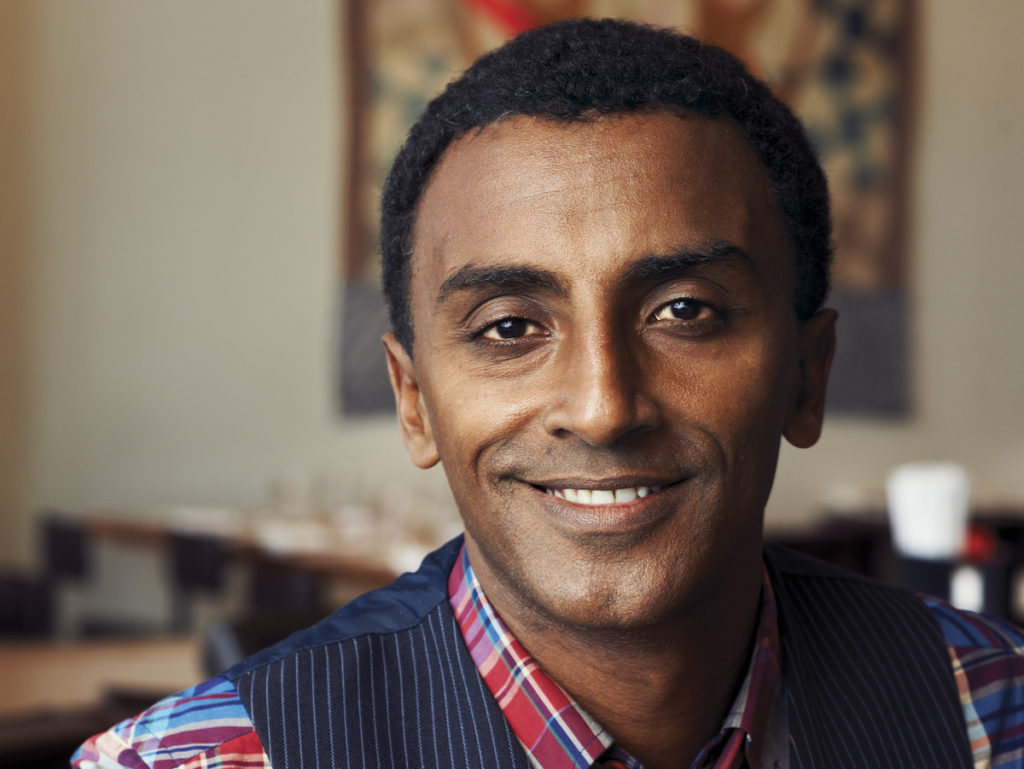
Born in Ethiopia, raised and trained as a chef in Sweden, and now living and cooking in Harlem, Marcus Samuelsson understands food’s power in placemaking and reclaiming histories. His new cookbook, The Rise: Black Cooks and the Soul of American Food , co-authored with Osayi Endolyn, addresses the history of Black cooking and its significance in shaping the American identity. Along with Toni L. Griffin, professor in practice of urban planning, Thelma Golden and Mark Raymond, Samuelsson will present a guest lecture at Harvard’s Graduate School of Design on October 15.

Marcus Samuelsson
The Rise: Black Cooks and the Soul of American Food

By Marcus Samuelsson

“It’s the last week of February, and I’m in Miami setting up my new restaurant, Red Rooster Overtown. I’m talking to chefs, cooks, dishwashers, investors, all part of the frantic setup before we open.

Fast forward to a week later and this coronavirus is real. Twenty-five years of work, from coming to the US as an immigrant in the mid-90s to growing up as a chef at Aquavit to opening Red Rooster in Harlem and expanding to Overtown, is falling apart.

It only took ten days.

My phone rings. I speak with my business partner in Miami. The opening is not going to happen. We let go of the staff we’ve been training for weeks. Marcus B&P in Newark, New Jersey, follows, and then Red Rooster in Harlem. I don’t want to shut down. I want to hold on.

The next day, everything is still. The first time in years.

I gather with my team and we pivot. Who can help us out of this—knowing that Covid-19 will live very differently in Harlem, Newark, and Overtown compared to the rest of America? One thing about being Black and an immigrant is that I never really trust the system—you learn to go through a lot of adversity on your own. I think about my father, a leader in a small Ethiopian village.
How he led his people to build a well out of nothing. How every night they prayed and held themselves with dignity. Now is the time to pull from that side of me.

The first call is to Jos. Andr.s and World Central Kitchen. In two weeks, Jos.’s team helps transform Red Rooster Harlem into a community kitchen to feed hundreds of people a day. The next question is who will stay in Harlem to help? Robert, our greeter, is in. Jamie, our server, says, “I can.” Nicolette, our hostess, says to count her in as well.

I don’t know what to expect from our first days of service. Would there be nurses on the line? Firemen? Teachers? Or the folks who most of the time we ignore? The homeless. Folks from the nearby methadone center. They become our new regulars. The daily number rises to five hundred, and more.

Chicken one day, gumbo the next. Then rice and beans. Chile con carne after that.

We start a new routine I never learned in cooking school. Instead of yelling “Behind you! Hot pan!” we yell “Six feet apart! Please stay in line.” Robert coaches the line on social distancing. But how do you instruct someone who is high or mentally ill and appears unstable, next to a mother trying to get food for her family?

At the beginning of April, the folks who make up the food line shift again—the working class is now joining in. People start to arrive early. Jamie and Robert hold back portions for the elderly who can’t make the line, do an extra run to Ms. Johnson in 4B, to aunties and uncles who cannot stand for hours to receive a nourishing meal.

The worst calls have begun to come in. The virus is more than just numbers in the news. We lost my friend Chef Floyd Cardoz. Samuel Hargess Jr., from the iconic Paris Blues, is dead—a veteran of an incredible juke joint where the best musicians in the world have performed. Gary Samuels, who played in our band for nine years every single Sunday, is now gone. Kerby, another door greeter, and Reggie, a manager, have each lost a parent. Customers are also dying.

We reach twenty thousand meals served, with kitchens firing away in Harlem, Newark, and Overtown. I never thought of cooks and servers as first responders. In this moment in America, once again, the immigrants are helping. The guy at the deli. The lady delivering your package. These people are the first to not get health insurance. The first to be looked down upon or pushed aside. They are my heroes.

Through this, we are survivors. Our heritage has long shown how we continue to prevail even when the light seems dim and fades to black. A cultural experience of healing that we must all go through now.

But Covid-19 is not the only disease infecting America. The pandemic will eventually be overcome, though its effects will stay in the Black community for longer than elsewhere.

The bigger disease we must fight is the virus of systemic racism.

Alongside the rise of the coronavirus this year, we saw the killings of Ahmaud Arbery, Breonna Taylor, and George Floyd by police. David McAtee, who ran YaYa’s BBQ Shack in Louisville, often served food at no cost to struggling members of his neighborhood and police officers, yet he was killed by the Kentucky National Guard in the aftermath of Black Lives Matter protests. In these and too many other violent tragedies we have seen the ugliest and worst of America.

We have also seen the bravest and best in response. Some of the most important work in fighting back against racism has happened during this pandemic. Although John Lewis passed during this time, his legacy has never been stronger. The changes we are a part of now are having a ripple effect—not only in America’s Black communities and communities of people of color, but in marginalized and Black communities throughout the world.

It will also have a tremendous impact on the food industry.

Food has always been part of the movement for racial justice. Change has often come from ordinary people doing extraordinary things through food, and changing our table. Take Georgia Gilmore, a mother of six in Alabama who fed and funded the Montgomery bus boycott for more than a year in the 1950s. Her cooking and efforts to organize the “Club from Nowhere” raised hundreds of dollars a week for the civil rights movement. Or Zephyr Wright, the chef for Lyndon B. Johnson, who was constantly in the President’s ear about injustice and how America needed to change, and who later was invited by the President to personally witness the signing of the Civil Rights Act of 1964.

Sometimes leaders are famous and widely documented. Sometimes they are not as well-known. The contributions of Black people in this country have always been underdocumented and undervalued. We can change that narrative. And we must.

We have to get rid of our biggest wound in America: racism. I hope that feeding each other, learning about our food and who makes it, is part of what will help us heal.

The Rise was created to highlight the incredible talent and journey of Black chefs, culinarians, and writers at work today, and to show how the stories we tell can help make a more equitable, just industry. I hope this work, and this moment, leads to us raising up Black winemakers, authors, and farmers. I hope it leads to us supporting the next generation of Black chefs and hospitality workers who will change our industry forever.

And I hope that this movement becomes a part of a permanent and much broader social change.

So much beauty and achievement has come out of tough times throughout history, and it is inspiring to see communities across the globe coming together to care for one another. We also know that the road “back” from the current crisis will be harder for Black people because of the systemic challenges that disproportionately affect Black restaurateurs and creators of all kinds. That’s why it’s so important for everyone to help bring more equity to this industry. See the Resources section on page 301 for a few starting points to take this message and turn it into action in your own life.

We are the Black Food Community: Black chefs, Black servers, Black bartenders, Black food writers, Black culinary historians, Black recipe developers. Our food stems from challenged communities and challenged times. It comprises enslavement, poverty, and war, yet our food has soul, and has inspired and fed many. We will rise, we will shine, we are survivors.

Black Food Matters.

Marcus Samuelsson
July 2020

Marcus Samuelsson is the acclaimed chef behind many restaurants worldwide, including Red Rooster Harlem, Marcus Restaurant + Terrace in Montreal, and Marcus B&P in Newark. Samuelsson was the youngest person to receive a three-star review from the New York Times and was the guest chef for the Obama Administration’s first state dinner. He has won multiple James Beard Foundation awards including Best Chef: New York City and Outstanding Personality for No Passport Required, his television series with VOX/Eater.