Harvard GSD Faculty and Alumni Feature Prominently in Chicago Architecture Biennial

Harvard GSD Faculty and Alumni Feature Prominently in Chicago Architecture Biennial

Wooden installation with people and orange beam.
SHIFTING REUSE AND REPAIR: the Door County Granary. Courtesy of LA DALLMAN.

As a Loeb Fellow at the Harvard Graduate School of Design (GSD) more than a decade ago, Florencia Rodriguez (LF ’13) researched modes of architectural criticism. This theme remains uniquely relevant to Rodriguez in her current role as artistic director of the sixth Chicago Architecture Biennial (CAB), on view September 19 through February 28, 2026. An editor, writer, and assistant professor and director of the School of Architecture at the University of Illinois Chicago, Rodriguez has fashioned the biennial—titled SHIFT: Architecture in Times of Radical Change—as an exploration of our uncertain era’s generative and transformational possibilities.

Florencia Rodriguez Headshot

“Architecture is fundamentally about engaging with change—understanding it, responding to it, and proposing ways to improve the conditions we inhabit,” Rodriguez explains . “We always have choices, and the decisions we make define what becomes possible tomorrow. As Artistic Director of the Chicago Architecture Biennial on its 10th anniversary,” she continues, “I hope to foster a critical platform where bold, imaginative ideas can surface and be shared with the public.” 

For the next five months, SHIFT will present installations, capsule exhibitions, programming, and events throughout Chicago, collecting the work of over 100 creative designers, practitioners, and artists who hail from 30 countries. This international assemblage features contributions by more than two dozen GSD affiliates that investigate new, alternative models for our built environment, housing, future resiliency, and more.  

FACULTY (in alphabetical order)

Stan Allen, design critic in architecture, presents Building with Writing, an installation of Allen’s work examining the relationship between drawing and the written word. Specifically, 48 drawings from 12 buildings and 12 pieces of writing are (re)presented as pamphlets and displayed in an installation designed by Michael Meredith (MArch ’00) and Hilary Sample, conceived as a reading room. Writing and design are distinct yet parallel practices, usually kept separate. This exhibition presents writing and buildings together, juxtaposed on folded metal bookstands. Visitors are encouraged to engage with the work—rearrange the drawings, take down the pamphlets, sit and read, and spend time in the space, together. Originally shown at the Princeton School of Architecture Gallery, for this iteration at the CAB, the reading room is installed on the second floor of the Graham Foundation. 

Associate professor of architecture Sean Canty (MArch ’14) presents Regal Reverb, a semi-circular public forum designed for the CAB’s Speaker Corners. The project draws from the Regal Theater (by Edward Eichenbaum, 1928), once a celebrated center of Black performance and cultural life in Chicago’s Bronzeville neighborhood. Adorned with velvet drapes, gilded ornament, and a monumental proscenium, the Regal regularly featured musical performers such as Nat King Cole, Ella Fitzgerald, Sarah Vaughan, Duke Ellington, and Louis Armstrong, securing the theater’s place on the Chitlin’ Circuit and in the cultural memory of Chicago’s South Side. Demolished in 1973, the theater remains an enduring figure of collective experience and architectural presence. 

Gold, green, and blue render of a stage where people can meet or perform.
Regal Reverb. Courtesy of Sean Canty.

Canty’s installation translates this history into a contemporary spatial register. A sweeping arc, drawn from the theater’s façade and proscenium, organizes the plan. In elevation, three brass-edged, color-blocked arches open onto the central space, evoking the ornamental profiles and window figures of the demolished theater. The composition is structured by a consistent datum that links each module, establishing order while leaving room for open occupation. Regal Reverb is not a reconstruction but a reverb: an architectural echo of a vanished landmark. 

Grace La (MArch ’95), professor and chair of the GSD’s Department of Architecture, and James Dallman (MArch ’92), co-principal of LA DALLMAN Architects, present SHIFTING REUSE AND REPAIR: the Door County Granary. The installation contemplates emerging strategies to reuse and repair derelict buildings—not only to prolong their useful life but to transform and extend their historical and civic meaning. Using the reclamation of an abandoned granary in Sturgeon Bay, Wisconsin, as a case study, LA DALLMAN demonstrates how strategic excisions and insertions within existing structures produce new modes of habitation. A comprehensive architectural model suspended within an occupiable fragment of a grain storage bin comprises the installation. LA DALLMAN’s exhibition team includes Elias Bennett (MArch ’25), Oonagh Davis (MArch ’23), Belle Verwaay Delatour (MArch ’18), Sigmund Seongyun Jeong, Min Ho Kim (MArch ’26), Brian Lee (MArch ’22), and Go Nakao (MArch ’28). 

Wooden installation with people walking around it.
SHIFTING REUSE AND REPAIR: the Door County Granary. Courtesy of LA DALLMAN.

Iman Fayyad (MArch ’16), assistant professor of architecture, presents In The Round, part of a larger line of work that deals with the effects of standardization in building materials on architectural typology, addressing formal exploration as a function of material waste. This installation invites visitors to contemplate the spatial potentials of material transformations from thin, planar sheets to volumetric form. The space is composed exclusively of uncut 4-ft x 8-ft rectangular sheets of plywood bent into composite cylindrical forms. The radial assembly allows the membrane to operate as a compressive structure in both plan and section (similar to a dome), while the oculus opens the interior to its surroundings above. Seating elements around the interior and exterior serve as structural anchor points for people to rest and gather. The structure offers an intimate, collective inward-facing space as well as outward-facing individualized spaces that are simultaneously contemplative and exposed. 

Circular plywood pod with niches for sitting.
In The Round. Courtesy of Iman Fayyad.

The capsule exhibition Inhabit Outhabit brings together over 30 housing projects from around the world that explore new solutions and challenge traditional models in response to contemporary needs. French 2D, led by assistant professor in practice of architecture Jenny French (MArch ’11) and Anda French, contributed material on Bay State Cohousing, a 30-unit community developed by its residents in Malden, Massachusetts. Each individual unit provides the amenities of a private home, while shared spaces and resources promote the creation of a vibrant, multigenerational community. 

To mark the 10th anniversary of the CAB, Harvard Design Magazine  and biennial leadership invited GSD design critics in architecture Lap Chi Kwong (MArch ’13) and Alison Von Glinow (MArch ’13) to imagine a new future for the Chicago Horizon, a temporary pavilion—by the architecture firm Ultramodern and structural engineer Brett Schneider—commissioned for the inaugural CAB that, despite original intentions, still exists. Kwong Von Glinow’s proposal, Forget-Me-Not, preserves the pavilion’s essential structural character while responding thoughtfully to its site, materiality, and context. Kwong Von Glinow consulted closely with the original team, modeling a collaborative approach to architectural practice that considers a building’s evolution from conception through execution and beyond. 

With Living Histories: Space for ReckoningMónica Ponce de León (MAUD ’91) of MPdL Studio, Mark Lamster (LF ’17 ), and STOSS Landscape Urbanism—founded by Chris ReedGSD professor in practice of landscape architecture and co-director of the Master in Landscape Architecture in Urban Design program—propose a new way of approaching commemorative space. Their installation addresses questions of how public space might tell the complex and interconnected histories that shape culture and inform who we are vis-à-vis a proposal for memorializing political and racial violence at Dealey Plaza and Martyr’s Park in Dallas, Texas. 

aerial rendering of city with greenery and roadways.
Living Histories: Space for Reckoning. Courtesy of STOSS Landscape Urbanism.

ALUMNI (in alphabetical order)

Two men in a glass pavilion.
Our Second Skin. Courtesy of Sol Camacho.

RADDAR, led by Sol Camacho (MAUD ’08), presents the glass pavilion Our Second Skin. More than 2,200 glass pieces comprise the pavilion, forming a translucent skin that simultaneously evokes the omnipresence of glass facades in contemporary cities and the invisible materiality of the industrial process that produces them. Inside the pavilion, an audiovisual essay presents excerpts from several interviews Camacho conducted with 23 leading international architects, engineers, and artists whose expertise spans design, research, construction, and technology. These individuals reflect on our contemporary indiscriminate use of glass, highlight its unparalleled and enigmatic qualities in architecture, and propose ideas for the material’s future. 

Water droplets on a screen.
Liquid Glass. Courtesy of Abigail Chang.

Abigail Chang (M Arch ’16) presents Liquid Glass for the CAB exhibition Melting Solids, located at the Stony Island Arts Bank. Liquid Glass examines a larger question about the boundary between our interior and exterior worlds. The work reflects on water as a resource whose invisible presence in air and vapor has the potential to materialize as condensation on windows. The installation, composed of hanging resin objects with various lenses, asks visitors to reflect on the fragility in our ever-changing surroundings as they move between and peer into opaque windows that seemingly stream, drip, and puddle.

Ignacio G. Galán (MArch ’10) with David Gissen and Architensions (Nick Roseboro, Alessandro Orsini) offer Fragments of Disability Fictions. Presented as a discontinuous description of a fictional disability world mixing different scales and times, Fragments of Disability Fictions highlights how disability and impairment offer alternatives to conventional representations of the past and future. The installation’s fragmentary character also disrupts the connection between the crafting of physical models and the pursuit of totalizing forms of control that produce “model” (i.e., “ideal”), streamlined worlds. The latter are often ableist (if not eugenic) representations of life. Unlike many visions of urban health and well-being, the architectural and urban histories we explore include messier, more complex, and more inclusive embodiments, materialities, cultures, socialities, technologies, and ecologies. Developed with the guidance of a group of disabled scholars, activists, and policymakers, such histories conceptualize physical and emotional well-being in complementary, contrasting, and even contradictory ways. 

Fragments of Disability Fictions. Courtesy of Ignacio Galán.

Fragments of Disability Fictions includes contributions by Neta Alexander, Victor Calise, David Serlin, and Eman Rimawi. The exhibition team includes Sharona Cramer and Yotam Oron, Thomas Gomez Ospina, Lauren Jian, Norman Keyes, Yuna Li, Lajja Mehta, Natalia Molina Delgado, Nur Nuri, Aistyara Charmita Shaning, Sherry Aine Chuang Te. Voice is provided by Sophie Schulman; ASL interpreting is provided by All Hands in Motion / Diana Abayeva (DI on screen) and Maria Cardoza (HI).

SHIFT’s curatorial team includes co-curators Chana Haouzi (MArch ’14) and Igo Kommers Wender and artistic director Florencia Rodriguez (LF ’13).

Series of black geometric figures on a white background.
Speaker Corners. Courtesy of Johnston Marklee.

Johnston Marklee, led by Sharon Johnston (MArch ’95) and Mark Lee (MArch ’95), presents Speaker Corners. Located on the second floor of 840 N. Michigan Avenue, this project takes the form of a grandstand with seating for more than 50 people. This small arena will host talks, panels, and other public events during the full run of the CAB. Speaker Corners was conceived as part of a series of spaces that promote discussions, presentations, and exchange, which began with Speakers’ Corner—an installation by Christopher Hawthorne, Florencia Rodriguez, and Johnston Marklee—one of the featured curator’s special projects at the 19th International Architecture Exhibition of La Biennale di Venezia 2025.

Different building materials with a pendulum handing down between them.
Two Foundations. Courtesy of Alex Yueyan Li.

Two Foundations, presented by Alex Yueyan Li (MArch ’21) and Mahsa Malek of 11X17, examines the dichotomy of stability/instability through two everyday construction practices—house lifting and underpinning—that accept instability as a perpetual architectural condition. The installation reconstructs these techniques through a series of technical objects; cribbing stacks, shoring posts, plumb bobs, and formwork are arranged as a structural diagram, enacting the physical operations they are designed to perform. Taken together, they reveal the mechanisms that allow an existing structure to pause, frame, and accommodate acts of repair. In doing so, the installation foregrounds instability as a fundamental aspect of architecture’s life, despite the persistent quest to create stable, unchanging buildings. Aging is a material fact that requires continuous care, and architecture will only endure through ongoing acts of adjustment and maintenance that sustain it over time.

White five-story apartment building with bright teal accents.
26 Point 2 Apartments, Long Beach, California, by Michael Maltzan Architects. Photo by Iwan Baan.

Michael Maltzan (MArch ’88) of Michael Maltzan Architects has contributed materials on 26 Point 2 Apartments to the Inhabit Outhabit exhibition. Completed in 2023 in Long Beach, California, 26 Point 2 Apartments is a five-story permanent supportive housing apartment building that bridges a busy commercial zone and a residential neighborhood, providing 77 units plus amenities, staff, and supportive services that address the needs of chronically unhoused people.

To Inhabit Outhabit MASS Design Group has contributed materials on their Maternity Waiting Village in Kasungu, Malawi. Completed in 2015, this complex offers a housing model for expectant mothers. Alan Ricks (MArch ‘10), Michael Murphy (MArch ’11), and Matt Swaidon (MArch ’12) took part in the design of this project.

Two dozen women standing in a courtyard.
Maternity Waiting Village, Kasungu, Malawi, by MASS Design Group. Photo by Iwan Baan.
Jungle with crystal-like fragments of sticking through the greenery.
The Crystal Forest. Courtesy of Sayler/Morris.

Susannah Sayler (LF ’09) and Edward Morris (LF ’09) of Sayler/Morris present The Crystal Forest, a body of linked works (photography, collage, a short film, animation) that meditates on the Amazon as a mosaic of symbolic meanings and a place where humans and other beings dwell. The work circles around the remains of a building the artists encountered on the edge of the jungle that inspired the title. The Escuela Superior Politécnica Ecológica Amazónica in Tena, Ecuador, was part of an ambitious 1997 endeavor to create a network of universities across the Amazon that would educate indigenous people and other citizens in subjects like business management and computer science. The “modernization” enterprise failed almost immediately, the jungle quickly overgrowing and re-absorbing its remnants, authoring its own architecture of entropy. The title The Crystal Forest also references the Crystal Palace built in London (1851) to house the Great Exhibition of the Works of Industry of All Nations, which has been cited as an epochal moment in the development of integrated world capitalism. In this sense, The Crystal Forest is the inverse or shadow of the Crystal Palace.  

Women in desert-like environment sitting under  green and yellow framework.
Film still from Nagarannam: Home Coming. Courtesy of Tosin Oshinowo.

As part of the Inhabit Outhabit exhibition, Tosin Oshinowo (LF ’25) of Oshinowo Studio presents the film Nagarannam: Home Coming, which shares the story of a community displaced by the insurgency group Boko Haram operating in Nigeria, Chad, Niger, Cameroon, and Mali. In addition, to the capsule exhibition Ecologies, opening November 6, Oshinowo has contributed Alternative Urbanism, a continuation of her research exhibit from the 19th Venice Architecture Biennale that explores specialized markets in Nigeria. These markets operate as factories processing “waste” or “end-of-life” items from industrialized economies and showcase the principle of circularity prevalent in African cities through the ingeniousness of iterative self-organizing initiatives. Often foreign to their host environments and not structured by the state, these markets coexist with and may re-appropriate the urban fabric, speaking to the realities that enable the African city to function in modernity. 

Blue model with wood structure on wood board.
The Embellished, the Transient, and the Critical. Courtesy of Alejandro Saldarriaga Rubio.

The Embellished, the Transient, and the Critical, presented by Alejandro Saldarriaga Rubio (MArch ’23) of alsar-atelier, explores an architecture of post-pandemic magical realism within the context of temporary exhibits. The installation uses quotidian plastic pallets as a primary compositional element and speculates on the spatial possibilities behind a single vertical partition built from this ordinary object, critically addressing the economic and environmental implications of experimental ephemeral design. By embracing “off-the-shelfness” and “dryness” as structural principles, the installation embellishes the ordinary, accepts its own impermanence, and challenges norms through critical material choices. 

Floating roof with red tiles in a woodland setting.
AIR VAPOR BARRIER. Courtesy of Oscar Zamora.

Oscar Zamora (MArch ’23) in collaboration with Michael Koliner worked on AIR VAPOR BARRIER, a piece that juxtaposes vernacular archetypes with Western envelope technologies by reinterpreting the tropical roof through mass-produced air-and-vapor-barrier (AVB) shingles. This material transposition critiques the persistent framing of the tropical as primitive while exposing the entanglement of indigenous practices and imported standards. The project demonstrates how industrial materials gain new significance when recontextualized through local construction logics. Positioned beyond nostalgia or technical determinism, it proposes a “third space” of contradiction, improvisation, and critique, reclaiming the tropical roof as a site of cultural negotiation and architectural imagination. 

A New Way of Seeing: The Laboratory for Computer Graphics and Spatial Analysis

A New Way of Seeing: The Laboratory for Computer Graphics and Spatial Analysis

man holding up computer generated map
Cover image, Harvard Graduate School of Design Supplement, 1967.

In 1965, as students protested the escalating war in Vietnam, President Lyndon B. Johnson signed the Voting Rights Act into law, and the federal government sought to revive faltering cities through urban renewal programs, Harvard’s Graduate School of Design launched a groundbreaking initiative: the Laboratory for Computer Graphics. Over the next quarter century, this multidisciplinary research group developed programs for automated mapping and spatial analysis that changed the ways we understand and create the world around us, from forecasting the weather to designing buildings. The lab served as an incubator for computer-based technologies that pervade all aspects of contemporary life—including the ability to avoid traffic back-ups, courtesy of the now-standard mapping software in today’s vehicles.

man on sail boat.
Howard T. Fisher Sailing on Lake Pátzcuaro, Mexico, October 1952. Photo by Leonard Currie. University Libraries, Virginia Tech, Blacksburg, Virginia; Leonard J. Currie Slide Collection.

Origins: Howard Fisher and SYMAP

Howard T. Fisher was no stranger to Harvard. He had earned his undergraduate degree there in the mid-1920s and then studied architecture at the school, prior to the advent of the Graduate School of Design (GSD). Fisher, who for a time specialized in prefabricated housing and commercial architecture, was a versatile designer; a colleague would later describe him as “a complete architect, planner, master builder, inventor, environmental scientist, teacher, and scholar . . . truly a Renaissance man of the 20th century.”1 Yet, those who knew Fisher best characterized him, above all, as a problem solver—a trait that prompted his return to Harvard in 1965.

In the decade following World War II, the flipside of American prosperity was urban turmoil. People with means abandoned the city, opting instead for suburban life. Businesses soon followed, leaving in their wake empty downtown commercial districts, deteriorating neighborhoods, and substandard living conditions. Cities were in crisis, and the search was on for potential solutions, many of which drew on the era’s developing technologies—including the computer. It was in this cultural milieu that Fisher, practicing and teaching in Chicago in the early 1960s, devised a software program to create legible maps from complex data.

black and white computer graphics maps.
Three varieties of maps created with SYMAP. Lab-Log (1977), published by the Laboratory for Computer Graphics and Spatial Analysis, Graduate School of Design, Harvard University.

Fisher’s creation, named SYMAP (short for Synagraphic Mapping System), was conceived as “a new way of seeing things together as a whole.”2 In other words, SYMAP could analyze information from many sources and present it so that relationships were readily visible to planners, designers, or anyone. Furthermore, while earlier software programs required users to physically assemble the layers of a thematic map (essentially a map that tells a story about a place), SYMAP used a computer to create an entire thematic map, representing data by using contour lines, shading, patterns, and eventually color. To create such a map, the programmer manually keypunched data on cards, brought them to a computing center for processing, and returned for the printout hours or days later.3 In the mid-1960s, Harvard had a single computer for such purposes; registered users were permitted one visit per day, and due to processing time, it could take up to a month to produce a single map.4 Nevertheless, SYMAP’s ability to synthesize material and generate information-laden maps was an improvement, both in the sophistication of analysis and the time required to create such maps sans computer.

coding computer key cards.
Lab member coding keypunch cards for use in generating a map. HGSD Supplement, 1967.

Given the precarious state of American cities at the time, SYMAP’s potential applications in the realm of planning and design offered great promise.5 This appealed to the philanthropic Ford Foundation, which sought to further the public welfare by “identify[ing] and contribut[ing] to the solution of problems of national and international importance.”6 Foundation officials signaled that they would be open to funding Fisher’s continued research, however he first needed a university to house this research. Fisher thus turned to his alma mater, where he found a champion in Harvard GSD dean Josep Lluís Sert.

Fisher and SYMAP relocated to Harvard in February 1965 where, within the GSD, he established the Laboratory for Computer Graphics (LCG).7 That fall, through the GSD’s Department of City and Regional Planning, he submitted a proposal to the Ford Foundation, which promised $294,000 (equivalent to nearly $3 million today) “for research and training in the use of computers to make maps of social and economic features of cities.” This grant to the GSD, to run through 1969, formed part of a larger effort to address the ongoing crisis in American cities by, as the foundation characterized it, “harness[ing] computer-based analysis to the study of urban problems.”8 Subsequent funding for the LCG would come from a variety of sources, including the sale of proprietary software; correspondence courses, professional development seminars, and conferences; local and federal government contracts; and grants from institutions such as the Office of Naval Research and the National Science Foundation.

man looking at maps and models.
Lab member with maps and models. HGSD Supplement, 1967.

Early Years

Major funding in hand, Fisher wasted little time in attracting attention—and talented researchers—to the LCG, launching an ambitious lecture series in April 1966. Held weekly throughout the spring and fall semesters that year, these meetings attracted participants from throughout Harvard and beyond. Regular attendees, dubbed “Computer Graphics Aficionados,” engaged with distinguished speakers from many disciplines, including geography, cartography, engineering, economics, sociology, psychology, anthropology, classics, transportation and city planning, urban design, and landscape architecture.9

Mathematical geographer William Warntz, known for population analyses of social and economic patterns, spoke at an Aficionados session on the topic of statistical surfaces. Warntz soon became a key figure in the LCG, leaving his position with the American Geographical Society to join the GSD in 1966 as professor of theoretical geography and regional planning, and the LCG’s associate director. When Fisher retired two years later, Warntz moved into the role of director and added “Spatial Analysis” to the group’s name, signaling the lab’s expanding focus. Thus, from 1968 on, the organization was officially known as the Laboratory for Computer Graphics and Spatial Analysis.

US density map.
US Density map, created from census data, drawn by SYMVU (a successor to SYMAP).

In fall 1966, geographer and urban planner Allan Schmidt was featured at an Aficionados meeting, where he discussed the role of computer mapping in the planning process. Shortly thereafter Fisher persuaded Schmidt to leave his position at Michigan State University and assume a new post at the LCG, starting in spring 1967. For the next 15 years, Schmidt remained at the lab in various capacities, including director (1971–1975) and executive director (1975–1982).

Another key figure who took part in the LCG’s formative years is Carl Steinitz, now Alexander and Victoria Wiley Professor of Landscape Architecture and Planning Emeritus at the GSD. Steinitz traced his involvement to a fortuitous 1965 encounter with Fisher, where Steinitz—then a graduate student in city and regional planning at the Massachusetts Institute of Technology—learned of SYMAP. With Fisher’s tutelage, Steinitz used SYMAP to analyze and map data for his doctoral thesis, which explored Central Boston’s urban features in relation to his advisor Kevin Lynch’s The Image of the City (1960).10 In 1966, Steinitz accepted a joint post at the GSD: assistant professor in the Departments of Landscape Architecture and City and Regional Planning, and research associate at the LCG.11 He would stay with the lab through 1972.

By the end of the 1966–67 academic year, the lab employed 29 people, including GSD graduate students, Harvard undergrads, and experts from many fields. Staff numbers would fluctuate in the coming years, depending on specific research projects and funding. Despite being an organization within the GSD, the LCG was housed for its first seven years not in Robinson or Hunt Halls, but in the basement of adjacent Memorial Hall. In 1972, the lab joined the rest of the GSD across the street in the newly completed Gund Hall, occupying space on the 5th floor.

two maps of US.
Examples of maps created by software that built on SYMAP. Harvard Computer Graphics Week 1980 brochure.

Research and Outreach

Fifty years after its founding, Steinitz described the LCG’s early research as falling into two basic categories. The first stemmed from SYMAP, involving “investigations into computer graphic representation of spatially and temporally distributed data.”12 This research included time-series maps of a storm’s progression, three-dimensional data displays, and maps that conveyed large data sets, such as early census maps for New Haven, Connecticut.

The lab’s second area of inquiry, according to Steinitz, “related to city and regional planning, landscape architecture and architecture, focused on the role of computers in programming, design, evaluation and simulation.”13 These efforts included research that drew on SYMAP and other programs to analyze data—such as a region’s possible uses, resources, and vulnerabilities—and generate models to assess future land-use impacts, which could in turn guide design and development decisions. This methodology, envisioned by Steinitz in 1967 to apply computer analysis and mapping to environmental planning, is today widely known as geodesign.

In tandem with its research and development activities, the LCG circulated its work through a variety of means. The lab sold SYMAP and later programs commercially, with nearly 1000 practitioners throughout the world participating in the lab’s correspondence training course, initiated in 1966. Beginning the following year, the LCG staged conferences, some for researchers and others for a broad audience that encompassed corporate and government employees—including from General Motors, Bell Laboratories, Anaheim Police Department, and the US House of Representatives. Branded as Harvard Computer Graphics Week, this renowned five-day conference occurred annually between 1978 and 1983, drawing up to 500 participants its final year.14

Highlighting Harvard Computer Graphics Week’s disciplinary breadth, a program for the 1981 session noted that participants would learn “how computer graphics is being used to solve problems in corporate planning and management, marketing, energy exploration and distribution, physical design, natural resource management, city and regional planning, education, research, financial management, and many other areas.”15 And for those unable to attend this or other meetings, the LCG issued and sold the conference papers for all six years in the 19-volume publication Harvard Library of Computer Graphics.

cover of Harvard Computer Graphics Week '80 brochure.
Brochure, Harvard Computer Graphics Week, 1980.

Legacy

The LCG continued operation throughout the 1980s, albeit at a greatly reduced capacity due to shifting priorities and changes in GSD

leadership. The lab ultimately disbanded in 1991, leaving an impact that well exceeds its relatively brief existence.16 Through the development of cutting-edge software packages and a robust outreach program, the LCG introduced computer graphics and spatial analysis to a host of disciplines—including architecture, landscape architecture, and urban design. In addition, the lab acted as an incubator for innovation, providing “many of today’s essential ideas and early versions of tools now embedded in GIS [geographic information systems], remote sensing, geospatial science, geodesign, and online culture.17 Finally, the LCG served as a training ground for researchers who, following their time at the lab, went on to develop life-altering computer-based technologies. For example, the architectural software used throughout design professions today is grounded in the LCG’s work, as are four-dimensional holograms and digital mapping.

Among the LCG’s renowned former members are Jack and Laura Dangermond, then a GSD landscape architecture student and a social scientist, respectively. The Dangermonds spent a year in the late 1960s working in the LCG, which Jack recently described as “a place that shaped the rest of my life.”18 After Jack’s graduation from the GSD (MLA ’69), the Dangermonds returned to his hometown of Redlands, California, and cofounded the Environmental Systems Research Institute (Esri), building on their experience at the LCG. Today Esri is a global leader in GIS software, location intelligence, and digital mapping.

In 2015, Dangermond and other participants from the LCG’s heyday joined with contemporary researchers for a two-day conference entitled The Lab for Computer Graphics and Spatial Analysis and Its Legacy, organized to celebrate the 50th anniversary of the LCG’s founding.19 Mohsen Mostafavi, then GSD dean and Alexander and Victoria Wiley Professor of Design, offered introductory remarks that situated the lab and its contributions as “part and parcel of our history.”20 This holds true not only for the GSD, where spatial mapping software is the cornerstone of many research studios, but for daily life in general. As we navigate city streets with the digital maps on our phones or learn about election results in precinct-by-precinct detail, we rely on LCG-derived technologies. As Mostafavi suggested, far from a bygone entity, the LCG endures as “a vision for the future.”21

 *Unless otherwise noted, all images are courtesy of the Special Collections, Loeb Library, Harvard Graduate School of Design.


  1. Leonard J. Currie, “Digest of the Career and Achievements of Howard T. Fisher,” sponsorship letter for Fisher AIA Fellowship application, c. 1974, https://web.archive.org/web/20150105113516/http://public.aia.org/sites/hdoaa/wiki/AIA%20scans/F-H/Fisher_Howard.pdf. ↩︎
  2. Nick Chrisman, Charting the Unknown: How Computer Mapping at Harvard Became GIS (Redlands, CA: ESRI Press, 2006), 20. For a detailed discussion of SYMAP, see chapter 2. ↩︎
  3. Evangelos Kotsioris, “The Computer Misfits: The Rise and Fall of the Pioneering Laboratory for Computer Graphics,” in Radical Pedagogies, eds. Beatriz Colomina et al. (Cambridge, MA: MIT Press, 2022). An excerpt of this article appears in The MIT Press Reader, https://thereader.mitpress.mit.edu/the-computer-misfits-the-rise-and-fall-of-the-pioneering-laboratory-for-computer-graphics/. ↩︎
  4. Carl Steinitz, “The Beginnings of Geographical Information Systems: A Personal Historical Perspective,” Planning Perspectives 29, no. 2 (2014): 239–254, doi:10.1080/02665433.2013.860762. ↩︎
  5. A recent MoMA show, Emerging Ecologies, included a four-dimensional model derived from SYMAP’s output as an example of a pioneering approach to visualizing complex data about the environment. See Carson Chan and Matthew Wagstaffe, Emerging Ecologies: Architecture and the Rise of Environmentalism (New York: MoMA, 2023), 70–71. ↩︎
  6. Ford Foundation, The Ford Foundation Annual Report 1966 (New York, NY: Ford Foundation, 1966), mission statement, https://www.fordfoundation.org/wp-content/uploads/2015/05/1966-annual-report.pdf. ↩︎
  7. Matthew W. Wilson, “Celebrating the Advent of Digital Mapping,” ArcNews, Esri, Winter 2015, https://www.esri.com/about/newsroom/arcnews/celebrating-the-advent-of-digital-mapping/. Chrisman’s summarization of the LCG’s founding provides a slightly different ordering of events. See Chrisman, Charting the Unknown, 3. ↩︎
  8. Ford Foundation, Annual Report 1966, 7. ↩︎
  9. Chrisman, Charting the Unknown, 10–11. ↩︎
  10. Carl Steinitz, “Meaning and the Congruence of Urban Form and Activity,” Journal of the American Institute of Planners 34, no. 4 (July 1968): 223–247. ↩︎
  11. Steinitz, “Beginnings of Geographical Information Systems.” ↩︎
  12. Ibid. ↩︎
  13. Ibid. ↩︎
  14. Chrisman, Charting the Unknown, 158. ↩︎
  15. Harvard GSD Lab for Computer Graphics, brochure for Harvard Computer Graphics Week ’81, July 26-31, 1981, https://www.vasulka.org/archive/ExhTWO/Harvard/general.pdf. ↩︎
  16. The author thanks Martin Bechthold, Bruce Boucek, Stephen Erwin, Carl Steinitz, and Charles Waldheim for their willingness to be interviewed about the lab and its legacy. For more on the lab’s last decade and dissolution, see Chrisman, Charting the Unknown, chapter 11. ↩︎
  17. Harvard Center for Geographic Analysis, The Lab for Computer Graphics and Spatial Analysis and its Legacy, conference program, April 30 through May 1, 2015, https://cga-download.hmdc.harvard.edu/publish_web/CGA_Conferences/2015_Lab_Legacy/2015_CGA_Conference_Program.pdf. ↩︎
  18. In a recent article, Jack Dangermond wrote about his formative time in the lab. See Jack Dangermond, “How the Geographic Information System May Help Make the World Better,” Forbes, Oct. 8, 2024, https://www.forbes.com/sites/esri/2024/10/08/how-the-geographic-information-system-may-help-make-the-world-better/. ↩︎
  19. The conference was hosted by the Harvard Center for Geographic Analysis (CGA), established in 2006 to support the use of GIS in research and teaching across the university. As such, the CGA acts as a successor of sorts to the LCG. ↩︎
  20. Mohsen Mostafavi, “Welcome & Introduction,” talk at The Lab for Computer Graphic and Spatial Analysis and Its Legacy, April 30, 2015, https://vimeo.com/128158780?autoplay=1&muted=1&stream_id=Y2xpcHN8MTMxODA5NTR8aWQ6ZGVzY3xbXQ%3D%3D. ↩︎
  21. Ibid. ↩︎

The Plan for a More Sustainable and Accessible Gund Hall

The Plan for a More Sustainable and Accessible Gund Hall

Gund Hall, Harvard University Graduate School of Design. Photo by Noritaka Minami
Date
Dec. 18, 2023
Author
Joshua Machat

This fall, teams of workers at Harvard’s Graduate School of Design began the first stage in an ambitious renovation of Gund Hall that will be underway through summer 2024. While preserving and updating the School’s iconic main building, the renovations will also vastly increase its energy efficiency. Beyond enhancing the GSD’s core facility, the overall project will model best practices for updating and sustaining mid-twentieth-century buildings.

Gund Hall, 1972.
Gund Hall, Harvard University Graduate School of Design, 1972. Photo: Scott Rosenthal.

Designed by John Andrews, Gund Hall first hosted students and faculty in 1972. At the heart of the building are the trays, a five-storey glass-enclosed studio block that serves both as work space and as a center of student community and engagement. In his recent book John Andrews: Architect of Uncommon Sense, Paul Walker writes, “Gund Hall’s famous ‘trays’ came from the priority that Andrews himself gave to the studio as the center of design education.” The trays have retained their vital role at the GSD as one of the most innovative spaces for design pedagogy even as building technology has advanced over the decades. Gund Hall is “largely sheathed in extensive uninsulated glazing systems and minimally insulated exposed architectural concrete,” according to David Fixler, lecturer in architecture at the GSD and an architect specializing in the conservation and rehabilitation of twentieth-century structures. Gund Hall’s existing uninsulated envelope contributes to high energy consumption that translates directly to expensive energy bills, occupant discomfort, and elevated maintenance costs.

Fixler is chair of the Building Committee, which consists of GSD faculty representing the three core disciplines at the school and is charged with overseeing the renovation project.1 “One of the great rehabilitation challenges of our era,” he said, “is to dramatically improve the durability and sustainability of mid-twentieth-century structures while maintaining the architectural essence and character-defining features of these buildings.”

The project’s design is being led by Bruner/Cott Architects, a firm specializing in adaptive transformation and historic preservation. Expert in working with buildings of this period, Bruner/Cott Architects have previously worked with Hopkins Architects and Harvard Real Estate to convert the 1960–1965 Holyoke Center into the Richard A. and Susan F. Smith Campus Center. They are part of a large, multi-disciplinary design and construction team that has developed a highly iterative and collaborative process to ensure sound, timely delivery of a state of the art product.2

Gund Hall, East Elevation.
Gund Hall, East Elevation, Harvard University Graduate School of Design.

The renovation process began this fall with a phase to test the design and installation strategies for the upcoming reglazing of the trays. A temporary walled-off “laboratory” has been built in the Pit, a multiuse space in Gund Hall. The mock-ups installed in this laboratory—located on the southeast corner of the building, and including one clerestory section—will be used to assess three replacement glazing systems.

The systems under evaluation include a high-performance double glazing at the east facade slope; a triple glazing at the vertical east facade and clerestories; and a hybrid vacuum-insulated glass (VIG) composite that adds a third layer of insulating glass to the north and south curtain walls. Expectations are especially high for the VIG hybrid, which is not used widely in the United States, but has a strong track record in Europe. By leveraging the insulating properties of the internal vacuum in a glass sandwich that is overall only a few millimeters thicker than conventional double glazing, the hybrid VIG is capable of unprecedented thermal resistance. These hybrid units can deliver energy performance that is two to four times better than standard insulating glass and up to 10 times more efficient than single-pane glass.

The trays captured from the side at night illuminate from within.
Gund Hall’s terraced studio space, known as the trays, is captured at night. Photo: Peter Vanderwarker.

Following this testing phase, the project work will begin immediately after commencement in the spring and finish by the fall semester. The trays will be inaccessible during this period.

Replacement of the glazing systems creates an opportunity to make other needed enhancements, including widening the exits onto the outdoor terraces and making them fully accessible. Improvements made to door, sill, hardware, and exterior landing elevations, along with other studio block modifications, will address accessibility issues and bring the building into compliance with current standards where practicable. New under-tray lighting will provide better illumination and upgrade the working environment for these portions of the studio. In addition to the glazing upgrades, a new system of automatic and manual shades for the south and east curtain walls will help mitigate heat gain and control glare.

While temporarily disrupting this core studio activity during the summer, the renovation project will be instructive in other ways, allowing students to view a renovation project in-action, and ultimately leading to improved workspaces. Fixler calls the renovation “a poster child” for rehabilitating buildings of the 1960s and 1970s, “both in the replacement of the studio glazing with state-of-the-art high-performance systems specifically developed for this project, lighting upgrades, and a campaign of careful, targeted concrete conservation.” He continued, “the revitalized studio block will stand as a proud statement of the GSD’s commitment to honor and enhance the legacy of John Andrews, while delivering a significant upgrade in energy performance and occupant comfort.”

Ariel view of Gund Hall.
Aerial view of Gund Hall.
  1. 1. Past and present members of the Building Committee include, Anita Berrizbeitia, professor of landscape architecture; Gary Hilderbrand, Peter Louis Hornbeck Professor in Practice of Landscape Architecture and chair of the Department of Landscape Architecture; Grace La, professor of architecture and chair of the Department of Architecture; Mark Lee, professor in practice of architecture; Rahul Mehrotra, professor of Urban Design and Planning and the John T. Dunlop Professor in Housing and Urbanization; Farshid Moussavi, professor in practice of architecture; Holly Samuelson, associate professor of architecture; and Ron Witte, professor in residence of architecture. ↩︎
  2. 2. Other members of the design and construction team are Vanderweil, mechanical and electrical engineers and energy modeling; LAM Partners, lighting; Simpson Gumpertz & Heger (SGH) structural, waterproofing, and façade engineering; Shawmut Construction, construction management and prime general contractor; A&A Window Products, Design Assist and installation; Redgate Real Estate, project management; and Heintges, BECx services. ↩︎

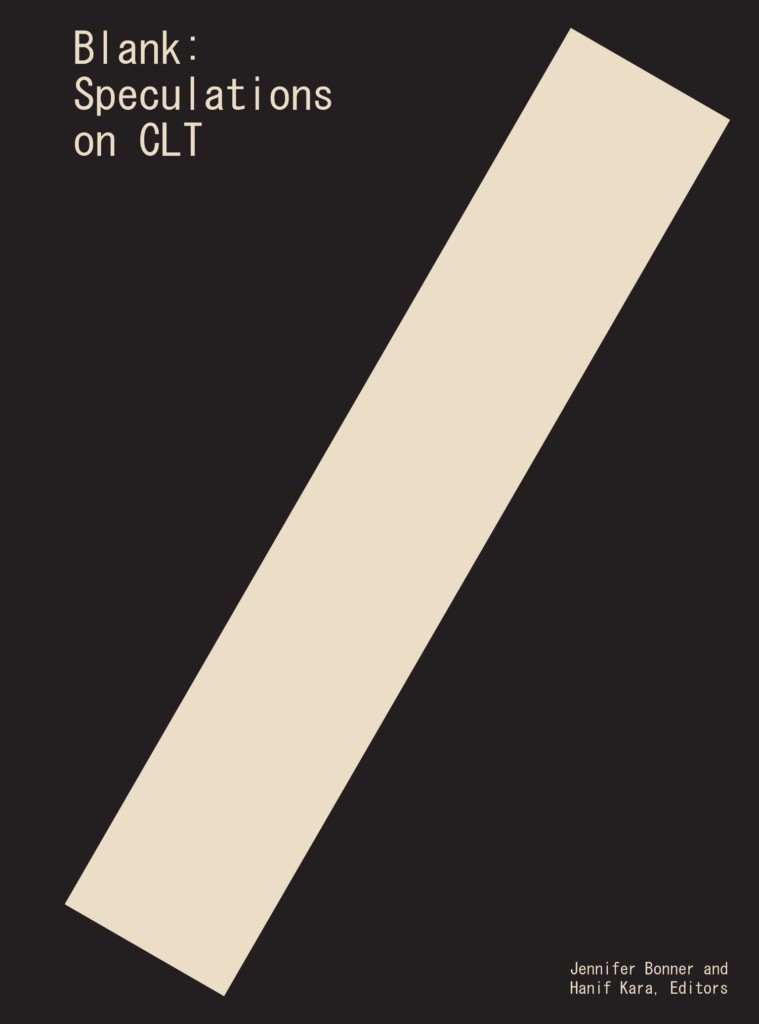
Blank: Speculations on CLT, edited by Jennifer Bonner and Hanif Kara

Blank: Speculations on CLT, edited by Jennifer Bonner and Hanif Kara

When I began studying architecture in the 1980s, students would often get asked at crits what, exactly, those blank white or beige walls indicated on their drawings or models were intended to be made of. The answer, almost inevitably, was “concrete.” Concrete was the wonder material, the realizer of dreams. The reliable, universal one-word answer. The staff would, inevitably, roll their eyes. But that reliance on a blank material rendered as an abstract surface has been threaded through the history of the last century of so of architecture. In the beginning, even architects themselves could only dream of abstract planes of concrete. Le Corbusier, Rietveld, and the others built walls of brick, rendering them so they would appear as concrete—smooth, featureless, as if drawn rather than built. They made concrete through manifestation.

A century on, with the world more aware of impending climate crisis, that one-word answer of “concrete” might be dumber and even less acceptable than it was then. The response now, however, might well be “CLT.” Even more than concrete, big panels of cross-laminated timber, cut in a spotless factory by robots, far away from the mud, sweat, and swearing of the construction site, looks like the future. Prefabricated, clean, as much drawing as material, rendering as reality, it represents the new wonder material of our eco-aware, guilt-burdened age; the world-saving, carbon-soaking, multifunctional stuff sent to salve our consciences in the creating of new buildings we know to be wrong, in attempting to make architecture at all.

top: wood tower model on wood grain background; bottom: detail view of wood grain model pieces showing layered details
Tower 02: Wood Grain Model, Page 132, Blank.

It is a heavy burden for one material to bear. And that is why Hanif Kara and Jennifer Bonner, who teach together at the GSD, have compiled a book that attempts to feel a way toward a new language for CLT, a material that looks like it has everything, but that hasn’t yet coagulated a sense of theory, meaning, or material culture around itself yet.

The book’s title, Blank (Applied Research and Design Publishing/ORO Editions, 2022), hints at this emergent identity, the still-unformed nature of a material that is both lumber and number, wood and data, a slab that exists between the forests and the digital. In one way, CLT is nothing new. It’s a close cousin of the plywood which emerged as a mass-market material a century or so ago and became a staple building product after having been adopted from other industries including aviation.

Clearing my parents’ old house out the other day, I took an ancient Singer sewing machine to the dump. Heavy as hell in cast-iron, it came in its own vaulted carrying case. I’d guess it was from the 1920s and that curved wooden top was probably the product that propelled plywood into a mass-market material. Singer’s slice of the market was so huge in the early 20th century that their adoption of bent plywood for their sewing machine cases gave this new wonder-material the scale to become an accessible material, one that subsequently came to define varying strands of modernism, from Aalto’s and Breuer’s ergonomic loungers via the streamlined bars and railway carriage interiors of Deco to the spartan studio-interiors of Case Study houses and artists’ studios.

Plywood however was mostly a surface rather than a structure. It’s true there were all kinds of laminated beams and ply products but we still probably think of it as a surface, a sheet. CLT is surface, too. But also structure. It is wall but also floor, ceiling, roof, insulation, internal finish, and the rest. Its versatility is almost comical. It holds, perhaps, a similar status in our age as not only concrete did to the modernists but as plastic did in the postwar era. It looks like the future; a total, wraparound environment.

left: stone wall carved with portraits and words with doorway cut out to show stone interiors; right: detail view of carved stone wall showing brick pattern, images, and words.
left: Lauren Halsey, the Crenshaw District Hieroglyph Project (Prototype Architecture_, 2018. Installation views, Made in LA, June 3- September 2, 2018. Hammer Museum, Los Angeles, Page 162, Blank..
Right: Lauren Halsey, The Liquor Bank, 2019. Hand-carved gypsum on wood, 47 5/8 x 47 5/8 x 1 7/8 in, Page 163, Blank.

On the other hand, it also smells like the past. It might be high tech in its manufacture but CLT is still lumber. Its future should seem assured then, particularly in the US, where the history of housing has been one of adopting the cheapest, easiest timber construction techniques. The American house is already an all-timber affair: the balloon frame, timber windows and doors, shingles, log cabins, lodges, sticks of timber nailed together. It should be simple to segue into CLT construction in which all of that comes in one package.

The writers here outline possible histories and futures, their texts interspersed with designs— plans, models, cutout kits of parts, propositions for a new language of architecture constructed around the capabilities of a material that does so many things at once. Along with the optimism, there is a sense of feeling a way toward new modes of expression. If the designs can look a little familiar, shot through with elements of deconstruction, wiggly walls, Swiss seriousness, and parametric ambition, many of the texts consider what the shift means. This kind of mass timber, Hanif Kara points out, is now being employed in ways more akin to how concrete is currently used in construction. It’s an odd shift—the move from the formwork leaving its imprint on the structure to the timber being employed directly—the return of the uninverted grain.

Blue wall with words "the sun" above yellow, red, and pink arch doorway in the wall
The Sun,” by Sam Jacob Studio at Science Museum, London.

Erin Putalik puts mass timber back in its plywood context with a brisk potted history and Courtney Coffman chooses to look at the qualities of the book’s title, the curious blankness of the material. In his essay, Sam Jacob points out the cartoonish qualities of CLT, the ways in which cutouts and punched openings might resemble the cat-shaped holes in a wall through which Tom has fled at speed or the fake/real ACME tunnels constructed by Wile E. Coyote. There is something clunky in these cutouts, a super-graphic approach to the material as two-dimensional with extruded depth, rather than the complex strata of a more familiar wall or door frame with its codified layers. It has a weird confluence with foam board as a substrate for models, a super-simplified language blown up to 1:1 without translation in material quality.

Buster Keaton 1928 (Source)
00:00
00:00

It is also, as Elif Erez (March ’21/ MDes ’22) points out in her essay for Blank titled “Deadpan CLT”, impossible not to think of the scene from Buster Keaton’s Steamboat Bill, Jr. (1928, featured above) in which the facade of a house rips away from its walls and falls on the deadpan comic in the most perfect way so that his form is accommodated by an upstairs window. The scene was resurrected in Deadpan (1997) by British artist Steve McQueen, who subtly subverted it as an echo of the invisibility of the Black body in 20th-century popular culture. That delaminated elevation is a cipher for CLT, a thing both seriously substantial and comically weightless, sign and signified. There is something slapstick about an entire elevation built from a single sheet as it appears here (though of course this was frame and shingles). It reduces architecture to the condition of a stage set, a flat, something fake built only to represent reality and enable the suspension of disbelief.

Black and white image of man standing in white shirt in the middle of a fallen house façade; interior of empty house pictured in background.
Installation shot of Steve McQueen’s Deadpan (1997) at the Steve McQueen exhibition at Art Institute Chicago, 2012. Image courtesy of Art Institute Chicago.

Other contributors, including Jennifer Bonner, point to the condition of the blank as something already fully assimilated in fine art (she singles out Mavis Pusey; perhaps she might have also alighted on Richard Woods or even Roy Lichtenstein) who used the “plank-ness” of timber as a shorthand for materiality. Elsewhere Gehry, Rossi, Mies, and Corb appear, sometimes as plywood pioneers, at other times as adopters of the blank slab which could be concrete or marble—but why not CLT next? Even Lewerentz makes a guest appearance (in Nader Tehrani’s essay) as an architect who adopted one material—brick in his case—as if it were a contiguous surface, in often surprising and surreal ways, anticipating the way in which CLT is employed as a total environment, a laminated bubble.

corner view of light wood architectural model with many windows and shingles
Tower shingle detail by Elif Erez (MArch ’21/ MDes ’22).

Other writers here comment on the unsettling similarity of CLT structure to a supersized architectural model. Like the basswood or balsa wood architects meticulously incise to building miniature models in which everything is simplified, complex structural beams and details are stripped out and one material, one strip of wood is left to represent all surfaces and both internal and external finishes, CLT, with its clunky depth and chunky cutouts can look like a hypertrophied miniature. It has that quality of a photo taken with an endoscope in a tiny model or those mesmerizing snaps you sometimes see on social media of the inside of a musical instrument, a violin or a guitar suddenly appearing as a kind of Gehry phantasmagoria with a shaft of light piercing the F-holes and the struts and bracing: the everyday made suddenly unfamiliar.

Photograph of grassy field with light wood pavilion featuring a central stair with expansive views of Lake Michigan.
Chicago Horizon, Ultramoderne, 2015. Photo by Naho Kubota.

Many of the authors point out something both curiously cuddly and unsettlingly uncanny about the material. In its grain, its feel, its smell, it is wood; but in its use it is concrete and in its manufacture it is digital. It is that hybridity that has made it simultaneously so attractive and so difficult to pin down, to position in the architectural palette.

Mass timber is, in its way, the architect’s dream material. It is (relatively) sustainable, a renewable resource, prefabricated, digital in its milled manufacture, precise, warm, and able to elude the requirements for the endless layers of finish and insulation which have made a mockery of Victorian and early modernist calls for “honesty” in construction and the show-and-tell approach to elevations. But perhaps sometimes, when we get what we dream of, we don’t know quite what to do with it. Regulation is still catching up, the notoriously conservative construction industry is still not quite convinced, and planners remain, despite endless screeds about sustainability, stuck in concrete.

Every new material, of course, provokes its own reaction. CLT’s super-sustainable halo is now being questioned by some for its liberal use of glue. Dowel-laminated timber (DLT) is occasionally touted as the next next big thing, avoiding petrochemical adhesives entirely. But it looks like CLT is, for the moment at least, here to stay. Blank is as much a comment on its newness, the lack of imprint on the culture, as it is on the character of those enigmatic slabs.

9 black and white building frames arranged in a grid; varying degree of windows and detail on each building
CLT diagram by Hanif Kara.

Concrete, Kara points out, had Le Corbusier’s 1914 Maison Dom-Ino—the ubiquitous image of the column and slab—that remains the model for almost all contemporary construction. The boosters of CLT have not yet emerged with an ur-model as elemental and memorable as this, perhaps because the results might just be too simple, too bizarrely familiar—a house-shaped house, a box. Ironically, Kara suggests, CLT would make a better Dom-Ino house than concrete ever could as planes provide more rigidity than reinforced concrete columns. There is no single image for CLT like Corb’s for concrete in this book, rather an increasingly complex series of explorations of form, each of which points in different directions as attempting to suggest that the possibilities are infinite.

Blank: Speculations on CLT Jennifer Bonner and Hanif Kara, editors Applied Research and Design Publishing/ORO Editions.

The construction of the American balloon frame house, which still seems so simple, fragile, and astonishing to Europeans, was a result of a number of factors. First the availability of cheap timber, second the abandonment of the guilds and master carpenter networks of Europe which prescribed long apprenticeships and complex jointing techniques (along with the propensity of people to build their own houses using limited skills), and third the mass production of the nail as a machine-made and abundant good.

The construction industry since then has become specialized and exclusive, though the framing technique remains.

left: model of timber tower with undulating facade and circular opening at top; right: close up of circular opening
Balloon frame tower by Benson Chien (MArch ’21).

Perhaps CLT needs its barn-raising moment. Perhaps its real adoption will need not only the complex renders and undulating lines of attempts at a parametric city of CLT towers but a return to the cartoonish world of Tom and Jerry and Buster Keaton. Perhaps Spike’s doghouse is a better model than the most complex CLT skyscraper. The charm of the material lies precisely in its elemental simplicity. Anyone who has ever built a model, used Lego, or played with a dollhouse can understand how it works. The problem is not problematizing it, but making it legible. Should be easy.
Right?

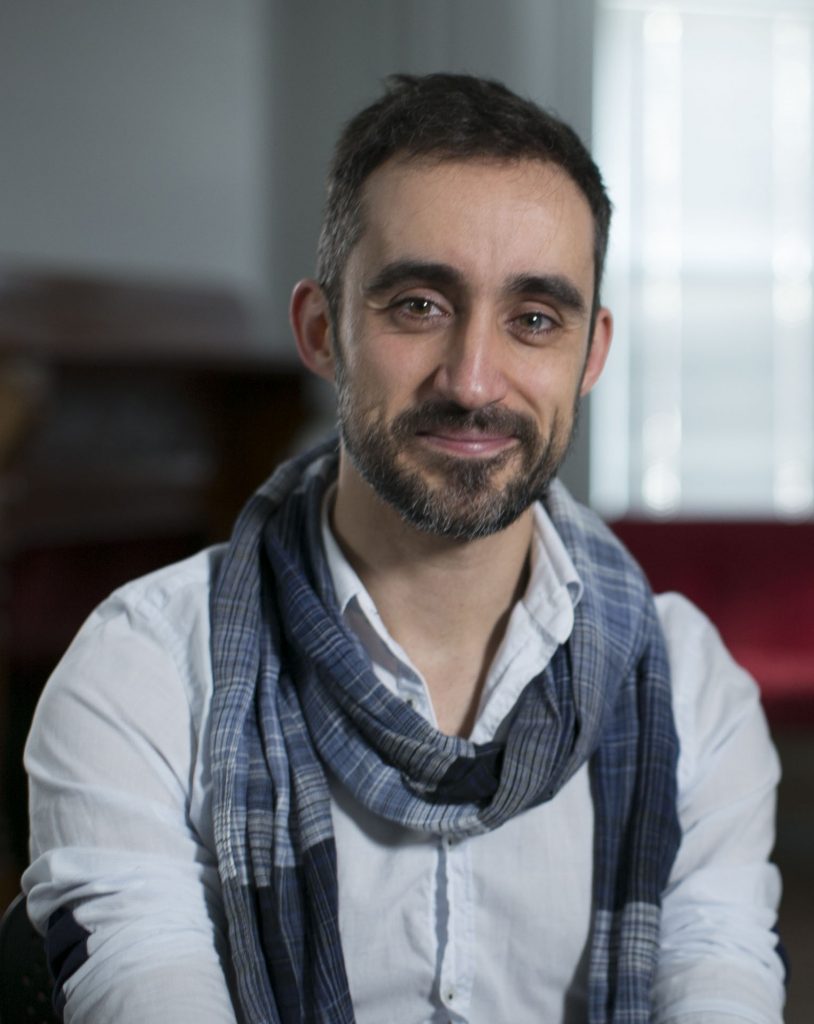
Jose Luis García del Castillo y López talks “tech to expect” in Architect Magazine

Jose Luis García del Castillo y López talks “tech to expect” in Architect Magazine

Last year brought staggering change to our lives, but the impact on technology—and the resulting tech trends we can we expect in 2021—are of particular interest to many designers. Lecturer in Architectural Technology Jose Luis García del Castillo y López was among 12 thought leaders to reflect on these questions in a recent feature for Architect Magazine.
Jose Luis Garcia del Castillo Lopez

García del Castillo y López also serves as the Area Head for the Technology MDes group.

García del Castillo y López argues that the remoteness caused by the pandemic has impacted the way we interact with each other in digital spaces and how we present ourselves to the world. He predicts that “architects will have a bigger role in rethinking our new forms of presence, both physical and digital” and in designing how those two spheres can blend. “We are witnessing an increasing number of architects moving on to UX/UI design, software development, and generally thinking, designing, and building digital environments that are more pleasant to work, interact, and augment our physical selves in.” García del Castillo y López anticipates that 2021 will bring “a surge in the popularity of frameworks that streamline collaborative work among stakeholders in AEC (Architecture, Engineering, and Construction) enterprises.” Read García del Castillo y López’s full response in Architect Magazine.

Ali Malkawi talks Center for Green Buildings and Cities, HouseZero project with Harvard Gazette

Ali Malkawi talks Center for Green Buildings and Cities, HouseZero project with Harvard Gazette

Date
June 13, 2017
Author
Travis Dagenais
Ali Malkawi, professor of architectural technology at the GSD, founding director of the Harvard Center for Green Buildings and Cities, and the creator of the HouseZero project.
Professor Ali Malkawi, Professor of Architectural Technology; Director of Harvard Center for Green Buildings and Cities is seen at 20 Sumner Road, a house he is retrofitting to become an ultra-efficient building that will be the home of the Harvard Center for Green Buildings and Cities. Kris Snibbe/Harvard Staff Photographer

The Harvard Center for Green Buildings and Cities (CGBC) revealed its centerpiece initiative, the HouseZero project, last month, and CGBC founding director Ali Malkawi recently conducted a Q&A with the Harvard Gazette  to offer an inside look at the ambitious venture.

“Being in a university setting and having the knowledge that we have accumulated, we thought it would be important to be able to see what we can do with existing technologies and design ideas that enable us to have ambitions that have not been met before, as well as change the perception about certain challenges that we have in relation to the built environment,” Malkawi tells the Gazette.

With the HouseZero project, Malkawi, who also is professor of architectural technology at the GSD, aims to turn the CGBC’s Cambridge headquarters into a building that uses as little energy, materials, and resources as possible. Among other design and engineering elements, HouseZero’s HVAC system will be replaced with thermal mass, and a ground source heat pump for extreme cold. A solar vent will instigate buoyancy-driven ventilation and triple-glazed windows will employ natural cross ventilation through a manual and automated system that monitors for temperature, humidity, and air quality.

“Though this is a stick-frame building, the same ideas can be applied to other types of homes or structures throughout the world,” Malkawi tells the Gazette. “We will be able to translate some of our learning lessons, not just now but as it evolves. It’s not about globalization. It’s about localization related to principles that can then be applied.”

Read Malkawi’s full Q&A at the Harvard Gazette‘s website , and learn more about the launch of the HouseZero project via the GSD’s coverage.