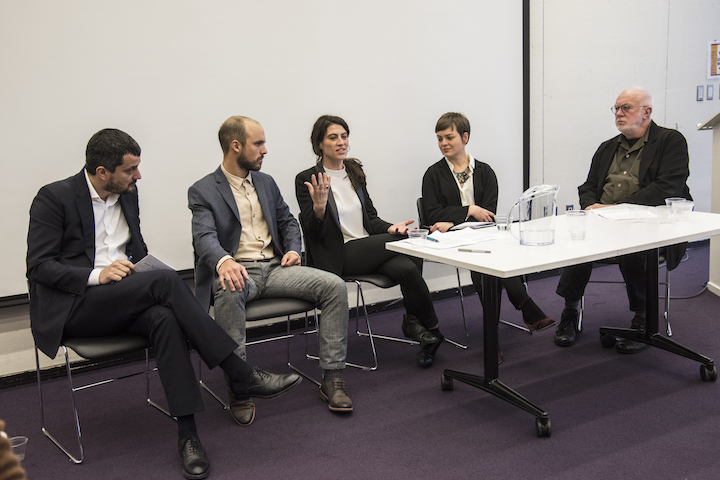
Eric Parry, “Webs, Plates, Fists and Gloves: Designing with Metals in Architecture”
Iron used in the domestic interior revolutionized our understanding of the spatial setting; used in tall buildings, it has equally contributed to radical redefinition of the contemporary city. The breadth of its surface character and sectional dimensions are amazing, ranging from surgical instruments to infrastructure. As a prompt to this conversation, Eric Parry will illustrate a journey through the alchemic possibilities of metals in his own architecture.
Eric Parry has developed a particular reputation for delivering beautifully crafted and high-quality contemporary buildings that respond to their context.
His practice, Eric Parry Architects, is renowned for cultural projects involving sensitive historic buildings such as the restoration of the historic St Martin-in-the-Fields Church in Trafalgar Square and the highly acclaimed restoration for the Holburne Museum in Bath, as well as a number of prestigious commercial projects in the City of London and the City of Westminster including 1 Undershaft. This work also includes the Stirling Prize shortlisted schemes at 30 Finsbury Square and 5 Aldermanbury Square, One Eagle Place in Piccadilly and 8 St James’s Square. International projects include the residential schemes Damai Suria in Kuala Lumpur and the Westminster Nanpeidai in Tokyo for Grosvenor.
In addition to his work in architectural practice, Eric serves on the Council of Royal Academy, The Fabric Advisory Committee of Canterbury Cathedral and the Council of the British School at Rome. He has in the past served on the Arts Council of England’s Visual Arts and Architecture panel, chaired the RIBA Awards Group and was President of the Architectural Association.
His contribution to Academia includes fourteen years as lecturer in Architecture at the University of Cambridge and visiting lectureships at the Harvard University Graduate Design School and the Tokyo Institute of Technology.
In 2006 Eric Parry was elected Royal Academician (RA), one of the highest accolades for a practicing architect or artist in the UK and also received an Honorary Doctorate of Arts from the University of Bath in 2012.
Reinier de Graaf, “Phantom Urbanism”
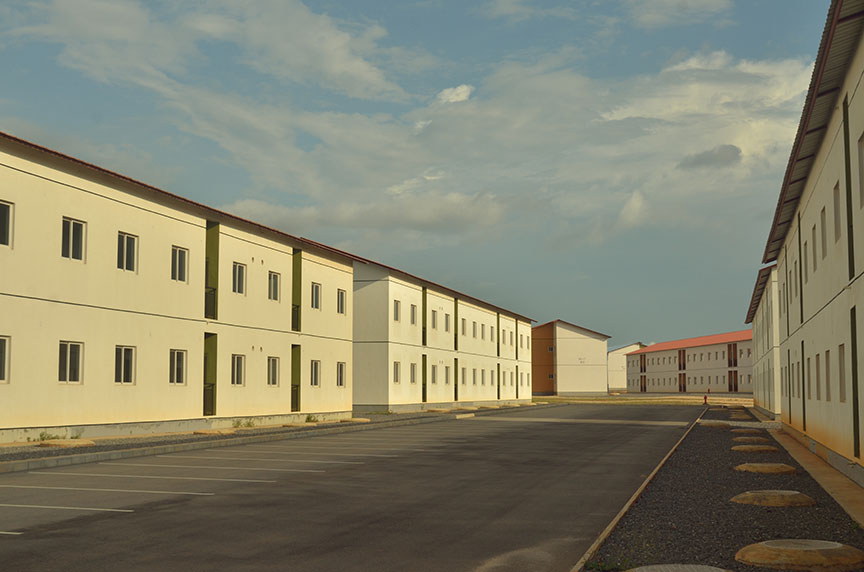
Once cities were designed to accommodate the masses; today the masses have to be seduced. During the past forty years, like all sectors of the economy, urban planning has become free enterprise: a perpetually speculative activity, which must give shape to developments even if it remains uncertain whether those developments will ever happen, or attract the people for whom they were planned.
This presentation explores the flipside: large urban plans that were built but never used. These now occur on every continent – the inevitable fallout of a world urbanizing at a staggering pace. But perhaps they are more… perhaps these towns also constitute compelling reasons for reflection in the face of a seemingly unbreakable consensus that the city is our one and only common future.
Reinier de Graaf (1964, Schiedam) is a Dutch architect, architectural theorist, urbanist and writer. He is the Office for Metropolitan Architecture (OMA)’s longest serving non-founding partner, leading projects in Europe, Russia and the Middle East. His recent built work includes the Timmerhuis, a mixed-use project in Rotterdam widely recognized for its innovation in ways of working and living, sustainability and cost efficiency; fashion brand G-Star Raw’s corporate and design headquarters in Amsterdam; and De Rotterdam, currently the largest building in the Netherlands.
Reinier is a co-founder of OMA’s think tank AMO and has taught at various institutions, such as the Strelka Institute for Media Architecture and Design, The Berlage Institute and the University of Pennsylvania. He is the author of the book Four Walls and a Roof: The Complex Nature of a Simple Profession, named best books of 2017 by both the Financial Times and the Guardian.
Beatriz Colomina, “The Secret Life of Modern Architecture or We Don’t Need Another Hero”
The secrets of modern architecture are like those of a family and it is perhaps because of the current cultural fascination with exposing the intimate that they are now being unveiled, little by little. There is increasing interest in the ways in which architecture works. It is as if we have become just as concerned with the “how” as with “what.” And the “how” is less about structure or building techniques—the interest of earlier generations—and more about interpersonal relations. The previously marginal details of how things actually happen in architectural practice are now coming to light.
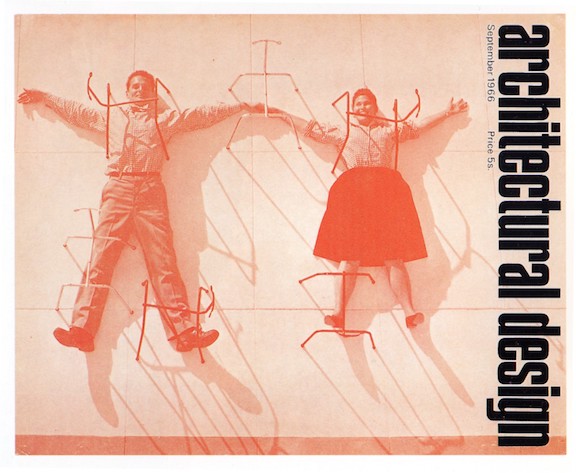
“With,” and not “and,” is the way in which women are usually credited alongside men in the official records, if they are credited at all. Women are the ghosts of modern architecture, everywhere present, crucial, but strangely invisible. Unacknowledged, they are destined to haunt the field forever. But correcting the record is not just a question of adding a few names or even hundreds to the history of architecture. It is not just a matter of human justice or historical accuracy, but of opening the field to its own productive complexity. Architecture is deeply collaborative, more like moviemaking than traditional visual art. But unlike movies, this is hardly ever acknowledged. Until recently, it has been a secret carefully guarded.
Beatriz Colomina is Professor of History and Theory in the School of Architecture and founding director of the program in Media and Modernity at Princeton University. She has written extensively on questions of architecture, art, sexuality and media. Her books include Are We Human? Notes on an Archeology of Design (Lars Müller, 2016), The Century of the Bed (Verlag für Moderne Kunst, 2015), Manifesto Architecture: The Ghost of Mies (Sternberg, 2014), Clip/Stamp/Fold: The Radical Architecture of Little Magazines 196X-197X (Actar, 2010), Domesticity at War (MIT Press, 2007), Privacy and Publicity: Modern Architecture as Mass Media (MIT Press, 1994), and Sexuality and Space (Princeton Architectural Press, 1992). She has curated a number of exhibitions including Clip/Stamp/Fold (2006), Playboy Architecture (2012) and Radical Pedagogies (2014). She was curator with Mark Wigley of the third Istanbul Design Biennial (2016). She has been the recipient of diverse awards and fellowships, including the Samuel H. Kress Senior Fellowship at the CASVA (Center for Advanced Studies in the Visual Arts), SOM Foundation, Le Corbusier Foundation, Graham Foundation, the CCA (Canadian Centre for Architecture), The American Academy in Berlin and the Getty Center in Los Angeles.
This event is organized by Women in Design at the GSD as was planned in conjunction with International Women’s Week 2018.
Harvard HouseZero Typology Symposium
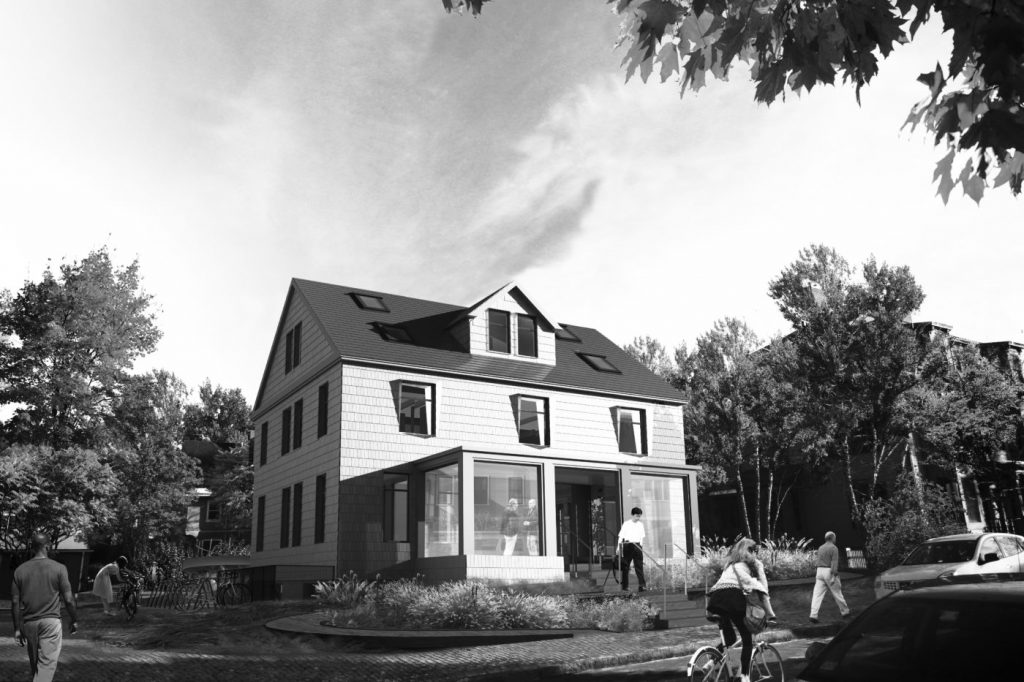
The Harvard Center for Green Buildings and Cities (CGBC) retrofitted its headquarters, a pre-1940s house in Cambridge, MA, into a first-of-its-kind test case to demonstrate unprecedented levels of building efficiency and promote substantial shifts in the design and operation of existing buildings. Dubbed “HouseZero,” the project aims to prove that ultra-efficient retrofits can, indeed, be achieved and replicated by coupling current technologies with better design. All components of HouseZero are highly-sensored to generate data that will allow the building to adjust and reconfigure itself. This data will fuel future CGBC research involving simulated environments and the development of new systems and algorithms that can help to answer pressing questions involving energy efficiency, health and sustainability. Scheduled to coincide with the completion of the retrofit, the Harvard HouseZero Typology Symposium will gather GSD faculty members to analyze the project. Presentations will discuss the building’s typology, design, and technologies, the collaborative process, historical context and more—resulting in a diverse range of observations that illustrate the complex issues involved in realizing an ultra-efficient retrofit and determining scalability. The program will conclude with a panel discussion. PRESENTERS:- Preston Scott Cohen, Gerald M. McCue Professor in Architecture, Harvard Graduate School of Design
- Ali Malkawi, Professor of Architectural Technology, Harvard Graduate School of Design; Founding Director, Harvard Center for Green Buildings and Cities
- K. Michael Hays, Eliot Noyes Professor of Architectural Theory, Harvard Graduate School of Design
- Antoine Picon, G. Ware Travelstead Professor of the History of Architecture and Technology, Harvard Graduate School of Design
- Erika Naginski, Professor of Architectural History, Harvard Graduate School of Design
- Stephen Gray, Assistant Professor of Urban Design, Harvard Graduate School of Design
- Gary R. Hilderbrand, Professor in Practice of Landscape Architecture, Harvard Graduate School of Design
- Grace La, Professor of Architecture, Harvard Graduate School of Design
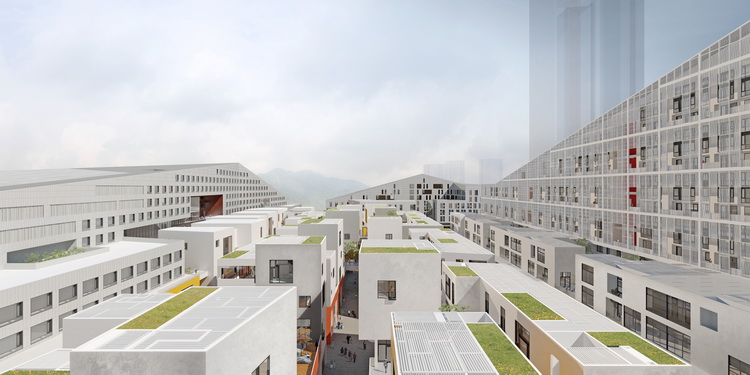
Zhang Jian and Meng Yan, “Urban Coexistence: City Upon the City”
Please join us for a lunchtime lecture by Zhang Jian and Meng Yan.
Meng Yan is Principal Architect and Co-founder of URBANUS Architecture & Design Inc and is an architect licensed in New York State. In 1999, MENG Yan co-founded URBANUS with partners LIU Xiaodu and WANG Hui. As Principal in charge of Design of URBANUS, MENG Yan has led numerous design projects over the years. These projects have won an international reputation for URBANUS. Mr. Meng received his Bachelor and Master’s degrees of Architecture from Tsinghua University and Master’s degree of Architecture from Miami University. He has been a design critic in many universities, and taught at the School of Architecture at the University of Hong Kong. Currently, he serves as a visiting professor at Syracuse University. He has been invited as a jury member for numerous international design competitions and to give lectures at many influential academic institutions in New York, Venice, Moscow, Rotterdam, Brussels and Singapore. MENG Yan was appointed chief curator of the Shenzhen Pavilion in 2010 Shanghai Expo, and is appointed to be one of the chief curators for 2017 Shenzhen-Hong Kong Urbanism Architecture Bi-City Biennale (Shenzhen).
Zhang Jian is an Architect and the Chairman of Shum Yip Land Company Limited. Shum Yip Land Company Limited is a subsidiary of Shum Yip Group Company Limited, a State Owned Enterprise, with a net worth around RMB 30billion (USD 4.5billion). Shum Yip Land Company Limited engages in commercial property development, property portfolio development, and property management. They have four major current projects in China, including developments in Shenzhen, Suzhou, Chaohu and Kashi. Shum Yip provided special support to the 2017 Shenzhen Bi-City Biennale of Urbanism and Architecture.
Alumni Insights Lecture: Experiments in Global Design Practice: The VERITAS Adventure
/p>
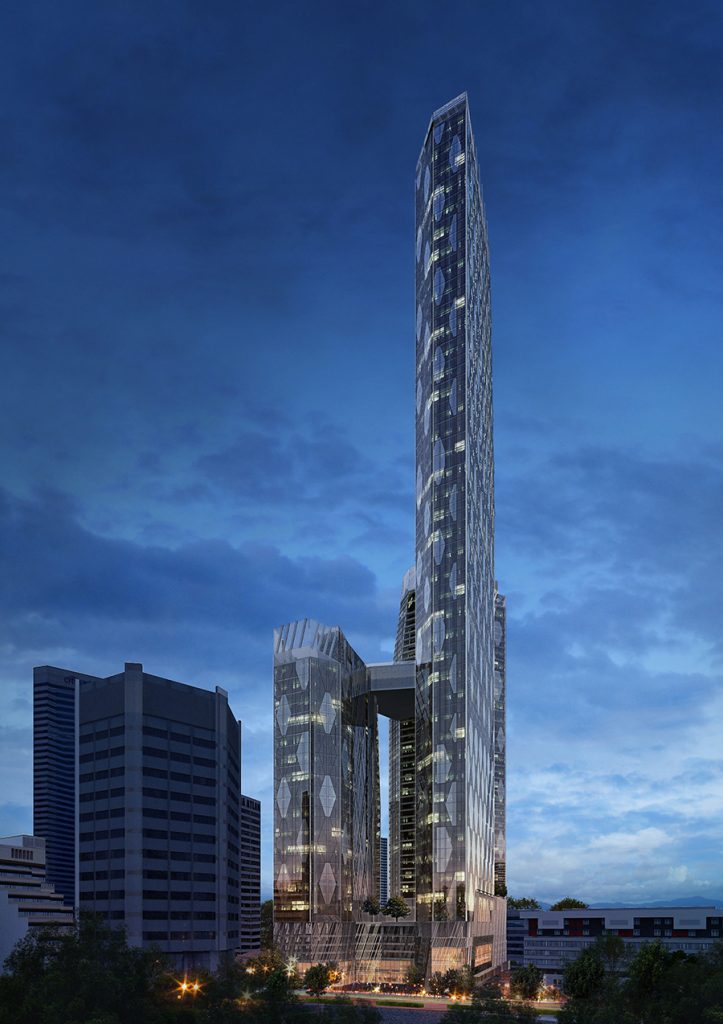
Join us for a GSD Alumni Insights Lecture with David Mizan Hashim (MArch ’86) as he discusses the global adventures of VERITAS, the multi-disciplinary design practice he founded immediately after graduation and returning to his home in Malaysia. David will speak about how an award-winning international practice from a developing nation evolved from its humble beginnings into one of the largest design firms in the ASEAN region. His presentation will investigate the cultural, entrepreneurial and political instincts that are necessary to navigate the complex ecosystem of global design practice, with special focus on the evolution of the Asian city.
David obtained his Bachelor of Arts degree from MIT in 1983 before moving up-river to Harvard in the same year. Upon graduation from the GSD in 1986 he was awarded the prestigious Aga Khan travel fellowship for studies in Islamic architecture in the ASEAN region. Soon after, he founded VERITAS, which has evolved into a multi-disciplinary design practice which provides architecture, planning, landscape and interior design, environmental consulting, quantity surveying and project management services across the world. VERITAS offices are located in several cities throughout Malaysia, as well as Portland OR, London, Melbourne, Ho Chi Minh City and Mumbai.
David is a fellow of the Malaysian Institute of Architects and an associate member of the American Institute of Architects. He has received many personal accolades over the years such as Most Outstanding Entrepreneur from the Malaysian Junior Chamber of Commerce, Brand Icon Leadership award from the Malaysian branding authority and was twice a finalist for Ernst & Young’s Malaysian Master Entrepreneur award. David has been President of the Malaysian chapter of the global Entrepreneur’s Organization (EO) and the World Entrepreneur’s Organization (WEO).
His recognition as a successful entrepreneur is only exceeded by recognition of the design awards VERITAS has received over the last 3 decades. These include innumerable prizes from the Malaysian Institute of Architects, Malaysian Institute of Landscape Architects, Malaysian Institute of Interior Design, Cityscape Dubai, Building Construction Investment Asia (BCIAsia), FIABCI, CNBC and others. David’s work at VERITAS has been featured in countless media forums including Forbes and Bloomberg, CEO magazine and the Robb Report.
Following the lecture, the audience is encouraged to participate in a Q&A with Hashim. Questions? Contact [email protected].
Gerard & Kelly, “On Modern Living”
Please join us for a presentation by Gerard & Kelly where they will discuss their collaborative practice and their ongoing project entitled “Modern Living”, which explores intimacy and domestic space within legacies of modernist architecture. Structured in chapters, each sited in a modernist home, the project is driven by the question, “what would a home have to look and feel like today to protect and produce intimacies and relations that don’t fit within dominant narratives of family, marriage, or domesticity?” Gerard & Kelly will return the week of March 19 to lead a collaborative workshop for GSD students. More information about the workshop will be given during their presentation. See Silvia Benedito for more information about participating in the workshop. Modern Living is an ongoing series of performances and videos by Gerard & Kelly sited in iconic modernist homes around the world. Mining these “ruins” of modernism for their hidden choreographies and radical social experiments, the artists posit questions around memory, domesticity, and the architecture of intimacy. Brennan Gerard and Ryan Kelly have collaborated since 2003. Their installations and performances use choreography, writing, video, and sculpture to address questions of sexuality, memory, and the formation of queer consciousness. Exhibitions and performances of their work have been presented by the Festival d’Automne (Paris), Chicago Architecture Biennial, Guggenheim Museum (New York), New Museum (New York), Made in LA Biennial at the Hammer Museum (Los Angeles), and The Kitchen (New York). Gerard & Kelly completed the Whitney Museum Independent Study Program in 2010, and received their MFAs from the UCLA Department of Art in 2013.Gerard & Kelly have received numerous recognitions for their work, including grants from the New England Foundation for the Arts’ National Dance Project, Art Matters, Graham Foundation, and the Juried Award from the New York Dance and Performance Awards, also known as the Bessies. Their work is in the collections of the Hammer Museum, Los Angeles, and the Guggenheim Museum, New York.
“On Monuments: Place, Time, and Memory”
This event is co-organized by the Harvard University Committee on the Arts, the Harvard University Graduate School of Design, and the Harvard University Faculty of Arts and Sciences.
Opening Remarks by:
Drew Faust
President of Harvard University
Lincoln Professor of History
Introduction by:
Mohsen Mostafavi
Dean and Alexander and Victoria Wiley Professor of Design
Presentations by:
- Robin Kelsey, “Camera Angle: Revisiting Maya Lin’s Vietnam Veterans”
Dean of Arts and Humanities Faculty of Arts and Sciences and Shirley Carter Burden Professor of Photography, Harvard University - Sarah Lewis, “The Future Perfect: Race and Monuments in the United States”
Assistant Professor of History of Art and Architecture and African and African American Studies, Harvard University - Jennifer Roberts, “Trying to Remember”
Elizabeth Cary Agassiz Professor of the Humanities , Harvard University - Krzysztof Wodiczko, “Let the Monument Speak”
Professor in Residence, Art, Design & the Public Domain, Harvard University Graduate School of Design
Following their presentations, participants will engage in a panel discussion and will be joined by:
- Homi K. Bhabha
Anne F. Rothenberg Professor of the Humanities in the Department of English, the Director of the Humanities Center and the Senior Advisor on the Humanities to the President and Provost at Harvard University - Erika Naginski
Professor of Architectural History and Director of Doctoral Programs, Harvard University Graduate School of Design
Sarah Oppenheimer, “FE_20180201”
Dynamic equilibrium: on developing degrees of freedom.
Sarah Oppenheimer’s (SM ’05) calculated manipulation of standardized spaces disrupts the embodied experience of spatial continuity, reorienting and clarifying the experience of the built environment. Recent solo projects include S-281913 (Pérez Art Museum Miami 2016), S-337473 (Wexner Center for the Arts 2017), S-399390 (MUDAM Luxembourg 2016), 33-D (Kunsthaus Baselland 2014) and W-120301, an architecturally embedded permanent commission at the Baltimore Museum of Art (2012). Her work has been exhibited at such venues as the Andy Warhol Museum (2012); the Museum of Contemporary Art San Diego (2009); Art Unlimited, Art Basel (2009); Skulpturens Hus (Stockholm); the Saint Louis Art Museum; the Mattress Factory; the Drawing Center; and the Sculpture Center. Ms. Oppenheimer is currently a senior critic at the Yale University School of Art.
Henry N. Cobb, Peter Eisenman, and Rafael Moneo, “How Will Architecture Be Conceived?”
Join us for an evening with Henry N. Cobb, Peter Eisenman, and Rafael Moneo as they investigate the question, “How will architecture be conceived?” Each participant will give a brief presentation, after which, they will engage in an intimate discussion together on stage.
Henry N. Cobb (AB ’47, MArch ’49) was among three University alumni to receive the Harvard Medal during the 2017 commencement exercises. The award, which recognizes extraordinary service to the University, was presented to honorees by Harvard University President Drew Gilpin Faust at the Annual Meeting of the Harvard Alumni Association.
Cobb is the first Harvard Graduate School of Design alumnus to receive the Harvard Medal in 30 years, and only the second GSD alumnus to be honored with the award.
Cobb has demonstrated a strong commitment to Harvard as an alumnus, teacher, administrator, and architect. During his term as president of the Harvard Graduate School of Design (GSD) Association from 1969 to 1971, he also served as an appointed director for the HAA, representing the GSD, and as a member of the GSD visiting committee. From 1980 to 1985, he was studio professor of architecture and urban design and chair of the Department of Architecture, where he continues to teach occasionally as a visiting lecturer and design critic. Currently, he serves as an honorary member of the GSD Campaign Committee.
Cobb designed the Harvard Center for Government and International Studies (CGIS), completed in 2005 and comprising two buildings flanking Cambridge Street; the renovation of several houses on Sumner Road; and the rehabilitation of an important mid-block open space shared by the University and the adjoining residential community. Dean Mohsen Mostafavi described the CGIS project as “representative of Harry’s contributions to the University and the Harvard community, and of his vision as an architect.”
As a founding partner of Pei Cobb Freed & Partners LLP, Cobb has contributed to the work of his firm since its formation in 1955. His practice has embraced a wide variety of building types across North America and around the world, including 200 Clarendon St. (formerly the John Hancock Tower), the John Joseph Moakley U.S. Courthouse in Boston, and the Portland Museum of Art in Maine. His current projects include the Four Seasons Private Residences Boston and the International African American Museum in Charleston, S.C.
Born and raised in Boston, Cobb and his wife, Joan Spaulding Cobb, live in New York and are the parents of three daughters, two of whom are graduates of Harvard College. Joan Cobb’s father, Francis T. Spaulding, was dean of the Harvard Graduate School of Education from 1940 to 1945.
Peter Eisenman is an internationally recognized architect and educator whose award-winning large-scale housing and urban design projects, innovative facilities for educational institutions, and series of inventive private houses attest to a career of excellence in design.
Prior to establishing a full-time architectural practice in 1980, Mr. Eisenman worked as an independent architect, educator, and theorist. In 1967, he founded the Institute for Architecture and Urban Studies (IAUS), an international think tank for architecture in New York, and served as its director until 1982.
Mr. Eisenman is a member of the American Academy of Arts and Sciences and the American Academy of Arts and Letters. Among other awards, in 2001 he received the Medal of Honor from the New York Chapter of the American Institute of Architects, and the Smithsonian Institution’s 2001 Cooper-Hewitt National Design Award in Architecture. He was awarded the Golden Lion for Lifetime Achievement at the 2004 Venice Architecture Biennale. Popular Science magazine named Mr. Eisenman one of the top five innovators of 2006 for the University of Phoenix Stadium for the Arizona Cardinals. In May 2010 Mr. Eisenman was honored with the Wolf Foundation Prize in the Arts, awarded in Jerusaleum.
Currently the Charles Gwathmey Professor in Practice at the Yale School of Architecture, Mr. Eisenman’s academic career also includes teaching at Cambridge, Princeton, Harvard, and Ohio State universities. Previously he was the Irwin S. Chanin Distinguished Professor of Architecture at The Cooper Union, in New York City. He is also an author, whose most recent books include: Written Into the Void: Selected Writings, 1990-2004 (Yale University Press, 2007) and Ten Canonical Buildings, 1950-2000 (Rizzoli, 2008), which examines in depth buildings by ten different architects.
Rafael Moneo is the first Josep Lluís Sert Professor of Architecture. He was chair of the Department of Architecture from 1985 until 1990 and teaches the lecture courses On Contemporary Architecture and Design Theories in Architecture.
Before joining the Graduate School of Design, Moneo was a fellow at the Spanish Academy in Rome and taught in Barcelona and Madrid. His scholarly work includes numerous articles and lectures published throughout the world. His projects include the Bankinter Building in Madrid, the Museum of Roman Art in Mérida, the L’Illa building in Barcelona, the Pilar and Joan Miró Museum in Palma de Mallorca, the “Kursaal” Auditorium and Congess Center in San Sebastián, the extension of the Prado Museum in Madrid, as well as the Davis Art Museum at Wellesley College, the Houston Museum of Fine Arts, and the Cathedral of Our Lady of the Angels in Los Angeles. Moneo has been awarded the Gold Medal by the Spanish government, the Arnold W. Brunner Memorial Prize by the American Academy of Arts and Letters, the Prince of Viana Prize (Spain), the Swedish Schock Price for the Visual Arts and the Royal Institute of British Architects Gold Medal. In 1996, he received the UIA Gold Medal and the Pritzker Prize.