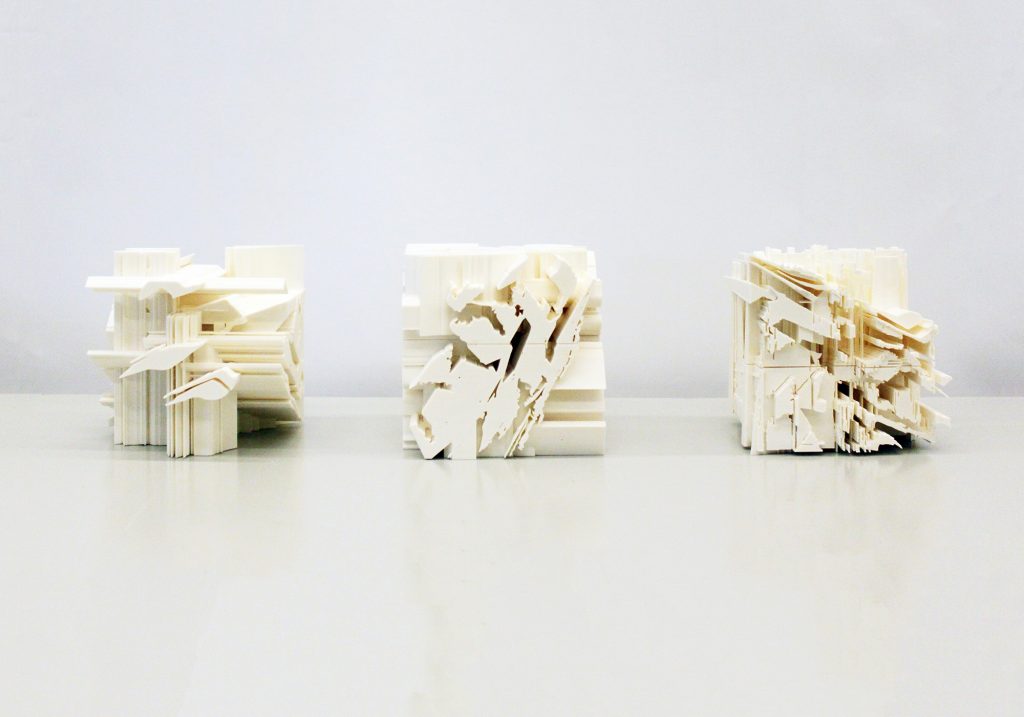
KAWAII-KOWAI Amplifying the Affective Loop
Erin Cuevas (MArch II ’16)
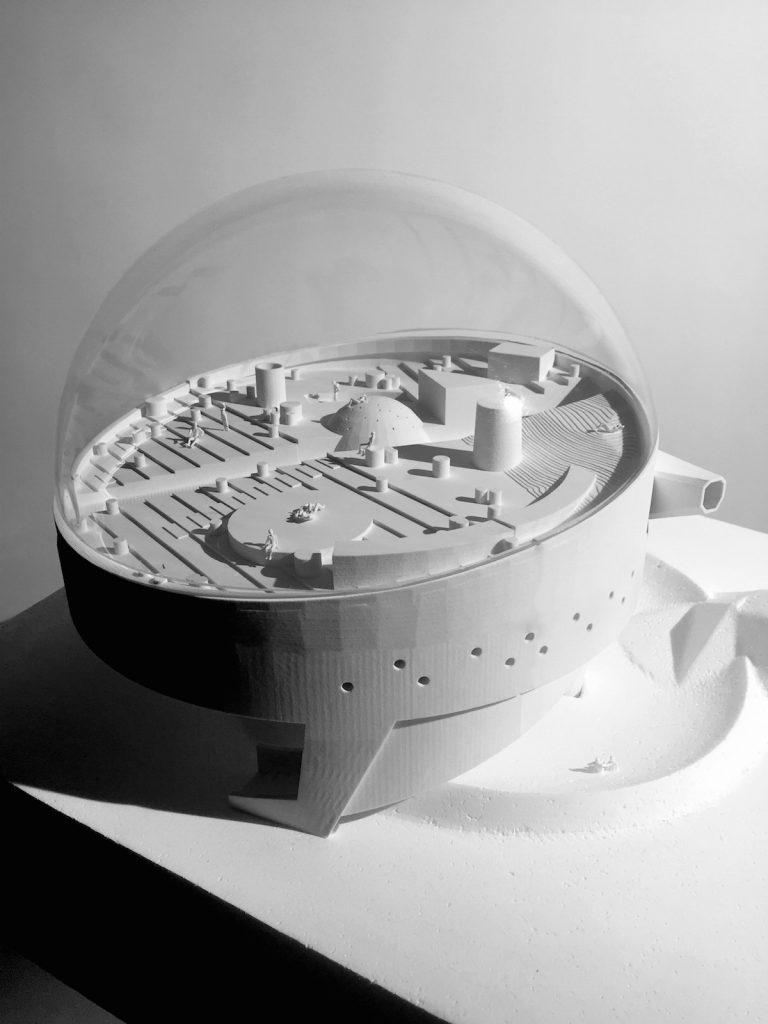
The proposal in Tokyo addresses the duality between Kawaii and Kowai — two Japanese words with similar phonetics, but opposing meanings. Kawaii denotes a purity, innocence, and femininity, while Kowai, on the other hand, denotes fear, danger, and perversity. The architecture provokes the overlapping of Kawaii-Kowai in terms of social interaction and subjective perceptual experience. Layers of concrete delaminate to enclose product showrooms, and a series of varied apertures allow for dual peepshow-panopticon interactions surrounding a central atrium. The design embraces human and architectural alias, translating space into profitable advertisement, ultimately integrating architecture into a feedback system where immaterial culture is both consumed and produced simultaneously.
Thesis Advisor:
Iñaki Ábalos
The Littleton Trials
David Kennedy (MDes ’16), Jacob Mans (MDes ’16), and Benjamin Peek (MDes ’16)
This inquiry seeks a method for identifying feedback indicators that operate across scales in mass timber buildings. Reinforcing feedback loops offer an alternative metric to efficiency-based performance indicators that operate solely within the envelope boundary of a building. The project unfolds across the design and construction of three wooden huts at the Prouty Woods in Littleton, Massachusetts. We dissect wood across scales to understand how material-scaled thermodynamic variables, building-scaled construction logics, and landscape-scaled forest management regimes can operate as non-linear feedback loops that shape trans-scalar design decisions.
Our methodology leverages observation, making, and occupation across scales to inform a theory of design research and practice that engages architecture as an open system. Wood, as our explorative media, diverges and converges through the act of construction and testing. The design iteration and construction of Trial Hut001 focuses on characterizing different mass timber construction logics (nail-laminated timber, dowel laminated timber, nailed cross laminated timber, and doweled cross laminated timber). The design iteration and construction of Trial Hut 002 focuses feedback from the initial trial and modified it through the introduction of critical New England wood species to understand the impacts of a multi-species wood construction across scales. The design iteration and construction of Trial Hut 003 converges feedback from the first two trials into a set of thermally tuned multi-species wood panel concepts informed by the de-construction of existing construction logics and the incorporation of different local wood species.
The project is continuously changing and redefining as it tracks opportunities opened by our collaborators and the trials undertaken during the construction and testing of aspects of the project. Trial Hut003 embodies a number of critical feedback loops that begin to connect local forest management practices to heat transfer considerations at the scale of a building. The project embodies the formation of a method for design research that leverages the physical medias of large-scale making and material organization into a critical abductive process. This method is an alternative model that couples academic research with professional practice–a critical alignment that bridges the academic and commercial realm.
Final Review Presentation
Sponsored by Softwood Lumber Board, Northeastern Lumber Manufacturers Association, New England Forestry Foundation, Massachusetts Department of Conservation and Recreation, and the GSD Energy, Environments, and Design Lab
Wildland-Urban Interfaces: Attitudes and Altitudes
Oliver Curtis (MDes ’17)
This project explores the wildland-urban interface, “wilderburbs,” the growing borderland between forested wilderness and human settlement.1 These areas are increasingly subject to intense and destructive wildfires because settlement has encroached into the dry fuel-laden forests. I propose a three-pronged research approach to explore this issue: interviewing engineering experts at the Insurance Institute for Business & Home Safety (IBHS) Research Center, documenting the landscape of recent wildfires in the lower Colorado Plateau, and mapping the available construction material supply chain. The purpose of the data collection is to advance materially feasible and insurance-accepted landscape and construction methods to improve wildfire resistance in those prone areas of the American West. The field research will culminate in the production of a eponymously titled handbook with ideas to go beyond the proverbial defensible space and roofing material advice. The field research will be juxtaposed with photographic evidence of the fire’s restorative role in a fire-dependent landscape.1
1 Bramwell, Lincoln. Wilderburbs: Communities on Nature’s Edge. Seattle: University of Washington Press, 2014.
Hyperbolic Cosines: Recasting Form Finding to Induce Ventilation Performance
We explored the allometric potential of a funicular catenary form to both modulate interior climatic conditions and provide fresh air. The project was situated in the dry desert climate of Palm Spring, California because of the large year-round dry bulb daily temperature oscillations. Weather data confirmed typical daily diurnal swings of between 14-18° C, with larger swings in during the summer months (shown below). We anticipated that the form when in sync with its “peak” resonance cycle would produce conditions at the upward bounds of the Thermal Comfort Tool, developed by the Center for the Built Environment at the University of California Berkeley. While we were correct that large daily oscillations would result in a modulation of interior conditions, the effect of “peak” oscillation produced a reduction of approximately 5° C with ventilation rates exceeding the 10 liters/second per person. This was considerable drop through mass coupled ventilation.
The investigation of the Hyperbolic Cosines, an exercise in form finding through performative criteria uncovered a duality in tension. The tension uncovered exists between the forms ability to drop the overall temperature of the defined interior space and the ability to create air flow; air flow defined by pulling in exterior air into the interior and subsequent exhaust of to the exterior environment. The choking of airflow compromises the air changes required for the interior environment and inhabitants, creating a space resembling something closer to a hermitically sealed envelope. This is in opposition to an open exchange between the interior and the exterior, which was extracted from the taxonomy created through a framework of performative criteria. However, when the space is allowed to produce air exchange or air flow the ability of the form to drop the interior temperature diminishes. The exposure of the duality specific to an architectural intervention comes from the need to lower the interior temperature and the ability of the form to produce air flow. The inability of the form to function as inhabitable space limits the opportunities for an engagement at the scale of an architectural intervention, as shelter. When the form can not play host to inhabitants in the form of shelter the performative criteria must be questioned. The performance shifts from creating an interior space with the intent to produce comfort for human inhabitants to a mechanical provocation. The forms ability to drive mass air flow defines the intentionality closer to that of a mechanical intervention.
Living and Working in Phytoremediating Brownfield Sites, Creating Healthier Environments than Is the Norm in Urban Conditions
Jane Philbrick (MDes CC ’16)
Phytoremediation, a remedial technique using living plant material, is a cost-efficient alternative to conventional land reclamation practices. However, the timeframe for natural processes is lengthy, measured in decades not months. Without a means of generating income, the carrying costs of fallow land dwarf any gains in savings realized through implementing plant-based methods. Shifting the focus of concern from contaminant sources (i.e., impacted soil and water) to exposure pathways (i.e., eating impacted soil or food grown in impacted soil; drinking contaminated water) allows a broader range of uses and possibilities for sustaining economies in phytoremediating landscapes. Not only is it possible to live and work in the park-like setting of phytoremediating brownfield sites without compromising health, doing so in fact offers healthier environments than is the norm in urban conditions.


Show/Flow
Andrew Keating (MArch I ’17) and Scott Smith (MArch I ’17)
This project hybridizes an assortment of large public program into an iconic, regional-scale entertainment, leisure, and transportation complex supported by and supporting a waste-to-energy facility. The program—a regional transit hub for buses and electric vehicles, a sports stadium, an amphitheater for music performance, and a riverwalk—grows from the relatively open, semi-rural site, which currently hosts the Southeastern Connecticut Regional Recovery facility. The plant sits on the riverfront between the two largest casinos in the United States—Foxwoods, several miles to the east, and Mohegan Sun just across the Thames River to the west. This intensity of entertainment space and lack of urban density near the site motivated a search for large-scale program that would capitalize on the draw of the casinos, bringing visitors (and their attendant waste) to the facility, rather than solely relying on trucking as a waste source. Waste travels from the stadium and other facilities to the bunker hall via a vacuum system, so on site collection does not require additional trucking.
The building gathers the stadium, amphitheater, waste-to-energy plant, transit hub, and two large parking structures under a sinuous shell, which at times rises hundreds of feet above the landscape while at others meeting the ground plane and allowing visitors to walk up onto it. The shell takes part of its form from the spatial requirements of the waste-to-energy process, which, while linear, can be reorganized so that the tallest elements (the bunker hall, incinerator, and stack) all collect to one end. This creates the dramatic slope of The Hub, the central lobe of the greater shell. The tipping hall sinks below ground, accessible via a spiraling ramp that brings tipping traffic down while sending electric vehicles up drop visitors at the sky lobby for music and cultural events in the amphitheater. The amphiteather is suspended directly above the waste processing equipment. Bus traffic proceeds below the western portion of the hub, where visitors ascend into the transit hall, and can proceed up a long, sculptural ramp up through the oculus overhead and out onto the riverwalk. The waste-to-energy facility provides electricity and heating for the activities on site, and also to surrounding communities.
The project proposes a new way of thinking about regional-scale buildings and entertainment facilities, one that uses waste generated on site as an energy source, minimizes the carbon impact of waste removal, and reduces the inevitable loss of energy in transport from power plants to the point of use. Further, the waste-to-energy process supports a new kind of regional transit, relying on small electric vehicles, which may soon be able to drive themselves across the southeastern Connecticut region. The project results from the complexity of processes, not just within the waste-to-energy system, but also inherent to the site–flows of people, capital, vehicles, culture–bringing them all together into a manifold event space of event and flux, performance and circulation: Show and Flow.
RESHIM: Rethinking Social Housing in Mexico
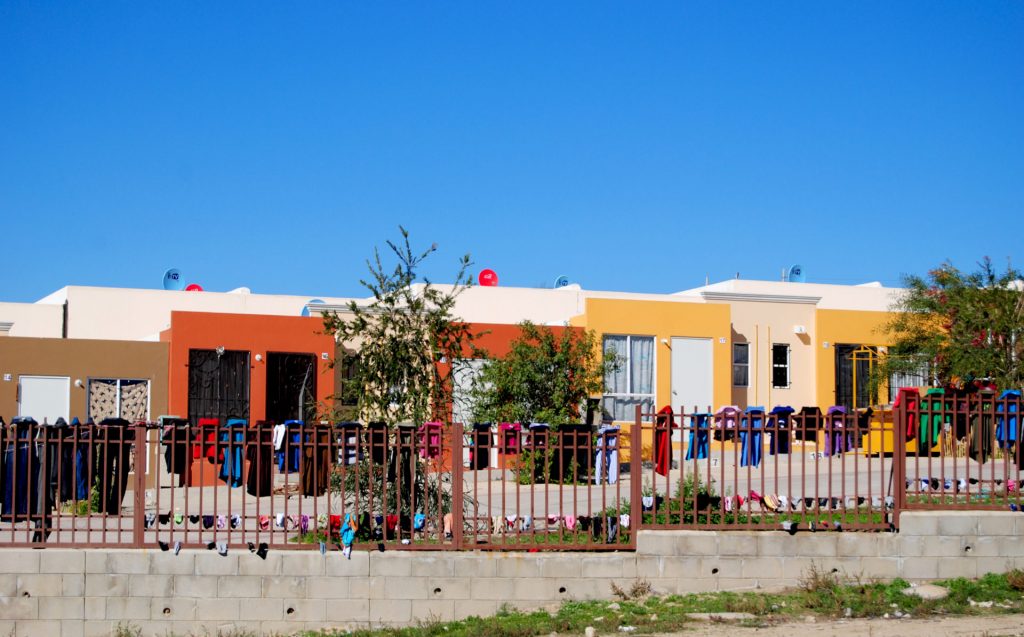
RESHIM is a multifaceted project focused on two central research components: 1) report on urban governance conditions and case study research in seven metropolitan areas across Mexico and 2) planning guidelines for redensification and sustainable urban development. In partnership with INFONAVIT, the RESHIM project has coordinated three Urban Planning and Design Option Studios at the GSD, with work in Celaya, Tlalnepantla, Oaxaca, and Mérida. Together with Harvard GSD Executive Education, the RESHIM project has also collaborated on Capacity Building training for executives and partners working on federal housing and urban development policy in Mexico.
Building on fieldwork in seven Mexican cities, the governance research led by Professor Davis introduces findings from the fieldwork and policy recommendations proposed to INFONAVIT. The report outlines the major barriers and enablers to densification and identifies the series of obstacles that must be overcome if mortgage credits for social housing are to be used to build more sustainable cities. Case study research has taken place in seven metropolitan areas across Mexico: Aguascalientes, Aguascalientes; Cancún, Quintana Roo; Guadalajara, Jalisco; Mérida, Yucatán; Monterrey, Nuevo Leon; Oaxaca, Oaxaca; and Tijuana, Baja California. Fieldwork research has revealed the range of housing dynamics across different cities and a unique set of challenges facing densification and social housing development.
Overall, the project addresses the following questions: What are strategies for better coordinating different levels of government to produce and renovate social housing in urban Mexico? What kinds of regulatory and technical tools, or other urban planning and design interventions, can be used to improve practice and successfully implement the new national housing policy? What levels of government would have to embrace them and how can they be mobilized? What are the challenges in coordinating the new national housing and urban policies with state and local government actions critical to the success of the national policies?
Ann Forsyth (Co-Principal Investigator), Diane E. Davis (Co-Principal Investigator), Nelida Escobedo (Research Associate), Margaret Scott (Research Associate), Elizabeth Antonellis (Project Assistant)
2014-2016
Visit the Rethinking Social Housing website.
Sponsored by INFONAVIT, Mexico’s National Worker Housing Finance Agency
The State of the Nation’s Housing 2016
The national housing market has now regained enough momentum to provide an engine of growth for the US economy, according to the latest The State of the Nation’s Housing report released today by the Joint Center for Housing Studies. Robust rental demand continues to drive the housing expansion, and sales, prices, and new construction of single-family homes are on the rise. Even more important, income growth has picked up, particularly among the huge millennial population that is poised to form millions of new households over the coming decade. At the same time, however, several obstacles continue to hamper the housing recovery—in particular, the lingering pressures on homeownership, the eroding affordability of rental housing, and the growing concentration of poverty.
A Slight yet Reliable Breeze
Aaron Mendonca (MDes ’17), Sarah Kantrowitz (MArch I ’17), and Jerónimo van Schendel Erice (MArch I ’16)
Tuning thermal mass with daily temperature cycles to drive buoyancy ventilation, we propose a thermally resonant interior architecture that lightly conditions exterior space. Scaling from house to palace, an allometric balance between mass surface area, thermal exchange rate, interior volume and aperture all works together to drive a gentle breeze.
Courtyard Breeze by Day
While comfort is codified, experience may be characterized through sensation. Ventilation, inside of a building, is fresh air changes but at the boundary it is a breeze. Characteristic ventilation is a function of stack height and temperature differential. Generating a sensible breeze involves clustering apertures at two ends of a maximum stack. Sufficient air changes requires a morphology that wraps a large mass surface over a tight interior volume. At the same time, the morphology must funnel breeze into a spatial experience without losing it to the vastness of an exterior sink.The courtyard satisfies these requirements encouraging a resonating architecture that goes beyond the comfort consensus so as to afford experience. During the hot afternoon hours, the interior thermal mass leaks a cool gentle breeze into the courtyard.

Balcony Breeze By Night
Scaling up to a palace grants a greater stack and stronger characteristic ventilation. However, leveraging the full power of the stack imposes a spatial program that arranges, in series, along the ventilation stream. Walls as well as structural floors act as thermal mass allowing for a high rate of exchange within a narrow volume. Floors are punctured in a staggered manner, at the center and then the periphery, causing the ventilation stream to weave around them. During the day, a cool downdraft descends into the building’s porch, much like the courtyard turned inside out. At night, the thermal mass drives a warm updraft that blows into the highest balcony.

Root
Adria Boynton (MDes ’16)
The city of Miami Beach experiences frequent flooding events due to sea level rise, heavy rains, and porous limestone that allows water to bubble up from underground.
What if Miami Beach specified rhizomatous, salt-tolerant grasses as a form of urban adaptation? Encouraging pervious surfaces would increase water absorption rates despite tourism-related disturbances. And by taking cues from Everglades’ sawgrass, plant species with dependable root mass could help alleviate localized flooding.