Paper or Plastic: Reinventing Shelf Life in the Supermarket Landscape
We tend to assume that supermarkets are static, neutral spaces where little of significance ever happens. The supermarket shelf is actually a highly volatile, hyper-competitive dynamic market landscape. On this shelf, products struggle to maximize every possible advantage, all in a ruthless effort to lure consumers away from competitors. However, what may have once been merely an issue of attention-grabbing graphics applied to packaging has quickly become much more complex. The contemporary consumer in today’s strained economy demands tangible value from the products that he/she consumes. To survive, brands must wrestle with new issues that include the ergonomics of the hand, the complex geometries of the refrigerator, and even sustainable material innovations that determine a product’s afterlife and its impact on the environment. These are multi-scalar, spatial life problems that designers are uniquely suited to address.
This seminar will ask students to operate as brand strategists. However, rather than invent new products, students will instead innovate upon existing brands. Outdated supermarket products will be reconsidered from the top down (brand identity, consumer target, logo, tagline, packaging, etc.). Students will also be required to study their product’s shelf competitors and will learn by presenting their observations through visual arguments rather than those that are explicitly verbal.
Each seminar will open with multimedia presentations on topics such as conducting demographic research, global color psychology, brand architecture, case studies in product launch failures, creating brand touchpoints, crafting a visual argument, and making an effective pitch. These conversations will be supplemented by readings from the business and financial sections of several newspapers, magazine articles, and blog interviews with brand experts.
The deliverables for the seminar will be presented in final review format in front of a cross-disciplinary jury of business luminaries. The output will include a full-scale 3-D print of the product redesign supplemented by graphical data, renderings, and digital animations. Ultimately, the seminar’s ambition is to make real a scenario that finds designers sitting at multiple tables, tackling issues of economics, technology, politics, and media at macro and micro scales.
Note: the instructor will offer online live course presentations on 08/26, and/or 08/27. To access the detailed schedule and Zoom links, please visit the Live Course Presentations Website.
Please note this course will meet online through 9/15.
Constructing Visual Narratives of Place
The seminar explores the representation of identity and memory in the city and its territory. The case study is Boston, in its large surrounding area, the so called Greater Boston, whose memory and identity are directly connected to the perception of its inhabitants and visitors. Such memory and the history that has characterized it since 1960, the year in which The Image of the City by Kevin Lynch was published, has influenced and conditioned the way we look at cities all over the world, the way we perceive those cities’ expansion and how we acknowledge their new horizons.
The course aims to use this memory and identity to make visible not only the city of Boston but also the larger scale of the Greater Boston Metropolitan area.
The complexity of this territory and its imageability is still something that requires deep research and interpretation. The seminar will especially consider the emerging topics of climate change adaptation, sea level rise and their implications for the displacement of individuals and communities across physical, social and political levels.
The observation of this area is based on two principles. The first is to define the field of survey, starting from the geographic systems and the big environmental area. The other is to have a more rich and complex picture of the inhabitants of this bigger territory and to focus more on their collective memory and identity.
The final goal of this research and work is dual: firstly, we’ll visually define the public image of the city on its larger scale. Secondly, we’ll explore possible future scenarios for the Greater Boston, starting from the observation of the present conditions and predictions and projections over climate change. The course intends to provide tools of observation, reading and interpretation of the territory and it has the will to communicate in a more narrative way stories about different visions of this metropolitan area. The students will use a variety of media: mapping, drawings, making of collages, shooting and storyboarding.
Note: the instructor will offer online live course presentations on 08/26, and/or 08/27. To access the detailed schedule and Zoom links, please visit the Live Course Presentations Website.
Please note this course will meet online through 9/15.
An Unsentimental Look at Architecture and Social Craft
Designers of the built environment have had an on-again, off-again relationship with social agency. Progressive design and social outcomes were closely linked in early modernism. These interests realigned again under much different circumstances in the 1960s and 1970s. Now, we are again witnessing an elevated interest in their linkage. To date, however, we lack the ability to articulate what forms of social impact are actually within the architect’s scope. The majority of the praise given to projects of perceived societal value is limited to the project’s social benefit program or its underserved community context. The problem with these critiques is that they reveal little about how the architect’s design decisions have created any greater or lesser social value. This course will have you move beyond program and context to speculate how you can address social impact opportunities within mainstream practice.
Because this area of knowledge is so nascent, we will use dialogue as the exploratory tool and final products of the course. The challenge of this course is to develop your own inquiries into social agency and learn to leverage your agency as a student to influence the discourse within the school. Working in small teams, your final deliverable is to curate an action that influences the conversation concerning the social agenda within the Harvard GSD and beyond. You will choose the focus of the discourse and you will have room to pursue both conventional and unconventional methods of engagement. Projects could include, film, open letters, installations, online campaigns, or dinner parties.
Throughout the semester, you will meet with me or the TAs to discuss the development of your project. Success will be determined by the quality of debate you are able to generate around the issue you are raising. Classes will explore different approaches and tools for negotiating our agency through case studies and guest speakers. You will be required to read short case studies and brief weekly readings. Once over the semester, you will each be asked to analyze a particular project and present it to the class. The task is to evaluate the options available to the designers as well as the choices they made. While this course is within the architecture program, we will consider design interventions at many scales and I welcome students from all disciplines to join the course.
Please note this course will meet online through 9/15.
The first class meeting will be on Wednesday, September 8th. The rest of the semester, classes will meet during the official scheduled time.
Equivocal Elevations
Anna Kaertner (MArch I ’21)
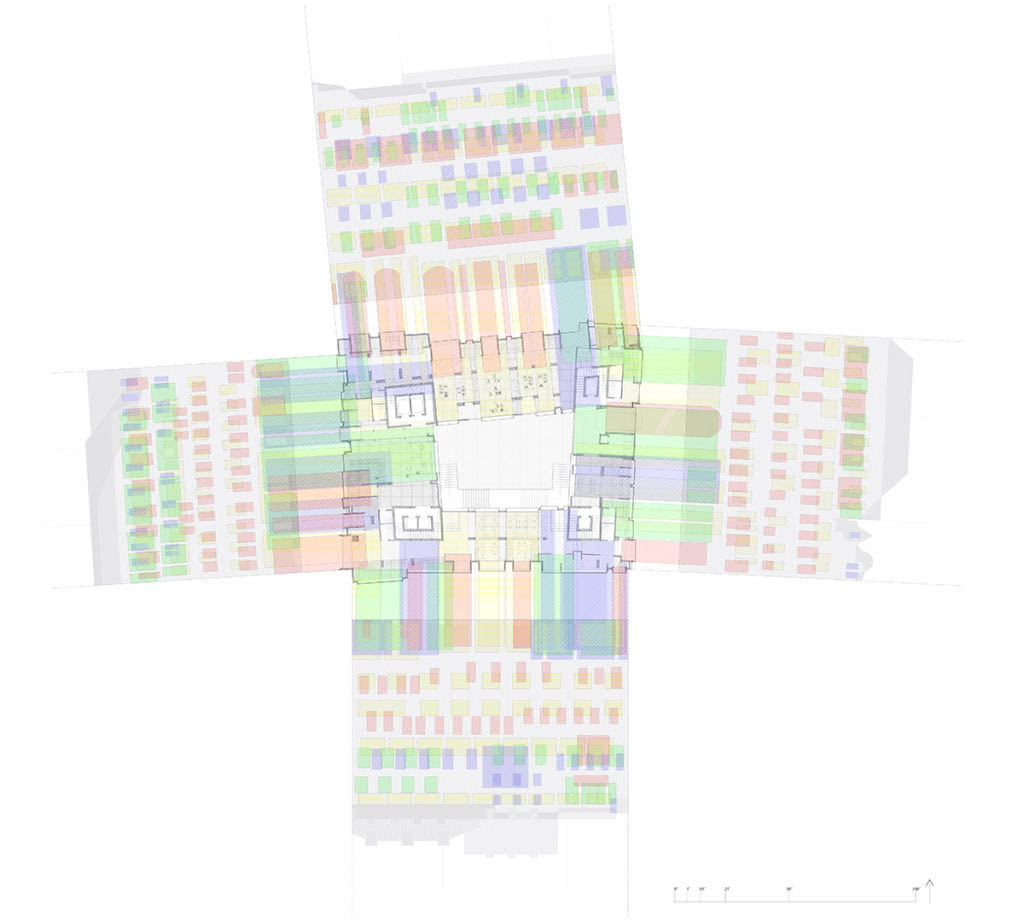
The city of Leipzig has gone by many names—’Messestadt’, ‘Reichsmessestadt’, ‘Heldenstadt’, ‘Boomtown vom Osten’, ‘Schrumpfendestadt’, and more recently the hyphenated ‘Hypezig’. These pet-names serve as an index of the city’s successive civic identities. Since Leipzig’s bombing in 1943, political regimes and architects have utilized these identities as a means through which to direct construction. Individual sites are marked by a frenetic churn of destruction, construction, and re-construction.
These interrupted civic identities leave the context of Leipzig indeterminate—with unraveling, overlapping, and competing projections of past and future. Each interrupted version has sought to produce a resolute clarity to Leipzig’s urban legibility, with building elevations serving as the primary registration of each attempt at identity resolution.

Equivocal Elevations proposes a Super Civic Service Center—building on the existing city-government institution of the Bürgerzentrum which provides public—to address the intersection of individual identity, city bureaucracy, and civic identity. Born out of the intense archival study of Leipzig, the elevations unearthed from site provide the architectural foundation for this new center. Elevations here do not propose a finite or shallow representation but instead equivocal relationships between histories and building, allowing elevation to both figure and be figured by the exterior and interior. By developing this method, the intent is to project a continued, open-ended irresolution to Leipzig’s identity while reflecting on the specificity of Leipzig’s numerous histories.
Visit the 2021 Virtual Commencement Exhibition to see more from this and other prize-winning projects and graduates.
Asignifications: Destabilizing the Colonial Imaginary
Sum In Sarah Cheung (MArch I ’21)
In Hong Kong, a city caught between two colonialities, historical preservation has become a politics of the image: in which the excesses of capitalism are conflated with a deep-set desire for a unified cultural framework, and where the prosthetic seeing of singular fictive identities has become a tool for the severing of history and memory. Part kitsch, part simulacra, these images—static and monumental—collapse all critical distance between observer and observed, becoming representations that absorb themselves into a system of signification of the colonial imaginary.
This thesis attempts to bring forth an asignification through the rewriting of the city’s oldest remaining colonial building and its immediate context. The ideological undoing of this building’s symbolism and the creation of interludes and digressions within its simulacra produces an urban ensemble that occupies and solidifies the space in between its two neighboring, and opposing, institutions: that of I.M. Pei’s Bank of China Tower and the High Court of Hong Kong. In considering the complex network of mutations and permutations of nationalism, colonialism, and capitalism so embedded in the city’s built environment, the resultant programmatic entanglement seeks to restore a multivalence in architecture that destabilizes the privileged perspectival space within, which the colonial gaze is cast in place. The constant appearance and disappearance of historical image, typology, and symbolism may perhaps begin to restore a critical distance—a gap, a void—within which a new postcolonial subject might be invented, subsequently encouraging an embracing of the in-between.
The ideological undoing of the Flagstaff House comes in two steps: firstly, the breaking down of the building’s symbolism, and secondly, the reconstruction of a novel image – both of which occur simultaneously and culminate in a new building. Taking cues from myriad precedents of found-object assemblies, contextual elements are distilled and treated as found objects themselves, and subsequently put together into assemblages that begin to destabilize the static image that the Flagstaff House once projected.

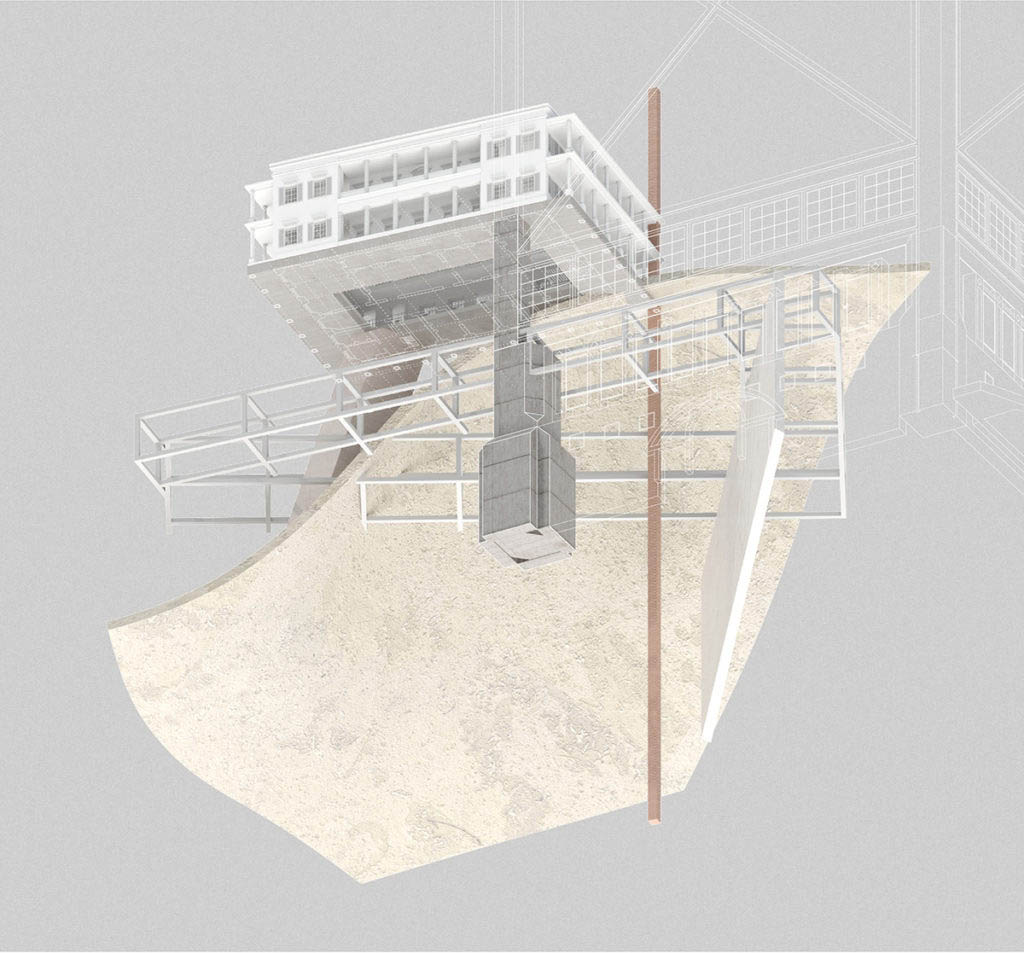
The resultant urban ensemble is thus: a bridge-building forms below as programmatic extensions for each institution that plug into both Towers. Rising above the center point is the new projection of the Flagstaff House – which becomes a public archive and library of Hong Kong’s judicial and colonial history. As an archive of the city’s rapidly morphing rule of law and amorphous sociocultural identities, the new structure becomes a cenotaph, a repository of memory that documents the complex network of mutations and permutations of nationalism, colonialism, and capitalism so embedded in the city’s coming-into-being. Skewed and contorted by axes projected from both towers, the organization of this new building draws upon the existing plan of the Flagstaff House: its column order is replicated, as is a building skirt reminiscent of the House’s existing loggia which reincarnates itself in the archive as peripheral library stacks.
Eroded by the landscape, the tea museum is displaced downwards as one progresses through and below to an underbelly, which in turn sags under the weight of the city’s memory of a bygone history. This history is reincarnated in the form of an archive that seamlessly loops from one room to another around the vortex point. At bridge level below a programmatic entanglement between the Court and Bank, although private, allows for an idiosyncratic spatial connection to the displaced museum above. Despite its programmatic separation everything is sutured together by the public park.

The column order of the existing House is replicated in its extension as a large Vierendeel truss from which the building’s loggia hangs. This truss is supported at three points: at its rear corner it sits on the park landscape through which a large foundation pile is driven. Just off center, a slanted core pierces the structure which contains the building’s main staircase. At the very front, a third core extends itself all the way to the ground level. This frontal core-column appropriates the chamfered form of the Bank of China’s base.
The building itself is clad in grey brick, reminiscent of those typically found in vernacular Chinese buildings. However, this brick aggregation makes use of gaps in between each brick which allow the façade to become porous. From afar, a giant grey mass; upon a closer look, the column order of the interior Vierendeel – and of the Flagstaff House – shines through this mass. Moving closer, however, the volume itself begins to break down: cuts on the side facades allow views from the bridge to frame the opposing Bank and Court buildings, as if their foundations are also eroded by the building itself.
The judicial library is spatially linked to the now displaced tea museum on the ground level just above; pedestals rise through the downward leading ramp towards the displaced Museum space which also serves as a main access. Traversing under and through, we now encounter the underbelly of the public archive. The downwards dip of the underbelly deforms the ground plane and intersects with the slanted stair core at a point of singularity. Skewed by the axes of neighboring towers, the facade envelope folds upwards. This produces an open study area and a single window above framing the sky.
Visit the 2021 Virtual Commencement Exhibition to see more from this and other prize-winning projects and graduates.
Health and Buildings
Former course title: “Building [/] Human Interaction”. This course investigates the interactions between humans and buildings with a focus on health. Students will investigate architectural design concepts that can improve indoor air quality, reduce exposure to toxic materials, improve visual and thermal comfort, help prevent the spread of infectious disease, and potentially impact other aspects of health, such as mood, sleep quality, and circadian rhythms. Students will explore how architects might encourage healthier occupant behavior, such as increased physical activity. Through first-hand experience navigating the built environment with assistive devices like wheelchairs, students will consider how designers could better accommodate many types of users. The final project can be a research or design project that dives into one or more of the topics covered. In short, we will explore elusive yet weighty design goals with the aim of improving public health.
Note: the instructor will offer online live course presentations on 08/26, and/or 08/27. To access the detailed schedule and Zoom links, please visit the Live Course Presentations Website.
Please note this course will meet online through 9/15.
Materiality and Atmosphere: Media and Environments (at AFVS)
What is the place of materiality in our visual age of changing materials and media? How do media mediate material relations? Can media be understood as environments? This seminar investigates a “material and environmental turn” in philosophy and visual culture, focusing on the atmosphere of visual arts, architecture and media. Topics include: the life of objects, the haptic and ambiance, vibrant materialisms, plant thinking, elemental philosophy and screen media, light and projection, and the immateriality of atmosphere.
Pre-requisite: A course in film or visual studies, art history, architecture studies or the equivalent course in cultural history or theory. This is an advanced seminar with pre-requisites. Preference for admission will be given to doctoral students in Film and Visual Studies. Students will be selected on the basis of an application posted on canvas and, if necessary, short interviews.
Jointly offered course: This course is jointly offered as AFVS 279. GSD students should enroll in the course via the GSD.
Inscriptions: Recent Experimental Architecture
This course is appropriate for students who can devote time to reading advanced theoretical material and do close formal and material studies of experimental projects. Completion of the BTC sequence is required for MArch I students. Background in formal analysis and architecture theory will be expected for all who enroll.
One has heard the characterization of the work of the recent generation of architects as neo-postmodern. The assumption behind this label is twofold: first, that postmodern architecture sought, through index or metaphor, to reference specific and multiple historical precedents; and second, that certain contemporary practices, because they can’t fathom any other way forward, reference that referencing in a modius-strip-like bending back of history—the eternal return of same.
Might it be suspected, then, that the title of “Inscriptions” signals a retreat to old certainties? Is it not difficult to deny the appearance of emphatically familiar, fundamental, and even ancient forms in much recent work—a retracing of architecture’s most solid tropes in order “to regain the innocence of archetypal symbols; the pyramid, the sphere, the circle, the ellipse, and the labyrinth” (Tafuri)? And does not the contradictory impulse reaffirm the rule by exception—boxes, stacks, arrays, sets, mazes, bodies, mark, blocks…. Not to mention the rock. At first glance it is an almost nursey-rhyme list, a survey of objects in an untidy room. But that’s just it. The logic of the list is, again, the block-by-block assumption of fundamentals.
We see the situation differently. If the ancient labyrinth was supposed to contain the path to wisdom and freedom, then the contemporary one signals the acceptance of the failure of a universal language, the failure to complete the Tower of Babel. Jacques Derrida recognized this: “Only the incompletion of the tower makes it possible for architecture as well as the multitude of languages to have a history.”
This course begins with the failure of modernism’s effort to install a universal language (an effort now recognized in all its imperialism) and the failure of postmodernism’s critique (and the consequent demise of any symbolic authority for architecture’s practice). The course will then proceed to investigate what seems to be a shared mechanism among current architects, an agreement about how architectural objects emerge from the procedures of design. This conjecture emerged in the last days of 2017 as the instructors of this course collaborated to mount a survey exhibition of contemporary architecture and noticed a pattern. It was not the unearthing of similar forms exactly but rather the flash of recognition itself that gave the discovery of each project a quality of confirmation, of underscoring premonitory knowledge. That under-scoring is part of what we mean by inscription—opening a space for new architectures by abrading, marking, and overwriting the discipline’s known tropes.
Note: the instructor will offer online live course presentations on 08/26, and/or 08/27. To access the detailed schedule and Zoom links, please visit the Live Course Presentations Website.
Please note this course will meet online through 9/15.
The Fifth Plan
In this seminar we will consider the evolution of the floor plan across five iterations: proto-modern, modern, post-modern, sequel-modern, and, most importantly, the present. We will begin with a simple hypothesis about the present, namely that there is a new plan afoot. It has been making its way into architecture for several years, announcing its arrival via the paroxysms that come with a long gestation. Its terms are not those of the suck-the-air-out gangly hollowness of proto-modern experiments in iron and steel (as seen in train stations, department stores, and exhibition halls), nor the give-me-liberty-or-give-me-death plan of modernism (universal, free), nor the we-used-to-do-it-like-this-plus-je-ne-sais-quoi plan of post-modernism (neo-historical, juxtaposing), nor the plan-non-chalant of recent reinvigorations of modernist architecture (data-driven, a-formal). Given it descends from these four earlier paradigms of plan thinking, I’ve provisionally labeled this new plan the “fifth plan.”
As surely as it descends from these precedents, the fifth plan is decidedly not like its predecessors. Our understanding of plans (and of architecture) depends on our ability to distill the characteristics of plan-based organizations, characteristics that the fifth plan incessantly meddles with: open or defined, perimeter or interior, figure or system, history or future, homogeneous or varied. This new plan confounds classification because it conflates spatial temperaments. It slips into and out of categorical restraints as needed. It signals neither a return to nor a rejection of previous plan models and, most importantly, can’t be singularly aligned or contrasted with its antecedents.
A few clarifications might be useful. First, “plan” here refers to the term’s basic definition in architecture, namely the horizontal organization that modulates degrees of enclosure, program organizations, circulation systems, optical dispositions, formal geometries, and hierarchies. Second, the plan is taken to be a primary part of architecture’s makeup, which is to say the plan is deeply wound into both the momentum of architecture’s disciplinary history and the transformation of architecture as we face the future. The plan structures architecture’s formal systems, economies, social constellations, and material constructs. It is the discipline’s constitution: equal parts social contract, technical diagram, spreadsheet, and aesthetic code. What changes from plan-era to plan-era are the hierarchies among parts and the ways in parts deemed important are related to one another, invariably producing constantly changing definitions of what we think of as wholes in architecture.
Where can this new plan be found? In its nascent state, various strains of the fifth plan can be found in a range of contemporary practices including Mansilla & Tunon, Michael Maltzan, Sou Fujimoto, Barkow Leibinger, Johnston Marklee, Toyo Ito, SANAA, as well as a host of other practices. In fact, none of these firms lays claim to this new plan type, and none of them can be said to deploy it consistently. Further complicating things, individual examples can be found in unexpected authors such as SOM (the Burr Elementary School) or Gintautas Natkevicius (a Lithuanian architect whose Birstonas House is relevant). Nonetheless, collectively an increasingly forceful exhibition of new plan thinking is being produced by these practices and others. The fifth plan’s presence might be found in a single building, in a part of a building, or across a string of projects produced by a particular practice. And yet it appears evermore ubiquitously in architecture: across scales of work, types of programs, geographies, practices, and even economies and social worlds.
Note: the instructor will offer online live course presentations on 08/26, and/or 08/27. To access the detailed schedule and Zoom links, please visit the Live Course Presentations Website.
Please note this course will meet online through 9/15.
The first class meeting will be on Wednesday, September 8th. The rest of the semester, classes will meet during the official scheduled time.
Spatial Analysis
Planners today have access to unprecedented amounts of data on the built environment and the people who use it. These data come from a wide variety of sources ranging from traditional administrative data and survey data to emerging sources of passively-collected and crowdsourced data. By then end of this course, you will be able to confidently navigate unfamiliar datasets and create information that you can use to (1) improve your own understanding of places and spatial phenomena at the national, regional, and neighborhood scales and (2) communicate your ideas and conclusions to others. You will learn to create figures and maps that are appropriate for inclusion in reports, posters, and web-based presentations.
Please note this course will meet online through 9/15. After that, the class will meet on Zoom on Tuesdays and in-person on Thursdays. Please review the syllabus for more details.