The Grandest Form
The Fall 2024 Public Programs series at the Harvard Graduate School of Design (GSD) launched this month with the opening of Farshid Moussavi’s exhibition, “Architecture as an Instruction-Based Art.” The show features construction coordination drawings: visual instructions architects use throughout the building process. More than 75 studios and practitioners submitted examples of these drawings, and Moussavi invited several of the participants to speak about their contributions for the opening event at the GSD.
Moussavi contextualized the exhibition with the history of art, drawing connections between the practice of architecture and the work of Conceptual artists like Sol Lewitt. Early in his career, Lewitt worked as a graphic designer in architect I.M. Pei’s office. As Moussavi noted, “it is there that [Lewitt] drew inspiration from the architectural process and started to explore the notion that art could be a concept for creation.”
Because architects create instructions for the often hundreds of laborers, engineers, and other construction experts who will make the building, their authorship—like Lewitt’s in the conceptual drawings—rests “in their instructions and their drawings, and not in the actual physical building itself.” While Lewitt was interested in leaving space for interpretation, Moussavi notes that architects have a “moral and legal responsibility” to ensure that instructions are meticulously followed: “Every line in a drawing carries consequence.” Because of this level of precision and the complexity of the design and construction process, she argues that architecture is “perhaps the grandest form of instruction-based art.”
Moussavi defines her methodology in her most recent book, Architecture & Micropolitics (2022) , which engages with Deleuze and Guattari’s theories of assemblages and rhizomatic systems. With no beginning and no end, and the ability to grow from any section rather than a central root, the rhizomatic design process creates many examples of micropolitics at work. As in experimental literature, Moussavi argues in the book, assemblages, rather than hierarchical architecture, open opportunities for the design to change as the piece is created, and for users to alter the space to suit their needs. The complexity of construction coordination drawings, with each layer communicating a different aspect of a building, attests to the many specialists who contribute to a work of architecture. As Moussavi writes in the exhibition text, “the architecture of a building is a product of assemblage, or the way physical elements—forms, materials, textures, colors—are combined to create enclosed and open spaces that have a distinctive presence.”
Conversations throughout the event reflected back on the ways in which users were part of the design process, the level of control an architect maintains, and how mechanical systems could be rendered visible or hidden. Grace La, GSD Professor of Architecture and Chair of the Department of Architecture, noted that the exhibition offers the opportunity to cluster different sets of images together to “theorize a way in which the ‘instruction-based-ness’ of the architect’s project is part and parcel with a kind of design thinking.”
One of the most resonant notes of the evening was a rallying call from Moussavi to “claim our work as art. I cannot imagine any other practice that is more complex than the work of the architect. You have to be artful in the way you see, think, negotiate, and manage all the unpredictability thrown at you. How can anything be more exciting than architecture?”
In this spirit of instruction-based art and Moussavi’s assemblages, what follows is a nonlinear glimpse of the evening’s conversation, in images and excerpts from the speakers’ presentations, which have been edited for clarity and length.
Toyo Ito

The structure looks like thick columns consisting of slabs extending upwards from below, while the area where light that falls from above are tubes extending upwards from the slabs. As you see, the structure of this architecture is a combination of these two types of tubes and is very complex. Initially, this structure was created by interlacing two gridded panels with stretching fabric, forming three dimensional curved structures. This drawing was created to explain this structure more clearly for the contractor. Although floor plans for each floor were prepared, they were not sufficient on their own, so this colored drawing was added to distinguish between tubes growing upward and those extending downward. This is intended to clearly illustrate the directions of the interwoven tubes.
Angela Pang

This drawing looks absolutely oversaturated with information. In fact, it is—it’s an explosion of layers of coordinates and information that, along with the hundreds of people involved—structural engineers, building services engineers, landscape architects—enable us to decipher how the building comes together and should be built. In a city like Hong Kong that is all about verticality, it’s very unusual to push for flatness. But that’s what we’ve done here. The project is 150 meters long, or about 500 feet. Every inch of space was used. The drawing reveals the intensity that is required to create a very simple space.
Our concept for this drawing is to frame it like a human body. There’s a spine, out of which various components emerge. Headroom is very limited. We had to scrutinize every cross-section and every pipe and duct. A drawing like this speaks to the complexity and intensity that lie behind the scenes.
Pang is an assistant professor in practice of architecture at the GSD.
Sean Canty

The process of the project is developed through three layers: the landscape and plinth plan, the reflected ceiling plan, and the roof plan. The idea of the house and the yard, and the park’s reflection of that, was determined in workshops with community stakeholders. It was important to come up with a design that could withstand all the rounds of value engineering. It went through many different structural systems, but the formal conceit stayed the same. In some ways, the choice of project for the exhibition is interesting. I decided to choose two large-scale pavilions because the three layers that are turned on will be co-present in reality, after they’re constructed. That kind of coherence in the structural systems, the limited mechanical systems, are all present in the drawings—and they’re not hidden away in reality. So, when [Farshid Moussavi] gave the prompt, I went to find the least complex building, to show something with instructions that said: “Nothing is hidden.”
Canty is an assistant professor of architecture at the GSD.
Mack Scogin and Merrill Elam

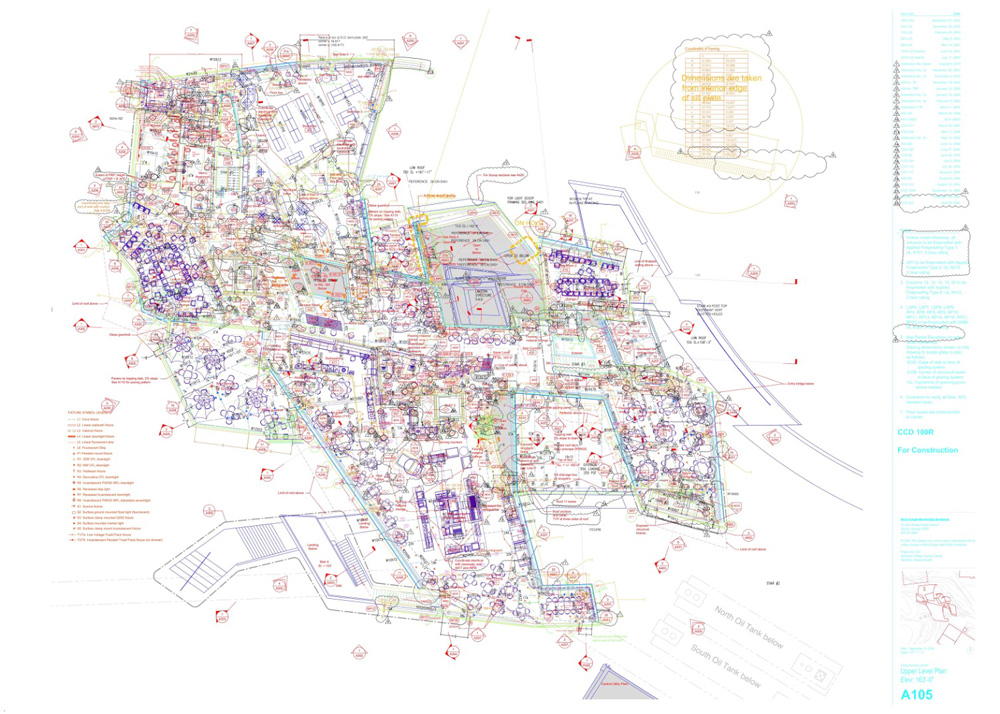
The building is conceived as six levels of distinctive cascading forms. If you look on the right-hand side of the drawing, there’s a long list of dates in the upper right-hand corner, indicating the number of times this drawing was issued—first in September of 2002, and last in April of 2005. That’s 30 months of construction. The drawing was reissued to the contractor on average once a month. I can’t emphasize enough the intensity this client exhibited throughout the project in terms of their dedication to the education of these young women, and the idea that they were going to build something called a center for the campus—that was a huge change in something that they believe in fully, the idea that these young women should never think of themselves as centered, but always de-centered and always challenged by the things that they hold dear in their life. It was the most amazing three years of talking about their expectations for this project and what architecture can do.
Scogin is Kajima Professor in Practice of Architecture, Emeritus, at the GSD.
Philip Schmerbeck

The drawing that we selected for this presentation is, in a way, a limiting of information. We’ve extracted everything but the mechanical systems—the hidden, technical layers in our projects. By focusing only on these systems, we find clues to the instructions and the technical requirements that were handed to us by a whole constellation of technical know-how that had to be integrated into the core program, to generate a 2,100-seat concert hall at the center of this extruded trapezoid. Let’s call it the ghost of the concert hall, because we’re only seeing the large ductwork wrapping around the concert hall itself. By seeing the mechanical system, you also get a sense of what is invisible to the public from the outside. There was a choice not to make a building that was the formal embodiment of a concert hall. The mechanical system is the lens through which to understand all the complexities of that goal. The ductwork had to be acoustically isolated from the adjacent program, so the mechanical plant is positioned at the top of the hall where it can lend vertical presence volumetrically as seen from the harbor. The hall is a shell within a shell, serviced in-between by this octopus of low-velocity, high-volume air, all emanating from that very large plant at the top of the building.
Christian Kerez

The landscape and the topography lines are crucial for the understanding of the constant height changes within the slabs. The plans highlight the position of the connections between slabs given that, in reality, one should not be able to differentiate where they start and end. The project required 20 different scales of scaffolding towers in order to redraw the changing levels as close as possible; larger scaffolding towers were used for less inclined areas, while the smaller towers were assembled around the biggest changes in levels. While the floor plan is the key plan for understanding the overview and relationship between all elements within the slab, the sections were crucial for retracing the project on site. The sections were cut and drawn every 50 centimeters totaling more than 40,000 sections. They indicated the height of the towers and, more importantly, the small formwork beams which were customized on-site to achieve the different curvatures. All the drawings were developed on-site by Brazilian architect Caio Barboza, who studied at Harvard, and was the project manager with the local construction company.
Farshid Moussavi

These visualizations were made for the Ismaili Center Houston. One of the foundational layers of the drawing is a grid, which we have used to develop two key concepts for the building: simplicity and openness. Simplicity through repetition is inspired by Islamic and minimalist art. It’s about creating harmony and unity. This grid spans across the whole site. One of the main functions of the grid is to bring together the sacred and the profane, or the everyday aspects of the project. The sacred is to do with qibla, the orientation towards the Kaaba, which is significant for the Ismaili community. The other everyday aspects of the site have to do with the north-south orientation, the topography, and the floodplain.
As you see, the grid helps integrate the building with its garden and creates a sense of openness, which is vital for the Ismaili Center because it is meant to be not just for the Ismaili community, but for other communities in Houston and beyond. We’ve used the grid to create a form that opens out in all four cardinal directions—north, south, east, and west—so it is highly accessible from all its sides and integrated with its surroundings. This has also allowed us to introduce three verandas to the building, reinforcing our concept of openness. Inside, we used the triangular grid, together with the long span structure to create three atriums inside the building, which abut the verandas. This coupling of the atriums and the verandas connect the interior with the exterior, enhancing the sense of openness. To keep the prayer hall as a quiet, contemplative space, we’ve added a two-layer perforated aluminum suspended ceiling, which is shown in pink on the drawing, with a layer of diffused light underneath. This assembly of elements not only hides the M&E elements, but also creates a soft, infinite ceiling effect that will contribute to the serenity of the space. Without these carefully designed ceilings, we would see all of the ducts, pipes, and cables. By concealing them, we maintain a sense of lightness and serenity, which supports the building’s spiritual and contemplative atmosphere.
Moussavi is a professor in practice of architecture at the GSD.
Summer Reading 2022

Looking for something design-related to read this August? In this list of recent publications by GSD faculty, alumni, and students, you can find everything from a deep dive into cross-laminated timber to a murder mystery set during a design competition.
John Ronan (MArch ’91) recently published Out of the Ordinary (Actar Publishers, 2022), showcasing the firm of John Ronan Architects and its spatial-material approach to architecture.
Stanislas Chaillou (MArch ’19)’s Artificial Intelligence and Architecture: From Research to Practice (Birkhäuser, 2022) explores the history, application, and theory of AI’s relationship to architecture.
Bert De Jonghe (MDes ’21, DDes ’24) examines the intense transformation of Greenland through the lens of urbanization in Inventing Greenland: Designing an Arctic Nation (Actar, 2022). The book is based on De Jonghe’s MDes thesis, which was advised by Professor of Landscape Architecture Charles Waldheim.
Verify in Field (University of Chicago Press, 2022) is the second book from the firm Höweler + Yoon, founded by Eric Höweler (associate professor in architecture) and J. Meejin Yoon. It features recent designs by Höweler + Yoon, including the Memorial to Enslaved Laborers at the University of Virginia; a floating outdoor classroom in Philadelphia; the MIT Museum; and a pedestrian bridge in Shanghai’s Expo Park.
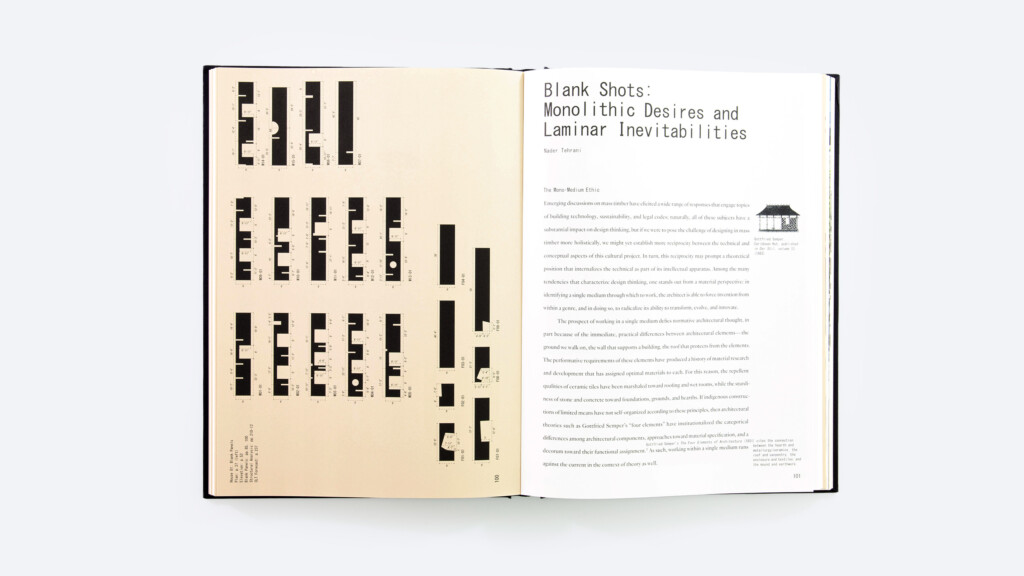
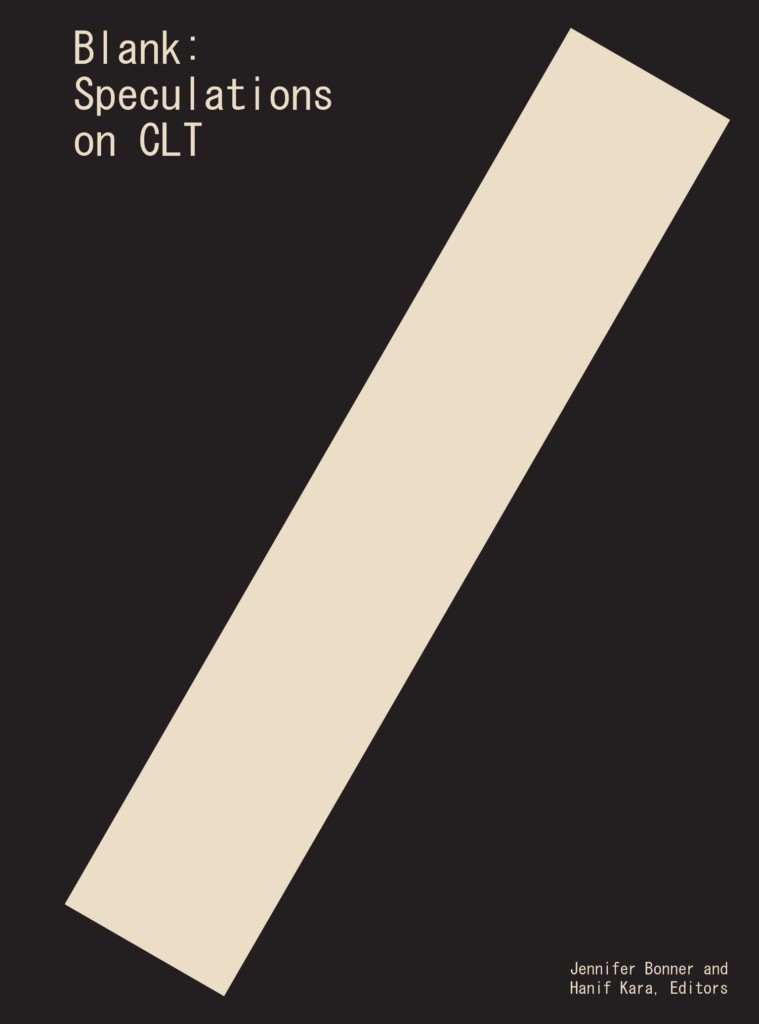
Blank: Speculations on CLT (Applied Research + Design Publishing, 2021), by faculty members Hanif Kara and Jennifer Bonner, explores the history and future of cross-laminated timber as a building material.
The Kinetic City & Other Essays (ArchiTangle, 2021) presents selected writings from Rahul Mehrotra, chair of the Department of Urban Planning and Design and John T. Dunlop Professor in Housing and Urbanization. Mehrotra writes about the concept of the “Kinetic City” (as opposed to the “Static City” conceptualized on many city maps) and argues that the city should be seen as “patterns of occupation and associative values attributed to space.”
Looking for fiction? Check out Death by Design at Alcatraz (Goff Books, 2022) by Anthony Poon (MArch ’92). Described by LA Weekly as “The Fountainhead meets Squid Game,” it’s a mystery about architects being murdered during a competition to design a new museum at Alcatraz.
Photographer Mike Belleme and landscape-urbanist Chris Reed, professor in practice of landscape architecture at the GSD, collaborated on Mise-en-Scène: The Lives & Afterlives of Urban Landscapes (ORO Editions, 2021). It includes case studies of seven cities: Los Angeles, Galveston, St. Louis, Green Bay, Ann Arbor, Detroit, and Boston. Reed describes Mise-en-Scène as “a collection of artifacts and documents that are not necessarily intended to create logical narratives, more intended as a curated collection of stuff that might reverberate . . . to offer multiple readings, multiple musings, multiple futures on city-life.”
What makes an environment “responsive”? Responsive Environments: An Interdisciplinary Manifesto on Design, Technology and the Human Experience (Actar, 2021), from the GSD’s Responsive Environments and Artifacts Lab (REAL) and co-authored by Associate Professor in Practice of Architectural Technology Allen Sayegh, Stefano Andreani (MDes ’13), and Matteo Kalchschmidt, uses case studies to examine our “technologically-mediated relationship with space.”
Formulations: Architecture, Mathematics, Culture (MIT Press, 2022) by Andrew Witt, associate professor in practice, draws from Witt’s GSD seminar “Narratives of Design Science” and examines the relationship between mathematical calculation systems and architecture in the mid-20th century.
Environmental Justice, Energy Infrastructure, Migration and War: What Role Does Design Play in Mitigating a Crisis?
At their speculative edge, the design professions flourish in envisioning future scenarios, and we usually imagine these to be positive additions to a well-ordered world. A true crisis throws fundamental assumptions into disarray, requiring designers to rethink the way they operate as the ground shifts beneath their feet. The old rules of geopolitics suddenly don’t lead the imagination anywhere predictable. What’s left is a feeling that the game itself is being reinvented.
In the past two years, the theme of crisis has been studied across the GSD at the annual Practice Plenary, and lessons learned by investigating responses to pandemics and hurricanes can help us look at responses to crises happening now across the globe. I spoke with three professors teaching practice courses and plotting new modes of practice in architecture and urban planning. All three encouraged humility, and they spoke of the central place for self-reflection in designing a profession better able to address injustices and inequalities. Asked about the ongoing war in Ukraine, Elizabeth Christoforetti, a founding principal at Supernormal and an assistant professor in practice of architecture, urged caution: “It’s a response time question. We’re just not built to respond quickly as a profession. It can feel frustrating, not being able to confront the crisis, but our impact happens in different ways.” Jacob Reidel, also an assistant professor in practice of architecture and a senior director at Saltmine, a technology startup, suggested that designers “focus on what our responsibility is as engaged citizens,” noting that “there’s a tendency to try to make everything a design problem—but there are other ways one can and should be active in the world.” Matthijs Bouw, founder of One Architecture and Urbanism, saw a parallel between his work on climate adaptation and the exodus from Ukraine (there are more than 5 million refugees so far): “One of the things I worry about is how our cultural fabric will be able to cope with the climate crisis and the associated migration. It’s going to change our cities in drastic ways.” The war also exposes problems with the global energy infrastructure: “We should have been investing much more in renewables and decentralized systems,” Bouw says. “This is an issue of environmental justice. Who gets to own the energy infrastructure? Many communities have really suffered in the past from energy infrastructures.”
Bouw’s work and teaching at the GSD has placed designers at the edge of several unfolding crises. Among his best-known projects at One Architecture and Urbanism is the Big U—a proposal for a protective system that encircles Manhattan to mitigate the effects of rising sea level—which was originally developed with a multidisciplinary team including BIG (Bjarke Ingels Group). The associated research and design continues in ONE’s work on the Financial District and Seaport Climate Resilience Master Plan, among other projects. This semester at the GSD, Bouw is teaching “Houston: Extreme Weather, Environmental Justice, and the Energy Transition.” The course begins with the premise that crises have a tendency to build on one another. Bouw says it’s important to distinguish between two types of crisis: “There are slow-running crises that are eating away at people’s health and livelihoods, or coastal areas, or ecosystems, and then there are catastrophic crises that are—in the language of resilience—low probability and high impact.”
As Bouw explains, “During COVID, we have seen how public health is related more than ever to issues of structural racism, to our fossil fuel economy (because of pollution and respiratory issues), and so on.” This logic applies to other crises as well: “The climate crisis is intimately connected to the biodiversity crisis.” The complexity inherent to interrelated systems is the first problem found in crisis situations, he says. “There is a lot that we don’t know about these relationships, but we do know that many of these relationships play out on a systemic scale and bring with them a high level of uncertainty.”
Bouw advises that we should approach crisis through careful research and as part of a team. “Projects you do as a practitioner cannot stand on their own,” he says. “Any project is part of something much bigger.” This can be an uncomfortable situation for designers: “I was trained as a designer to stand in front of an audience and say, ‘This is the big idea,’ and then try to sell the idea,” Bouw says. “That’s an ethic of the past. You need to start thinking about yourself more as a participant in a much more complex process.” Design in face of crisis requires “the right mix of willfulness and humility.”
This doesn’t mean abandoning the tried-and-true techniques of design. Bouw emphasizes the importance of “tools for communication—creating the material to make conversations easier—and the tools of research through design exploration.” He says that design professionals play an important role as mediators: “Balancing the systemic dimension with the hyperlocal or the hyperprecise is what we do.” This is particularly important in large-scale crises, which are also largely invisible. Take the climate crisis, for example. “Given the magnitude of changes that we need to make in our Earth system,” Bouw says, “we need to develop quick ways of learning and protocols that can be scaled and replicated, and which don’t get in the way of the nuance that’s needed in some situations.” He cautions that there is no single framework for understanding something so complex. “The Earth system as a whole cannot be captured in an algorithm,” he observes. “You need to understand the limits of the algorithms you develop because otherwise you start to reduce reality to the algorithms.”
Asked about specific participatory design practices, Bouw notes that they vary around the world: “In planning in the Netherlands, we are employing design in a more integrated way to engage complex processes. Planning in the United States is relatively disassociated from design—the tools of planning are predominately things like texts and spreadsheets and PowerPoints. It doesn’t tend to test things and try to see how things come together on the ground.” For Bouw, this tendency avoids the crucial questions of practical engagement: “What would it take to implement this? Where could it get funding from? How do we engage the powers that be in the set processes of delivering projects?” Without practical, on-the-ground participation, Bouw says, “the end is often either paralysis or business as usual, and we can’t do either.”
Crisis frequently spurs invention. In her class this semester, Elizabeth Christoforetti focuses a historical lens on a range of design practices to ask when and why they were first formulated. “Products of Practice” begins by showing students that “the profession of architecture is actually relatively new,” she says. “It came out of a number of radical social and economic changes—the French Revolution and the Industrial Revolution, for instance.” The course builds on Christoforetti’s class last semester, “Elements of the Urban Stack,” which delaminated the built environment from its most expansive social fabric to its smallest detail. Across both classes, Christoforetti asks students to “look back at historical hinge points to see, for instance, how architectural specifications changed over time and how those changes impact the architect’s agency or relationship with society.”

This approach gives students a perspective on the possibilities of design practice. “The best thing we can do is to understand the limits of the structural framework of practice now,” Christoforetti says, “and where we can or must push boundaries if we want to change things.” Critical reflection plays an important role in formulating new directions. “We can identify what the value systems out there are—in the discipline, in practice, and in society at large,” she says. “Then if architects want to impact the future of housing, for example, maybe the thing to do isn’t to design a single-family home. Maybe it would be better to go work for Fannie Mae and design mortgages, because they shape housing at scale. Or maybe it’s okay to just design a really remarkable single-family home. But it’s a choice about impact and agency.”
This wider view of practice suggests an expanded notion of professional ethics. Christoforetti asks, “Do we need a redefinition of design in an era when we are accountable to the major crises of the moment, whether it’s climate change, war, systemic racism, or computer surveillance? Is form enough?” This can appear sometimes as a drastic decision to be made—a fork in the road. “Maybe we’re thinking about how to fundamentally redefine our practice, and maybe the profession as we know it dies as a result,” Christoforetti speculates. This sort of wholesale redefinition has happened before, and like previous hinge points, she says, “We live today in an unprecedented moment for the role and agency of the designer.”
When it comes to dealing with the compounding crises of the contemporary world, Christoforetti is particularly interested in the problems and potentials of computation. She cites Architectural Intelligence by Molly Wright Steenson which mentions that, in the world of technology, the verb “to architect” refers to the design of information systems. “The people she writes about are not thinking about buildings per se,” Christoforetti says, “they’re thinking about something much bigger. They’re thinking about an operative process for creation.” She pinpoints the central conundrum of contemporary professional practice in a way that parallels Bouw’s observations: “The crisis that we look at in “Products of Practice” is one of scalable systems and late capitalism.”
The professional practice course taught by Jacob Reidel last semester also took a historical perspective. He notes that “the profession of architecture as we currently understand it is not nearly as old or straightforward as is often assumed.” On this basis of historical contingency, “Frameworks of Practice” is designed to get students “to look critically at what they’ve been told it means to be an architect, and to see both the profession and their own careers as designed things,” Reidel says. Opportunities provided by unexpected circumstances offer a good starting point for this investigation. “Crises, even if only temporarily, tend to throw the old way of doing things out the window,” says Reidel, and he has numerous examples.

“One of the few built responses to the crisis of COVID,” he points out, was the “thousands of structures built in the street, practically overnight, in one of the most heavily regulated built environments in the world, New York City. All the rules had to be rewritten, and myriad public and private entities had to come together to figure out how to make it possible for the restaurant industry to continue operating. Suddenly the Department of Transportation was regulating building because the shacks were in the street.” The result was the Open Restaurants and Open Streets programs, the latter of which set itself the task of “transforming streets into public space open to all,” according to their website. This made for an apt case study in the relationship between crisis and design—and it became the subject of the second Practice Plenary.
Reidel brings the questions raised by Open Restaurants and Open Streets to bear on a wider investigation of design. “What did it reveal about how the design professions can and cannot effectively engage in moments of crisis?” he asks. One lesson involves seizing opportunity. Reidel tells the story of the creation of the re-ply program: “During the first COVID summer of 2020, many businesses in New York City temporarily covered their storefronts in plywood. Seeing that a ton of valuable plywood was headed to the dump, members of the small New York studio of the international Australian practice BVN began collecting plywood from businesses and landlords, some as big as Rockefeller Center’s Tishman Speyer, and started a pro bono effort to repurpose it into affordable outdoor seating for local restaurants that couldn’t serve food indoors because of COVID. What started as plywood furniture eventually became a kit-of-parts streetery building system named re-ply that’s now operating almost like a small independent product business within the larger BVN design practice.” It’s an example, Reidel says, of how a crisis can spur “new approaches to operating as an architect.” The example suggests the importance not only of having a good eye for opportunity, but also of being prepared. This is the practical, on-the-ground knowledge that Bouw also emphasized.
Although the place of design may be far from the battlefield, it can help to think about crisis situations in terms of wartime mobilization. “What we are trying to do as a practice is to have the boots on the ground and to change the practices of implementation,” Bouw says. “It is difficult to build coastal adaptation projects or integrated stormwater projects that also improve the urban environment as a whole and deal with other systemic issues. We have to create the conditions necessary to capitalize on those opportunities.” A lot of the work involved in addressing crises comes beforehand, in the form of research and planning—and this requires being out there, on the ground, embedded in the complex systems in which we may have to intervene. So whether it’s destabilized ecosystems, new technologies, or something else driving change, Bouw’s advice applies: “A shock is also often an opportunity, but we need to have equitable plans ready before the event occurs.”
Blank: Speculations on CLT, edited by Jennifer Bonner and Hanif Kara
When I began studying architecture in the 1980s, students would often get asked at crits what, exactly, those blank white or beige walls indicated on their drawings or models were intended to be made of. The answer, almost inevitably, was “concrete.” Concrete was the wonder material, the realizer of dreams. The reliable, universal one-word answer. The staff would, inevitably, roll their eyes. But that reliance on a blank material rendered as an abstract surface has been threaded through the history of the last century of so of architecture. In the beginning, even architects themselves could only dream of abstract planes of concrete. Le Corbusier, Rietveld, and the others built walls of brick, rendering them so they would appear as concrete—smooth, featureless, as if drawn rather than built. They made concrete through manifestation.
A century on, with the world more aware of impending climate crisis, that one-word answer of “concrete” might be dumber and even less acceptable than it was then. The response now, however, might well be “CLT.” Even more than concrete, big panels of cross-laminated timber, cut in a spotless factory by robots, far away from the mud, sweat, and swearing of the construction site, looks like the future. Prefabricated, clean, as much drawing as material, rendering as reality, it represents the new wonder material of our eco-aware, guilt-burdened age; the world-saving, carbon-soaking, multifunctional stuff sent to salve our consciences in the creating of new buildings we know to be wrong, in attempting to make architecture at all.

It is a heavy burden for one material to bear. And that is why Hanif Kara and Jennifer Bonner, who teach together at the GSD, have compiled a book that attempts to feel a way toward a new language for CLT, a material that looks like it has everything, but that hasn’t yet coagulated a sense of theory, meaning, or material culture around itself yet.
The book’s title, Blank (Applied Research and Design Publishing/ORO Editions, 2022), hints at this emergent identity, the still-unformed nature of a material that is both lumber and number, wood and data, a slab that exists between the forests and the digital. In one way, CLT is nothing new. It’s a close cousin of the plywood which emerged as a mass-market material a century or so ago and became a staple building product after having been adopted from other industries including aviation.
Clearing my parents’ old house out the other day, I took an ancient Singer sewing machine to the dump. Heavy as hell in cast-iron, it came in its own vaulted carrying case. I’d guess it was from the 1920s and that curved wooden top was probably the product that propelled plywood into a mass-market material. Singer’s slice of the market was so huge in the early 20th century that their adoption of bent plywood for their sewing machine cases gave this new wonder-material the scale to become an accessible material, one that subsequently came to define varying strands of modernism, from Aalto’s and Breuer’s ergonomic loungers via the streamlined bars and railway carriage interiors of Deco to the spartan studio-interiors of Case Study houses and artists’ studios.
Plywood however was mostly a surface rather than a structure. It’s true there were all kinds of laminated beams and ply products but we still probably think of it as a surface, a sheet. CLT is surface, too. But also structure. It is wall but also floor, ceiling, roof, insulation, internal finish, and the rest. Its versatility is almost comical. It holds, perhaps, a similar status in our age as not only concrete did to the modernists but as plastic did in the postwar era. It looks like the future; a total, wraparound environment.

Right: Lauren Halsey, The Liquor Bank, 2019. Hand-carved gypsum on wood, 47 5/8 x 47 5/8 x 1 7/8 in, Page 163, Blank.
On the other hand, it also smells like the past. It might be high tech in its manufacture but CLT is still lumber. Its future should seem assured then, particularly in the US, where the history of housing has been one of adopting the cheapest, easiest timber construction techniques. The American house is already an all-timber affair: the balloon frame, timber windows and doors, shingles, log cabins, lodges, sticks of timber nailed together. It should be simple to segue into CLT construction in which all of that comes in one package.
The writers here outline possible histories and futures, their texts interspersed with designs— plans, models, cutout kits of parts, propositions for a new language of architecture constructed around the capabilities of a material that does so many things at once. Along with the optimism, there is a sense of feeling a way toward new modes of expression. If the designs can look a little familiar, shot through with elements of deconstruction, wiggly walls, Swiss seriousness, and parametric ambition, many of the texts consider what the shift means. This kind of mass timber, Hanif Kara points out, is now being employed in ways more akin to how concrete is currently used in construction. It’s an odd shift—the move from the formwork leaving its imprint on the structure to the timber being employed directly—the return of the uninverted grain.

Erin Putalik puts mass timber back in its plywood context with a brisk potted history and Courtney Coffman chooses to look at the qualities of the book’s title, the curious blankness of the material. In his essay, Sam Jacob points out the cartoonish qualities of CLT, the ways in which cutouts and punched openings might resemble the cat-shaped holes in a wall through which Tom has fled at speed or the fake/real ACME tunnels constructed by Wile E. Coyote. There is something clunky in these cutouts, a super-graphic approach to the material as two-dimensional with extruded depth, rather than the complex strata of a more familiar wall or door frame with its codified layers. It has a weird confluence with foam board as a substrate for models, a super-simplified language blown up to 1:1 without translation in material quality.
It is also, as Elif Erez (March ’21/ MDes ’22) points out in her essay for Blank titled “Deadpan CLT”, impossible not to think of the scene from Buster Keaton’s Steamboat Bill, Jr. (1928, featured above) in which the facade of a house rips away from its walls and falls on the deadpan comic in the most perfect way so that his form is accommodated by an upstairs window. The scene was resurrected in Deadpan (1997) by British artist Steve McQueen, who subtly subverted it as an echo of the invisibility of the Black body in 20th-century popular culture. That delaminated elevation is a cipher for CLT, a thing both seriously substantial and comically weightless, sign and signified. There is something slapstick about an entire elevation built from a single sheet as it appears here (though of course this was frame and shingles). It reduces architecture to the condition of a stage set, a flat, something fake built only to represent reality and enable the suspension of disbelief.

Other contributors, including Jennifer Bonner, point to the condition of the blank as something already fully assimilated in fine art (she singles out Mavis Pusey; perhaps she might have also alighted on Richard Woods or even Roy Lichtenstein) who used the “plank-ness” of timber as a shorthand for materiality. Elsewhere Gehry, Rossi, Mies, and Corb appear, sometimes as plywood pioneers, at other times as adopters of the blank slab which could be concrete or marble—but why not CLT next? Even Lewerentz makes a guest appearance (in Nader Tehrani’s essay) as an architect who adopted one material—brick in his case—as if it were a contiguous surface, in often surprising and surreal ways, anticipating the way in which CLT is employed as a total environment, a laminated bubble.

Other writers here comment on the unsettling similarity of CLT structure to a supersized architectural model. Like the basswood or balsa wood architects meticulously incise to building miniature models in which everything is simplified, complex structural beams and details are stripped out and one material, one strip of wood is left to represent all surfaces and both internal and external finishes, CLT, with its clunky depth and chunky cutouts can look like a hypertrophied miniature. It has that quality of a photo taken with an endoscope in a tiny model or those mesmerizing snaps you sometimes see on social media of the inside of a musical instrument, a violin or a guitar suddenly appearing as a kind of Gehry phantasmagoria with a shaft of light piercing the F-holes and the struts and bracing: the everyday made suddenly unfamiliar.

Many of the authors point out something both curiously cuddly and unsettlingly uncanny about the material. In its grain, its feel, its smell, it is wood; but in its use it is concrete and in its manufacture it is digital. It is that hybridity that has made it simultaneously so attractive and so difficult to pin down, to position in the architectural palette.
Mass timber is, in its way, the architect’s dream material. It is (relatively) sustainable, a renewable resource, prefabricated, digital in its milled manufacture, precise, warm, and able to elude the requirements for the endless layers of finish and insulation which have made a mockery of Victorian and early modernist calls for “honesty” in construction and the show-and-tell approach to elevations. But perhaps sometimes, when we get what we dream of, we don’t know quite what to do with it. Regulation is still catching up, the notoriously conservative construction industry is still not quite convinced, and planners remain, despite endless screeds about sustainability, stuck in concrete.
Every new material, of course, provokes its own reaction. CLT’s super-sustainable halo is now being questioned by some for its liberal use of glue. Dowel-laminated timber (DLT) is occasionally touted as the next next big thing, avoiding petrochemical adhesives entirely. But it looks like CLT is, for the moment at least, here to stay. Blank is as much a comment on its newness, the lack of imprint on the culture, as it is on the character of those enigmatic slabs.

Concrete, Kara points out, had Le Corbusier’s 1914 Maison Dom-Ino—the ubiquitous image of the column and slab—that remains the model for almost all contemporary construction. The boosters of CLT have not yet emerged with an ur-model as elemental and memorable as this, perhaps because the results might just be too simple, too bizarrely familiar—a house-shaped house, a box. Ironically, Kara suggests, CLT would make a better Dom-Ino house than concrete ever could as planes provide more rigidity than reinforced concrete columns. There is no single image for CLT like Corb’s for concrete in this book, rather an increasingly complex series of explorations of form, each of which points in different directions as attempting to suggest that the possibilities are infinite.

The construction of the American balloon frame house, which still seems so simple, fragile, and astonishing to Europeans, was a result of a number of factors. First the availability of cheap timber, second the abandonment of the guilds and master carpenter networks of Europe which prescribed long apprenticeships and complex jointing techniques (along with the propensity of people to build their own houses using limited skills), and third the mass production of the nail as a machine-made and abundant good.
The construction industry since then has become specialized and exclusive, though the framing technique remains.

Perhaps CLT needs its barn-raising moment. Perhaps its real adoption will need not only the complex renders and undulating lines of attempts at a parametric city of CLT towers but a return to the cartoonish world of Tom and Jerry and Buster Keaton. Perhaps Spike’s doghouse is a better model than the most complex CLT skyscraper. The charm of the material lies precisely in its elemental simplicity. Anyone who has ever built a model, used Lego, or played with a dollhouse can understand how it works. The problem is not problematizing it, but making it legible. Should be easy.
Right?
Practice in a Time of Economic Uncertainty: Advice for Emerging Architects
For many architects—particularly those at the start of their careers—the current moment feels fraught with uncertainty. How will design engage the climate crisis and calls for a more equitable and inclusive society? What is the future for collective practice and for firms based on more traditional models? Will the skills architects have relied on in the past equip them to meet future demands? In a series of interviews with architects from Harvard’s Graduate School of Design—James Cheng (MArch ’77), Elyse Agnello (MArch ’14), Alex Shelly (MArch ’13), and faculty members Emanuel Admassu (Design Critic 2020) and Jennifer Bonner (MArch ’09)—a consensus seems to emerge that, while we may not be in the throes of an economic crisis like the devastating recession of 2008, this could very well be the proverbial “calm before the storm.” They offer insight for newly-minted architects who harbor doubts about the typical ways in which architecture is practiced or uncertainty about how things might change.
James Cheng: “You have to believe in yourself and your portfolio, because as an architect, that’s the most important thing that we have to represent us.”
James Cheng (James K.M. Cheng Architects)
You started your firm in Vancouver in 1978, and since then you have weathered more than one recession—and in fact your firm has done quite well. What advice would you give to architects at the beginning of their career in the current mood of economic uncertainty?
How you weather these things depends on the stage of the career you’re at. If you’re mid-career and working for a firm, the firm can support you, and if you set out on your own after that you’ll have some real experience with built projects to convince potential clients. For a recent graduate it’s more difficult. My first piece of advice to young people starting out is to be tenacious. You have to believe in yourself and your portfolio, because as an architect, that’s the most important thing that we have to represent us. It was a horrible economic climate when I graduated from the University of Washington with an undergraduate degree in architecture. Architects were not getting jobs or even interviews. I was lucky to have part-time work from when I was a student, and I had already won national awards for my design. I stayed with the firm for a while—and they offered to pay for my graduate education—but I eventually decided that Seattle didn’t have anything more to offer me. At that point I moved to San Francisco, which was the biggest city on the West Coast for architecture. I was a nobody. I had no connections. I tried to show firms my portfolio but they said they were not hiring—I couldn’t even get in the door. It was very tough—I was sleeping in my car because I couldn’t afford rent in San Francisco. As luck would have it, I had learned architectural photography as a student. I was good at it, and a couple of my photographs were published in Architectural Record. A senior editor, Elizabeth Thompson, had her office in San Francisco, and she was very kind to me—she wrote to me about how I could improve my photographs. When I got to the city, I took a chance and called her up to say I was looking for a job and that I was getting nowhere. She said she’d take a look at my portfolio. She thought it was great—good enough to get me a job. Then she picked up her phone and called the top architects in the city to say, “You’ve got to see this guy.” So I got an interview with a renowned architect in the city; we talked for an hour, and he said, “Well, I’d love to offer you a job, but we just don’t have any work. But I have friends and you should go see them.” One of these said, “We have no work, but if we find something we’ll contact you.” A month later I got a letter from them saying they had three months’ worth of work, and was I interested? I said Sure! That month turned into three years, and I’ve worked my way up since then. The second piece of advice is to pick the best firm to work for. Now that I have my own company, the first thing I look at is: where did you go school? The second thing is: what firms have you worked for? If you’ve gone to a great school and worked at one of the top firms in the world, then automatically you’re at the top of the pile. The third thing that’s very important in today’s world is your skill set. A lot of us think we’ll be great designers right out of school, but that’s not true. There’s a lot to learn that is not academic: knowing how to put together a building, manage a project, and so on. No firm is going to give a young graduate a major project to do. But this is the computer generation, and most graduates today are good at four or five different programs, and they’re very savvy with social media. Most firms need this because nowadays communication and presentation is almost everything. Our clients are conditioned by the internet to expect an instant response. Unique expertise is always beneficial, especially if it has to do with presentation—editing, writing, graphics, photography. Recently I’ve been invited to participate in the RFQ [request for qualifications] for a major federal project—a $500–$700 million job. To even submit our qualifications, we have a team of more than 20 people, including lots of very talented writers, photographers, designers, and people who know the system and how to score. Clients are sophisticated. They know about branding. They know how an architect can help their object by creating a certain image. A subtext to all this is connection. I’m surprised by how many staff we hire through reference from people who work here. They like the firm, they tell their friends, and pretty soon their friends are in here for an interview. That’s very important: maintain connections with your classmates and colleagues, because that’s how you get a job. The first thing for young people is to round out their education. After I graduated from Harvard and moved back to Vancouver, I called up Elizabeth Thompson again, and asked her, “Who are the good architects in Canada?” She said to go see Arthur Erickson. She wrote me a letter to go to see Arthur, but initially I didn’t really want to work for him because I was worried that I’d be too overwhelmed and that I’d be too influenced by him. But I wanted to at least meet the guy. When I did, he liked my portfolio and we talked for over an hour about architecture. And he offered me a job. I didn’t take it because I was worried. I had read the history: he had been offered a job working for Frank Lloyd Wright, and he decided not to take it for exactly the same reason—because he didn’t want to turn into a mini-Wright. But I realized after talking to other top firms in Vancouver that his firm was unique. He had just gotten a big job, and he had people from all over the world working in the studio. So I decided to take the job. It changed my life because I was exposed to international practice. On big urban projects I got to meet with experts from San Francisco and New York—to sit together and draw with them. Another thing I would suggest is to win as many awards as possible and get published. Joining and winning competitions is one way. While working for Arthur Erickson I also did a competition for the Chinese Cultural Center in Vancouver. Since winning that competition and getting a house I built published, I’ve never had to go looking for a job. People start to hear about you and the jobs come your way. Just being an architect is not good enough nowadays. A lot of smart young architects collaborate and share studio space. Some might specialize in graphic design others will be industrial designers, some focus on research, and so on. And then they go for jobs together. These people know their own strengths, and they also know they need other people with different strengths. Somebody might want to focus on affordable housing, or to do nonprofit work. You can do environmental research or be an activist. Ask yourself, “What do I want to do as an architect?” Then prepare yourself for that role—it could be anything, the opportunities are huge.
Emanuel Admassu: “I’m in favor of designers and artists learning how to listen, but also learning how to accept critique. We have to embed these in the pedagogy and make sure that we practice them on a daily basis. It’s something that you can always get better at.”
Emanuel Admassu (AD-WO)
As the co-founder of a new firm (with Jen Wood) that works in the worlds of both art and architecture, have you found the current economic situation difficult? Have you had to adjust the way you practice due to the pandemic?
There was no work in 2008, after I graduated as an undergrad. Now a lot of practices are actually pretty busy. Our firm is relatively small, and we’ve been working on a big exhibition for the Museum of Modern Art, Reconstructions: Architecture and Blackness in America, as well as a couple other projects, so it’s been an incredibly productive time. The real challenge has been figuring out how to work from home. The lockdown happened a month after we had our son, so managing new parenthood alongside the practice was a challenge. But maybe it’s better not to think in strictly economic terms. A driving force for us has been thinking about the role of architecture in producing certain forms of inequity. This has led us to question the ethical implications of the discipline of architecture and how we’re contributing to systems that have always been incredibly problematic. That fits the second half of our practice, which has less to do with architecture and more to do with research and art production. When we receive an invitation from a client or an institution, it always comes with a set of constraints and requires us to position ourselves in relation to those constraints. In contrast, the art side of things has been fairly imaginative, and it has allowed us to be a lot more radical with ideas.Is there more of an appetite now for your radical ideas, compared to 2008? Would you have been able to do your artistic practice back then? I’m thinking of your role on the board of the Black Reconstruction Collective and the MoMA exhibition.
The Black Reconstruction Collective was produced out of a certain frustration with institutions. A particular institution invited 10 Black architects to do an exhibition, but it became clear very early on that they weren’t ready to really understand the implications of that exhibition. This is unique to architecture and design, because the other departments at that museum have already engaged with these issues more directly and have done a kind of institutional critique. Even before the pandemic, forming a collective gave us leverage to go back and forth with the institution and ask for certain things. When you’re operating as a set of individuals, you are a lot more vulnerable, especially to these structural problems. My personal understanding of this recent history is that the 2008 recession really helped us understand how much of a luxury sport architecture is. A lot of us had to recalibrate and ask, “What is the role of architecture in this particular moment, when a lot of the harm that we’re seeing is caused through the speculation of occupation?” I think that was a moment for us to move away from the self-righteousness that was always embedded in architectural discourse and ask, “What are we doing and how are we implicated?” By the time I went to grad school around 2011, the shift was already happening, and it was mostly driven by the incredible injection of capital into the realm of art. A lot of my colleagues became curators. The curator-architect type came out of the post–Great Recession era, and it started an engagement with critical theory and other ideas that architects had typically shied away from. Now we’re at a moment in which even the figure of the curator is no longer new, and more architects are leaning into art practice. For instance, Amanda Williams and Lek Jeyifous, two out of the 10 founding board members of the BRC, left architecture a while ago and became artists. The rest of us are catching up and thinking that a lot of the ideas that we’re interested in could be explored much more directly and with a greater level of precision within the realm of art. Architecture is still not really providing space for that conversation, especially when it comes to anything related to race, gender, or class. I think the shift is happening now with architects who are producing artworks. To do a genealogy, I would say that after the Great Recession there were the austerity architects trying to do cheap buildings. Then came the figure of the architect-curator. And I think now we’re really starting to see the figure of the architect as an artist. That might be too reductive because all of these figures have existed for a while, but it’s intensifying due to recent shifts in culture, politics, and economy. It’s also driven by the people on the ground—activists who are demanding a better world. Institutions are still not fully meeting the moment.Do you have advice for someone who might want to start a collective or collaborative practice?
For me, it’s very simple. When you’re operating within an academic institution, a cultural institution, or even practicing within a firm, you begin to hit a wall when the work you’re producing starts to feel soulless—it feels as if you’re contributing to a world that you’ve always been against. The first step is to identify a set of people that you want to be in extended conversations with and who will continue to challenge you. Build a community that has embedded within it certain contradictions and disagreements, but also fundamentally some sort of mutual respect and willingness to challenge one another. That way you can be sure to grow as an artist or as a designer. Being part of BRC means being part of a group where the people don’t always agree with each other’s methods, but we have a common goal and there are certain fundamental things that we’re not willing to compromise.Is there a set of skills necessary for collective practice?
Absolutely. In our practice we have a certain commitment to drawing, and we put a lot of energy into producing drawings that we believe in. We are interested in beauty, for sure. But beyond that, there are certain faculties like critical thinking and even just being able to genuinely listen to people. These aren’t taught in school. I think a lot of the conversations about decolonizing pedagogy and decolonizing the canon are really about listening: can we actually listen to other people who are from non-dominant cultural backgrounds or who come from environments that are “marginalized”? I’m in favor of designers and artists learning how to listen, but also learning how to accept critique. We have to embed these in the pedagogy and make sure that we practice them on a daily basis. It’s something that you can always get better at. When it comes to forming collectives with a group of people that might not have the same aesthetic sensibilities or political sensibilities, you need to find ways to negotiate and listen to the people you don’t agree with. I hope that architects will stop trying to be tastemakers and instead try to understand how our ideas of beauty have been constructed, how they might be in conflict with someone else’s ideas of beauty, and how negotiation produces something fresh.In this hypercapitalist world, we’re taught to be individual free agents selling ourselves, so even just sitting down and agreeing to work with somebody can be a leap.
Everything is being further fragmented, individuals are turning into brands, and everything is really tied to a certain underlying value system—some voice saying, “Get that money.” And that’s at the cost of everything else. That’s at the cost of the planet. That’s at the cost of relationships. I hope we can really begin to think about those fundamentals and the things that we value in our everyday lives.Has the pandemic helped put things in perspective?
No matter what, twice a day we have had to go for a walk, to get out of the house—and that compresses the workday. I think it’s been great because it forces us to edit out all of the things that we typically say yes to, and to really focus on the things we value.
Jennifer Bonner: “My advice is to focus on your work—no matter what the noise is around you, no matter what’s on trend.” Portrait by Christopher Dibble.
Jennifer Bonner (MALL)
How does the job situation look for architects right now, from your perspective of running a boutique practice? How tough is it?
I think graduates are getting jobs right now. When I finished grad school, it was in the middle of the Great Recession. People were leaving architecture before they even started because they were frustrated at having worked so hard and then not being able to do the kind of work they wanted to do. I have friends who ended up in film, and others working as consultants at think tanks. Now it’s different—we’re not in a recession like that. As for getting projects to work on, it seems like there are a lot of developers who are still pursuing large-scale building projects. In most cities nobody is going to build an office building for a few years, so office projects are out. But those developers are switching to housing—affordable housing or the missing middle. I’m working on a project designing the cladding and aperture system for a modular housing project in the Pacific Northwest. It’s fun because it’s not the entire project, but a very particular scope of work that overlaps with my spring 2021 core housing studio, “Matchy Match,” which was all about the role of materials, contemporary culture, and the city.How do you choose between focusing on one particular approach to architecture and being more of a generalist?
My critique of American practices is that they get locked into a single building type and method pretty quickly, and they end up churning out the same formal project. In contrast, I’m interested in designing a small number of buildings that are each very different. Each project attempts to have a different form, a different program, and a different idea. The aim is to jump from working with CLT [cross-laminated timber] on Haus Gables—a single-family residence in Atlanta—to working with wood frame construction on Lean-to ADU, an accessory dwelling unit in Los Angeles. And then to dive into a mid-rise tower. This strategy is linked to a way of seeing architecture as an intellectual pursuit. Some people see my work and think I’m all over the place, but I’d politely counter by saying it’s an optimistic way to build a boutique practice: being able to reinvent yourself with each project is liberating. The generation of architects before me named their housing projects in numerical series—houses one through 10—and some of my contemporaries have continued in this tradition. Pushing back on this approach to architecture and thinking about how to transition from Haus Gables, I was interested in moving beyond the diagram of the roof plan. The next house will have a flat, commercial roof, and it takes a deeper dive into a material argument. This has certainly been a process of discovery that I would connect back to my time at Foster and Partners, where I was exposed to the workings of a big office. I initially had ambitions to run a larger office—like Jeanne Gang or Farshid Moussavi. It was jarring to begin a practice during the recession. Slowly my career has evolved into what it is today, with one foot in academia and one foot in practice.Running a solo practice, how have you kept momentum in this last year when most of us have felt pretty isolated?
The cross-conversation between colleagues and friends about architecture is not happening right now on design crits. I’m missing those run-ins, but I’m really enjoying putting my head down into making new work—specifically, leaning in on creativity. For example, Hanif Kara and I put together a book called Blank: Speculations on CLT. Hanif calls it our “lockdown project.” We conceived of and completed the book virtually from our respective cities of Portland and London, and throughout the process we conducted dozens of conversations with all the contributors on Zoom. So my advice is to focus on your work—no matter what the noise is around you, no matter what’s on trend. That’s the strategy I took during the last recession, too. Even though there was no work—except for the odd gallery installation —I filled out one hundred RFQs for public art callings with my partner at the time, Christian Stayner, under the label Bonner+Stayner, posing as public artists. We didn’t necessarily plan on working in the realm of public art, but rather seized an opportunity and made sure the projects had architectural ideas embedded within them. Out of one hundred applications, we landed our very first commission in Miami. That’s been my secret strategy: work your way out of it.
Elyse Agnello (left): “You really need to be a self-starter, but beyond that it depends on what you want to do. If you’re working at a firm, you should be educating yourself on the process of making and how a project gets delivered.”
Elyse Agnello and Alex Shelly (DAAM)
How has the pandemic changed architectural practice in Chicago, and at your firm?
EA: The biggest change was that we decided to go remote. We also downsized a little bit early in 2020, but then residential work really started to take up for us as people were spending more time in their spaces and figuring out the additions and renovations they needed. Then early in 2021 there was more commercial work as people were getting vaccinated, but the construction industry has its own challenges, so it has been slow to start those projects. We’ve been trying to stay lean—to take on the new work, but to move through it methodically. We haven’t staffed up yet, although we’re now thinking about it and deciding whether to run a remote studio or to return to a physical space for our office. AS: It seems that there’s a strong interest out there in getting back to working together because architecture is such a highly collaborative industry. Also, it’s good to have a kind of third space to work intimately with other people—with some aspects of work and some aspects of a more personal space. But we’re a bit cautious at the moment. And to echo Elyse, the other biggest challenge has to do with the ever-changing dynamics of the construction industry—supply chains, material costs, and so on. Wood prices and delivery times have shot up, for example. The last 12 months have been a lesson in adaptability and flexibility—just trying to keep the ship moving forward, but understanding that the wind and the waves are moving in all sorts of directions.Are clients more forgiving of disruptions that are beyond anyone’s control?
EA: We have had the good fortune of working with some great clients that have come to us through referrals, but they are not as experienced as institutions and larger companies are, so it has been important to be transparent about issues that are beyond our control. If we send a millwork package to five different local fabricators and everyone says that they can’t take it on until November, that’s tough news for a client to hear. We’ve always been willing to take on projects that have challenges—whether they have to do with existing conditions or budget—and that means that we’re always rolling up our sleeves and having to work harder and smarter. That ethos has made relations with clients smoother in the current situation. I’d imagine that working with larger institutions would be tough right now. They might not hesitate to put a project on hold if the numbers come in too high. It’s hard to know how everyone is reacting, which is its own challenge. AS: At least everybody’s in the same boat and relatively aware of what the entire world is going through. There’s a general sense of wanting to make the best of a bad situation.Do you see changes in what clients are asking for as a result of the pandemic? Is the focus of architecture itself shifting?
EA: I think that there’s an awesome opportunity right now to rethink so many things. For instance, we’re working with a local design company on their new office space—we’re working with 12 designers as clients, so it’s an intense situation to say the least. We’re inventing a new process for how to engage them. A few years ago there was an easy answer: it’s a creative office, so you’re going to have an open studio space, breakout rooms, and so on. The pandemic has allowed us to inspect it all differently. How do we work? How’s it been to work from home? What did you find that absolutely hasn’t worked? The slower pace of work in the pandemic has given people an opportunity to reflect on what’s important. Maybe we’re entering a period in which people value quality over quantity. Minimal aesthetic interventions, less ostentatious, but higher quality building systems, for example. Prioritizing physical comfort might be a real turn for architecture.How do you strike a balance between specialization and broadness at your firm?
EA: I think our projects to date have followed our interests. But when you’re known for certain things, it can become difficult to get different kinds of work. Even getting a foot in the door can be really challenging. My thinking on this is that you should enjoy the projects that you do get, and you will continue to amass projects. We’ve found that doing an excellent job on any project, no matter the scale, no matter the type, can give us leverage to break into other areas. For example, we were able to convince a developer in Green Bay to hire us to do a 60,000-square-foot condo project—at least the first couple of phases before it went on hold. And we didn’t have that type of experience actually. AS: I would agree that once you have a project type, it’s easier to continue to get similar projects, but if you want to diversify or expand—whether that’s in scale or typology—that’s a bigger challenge. So we’re always strategizing around that.How do you make work you’ve done at other firms legible to clients? If you’ve worked as a project architect at a big firm, how do you convey that?
AS: We do leverage our past experience at other firms, for sure, because our first wave of projects are really only being completed now. We always get permission to show work done at other firms in our promotional materials. Generally speaking, previous employers empathize—they’ve been there, right? EA: No one teaches you in school that if you want to be an architect, you also need to be a salesperson. Otherwise there really is no firm. That means that you need to frame and reframe, and pitch and repitch. It’s a very complicated business. There’s a reason that the Genslers of the world have business development departments. So give yourself all the props that you can in presentations, on your website, and so on. AS: Narrative is really important. You need to be cognizant of your client’s goals and interests and understand how your skill set meshes with them. In the sales conversation or on an RFQ or RFP, you have to craft a project narrative that incorporates your strengths as well your understanding of what their needs and desires are. Architecture, particularly in Chicago, is dominated by older, more established firms. When you’re dealing with millions of dollars of somebody or some institution’s money, they want to be sure they can trust you. So we try to build that trust by overdelivering on promises—even if we’re making a big promise.What skills are most important right now?
EA: You really need to be a self-starter, but beyond that it depends on what you want to do. If you’re working at a firm, you should be educating yourself on the process of making and how a project gets delivered. It’s obviously different at every firm, but having more than an academic understanding is important. AS: You’ll stand out above the rest if you do one thing really well, whether it’s assembling models, creating renderings, or even just design. EA: There’s a certain way that we talk about architecture when we’re in school that doesn’t translate to the professional world. I’m talking about the words you use and the personality you’re putting behind those words. There has to be a cognitive shift between communication within academia and within the firm, versus more externally focused communication. The sooner young architects learn that, the more powerful they’ll be. Contractors, clients, consultants aren’t necessarily in our internal club, and we need to know how to talk to people not in the club. AS: Know your audience. Who’s in the room with you? What’s their level of experience with architecture? We may have conversations in our office that are similar to what you’d experience in academia, but then with the client, word selection may be changed or topics are slightly adjusted to get the point across.Urban Planning alum Justin Rose on community organizing in Baltimore: “Often the people who hold the knowledge or insight that can unlock a creative solution are overlooked.”
Excerpted from the Harvard Gazette series, To Serve Better .
Whenever Justin Rose (MUP ’18) sits in a community meeting, he takes note of the people who aren’t speaking. They are generally the ones who haven’t yet been invited to offer their opinions — and they are the ones Rose wants to hear from most.
“Often the people who hold the knowledge or insight that can unlock a creative solution are overlooked,” said Rose, who works as a performance analyst in the Baltimore mayor’s office of Performance and Innovation. “I seek out those people and bring them into the process; their experiences are essential.”
That interest in engaging residents and finding ways to bring them into the conversation sits at the heart of the way Rose views his work. The North Carolina native spent time in Boston working as a community organizer with low-income and elderly populations, and the path to his current job began at the Bloomberg Harvard City Leadership Initiative while studying at the Harvard Graduate School of Design.
“There can be a big disconnect between policymakers, the decisions they make, and the lived experiences of the people who are most impacted by those decisions,” said Rose. Because of this, he spends his time in the community working to bridge that disconnect by helping residents track the efforts of city departments in their neighborhoods.
Rose emphasizes that his role is equal parts organizing and data analysis. Relationship building, both in the community and with his government colleagues, is what he points to as keys to success.
Often the people who hold the knowledge or insight that can unlock a creative solution are overlooked.
Rose’s Performance and Innovation team just launched CleanStat , a component of Mayor Jack Young’s “Clean It Up!” campaign to tackle the city’s persistent trash and litter problem. CleanStat takes the trove of data the city has and turns it into visual representations of targets and successes, and it allows residents to easily sort through that data to see progress in their own neighborhoods.
“The dashboard [we developed] has to serve multiple purposes: inform the public; help departments manage their business, and serve as a quality check,” Rose said. “We have so much [data] that can be used to communicate how, where, and why we deliver services.”
Something he appreciates about the people who serve in city government is their passion and commitment; they live the issues that they go to work each day to address, he noted.
It is a personal connection he not only admires but tries to emulate by getting out into the community, asking questions, and listening.
“With every data set I work with, I try to pop the hood and find out specifically how the data is generated and what the story behind it is,” he said. “Doing this, you get to the truth of the matter really quickly.”
As he continues working on the mayor’s ambitious agenda and the essential priorities of the community, Rose says his goal is to help city government slow down and recognize the knowledge that exists in the community as they work to implement change.
Justin Rose (MUP ’18) is using his skills as a community organizer and his experience working with complex data sets to help Baltimore solve their most pressing problems, all while preserving the city’s rich history.