Contact

Graduate School of Design
48 Quincy Street
Gund Hall
Cambridge, MA 02138

Current Exhibition


Commencement 2009

New Trajectories: Convergent Flux, Korea


January 20–March 7, 2010

From “hermit kingdom” to international economic powerhouse, the small nation of South Korea has experienced vast cultural, societal, and urban shifts in the last century. Although this state of flux is symptomatic of many nations that have undergone rapid industrialization, the story of Korea is somehow more condensed, more marked by upheaval, and through the country’s radical transformation, perhaps more able to produce new conditions. Facilitated by the speed at which commissions are designed and constructed, innovations are tested almost immediately in built form. It is this intense overlay of idea and materialization that has allowed Korea to emerge as a nexus for design culture.  

A set of conditions that gained strength in the 1990s catalyzed the architectural scene and marked a seismic shift in Korean design thinking that continues today. Transnational influences, rapid economic advances, and transformative politics converged to produce a psychic and physical terrain ripe for architectural experimentation. Amplifying this shift was a crucial change within architectural pedagogy, whereby the study and practice of architecture was released from its institutionalized status as a subset of the engineering field. The university’s full recognition of architectural education (and thus of the profession) fueled even greater freedoms.

Exciting convergences have occurred In the midst of this literal and metaphysical flux, yet the very fact of constant change has served to destabilize architectural movements before they can be fixed into  “isms.” In the absence of any one strong ideological direction, then, what can be defined as emblematically Korean is perhaps this state of continuous evolution. 

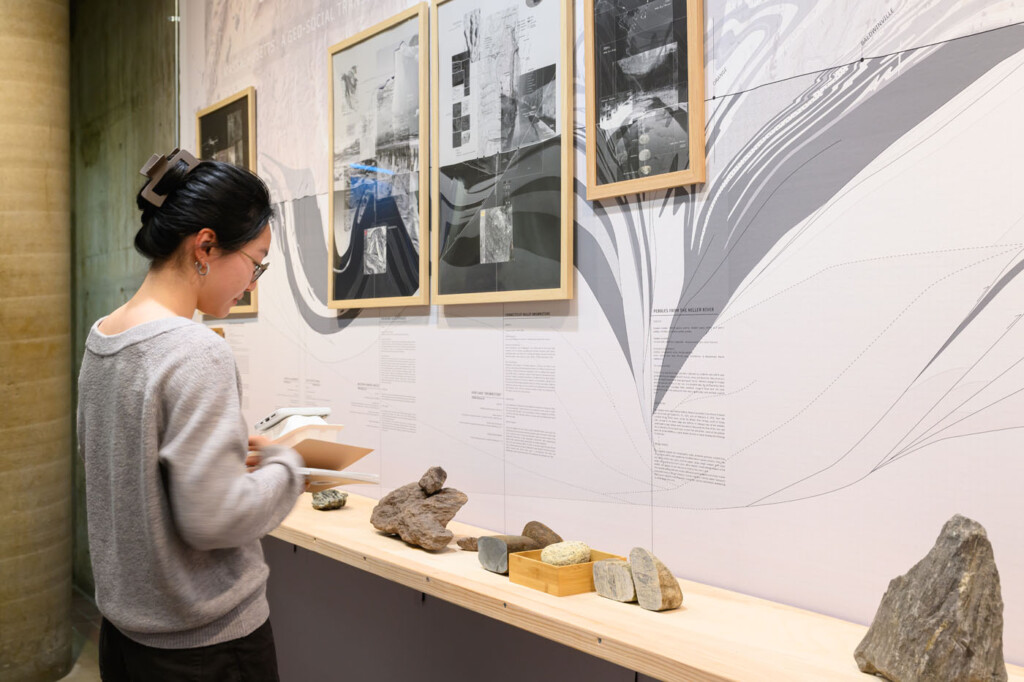
The exhibition examines twenty-eight projects in relation to salient themes that have provided a charged backdrop for recent design in Korea. In this way, the emphasis is less on the individual authors, as there are too many significant Korean designers to include in a single exhibition. Instead, the featured selection of work exemplifies the interrelated trajectories that mark the contemporary condition. Six organizational operatives—historical transformation, accelerated density, topographical syntax, material identity, ecological intersection, and infrastructural alliance—map the individual works in a relational field. While this synthetic structure delineates the rich and specific sociocultural ground from which the projects emerge, it also provides a transferability of the concepts embodied in the work to other situations well beyond the compressed boundaries of this particular nation. Finally, these mappings allow a temporary critical pause within the accelerated production that has become the norm in Korea and many other Asian nations, providing space to reevaulate the work and positively shape its future evolution.


Co-curators:

John Hong
Adjunct Associate Professor of Architecture
Jinhee Park
Lecturer in Architecture, Landscape Architecture, and Urban Planning and Design

Advisor:
Hailim Suh
Lecturer in Architecture, Landscape Architecture, and Urban Planning and Design

Arts Council KoreaGICO Space Ministry