Harvard GSD announces Master in Real Estate degree

Harvard GSD announces Master in Real Estate degree

Date
May 19, 2022
Author
Joshua Machat
Gund Hall by Noritaka Minami
Gund Hall, Harvard University Graduate School of Design. Photo by Noritaka Minami.

The Harvard Graduate School of Design (GSD) is pleased to announce a new 12-month degree, the Master in Real Estate (MRE), for individuals seeking to acquire core real estate skills while learning how real estate can advance beneficial spatial, social, and environmental outcomes in cities and metropolitan areas worldwide. The school has received a combined $13M in gifts from GSD alumni and friends. The program will accept applications in fall 2022 for up to 25 spaces, with the first class enrolling in fall 2023.

“As our cities, their communities, and the environment face mounting crises, the world needs a new kind of developer, and with this degree the GSD aims to educate leaders in real estate who are prepared to face such complex and urgent ethical challenges,” said Sarah M. Whiting, Dean and Josep Lluís Sert Professor of Architecture.

The MRE program is designed to train future practitioners to address new and urgent realities facing the built environment and cities today. Whether undertaken by for-profit businesses, not-for-profit organizations, or public entities, real estate occupies a pivotal role in determining how the places where we live, work, and play are equitable, environmentally sustainable, and appealing, in addition to being productive for the economy. On top of today’s routine pressures of making real estate projects successful are the effects of climate change, the need for equitable development, shifting boundaries between home and work, online consumerism, and global flows of capital. Today, real estate investors are applying environmental, social, and governance criteria (often referred to as ESG criteria) as new metrics for performance, and regulatory agencies are requiring developers to demonstrate that their projects account for environmental factors. Providing public benefits such as affordable housing is also becoming a common requirement of local development approval.

Jerold S. Kayden, the Frank Backus Williams Professor of Urban Planning and Design and Founding Director of the MRE program, sees the MRE degree as “transformational in its recognition that future success in real estate will depend not only on traditional financial and management skills but on a profound understanding of and responsiveness to the new dynamics of social and environmental conditions.”

Through a cross-disciplinary pedagogy of required and elective courses, concluding with a two-month practicum based at a private or public real estate organization working on a socially and environmentally oriented project, students learn about finance, project and construction management, government regulation, urban economics, public-private partnerships, politics, technology, real estate law, ethics, entrepreneurship, negotiation, leadership, and other subjects essential to the practice of present and future real estate.

“In establishing the Master in Real Estate program as part of the Department of Urban Planning and Design, the GSD recognizes real estate as a critical domain in the production of the built environment spanning many concerns,” said Rahul Mehrotra, Chair of the Department of Urban Planning and Design and John T. Dunlop Professor in Housing and Urbanization. “The program will educate new generations of real estate entrepreneurs who will imagine new possibilities for healthy synergies between property development, government regulation, and social imperatives, all while safeguarding the health of our planet.”

Students enrolled in the MRE program will benefit from being part of one of the largest design schools in the world, with close to 200 faculty members and 900 graduate students, of whom more than fifty percent hail from countries outside the United States. Offering the MRE degree within the GSD’s Department of Urban Planning and Design builds upon its longstanding strengths in real estate education and research and reflects the Department’s intentional synthesis of planning, policy, and design. With nearly a century of experience in studio-based education, the GSD is ideally positioned to tailor instruction to emphasize the holistic and collaborative environment in which real estate projects are successfully launched. The MRE program also benefits from programs and courses offered by Harvard’s 11 other schools, including the schools of business, government, law, public health, and engineering and applied sciences, as well as the Faculty of Arts and Sciences.

In addition, the Joint Center for Housing Studie s (overseen by the GSD and the Harvard Kennedy School ) as well as the GSD’s Center for Green Buildings and Cities offer an important resource to MRE students. Both centers sponsor applied research and organize public programs and other engagements with private industry and the public sector.


Harvard Graduate School of Design shortlists four architects for 2022 Wheelwright Prize

Harvard Graduate School of Design shortlists four architects for 2022 Wheelwright Prize

2022 Wheelwright Prize Shortlist
Harvard GSD’s 2022 Wheelwright Prize finalists, L to R: Marina Otero, Curry J. Hackett, Summer Islam, and Feifei Zhou
Date
May 17, 2022
Contributor
Joshua Machat
Harvard Graduate School of Design (Harvard GSD) has announced four shortlisted architects for the 2022 Wheelwright Prize. Now in its 10th cycle, the Wheelwright Prize supports innovative design research, crossing both cultural and architectural boundaries, with a $100,000 grant intended to support two years of study. Previous winners have presented diverse research proposals, including studies of kitchen typologies around the world; the architecture and culture of greenhouses; the potential of seaweed, shellfish, and the intertidal zone to advance architectural knowledge and material futures; and how spaces have been transformed through the material contributions of the African Diaspora. The 2022 Wheelwright Prize drew a wide international pool of applicants. A first-phase jury deliberation was conducted in April; a winner will be announced in June. Jurors for the 2022 prize include: Will Hunter, 2022 Harvard GSD Loeb Fellow and founder and chief executive of London School of Architecture; Adrian Lahoud, dean of the School of Architecture at the Royal College of Art; Mark Lee, chair of the Department of Architecture at the Harvard GSD; Irene Sunwoo, John H. Bryan Chair and Curator, Architecture and Design at the Art Institute of Chicago; Shirley Surya, curator of design and architecture at M+; and Sarah M. Whiting, dean and Josep Lluís Sert Professor of Architecture at the Harvard GSD.

The four finalists for the 2022 Wheelwright Prize, and their proposals, are:

Curry J. Hackett: “Drylongso: Sociospatial Tropes of the African Diaspora”

Curry J. Hackett is a lecturer and adjunct assistant professor at the School of Architecture at the University of Tennessee, Knoxville, and core organizer of the anti-racist design justice school, Dark Matter University. His practice, Wayside Studio, primarily based in Washington, DC, collaborates with communities and organizations to engage in matters pertaining to culture, infrastructure, ecology, and the public realm. Hackett earned a BArch from Howard University in 2013. Noteworthy work includes Howard Theatre Walk of Fame, Swept Yard, King Park, the DC High Water Mark system, and DC Clean Rivers Project. Through his research, Hackett explores the relationships between Blackness and land, particularly in the culturally hybridized region of the American Atlantic and Gulf Coasts. Borrowing the Black term “Drylongso,” meaning “ordinary” or “same old,” Hackett calls for the architecture discipline to advance a more ethnographic mode of practice which celebrates informality and honors institutional memory. Hackett’s “Drylongso: Sociospatial Tropes of the African Diaspora” proposal involves a critical study of diasporically linked regions, including South Carolina, Trinidad and Tobago, and Senegal, to shed light on transatlantic vernacular. With his 2021 solo exhibition, Drylongso: An Ode to the Southern Black Landscape, displayed at the Twelve gallery located at Union Street Market in Washington, DC, Curry brought forth a personal testament of family, identity, and place, and documents his family’s experience growing up on generational farmland in Prospect, Virginia. Hackett’s Wheelwright Prize proposal stems from his solo exhibition and would provide future resources to investigate other Black sociospatial tropes that continue to be excluded by the traditional canons in the disciplines of architecture and landscape design. Hackett proposes travel to diasporically related regions in Mexico and Central America, the Caribbean, and West Africa that would yield a multimedia representation of customary relationships with these lands, including a suite of drawings, installations, publications, archival oral histories, and a short film.

Summer Islam: “Groundwork”

Summer Islam is an ARB registered architect, researcher, and activist who works at the intersection of architectural design, engineering, systems thinking, digital technologies, and material science. She is a founding director of Material Cultures, a nonprofit organization that brings together design, research, and action toward a post-carbon built environment. She has taught at University of the Arts London, University College London, London Metropolitan University, the Architectural Association, and the University of Cambridge. Islam earned her BArch from the Middle East Technical University, Ankara (2008), and RIBA part 1 (2011) and RIBA part 2 (2014) from the Architectural Association School of Architecture, London. With “Groundwork,” Islam explores how different industrial, social, cultural, and economic pressures interrelate with the land, while examining the potential new role of the architect in reconciling these demands, specifically in the complex interdependencies that exist in Britain. Given the immediate challenges of climate change, the global housing crisis, and the toxic and destructive results of fossil-fueled industries and raw material extraction, Islam aims to unite and educate stakeholders in efforts to persuade a new generation of architects, developers, planners, and citizens to reconsider how new methods of construction material are designed and produced. The proposal assigns resources for research, publications, consultancy, and advocacy—all in efforts to recalibrate a new model of regenerative land management across the UK and advise on the most ecologically advanced and sustainable practices for design policy, the construction industry, and agriculture. Work site visits to innovative agroforestry and agriculture practices are a critical part of her proposal, including locations in Britain, Spain, France, and Italy. The “Groundwork” proposal also allocates funds for mapping ecosystems and morphologies, public programming, and a list of sustainable materials to be shared widely as a research depository.

Marina Otero: “Future Storage: Architectures to Host the Metaverse”

Marina Otero is head of the social design masters at Design Academy Eindhoven. The program focuses on roles for designers attuned to contemporary ecological and social challenges. From 2015 to 2022, she was the director of research at Het Nieuwe Instituut (HNI), the Dutch Institute for Architecture, Design and Digital Culture. At HNI, she led initiatives focused on labor, extraction, and mental health from an architectural and post-anthropocentric perspective, including “Automated Landscapes,” “BURN-OUT: Exhaustion on a Planetary Scale,” and “Lithium.” Otero received an MS in critical, curatorial and conceptual practices in architecture from Columbia University’s Graduate School of Architecture, Planning and Preservation in 2013 and completed her PhD at Escuela Técnica Superior de Arquitectura de Madrid in 2016. She is a co-editor of Unmanned: Architecture and Security Series (2016), After Belonging: The Objects, Spaces, and Territories of the Ways We Stay In Transit (2016), Architecture of Appropriation (2019), and More-than-Human (2020); and editor of Work, Body, Leisure (2018). With “Future Storage: Architectures to Host the Metaverse,” Otero examines new architecture paradigms for storing data and how reimagining digital infrastructures could meet the unprecedented demands facing the world today−questioning the functionality, efficiency, and sustainability of the colossal data storage centers and facilities managed across the globe. This research explores innovations in data storing architectures attuned to social and ecological challenges, land availability, the growing cost of energy, and changing data. The research proposal analyzes historical and contemporary cases and engages with experts, local communities, and ecosystems. Otero has already conducted fieldwork in France, the Netherlands, and the UK. The Wheelwright Prize would expand research visits to include Singapore, Australia, Nigeria, California, Iceland, Sweden, and Chile. The fieldwork, data collection, and prototype development, among additional research, will all result in the first manual for global data center architecture design containing examples of ecological, circular, and egalitarian data storage models. This manual will ultimately inform an open-source design course syllabus and a series of public programs bringing designers and service providers together.

Feifei Zhou: “Between Land and Water: Architecture of Porosity”

Feifei Zhou is a Chinese-born artist and architect who works between China and London. She holds a BArch from the University of Sheffield, UK (2014) and an MArch from Royal College of Art in London (2018). Her work explores spatial, cultural, and ecological impacts of the industrialized built environment. She co-edited the digital publication Feral Atlas: The More-than-Human Anthropocene (2020). Zhou is currently an associate lecturer at Central Saint Martins, University of the Arts London. With “Between Land and Water,” Zhou investigates the future of coastal architecture, specifically architecture that allows porosity at the land-water interface, and its potential in combating coastal natural disasters and participating in human and nonhuman livelihoods. Zhou’s research brings her to Southeast Asia’s coastlines where rapid urbanization is only compounded by the social and ecological tensions in the region. This proposal also takes a critical look at social and ecological tensions of the simultaneous decline of Southeast Asia’s small-scale farming and the vernacular stilt houses, as well as the growing dependence on large-scale infrastructures. “Between Land and Water” aims to combine academic research with local-based practice and explore the potential of architecture as the contemporary answer of coastal environmental challenges through allowing more-than-human cohabitation. For the Wheelwright Prize, Zhou plans to create and produce visual essays that will be exhibited together as a series, accompanied by other produced work such as photographs, publications, and material studies. Zhou proposes that each visual essay represents site-specific social and environmental complexities facing Southeast Asia, but that together they will offer a matrix of connections and comparisons of interregional coastal built environments.

Eve Blau among the newly elected members of the American Academy of Arts & Sciences

Eve Blau among the newly elected members of the American Academy of Arts & Sciences

Date
May 13, 2022
Contributor
Joshua Machat
 
Eve Blau

Eve Blau

Eve Blau, adjunct professor of the history and theory of urban form and design and director of research at the Harvard GSD, joins 16 Harvard faculty as newly elected members of the American Academy of Arts & Sciences. In 2022, the academy inducted 261 new members to honor exceptional scholars, leaders, artists, and innovators engaged in advancing the public good. The complete list of new members can be viewed on the American Academy’s website. “We are celebrating a depth of achievements in a breadth of areas,” said David Oxtoby, President of the American Academy. “These individuals excel in ways that excite us and inspire us at a time when recognizing excellence, commending expertise, and working toward the common good is absolutely essential to realizing a better future.” Founded in 1780, the American Academy of Arts and Sciences honors excellence and convenes leaders from every field of human endeavor to examine new ideas, address issues of importance to the nation and the world, and work together “to cultivate every art and science which may tend to advance the interest, honor, dignity, and happiness of a free, independent, and virtuous people.” At the GSD, Blau teaches courses on urban history and theory, modern architecture, urban form, and issues of representation. She also leads core and elective courses on Urban Design, including the Urban Design Proseminar: History, Theory, Practice; Cities by Design; Urban Form: Transition as Condition. In recent years she has taught a series of research seminars: Berlin as Laboratory; Baku: Oil and Urbanism; Mapping Cultural Space Across Eurasia. In addition to serving as Director of Research at the GSD, Blau is Co-Director of the Harvard Mellon Urban Initiative, a cross-Harvard initiative supported by funding from the Andrew W. Mellon Foundation. Her most recent publication Baku: Oil and Urbanism (2018), received the 2019 DAM Architectural Book Award from the Deutsches Architekturmuseum in collaboration with the Frankfurt Book Fair.

Inventing Greenland by Bert De Jonghe Examines the Urban Transformation of an Arctic Nation

Inventing Greenland by Bert De Jonghe Examines the Urban Transformation of an Arctic Nation

Date
May 6, 2022
Contributor
Barbara Miglietti
Cover of the book 'Inventing Greenland" A new book by doctor of design candidate Bert De Jonghe (MDes ’21), Inventing Greenland: Designing an Arctic Nation (Actar, 2022), examines the intense transformation of Greenland through the lens of urbanization. The book is based on De Jonghe’s MDes thesis at the Harvard Graduate School of Design, which was advised by Professor of Landscape Architecture Charles Waldheim, who also wrote the book’s foreword. Inventing Greenland explores Greenland’s cultural, social, and environmental realities and recognizes an array of relationships supported and produced by the built environment. Aimed at architects, landscape designers, and urban planners, it draws attention to the island’s emerging opportunities and ongoing challenges. “By exploring Greenland as a complex and interconnected cultural and geographical space, Inventing Greenland reveals and anticipates transitional moments in the region’s highly intertwined urbanized, militarized, and touristic landscapes,” according to the publisher. De Jonghe’s interest in Greenland began during a research trip in 2017 as part of his MLA thesis at the Oslo School of Architecture and Design. He describes Kulusuk, a small town in East Greenland, where “the airport became a public space in which the community would gather to socialize, people-watch, and have a snack.” It was this observation that “spurred a design project emphasizing the relationship between Kulusuk’s community and the airport as a gathering place.” While De Jonghe’s final design is not featured in the book, the project spurred his interest in Greenland’s unique relationship with urban and infrastructural landscapes, and led him to continue the work at the GSD. Interior spread of 'Inventing Greenland' As a first-year DDes student, De Jonghe has been investigating the Arctic urbanization of Russia while drawing attention to emerging influences and ambitions of the “near-Arctic state,” China. Before studying at the GSD, De Jonghe worked as a landscape architect in Belgium, South Africa, and Norway. He is also the founder of Transpolar Studio, a spatial design practice specializing in landscape architecture, urbanism, and design research in the Arctic and subarctic regions.  

Sharon Johnston and Mark Lee among American Academy of Arts and Letters 2022 Architecture Award winners

Sharon Johnston and Mark Lee among American Academy of Arts and Letters 2022 Architecture Award winners

Date
Apr. 20, 2022
Contributor
Joshua Machat
Sharon Johnston and Mark Lee

Sharon Johnston, left, and Mark Lee, founders of the L.A. architectural firm Johnston Marklee.(Marcus Yam / Los Angeles Times)

Sharon Johnston, Professor in Practice of Architecture, and Mark Lee, Chair of the Department of Architecture & Professor in Practice of Architecture, are recipients of the American Academy of Arts and Letters 2022 Architecture Award. Sharon Johnston (MArch ’95) and Mark Lee (MArch ’95) are founding partners at Johnston Marklee, an architecture firm based in Los Angeles, CA, and Cambridge, MA. Arts and Letters recognized Johnston and Lee as “American architects whose work is characterized by a strong personal direction.” The Academy’s annual architecture awards program began in 1955 with the inauguration of the Arnold W. Brunner Memorial Prize and has since expanded to include four Arts and Letters Awards. This year’s winners were chosen from a group of 25 individuals and practices nominated by the members of the Academy. The jurors were Toshiko Mori (MArch ’96, chair), Marlon Blackwell, Peter Eisenman, Steven Holl, Annabelle Selldorf, Nader Tehrani (MAUD ’91), and Meejin Yoon (MAUD ’97).
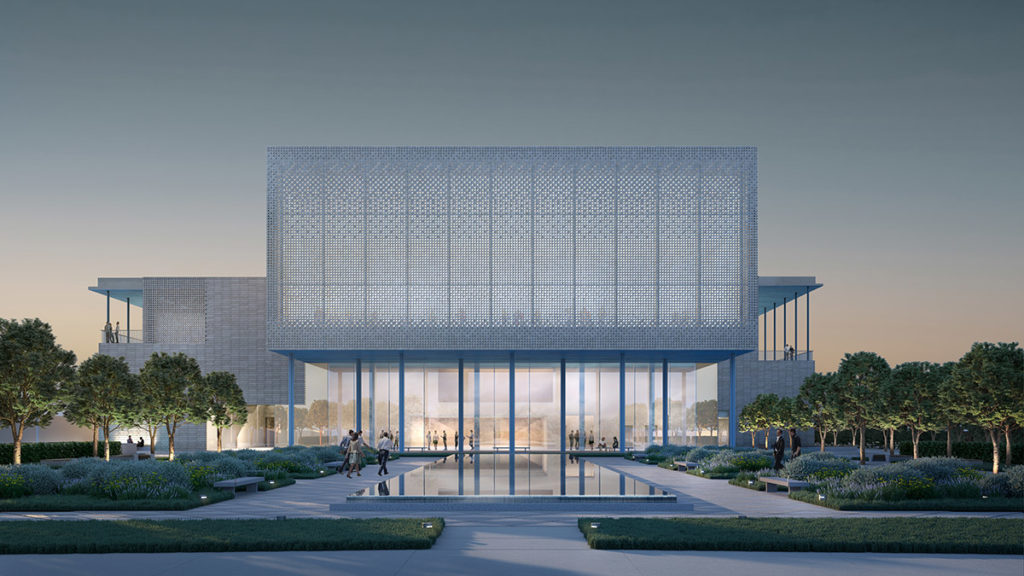
The Johnston Marklee-designed Menil Drawing Institute in Houston

The Johnston Marklee-designed Menil Drawing Institute in Houston, a 2022 AIA Architecture Award-winning project. (Richard Barnes)

The American Academy of Arts and Letters is an honor society of the country’s 300 leading architects, artists, composers, and writers. Each year it elects new members as vacancies occur, administers over 70 awards and prizes, exhibits art and manuscripts, funds performances of new works of musical theater, and purchases artwork for donation to museums across the United States.

Coming Soon: Harvard Design Magazine #50: Today’s Global Edited by Sarah M. Whiting and Rahul Mehrotra

Coming Soon: Harvard Design Magazine #50: Today’s Global Edited by Sarah M. Whiting and Rahul Mehrotra

Figures walking around a desert landscape at the base of an abstract built structure.
Kiluanji Kia Henda, A City Called Mirage, 2014–2017. Featured in Diana L. Eck's "The World-Cities of the Global Age," from Harvard Design Magazine #50: Today's Global. Courtesy of the artist.
Date
Apr. 19, 2022
Contributor
Joshua Machat
Is globalization the most powerful single force shaping the built environment today? Guest edited by Sarah M. Whiting and Rahul Mehrotra, Harvard Design Magazine 50: Today’s Global (launching in May 2022) considers the sustainability of contemporary architectural production and how design has the potential to advance a deeper and more productive discourse over globalization. Modernity has entered a phase of critical backlash against globalization, which is for some a critique of international integration, for others a critique of global and local inequalities produced by neoliberal extremism, and for many, a shared global concern over climate change. Over the past 50 years, advanced technology and the digital revolution have afforded architects and designers the ability to operate outside their own regions, customs, and cultures, at a scale and freedom that has not previously been realized. The resulting industry produces architectural commodities that increasingly dominate the built environment and promote the trend toward globalizing, consumerist cities. Globalization has not only shifted our perspective of the world, it has also transformed how architectural identity defines itself. Today’s Global enriches this dialogue and celebrates the emergence of new resources that have made broader global design talent more visible and rejects the stultifying categories—such as “first world” and “third world”—defined by contemporary boundaries. In this issue, Sarah M. Whiting and Rahul Mehrotra have invited an international group of public intellectuals, critics, scholars, and practitioners in architecture, urban planning, landscape design, and the social sciences and humanities to offer in-depth analysis of the political, social, and economic forces that have shaped global architecture and design over the past 25 years. Today’s Global features essays and conversations by distinguished contributors in their respective fields, which address the challenges and opportunities facing design thinking in a time of expanding globalization and shifting localities and regionalism. The issue concludes with a call-and-response segment, in which contributors respond to the provocative prompt: “What does it mean to be a global practitioner today?” Harvard Design Magazine is an architecture and design magazine that probes at the reaches of design and its reciprocal influence on contemporary culture and life. Published twice a year and helmed by Editorial Director Julie Cirelli at Harvard’s Graduate School of Design, Harvard Design Magazine invites guest editors to consider design through an interdisciplinary lens, resulting in unique perspectives by an international group of architects, designers, students, academics, and artists. For current and back issues, as well as subscription information and stockists, visit the Harvard Design Magazine website.

Zina Fraser (MLA ’23) named a 2022 Hart Howerton Fellow

Zina Fraser (MLA ’23) named a 2022 Hart Howerton Fellow

Date
Apr. 15, 2022
Contributor
Joshua Machat

Zina Fraser Portrait

Courtesy of Zina Fraser

The global planning and design firm, Hart Howerton has named Zina Fraser (MLA ’23) to its Research & Travel Fellowship Program for 2022. Fraser’s proposal to investigate the broader implications of climate change adaptation will take her to Prince Edward Island, Canada, where she will examine the area’s changing landscape and mitigation strategies for rising sea levels. “Year by year, the energy, enthusiasm and quality of research from each class of Hart Howerton Fellows has been extraordinary,” states Hart Howerton Chairman, David Howerton. “It is exciting to help foster this next generation of design thinking.” The Hart Howerton Fellowship is open to planning, architecture, landscape architecture and urban design students who are entering their final year of study. The fellowship defines an 8-week professional internship, followed by the Fellow’s self-defined topic of travel study. View the 2022 Fellowship details. Now in its sixteenth year, the Fellowships offer students an unparalleled learning experience, working as part of Hart Howerton’s project team in either their New York or San Francisco office and pursuing a self-defined research and travel topic. Fellows return to the offices after their travel to complete their professional internship and prepare a final “report,” which is presented to the firm.  

Katarina Richter-Lunn (MDes ’21) awarded a 2022 Paul & Daisy Soros Fellowship

Katarina Richter-Lunn (MDes ’21) awarded a 2022 Paul & Daisy Soros Fellowship

Date
Apr. 14, 2022
Contributor
Joshua Machat
Katarina Richter-Lunn

Courtesy of Katarina Richter-Lunn

Harvard University Graduate School of Design DDes candidate Katarina Richter-Lunn (MDes ’21) has been awarded the 2022 Paul & Daisy Soros Fellowship for New Americans, a merit-based graduate school program for 30 immigrants and children of immigrants. Chosen from a competitive pool of over 1,800 applicants, Richter-Lunn was selected for her potential to make significant contributions through her research and work in the United States. She will join 10 other Harvard affiliated students who are being honored in 2022 by the Soros organization—all of whom receive up to $90,000 to support graduate studies. The new class of Fellows have heritage in the following countries: Afghanistan, Cameroon, China, Democratic Republic of Congo, El Salvador, France, Germany, Grenada, India, Israel, Mexico, Myanmar, Nigeria, Pakistan, Poland, Romania, Russia, Syria, Taiwan, Uganda, and Vietnam. “I love being at the intersection of architecture, psychology, and technology because it allows me to be creative while still using the power of science to look for adaptable, amiable, and most importantly, universally accessible solutions to address mental health.” Richter-Lunn said.  “Not only is the topic of mental health very close to my heart but doing what I do for a living makes me truly feel that I can make a change in my field, and contribute to the vision of what the future of design will be.” After holding positions at Arup, Gehry Partners, IwamottoScott, and Snøhetta, Richter-Lunn returned to school and received her MDes from GSD in 2021. She is now enrolled in GSD’s DDes Program, where her primary research lies at the intersection of design, psychology, and neuroscience to address mental well-being through the built environment. As part of this work, she explores perception through the lens of material development, computational design, affective computing, and robotics. Additionally, Richter-Lunn seeks to envision how architecture, design, and our latest technological tools can embody spatial forms of therapy to provide more empathetic, seamless, and accessible design solutions to emotional disorders.

Jeanne Gang, Special Commencement Ceremony Speaker for the Classes of 2020 and 2021

Jeanne Gang, Special Commencement Ceremony Speaker for the Classes of 2020 and 2021

Date
Apr. 13, 2022
Contributor
Joshua Machat
Jeanne Gang Open-House Lecture 2018

Jeanne Gang, Open House Lecture, 2018

Harvard University’s Graduate School of Design has named Jeanne Gang (MArch ’93) to address the 2020 and 2021 classes as the GSD welcomes back these graduates for an in-person celebration and Special Commencement Ceremony. Gang will address the GSD’s classes and their families on Sunday, May 29 at 10:30 AM ET in the Gund Back Yard. Jeanne Gang is Professor in Practice of Architecture at GSD and the founding principal of Studio Gang, an international architecture and urban design practice based in Chicago, New York, and San Francisco, where her professional studios have focused on cities, ecologies, and materials. Her analytical and creative approach has produced projects across scales and typologies, from cultural and public buildings to urban parks and high-rise towers. These include Writers Theatre, a professional theater for a company north of Chicago; the Arcus Center for Social Justice Leadership at Kalamazoo College in Kalamazoo, Michigan; and the 82-story Aqua Tower in downtown Chicago. Intertwined with their built work, Jeanne and the Studio also develop research and related projects such as publications and exhibitions that push design’s ability to create public awareness and give rise to change—a practice they call “actionable idealism.” Jeanne and Studio Gang are currently designing major projects throughout the Americas and Europe. These include the expansion of the American Museum of Natural History in New York City; the new United States Embassy in Brasília, Brazil; a unified campus for the California College of the Arts in San Francisco; Civic Commons, a multi-city project reimagining public spaces across the United States; and mixed-use towers in Toronto, Chicago, Amsterdam, and Los Angeles Gang’s work has been honored and exhibited widely, including at the International Venice Biennale, the Museum of Modern Art, and the Art Institute of Chicago. A MacArthur Fellow, 2017 William A. Bernoudy Architect in Residence at the American Academy in Rome, and an elected member of the American Academy of Arts and Sciences; Jeanne has been honored with the Cooper Hewitt National Design Award in Architecture and was named one of 2019’s most influential people in the world by TIME magazine. Further accolades include Architectural Review’s Architect of the Year, the Louis I. Kahn Memorial Award, and the Marcus Prize for Architecture. Reveal, her first volume on Studio Gang’s work and process, was published in 2011, followed by Reverse Effect: Renewing Chicago’s Waterways, and Studio Gang: Architecture in 2020. To see a full schedule of the 2020 and 2021 Special Commencement Ceremony, and for other Commencement information, please visit the GSD’s Commencement webpage.

Danielle Allen, 2022 Class Day Speaker

Danielle Allen, 2022 Class Day Speaker

Date
Apr. 8, 2022
Contributor
Joshua Machat
Danielle Allen Portrait

Photo Credit: Laura Rose

Harvard University’s Graduate School of Design has named Danielle Allen as its 2022 Class Day speaker. Allen will address the GSD’s class and their families during the School’s 2022 Class Day exercises on Wednesday, May 25 at 3:30 PM ET in the Gund Back Yard. Danielle Allen, James Bryant Conant University Professor at Harvard University, and Director of Harvard’s Edmond J. Safra Center for Ethics, is a political theorist who has published broadly in democratic theory, political sociology, and the history of political thought. In 2022 Allen launched a historic bid as the first African-American woman to run for governor in Massachusetts state history. Widely known for her work on justice and citizenship in both ancient Athens and modern America, Allen is the author of The World of Prometheus: The Politics of Punishing in Democratic Athens (2000); Talking to Strangers: Anxieties of Citizenship since Brown vs. the Board of Education (2004); Why Plato Wrote (2010); and Our Declaration (2014); and co-editor (with Rob Reich) of Education, Justice, and Democracy (2013). In 2002 Allen was awarded a MacArthur Fellowship for her “ability to combine the classicist’s careful attention to texts and language with the political theorist’s sophisticated and informed engagement.” Allen is a frequent public lecturer and regular guest on public radio affiliates to discuss issues of citizenship and education policy, as well as a contributor on similar subjects to the Washington Post, Boston Review, Democracy, Cabinet, and The Nation. Allen is a former Chair of the Mellon Foundation Board, past Chair of the Pulitzer Prize Board, and a member of the American Academy of Arts and Sciences and the American Philosophical Society. She is currently working on books on citizenship in the digital age and political equality and directs The Democratic Knowledge Project, a group of research projects on knowledge and democracy. To see a full schedule of 2022 Class Day and Commencement exercises, and for other Commencement information, please visit the GSD’s Commencement webpage.