Material Cultures:
Steel and Our Entangled Present in Gary, Indiana
Steel, skyscrapers and Chicago’s explosive growth at the fin de siècle—it’s a story we know by heart. In architecture’s history, the steel skeleton’s brisk ascension from a speculative pipe dream to a standard so ubiquitous as to be almost invisible is frequently recounted. What, however, does our understanding of this serendipitous intersection between capital, engineering and real estate in Chicago at the dawn of the 20th century leave out?
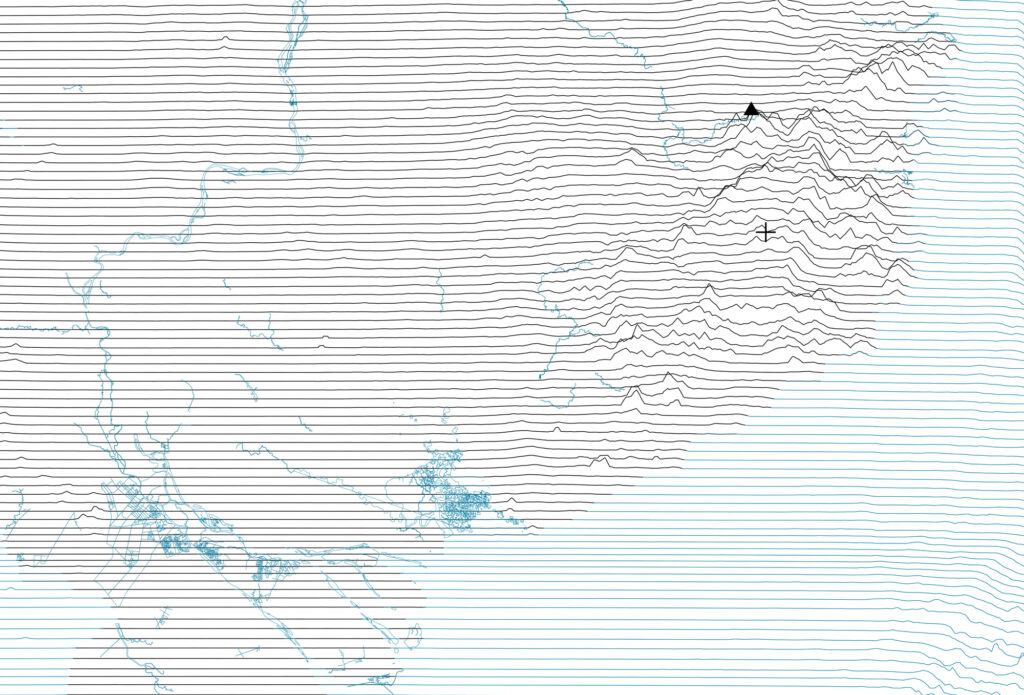
This exhibition looks to unpack the spatial consequences of this overlooked history, reenvisioning the Chicago Frame through the simple lens of its material composition: steel. Where did the steel necessary to abet Chicago’s rapid verticalization come from? Whose land begot its production? Moreover, what industrial apparatus was necessary to transform iron ore, the raw matter at the heart of steel, into a malleable building material? In seeking the unseen headsprings of Chicago’s steel, this project focuses on the city of Gary, Indiana, a monument to the industrial imaginary built entirely under the egis of US Steel—America’s most prodigious early 20th-century conglomerate and the first billion-dollar corporation in the history of capitalism.
After more than a century of steel production, the relations to labor, ecology and land on which Gary was built have become untenable, and a future is not inconceivable in which US Steel goes out of business. This exhibition speculates on just such a scenario, probing the material afterlife of the American steel industry at its ground zero to envision the material conditions of the Rust Belt factory town not as the tarnished ruins of a bygone modernity but imbued with the radical ingredients for a less extractive, rehabilitative future.
Connor Gravelle (MArch II ’25)
Project (Un)Build
As we recognize that our extractive practices are driving humanity toward an environmental crisis, there has been renewed interest in reusing materials. From the European Union’s Circular Economy Action Plan to emerging deconstruction ordinances in U.S. cities like Portland, Seattle, and Denver, and the Los Angeles 2028 Olympics’ commitment to “radical reuse,” sustainability has become both the ethical compass and ideological underpinning guiding the practice of architecture for our generation.
Project Un(Build) proposes a reinvention of timber construction to enable Design-for-Disassembly and wood reuse. In 2018, the U.S. construction and demolition (C&D) sector generated 41 million tons of wood waste, with only 9% recycled. Inspired by bamboo lashing techniques, Project Un(Build) uses strapping as a non-penetrative assembly method, facilitating easy disassembly while maintaining material integrity. The system envisions a wide range of applications across varying scales—wood-framed houses, office partitions, temporary shelters, outdoor pavilions, exhibition walls, and even furniture. It can also be adapted to join various types of dimensional lumber and engineered wood products.
Project Un(Build) presents not only a transformation in material approaches but also an invitation to view design as a form of innovation—and designers as innovators actively engaged in finding solutions to the climate crisis.
Acknowledgements:
This exhibition originates from Clara He’s master’s thesis, How to (Un)build a House?, advised by Toshiko Mori. The thesis was honored with the James Templeton Kelley Prize and the Peter Rice Prize. Heartfelt thanks to Toshiko Mori for her support during and beyond Clara’s thesis, and to the GSD for conferring both prestigious awards.
The project was further developed in collaboration with Henry Chung, who led the technical refinement and load testing. In September 2024, Project Un(Build) was selected as one of 16 proposals worldwide to participate in the Venice Biennale College Architettura 2024–2025. This phase of development was enriched by advice from Carlo Ratti’s curatorial team, particularly Fábio Duarte and Martina Mazzarello. It also greatly benefited from the insights and guidance of numerous others, including Jonathan Grinham and Hanif Kara.
Finally, sincere thanks to Dean Sarah Whiting for her invitation to exhibit, and to the GSD exhibition team for their assistance with the installation.
SURVEY: Multi-Modal Readings Of Bandelier National Monument’s Geologic And Spatial Relations
Bandelier National Monument preserves the homes and territory of the Ancestral Puebloans who inhabited the Frijoles Canyon fifty miles west of Santa Fe, New Mexico between 1150 and 1600 AD. The site contains a unique assembly of Ancestral Puebloan homes and kivas carved into Bandelier’s porous volcanic tuff cliffs. Supported by Harvard GSD’s Penny White Project Fund and Cornell AAP’s Robert James Eidlitz Travel Fellowship, the team documented and analyzed Bandelier National Monument in Summer 2023 on and off-site as a case study of intimate human-landscape interaction. SURVEY’s result is a first-of-its-kind digital model paired with experimental photography that preserves these fragile, ancient marvels to serve as an immortal primary source for archaeologists, historians, scientists, or artists. On a broader theme, the exhibition encourages the multi-modal documentation of fragile sites such as Bandelier National Monument at a time when it, and other critical landscapes around the globe, are at risk of accelerated deterioration due to unprecedented factors related to climate change. The exhibition aims to catalyze a dialogue in the GSD community about the role of qualitative and quantitative reality capture technology in landscape conservation and preservation.
Background
Geologic structure and socio-geography intertwine within Bandelier National Monument to enable a collapse of human and geologic time scales and spatial scales. The Bandelier cliffside was formed by a series of gigantic volcanic ash flows between 1.4 and 1.1 million years ago. The eruptions blanketed the area in a 300-ft thick carpet of ash, which consolidated into a very soft rock called tuff. Air bubbles formed within the ash flow as it deposited, which gives the sheer cliffs their porous appearance. These thousands of pockets are called “cavates,” which Ancestral Puebloans further hollowed out as a framework for their dwellings.
Methods
Employing LiDAR scanning, analog photography, analytical drawing, and cartography, SURVEY interrogates the landscape’s precise geologic and material conditions that prompted human habitation in an otherwise hostile terrain. The multi-modal survey of Bandelier National Monument serves two purposes within this theme: 1) capturing both quantitative and qualitative site data 2) contributing new digital recording techniques to existing archaeological and ethnographic surveys of the site. The team employed Leica Geosystems’ BLK360, a high-precision 3D laser scanner in conjunction with Lomography’s experimental analog film cameras to document the ruin system. The laser scanning equipment captured billions of precise three-dimensional data points, while experimental photography breathed spirit, atmosphere, and texture into the dataset. Through this, the team identified climate vulnerabilities, explored what gives this delicate site cultural value today, and emphasized the importance of devoting technological resources to uphold it.
Acknowledgments
Thank you.
Thank you to the family of Penny White who dedicated resources for future students to explore and learn about our world. Thank you, Harvard University Graduate School of Design, Frances Loeb Library, our advisors Dan D’Oca and Tao DuFour for your support of our curiosities and providing the resources for us to pursue them.
Thank you to Ranger Steve and fellow Park Rangers at the Bandelier National Monument for your warmth, knowledge, and accommodation of our requests to laser scan, charge equipment, and ask questions. Also, thank you to the Bandelier visitors for your patience, encouragement, and exciting conversations as we met along the trail.
Thank you to Chris Curley, Chris Wilkes, and the Leica GeoSystems team for your kindness, trust, and generosity in providing us with the Leica BLK360 laser scanner and Register360 software which made the LiDAR documentation possible. We are eternally grateful for your technical assistance in retrieving the data from our scans after our trip, and for having us as early-access users of your new Reality Cloud Studio platform. We are also thankful for Elias Kruse Logan and Andy Fontana who kindly connected us to Chris and Chris so quickly.
Thank you to Kayla Lew, Elena Loffreno, and the Lomography team for your openness and graciousness in providing analogue cameras and experimental films to allow us to creatively photograph the atmosphere of the cavates. “Don’t think, just shoot!”
Thank you Lance Li for entrusting us with your FLIR C3 as we explore the Ancient Puebloan caves.
Thank you to Elizabeth Ehrnt and the Georgia O’Keeffe Museum for accommodating our visit and sharing the stories and artifacts of Ms. O’Keeffe with us.
Thank you Porus D. Olpadwala for your warmth, generosity, wisdom, and delicious home cooking.
And thank you to Joseph Kennedy Jr. and Sonny Meng Qi Xu for your labor (carrying equipment and supplies, driving, navigating, battery charge runs, waiting, crowd control, etc.), patience, humor, courage, and emotional support. We couldn’t have done this without you. Please continue to wear sunscreen daily.
Plantation Futures: Foregrounding Lost Narratives
Masters in Landscape Architecture, AP Thesis Prize, 2023 Advised by Rosalea Monacella Oak Alley Plantation, located in Louisiana, is the most famous and visited plantation in the United States. Today the plantation is preserved as a cultural landscape reflecting and glorifying the values of the Antebellum era. What is absent at Oak Alley and all the plantations upon which the United States was formed is the recognition of the forged Black landscapes used for refuge, joy, and resistance: the swamp, the ditch, and the plot. The plantation was a complex of white supremacy that linked the exploitation of racialized bodies and non-human agents to fertile lands and commodities. These landscapes emerged as an economic and political model based on dislocated forced labor, intensive land exploitation, and global commerce supported by land dispossession, labor extraction, and racialized violence. The thesis questions the concept and practices of heritage in the profession of landscape architecture as it is embedded in the colonial imaginary and its racial legacies. Moments for accountability and restoration are conceived, such as the Citizen Assembly, which holds industry and systems of dispossession to account through new forms of democratic processes and landscape-based evidence collection. Black ecologies emerge through layering archival narratives, poetry, and literature, foregrounding lost narratives within the plantation. These narratives envision radically different futures, where interspecies kinship and empathy surface as new ecologies that point to new Black futurities.Aamha//قمحة: Uncovering Beirut’s Phantom Ecologies
The National Institutes of Health defines a phantom limb as the perception of pain or discomfort in a limb that is no longer there. This project explores the notion of phantom limbs in urban environments, investigating what has been forgotten, gone unseen, or been left uncontained: ghost Ecologies lurk hidden, but very much present. Beirut is no stranger to staggering occurrences, in its more recent history, Lebanon has found itself in turmoil for over half a decade. A singular event is not what caused the upheaval. Besides the political vulnerability that Lebanon has–unfortunately–adapted to, an unprecedented economic crisis has pushed the people to the brink of hopelessness. An uprising was the people’s answer. On August 4, 2020, Beirut was shaken by a devastating explosion- one of the five most powerful non-nuclear explosions in human history. The blast claimed 218 lives and as many as 100,000 homes, as well as an unquantifiable degree of destruction across the country. The Grain Silos at the epicenter of the explosion were severely damaged but did not fully collapse. In the aftermath of the explosion, wheat stored in these silos was sent flying across the city, sprouting, and spreading throughout neighborhoods, creating unexpected pockets of nature that peppered areas of industry and urbanity. The wheat grew where destruction had gone. Some may see this as a sign of hope, while others may view it as a romanticized idea of “resilience”. Aamha (which is Arabic for “a grain”) hopes to shed light on the unseen and forgotten aspects of Beirut and explore the complexity of the city’s history and its narrative–still being written. How much can a single grain of wheat contain? Beckoning unfiltered truth in content, Aamha (which is Arabic for “a grain”) currently investigates the impact of the wheat silos on social, economic, and cultural levels and explores its geographic, socio-political, and metaphorical aspects. As the first edition drops on August 4th of this year – the 3rd anniversary of the Beirut Blast -, crowd-sourced features will delve into the thoughts, feelings, and reactions of the population as they process their experiences through the abstraction of a single grain of wheat. -Layal Merhi, MDes 2023Upon Concrete: Retrofitting Architecture With Malleability
by Hangsoo Jeong (MArch ’22) — Recipient of the Peter Rice Prize Throughout history, architecture has evolved and advanced in parallel with the technical development of reinforcements. With the innovations of processing and shaping smelted metals and the development of reinforced concrete structural systems, the concrete structure—which only provides a short-span spacing—was reinforced with iron and other metals to achieve a more expansive and porous space. As a result, the strengthened structural system enabled architecture not only to accommodate various scales of programs and occupancies, but also to retain the impartiality between humans, space, and structure. In other words, the structural reinforcements could be integrated with building retrofits and become the component that creates spatial flexibility and adaptability in architecture and the urban environment. Concrete structures are gradually becoming underused because of the unadaptability and the oppressive qualities of the space confined within: hence it provides an opportunity to intervene and to experiment with steel-reinforced techniques for further uses of various programs and occupancies. Different steel reinforcing techniques—buttressing, bracing, column jacket, and cathodic protection, to name a few are integrated together into a system that can infuse rigid structures with the adaptability to accommodate heterogeneous habitable spaces. The retrofitting interventions on different scales, for better confronting the shear and bending moment stress, enable the existing structure to hold a higher beam and slab for immense and porous rooms. It also reinforces vertical communications as both circulation passageway and assembly space across different levels, while dividing the building into different zones. That is to say, the structural coalescence creates spatial subdivision, assembly, communication, and transition for different program needs within the building. Innovations in architecture stem from redefining value in different material properties and tectonic aspects that respond to diversity, sustainability, and other social urgencies. Retrofitting existing concrete structures with zinc-plated steel reinforcements significantly elevates the structural elements into which could endow the architecture with integration, both socially and morphologically.Anny Li’s “The World was Their Garden,” Design Studies thesis prize
The World Was Their Garden: Plant Introductions at the US Department of Agriculture, 1898–1984 In 1898, the US Department of Agriculture established the Office of Foreign Seed and Plant Introduction (SPI) to systematically collect and introduce plants of economic interest to US soil. Employing a group of trained “agricultural explorers” to collect plants from all over the world, the office is credited with introducing a mouthwatering array of new fruit industries–mango, avocado, date palm, and citrus, to name just a few–as well as securing billion-dollar staple crops that combat diseases, pests, and drought with infusions of genetic material for breeding improved varieties. Yet, traditional accounts of federal plant introduction often leave out what it took to integrate these collections into the agricultural landscape: systematic experimentation that inhered in monumental recordkeeping practices, imperial relationships, and the ravenous need for industrial agriculture to reproduce itself at scale–thus motivating continual investment in seeds as experimental capital. This project resituates the SPI’s administrators and explorers as actors in the US imperial environmental management state emergent at the turn of the century. It examines the infrastructure built to manage plant genetic resources as the living substrate of industrialized monocultures. First, it attends to the SPI’s paper technologies and media artifacts–bulletins, inventories, photographs, and films–as a recordkeeping system constitutive of its scientific authority and reputation, but also as productive of a modern national identity. Next, it situates federal plant introduction work in the geography of southern Florida, mapping out its impact on an agricultural frontier through the establishment of the Fairchild Tropical Garden. Finally, it follows the material traces of the USDA’s 1929–31 soybean collection expedition to East Asia to explore how living plant germplasm endures across changing institutions and landscapes. Through these living and non-living material traces, this thesis elaborates how the SPI serves as a conceptual and material precursor to contemporary practices of biodiversity preservation and environmental politics.A Giant Among Us
Text by Yueyan Li (MArch ’21) and Son Vu (MArch ’21), winners of the 2019 Clifford Wong Prize in Housing It is hard to get in and out of Somerville, and true public spaces are few and far between. Though several nodes do exist, these piecemeal developments are often solely commercial enterprises. Furthermore, Somerville’s residential identity is tied to triples-deckers dotted among low-slung homogenous areas. Under existing conditions, the kind of dense and unpredictable urban quality – whether it be effects, experiences, or the buildings themselves – cannot be much lived. This project interprets the urban condition as a digital line strewn with points of interest. Through a digital mean, our ‘line’ is quite literally operated on – by stretching, twisting, and rotating, at the building scale. We first began by thinking through ways to mitigate the ground level. We negotiate the understood existing boundaries by stretching elements out to touch on key edges of the site, continuing on the rhythm of existing buildings. Within this thickened at site’s edge-line are shops, restaurants, and cafes; and within the agglomeration of these shops and stalls, lobbies and unit entrances are camouflaged. As the ‘feet’ of our line touch ground, they are spread out enough to make the boundary porous –a dashed line which allows physical and visual connections through this giant. The flexibility and versatility was enabled by a strategic use of digital means and process, which would not be possible otherwise. The digital line leans in onto itself to create a mountainous form made of residential units. This digital process of residential self-formation carves out a cavernous space for the various mixing of events, resulting in spaces which may accommodate seasonal, sponsored, or informal activities such as Porchfest or perhaps an evening film projection. These events may be deeply rooted in Somerville’s social tradition, but rather generic ones can also be accommodated for. There are four unit types engendered by the angle of line’s lean. Corresponding units offer a selection of living types and styles that relates to density, vertical circulation, usable floor area, and opacity among neighbors in varying ways. From shallow to steep, the living arrangement shifts from public to private, communal to individual: live-work, artist commune, multi bedroom, and single bedroom. Different housing bars intersect, and housing types overlap, bleeding into each other as shared areas which reimagine collective living: communal cooking, dining, relaxing, creating, working, playing all arise from these bars’ agglomeration. From the outside, the project is a megastructure with impossible formal gestures; but as the building performs, key elements nurture flexibility above any specific program or use. Perhaps daunting at first glance, the digital form draws one in – a friendly giant.Grayscale
“Grayscale” is based on an architecture thesis by Khoa Vu (MArch ’19) of the same title. Thesis advisor: Preston Scott Cohen Grayscale is a term used in computation to describe the range of gray shades from white to black. As a framework for design, grayscale exploits the in-between as central to providing a new design methodology and spatial type. The aim of this thesis is to discover spatial conditions that exist between nature and the man-made, the old and the new, the inner, imaginative mind and the external, perceived world. As a methodology, grayscale allows for the negotiation between top-down and bottom-up design. This thesis was developed by operating at multiple scales: from material systems at the pavilion scale to building systems at the scale of architecture, to spatial and infrastructural organization at the urban scale. As a spatial type, grayscale celebrates the dualistic, the adaptive, and the ambiguous. Extremes are not disregarded, but rather amplified as nodes on a gradient.
Under a 53- meter-radius circular “floating lake,” a new cultural hub provides public, education and research spaces for the city: agricultural lab, library (left), and exhibition center (right). The arrival and departure from the train station in an interstitial semi-floating zone coupled with a centrifugal directionality within the pedestrian spaces.