Two Years Later: What has COVID-19 Permanently Changed for Design?

Two Years Later: What has COVID-19 Permanently Changed for Design?

A photo of a student sitting at a white picnic table in the front plaza of Gund Hall that faces the street.
Tables on the Gund Hall front plaza accommodate outdoor learning and social space. Photograph by Justin Knight.

COVID-19 is undeniably the defining experience of a generation. Globally, few people have escaped its effects—either the direct effects of disease or the indirect ones of economic disruptions, public health requirements, and workplace changes. COVID has redefined possible futures in the minds of many.

How has this period changed urban life and the work of urban planners and designers? The short version is that this has been a moment of openness to new ideas. And it has sped up some preexisting trends—such as using video communication at work and deliveries at home. However, some more difficult challenges—like providing affordable healthy housing or comprehensive healthy placemaking—remain out of reach.

The view from the early pandemic

In March 2020, nine days after Harvard announced it would close its doors and go online due to COVID, I wrote an op-ed for this site trying to untangle what was happening and what it meant for urban planning and design. I reported that vaccines were estimated to be six to 18 months away, and indeed the Pfizer-BioNTech vaccine received emergency authorization nine months later. Facing an interim period where inaction would lead to many deaths and overwhelmed hospitals, countries were embarking on a mixture of strategies that would manage and even largely suppress the virus. Terms that had been largely confined to public health circles, such as social and physical distancing, were to become very familiar.

Estimates at the time, notably from Imperial College in London, were that without these measures two million in the US would die of COVID-19 by October 2020. Ultimately, the death toll in the US in 2020 was 350,000 people. However, new variants that were more contagious or more deadly sprang up before vaccines were available or widely used. Vaccinations were politicized, meaning fewer people were vaccinated than had been projected. Governments juggled the need to protect health while maintaining economic activity, and even though those conflicts were overblown, they lessened the power of public health arguments. At the two-year anniversary of the Harvard announcement, US deaths are now approaching one million.

Other countries have suffered from these same issues with different flavors and to different extents. China had COVID cases starting in late 2019 , with the first Wuhan lockdown in January 2020. Along with some island countries, China has employed a suppression strategy—keeping its borders more firmly closed. In Africa, vaccines have been slow to arrive.

The COVID experience will shape the ways planners and designers think about a healthy environment.

In March 2020, when I wrote my op-ed, it was already apparent that there would be economic ramifications, travel disruptions, supply chain issues, and stress. Some of these negatives came from the pandemic itself, but others were likely fallout from the response. At that time, commentators were already forecasting the end of urban life, something I suggested was premature. However, it was apparent that places with existing crowding (many people per room) and with sanitation problems might suffer more, and that “a long period of suppression may well change patterns of urban life.” People were already working from home—which could be a supportive environment, or a stressful one—and would be a key factor in people’s lives. The potential for evictions to rise was also apparent. It was clear that the pandemic, while affecting everyone, was not going to have the same effects everywhere.

Reflections two years later

In terms of urban issues and the work of planning and design, several preexisting trends sped up. And while there will be a return to a number of the old ways, at least a few of the changes will be sticky. In some dimensions physical space became less important (e.g., business travel being replaced by online meetings) and in others it became more salient (e.g., intensive use of local outdoor areas). For many trends, it is still too soon to be certain how they will evolve—and they will almost certainly differ by place. However, some trends seem likely to stick around. Here I look at three key issues: the complex interplay between virtual and physical space, the importance of the outdoors, and challenges with collaboration for the common good.

The internet has allowed people to use physical space differently

Telework boomed and while it will not stay that way, it does allow a proportion of the workforce to relocate away from expensive urban areas. This could cause a lot of sprawl if not managed well, but it may also revitalize regional areas and smaller cities, providing more affordable housing opportunities for those who might otherwise have to live in major metropolitan areas. While only some jobs can be done online, those people who move also bring with them demand for goods and services, allowing other jobs to decentralize. Offices are already fairly decentralized in the US, in spite of the visible downtown towers, and it is not yet clear how offices will be distributed in the longer term.

Screenshot from a virtual event. Five speakers appear side by side in five rectangles. They are all surrounded by a green background.
A screenshot from the virtual event “Small Town Urbanism in the 21st Century” hosted by the GSD in the spring of 2021.

Some long-distance travel for work may be at least partially replaced by online meetings, virtual tours, and other means. Business travel is unlikely to go away totally, though climate change considerations are also pushing toward limiting air travel. But organizations are likely to be more selective about when they really need to meet in person.

Similarly, while there is a return to face-to-face participation in public processes, virtual and hybrid options are here to stay, in part because they enhance access for new groups. Parents of young children, people with disabilities, those working nontraditional hours, and many more have benefited from being able to attend meetings in new ways. Urban planners have become more imaginative in terms of online surveys, virtual open houses, and the like, helping enlarge the group of voices engaging in planning discussions.

Online shopping also expanded and for some businesses this may make keeping a brick-and-mortar store more difficult. This will affect local shopping areas, where empty storefronts will be the result of the virtual competition. On the other hand, it brings new markets to other kinds of businesses, such as expanded options for pickup and delivery direct from farms.

It is unclear what will happen to transit, at least in part because the transportation sector was already undergoing many changes before the pandemic: the shared economy, autonomous vehicles, and fleet electrification, for example. Worries about contagion took people off transit and not all have come back. The move to decentralize and also work from home has changed the patterns of transportation demand. This is an area with a great deal of uncertainty.

Access to open outdoor spaces has been recognized as important for all

Access to outdoor spaces has always been important, and it became essential in the pandemic. Early on, there was a lot of confusion about density and crowding. Density can mean many things , but it is different than crowding or having many people in one space. While initially it was unclear how COVID spread, after a few months we learned that it could spread through the air, particularly in crowded indoor places where ventilation was difficult and people were close together. Thus, access to open spaces became more critical.

An image of an instructor teaching a class outside under a tent in the GSD backyard. There is a screen that has been set up, and the student are sat at tables.
Associate Professor of Architecture Faculty Holly Samuelson (third from the left) leads a Fall 2021 class outside under a tent in the Gund Hall backyard. Photograph by Justin Knight.

Open streets that use the right-of-way as temporary or permanent public spaces have been one of the most visible ways cities tried to increase public open spaces. Towns and cities around the world closed streets to allow recreation and play, and let restaurants expand onto sidewalks. Some of these operated part of the day or week, others were permanent. People also used parks in new ways for public socializing and events. Many of these programs have outlasted the peak of the pandemic, making the space of the street more public.

However, while urban planners and designers like to valorize public spaces, having private outdoor space is also key . On balconies and patios and in small fenced yards, people can dry laundry, have moments of respite from indoors, socialize with visiting family and friends, and play safely. These are activities that public open spaces do not support as well. Those least likely to have such private outdoor space are renters or low-income owners in multiunit dwellings. Nursing home residents deserve easily accessible open space and many do not have it. Indeed, private open space may still be seen as a luxury. It should not be seen that way.

The local food system, typically relying on local farms, became even more vital. Agricultural land is an important form of open space. While there are many good reasons to bring food from beyond local areas, supply chain disruptions demonstrated the value of having a lot of redundancy in the food system, including having nearby suppliers. The pandemic enabled new means of connecting farms to buyers and at least some of these processes are likely to stay around.

Comprehensive and collaborative approaches have proven to be politically fraught

Early in the pandemic, Hong Kong stood out as a high-density city where the population cooperated to face COVID, even at a time of great political uncertainty. Prepared by SARS in the early 2000s, Hong Kong residents donned masks early and kept COVID at bay for a very long period. Elsewhere, governments managed to pass large bills to keep their economies afloat. Essential workers were redefined to include a wide range of occupations and that may well change how they are valued in the longer term. In the US, public health measures were far-reaching; they included banning evictions and reshaping workplaces, for example. For many people, COVID has highlighted how important our connections are to each other.

Elsewhere, however, social cooperation has broken down—demonstrating how hard it is for people to work together to create healthier places, even at a time of extreme need. When the question of what matters in life was being posed in stark terms, at least some people turned away from the collective endeavor. Protests and conflicts around vaccines and other public health mandates have demonstrated social schisms. Governments have not yet rallied to pass affordable housing legislation in spite of proposals. But a sense of interconnection and mutual responsibility is what is needed to further well-being through more comprehensive approaches to creating healthy places. Without cooperation, much less will be accomplished.

Facing the future

COVID has helped many people imagine a far wider range of futures than they might have before. And in that vein, we can’t prepare for the next pandemic by thinking only of the last one: future pandemic diseases may be airborne like COVID, but also may be waterborne, or spread via human contact or animal vectors. Still, the COVID experience will shape the ways planners and designers think about a healthy environment. Not surprisingly, the places that did well in this pandemic, particularly in the early period, were often those that had faced similar diseases—such as SARS and MERS—in prior decades. Noncommunicable diseases like heart disease and cancer also remain big killers, so the issue of health is not only about infectious disease pandemics.

While COVID created a window for experimenting with strategies that had not been widely used, many of these focused on one or two issues, rather than on a more comprehensive approach to creating healthy places. Such approaches combine physical places, government policies, collaborative processes, and an ethical perspective. They address multiple sectors such as housing, transportation, green infrastructure, and economic development. They consider the needs of different kinds of people, focusing on those most vulnerable. And they address larger processes, including environmental degradation and climate change.

To go beyond emergency responses, truly comprehensive approaches to healthy placemaking require cooperation among people. While this cooperation may be the most challenging dimension to attain, the disruption and experimentation of the past two years shows that change is possible.

A Behind-the-Scenes Look at Interrogative Design: Selected Works of Krzysztof Wodiczko, through Seven Candid Conversations

A Behind-the-Scenes Look at Interrogative Design: Selected Works of Krzysztof Wodiczko, through Seven Candid Conversations

Date
Mar. 1, 2022
Story
Dan Borelli
Interrogative Design Exhibition – Introduction
00:00
00:00
Listen to Krzysztof Wodiczko and the curator Dan Borelli discussing six of the seventeen projects featured in the exhibition Interrogative Design: Selected Works of Krzysztof Wodiczko.

Spanning five decades, the artistic practice of Krzysztof Wodiczko is well known for public projections that offer marginalized people an opportunity to inscribe their lived experiences onto public squares, institutional buildings, wartime monuments, and other pieces of civic architecture. Interrogative Design: Selected Works of Krzysztof Wodiczko, on view through April 8th in the Druker Design Gallery, presents one of the most vital artistic practices of the 21st century. Here, the artist offers insights into some of his most iconic works through conversations with curator Dan Borelli.

 
Learn more about Krzysztof Wodiczko’s project Homeless Vehicle:
Interrogative Design Exhibition – Homeless vehicle
00:00
00:00


Learn more about Krzysztof Wodiczko’s project Poliscar:
Interrogative Design Exhibition – Poliscar (Source)
00:00
00:00


Learn more about Krzysztof Wodiczko’s project The Real Estate Projection:
Interrogative Design Exhibition – Real Estate (Source)
00:00
00:00


Learn more about Krzysztof Wodiczko’s project Alien Staff:
Interrogative Design Exhibition – Alien Staff (Source)
00:00
00:00


Learn more about Krzysztof Wodiczko’s project El Centro Cultural Projection, Part II:
Interrogative Design Exhibition – El Centro Cultural (Source)
00:00
00:00


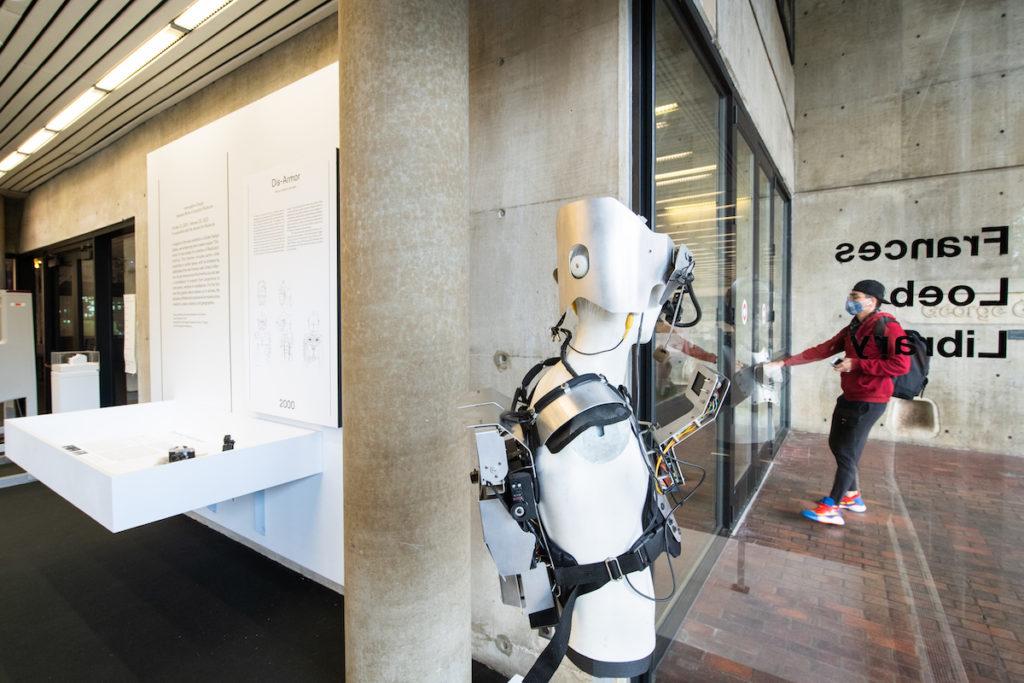
Learn more about two of Krzysztof Wodiczko’s projects: Personal Instrument and Dis-Armor
Interrogative Design Exhibition – Personal Instrument and Dis-Armor
00:00
00:00
00:00
00:00

Heat Magnets: Jeannette Kuo on Mitigating the Harmful Effects of Glass Building Facades

Heat Magnets: Jeannette Kuo on Mitigating the Harmful Effects of Glass Building Facades

Date
Mar. 1, 2022
Author
Karen Schiff

Lever House, Gordon Bunshaft and Natalie de Blois (SOM), New York City, 1952. Photo © Ezra Stoller/Esto .

“More light!” Goethe reportedly said on his deathbed in 1832. At that time, the outer walls of buildings were load-bearing, so they tended to be thick and windows were necessarily small. In the decades after Goethe’s death, structural advances in architecture meant that these outer walls could be relieved of their weight; designers could increase window sizes and admit more light into building interiors. Glass came to be associated with the luxury of being able to pay for the most current building technologies. In the 20th century, this trend of increased transparency evolved into the curtain wall—a building’s outer envelope of sheer glass. Office buildings especially adopted this facade to signal participation in the high-tech world of global capitalism. Though curtain walls tend to look a lot alike, each carries an “aura”: an association with power.

Bringing in “more light,” unfortunately, has become associated with another kind of death: that of the planet. With sunlight comes heat, and the cooling systems that are needed to counteract that heat—aside from being costly—consume more energy and generate even more heat, both of which contribute further to global warming. Glass is also notoriously inefficient with insulation values, increasing energy loss. Now that so many skyscrapers feature all-glass curtain walls, the cumulative environmental effect has become troubling. In 2019, New York City responded with Green New Deal legislation that imposes severe restrictions on curtain walls in future construction. Existing large buildings (25,000 square feet or more) will be required to undergo redesign or retrofitting to reduce energy use, rendering them more environmentally sustainable.

Enter architect Jeannette Kuo, who this past semester taught “THICKER,” a seminar at the GSD about the curtain wall phenomenon. The title came from the possibility that alternatives to the all-glass curtain wall might emerge from the critical study of older and often “thicker” facades. Kuo, who cofounded the Karamuk Kuo firm in Zurich in 2010, had noticed that issues of sustainable facades have yet to be addressed in university curricula from a design theory perspective. Courses often focus more on technological solutions rather than greater conceptual, cultural, and design underpinnings. She imagined that the seminar could be a model for filling this gap in architectural education and practice.

Black and white archival photo of the bottom floors of the Banque Lambert.
As part of the seminar, students conducted studies of buildings with classic curtain walls, including Gordon Bunshaft’s (SOM) Banque Lambert in Brussels, (1961). Photo © Ezra Stoller/Esto.

The motivation for the course has roots in Kuo’s personal history. She watched as glass skyscrapers colonized the built landscape in Indonesia, the tropical country where she grew up, as well as in even hotter, sunnier areas, such as Dubai and Egypt. She noticed that global corporations were using all-glass facades to promote an image of economic advancement tied to the West. Yet the design choice ignores local contexts and is obviously unsustainable: cooling costs in desert climates are immense. Kuo wondered how the worldwide proliferation of these “heat magnets” could be addressed through a shift in architectural culture. She theorized that the curtain wall would remain an automatic design choice in a corporate landscape still driven by global capitalism until it becomes possible to craft alternative images of progress and even alternative structures of power.

Instead of leaving the outside of the building for last, what would happen if the building were designed from the outside in?

The curriculum for “THICKER” was not a technical survey of “green design” possibilities, but rather a discussion-based dive into theoretical and historical material. Kuo blended environmentalism with aesthetics and cultural studies to reconsider facade design altogether. Instead of leaving the outside of the building for last, what would happen if the building were designed from the outside in? If the pressing environmental issues related to the building envelope were treated as a design opportunity, the reconceptualization of the curtain wall could affect the entire building.

Kuo posed several questions to guide the inquiry: What have we found so seductive in the curtain wall’s transparency and reflectivity? How can we understand and call into question this cultural conditioning? Given the environmental concerns, what technical and visual strategies might be gleaned from earlier, “thicker” facades, and why are these older solutions now less popular? What kinds of cultural work does the building’s envelope perform? Finally, how might a facade which integrates cultural and aesthetic details with sustainable technical solutions propose creative visual and conceptual responses to global capitalism?

The course was conducted as a theory and design seminar in a hybrid format. Discussions were open-ended as Kuo encouraged a think-tank atmosphere. Some particularly engaging topics included contrasting the hermetically sealed glass envelope with design strategies that function in conversation with local social contexts. Also, whose vision of “progress”—and what kinds of “power”—does the all-glass curtain wall signify? The class interrogated the value of light in Western mythologies, given that in many non-Western cultures, it has historically been shadow and not light which gives comfort. How might prioritizing shade present a new view of strength?

Reading selections investigated theoretical contexts and case studies starting in the late 19th century, when Louis Sullivan was insisting that “the loftiness of the tall office building must be . . . made the dominant chord in the design.” Studies of buildings with classic curtain walls were contrasted with moments in the mid-20th century when some buildings’ more sustainable facades could be models for challenging the curtain wall, though these projects often were not recognized for the contributions they could offer. The 1962 Economist Building in London, for instance, is remembered for responding to the urban site with a multi-building campus featuring a public plaza, but Alison and Peter Smithson’s facade design featured mullions that channel rainwater flows. Paul Rudolph’s Blue Cross Blue Shield Building in Boston, also completed in the early 1960s, similarly features air distribution through prefab concrete “mullions.” Many of Le Corbusier’s postwar buildings featured brise-soleils and even pioneered the double-glazed “mur neutralisant,” which attempted to address the low insulative performance of glass. He had famously opposed the all-glass curtain wall that was installed at the United Nations headquarters in New York. But a “thicker” facade need not mean a heavier one. The more recent BBVA Tower in Madrid (1981) offered the class a model for using extended balconies to shade a building from the bright Spanish sun while at the same time presenting an image of lightness.


All of these histories and frameworks informed students’ proposals, in the last few weeks of class, for redesigning the Lever House in Manhattan. This choice of a site was thoroughly strategic. The building was declared New York City’s first modernist landmark in 1982; it had been the city’s first commercial building to use an all-glass envelope when it opened in 1952. The building at 390 Park Avenue, about a dozen blocks north of Grand Central Station, still houses the US headquarters of the international company now called Unilever. It has undergone updates to its iconic facade before, and there are plans for another redesign. The company, which spans many types of product brands beyond its original soap, has a clear commitment to sustainability in its buildings worldwide, and now of course it will be subject to New York City’s new energy guidelines for large buildings.


Students imagined various approaches to redesigning the facade. Yet the situation was also technically constrained: the enormity of the surface area and the building’s height meant that students couldn’t simply block light with heavy materials such as brick. The group researched the building, site, local environmental conditions, and corporate history, and each student developed a design proposal based on an aspect of the architectural situation that they found particularly compelling.


Several students attended closely to the aesthetics of Gordon Bunshaft’s original facade design for the Lever Building, which included an all-over grid and a color scheme to match the palette of the company’s signature soap packaging. Others proposed an outer layer of shading in the form of wraparound balconies, especially on the building’s sunny south side. Balconies had the additional benefit of incorporating the breaks that had become a recommended part of work culture since the building’s original design. Some students used in-depth studies of wind patterns to create subtle interventions in air circulation and to harvest wind energy; others looked to the building courtyard’s original landscape design by Isamu Noguchi to inspire ideas that would involve plant life. Inevitably, many designs featured light-blocking panels such as louvers, sails, retractable awnings, and moveable wall elements. These all had the challenge of making sure daylight could penetrate the building envelope while still creating reliable heat reduction and energy savings.


Student projects succeeded in suggesting new possibilities and visual languages for environmentally integrative facade design. Given the environmental damage that the all-glass curtain wall can cause, Kuo’s course demonstrated that there is no reason for remaining entrenched in this design cliché. And as we face an uncertain economic future—“Extreme capitalism is over,” notes Kuo—this course showed how the reconceptualization of the curtain wall could advance new images of corporate health as well as new paradigms for sustainable design.

Blank: Speculations on CLT, edited by Jennifer Bonner and Hanif Kara

Blank: Speculations on CLT, edited by Jennifer Bonner and Hanif Kara

When I began studying architecture in the 1980s, students would often get asked at crits what, exactly, those blank white or beige walls indicated on their drawings or models were intended to be made of. The answer, almost inevitably, was “concrete.” Concrete was the wonder material, the realizer of dreams. The reliable, universal one-word answer. The staff would, inevitably, roll their eyes. But that reliance on a blank material rendered as an abstract surface has been threaded through the history of the last century of so of architecture. In the beginning, even architects themselves could only dream of abstract planes of concrete. Le Corbusier, Rietveld, and the others built walls of brick, rendering them so they would appear as concrete—smooth, featureless, as if drawn rather than built. They made concrete through manifestation.

A century on, with the world more aware of impending climate crisis, that one-word answer of “concrete” might be dumber and even less acceptable than it was then. The response now, however, might well be “CLT.” Even more than concrete, big panels of cross-laminated timber, cut in a spotless factory by robots, far away from the mud, sweat, and swearing of the construction site, looks like the future. Prefabricated, clean, as much drawing as material, rendering as reality, it represents the new wonder material of our eco-aware, guilt-burdened age; the world-saving, carbon-soaking, multifunctional stuff sent to salve our consciences in the creating of new buildings we know to be wrong, in attempting to make architecture at all.

top: wood tower model on wood grain background; bottom: detail view of wood grain model pieces showing layered details
Tower 02: Wood Grain Model, Page 132, Blank.

It is a heavy burden for one material to bear. And that is why Hanif Kara and Jennifer Bonner, who teach together at the GSD, have compiled a book that attempts to feel a way toward a new language for CLT, a material that looks like it has everything, but that hasn’t yet coagulated a sense of theory, meaning, or material culture around itself yet.

The book’s title, Blank (Applied Research and Design Publishing/ORO Editions, 2022), hints at this emergent identity, the still-unformed nature of a material that is both lumber and number, wood and data, a slab that exists between the forests and the digital. In one way, CLT is nothing new. It’s a close cousin of the plywood which emerged as a mass-market material a century or so ago and became a staple building product after having been adopted from other industries including aviation.

Clearing my parents’ old house out the other day, I took an ancient Singer sewing machine to the dump. Heavy as hell in cast-iron, it came in its own vaulted carrying case. I’d guess it was from the 1920s and that curved wooden top was probably the product that propelled plywood into a mass-market material. Singer’s slice of the market was so huge in the early 20th century that their adoption of bent plywood for their sewing machine cases gave this new wonder-material the scale to become an accessible material, one that subsequently came to define varying strands of modernism, from Aalto’s and Breuer’s ergonomic loungers via the streamlined bars and railway carriage interiors of Deco to the spartan studio-interiors of Case Study houses and artists’ studios.

Plywood however was mostly a surface rather than a structure. It’s true there were all kinds of laminated beams and ply products but we still probably think of it as a surface, a sheet. CLT is surface, too. But also structure. It is wall but also floor, ceiling, roof, insulation, internal finish, and the rest. Its versatility is almost comical. It holds, perhaps, a similar status in our age as not only concrete did to the modernists but as plastic did in the postwar era. It looks like the future; a total, wraparound environment.

left: stone wall carved with portraits and words with doorway cut out to show stone interiors; right: detail view of carved stone wall showing brick pattern, images, and words.
left: Lauren Halsey, the Crenshaw District Hieroglyph Project (Prototype Architecture_, 2018. Installation views, Made in LA, June 3- September 2, 2018. Hammer Museum, Los Angeles, Page 162, Blank..
Right: Lauren Halsey, The Liquor Bank, 2019. Hand-carved gypsum on wood, 47 5/8 x 47 5/8 x 1 7/8 in, Page 163, Blank.

On the other hand, it also smells like the past. It might be high tech in its manufacture but CLT is still lumber. Its future should seem assured then, particularly in the US, where the history of housing has been one of adopting the cheapest, easiest timber construction techniques. The American house is already an all-timber affair: the balloon frame, timber windows and doors, shingles, log cabins, lodges, sticks of timber nailed together. It should be simple to segue into CLT construction in which all of that comes in one package.

The writers here outline possible histories and futures, their texts interspersed with designs— plans, models, cutout kits of parts, propositions for a new language of architecture constructed around the capabilities of a material that does so many things at once. Along with the optimism, there is a sense of feeling a way toward new modes of expression. If the designs can look a little familiar, shot through with elements of deconstruction, wiggly walls, Swiss seriousness, and parametric ambition, many of the texts consider what the shift means. This kind of mass timber, Hanif Kara points out, is now being employed in ways more akin to how concrete is currently used in construction. It’s an odd shift—the move from the formwork leaving its imprint on the structure to the timber being employed directly—the return of the uninverted grain.

Blue wall with words "the sun" above yellow, red, and pink arch doorway in the wall
The Sun,” by Sam Jacob Studio at Science Museum, London.

Erin Putalik puts mass timber back in its plywood context with a brisk potted history and Courtney Coffman chooses to look at the qualities of the book’s title, the curious blankness of the material. In his essay, Sam Jacob points out the cartoonish qualities of CLT, the ways in which cutouts and punched openings might resemble the cat-shaped holes in a wall through which Tom has fled at speed or the fake/real ACME tunnels constructed by Wile E. Coyote. There is something clunky in these cutouts, a super-graphic approach to the material as two-dimensional with extruded depth, rather than the complex strata of a more familiar wall or door frame with its codified layers. It has a weird confluence with foam board as a substrate for models, a super-simplified language blown up to 1:1 without translation in material quality.

Buster Keaton 1928 (Source)
00:00
00:00

It is also, as Elif Erez (March ’21/ MDes ’22) points out in her essay for Blank titled “Deadpan CLT”, impossible not to think of the scene from Buster Keaton’s Steamboat Bill, Jr. (1928, featured above) in which the facade of a house rips away from its walls and falls on the deadpan comic in the most perfect way so that his form is accommodated by an upstairs window. The scene was resurrected in Deadpan (1997) by British artist Steve McQueen, who subtly subverted it as an echo of the invisibility of the Black body in 20th-century popular culture. That delaminated elevation is a cipher for CLT, a thing both seriously substantial and comically weightless, sign and signified. There is something slapstick about an entire elevation built from a single sheet as it appears here (though of course this was frame and shingles). It reduces architecture to the condition of a stage set, a flat, something fake built only to represent reality and enable the suspension of disbelief.

Black and white image of man standing in white shirt in the middle of a fallen house façade; interior of empty house pictured in background.
Installation shot of Steve McQueen’s Deadpan (1997) at the Steve McQueen exhibition at Art Institute Chicago, 2012. Image courtesy of Art Institute Chicago.

Other contributors, including Jennifer Bonner, point to the condition of the blank as something already fully assimilated in fine art (she singles out Mavis Pusey; perhaps she might have also alighted on Richard Woods or even Roy Lichtenstein) who used the “plank-ness” of timber as a shorthand for materiality. Elsewhere Gehry, Rossi, Mies, and Corb appear, sometimes as plywood pioneers, at other times as adopters of the blank slab which could be concrete or marble—but why not CLT next? Even Lewerentz makes a guest appearance (in Nader Tehrani’s essay) as an architect who adopted one material—brick in his case—as if it were a contiguous surface, in often surprising and surreal ways, anticipating the way in which CLT is employed as a total environment, a laminated bubble.

corner view of light wood architectural model with many windows and shingles
Tower shingle detail by Elif Erez (MArch ’21/ MDes ’22).

Other writers here comment on the unsettling similarity of CLT structure to a supersized architectural model. Like the basswood or balsa wood architects meticulously incise to building miniature models in which everything is simplified, complex structural beams and details are stripped out and one material, one strip of wood is left to represent all surfaces and both internal and external finishes, CLT, with its clunky depth and chunky cutouts can look like a hypertrophied miniature. It has that quality of a photo taken with an endoscope in a tiny model or those mesmerizing snaps you sometimes see on social media of the inside of a musical instrument, a violin or a guitar suddenly appearing as a kind of Gehry phantasmagoria with a shaft of light piercing the F-holes and the struts and bracing: the everyday made suddenly unfamiliar.

Photograph of grassy field with light wood pavilion featuring a central stair with expansive views of Lake Michigan.
Chicago Horizon, Ultramoderne, 2015. Photo by Naho Kubota.

Many of the authors point out something both curiously cuddly and unsettlingly uncanny about the material. In its grain, its feel, its smell, it is wood; but in its use it is concrete and in its manufacture it is digital. It is that hybridity that has made it simultaneously so attractive and so difficult to pin down, to position in the architectural palette.

Mass timber is, in its way, the architect’s dream material. It is (relatively) sustainable, a renewable resource, prefabricated, digital in its milled manufacture, precise, warm, and able to elude the requirements for the endless layers of finish and insulation which have made a mockery of Victorian and early modernist calls for “honesty” in construction and the show-and-tell approach to elevations. But perhaps sometimes, when we get what we dream of, we don’t know quite what to do with it. Regulation is still catching up, the notoriously conservative construction industry is still not quite convinced, and planners remain, despite endless screeds about sustainability, stuck in concrete.

Every new material, of course, provokes its own reaction. CLT’s super-sustainable halo is now being questioned by some for its liberal use of glue. Dowel-laminated timber (DLT) is occasionally touted as the next next big thing, avoiding petrochemical adhesives entirely. But it looks like CLT is, for the moment at least, here to stay. Blank is as much a comment on its newness, the lack of imprint on the culture, as it is on the character of those enigmatic slabs.

9 black and white building frames arranged in a grid; varying degree of windows and detail on each building
CLT diagram by Hanif Kara.

Concrete, Kara points out, had Le Corbusier’s 1914 Maison Dom-Ino—the ubiquitous image of the column and slab—that remains the model for almost all contemporary construction. The boosters of CLT have not yet emerged with an ur-model as elemental and memorable as this, perhaps because the results might just be too simple, too bizarrely familiar—a house-shaped house, a box. Ironically, Kara suggests, CLT would make a better Dom-Ino house than concrete ever could as planes provide more rigidity than reinforced concrete columns. There is no single image for CLT like Corb’s for concrete in this book, rather an increasingly complex series of explorations of form, each of which points in different directions as attempting to suggest that the possibilities are infinite.

Blank: Speculations on CLT Jennifer Bonner and Hanif Kara, editors Applied Research and Design Publishing/ORO Editions.

The construction of the American balloon frame house, which still seems so simple, fragile, and astonishing to Europeans, was a result of a number of factors. First the availability of cheap timber, second the abandonment of the guilds and master carpenter networks of Europe which prescribed long apprenticeships and complex jointing techniques (along with the propensity of people to build their own houses using limited skills), and third the mass production of the nail as a machine-made and abundant good.

The construction industry since then has become specialized and exclusive, though the framing technique remains.

left: model of timber tower with undulating facade and circular opening at top; right: close up of circular opening
Balloon frame tower by Benson Chien (MArch ’21).

Perhaps CLT needs its barn-raising moment. Perhaps its real adoption will need not only the complex renders and undulating lines of attempts at a parametric city of CLT towers but a return to the cartoonish world of Tom and Jerry and Buster Keaton. Perhaps Spike’s doghouse is a better model than the most complex CLT skyscraper. The charm of the material lies precisely in its elemental simplicity. Anyone who has ever built a model, used Lego, or played with a dollhouse can understand how it works. The problem is not problematizing it, but making it legible. Should be easy.
Right?

Excerpt from Harvard Design Magazine, “South Side Land Narratives: The Lost Histories and Hidden Joys of Black Chicago,” by Toni L. Griffin

Excerpt from Harvard Design Magazine, “South Side Land Narratives: The Lost Histories and Hidden Joys of Black Chicago,” by Toni L. Griffin

Publicly expressing Black pain can render reactions of solidarity, healing, and empowerment, or exhaustion, guilt, and helplessness. However, Black voice can be a powerful instrument of change—used as a currency to be saved or spent or as a carrier of demand and solution. The past year has unearthed untold knowledge that gives additional context to the root of what drives this voice—its trauma, its demands, and its joy. Making this knowledge more public can help to inform how we understand and engage one another; how we reframe harmful Black narratives that shape the public perception; and how the power of Black creativity and resiliency as a political device can produce spaces of Black-centered freedom and liberation.

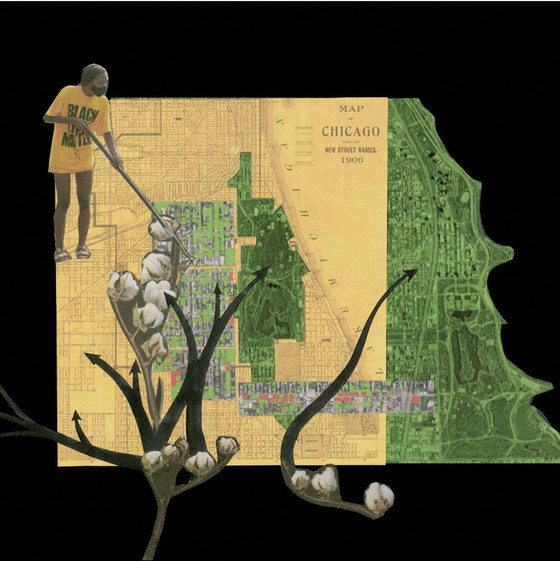
This essay and the corresponding collages aim to represent and make public the confrontation of pain and quest for joy found in the Black public realm of Chicago’s Mid-South Side. Each collage illustrates the relationship between publicness for Black Americans and the current urban landscape of vacancy including southern migration in response to public denial; the public scars left by urban renewal’s land mutilation; and the relentless pursuit of public freedoms in the public realm. The series offers a reflection on the contests that exist over land, space, and place alongside the aspiration of Black Americans to simply occupy and be carefree in public, unencumbered by fear and liberated from self-consciousness.

The collages include present-day mapping, photography, and historic images, in combination with clippings from, and references to, the imagery and symbols of Chicago’s Black life and prosperity used in the work of notable African American artists. My objective was to create new portrayals of the South Side and its people by making public some of the lesser-known narratives about these neighborhoods over the last century.

The narratives, rooted in the ownership and occupancy of land, reveal the practices of institutional racism, exclusion, and extraction, juxtaposed against images of the undiminished spirit, ambition, productivity, and creativity of Black Chicagoans. Richard Wright describes this as the “extremes of possibility” in his introduction to Black Metropolis: A Study of Negro Life in a Northern City, the seminal 1945 book by University of Chicago researchers St. Claire Drake and Horace A. Cayton on Negro life in Chicago: “There is an open and raw beauty about the city that seems either to kill or endow one with the spirit of life. I felt those extremes of possibility, death and hope, while I lived half hungry and afraid in a city to which I had fled with the dumb yearning to write, to tell my story.”[1]

BLACK MIGRATION | PUBLIC DENIAL

AVAILABLE WITHOUT FREEDOM | In the introduction to Black Metropolis, Richard Wright describes white Chicagoans questioning why Black migrants willingly uprooted themselves from the South, given the racial animosity and rapidly deteriorating built environment of Chicago’s South Side in the early 1900s. Between 1916 and 1970, six million African Americans migrated from the rural South to industrial cities in the Midwest and Northeast. In the first five years of the migration, Chicago saw a 50 percent increase in the Black population—from 46,000 to over 83,000 residents; by 1937, more than 237,100 Black Americans called the South Side home. [2]

Fleeing the Jim Crow South meant the possibility of industrial rather than agricultural work, with the promise of better wages and greater public freedoms to move about the city. Upon arrival however, migrant Blacks were confronted by a different form of public denial. Throughout the Jim Crow era, when separate but equal was the law of the South, northern cities maintained a different form of discriminatory practices perpetuated by white homeowners, real estate agents, lenders, and employers. Racial restrictive property covenants, redlining, and blockbusting formed an impenetrable barrier, intentionally constraining the geographic and economic mobility of Blacks in the city. These practices simultaneously and systematically devalued Black land assets and deepened the narratives of Black inferiority and Black neighborhood undesirability. The new Black Chicagoans found themselves spatially confined to an area that would become the Chicago Black Belt, unable to avail themselves of all the offerings of urban life.

Today, the Black Belt is simply referred to as the South Side. For a Black Chicagoan, growing up on the South Side is to be nourished in Black space, but often with little knowledge of the forced restriction that once bound people together in place. Nonetheless, the South Side now proudly belongs to Black Chicagoans, and their claim is validated by its history of confinement.

Collage featuring a map of Chicago with a masked Black person holding a stick over a larger than life drawing of cotton.
An Unguaranteed Existence.

AN UNGUARANTEED EXISTENCE incorporates the three Great Migration routes used by Black Americans to access the greater personal freedoms and fortunes promised by cities outside of the southern states. The routes are intertwined with thorny cotton stalks representing the escape from chattel slavery and journey toward the Chicago Black Belt. Underneath is a 2020 aerial map of the Washington Park and Woodlawn neighborhoods, where over 200 acres of publicly owned vacant land appear as green voids on the map similar to the formal park spaces of the neighborhood. These vacant lands, the byproduct of urban renewal, disinvestment, and Black population exodus from the South Side, are demanding a new form of land care by remaining residents. Today, however, tending the land is not generating wealth for anyone; instead it is a temporary investment of sweat equity to cultivate greater safety, beauty, and mental well-being while residents wait for redevelopment.

Continue reading on the Harvard Design Magazine website…

“South Side Land Narratives: The Lost Histories and Hidden Joys of Black Chicago” by Toni L. Griffin is excerpted from Issue No. 49 of Harvard Design Magazine: Publics.

Mise-en-Scène: A new book from Chris Reed and Mike Belleme explores the theater of urban landscapes

Mise-en-Scène: A new book from Chris Reed and Mike Belleme explores the theater of urban landscapes

Date
Feb. 18, 2022
Author
Vrinda Kanvinde
Black and white photograph of a structure covered in foliage.
Photo by Mike Belleme for Mise-en-Scène.

Conceived as a multidimensional investigation into “the social lives of urban landscapes,” Mise-en-Scène: The Lives & Afterlives of Urban Landscapes (ORO Editions) is a powerful collaboration between photographer Mike Belleme and landscape-urbanist Chris Reed, professor in practice of landscape architecture at the Harvard Graduate School of Design. The book is centered around seven case studies: Los Angeles, Galveston, St. Louis, Green Bay, Ann Arbor, Detroit, and Boston. It intersperses photo essays by Belleme with selected maps, drawings, and wireframe renderings of projects from Reed-led landscape firm Stoss Landscape Urbanism , along with essays from guest contributors, quotes from contemporary and historical writings on the city, and interviews with residents. Reed describes Mise-en-Scène as “a bit of a scrapbook, a collection of artifacts and documents that are not necessarily intended to create logical narratives, more intended as a curated collection of stuff that might reverberate, one thing off another, to offer multiple readings, multiple musings, multiple futures on city-life.”

In the context of theater, “mise-en-scène” refers to the arrangement of scenery, props, and actors onstage, and in a broader sense, to environment or milieu. Reed draws out both of these connotations through the book, describing the work he does as “understanding the scripts and dialogues as they are playing themselves out; interacting with those on stage and the forces behind the scenes in ways that both respond to and shift what is at work; re-setting the trajectory of the play in ways that sometimes reveals what is hidden; and giving new voice to those who have been off stage—all allowing for new and healthier interactions among urban dwellers, their cities, and the environments in which they live.”

Through the triangulation of what is, what was, and what ought to be, photography and design prompt one to indulge in the kind of utopian imagination necessary to energizing activism.

Headshot of Sara Zewde
Mise-en-Scène contributor Sara Zewde. Mise-en-Scène contributor Sara Zewde

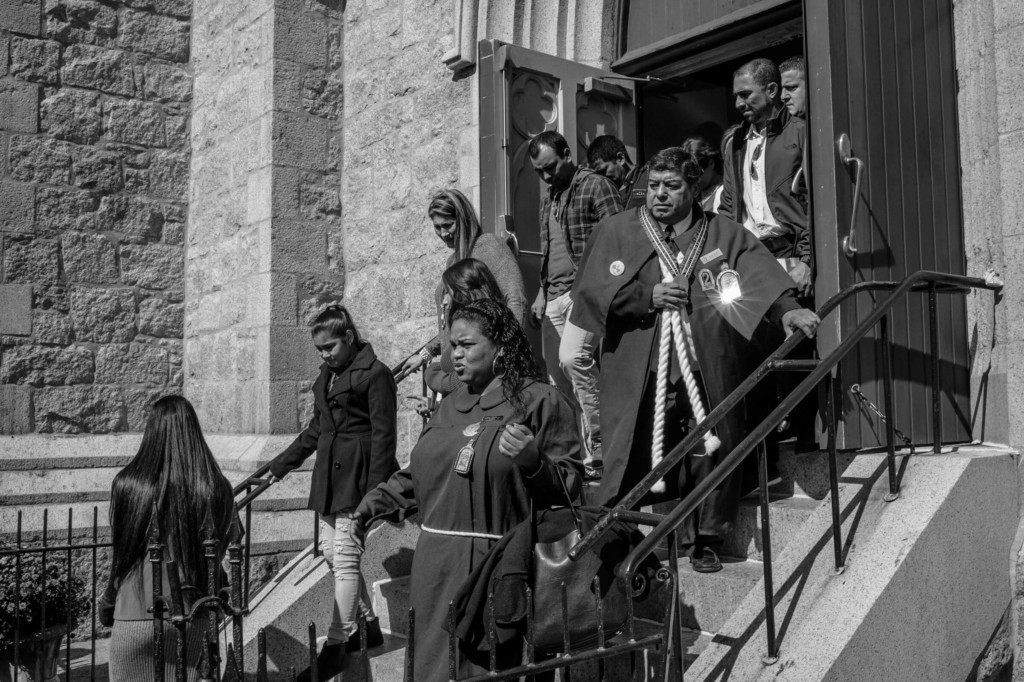
The book features textural black-and-white photography, often shot at street level, and unwavering in its portrayal of gritty detail that highlight the many facets of a city. Candid images of people, landscapes, and built form are occasionally overlaid with sketches and annotations. Through his photography, Belleme captures small, everyday moments of joy or interest and finds commonalities across cities, despite differences in size, density, and environmental features.

The maps in the introduction of each of the cities make obvious the difference in scale, morphology, and geographical features of the cities, and yet an inherent interconnectedness emerges. Perhaps this can be explained by the quote from Teju Cole that the book opens with: “All the cities are one city. What is interesting to find, in this continuity of cities, the less obvious differences of texture: the signs, the markings, the assemblages, the things hiding in plain sight in each cityscape or landscape.”

Black and white photograph of church goers exiting the building.
Photo by Mike Belleme for Mise-en-Scène.

And therefore, much as described by Jim Dwyer in Scenes Unseen: The Summer of ’78, or seen in William Whyte’s The Social Life of Small Urban Spaces (1980), which Reed lists as two of the influences for the book, there is a dynamic relationship of people’s interaction with public space, impacted by time of day, and patterns of sun and shade. The influence of The Social Life of Small Urban Spaces is clearly perceptible in the photographs—portraying people adapting the space to their own needs and using it as they see fit. As Reed says, “Many of Mike Belleme’s Mise-en-Scène photographs capture the rich social dynamics and urban-environmental conditions that we play off as designers and urban strategists; they document the lives of the places where we work, the afterlives of some of the places we have designed.”

The photo essays are interspersed with five essays from a diverse and interdisciplinary group of collaborators, to further provide framework. Curator Mimi Zeiger grapples with the issues of climatic and socioeconomic disparities in edge conditions in Los Angeles. Artist and activist De Nichols (LF ‘20) delves into issues of social equity and identity, along linear demarcations in cities such as St. Louis and Cleveland. Julia Czerniak analyzes the aesthetics and experiential quality of Stoss’s work, and speaks to the importance of aesthetics, in addition to today’s preoccupation with performance and sustainability. Nina-Marie Lister contextualizes landscapes within the climate crisis, and touches on issues of resilience and adaptation, stressing the need to work collaboratively across boundaries. In the final essay, Sara Zewde, assistant professor in practice of landscape architecture, reflects on the parallels of photography to design, positing them both as “acts of shaping how someone views the world.”

Graphic displaying predicted sea level rise from 1950 to 2100.
Diagram of predicted sea level rise in Galveston, Texas by Stoss Landscape Urbanism for Mise-en-Scène.

The writing is specialized, yet accessible, catering to activists, sociologists, aficionados of art, culture and photography, and city-lovers in general. These are spatial observations, and analyses of urban landscapes, but they are also deeply personal accounts. Nichols writes of her experience on the frontlines of protests in St. Louis that she was “harassed by patrons at the most deluxe mall of the county. I was tear-gassed in one the neighborhoods most lauded for its diversity and safety,” and Zeiger writes of the implicit privilege of inhabiting a white body in Pasadena.

Though the photographs were taken pre-pandemic, and this project has been four years in the making, the writings are oriented to a post-pandemic world. They reflect the inequity, systemic racism, and police brutality that were exacerbated by the pandemic, made glaring by the Black Lives Matter protests that swept the country. The photographs and writings shine a light on what the last two years have meant, environmentally and socially—and on the importance of having equitably accessible landscape spaces in our urban environments.

As Reed explains, “[Mise-en-Scène] is at once an artful documentary project on contemporary cities, city people, and the forces playing out across cities and public spaces everywhere. But it’s also a creative project about the future, about identifying pathways forward; about how people as individuals and entire communities, with artists, planners, designers, thinkers, government leaders, citizens, and activists can collaboratively shape our futures.”

Black and white photograph of birds flying over the horizon with an large boat in the distance.
Photo by Mike Belleme for Mise-en-Scène.

And Zewde echoes, “Through the triangulation of what is, what was, and what ought to be, photography and design prompt one to indulge in the kind of utopian imagination necessary to energizing activism. There are striking similarities in the analytical endeavors of remembering the past, analyzing the present, and imagining a future. What worked? What didn’t? What is working? What isn’t working? What shall we conserve, destroy, and build in our new world? And, how do we advocate for it?”

If the pandemic and the past two years have taught us anything, it is that despite human resilience, and moments of celebration captured by Belleme, cities as they are today do not work. As design professionals, we have a chance to pause, recalibrate, and pivot toward a more equitable and climate-resilient future for our cities, and we must take it.

Design Proposals for the Uncertain Future of American Infrastructure

Design Proposals for the Uncertain Future of American Infrastructure

As the world ground to a halt in the spring of 2020, with the COVID-19 pandemic shuttering shops, schools, subways, and offices, a street in Queens opened itself up as a new site of social infrastructure. [1] Located in Jackson Heights, one of the most congested neighborhoods in New York City with among the least green space per capita, a 26-block stretch of 34th Avenue was transformed into a 1.3-mile-long “vertical park” by the grassroots 34th Ave Open Streets Coalition. For 12 hours a day, every day, the street closed down to cars, permitting weary workers, solo-living seniors, and working-from-home parents and their children to stretch their legs, join in socially distanced exercise classes, swing by a community-led food pantry, or tend to a communal median garden that was—finally—their own.

Heralded as a visionary prototype for a more equitable and sustainable future city, the project also underscored the importance of civic space in an era marked by increasing privatization of the public realm. Reclaiming the street within a pandemic that both exposed and exacerbated the stark inequities of access to healthcare, community support, and green space across the United States framed the necessity of such spaces, in the words of sociologist Eric Klinenberg, as a matter of life or death. [2] In a keynote lecture recently delivered at the GSD , Klinenberg highlighted 34th Avenue as a success story within a larger domestic policy movement toward an expanded definition of infrastructure, in part fueled by the pandemic. “The pandemic forced us to hunker down and maintain physical distance,” says Klinenberg. “But we also developed newfound appreciation for gathering places that we had taken for granted. My hope is that we channel that into support for social infrastructure. We’re living through a unique moment, and we’re poised to make transformative investments in the physical systems that sustain us.”

Image of several elementary-aged school students walking to school on blocked-off street in Jackson Heights
Morning student commute. 34th Ave Open Streets advocated for car-free streets during morning school drop-off. “About 7,000 kids who go to school along the corridor are safer. That’s just one benefit but it’s a big deal, and other neighborhoods around the city should replicate it.” Image courtesy 34th Avenue Open Streets Coalition Facebook post.

Such an investment may begin through the Biden administration’s Build Back Better framework. Viewed as one of the most significant domestic policy agendas since the New Deal of the 1930s and the Great Society of the 1960s, Biden’s original $3 trillion BBB plan comprises two pieces of legislation: the $1.2 trillion bipartisan infrastructure bill, signed into law on November 15, and the $1.75 trillion Build Back Better (BBB) bill, which remains stalled after a firm rebuke from Senator Joe Manchin.

The infrastructure bill (also called the public works law) addresses what we typically think of as infrastructure, and offers the largest investment in the sector in over a decade. It includes funding for repairing and expanding roads, bridges, mass transit, and rail service, as well as upgrades to ports, electric grids, and water infrastructure. It casts a wide net across the country, including the replacement of lead pipes in Illinois, bridge repairs in Massachusetts, regional transit connections in Louisiana, and abandoned mine cleanup in Kentucky. In addition to bolstering material infrastructure, the bill hones in on the so-called “digital divide,” funneling $65 billion into expanding broadband access to rural and disadvantaged communities in the US.

The controversial BBB bill—focusing on what it terms “human infrastructure,” or social infrastructure—includes allocations of $150 billion for new affordable housing, $550 billion for climate-related policy and programs, $18 billion for universal pre-K, and $200 billion for childcare. For political reasons, however, many of these provisions will be absent from the bill, if it ever clears the senate. Both bills are the first pieces of federal legislation in over a decade to address the climate crisis and suggest solutions for mitigating the impact of global heating.

Rendering of converted bus painted lime green with orange signage that reads "Care-A-Van"
Care-a-Van the final project by Elif Erez (MDes ’21), Geraud Bablon (MUP ’22), Maggie Chen (MDes ’23), and Snow Xu (Mdes ’23) for “Reimagining Social Infrastructure and Collective Futures.” Care-a-Van features a converted bus that serves as a mobile dining room and community hub that centers old adults as integral parts of our social infrastructure.

Across both bills, the idea of infrastructure expands to include social reform, digital telecommunications networks, climate justice, clean energy, and affordable housing. In addition to Klinenberg’s keynote, multiple studios and seminars at the GSD last term attempted to grapple with this multifaceted understanding of infrastructure. “That the Biden bill recognizes and supports social infrastructure, the economies of care, and reproductive labor, particularly at the household scale, is an exciting step for a country wherein everything has been relentlessly privatized,” says Malkit Shoshan, who taught “Reimagining Social Infrastructure and Collective Futures” in the fall. “By strengthening the household economy, stronger households can better interact with other households and create a commons. These issues should be essential to talking about the future of infrastructure—that it’s a matter of the values we preserve as a society.”

Shoshan framed her project-based seminar with key theories intersecting the social sciences, economics, feminist theory, and ecology, including those of economist Kate Raworth, author of Doughnut Economics, and philosopher Sylvia Federici, whose writings on reproductive labor have found new relevance during the pandemic. Students were asked to envision a more intersectional social infrastructure, where the well-being of mothers, caregivers, the elderly, and other marginalized groups, as well as precarious public services, were integrated into a collective future vision of a healthier planet. Among the projects to emerge from the seminar was a reimagining of the post office infrastructure, which is at risk of privatization, as well as a mobile “Care-a-Van” that revitalizes the lives of the elderly and reintegrates them into public spaces, generating new social networks. A “school for the future” sought to support an underserved public high school in East Boston, the largest in the area, in a neighborhood expected to be flattened by sea-level rise as early as 2050. In addition to providing climate infrastructure, the project proposed opening up the physical infrastructure to community use in after-school hours.

Rendering of glass building at dusk with warm glow from windows.
“Rooms of UrbanEngagement” by Jeff Cheung (MArch II ’23), completed for the option studio “ROOM,”  re-imagines the reading room at the Boston Public Library to extend beyond the act of reading – it is a space that facilitates the civic and social activities of the surrounding urbanity. It connects the library to the public (Copley Plaza) by mediating between a set of dichotomies.

Ron Witte’s studio, “ROOM,” took a micro-scale lens to the question of what constitutes good social infrastructure, from the design perspective of the public interior. Utilizing a new reading room for the Central Boston Public Library as a case study, students were asked to envision alternative design protocols for indoor institutional spaces in an era where the role of such spaces is expanding as social infrastructure. Proposals varied widely, from reimagining the cultural status of the library to a “high-tech medium,” where visitors are given a window into the guts of archival space through a series of tubes transporting reading materials, to cracking the institution open like an egg, making its processes visible from the outside and expanding the internal boundaries of the building. “Architecture has been pushed to the side in this conversation around the future of infrastructure,” says Witte. “We’ve tended to focus on broad questions around social infrastructure, economies, and public spaces, but without architecture to prompt them into a new state, nothing will happen.”

rendering of interior with light pink stone floor, curtain wall windows showing outdoor greenery
Ground Level rendering of “Rooms of Urban Engagement” a project by Jeff Cheung (MArch II ’23) for the option studio “ROOM.”

Additional federal efforts are necessary to ensure the Building Back Better framework’s climate resilience funds meet those who need it most. The new White House Environmental Justice Advisory Council is a step in the right direction, with 26 leaders from diverse communities appointed to judge applications for community-led climate infrastructure projects. [3] But there must also be increased support at the local level, to ensure these communities have no barriers to accessing funds and can realize these projects collaboratively. Responding to this condition, Dan D’Oca’s fall studio, “Highways Revisited,” was an exercise in reimagining the future of 10 cities and their surrounding highway systems. Each student was connected with a local activist or government official to envision an alternative use for that highway infrastructure while taking stock of its historical damage to disadvantaged communities.

Whittled down from a short list of 50 areas, the selected sites cover a wide range of topologies and racial and socioeconomic spectrums—they include El Paso, the Jamaica Plain neighborhood of Boston, Detroit, Oakland, and New Orleans. “The idea was to find examples of cities where there was already a conversation about highway removal, but where things weren’t so settled,” explains D’Oca. “It was important for students to be able to think big and dream, but also have the guidance of a good liaison, and the tenability of a pitch process.”

“When you destroy a neighborhood you don’t just destroy homes, you destroy vehicles for amassing generational wealth.” – Dan D’Oca

With guidance from a lifelong resident of the Tremé neighborhood of New Orleans (one of the oldest Black neighborhoods in the US, and the birthplace of jazz), one student transformed a stretch of I-10 that decimated the neighborhood into a powerful piece of community infrastructure, complete with public housing, green space, events programming, and an arts and music venue. (The White House has proposed removing the expressway altogether). For El Paso, another student nixed the freeway running along the US-Mexico border, restoring the original landscape of a green river valley and building a new neighborhood alongside it. In the Minneapolis-St. Paul area, a student worked with local liaisons to envision the removal of an eight-mile stretch of I-94, replacing it with a parkway, a rapid transit system, and new neighborhoods. The studio explored the emerging concept of “right to return,” currently piloted by the city of Santa Monica , which specifies Black communities displaced by mid-century urban renewal policies should be at the front of the line in new affordable housing markets. “When you destroy a neighborhood you don’t just destroy homes, you destroy vehicles for amassing generational wealth,” explains D’Oca. “So this idea of a ‘right of return’ being implemented by some local policymakers integrates the idea of infrastructure as an opportunity for reparations.”

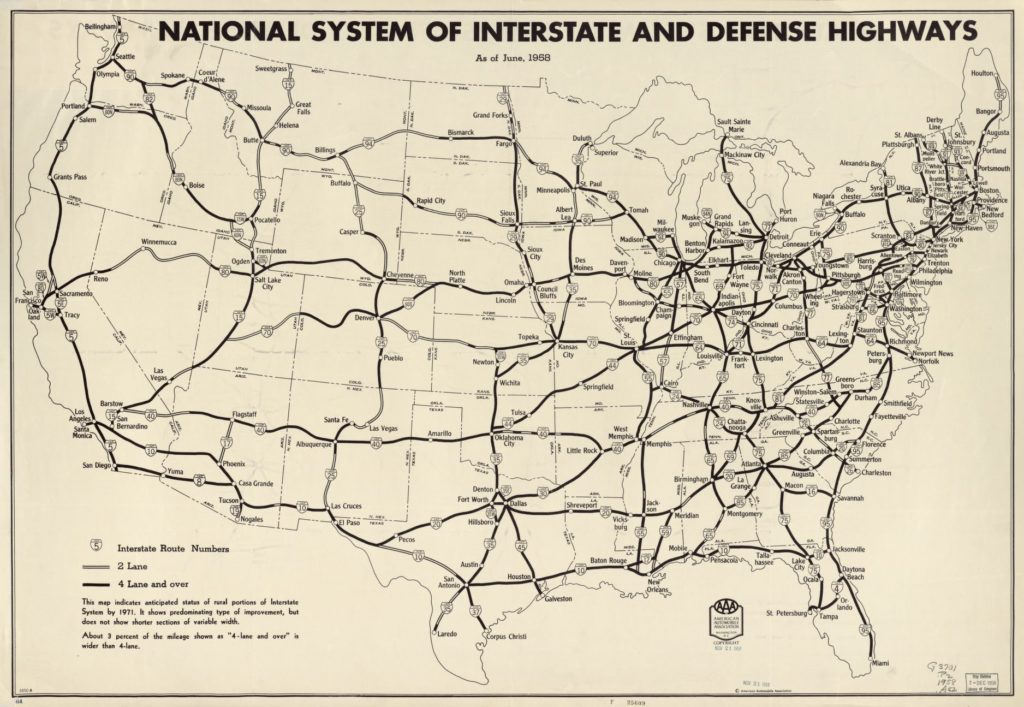
Map of US with interstate highway lines bisecting the land.
US national system of interstate and defense highways as of June 1958. Courtesy Library of Congress.

Tom Oslund and Catherine Murray’s studio, “Harnessing the Future,” looked beyond the US to address the social, ecological, and economic entanglements of digital infrastructure in the small west Irish town of Asketon and the surrounding Shannon Estuary, where a new data center is slated for development. With a local environmental engineer as steward, students were tasked with reimagining the design of the data center to support the local economies and histories of Ireland, while adhering to the region’s strict conservationist protocols, and achieving carbon neutrality. One of the proposals utilized the energy of cow waste and Atlantic wind turbine production to fuel the data center. Another restricted its size and energy consumption to the amount of energy needed to churn Ireland’s signature domestic export, Kerrygold butter (and recycling the energy to do so). And the third proposal divvied up the area into wind energy–producing parcels of land owned by locals to sell back to data providers, flipping the power hierarchy between opportunistic data companies and residents. Oslund cites the main challenge with equivalent projects in the US as “a problem of too much land and too little restraint”—but is optimistic that an industry-led initiative for ecological design alternatives could catch on across the Atlantic. “The paradigm change that must happen is the responsibility of these companies,” he says. “Data centers have already surpassed airlines in carbon emissions, and there’s too much at stake. This studio was put in place to showcase more environmentally conscious design alternatives that support local economies and culture.”

As the future of the BBB remains uncertain, and the real work of the Infrastructure Bill lies ahead, it’s crucial that in expanding our definition of infrastructure, we take care not to divide it. A truly democratic approach to infrastructure acknowledges its constituency and responsibility across all sectors and publics: in other words, digital infrastructure must be social infrastructure; climate resilience infrastructure must also impart a civic value. Closing out his keynote lecture, Klinenberg gave a simple example for how this might be achieved: by revamping the design of a levee, which will be an increasingly common piece of infrastructure amid rising sea levels, to include a public park on top. What’s required is a crucial shift of perspective that enables new infrastructure. As Oslund says, it needs to “provide the same function, but allow for a different story.” There must be a design sensitivity on both a micro and macro scale to ensure it benefits those it has a particular duty to serve. The future of infrastructure requires a feminist design approach that centers marginalized groups; an equitable approach that incorporates reparations to communities who bore the damage wrought by earlier infrastructure projects; an ecological approach that acknowledges the stakes of the climate emergency; and the support of a public resource system that ensures the longevity of grassroots initiatives. Despite its warranted criticisms, the BBB framework offers a vital first step in this direction. Now, it’s up to designers and policymakers to get to work.

[1] In his book, Palaces for the People, sociologist Eric Klinenberg defines social infrastructure as a loose category of public places—parks, playgrounds, libraries, and town halls, as well as grocery stores, cafés, and barber shops—that are the spatial glue of a healthy society. Formal and informal, organized and happenstance, these are the hang-out spots where communities are made and people learn to look out for each other, particularly in times of crisis.

[2] Klinenberg’s acclaimed research on the “high resilience” areas of the 1995 Chicago heatwave pinpoints the significance of robust social infrastructure in contributing to low death tolls in otherwise demographically similar neighborhoods.

[3] Both bills intend to jumpstart the Justice40 Initiative ordered by Biden just days after taking office. It outlines that 40 percent of federal climate spending must reach underserved areas (formally defined as low income, rural, and/or communities of color), as a climate justice initiative. Despite these promises, critics argue this money will largely benefit middle-class, white communities .

Mohsen Mostafavi Remembers Richard Rogers (1933-2021)

Mohsen Mostafavi Remembers Richard Rogers (1933-2021)

Date
Jan. 26, 2022
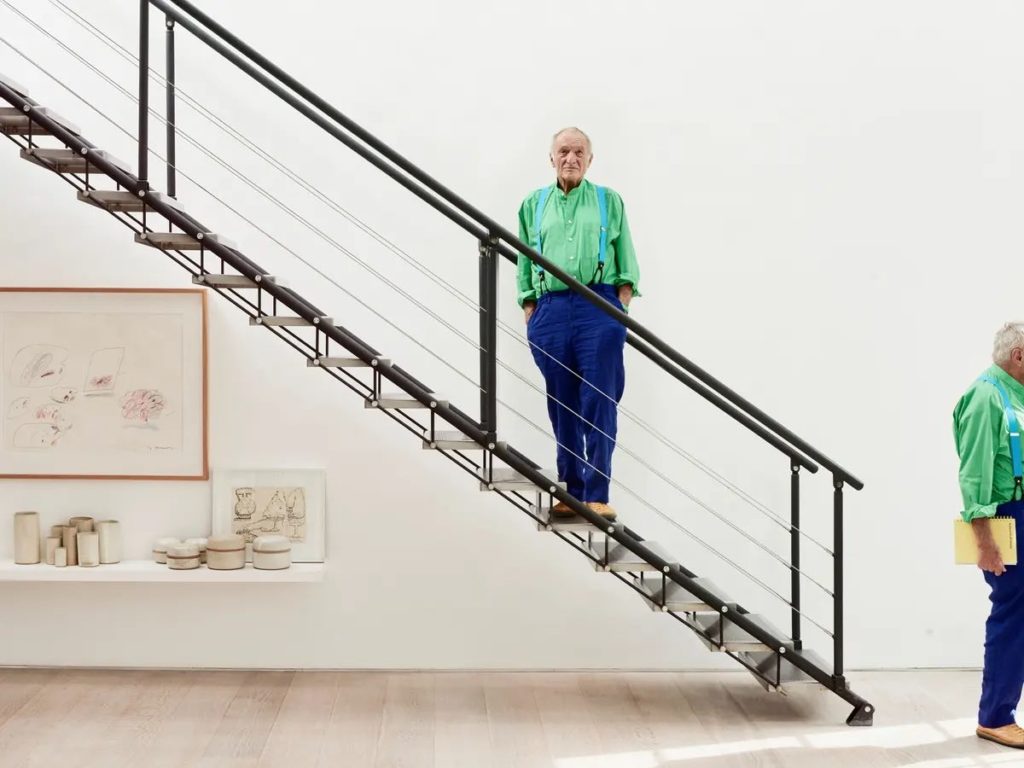
Richard Rogers wearing a florescent pink shirt, seated in front of 22 Parkside.
Richard Rogers in front of 22 Parkside in 2017. Photo: Mohsen Mostafavi.

Richard Rogers was one of the few remaining major figures in architecture whose career and education had a direct link with the ideological project of the modern movement and its call for social change. Richard loved bright colors, in architecture and in clothing, and believed in the contribution of cities toward a better quality of life. More specifically, he championed urban regeneration on brownfield or disused sites with an emphasis on compactness and density.

Born in Italy and raised in the UK, his ideas and works were shaped by his European heritage. He was related to the celebrated Italian architect Ernesto Nathan Rogers, editor of Casabella magazine and a founding member of BBPR, the practice responsible for the iconic Torre Velasca in Milan.

Despite having dyslexia, Richard completed his diploma at the Architectural Association in London, where he worked with Peter Smithson, among others. He then continued his education at Yale under Paul Rudolph. His time at Yale coincided with that of another British architect, Norman Foster.

Richard will probably be best remembered for two of his practice’s most iconic buildings, the Pompidou Center in Paris (1977) and Lloyd’s in London (1986). The former was designed in collaboration with Renzo Piano; Peter Rice was the engineer on both.

However, it is two relatively small houses that helped define his characteristic approach toward architecture. The first of these, Creek Vean, was designed within the context of a collaborative practice, Team 4, made up of Richard Rogers, Norman Foster, and their then partners, Su Rogers and Wendy Ann Foster. Anthony Hunt was the engineer for the project, which was completed in 1966.

Looking at the house today, one wouldn’t associate it with the later work of either Richard Rogers or Norman Foster—apart, perhaps, from the open-plan interiors with their beautiful views of the landscape captured through the plate glass windows. Still, the house is important for Richard’s subsequent and lifelong commitment to teamwork and the idea of collaborative practice.

While Creek Vean was designed for Su’s parents, Richard soon had the opportunity to design a house in the London suburb of Wimbledon for his own parents, a doctor and a ceramicist. Based on an unrealized project, the Zip-Up house, it required the use of factory-made insulation panels that could be easily assembled on site. Ironically, given this dream of industrial production, the result was, to a large extent, a bespoke and handcrafted artifact. But the innovative and experimental house not only captures the DNA of Richard’s later work, it also exemplifies the sense of lightness, joy, and color that defines the best characteristics of his architecture.

On a personal note, I was fortunate to have Su Rogers amongst a group of teachers when I first started my architectural education. Later, during my tenure as the dean of the Harvard Graduate School of Design, Richard and his second wife, Ruthie, generously gifted the Wimbledon house to the GSD. The house was meticulously restored by Gumuchdjian Architects. Philip Gumuchdjian had been a former student and had also worked with Richard for a long time before setting up his own practice. The landscape architect for the restoration of the garden was a GSD graduate, Todd Longstaffe-Gowan.

Wimbledon House—known as the Rogers House or 22 Parkside—was the primary residence and London venue for the Richard Rogers Fellowship. Photo: Iwan Baan.

When the house was first built it had a carport, which was subsequently turned into a separate smaller house, creating an intimate courtyard with the main house. The two buildings, with the help of a generous donor, provided the basis for a GSD/Richard Rogers residential fellowship program. The aim of the Richard Rogers Fellowship was to enable designers and scholars from around the world to spend up to three months in London and to engage in the study of the built environment. Richard’s own interests in architecture, culture, technology, the arts, and the city provided the framework for the broader scope of the fellowship.

In addition, a series of events on the city, and London more specifically, brought a diverse range of speakers and experts together. Organized as a “salon,” these small gatherings of around 50 people in the main living room of the house created great opportunities for debate, on such topics as engineering and housing. It was inspiring to have Richard participate in these events and to meet and mentor the fellows. He also enjoyed the experience very much.

Richard and Ruthie spent about a week at the GSD a few years ago when we invited them to be the Senior Loeb Fellows. Ruthie, a celebrated chef, gave a wonderful talk about how they managed and organized the produce and the menu at her restaurant, the River Café. Richard met with students and talked about architecture and, as you might expect, about what it could do for society.

Probably more than any other architect of the recent past, Richard was committed to architecture and technology’s social and political impact. It can be argued that his practice’s work, especially the exclusive residential projects, didn’t always align with his intellectual and political beliefs. But during certain moments, the practice’s outcome genuinely challenged the relationship between architecture, technology, and the conditions of production. He also managed to be hugely influential for a period of time with Britain’s then ruling Labour Party by making architecture and the built environment topics of political significance that affect people’s quality of life, and indispensable cornerstones of democracy.

I will miss Richard’s friendship, warmth, and generosity. And of course, his flair for colors.

Strictly Typographic: Behind this year’s public programs posters by Harsh Patel

Strictly Typographic: Behind this year’s public programs posters by Harsh Patel

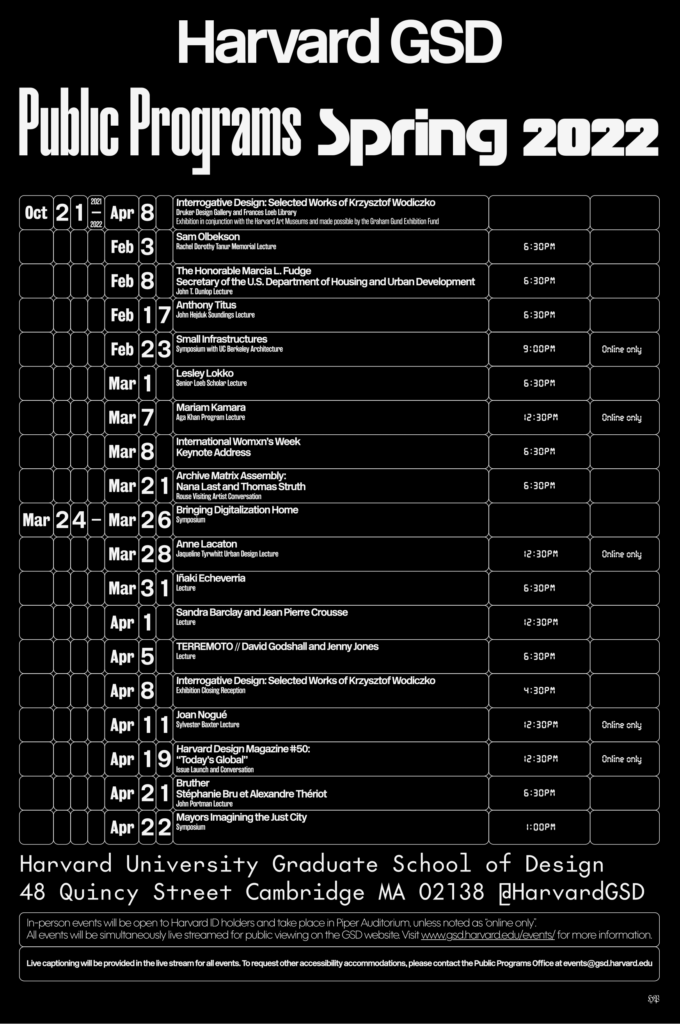
Black poster with white text listing the GSD's spring 2022 public programs.

The Harvard Graduate School of Design’s art director Chad Kloepfer first came across designer Harsh Patel ’s work in two books: Of Walking in Ice by Werner Herzog and Roman Letters by Evan Calder Williams (co-designed with Mark Owens). “They both felt as if they had landed in the here and now from a different era,” says Kloepfer. “It was hard to pin down a reference point and I was immediately charmed by the mystery and mood of it all.” It was in part due to these two exquisite objects that Patel was invited to design this year’s public programs posters, the second iteration of which will be unveiled today with the announcement of the spring semester’s public programs. Kloepfer and Patel sat down to discuss design practice and thinking in a world that’s pushed ever further into the digital sphere.

Chad Kloepfer: Coming into this season’s public programs posters, we were interested in pushing this project somewhere new, graphically. Can you talk about your entry into the process and the creation of this poster? 
Harsh Patel: In our initial discussions, I suggested that the seemingly straightforward task of presenting this information could simultaneously express two different feelings about the second year of this pandemic. The first approach—reflecting how introspective everything sort of got, assuming you stayed inside—was to be pared down typography, in a kind of first-person singular voice. It would be laid out in dense, intricate grids with pragmatic but idiosyncratic typefaces like the original Futura. The second approach resonated more with me on a personal level, although it made for a far less practical working methodology. It’s a visual summary of the anxious barrage that we stepped into when we went outside. The public programs poster and all of the individual event posters are pastiches of these ideas.

Black and white poster graphic with 3D, bubble, and bold type.
Fall 2021 Public Programs poster designed by Harsh Patel.

I want to backtrack for a moment and ask: when you get a commission like this one—where there is not a lot of specificity to the brief—how do you begin to generate an idea or concept? Do you have a methodology that applies to a broad range of work, or is it a different working model, specific to every project?
Employing a set methodology could make things easier on myself, financially. Designers in the cultural sector with one of those in place really do manage assembly-line operations, especially in cities like New York. But, no: the problem-solution model isn’t something I believe in. There’s sometimes a financial incentive to commit immediately to a project like this and think backwards from a timeline or budget, but nowadays it’s more important to find a meaningful intersection, and to know when to say no.

Something I’ve always appreciated about your work is how it defies an easy definition. Almost every component of the work appears, to me, to be “found” for lack of a better word—which I mean as a compliment—and this poster is no exception. How did you arrive at the mixture of different typefaces used on the poster and how do you see that relating to the form of the lecture poster?
The typography is a capsule of street level commercial design—mostly the more vernacular kind that preceded today’s digital hypermarket. It’s the lettering on a paper cigarette package, or the logo on the underside of a plastic toy, or the made-to-order lightbox signage of a fried chicken shop. The only purely institutional component was the base typeface, Margaret Calvert’s New Rail.

Is there a strategy to the typeface(s) chosen for each lecture, or is it something you come at from a more instinctual place?
There’s no set strategy, other than going for lesser-known types.

The posters for the GSD are strictly typographic, but I’ve always been curious about your use of imagery; it’s quite specific. How do graphics and imagery find a place in your work?
In our profession, we typically receive photographic content pre-determined to fit within the image-and-copy relationship that defines most advertising design. We are usually granted some license to manipulate these images and attempt to subvert their meaning, as long as we remain within the bounds of the brief. This framework just isn’t that interesting to me. Graphic design shouldn’t willingly constrict its expressive possibility to that kind of messaging.

We also have more access to images and to the means of comparatively simple image making than ever before. In my intro courses, a ground concept is that we can articulate our aesthetic subconscious into visual form. It takes confidence and honesty to mine those depths and hone meaning into an individuated language or style. Making images is only meaningful or fulfilling if I feel that the translation from thought to expression is clear and concise, that the process is economically sensible in terms of time and resources, and that there’s ideological consistency in the bird’s-eye view.

We spoke briefly over Zoom about the relationship, or influence, of European design on US design. You were born in Nairobi and you currently work from both Los Angeles and New York City: how does both a sense of place and design’s many histories enter your work?
My upbringing in India and Kenya gave me a set of cultural experiences that shaped how I see myself amongst the world, generally. The American cities I’ve lived in as an adult have shaped my critical outlook and working methodology. Certainly my perception is that our daily practice hasn’t fully realized the value of biographical self-examination. It usually draws a freehand line to mid-20th-century European techniques that were engineered for workhorse production and systemic portability. As an immigrant and as someone who is interested in more intimate, or sensitive, ways of creating and appreciating, I protest this reality more than I accept it.

"No More Free Ideas" written in black text on an orange background, repeated three times.
Harsh Patel “No More Free Ideas,” 2021.

I find this approach very beautiful and refreshing—and it brings to mind the influence and power of “local” design histories. I feel like there is still so much to learn from both individual and local practices.
Yeah, there is. I’ve taught and talked about the history of graphic design for 10 years now. A public archive of that class material is slowly building up here . Every example there asks questions about how and why things are categorized.

You work as both a traditional designer (taking commissions) and with self-generated content. How does either side of that coin inform the other, if at all?
Assuming I say yes to the right projects, then there shouldn’t be a marked difference. By sharing my editorial skills with my collaborators, and helping them identify some of their own visual amalgam, we usually find an authentic communication strategy.

I find being a graphic designer is to exist very much in a gray zone, which brings to mind the question of designer as editor, designer as artist. How do you see your role within the work or a given project?
The initial discussions—where you exchange values and decide what’s interesting, sustainable, and efficient—should take considerable time. Traditional studio structures operating on bureaucratic calendars can’t manage this as easily as someone with a completely solo operation like mine. My role is at first articulative, and then about devising expressive strategies.

Thank you, Harsh! We look forward to unveiling this spring’s public programs posters. 

Does Originality Still Exist? On Pushing the Boundaries of Architecture Representation

Does Originality Still Exist? On Pushing the Boundaries of Architecture Representation

Date
Jan. 19, 2022
Author
Alex Anderson

Architecture students arrive at the task of representation with a mounting sense of urgency. There is a lot to learn, and quickly. Plans, it turns out, are not merely arrangements of rooms and hallways on a page, but a particular way of conceiving buildings. Perspectives prove to be trickier to master but are less esoteric, maybe. Then there is a multitude of instruments, drawing media, modeling materials, software, and digitally mediated apparatuses to grasp. Even the basics of architectural representation reveal that there is more than skill involved in mastering its tools and techniques.

From the first it becomes clear that in representation the hand and mind interact in complex ways. Architects think, create, and communicate through representation, but the conventional techniques insert their own agendas. They carry traditions, place demands, shift motives, shape communication. Unsurprisingly, architects challenge and circumvent these techniques, even as they exploit them. So learning about representation does not entail merely gathering a set of handy skills for studio, it is the dawning realization that representation is the central task of architecture and one of its most daunting challenges—which takes more than a few weeks to figure out.

Even the term “representation” becomes uncertain. At first, re-presentation seems conceptually transparent: it obviously involves presenting something—again. But what gets presented, to whom, and why more than once?

Black and white axonometric of structure with three floor
The first exercise in “Representation 1: Origins, Originality” was an experiment beyond typical parallel projection drawing that asks: How can we hack the techniques of singular parallel projection by introducing a second parallel projection; from 1-way to 2-way? Can this methodology shift reveal aspects of design intent otherwise invisible in traditional orthographic drawing? Image courtesy of Elle Gerdeman.

Fundamentally, the process of representation in architecture starts with ideas and moves toward substance—from construal to construction, as architectural theorist Marco Frascari expressed it. Typically, it originates with the designer and ends with the builder. The first mark of drawing or the earliest glue joint in a model begins to give form to a thought, putting it before the designer for consideration, testing, and reconfiguration. The design takes shape in its various representations. It grows through new versions of drawings and models. These eventually mediate conversations between designer and critic or client, which lead to alterations and alternatives. At some point, usually after protracted exchanges with colleagues, contractors, and consultants, a designer must offer a provisionally complete set of representations for municipal approval. Finally, a more developed version serves as exhaustive, contractual instructions to builders. There is a many-linked chain between initial construal and final construction, and almost nothing an architect does happens independently of representation.

“Value-laden tools of representation underlie the conception and realization of architecture.”

– Alberto Pérez-Gómez & Louise Pelletier

Deeply embedded biases lurk in this process, however. Representation is not transparent. In the flow of design, drawing and modeling techniques fortify and contaminate the work. Architectural historians Alberto Pérez-Gómez and Louise Pelletier explain that, unavoidably, “value-laden tools of representation underlie the conception and realization of architecture.” Design necessarily moves through established methods of drawing and modeling, but every technique carries a historical legacy and an already-formed intellectual orientation. Representation in design thereby constitutes what anthropologist Edward Robbins refers to as a “cultural practice” that binds architects to a set of historical ideas and habits. It also serves, he explains, as “an instrument of social production” that mediates virtually all communication in architecture. To expedite the flow of information and avoid confusion, architecture relies on conventional techniques of representation, which are crucial but limiting. They facilitate design but also constrain it.

The most basic and ubiquitous architectural drawing convention that students must learn is orthographic projection, which carries historical vestiges of an old branch of advanced mathematics. Along with elevations and sections, modern plans arose from descriptive geometry, which involves the casting of parallel vectors from imagined objects to imagined planes in imagined space. Orthography lives in an abstract Cartesian expanse, best viewed these days in the pixel arrays of digital modeling viewports. It implies omniscience, infinity, homogeneity, and mastery over space and form.

Perspective, by contrast, emanates from the eye. Its Renaissance origins in painting point to its fundamentally humanist orientation, and terms used to set up a perspective drawing—ground line, horizon, station point—hint at an earthbound conception of space and the objects in it. Complicating this, the standard interfaces of Rhinoceros and other digital modeling tools blandly combine these conventions, presenting orthographic and perspectival views simultaneously. They imply control over both realms, while also staking a claim on the practice of modeling. Modeling, however, has its own conventions, which computer programs can’t quite replicate. These reside in the contraction of scale to accommodate the hand and the substitution of paper, cardboard, and wood as surrogates for construction materials. For architects, all of these tools can be relevant and useful.

However, one challenge with learning these conventions, valuable and fascinating as they are, is understanding where to find the intellectual space for creativity around them. Two Harvard GSD courses offered last semester—Elle Gerdeman’s short module, “Representation 1: Origins, Originality,” and Jennifer Bonner’s more advanced course, “Representation First (!!!) Then Architecture”—frame an attitude toward conventions of representation that helps students open their design process, shift entrenched biases, and build their creativity. The courses push students to question traditional techniques, import representational strategies from other disciplines, and undertake their own experiments.

“Representation 1: Origins, Originality,” a six-week introduction to architectural representation, starts, Gerdeman explains, “by investigating the origins of conventional representational techniques.” But it quickly expands beyond these techniques. Each lecture topic pursues “a tie between historical background and contemporary interpretation and pressures.” Her approach to this, for beginning students, is both instrumental and intellectual. She repeatedly brings together two basic questions about representation technique: “How do you do it, and what makes it theoretical or conceptual?”

In the first lecture on orthographic projection, for example, students learn the systems of projection and cutting that are essential to creating plans and sections but also learn that there can be “misreading and slippage” within these conventions. This opens an opportunity to challenge them. So an associated exercise responds to the presumed need for “a multiplicity of views to describe a single object” by shifting the requirement. Instead, students stitch together two projections in a single image. This exercise demonstrates how “thoughtful mis-use” of conventions might open space for new ways of thinking about design. Another lecture, “Temporality, Scale Figures, and Stuff,” essentially bypasses conventions by focusing on those aspects of architecture that standard representations often don’t depict—occupation, furniture, weathering, impermanence, maintenance. Through these examples, Gerdeman encourages students to imagine “buildings as environments, as places of performance, of ritual, of behavior” and to envision new ways of developing and depicting these aspects of architecture.

In “Representation First (!!!) Then Architecture,” Bonner extends this kind of thinking by stepping almost entirely out of the conventions of architectural representation. During the first course meeting, she offers the students a standard list of final review requirements—plans, sections, elevation oblique, axonometrics, wall sections, models, diagrams, and so on. This is something they are used to seeing, “But,” she argues, “that’s not the way we should be thinking about representations—like dressing up your building in the last weeks of the semester.” The primary goal of her course is to move way beyond this list, and to realize it is a tiny subset of possible representation techniques. She wants to expand architectural creativity through “novel representational techniques,” and to “push architecture in a new direction.”

Digital collage of distorted cake and pink frosting
Frost a Cake Assignment for “Representation First (!!!)” by Sam Sheffer (MArch I ’22)

In the first weeks of the semester, Bonner delivers a series of precisely formatted lectures “with the majority of sources located in art practice and popular culture.” These might include cake decorating, text redaction, 80s bubble lettering, main stream music videos; the range of possibilities is endless. Sometimes these images might develop unexpected associations that “leak into architecture,” she says; other times, they may be more practicable. For example, in Bonner’s own practice, Mall , she considered sandwich design when looking to change the typology of a midrise tower. The firm’s “Best Sandwiches ” research project yielded Office Stack , a bold new office building for Huntsville, Alabama.

During the last weeks of Bonner’s class, the students take over. Employing the same prescribed lecture format Bonner uses, they each explore six themes, often seemingly unrelated, and the class becomes “like an open source for visual imagery . . . it’s like a conceptual ideas generator.” Bonner admits that it’s a bit humbling. “What happens,” she says, “is that the students find more interesting things than you. . . .” But that is precisely the point: representation becomes wide-open, intellectually expansive exploration, out of which entirely new architectural ideas might (or might not) emerge.

Make a Collection of Scale Figures_Sam Sheffer
00:00
00:00
Video: Make a Collection of Scale Figures for “Representation First (!!!)” by Sam Sheffer (MArch I ’22)

“Representation 1” is manifestly for students at the beginning of their educations in architecture, whereas “Representation First (!!!)” is most useful for students thinking about their thesis work, or who might be envisioning academic careers for themselves. In both courses, though, an urgent sense of discovery seems remarkably consistent. An initial effort to acquire the skills for creative work in architecture brings a realization that conventional techniques might not be adequate to the task. Searching around—and past—these methods reveal new sources of creativity. Beyond architecture, the alternative representation strategies that art, music, and popular culture have to offer are abundant, varied, mind-expanding. Three exclamation points say it well: there is a lot to learn, and quickly!!!