Research & Writing as Practice: Peter Rowe

Research & Writing as Practice: Peter Rowe

Three book covers showing modern architecture with the titles "Chinese Modern," "Korean Modern," and "Southeast Asian Modern"
Gallery Location

Frances Loeb Library

Author
Peter Rowe
Curator
Rahul Mehrotra
Dates
Mar. 27 – May 12, 2023

Research & Writing as Practice: Peter Rowe, Raymond Garbe Professor of Architecture and Urban Design and Harvard University Distinguished Service Professor at the Harvard Graduate School of Design (GSD)

This exhibition celebrates four decades of the academic oeuvre of Peter Rowe, Raymond Garbe Professor of Architecture and Urban Design and Harvard University Distinguished Service Professor at the Harvard Graduate School of Design (GSD). His writings are uniquely situated in the disciplines of architecture and urban design, given the various thematic domains he has covered. Rowe has interrogated questions and issues all the way from those of methodologies to theorizing emergent paradigms in a range of geographies—Southeast Asia, Japan, Korea, China, the Middle East, Europe, and the United States. This spectacular trajectory is characterized by a pragmatism where conditions on the ground are observed and rigorously discerned and theorized. Simultaneously Rowe has situated these thematic underpinnings of his writings within the pedagogical formulations he has propelled as professor at the GSD. These have spanned environmental issues, housing, emergent forms of urbanism globally, and reflections on the emergence of the digital and the challenges these pose for the practice and teaching of architecture and urbanism more broadly. Along the way, Professor Rowe, in his prior role as the Dean of the GSD (1992-2004), designed platforms for the engagement with and propagation of these issues through the establishment of the Harvard Design Magazine and the Veronica Rudge Green Prize in Urban Design as well as establishing student groups such as the Asia GSD which became the forerunner to other such collectives. Peter Rowe’s body of work is expansive in content, insightful in its contribution to the field, and generous in its spirit of collaboration and dissemination. This seminal body of work epitomizes a model of practice—one that leads design through research and writing. – Rahul Mehrotra, Chair of the Department of Urban Planning and Design and John T. Dunlop Professor in Housing and Urbanization

Robin Evans: Drawings for Thinking

Robin Evans: Drawings for Thinking

An architectural line drawing of multiple circular shapes inside a diamond shape.
Gallery Location

Frances Loeb Library

Curators
Mohsen Mostafavi
Igor Ekštajn
Dates
Feb. 6 – Mar. 12, 2023

Drawings played an important part in Robin Evans’s thinking about architectural history. For Evans, making drawings was a way to understand and unravel the relation between idea and form–between the concept of architecture and its implementation. 

Even in his earlier career as an architect, before he became a historian, Evans used drawings, collages, and diagrams to help convey his thinking about a diverse range of issues. This can already be seen in his fascination, in his architecture thesis, with piezoelectric materials and diagrams of interference, much like those of electrical circuitry. Later, during the writing of the book, The Fabrication of Virtue: English Prison Architecture, 1750–1840, he developed a series of drawings to help the reader imagine not only the spatial arrangements of a building, but also the significance of important data. Examples of these include his analytic drawing of Dance’s design for the Southwark Compter and the visualization of the expenditure on prison buildings between 1800 and 1830. 

But it was Robin Evans’s focus on geometry in The Projective Cast, in particular his research into stereotomy, the art of cutting solids, which provided the opportunity to make and use drawings as a means of deciphering an architectural element or concept. In many ways, Evans revived the sixteenth-century tradition of the trait, the layout drawings made to enable the precise cutting of stone. The use of the trait went hand in hand with the invention of the forms, such as the trompe, that they made possible. Evans’s drawings involve a process of reverse engineering, helping not only to explain the procedures for the construction of particular forms, but also to verify the claims made about them by their designers. 

–Mohsen Mostafavi 


Robin Evans (1944–1993), was an English architectural historian who taught at the GSD as well as other academic institutions including The Architectural Association School of Architecture, where he had also studied architecture, and The Polytechnic of Central London (now the University of Westminster). Evans received his PhD from the University of Essex with a dissertation on the history of prisons, subsequently published as The Fabrication of Virtue: English Prison Architecture, 1750–1840. His other publications include The Projective Cast: Architecture and Its Three Geometries, and Robin Evans: Translations from Drawing to Building and Other Essays, both published posthumously. 

Energy||Power
Shaping the American Landscape

Energy||Power
Shaping the American Landscape

Gallery Location

Frances Loeb Library

Curator
Rosalea Monacella
Researcher
Craig Douglas
Dates
Jan. 24 – Mar. 13, 2020
All landscape develops in response to the energy sources that rest and run alongside it, below it, on top of it, and through it. The American landscape is no different. It was largely configured by the national electric grid—infrastructure that is now sorely out of date. Its transmission and distribution lines were constructed in the 1950s and 1960s with a life expectancy of fifty years. This exhibition reckons with the immediate need to upgrade and expand the electrical power grid system to meet the demands of growing urban communities while addressing the larger context of the climate crisis at every turn. In it, we envision energy systems that inherently hold a capacity for adaptation and at the same time serve as the foundation for the urban assemblages. Patterns of urban and territorial infrastructure are considered as material flows and processes to better develop an alternative to outmoded networks of energy production, distribution, and consumption. In this way, the exhibition takes the need for new infrastructure as an opportunity to re-imagine the way the city and its surrounding territory might be assembled. Time, Territory and Assemblage frame the three sections of the exhibition. The relationships of the interrelated components of the energy infrastructure are described as a timeline, thick section, as territorial maps over time, and as a catalogue of protocols with a set of rules inherent to their own function and procedures for implementation and networking that organize the new urban assemblage. This exhibition is supported by the Harvard Center for Green Buildings and Cities and the Office for Urbanization

End. Words from the Margins—New York City

End. Words from the Margins—New York City

Black and white open book.
A spread from the book "The Sound of the Woodpecker Bill: New York City"
Gallery Location

Frances Loeb Library

Curators
Francesca Benedetto
Lorenzo Giusti
Steven Handel
Dates
Oct. 30 – Dec. 20, 2019
In this exhibition, more than six hundred photographs, accompanied by maps and drawings, document a journey on foot along the natural edges of the five boroughs of New York City. Together, they create an original image of the most iconic and represented city in the world. The Sound of the Woodpecker Bill: New York City, published by Humboldt Books and on display in the Loeb Library, is divided into chapters that chronicle this long, cinematic walk along the city’s waterfronts. This book — the fruit of a collaboration between Italian artist Antonio Rovaldi and Francesca Benedetto, Design Critic in Landscape Architecture at Harvard GSD — features contributions from a series of authors who, through their own accounts, share a New York with the reader that is ordinary, hidden, and far away. Their descriptions constitute an essential and highly contemporary lens through which one can view the city’s neighborhoods and their inhabitants and thereby imagine the future of the city   In this exhibition, more than 600 photographs, accompanied by maps and drawings, document a journey on foot along the natural edges of the five boroughs of New York City. Together, they create an original image of one of the most iconic and represented cities in the world. The book The Sound of the Woodpecker Bill: New York City, published by Humboldt Books and on display in Frances Loeb Library, is divided into chapters that chronicle this long, cinematic walk along the city’s waterfronts. This book—the fruit of a collaboration between Italian artist Antonio Rovaldi and Francesca Benedetto, Design Critic in Landscape Architecture at Harvard GSD—features contributions from a series of authors who, through their own accounts, share a New York with the reader that is ordinary, hidden, and far away. Their descriptions constitute an essential and highly contemporary lens through which one can view the city’s neighborhoods and their inhabitants and thereby imagine the future of the city. Further investigations in the form of photographs, drawings, videos, sounds and objects come to the fore in the rooms of the library, helping bring to life the journey narrated in the book. The overall scenario that emerges is a sort of silent archeology which draws out a timeline weaving together a geological past with a present in a constant state of change and an uncertain future. The illustrated maps are presented in tandem with the long photo sequences, and through a range of various space-time scales, the reader is led through a geography which is at the same time physical and virtual. A brief walk along the natural edges of Queens and Brooklyn: Both the publication and the exhibition are the creations of a project by Antonio Rovaldi, promoted by GAMeC (Galleria d’Arte Moderna e Contemporanea, Bergamo/Italy) and winner of the 2019 Italian Council call (now in its fifth year), in partnership with Harvard GSD, Magazzino Italian Art, and the St. Gallen Kunst Museum.

Exhibition Acknowledgments

Curators: Francesca Benedetto, Lorenzo Giusti, Steven Handel Exhibition based on the book The Sound of the Woodpecker Bill: New York City, authored by Antonio Rovaldi and Francesca Benedetto, with Francesca Berardi, Cecilia Canziani, Claudia Durastanti, Lorenzo Giusti, Steven Handel, Mario Maffi, and Anna de Manincor; published by Humboldt Books Exhibition supported by: The Directorate-General for Contemporary Creativity and Urban Regeneration of the Italian Ministry of Cultural Heritage and Activities and Tourism under the Italian Council Program (2019) Exhibition promoted by: Galleria d’Arte Moderna e Contemporanea di Bergamo  Partners:  Harvard Graduate School of Design, Magazzino Italian Art, Kunst Museum St.Gallen Exhibition installation by: Dan Borelli, David Zimmerman-Stuart, Raymond Coffey, Jef Czekaj, Anita Kan, Sarah Lubin, Jesus Matheus, and Joanna Vouriotis With thanks to Harvard GSD’s Sensory Media Platform: Danielle Choi, Robert Pietrusko, and Krzysztof Wodiczko, with Nora Chuff Special thanks to: Anita Berrizbeitia, Mohsen Mostafavi, Sarah Whiting, Charles Waldheim, Gary Hilderbrand, Gareth Doherty, Jill Desimini, Silvia Benedito, Ken Stewart, Julie Cirelli, Paige Johnston, Karen Schiff

A Hole in the Wall

A Hole in the Wall

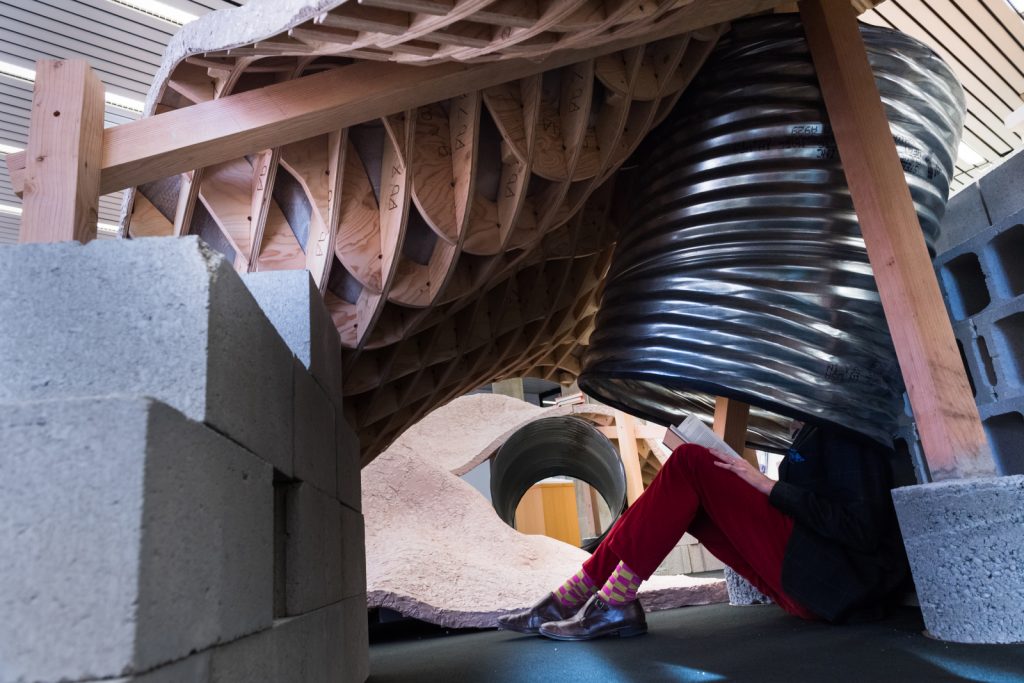
Multiple freestanding curved walls made of unpainted drywall in Loeb library.
Careful detailing accentuates places where openings shape the composition. Score lines facilitate warping of flat drywall panels.
Gallery Location

Frances Loeb Library

Curator
Michelle Chang
Dates
Aug. 30 – Oct. 20, 2019
Art historian Heinrich Wölfflin once characterized painterly architecture as a collection of “broad, vague masses.” This installation adopts a similar attitude towards form. Three eight-foot tall curved walls divide the Frances Loeb Library into smaller rooms. To design the masses, the project employs inpainting, a technique common to art restoration and imaging. In the field of art restoration, inpainting is used to fill in areas lost to damage. Conservators refer to a painting’s facture—how the artist has handled the paint—as primary source material for repair rather than to socio-historical contexts. This distances a restorer from subjective interpretation and protects a work’s authenticity. For example, restorers systematically covered gaps in Cimabue’s Crucifix with colored lines matching the palette of its remaining surface. The hatching at once reveals an accurate historical account (that the work was repaired) and removes visual distractions that an absence would otherwise draw attention to. In computer graphics, inpainting is a similar process of insertion. However, digital inpanting, in addition to recovering lost information, creates new content. Imaging algorithms seamlessly fill holes by sampling a picture’s visual patterns. Popular applications patch poor scans and erase blemishes in portraits. A Hole in the Wall adopts both analog and digital inpainting because the former privileges accuracy and the latter embraces artifice. Moving between modes preserves formal qualities of the existing condition and allows the viewer to imagine what could exist in its place. Whether in the fiction of a flawless face or in this case, a more intimate reading room, the tension between authenticity and artifice is essential to filling in holes. Exhibition credits Curator: Michelle Chang, Assistant Professor of Architecture Design Assistant: Jacqueline Wong (MArch ’22) Director of Exhibitions: Dan Borelli Exhibitions Coordinator: David Zimmerman-Stuart Exhibition Installation: Ray Coffey, Jef Czekaj, Anita Kan, Sarah Lubin, Jesus Matheus, and Joanna Vouriotis Frances Loeb Library Librarians: Ann Whiteside, Ines Zalduendo, and Alix Reiskind CNC Assistant: MinYoung Hong (MArch ’20)

Multiple Miamis

Multiple Miamis

Gallery Location

Frances Loeb Library

Curators
Sean Canty
Chris Reed
Dates
Apr. 1 – May 17, 2019

The “Multiple Miamis” exhibition encompasses research and studio work undertaken by students studying landscape architecture, urban design, and architecture at the Harvard Graduate School of Design. Directed by Chris Reed and Sean Canty under the Future of the American Cities Initiative, the eponymous Fall 2018 option studio examined the Overtown neighborhood near downtown Miami, and looked to imagine new and diverse urban strategies that recognized a multiplicity of environmental, social, cultural, and economic starting points that redefine what an inclusive and civically-minded urbanism could be. The studio was divided into three phases: Multiplicity, in which students tackled site-wide context research; Mash-up, in which focused, design-based explorations were deployed to format diverse formal starting points; and finally Mutations, with final design projects that elaborated new futures and sites of intervention in Overtown, evolving from the work of the previous phases.

As a whole, the interdisciplinary studio tackled pressing contemporary urban challenges facing many American cities, including accessibility and mobility, housing and affordability, race and cultural identity, climate change and adaptation, and struggles for a more inclusive and diverse public realm.

Studio Instructors
Chris Reed, Professor in Practice of Landscape Architecture
Sean Canty, Design Critic in Architecture

Seminar Instructor
Lily Song, Lecturer in Urban Planning and Design

Curators
Ting Liang (MLA/MAUD ’19)
Zishen Wen (MLA ’19)

Design Team
Dan F. Borelli
Director of Exhibitions

David W. Zimmerman-Stuart
Exhibitions Coordinator

Installation Team
Liz Asch, Raymond Coffey,
Jef Czekaj, Anita Kan, Christine
April, Sarah Lubin, Jesus Matheus,
and Joanna Vouriotis

Exhibitors
Studio Students: Charles Smith,
Chengzhang Zhang, Chuanying
Zheng, Evan Shieh, Hiroki Kawashima,
Maoran Sun, Panharith Ean, Parawee
Wachirabuntoon, Qiaoqi Dai, Samuel
Adkisson, Ting Liang, and Zishen Wen

Seminar Students: Catherine McCandless,
Chandra Rouse, Daniel Padilla, Eduardo
Pelaez, Elena Clarke, Laura Lopez, Muniba
Ahmad, Malika Leiper, Naomi Woods, Sidra
Fatima, Stefano Trevisan and Syed Ali

Acknowledgements
Mohsen Mostafavi
Dean and Alexander and Victoria
Wiley Professor of Design

Patricia Roberts
Chief of Staff

Ken Stewart
Assistant Dean and Director
of
 Communications and Public
Programs

Ann Whiteside
Director of Frances Loeb
Library, Assistant Dean for
Information Services


Drawing for “Multiple Miamis” by Qiaoqi Dai and Chengzhang Zhang


Drawing for “Multiple Miamis” by Hiroki Kawashima and Samuel Adkisson


Drawing for “Multiple Miamis” by Ting Liang and Zishen Wen


Drawing for “Multiple Miamis” by Parawee Wachirabuntoon and Charles Smith


Drawing for “Multiple Miamis” by Evan Shieh and Panharith Ean


Drawing for “Multiple Miamis” by Maoran Sun and Chuanying Zheng


How to Model a Mountain

How to Model a Mountain

Gallery Location

Frances Loeb Library

Curator
Edward Eigen
Dates
Jan. 28 – Mar. 17, 2019
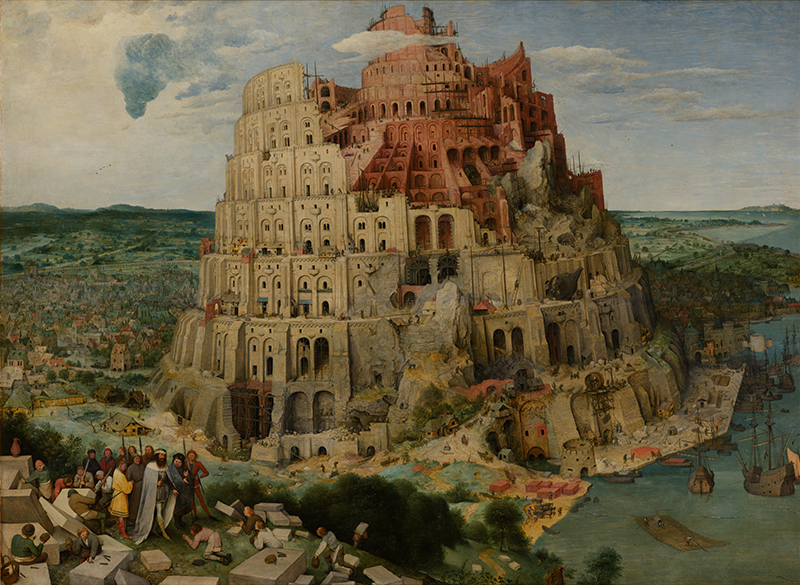
Complementing main exhibition “Mountains and the Rise of Landscape,” Ed Eigen curates “How to Model a Mountain,” on display in Frances Loeb Library.
How to See Architecture: Bruno Zevi (MArch ’42)

How to See Architecture: Bruno Zevi (MArch ’42)

Gallery Location

Frances Loeb Library

Curator
K. Michael Hays
Dates
Nov. 1 – Dec. 20, 2018
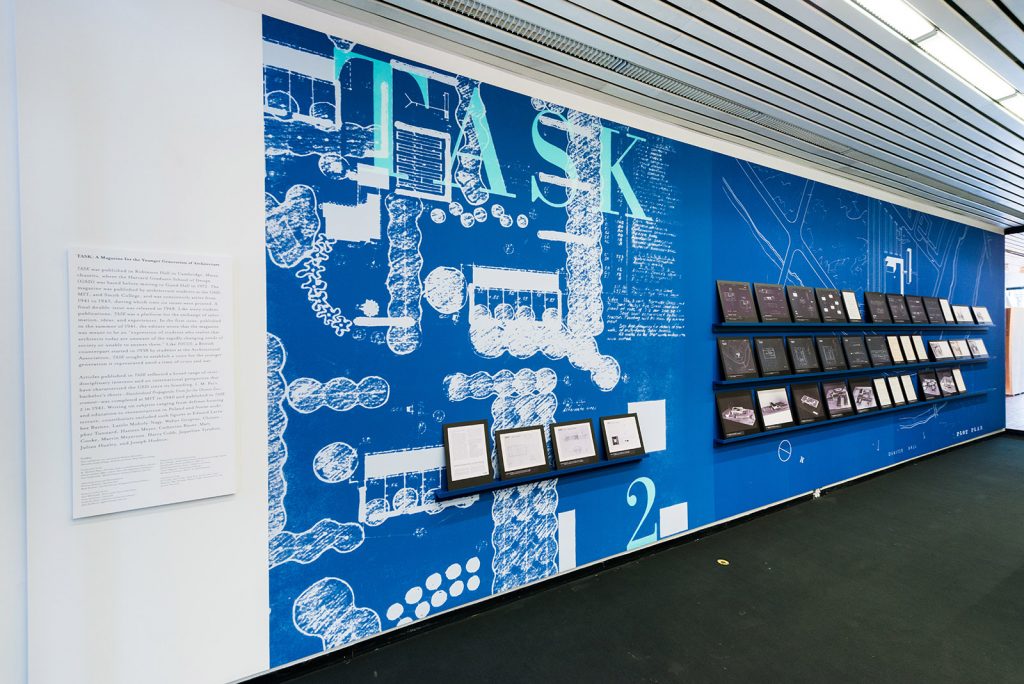
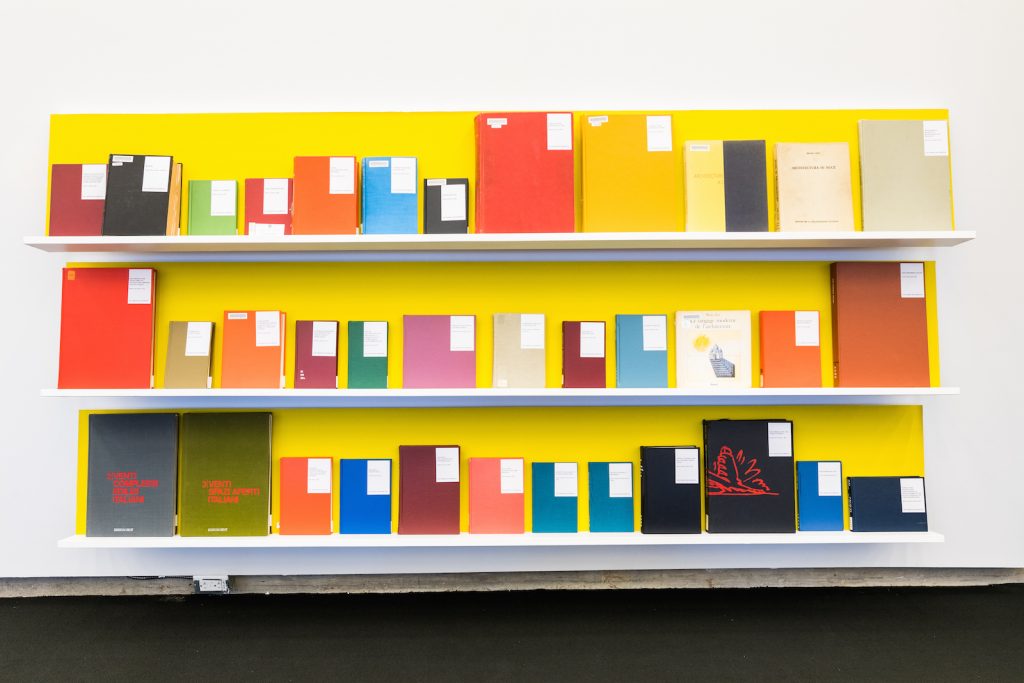
This exhibition begins with a 1941 student memo to the GSD, entitled “An Opinion on Architecture.” In this memo, Bruno Zevi, along with other student authors, states the importance of discourse in architecture in general, specifically calling upon GSD students to create their own publication. To evidence the importance of his position, we have created a bifurcated timeline: on the top are the suite of books authored by Zevi throughout his lifetime, and running along the bottom are the multiple GSD student publications created since “An Opinion on Architecture,” culminating in Platform 11, a new turn on the yearly Platform series that has shifted the editorial role from faculty to students. One hundred years after his birth, the prolific work of Roman architect Bruno Zevi continues to engage current problems in theory and criticism, and deserves to be revisited. From the publication of Towards an Organic Architecture, in 1945, to his monograph on Erik Gunnar Asplund published the very year of his death in 2000, many of his books have had an electrifying effect on architects and historians. Active as an educator and as a political activist, he was an engaged, charismatic contributor to the public discussion through his weekly chronicle in L’Espresso. Beyond Italy, Zevi has had a determining presence in Latin America and other parts of the world. Held at a school where his passage between 1940 and 1942 was far from uneventful, the GSD’s fall Zevi symposium addressed issues relative to Zevi’s life, to his writings and to his brave fights for his ideas. His position in Italian politics and in the historical interpretation of architecture will be questioned, as well as the theoretical, narrative and rhetorical strategies at work in his engaged texts. Exhibition curated by K. Michael Hays, Eliot Noyes Professor of Architectural Theory and Associate Dean for Academic Affairs
00:00
00:00