Tectonics of Tenure: Public Infrastructure for Collective Housing

Tectonics of Tenure: Public Infrastructure for Collective Housing

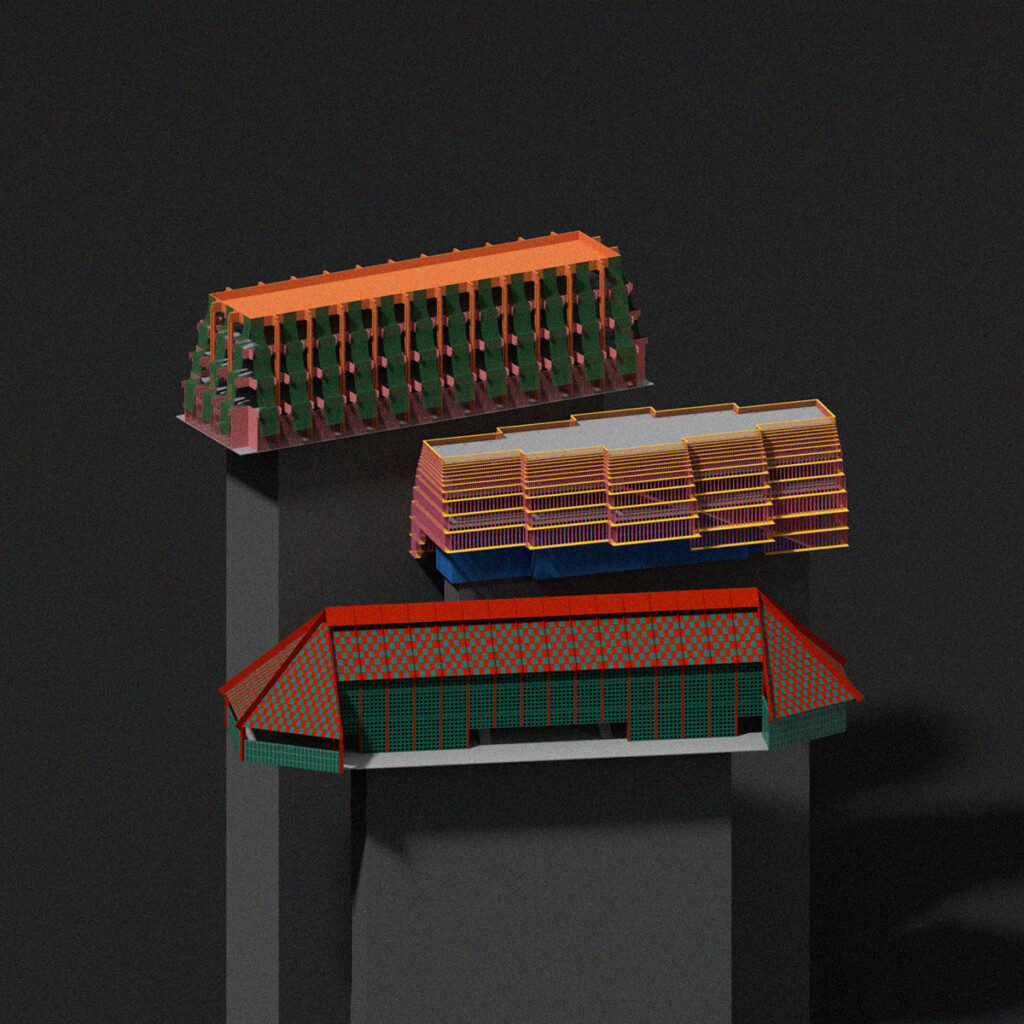
A rendering of a building interior and a photo of an architectural model next to each other.

Maggie Musante (MArch I ’24)

Since the 1980s, New York City’s commitment to the construction of decommodified housing eroded in favor of a neoliberal strategy—enticing private developers to build affordable housing through the disposal of public land. This tactic often relies on the longstanding, yet short-sighted practice of marginalizing critical urban infrastructure to maximize space for profitable land uses at the center. Under these conditions, affordability remains insufficient and available city land dwindles.

The thesis asserts architecture’s agency to act within and against capitalism’s tendencies through alternative financial models. While conventional trajectories of privatization and peripheralization persist, this thesis advocates for an alternative symbiosis: a model of public-collective co-ownership. An expanded infrastructure for housing is made possible through the maintained location and capital investment of a garbage truck garage in Astoria, Queens. Embedded in architectural form, this mutually-reinforced hybrid prioritizes durability, self-determination, and generosity—values absent today in conceptions of housing and public infrastructure.

Bådehus

Bådehus

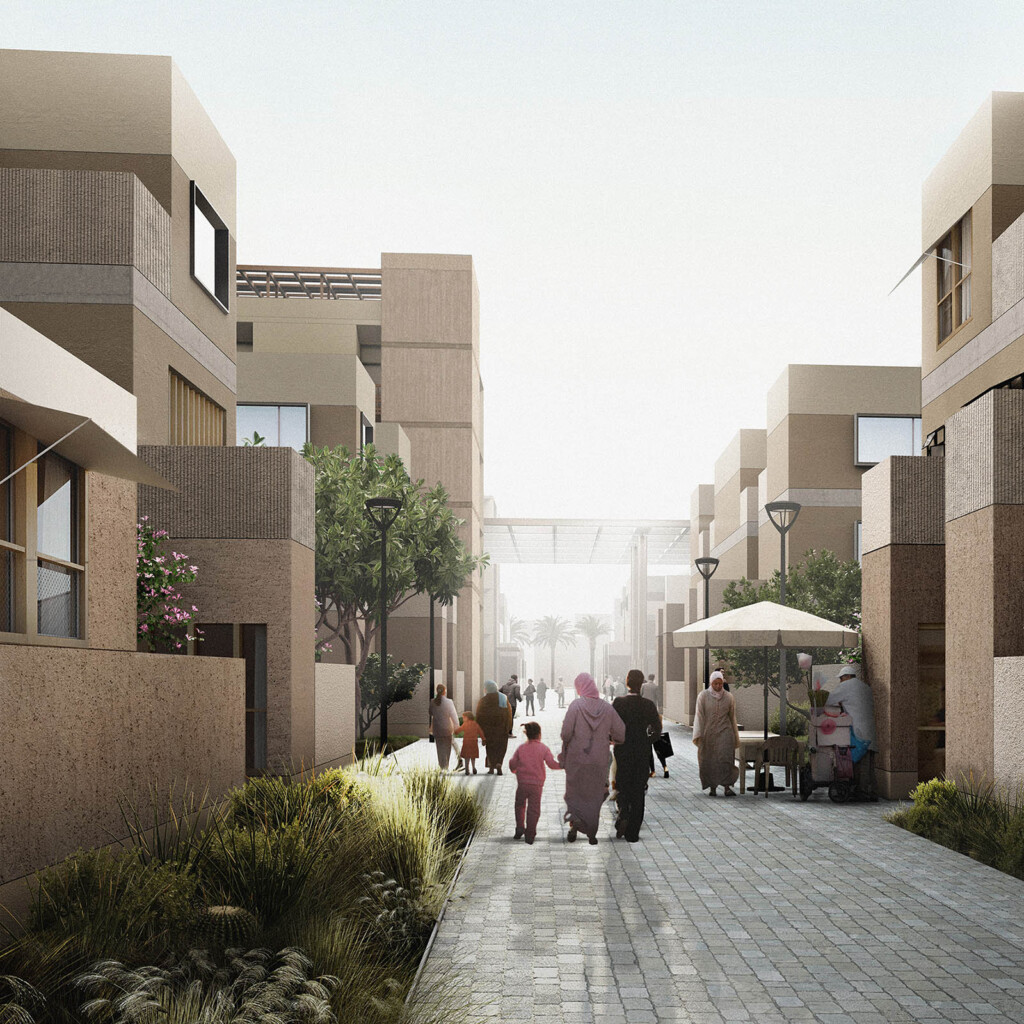
Two images showing views of a grey building six or seven stories tall on a waterfront with sailboats in the foreground.

Yeonho Lee (MArch II 24)

This project draws inspiration from Denmark’s maritime heritage and proposes a new residential typology in Nordhavnen Marina Bay, Copenhagen, with two main challenges: integrating the coastal urban environment with residential designs and incorporating the Danish concept of ‘Hygge’ into living spaces. Denmark, particularly Copenhagen, has a high proportion of single-person households, with about 70 percent. This demographic faces a housing shortage, creating a pressing need for innovative housing solutions. 

Copenhagen is highly vulnerable to global warming, especially flooding. The Nordhavnen area faces the risk of significant inundation with a projected 2-meter sea level rise over the next 50 years. To address this, the “House for Yachts” incorporates designs that hover above ground and adapt to tidal variations. Site selection criteria include proximity to yacht facilities, suitable geographical form for harbor creation, and minimal disruption to existing structures to reduce costs. 

This project includes two types of buildings: 30-unit tower-type buildings (Anchored Type) and 2-story skip-floor boathouses (Floating Type). The cantilevered design, inspired by the structural elements of the yacht mast and boom, adds a sense of vibrancy and speed to the yacht design. In addition, through co-ownership, residents who own shared yachts can access them directly via the communal ground floor spaces. Ultimately, these residential units aim to alleviate the housing shortage for single individuals while authentically reflecting Copenhagen’s coastal allure and the cultural essence embodied by ‘Hygge’ in Denmark.

Learning from Quartzsite, AZ: Emerging Nomadic Spatial Practices in America

Learning from Quartzsite, AZ: Emerging Nomadic Spatial Practices in America

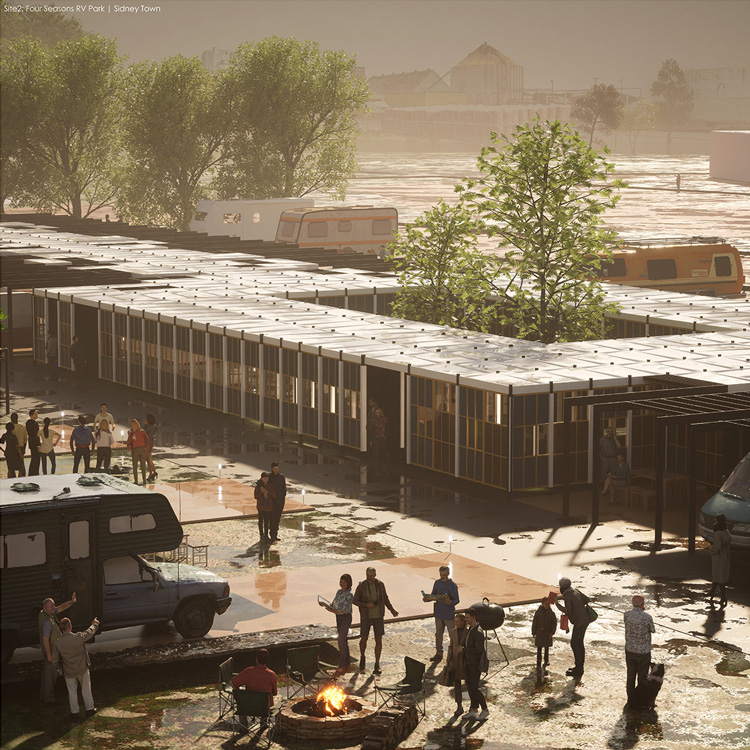
A digital rendering of a large open area with modular buildings interspersed with mobile camper vans. A crowd of people of various ages in the foreground gather around a campfire.
Nomads in Sydney town, Montana, for Sugar beet harvest.

Mojtaba Nabavi (MAUD ’24)

Quartzsite, in Arizona, is a popular winter home base for vehicle dwellers who identify as nomads. While vehicle dwelling in America has diverse motivations, this thesis focuses on about four million Americans who live in their cars full-time as their sole home and rely on them as a means of seasonal migrations. 

Building on the author’s participation in the nomads’ biggest annual gathering in Quartzsite called Rubber Tramp Rendezvous (RTR), the thesis investigates their spatial practices in urban and non-urban settings. It seeks to shed light on invisible mobile communities emerging from the ongoing decentralization process in the US, driven primarily by economic crises and climate change. 

This thesis claims that houselessness is not homelessness. Since the 1930s, vehicle-dwellers have gradually developed a communal alternative lifestyle, utilizing the country’s capacities in physical infrastructures like highways and, in recent years, non-physical infrastructures like digital networks, which they call “Nomadism.” This lifestyle, using mobility as a survival strategy to adapt to adverse living conditions, leads to the creation of intentional communities outside urban boundaries. These communities, in smaller units called caravans, constantly move towards temporary job opportunities, creating instant urbanism around a migration route. 

This thesis uncovers this cyclical migration route, attraction points, and spatial practices of the US nomadic community. It ultimately seeks the role of design in proposing this mode of houseless living as an alternative lifestyle by enhancing nomads’ visibility and vehicle dwelling reliability through systemic thinking, proposing complementary modular living spaces to address deficiencies along their migration route.

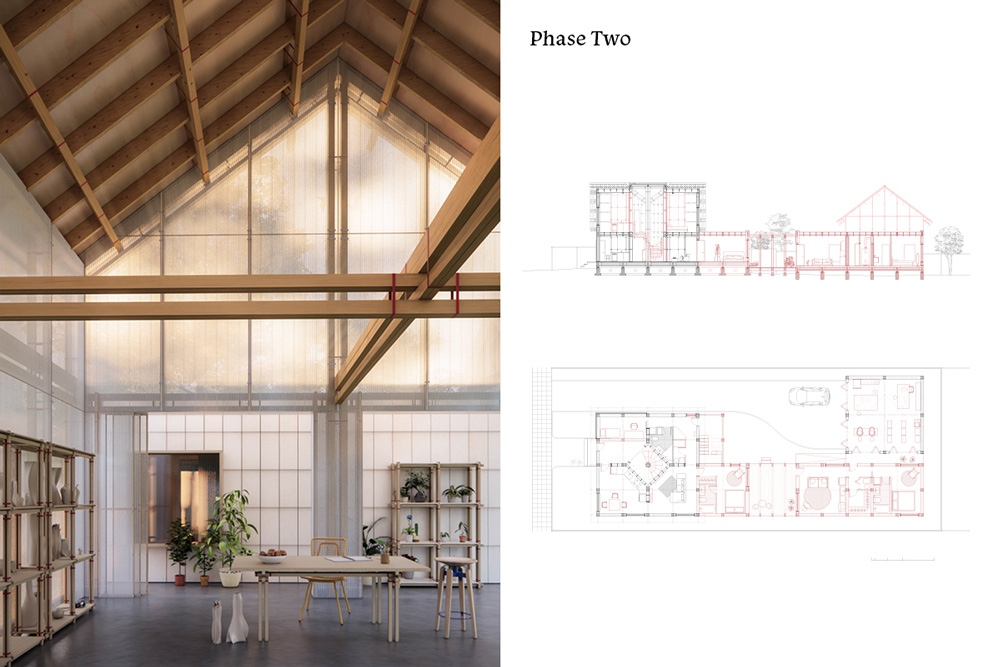
How to (Un)build a House? A Reinvention of Wood Framing

How to (Un)build a House? A Reinvention of Wood Framing

Two photographs, one shows a wood house and the other shows the detail of a wood beams crossing each other and fastened together with green straps.
How to un(build) a house? A reinvention of wood framing.

Clara Mu He (MArch I 24)

In recent decades, as we recognize that our extractive practices are driving humanity toward an imminent environmental crisis, there has been a renewed interest in reusing construction materials. Against the backdrop of a national housing crisis, densification policies, and an anticipated surge in residential construction and demolition—compounded by challenges of lumber shortages and sustainability concerns—there is an imperative to rethink how we build and demolish houses.

The predominant method of housing construction in America today is wood framing, which relies heavily on nails and adhesives. This makes materials difficult to reuse and contributes to environmental pollution due to the disposal of wood from demolitions. To divert wood waste from landfills, this thesis proposes a Design for Disassembly (DfD) wood framing system: the Strapped House. Inspired by traditional bamboo construction in Southeast Asia, this system aims to reinvent wood framing by introducing strapping as a non-intrusive means of assembly, facilitating easier disassembly and maintaining material integrity. The approach recognizes the momentum of our current construction industry and leverages the skill sets of local contractors. Instead of centralized prefabrication of panels or modules, the Strapped House system adopts a bottom-up approach, seamlessly integrating into the current labor market of housing construction and empowering local builders to actively participate in sustainable construction and deconstruction.

To demonstrate the application of the Strapped House system, this thesis proposes a three-phased incremental construction on a newly upzoned residential lot in Mattapan, Boston. The proposal illustrates the possibility of building six units on a previously low-density lot, enabling sustainable urban densification.


Seeding Grounds: Working Beyond Arcadia in The Pyrocene

Seeding Grounds: Working Beyond Arcadia in The Pyrocene

A trio of digital images showing people working on grassy open landscapes including by erecting a fencepost.
Process triptych: A coalition of rangers and farmers remove extant fencing across the site, keeping only the posts that lay along the burn line. These posts become the markers for the formation of the fireline remembrance trail, whereby hikers, rangers, farmers and visitors can fill the seed cans with seed as small gestures toward land reconciliation.

Stewart Crane Sarris (MLA I ’24)

From drought, to fire, Australia’s landscapes face multiple existential threats. A response to the tectonic loss of life in the 2019 ‘Black Summer’ bushfires, Seeding Grounds: Working Beyond Arcadia in the Pyrocene, seeks to reckon with Australia’s perception of country that has engendered its ongoing dance with ecological annihilation. Proposing the establishment of the Fireline National Park along Kangaroo Island’s 2019 ‘Black Summer’ burn scar, the work inverts the methods and means by which land ‘management’ has engendered the disconnect between country and process. Utilising the traditional interventions of the National Park, fence post, rain water water tank, and seed bank, the thesis inverts colonial land management infrastructures in an attempt to cultivate acts of disturbance as a means of growing ecologies forward into uncertain climatic futures. In so doing, Seeding Grounds resists the impulse of a static preservationism, rejecting the preeminent consumption | conservation paradigm in favour of acknowledging that our landscapes are embedded in processes of decay and renewal. Here, the anachronistic mythology of a static ‘Arcadia’ yields to an understanding of country as archival palimpsest, one that envisions a semantic shift from disturbance as destruction to phenomena as process. In this way, Seeding Grounds, brings awareness to Australia’s threatened landscapes, positing that phenomenological processes can perform as a form of generative catharsis through which socio-cultural relationships toward the natural world can be novelly (re)built.

Reforesting Fort Ord

Reforesting Fort Ord

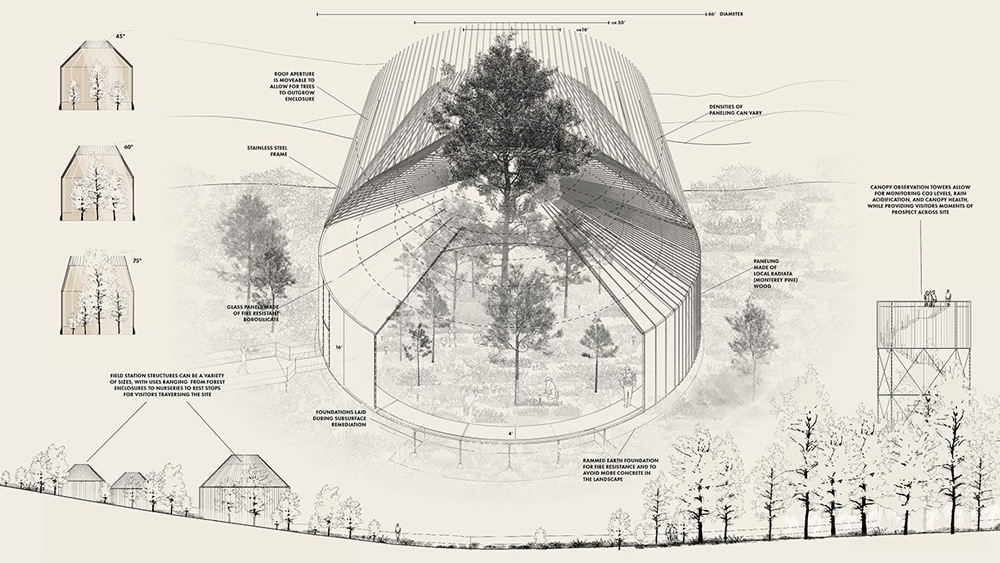
An image that includes renderings of trees and verdant landscapes with line drawings of people running, walking, and riding bikes on a road.
Traveling within a fuel break through the proposed remediated and planted landscape of Fort Ord. There are runners, a biking family, a canopy tower in the distance, foresters monitoring a stand of Monterey Pine, and a view of the Salinas Valley.

Slide Kelly (MLA I AP/MDes ’24)

This thesis examines the potential for the conservation of Monterey pine biodiversity through the active planting of an experimental forest in the Impact Area of Fort Ord: a former US military firing range soon to become part of a national monument. It choreographs a plan for expanded munitions disposal alongside the planting of a human-assisted forest – within which thread a network of field stations, transformed fuel breaks for travel across partially off-limits land, and a redefined porous edge between Fort Ord and the neighboring city of Seaside, California. 

In proposing larger-scale remediation alongside a more-than-native-restoration, this thesis addresses the delicate balance between the passive ecosystem restoration that is status-quo for compromised US public lands and the destructive subsurface remediation needed for any alternative future for Fort Ord. The result is a landscape where once-prohibited neighbors – including Monterey pine – are allowed to arrive, challenging the colonial freeze-frame of what species can be “native” and where.

Reforesting Fort Ord provides a framework for re-connecting communities to locked-up public lands, and envisions how experimental forests, designed landscapes, and collaborative management can cultivate identity and social investment in a newly designated urban national monument. Here is a place once forbidden to people and to pines, where finally there is a possibility for more than preservation.

Project Kin

Project Kin

A composite image of the various platforms developed in the project, including a phone application, a desktop platform, and an IVR feature.

by Priyanka Pillai (MDE ’24) and Julius Stein (MDE ’24)

When conflict arises from humanitarian crises, families are invariably separated. Sometimes, this occurs intentionally if the family decides it is safer to leave the child in someone else’s care or in another location. Other times, this happens accidentally during the disarray and confusion following the conflict, which can cause a child to suddenly find themselves alone or with a group of travelers from their home who are not their family. Still at other times, this occurs during travel from one’s home to their destination either because of groups splitting apart or because of accidental separations. 

Current approaches involve the use of pen and paper tracking, grids of posters and billboards of faces, and direct networking in person or over the phone without the help of any organization. These not only have low success rates, but they frequently expose the vulnerable party to unwanted attention. We would like to see what other alternatives could potentially offer higher likelihoods of reconnection without the risk that current approaches typically take on. Additionally, few systems give power to the displaced parties to reconnect themselves and instead will often place power in the hands of organizations, which we hope to avoid.

A set of images containing physical prototypes made by refugees including a model figurines and pipe cleaner houses, as well as photos of their fabrication and presentation.

Our approach, Project Kin, addresses the problem of family separation in refugee camps through an accessible online platform for refugees that allows them to find relatives themselves, returning ownership of the process to the displaced people. Families can register with the platform before separation, when arriving at the camp, or after they have been separated from their family. Project Kin begins by prompting refugees to input information about themselves through a combination of text and audio, and generates a set of follow-up questions based on their responses.

Advisors: Martha Thompson (MIT D-Lab), Krzysztof Gajos (SEAS), Shuya Gong (SEAS), Kathleen Brandenburg (GSD), Karen Reuther (GSD), Jon Jal Dak (YSAT, OXFAM)

INSURGENT GEOLOGY: Mineral Matters in the Arctic

INSURGENT GEOLOGY: Mineral Matters in the Arctic

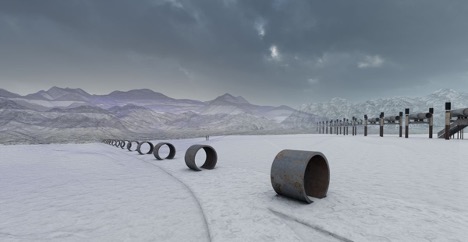
A digital rendering of an arctic landscape with cylindrical sections of a pipeline, each separated from any other, arranged on the ground in a straight line.
View from the Geo-memorial for the Great Explosion of 2042 (Stop 2 of the Pilgrimage). Land-art as a novel geo-aesthetics in the post-oil era of Alaska. The recycled pieces of the cut pipeline are aligned on the ground to abstract the direction of the deflagration.

Melanie Louterbach (MLA I ’24)

“Insurgent Geology” is about oil, fossils, power, and people. It is about blowing up pipelines and taking care of the soil. Shifting from deep time to speculative near future, it calls for both insurrection and geo-poetics for environmental and social justice in the Arctic.   
Projected in 2051, “Insurgent Geology” unearths past land trauma, speculates on the post-oil landscapes of Alaska, and investigates alternative geo-social practices and mineral kinships. It critiques geology as an extractive, neocolonial discipline and practice. It challenges the concept of the Museum of Natural History and explores novel methods to share geological knowledge to the public. A novel geo-social classification is proposed, and alternative geo-aesthetics are explored through the design of “mineral gardens” and “geo-memorials.”

A digital rendering depicting various sites for oil and gas drilling in the Arctic.
Composite long section along the Trans-Alaska Pipeline System (TAPS) in Alaska. Profiles have been selected and stitched together from the site of oil and gas extraction in Prudhoe Bay in the Arctic Plains to Valdez Town, the outlet of the pipeline, in southern Alaska. The lower grey section at the base of the drawing shows the actual elevation profile and the permafrost thickness along the pipeline.

“Insurgent Geology” reinterprets the concept of the Site and Non-Site. A counter-exhibition is designed (the non-site), paired with a pilgrimage through the extractive landscapes of Alaska. Following the oil from the outlet of the pipeline in Valdez town to the site of extraction in the Arctic slope, the pilgrimage is connected by site-specific interventions designed along the Trans-Alaska Pipeline System (the sites).

An image of the cover and interior pages of a publication called Manual for a Petrostate Dis-Assembly. The interior spreads include text and diagrams related to oil and gas drilling.
Manual for a petrostate dis-assembly. The guide urges eco-militants to escalate the climate justice movement by fostering direct actions against targeted private property related to the oil and gas industries. Technical information about the pipeline is provided, as well as the “Ethics of the Perfect Saboteur.”

Material Alchemy

Material Alchemy

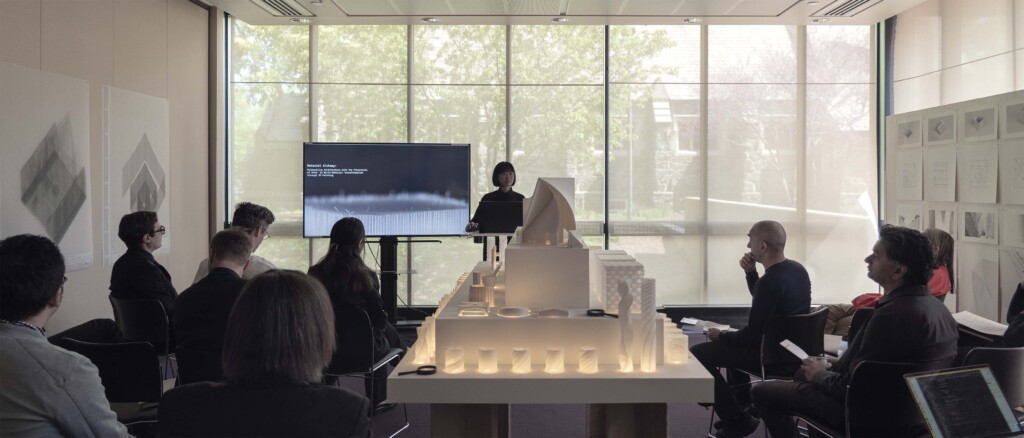
Sujie Park stands in front of a computer screen and several architectural models, presenting to a room full of people

Sujie Park (MArch I ’23)

The history of architecture and construction has been characterized by the emergence of new construction methods that have consistently led to the development of new architectural forms. The use of iron and steel in the 19th century enabled tall and large-scale structures, while the invention of modern concrete in the early 20th century allowed architects to design more expressive and sculptural buildings. In each case, the new building materials influenced architecture and conveyed unique stories through construction. In addition, the digital era introduced new considerations in the design process, including the choice of software and fabrication techniques.

This thesis focuses on 3D printing, which holds immense promise for sustainable architectural construction, to explore its creative potentials beyond the current predominant use as prototyping and the production of scale models for representational purposes. How can we leverage the untapped potential of 3D printing, to transform the way we design and build our environment?

The project embarks on the studies on Elements of Architecture; looking through the lens of 3D printer to explore how this technology can operate with existing building components. It aims to demonstrate how 3D printing, as an innovative construction method, can adapt visual, structural, and spatial qualities to various scales within the built environment. Ultimately, the project proposes a series of demonstration houses, each showcasing unique capabilities of 3D printing.

Project Acknowledgements

Rhetorical support: Seoyoung Lee (MArch ’22)

Physical model support: Wai Tat Justin Cheng (MArch ’23), Jae Min Seo (MArch ’25), Cynthia Kuo (Cornell MArch ’24), Kristine Chung (MArch ’24)

Drawing support: Seoyoung Lee (MArch ’22), Jae Min Seo (MArch ’25), Wai Tat Justin Cheng (March ’23), Chusu Kim (CalArts MFA ’22)

Rendering support: Kristine Chung (MArch ’24), Cynthia Kuo (Cornell MArch ’24)

Scripting support: Chuan Yin (March ’23), Karen Kuo (March, MDes ’23)

CNC TA support: Min Young Hong (March ’22)

Our History is our Resource: Historic Narrative as Urban Planning Strategy in Chicago’s Pullman Neighborhood

Our History is our Resource: Historic Narrative as Urban Planning Strategy in Chicago’s Pullman Neighborhood

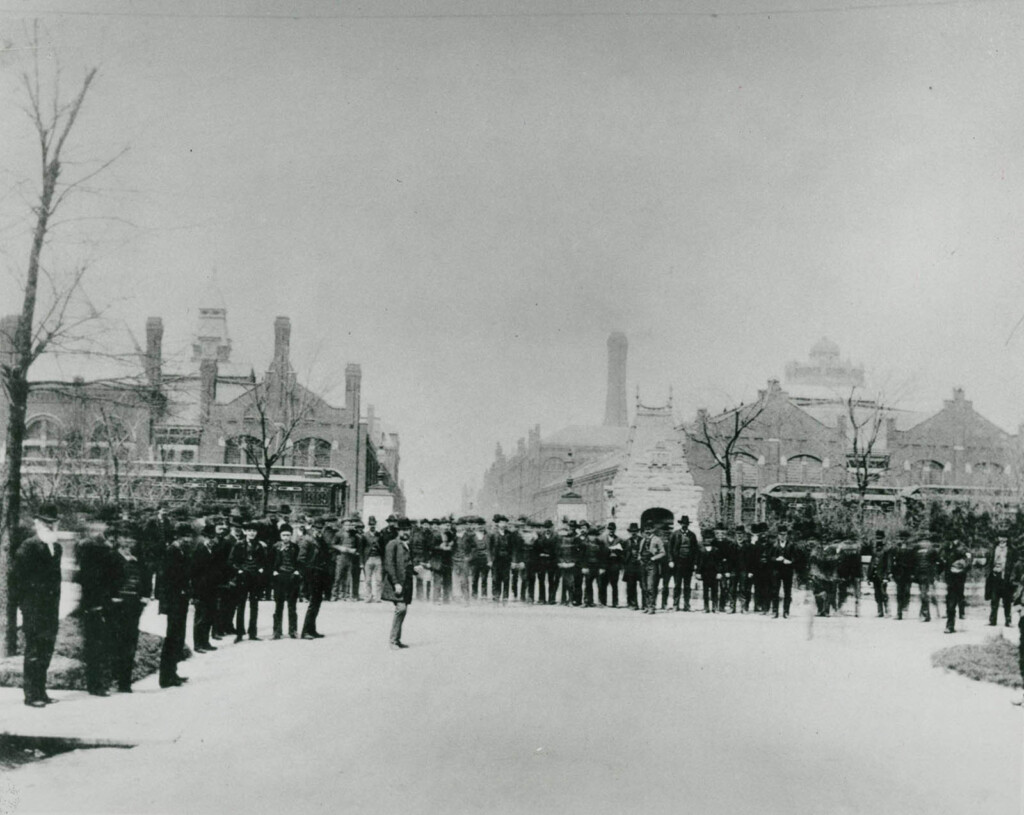
Black and White photo showing Striking workers at Pullman Factory in 1894
Striking workers at Pullman Factory in 1894

Michael Zajakowski Uhll (MUP ’23)

How do site and neighborhood history potentially inform material neighborhood development in the present? This investigation focused on Pullman, a neighborhood on the south side of Chicago that has a long and storied history of industry and labor activism. More recently, in the last few decades, the neighborhood has been held up as an example of equitable area development throughout the city and country. Through a comprehensive literature and data analysis and interviews with 23 area stakeholders, this thesis sought to determine whether Pullman’s history and historic narrative contributed to these patterns of development in the present.

Photograph shwing a sign of Pullman National Monument
Pullman National Monument

The findings indicate that, while Pullman may be an exceptional case in many ways, the historic narrative of the place itself is perhaps less important than the way the community chooses to interact with and institutionalize its own history. In Pullman, neighborhood history was developmentally relevant in five broad categories: history as informing community activism, institutionalization of history across diverse stakeholder groups (community organizations, residents, and businesses), history as a community identity, history as informing design decisions and the preservation of naturally occurring affordable housing, and history as “specter.” These findings are important for the field of urban planning because they illuminate potential ways to leverage and institutionalize site history as a planning strategy in the present, and the Pullman example offers some replicable strategies for other urban neighborhoods.