Copenhagen Cloudburst Plan
Copenhagen Cloudburst Plan
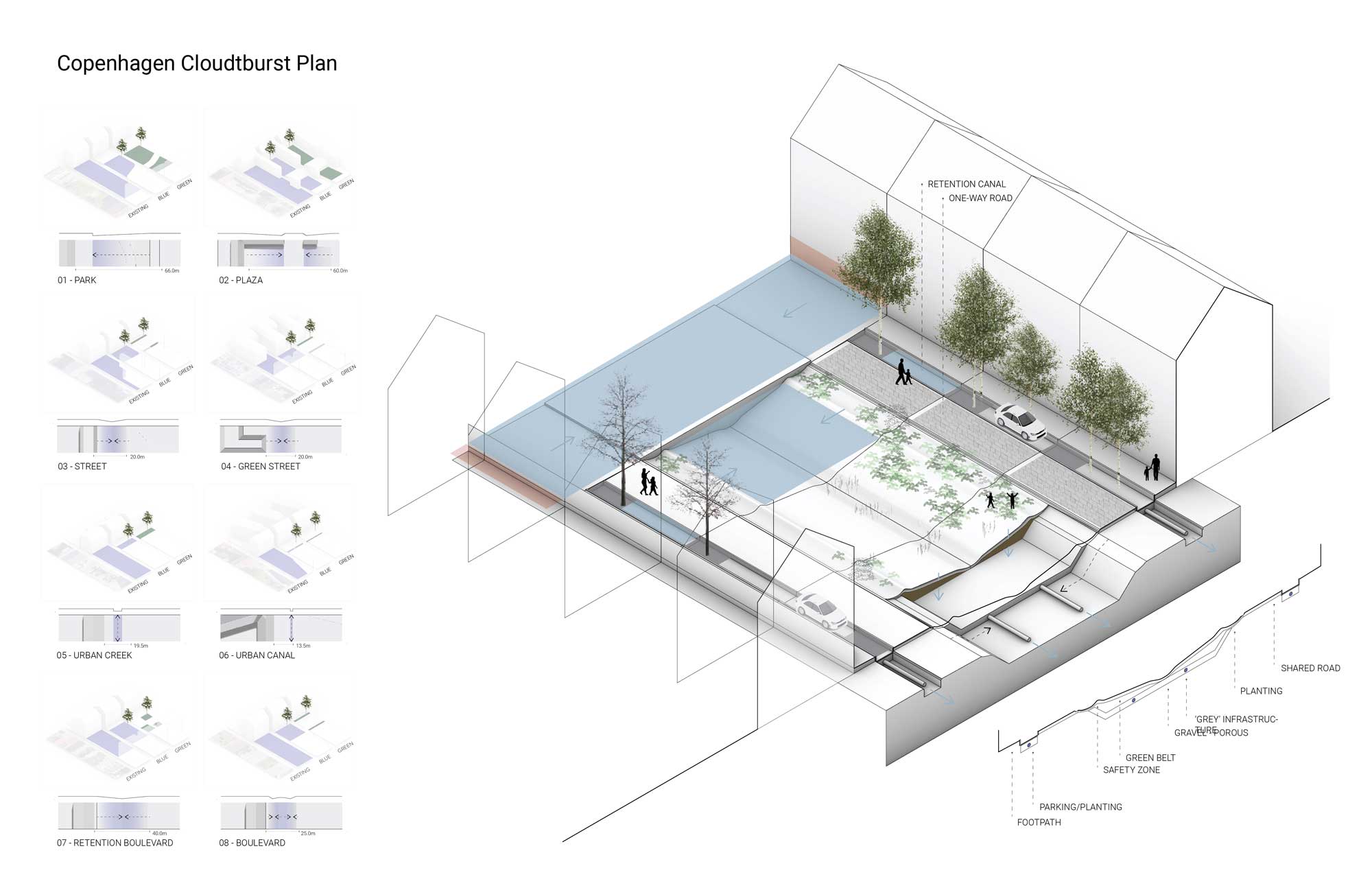
In 2011, Copenhagen was struck by a 1,000-year storm event, a Cloudburst, that flooded the city with three feet of water, causing over $1 billion in damage. The city engaged in a planning period to create the Cloudburst plan with the idea of Blue-Green solutions. These solutions are low-tech, on the surface, not engineered underground, and interactive. These climate adaptive solutions take place within the confines of urban space. The process followed a six-step procedure to integrate a Blue-Green approach, beginning with data gathering and investigation, modeling and mapping, a cost-of-doing-nothing scenario, a design period, community involvement, and design interaction. It concluded with a detailed socioeconomic cost-benefit analysis that tested two masterplan solutions. The masterplan variations, the conventional scenario, and the Blue-Green scenario were developed together to quantify the benefits of the adaptive scenario. The project was financed through a public-private partnership called the Copenhagen Formula, in which existing cities are retrofitted through Blue-Green solutions. Private developers invested in the government’s plan, and it gained traction for its focus not only on the areas where flooding occurs but also on upstream and upland areas where residents do not see the consequences of heavy rainfall. The plan designates a clear order of priority, in which high-risk areas, as identified in a climate adaptation plan, are addressed first, followed by areas where measures are easy to element, areas with ongoing urban development projects, and lastly, in areas where other policy directives are being followed.
References
Ziersen, J. J. Clauson-Kaas and J. Rasmussen. “The role of Greater Copenhagen Utility in implementing the city’s Cloudburst Management Plan.” Water Practice and Technology 12, no. 2 (2017): 338-343.
Delhi Stepwell Restoration
Delhi Stepwell Restoration
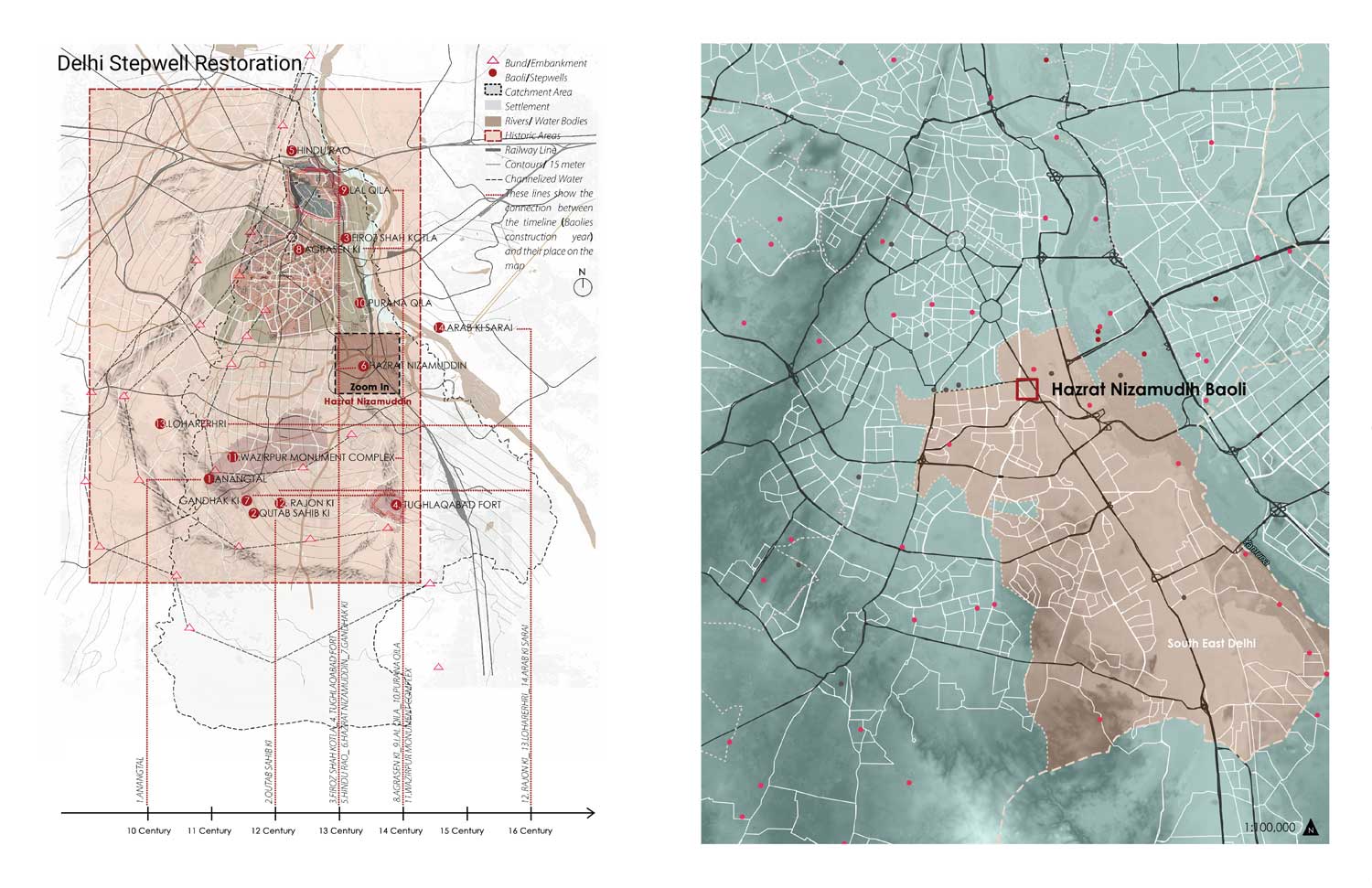
Baolis, or stepwells, are underground reservoirs where water can be stored close to the groundwater level to ensure a constant water supply during the dry season, one of two monsoon seasons across the Indian subcontinent. Baolis were first constructed as rock-cut stepwells between 200 and 400 AD to ensure water during periods of drought. While stepwells are utilitarian, they also have significant religious, social and cultural significance, and some have rooms built to provide shelters to caravans. The earthquake-proof construction and cool microclimate under the earth has made baolis a sanctuary for collecting water as well as bathing, meditation and prayers. Delhi has an estimated 32 stepwells, 16 lost or demolished, and 14 accessible to the public. Three of the baoli are permanently dry. The Indian National Trust for Art and Cultural Heritage began a project to de-silt and restore the 16 baoli that have not been lost, in an effort to bring back traditional means of water security and resilience against an increasingly erratic monsoon cycle that has deepened the water crisis across India, especially in urban centers like Delhi. To rehabilitate the stepwells, garbage and debris must first be removed, and then the stepwell must be desilted to reconnect the reservoir to the water table. In areas where there is significant unregulated pumping from wells, groundwater levels may be significantly below the lowest depths of the baoli, presenting a need for stewardship not only of the stepwell itself, but also equitable water policy for the surrounding areas to recharge groundwater.
References
Chandra, Sharad. “Steps to Water: Stepwells in India.” Chitrolekha International Magazine on Art and Design 5, no. 2 (2015).
Unnikrishnan, Hita, Sreerupa Sen and Harini Nagendra. “Traditional water bodies and urban resilience: a historical perspective frm Bengaluru, India.” Water History 9 (2017): 453-477.
Links
Indian National Trust For Art and Cultural Heritage (INTACH), Delhi Chapter, “Baolis of Delhi,” Google Arts & Culture
“India’s magnificent stepwells are relics of a nuanced history,”The Economist, July 13, 2019.
Panchali Dey, “Baolis of Delhi: Tracing the steps of incredible stepwells,” Times of India, December 3, 2018.
Victoria Lautman, “India’s Forgotten Stepwells,” ArchDaily, June 28, 2013.
Richi Verma, “Delhi: Dwarka’s Lodi-era baoli restored,” Times of India, May 10, 2015.
Swansea Bay Lagoon
Swansea Bay Lagoon
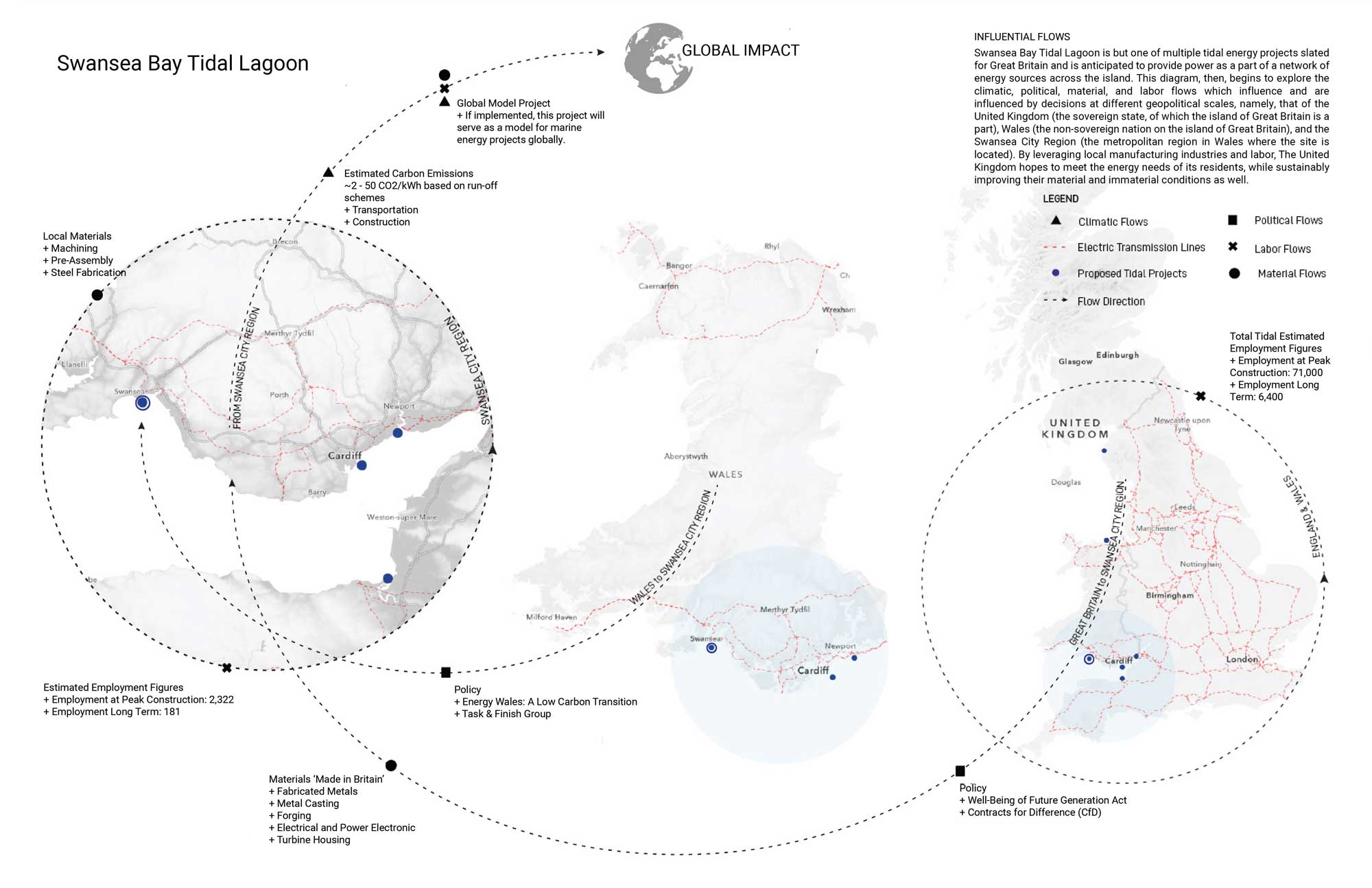
Swansea Bay was once home to a thriving oyster industry that employed 600 residents in the late 1800s. Since that time, overfishing, disease, and population have wiped out the oyster trade, and the bay has been severely polluted by sewage outfalls that were closed in 1996. The Swansea Bay Tidal Lagoon is a U-shaped breakwater proposed on the southwest coast of Wales. The project would be the world’s first tidal lagoon power plant, with hydroturbines located within the breakwater that generate electricity as the tide rises and falls in the lagoon twice a day, thus generating electricity four times each day with the cycles of the tides. The project could generate electricity for 155,000 homes over 120 years if completed. Construction was expected to begin in 2020, but the United Kingdom government rejected the project due to expense. The design of the lagoon includes a walkway over the breakwater, as well as lookout points with public gathering spaces and sheltered rooms for fishing. The project uses textile geotubes to create a breakwater, filled with sand and covered with a rock barrier, with heavy rocks covering the seaward side nine feet above the high tide level. In addition to pedestrian and bike access, an electric train is proposed. A marine ecological restoration project is proposed within the lagoon, called an aquatic farm, which will include mussels, oysters, and eelgrass are proposed, in addition to a 5-mile marine reef beyond the lagoon.
Links
Adam Vaughn, “Swansea tidal lagoon plan revived – without government funding ,” The Guardian, February 4, 2019.
“Swansea Bay tidal lagoon: Last-ditch bid to resurrect project ,” BBC, December 4, 2019.
Confronting Climate Change: A Foundation in Science, Technology and Policy (HKS)
This course will consider the challenge of climate change and what to do about it. Students will be introduced to the basic science of climate change, including the radiation budget of the Earth, the carbon cycle, and the physics and chemistry of the oceans and atmosphere. We will look at reconstructions of climate change through Earth history to provide a context for thinking about present and future changes. We will take a critical look at climate models used to predict climate change in the future, and discuss their strengths and weaknesses, evaluating which forecasts of climate change impacts are robust, and which are more speculative. We will spend particular time discussing sea level rise and extreme weather (including hurricanes, heat waves, and floods). We will look at the complex interactions between climate and human society, including climate impacts on agriculture and the relationship between climate change, migration and conflict. We will also discuss strategies for adapting to climate change impacts, and the implications of those strategies for sub-national and international equity.
The last half of the class will consider what to do about climate change. First, we will review the recent history of greenhouse gas emissions, as well as various national and international efforts to limit them in the future. We will discuss reducing carbon emissions using forestry, agriculture and land use, and then focus on how to transform the world’s energy system to eliminate CO2 emissions. We will conclude by examining different strategies for accelerating changes in our energy systems to limit greenhouse gas emissions.
The course is intended as a foundational course on climate change for students from around the university, preparing them for more specialized courses in their individual concentrations or degree programs. No prerequisites are required; students will be encouraged to apply their different preparations and interests to the various individual and group assignments. The course emphasizes the scientific and technological aspects of climate change (including the clean energy transition), but in the context of current issues in public policy, business, design and public health.
This course is jointly listed with HKS as IGA 402.
Please note, the first day of lectures will be Wednesday, September 6 (at FAS). The first day of discussion sessions will be on Monday, September 11 (at HKS). Please see HKS IGA 402 syllabus for details.
Because of the discussion component of the course, all graduate students are required to attend the Monday afternoon discussion sessions in person. Graduate students are encouraged to attend all of the GenEd 1094 lectures in person, but are allowed to attend up to two thirds of the classes through video feed (Panopto) to accommodate students from Longwood and Allston campuses. If students cannot watch the lectures live, they can also watch them later if they view them within 24 hours. If you cannot attend lectures on a regular basis for some other reason, please contact the instructor by email and he will try to make alternative arrangements that will allow you to participate.
Material Systems: Digital Production
Digital design and fabrication technologies have become integral to the discourse surrounding contemporary design and architectural practice. The translation from design to realization is mediated by a range of tools and processes whose development is informed over time by material properties, skill, technology, and culture. As a whole, these systems are the vehicle by which design teams, manufacturers, installers, and ultimately users engage the materiality of architecture and design. Parallel technological developments relating to the way in which things are designed (digital modeling, simulation, generative design, AI, etc.) and the way things are made (automation, computer-controlled equipment including robotics, advanced materials, etc.) have afforded new opportunities and challenges related to the realization of new forms in architecture, part customization, user-centered design, and enhanced building performance. Structured by the typologies of manufacturing processes – including subtractive, additive, molding, assembly processes, and beyond – this course will explore the materialization of design as both a technical and a creative endeavor. Special attention will be given to the interplay between digital information and physical artifacts, and the opportunities and shortcomings of those translations. Through lectures, hands-on workshops, and a series of making-centric assignments, students will engage with a range of methods and materials that underpin digital fabrication. In addition to a deep connection with the context of digital making, the course is designed to provide hands-on experience with the digital fabrication equipment–including CNC mills, 3D printers, and industrial robotic arms–located in the GSD Fabrication Lab and is suited for novices and experts alike.
Introduction to Generative Artificial Intelligence
This course provides an introduction to the rapidly advancing area of research in unsupervised machine learning with a focus on generative models.
Recent advances such as DALL-E and ChatGPT have captured the public imagination with radical new possibilities for the design of products, interfaces, graphics, texts, buildings and cities. For designers, the potential of these disruptive new workflows cannot be overstated.
This course takes an under-the-hood look at the anatomy of generative models. Students will come away with a computational toolkit enabling them to leverage state of the art techniques for visual representation, generative text, text to image synthesis and more.
The course will cover the foundational algorithms of deep learning and the techniques to implement them in machine learning frameworks such as Pytorch and Tensorflow, culminating in a hands-on final design project.
Over the course of the semester we will trace the evolution of the field of machine learning through its milestone papers and their implementations, providing students with perspective to appreciate the breakthrough moment of unsupervised learning that we find ourselves in. As students grow closer to the craft, they will be able to better imagine the possibilities for its future. The course will also introduce critical perspectives from which to interrogate core issues such as biases in machine learning models and their implications.
Prerequisite is intermediate programming. No prior knowledge of machine learning is assumed. Python experience is welcome but not required. While this course is outlined for designers, the course material is a comprehensive introduction for anyone looking to dive into the world of unsupervised learning, including engineers and scientific researchers.
Quantitative Aesthetics: Introduction to Coding for Creative AI and Digital Media Arts
This course introduces concepts and techniques from signal analysis, computer vision and machine learning that are related to the retrieval, processing, analysis and generation of sensory information. The course places emphasis on the development of practical skills that would enable students to interface at a deeper level with popular programming libraries. In addition, we are going to explore how the way text, audio and images are represented within these frameworks, that provide a unified system to think about the interface between human and machine perception as well as their intrinsic aesthetics. The course is structured as a series of workshops starting with a basic introduction to programming in python and building up towards using the popular pytorch ML library. Students will design and develop a real time interactive installation as their final project.
The first day of GSD classes, Tuesday, September 5th, is held as a MONDAY schedule at the GSD. As this course meets on Monday, the first meeting of this course will be on Tuesday, September 5th. It will meet regularly thereafter.
Exhibiting Architecture
In this seminar students will engage with curatorial studies and the specific domain of “exhibiting architecture.” Not only the “art of display,” from exhibition design to the conception of art spaces, but also the practice of curating has increasingly become an architectural concern. Architecture exhibitions are currently “en vogue,” so that architects are also expected to perform as curators, using exhibitions as a means of developing their practice in manifold ways. It is both paradoxical and challenging to represent the complexities of architecture or the urban realm within the space of an exhibition, which is necessarily displaced and therefore separated from the built, economic and societal context. We will study and question readings and strategies of exhibiting architecture. How can an exhibition articulate what we don’t know, rather than representing what we already know? How can exhibitions be dynamic and critical devices of experimentation?
As one investigation and exercise, we discuss how “exhibiting architecture” can be applied beyond the walls of the museum. Which curatorial strategies can shed light on existing, sometimes precarious and derelict buildings, which are “homeless in history,” neglected by official agencies of preservation and institutions of cultural memory? As a case study, we learn from the environmental sculptures of Beverly Buchanan—arrangements of monolithic mounds of concrete and cement that the artist placed throughout Georgia, USA, in the late 1970s and 1980s—and we also investigate the notion of “place markers.” Buchanan’s practice can be read as a critical form of exhibiting architecture. Through various readings and in particular Dolores Hayden’s treatise The Power of Place, we try to unravel histories of urban landscape and methods and thereby discover aspects often ignored by official representation in public art and architecture. We will research examples of curating architecture that counter official views of history and examine current societal contexts in order to address other narratives in urban landscapes.
Throughout the term we will be joined by numerous guests, artists, curators and scholars, contributing input lectures.
This course meets two times a week every other week.
Urbanization and Development
This course examines the relationship between urbanization and development through an historical and contemporary lens, paying close attention to the ways that the growth and structure of cities in the late-industrializing world has influenced the economic, social, and political prospects of residents and their host nations, as well as vice-versa. Students will learn how to interrogate and deconstruct the assumed relationships between urbanization and economic development. Although the latter is frequently understood as employment and prosperity conditions driven by market and investment dynamics at territorial scales that both include and transcend the city, students will also be encouraged to think about "de-growth" strategies and the politics underlaying the emergence of this discourse. Students will become versed with the inter-relationships between urban growth and national or global economic priorities, on one hand, and the connections between cities and their surrounding regions on the other. They will then be asked to consider the implications of these relationships for equity, inclusion, ecological sustainability, and social as well as environmental justice, with the aim of identifying potential actions to advance these aims. In addition, we highlight the social and economic exigencies of citizens in the face of these relationships, examining their capacities to accommodate, modify, or reject the priorities, projects, and policies imposed by planners, designers, governing authorities, investors or other capitalists, and multilateral development agencies with specific urban development agendas. Readings draw primarily from Latin America, South Asia, East Asia, and the Middle East, although on occasion evidence from Europe and the United States is used for contrast.
The first day of GSD classes, Tuesday, September 5th, is held as a MONDAY schedule at the GSD. As this course meets on Monday, the first meeting of this course will be on Tuesday, September 5th. It will meet regularly thereafter.
SPECIAL SCHEDULE NOTE: This course will meet ONLINE for the first course meeting, on Tuesday, September 5th. See Canvas site for more information.
Truly, Oregon! Empower Lloyd Center, Portland, OR
Truly, Oregon! Empower Lloyd Center, Portland, OR
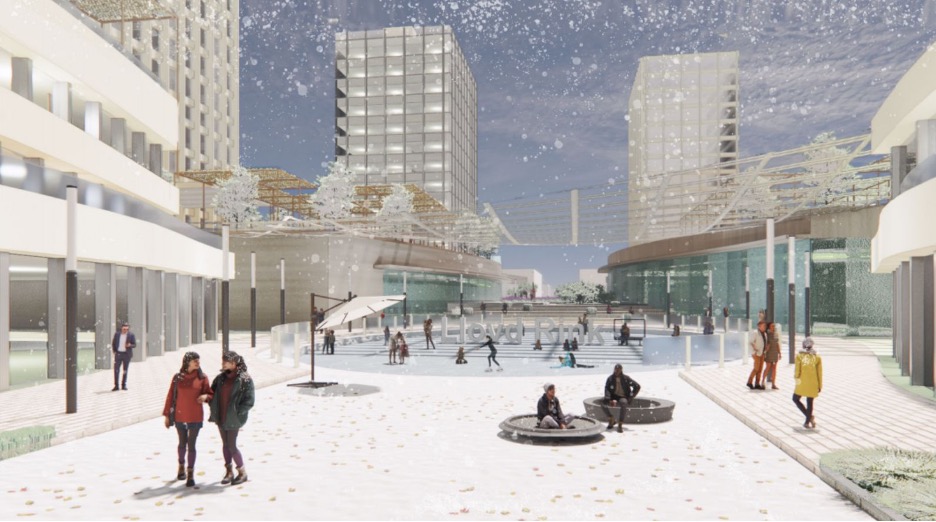
Heejin Park (MAUD ’23), Terry Kim (MUP ’23), Aelin Shaoyu Li (MDes ’24), Claire Tham (MUP ’23), and Li Zhou (MDes ’23)
Lloyd Center is an existing 1.2 million square foot mall located on approximately 26 acres in the Lloyd District on the east side of Portland, Oregon. When it opened on August 1, 1960, it contained over 100 stores and was considered the largest open-air mall in the country. However, Lloyd Center has struggled in recent years. The mall lost four of its five anchor tenants. The pandemic has accelerated its decline, dropping occupancy to approximately 40%. Currently, the Lloyd Center represents one of the largest land assemblage opportunities in the broader Portland CBD. Existing zoning on the site allows for dense, urban development (225 ft height limit; 6:1 base FAR): approximately 10 million square feet of total development capacity. However, numerous encumbrances restrict development on the site, impact liquidity, and impair value.
One key characteristic of Oregon is its emphasis on outdoor activities and sports. Bringing in such culture, our project will encompass “Sportainment” as the core concept of the family amusement park, where visitors can use all the indoor attraction points for a flat-fee ticket. The supporting retail space will be signified by experiential zones where customers can try out apparel, sports gear, and outdoor products. Complementary outdoor venues will provide further entertainment to visitors and neighbors. Furthermore, the retail space will accommodate local chains, boutique restaurants, and cafes to inject vibrancy and create a truly Oregon character to the retail mix.
Construction costs and overhead and government expenses associated with the development will be incurred as a real estate development project. We had the privilege to discuss the potential land selling price with the current owner, the Urban Renaissance Group. and derived an estimated 115 million dollars for the 26-acre parcel (1.1 mil. sqft). Due to the nature of real estate development, the majority of the costs come from the building side. As an investment structure, we will utilize the Private Real Estate Investment Fund vehicle and aim to attract Asian institutional investors, including insurance firms, sovereign wealth firms, and multinational corporations. Specifically, we will target such entities in South Korea, Singapore, and Japan, which are top sources of cross-border investment in US real estate, injecting billions of dollars per single year. Per the 2020 article, they only look for 6% to 9%, so the low cost of capital of Asian investors will add much value to our financing structure.