International Humanitarian Response (at HSPH)
This course offers practical training in the complex issues and field skills needed to engage in humanitarian work. Students will gain familiarity with the concepts and international standards for humanitarian response. While providing a solid theoretical foundation, the course will focus on practical skills such as conducting rapid assessments, ensuring field security, and interacting with aid agencies, the military, and the media during humanitarian crises. The course culminates in a required three-day intensive humanitarian crisis field simulation at Harold Parker State Forest in North Andover, MA, during May 1-3. 2020. Students will camp for two nights in the forest as part of an aid agency team responding to a simulated international disaster and conflict. Student teams will carry out rapid assessments, create a comprehensive humanitarian aid plan, and manage interactions with refugees, officials, and other humanitarian actors. Students will face challenges that test their subject knowledge, team skills, creativity, and grit.
Topics covered:
– Humanitarian response community and history
– International Humanitarian Law and Human Rights Law
– Sphere standards (shelter, water and sanitation, food security, health)
– Civil-military relations, media skills, logistics, and budgeting
– Monitoring and evaluation, accountability
– Personal security, metal health, stress, and teamwork
– Humanitarian technology, and crowdsourcing, and GPS skills
Course Fee: TBD (In previous years, $300 to cover camping gear hire, food, and other equipment costs).
This course is cross-listed with the Harvard Chang School (HSPH) as GHP 515 and GHP 518, and with Tufts University as NUTR324 and DHP213. All cross-registrants and Harvard Chan students must apply for instructor permission here.
Please note that this course is the equivalent of 3 GSD units, not 4.
This course will take place in Fong Auditorium in Boylston Hall, Harvard Yard, not at HSPH.
Public Space
In a digital age, does physical public space matter? Tahrir Square, the streets of Hong Kong, Brooklyn Bridge Park, Zuccotti Park, Madrid Rio, and other physical public spaces argue the affirmative, with ambitions ranging from accommodation of everyday leisure activities to political protests. Physical public space, although adapting to current demands and contexts, would appear anchored in transcendent human needs and desires.
This course examines the case and place for physical public space. Physical public space takes on a variety of physical forms, including sidewalks, streets, squares, parks, plazas, arcades, atria, and other outdoor and indoor spaces, but morphology alone is not destiny. Public space raises fascinating substantive and procedural questions. What are the purposes of public space? What makes good public space? Who decides what is good? Should public spaces serve all publics and allow all uses at once? Who should decide what is allowed? What role should design play? Who should design public space? Are there universal design principles? Who should own and manage public space? Can private parties participate in public space provision without loss of publicness? Is government provision always better that private provision? Does theory usefully inform practice? How much do democracy and equality depend on ample availability of public space? How much public space is enough? Is physical public space threatened or enhanced by the digital? Is a shopping mall a public space? And the list goes on.
This course introduces foundations for thinking about and making public space and offers students an opportunity to contribute research and new ideas to the field. Classes include lectures, discussions, and two small exercises (drafting rules of public space user conduct and creating a public space logo) that replace readings for that class. Students are expected to complete assigned readings for each class before class so that they may actively participate in discussions. A 5,000-word term paper or other instructor-approved final project of equivalent effort is required. The final project will count for 75% of the course grade, while class participation will count for 25%.
Local Government Solutions to America’s Affordable Rental Housing Challenge
There are 10.9 million renters who are severely housing cost burdened – spending more than 50% of their income on shelter. The solutions to this national crisis are varied and involve all levels of government, but local governments are closest to the particular housing challenges in their communities and arguably have the widest range of levers to apply to the problem. This course will challenge students to create new and innovative approaches to the affordable housing problem that can be implemented at the local level. These approaches will include a mix of strategies to raise additional funds for subsidies, reduce regulatory constraints, and encourage new forms of housing and new methods of housing construction. Students will be offering advice and solutions directly to mayors and housing professionals of four cities from different regions of the nation that have volunteered to serve as laboratories for the course: Austin, TX, Louisville, KY, Rochester, NY, and Stockton, CA.
Students will receive a package of information about their cities in the first session of the class and will hear from representatives of each of the cities early in the semester. Students will also have access to important local actors as the class proceeds. All four cities will return for presentations of the students final reports providing a comprehensive strategy for the cities to adopt that will substantially resolve the cities’ current need for housing affordable to severely cost-burdened residents.
The course will be limited to 20 students who will be divided into teams that will serve as “consultants” to the mayors and housing professionals of the participating cities. While there are not explicit prerequisites, this course will work best for students with some experience, either academic or professional in the housing sector.
The class will meet in a seminar format for three hours each week. Classes will include a mix of lectures, presentations and discussions with invited guest experts, and will often include presentations by student groups. Grading will include class participation, periodic presentations, and the final comprehensive strategy.
Circular Eco-nomics: Mapping Architectural & Urban Ecosystems
This course introduces students to the idea of circular sustainable economies, hereby described as “eco-nomics,” looking simultaneously into the economics of sustainable lifestyles and work styles, sustainable product lifecycle, and sustainable environmental development. Eco-nomics is based on the value assessment that economy and environment are and should be interconnected.
How can we rethink architecture and urban conditions as a “system of systems,” that instead of promoting linear entropy, decay, and the accumulation of waste, can be designed with circular and recursive material and energetic metabolisms? We will examine new and emerging models, technologies, and techniques for the design of innovative architectural and urban “metabolizing” environments. “Metabolizing” is hereby understood as the constant circular exchange of matter and energy in the creation and operation of living and nonliving systems.
To do this, we will constructively critique contemporary methods of design and collaboration, industrial and professional value creation and assessment, and persistent and evolving conventions of material fabrication, construction processes, and building operations within architecture and infrastructure. Materiality in these contexts must be studied holistically: Where do materials come from? How do materials transform and become what they are through human and nonhuman forms of labor? How does materiality and energy power systems represent systems of power? And how is materiality affected by global and international networks and trade practices?
By shifting toward a cyclical view of the lives of materiality and building products, their explicit and implicit web of connections, the seminar will focus on using architectural and urban proposals to provoke eco-nomics to modify the narratives of materiality, production, and their “commodity chains” of environmental resources, labor, and industry.
The seminar will cover framework of thought and the digital tools of technical craft to create speculative, cross-scale design interventions taking into account new emerging eco-nomics within circular sustainable economies. Student production will depart from a linear model of architectural and urban design thinking, and arrive at a circular model with the goal of resulting in significant changes to how we think, design, construct, operate, and deconstruct future products, architectures, and environments.
The course is a seminar-workshop. The first part of the course consists of readings and discussions, background research, site analysis, and direct use of provided emerging collaboration platform technology. Students will document their work in groups. The second part of the course will be the making of V&R prototypes that serve as proof of concept.
Students from any background and concentration are encouraged to apply. No specific prerequisites are needed (3-D modeling capabilities, coding, and a hands-on mentality are a plus).
Studio Abroad. Small is Big; Newborn Typologies from the City without a Manifesto
“For the human mind, the tree is the easiest vehicle for complex thoughts. But the city is not, cannot and must not be a tree. The city is a receptacle for life. If the receptacle severs the overlap of the strands of life within it, because it is a tree, it will be like a bowl full of razor blades on edge, ready to cut up whatever is entrusted to it. In such a receptacle life will be cut to pieces. If we make cities which are trees, they will cut our life within to pieces.”
– Christopher Alexander
Tokyo is a city in a constant state of becoming; metabolism reigns mighty as history and sentimentality are casted easily aside to make way for “newness” that comes already with an expiration date. Tokyoism[1] is an irresistibly veiled assemblage of the futuristic, the traditional, the ineffable, the finite, all bundled in a poignant narrative of the relational field of networked “super legal”[2] objects. Antithetical to an archipelago of skyscraper blocks and architectural debris floating, self-absorbed, in its own gleeful solitude, Tokyo is an ever-fluctuating, undulating network; thoroughly connected with embedded redundancies, resilient to hollowing, and simultaneously a stubborn collective of medieval structures, both physical and ephemeral. This city is a great laboratory and it is up to us to tease out an unintended, but nonetheless projective theory of Tokyo that may be more about the future of global cities.
Tokyo is a polycentric city, conceived from its inception and subsequent historical processes to develop in multiple nodes. It serves as a petri dish for a decentralized, highly distributed, and differentiated form of interventions in all scales. With this in mind, this studio will take a critical stance against the prevalent organizational model of consolidation and centralization insofar as urban developments have been concerned. We will begin by analyzing traditionally mega or XL-sized building typologies that occupy vast territories in other parts of the world, thrive in them, and perhaps some that can also be found in Japan. To name a few: shopping malls, hotels, office towers, high-rise condominiums, libraries, museums, theaters, concert halls, universities, convention centers, city halls, gymnasiums, stadia, aquariums, regional transportation hubs, airports, parks, parking garages, seawalls, power plants, water treatment facilities, dams, solar parks, and so on.
After a thorough analyses of those large to extra-large scale typologies, we will rigorously search for ways in which to dissect, fragment, atomize, combine efficiently, perhaps even absolve some redundancies in those bespoke contemporary megaliths into a distributed system instantiated into Tokyo. Thus, the whole city can potentially become a platform that thrives on diversity—in many senses conjured by that word—for complex coexistences of differences rather than demarcated into zoning segments for an efficiency of control, both politically and environmentally. Only then can Tokyo become a truly cosmopolitan global megapolis after the 2020 Olympics, and by chain reaction, can Japan become an open, unisolated archipelago in a sea of capitalism or whatever social order that may rise. Conversely, by releasing the programs from the sophisticatedly controlled interiority of a megastructure, a new kind of metabolism can emerge. This studio seeks to invent new typologies of architectural and urban space of diverse differences, rather than similarities; heterogeneity over homogeneity; heterotopic over utopic; exceptional over banal; small over large gestures.
Small is a new big, as it shall consume the city as a whole.
[1] Kaz Yoneda, 2014
[2] Yasutaka Yoshimura, Super Legal Buildings (Tokyo: Shokokusha, 2006).
Book Project Number Zero
1. Architecture is inseparable from bookmaking. Ever since Sebastiano Serlio discovered the potentials of the printing press, no cultural project in the field of architecture has escaped publishing and so thematising a possible reading of buildings—regardless of present or past, big or small, real or invented.
2. Even in the context of the extreme wealth of media available today, books are still the main instrument of architectural propaganda. The internet did not kill the architecture book. More likely, the internet increased the book’s value for an architect’s career.
3. Books are projects, as well as buildings. Books are imagined, sketched, designed and executed.
4. Students will develop a project for a book on architecture. The choice of topic is open, as well as the format.
5. The final output of the seminar is a “book” that will include a written introduction, an index, an atlas of images, and a graphic design scheme.
6. The imaginary book may be projected and assembled as long-form or short-form, text-based, image-based or composite. Students may realize their book using different media, but the final deliverable should be “book-alike” and printed.
7. Usually, when authors write a book, they A) first write the index and introduction, B) then write the actual book, C) then re-write the introduction. The seminar will stop at point A.
8. Instructors will present two case studies on bookmaking in fine detail. Pier Paolo Tamburelli will discuss his ongoing project of a (long-form) book on Bramante; Thomas Kelley will present his recent (short-form) treatise on vision. The seminar will consist of lectures, discussions with external guests, and a final review of the individual book projects.
9. And while the seminar will afford multiple strategies for ideating architecture through the medium of a book, each project will question how the essence of communication in architecture is informed, for better and for worse, by how a book (or any publication) relates to building.
This course has and irregular schedule:
Thomas Kelley will be in residence on January 30-31, February 6-7, 20-21, March 26-27, April 23-24, and for the Final Exam in May.
Pier Paolo Tamburelli will be in residence on January 30-31, February 27-28, April 9-10, and for the Final Exam in May.
Right to Grow: A Manifesto
Right to Grow: A Manifesto
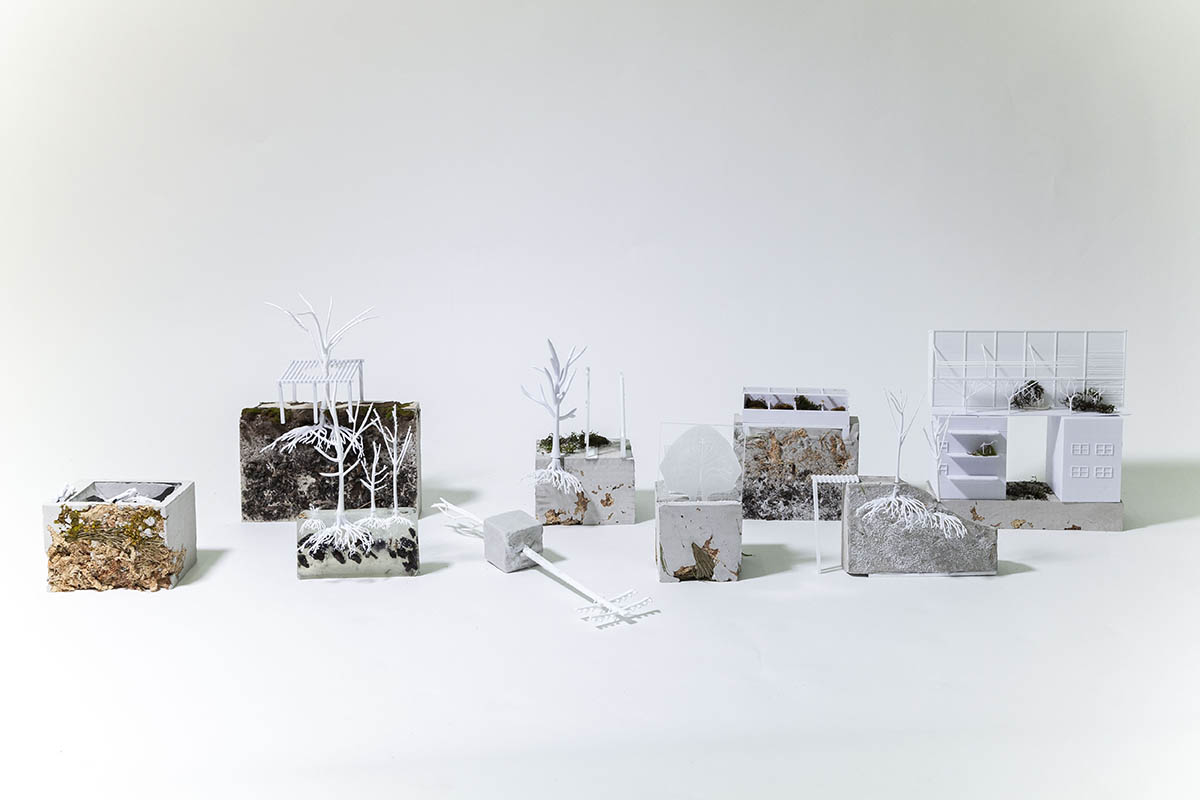
Kira Clingen (MLA I, MDes RR ’21), Carson Fisk-Vittori (MLA I ’20), Shira Grosman (MLA I AP/MDes ULE ’21)
The current rhetoric around city trees assigns monetary values to their carbon absorbed, health benefits provided, rainwater caught, and aesthetic appeal, but doesn’t prioritize their life-cycle beyond an average 7-year life expectancy. We critique the valuing of trees as resources for human benefit; we must revalue trees as intentional purposeful beings. This requires reconfiguration of the urban assemblage. This shift is catalyzed by an ordinance inserted into zoning code entitled Right to Grow. Rights prioritize trees needs in an urban environment. This ordinance reconfigures the false urban binary between people and woody plants by establishing spatial rights of way for tree communities built around their life-cycles. Establishing expanded space for plant communities challenges prevailing simplistic lists of street trees and planting conventions. Expanded typologies form empathetic spaces within cities reframing conventions of habitation between people and woody plants.
A case study in South Boston proposes three scenarios at different scales — City Corridors, Community Clusters, and Neighborhood Networks. These scenarios are inserted into the existing context of South Boston. The locations relate to their adjacency to the urban center and main transit thoroughfares, coastal edge, and upland conditions and are prototypical, but replicable across South Boston and nationally. Throughout the city, habitation intensifies. Zoning infrastructures are reconsidered as an entangled indeterminate web of relationships that shift towards infrastructure in service of plant communities. As cities extend across larger territories, this tree ordinance provides a framework for future tree communities at the national scale that moves beyond ecosystem services.
Bed Rooms
Bed Rooms

Qin Ye Chen (MArch I ’22)
In Bed Rooms, five modes of activation produce five spatial bays with formal and spatial qualities that encompasses a range of social conditions associated with the given object, “bed.” The five modes of activation are: play—a space for jumping on the bed; gaze—a space for lying on the bed to look up at the sky; rest—a space for sleeping; gather—a space for sleepovers; and meditate—a space for contemplative practices. These spatial bays work as a critique of default modes of thinking about the space of the bed, exposing misbehaviors that have interesting formal consequences.
During the design process, a key question was posed: how can the bays manage a number of spatial conditions and work with light, sound, body movement, and landscape? The result was a set of bays that follow an underlying grid framework while also exhibiting a variety of orientations, heights, opening sizes, and tilting angles, giving it an almost creaturely reading from the exterior.
Landscape is also an integral part of the project. Circulation stitches the bays together and pinching of landscape funnels in and out of the bays. Another question that was posed was how can the ground be used as part of the project to express “bedness?” Unlike other common objects, bed is large and spatial—its physical existence has an impact on how one experiences a room. The project challenges common perceptions of bedrooms; the next question would be how can a room express “bedness” without the bed being there?
Mycelium Stool
Mycelium Stool

Luke Warren (MArch I ’22), Aditi Agarwal (MDes ’20), Hangsoo Jeong (MArch I ’22), Victoria Patricia Lopez Cabeza (MDes ’20)
A seat grown from mycelium, soft and spongy, rests on three slender, hand-turned walnut legs. A hidden, CNC-milled piece of plywood, punctured with holes to reduce unnecessary weight, provides both the structure that connects the legs and a lattice for the mycelium to grow. The mycelium—the vegetative root structure of fungus—is grown around the wood structure in a mix of corn and hemp byproduct. As the mycelium grows, it binds this waste material together and conceals the construction of the stool. The visual and tactile contrast between the two materials produces a series of oppositions—light/dark, soft/hard, living/ dead, grown/machined, additive/subtractive—and, more to the point, a comfortable seat on a sturdy base. The use of soil to cast the mycelium eliminates both the material cost, in terms of dollars, and the environmental cost, in terms of embodied energy, of producing a mold, and further accentuates the contrast between the precision of the legs and the loose form of the mycelium seat. The stool is entirely constructed from renewable resources, and at the end of the stool’s life, the mycelium is fully compostable and bio-degradable.
Product and Experience Design for Desirability
Multi-disciplinary course for students interested in designing products and services that are simple, irresistible, delightful, cool, covetable, viral, and, increasingly these days, much more likely to be successful. Students study real world cases of how organizations (e.g., Apple, Gucci, Swarovski) strategically design for desirability. In weekly design challenges, students use analogical transfer to apply these insights to diverse industries and target markets (e.g., health literacy campaigns, declining technologies, the future of luxury). Weekly critique panels with experts enable students to develop their own design point of view and to finish with a diverse design portfolio.
Permission required for all students.
Jointly Offered Course: SEAS EngSci22.
This class meets in Maxwell Dworkin 119 (SEAS) on Mondays and WEdnesdays from 9:00 to 11:00 am.