Atlas for a City-Region: Imagining the Post-Brexit Landscapes of the Irish Northwest
Atlas for a City-Region: Imagining the Post-Brexit Landscapes of the Irish Northwest
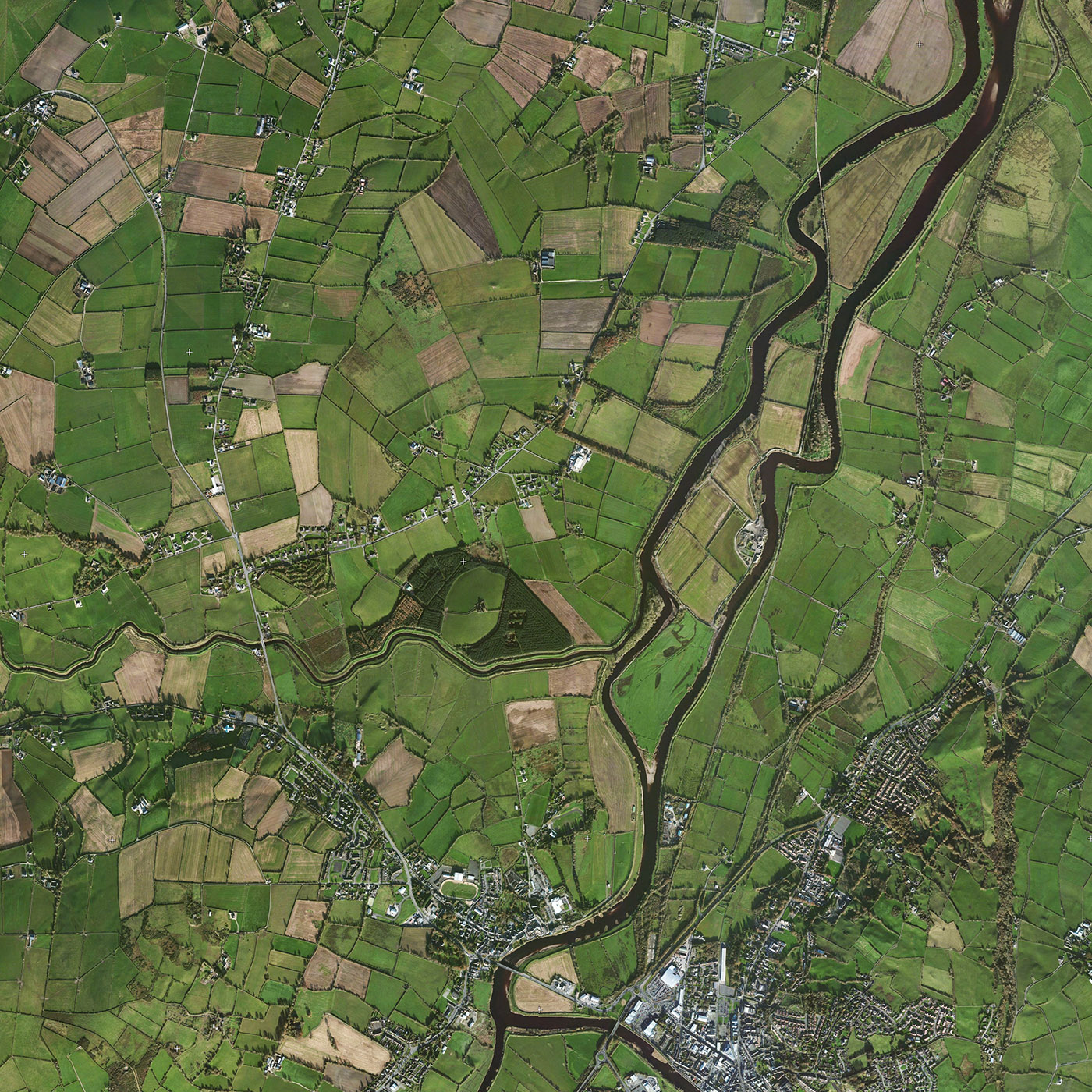
Centered on the northwest of Ireland, this eighteen-month long research project investigates how a cross-border city-region can be shaped in light of the economic, political and social realities of Brexit. Integrated within the teaching of the department of landscape architecture at the Harvard Graduate School of Design, and engaging faculty from across the university, the project asks how landscape can be an agent in the shaping of the cross-border city-region. Located between the counties of Derry, Donegal and Tyrone the cross-border city-region has a population of approximately 350,000, and growing. Through research seminar and option studio, the multi-scalar project will address the design of smaller urban spaces right up to the design of the region itself. The project will demonstrate how the post-conflict Northern Irish landscapes can adapt to post-Brexit conditions, and how landscape architecture can be instrumental in shaping not just the physical landscape but the new political landscape too.
Derry and Strabane District Council, Northern Ireland, Sponsor
Donegal County Council, Ireland, Co-sponsor
Excavated Extrusions
Excavated Extrusions
Hyperbolic Embrace: Film Studio
Hyperbolic Embrace: Film Studio
Brayton Gregory (MArch I ’21)
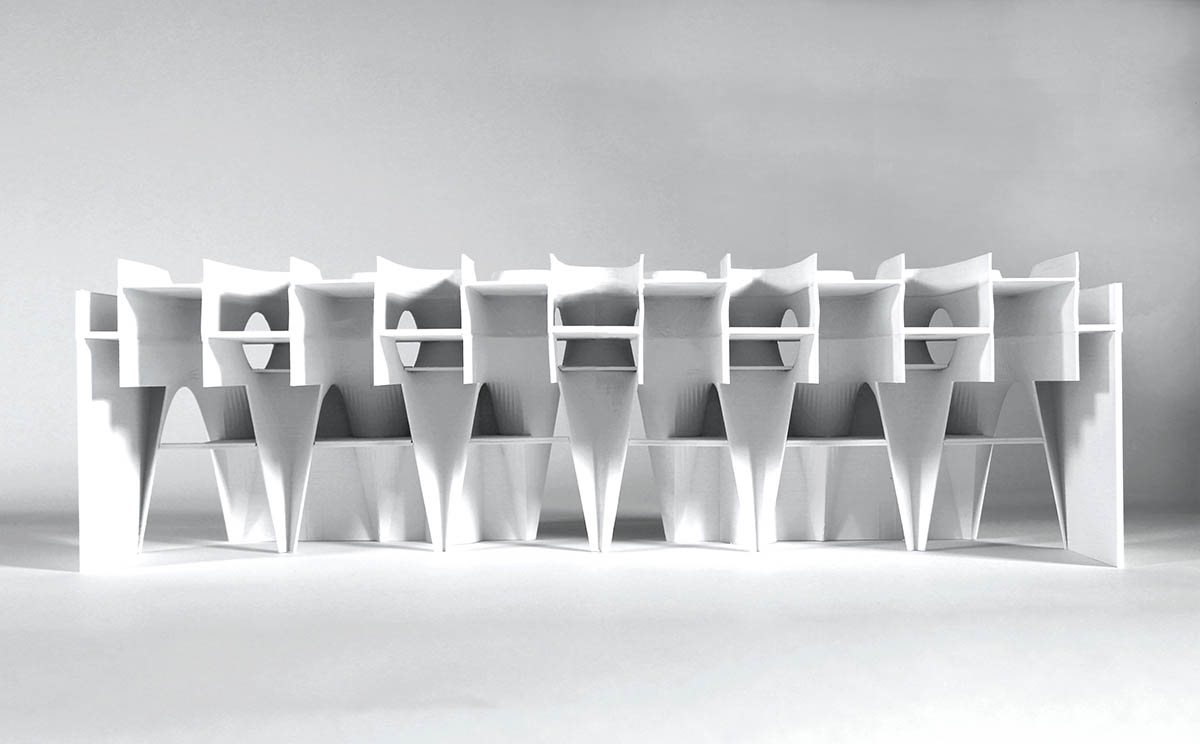
Using the geometric capabilities of hyperbolic parabolas, there was a creation of a structural module that could perform multiple moves. The module is composed of three hypars that are stitched along tangencies and then scaled in a vertical fashion. The structural system used for spanning large distances, samples part connections of hypars mimicking typical planar truss systems. The truss system acts as the main structure but also creates modular sized spaces of inhabitation above each film studio. The module is also capable of creating columns, walls, and a gradient of sized spaces. This includes the creation of a covered arcade system surrounding each individual film studio that produces a layered system of public and private spaces. The ultimate goal within this project was the deployment of one structural module that could achieve the following; spanning structure across large open spaces, creating multiple scale of spaces, housing a variety of sized program, and providing layers of enclosure.
Tectonic Construction
Tectonic Construction
Andreea Vasile Hoxha (MLA I ’20)
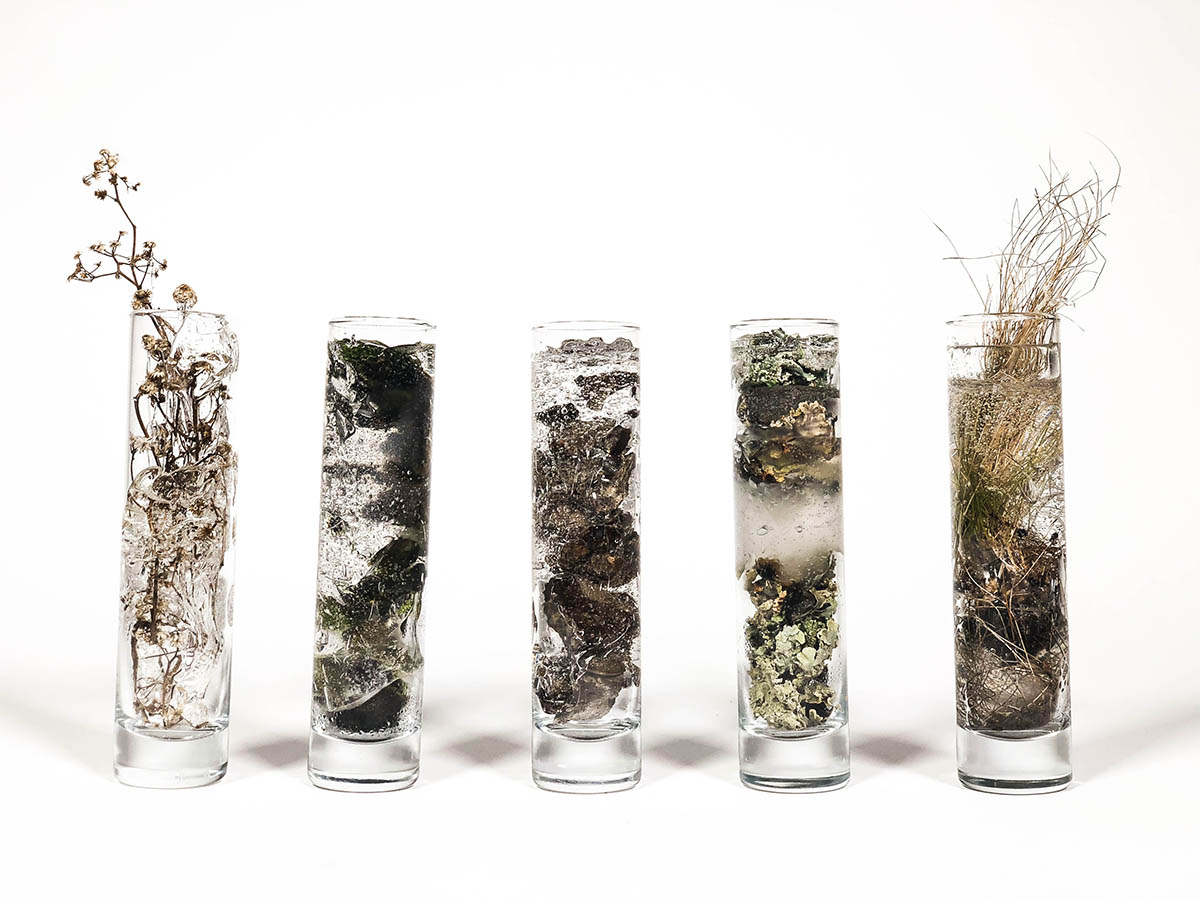
Landscape deeply engages with the materiality of the site, where tectonics offer multiple scales and processes for observation and manipulation. Tectonic Construction encapsulates a series of material samples collected in Franklin Park for further observation of aging and decay. The use of moss, lichen, and soil display a range of dynamic processes within days of being collected and enclosed with gel wax, while the rocks and dried grass seem to be frozen in time.
Tectonic Construction
Tectonic Construction
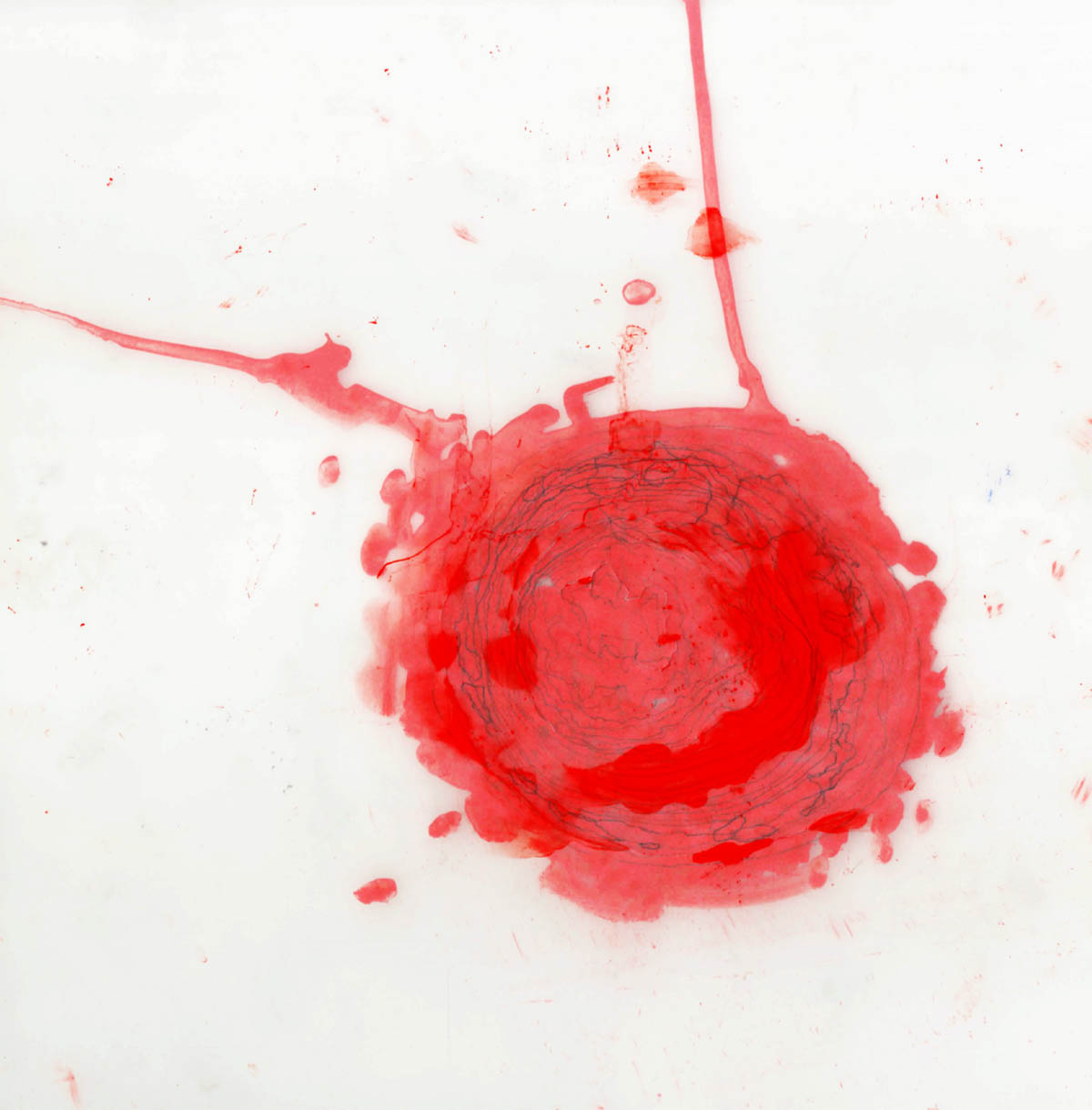
Xingyue Huang (MLA I ’20)
This project is based upon a score of the temporal void in ice. The morphology of an ephemeral void is captured in another material through the process in reverse. In this 2D tectonic reconstruction, the intangible form is abstracted into two overlaying layers: the contour of a score and the flow of material.
Islands in Islands
Islands in Islands
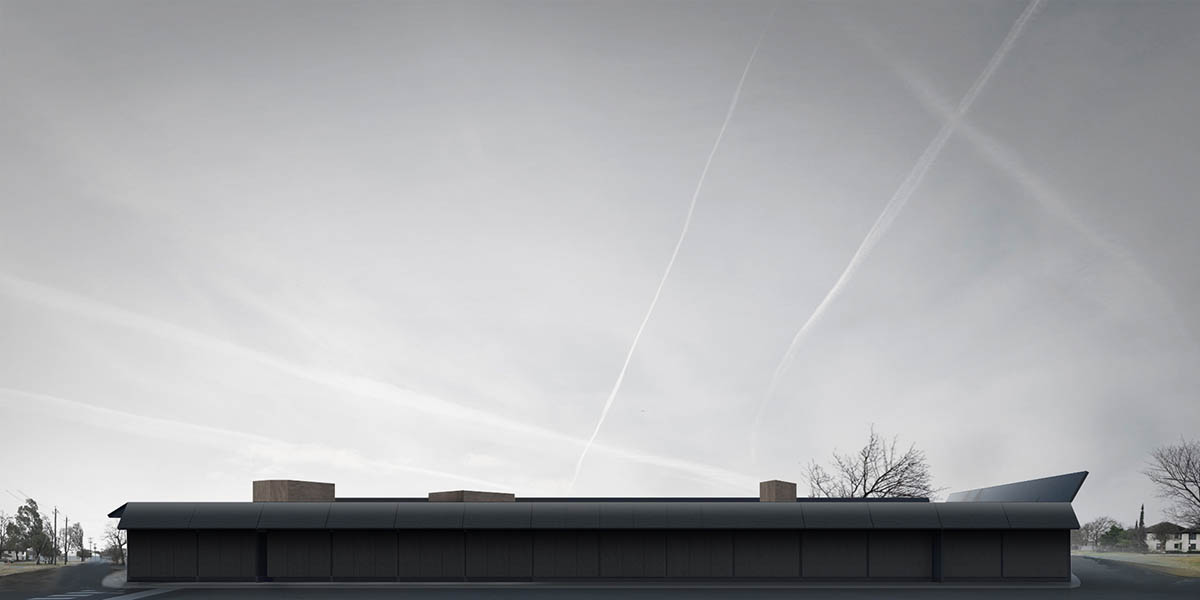
Eduardo Martínez-Mediero Rubio (MArch I ’19)
The studio investigated variations on the theme of island and archipelago organizations (mono-use spaces and their subsequent agglomeration) in architecture and their generative potential in urban design through the design of a new building for an Art Depot built with CLT construction on the campus of the Menil Foundation in Houston.
The building presents itself to the exterior as a quiet, ordinary warehouse, completely covered in tar paper, an industrial material that talks about the frugality of the program while conveying body memories through its craft and implementation. The blank exterior facades are topped with a series of tilted planes acting as roof cornices that dialogue with the neighboring prewar bungalows of the Menil campus.
The Art Depot is internally structured by a 15´x15´ chainlink grid that organizes the warehouse in nonhierarchical rooms where the art is exposed, allowing for unexpected cross-relations and dialogues between the various pieces of artwork that belong to the Menil Foundation.
The grid, understood as a geometrical tool of control, is challenged by abruptly interrupting it with a series of rooms that act as islands inside the building’s boundary and structurally support the roof. Built with CLT construction, these rooms accommodate those programs that require specific temperature, sound and humidity conditions while bringing indirect light inside.
The limits of art storage in contemporary architecture and the possibilities they trigger through uncurated exhibition spaces are explored in this project. It raises questions on the dissolution of boundaries and island configurations that, rather than understanding these as fissures, promotes connection through the demarcation of borders in a place where disorientation has become the norm.
Form-Based Coding
Form-Based Coding
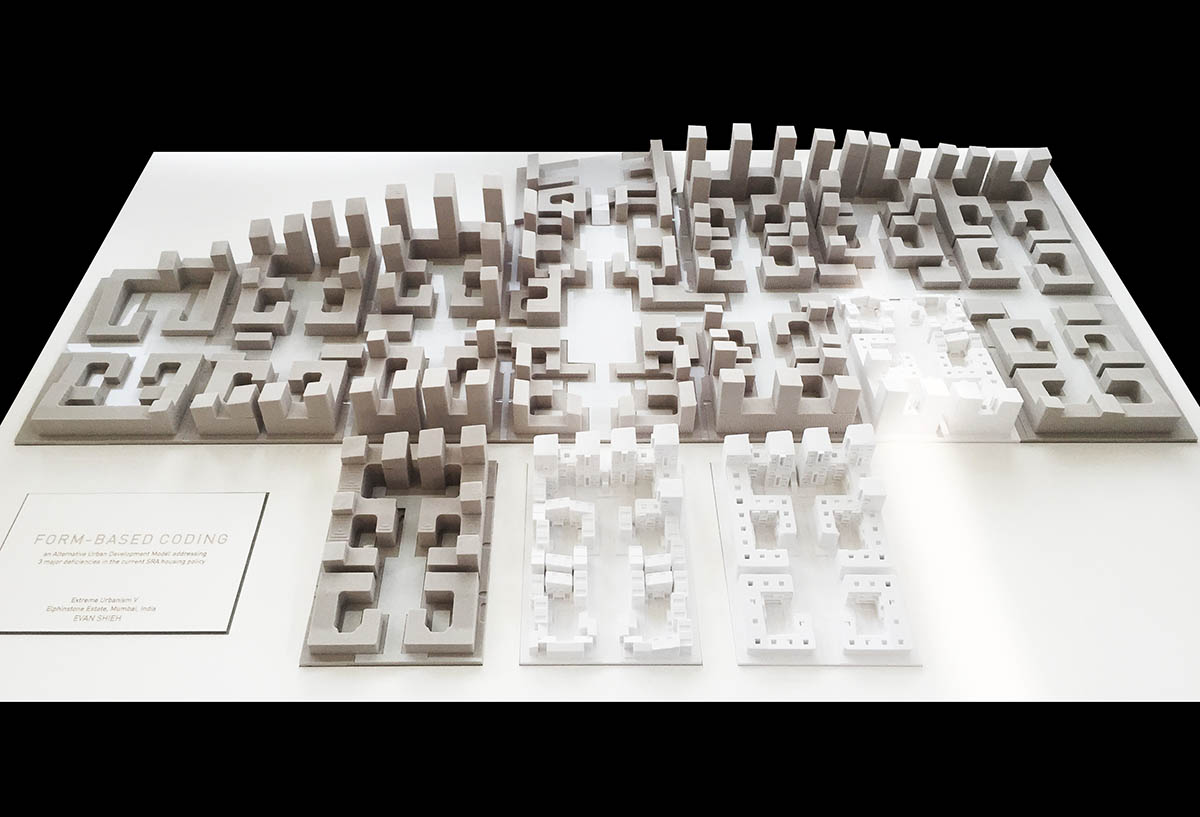
Evan Shieh (MAUD ’19)
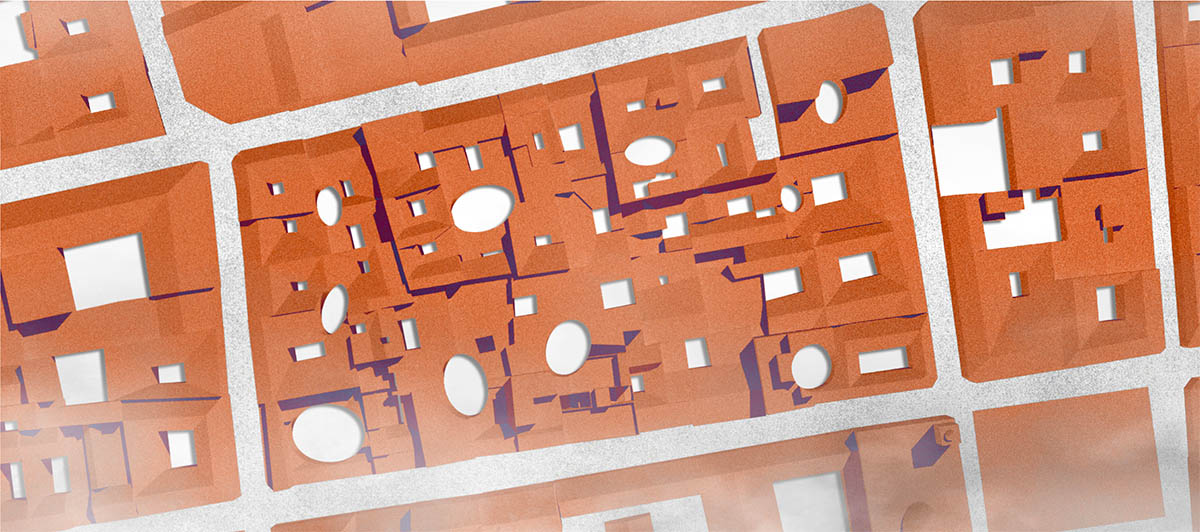
The proposed design methodology in this project examines form‐based code as a potential model that has the ability to address these three deficits. It proposes an alternative urban development model that fulfills the FSI density requirements that high‐value land like our project site demands, yet still provide a humane housing model that maintains access to a scaled set of open spaces, amenities & guardian institutions, and allows for a diversity of building typologies, densities, and aggregations to encourage flexibility in lifestyles. By dictating the larger form‐based coding of the block configurations, the model allows for a multitude of potential housing lifestyles & architectural aesthetic scenarios to take place within this maximum buildable zoning envelope, while a rigorous urban relationship to a scalar subdivided set of open spaces (from the neighbor to the entire district) is strictly maintained. In doing so, a gradient of building typologies, from the tower to the single‐family home, can successfully coexist on the same parcel of land, while dually ensuring that a wide range of unit sizes can accommodate household incomes of all ranges.
Fundamentally, the project shows how alternative models do exist and can be both financial performative and also urbanistic‐ly humane, without resorting to the severe cluster developments that the SRA schemes default to. In doing so, it both critiques the current SRA housing policy but also offers a new model of urban housing development for a city of such dire affordable housing needs.
Anthropic Infrastructure
Anthropic Infrastructure
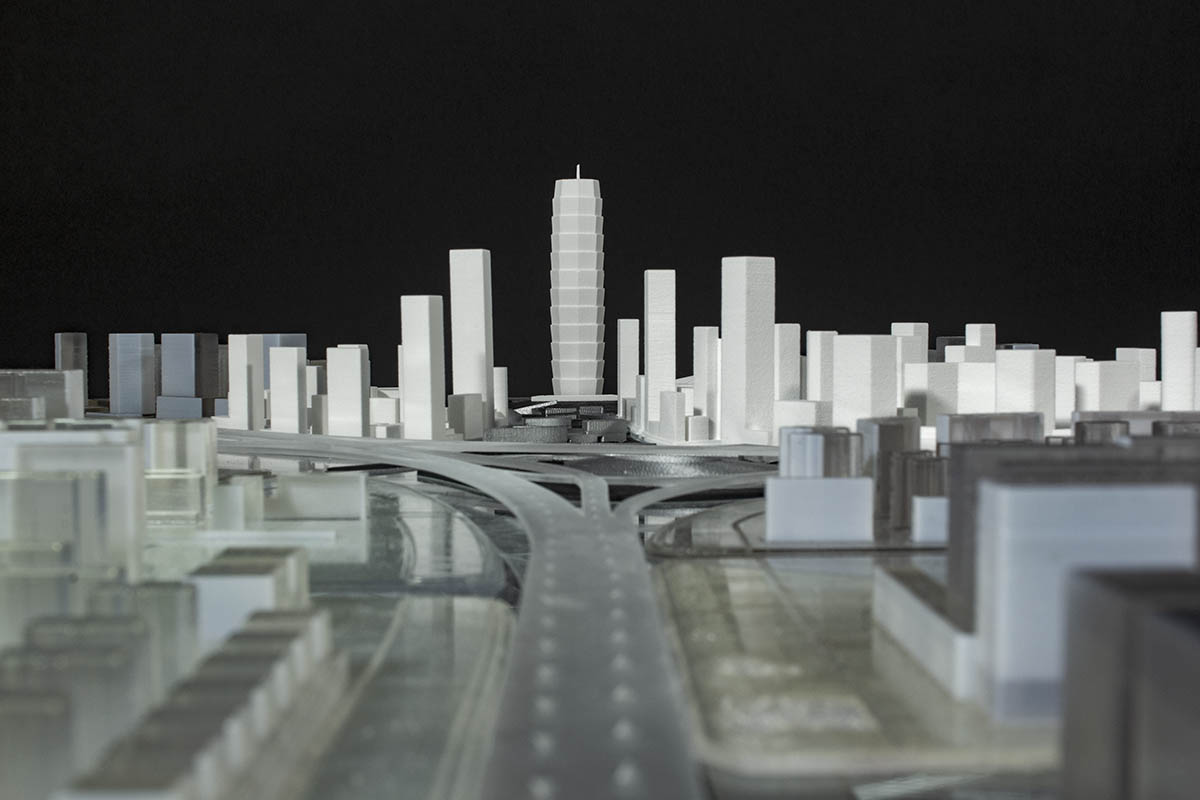
Yoeun Chung (MAUD ’19), Luke Tan (MAUD ’19)
Situated in Zhengzhou, China, this project reconfigures a highway interchange, reclaiming its previously- inaccessible residual areas to introduce a pedestrian-oriented development that leverages on an existing metro station for densification.
Convergent systems and ambitions produce a site that is characterized by contingency and disjuncture. The highway interchange is along an edge that is shared by the Zhengdong New District, historic area and an emerging station city. It is also the threshold of a symbolic axis inscribed by a highway that connects the airport with the Zhengdong New District and marks the intersection between two major metro lines. These are the existing Line 1 which is the east-west backbone that links all the vital functions of the city, and the vertical Line 4, which the studio proposes to develop as the new spine of Zhengzhou.
The project aims to bring the site’s confluent forces into a synergistic relationship in three operations. First, by reconfiguring the interchange to liberate its previously inaccessible residual areas. Next, by introducing a programmed green spine to increase access and influence of the adjacent metro station while preserving the city’s symbolic axis. Finally, by gridding the adjacent regions to enhance connectivity for densification.
The higher ambition of this project is to formulate strategies to engage the aberrant conditions produced by infrastructural artifacts that are characteristic of rapid urbanization and automobile dependency. It is conceived as part of the studio’s larger scheme to establish the planned metro Line 4 as the future spine of Zhengzhou.
Almost, But Not Quite, Entirely Unlike a Supermarket
Almost, But Not Quite, Entirely Unlike a Supermarket
Shaina Kim (MArch I ’18)
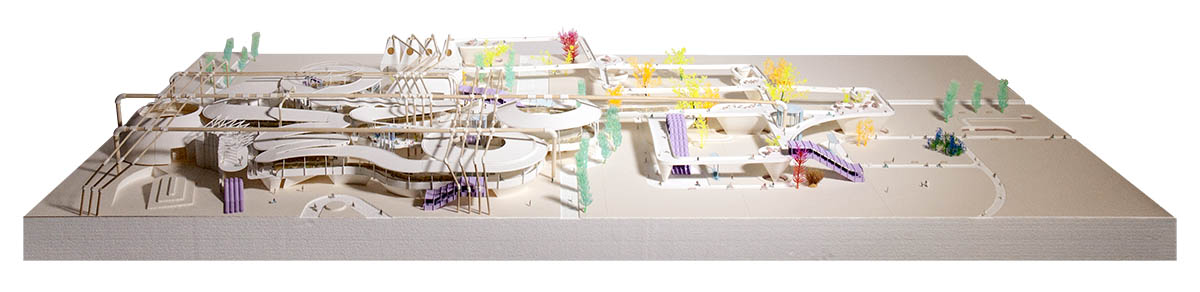
This thesis proposes an architectural typology of the supermarket. By extracting formal representations of the habitual rituals that we go through on a regular basis, architecture becomes a cognitive system that defamiliarizes the familiar. My interest in redefining the ordinary started with a towel, which features in the novel The Hitchhiker’s Guide to the Galaxy (1979) as a multifunctional device in circumstances across the universe. An object as banal as a towel suddenly obtains new meaning by taking it out of its ordinary context. The spectacle is not rendered by never-before-seen novelties, but through the reinterpretation of banal things.
Offcut: A Museum in Los Angeles
Offcut: A Museum in Los Angeles
Morgan Starkey (MArch I ’19), Alexandru Vilcu (MArch I ’19)
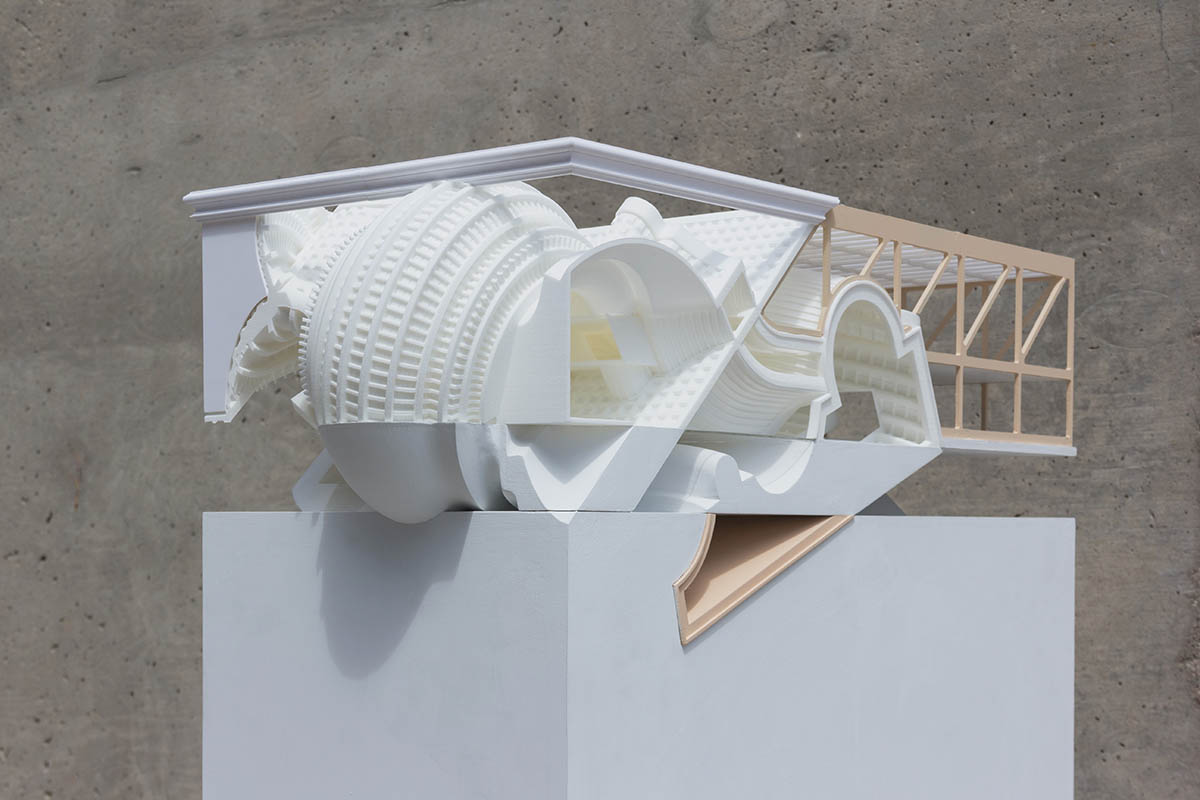
Interrogating the role of the architectural detail, this project examines how these small elements may be a generator of larger architectural spaces and logics. “Active Inlay” studies that parametrically sweep motific molding profiles through a host volume, both carve out and organize space, while engendering an attitude about joints, fits, and connections that appear across scales in the museum. The same series of Boolean operations that result in a desirable edge-to-edge host/inlay relationships on the macro scale, are used at the sweeping nodes that resolve the intersections of the two constructions systems: a 2-way concrete coffer surface and a glulam timber assembly. Beyond these formal and technical elements, the project poses questions about leveraging the function, misbehavior, and perversion of ornament in architecture.