New Geographies 03: Urbanisms of Color
New Geographies 03: Urbanisms of Color
Edited by Gareth Doherty
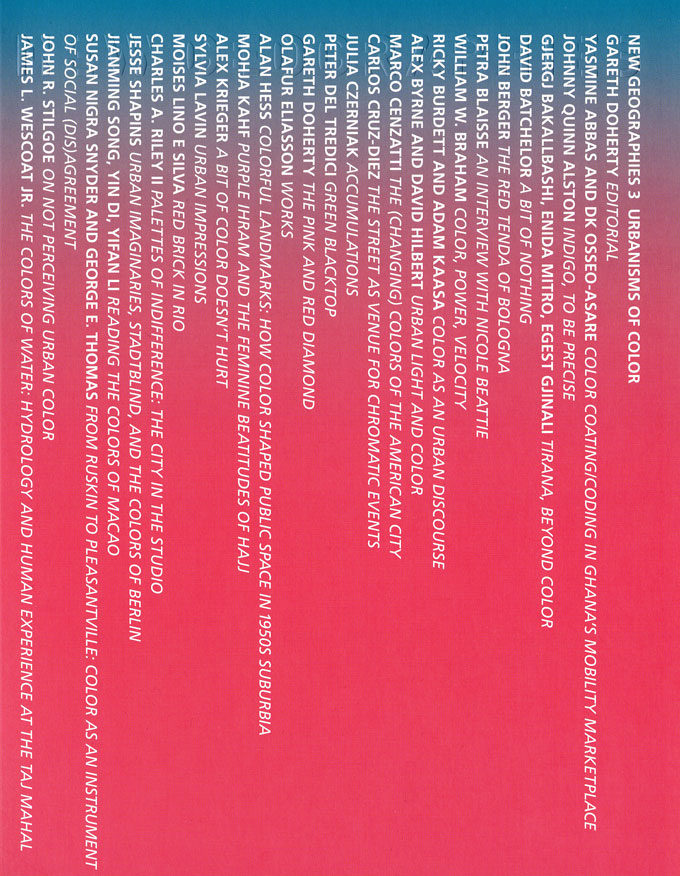
Color is a ubiquitous yet essential part of the city, creating and shaping urban form. Who can forget the whites of modernist Brasilia? The greens of historic Cairo? The rosy reds of Petra? The terracottas of South America’s shantytowns? The color cacophonies of Times Square and Shinjuku? Colors have a presence over and beyond the objects—buildings, spaces, billboards, artifacts, and people—that make up the city. Not only does color give meaning to cities, cities give meaning to color. Whether carefully coordinated, clashing, or an expression of materials, color is a powerful cultural, economic, and political force in cities. Yet discussions on the city do not usually focus much on color, perhaps because urban colors are too often understood as being beyond any one authority or taste, or are simply dismissed as cosmetic, naïve, or intangible. Volume 3 of
New Geographies brings together artists and designers, anthropologists, geographers, historians, and philosophers with the aim of challenging the status quo and exploring the potency, the interaction, and the neglected design possibilities of color at the scale of the city.
Published by the Harvard University Graduate School of Design, 2011; available through
Harvard University Press.
Platform 3
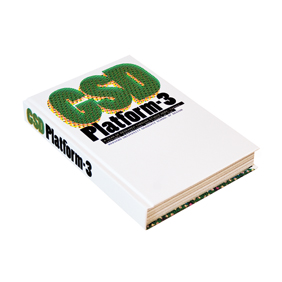
Platform 3 considers the expanded boundaries of the Harvard University Graduate School of Design. It features not only selections of work produced at the GSD during the 2009–2010 academic year, but also the potential of that work to address broader questions and inform global initiatives.
The selected projects, research, and lectures expand the limits of design and invite us to reconsider the role of the architect , the landscape architect, the urban planner and designer in defining the world of the future.
Available for purchase from
Actar.
Publisher: Actar, Harvard Graduate School of Design, 2010
The Function of Form
Farshid Moussavi, edited with Michael Kubo, Garrick Ambrose, Ben Fortunato, Ryan R. Ludwig, Ahmadreza Schricker
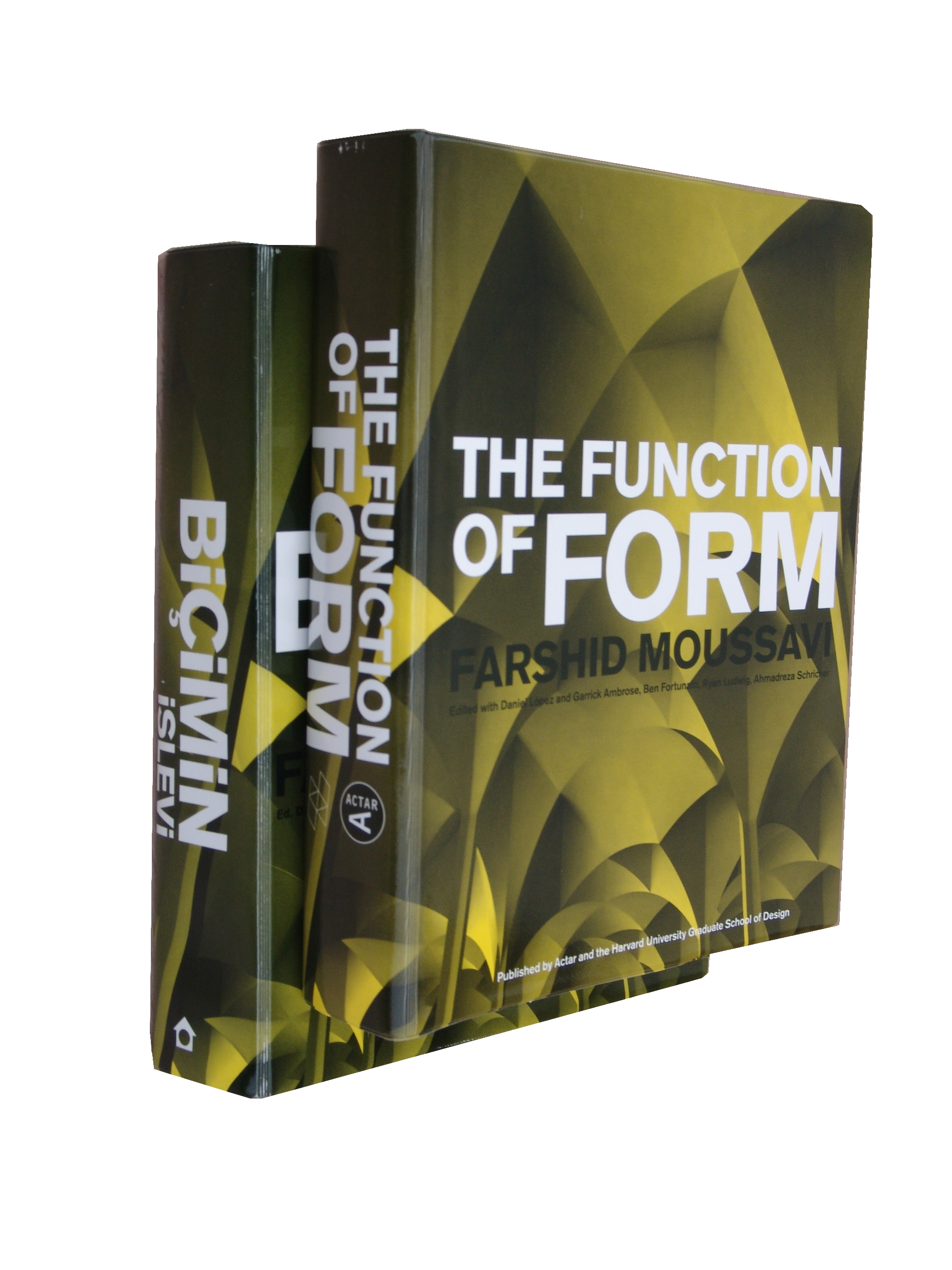
Following the success of The Function of Ornament, this is the ultimate graphic manual on structural systems and their capacity to produce a wide variety of forms. Based on the Harvard GSD research seminars of Farshid Moussavi (Foreign Office Architects), The Function of Form explores the production of singular affects through systems that relate form and content. This is an essential graphic manual on structural systems and their capacity to produce a variety of forms. Extracting their base geometric unit, a wide range of historical projects from the Medieval to the present are used as systems to proliferate different forms. The book distinguishes tessellation from modulation as a type of flexible system for producing complex repetition through diverse parts. The research presented aims to move architectural experiments away from ‘mechanistic’ notions of systems for re-producing forms, to ‘machinic’ notions of systems that determine how parts of an architectural problem interrelate and multiply. This open nature of transversal systems leads to new actualized forms and novel affects.
Harvard Graduate School of Design/Actar
Territories: Contemporary European Landscape Design
Territories: Contemporary European Landscape Design
Edited by Joseph Disponzio
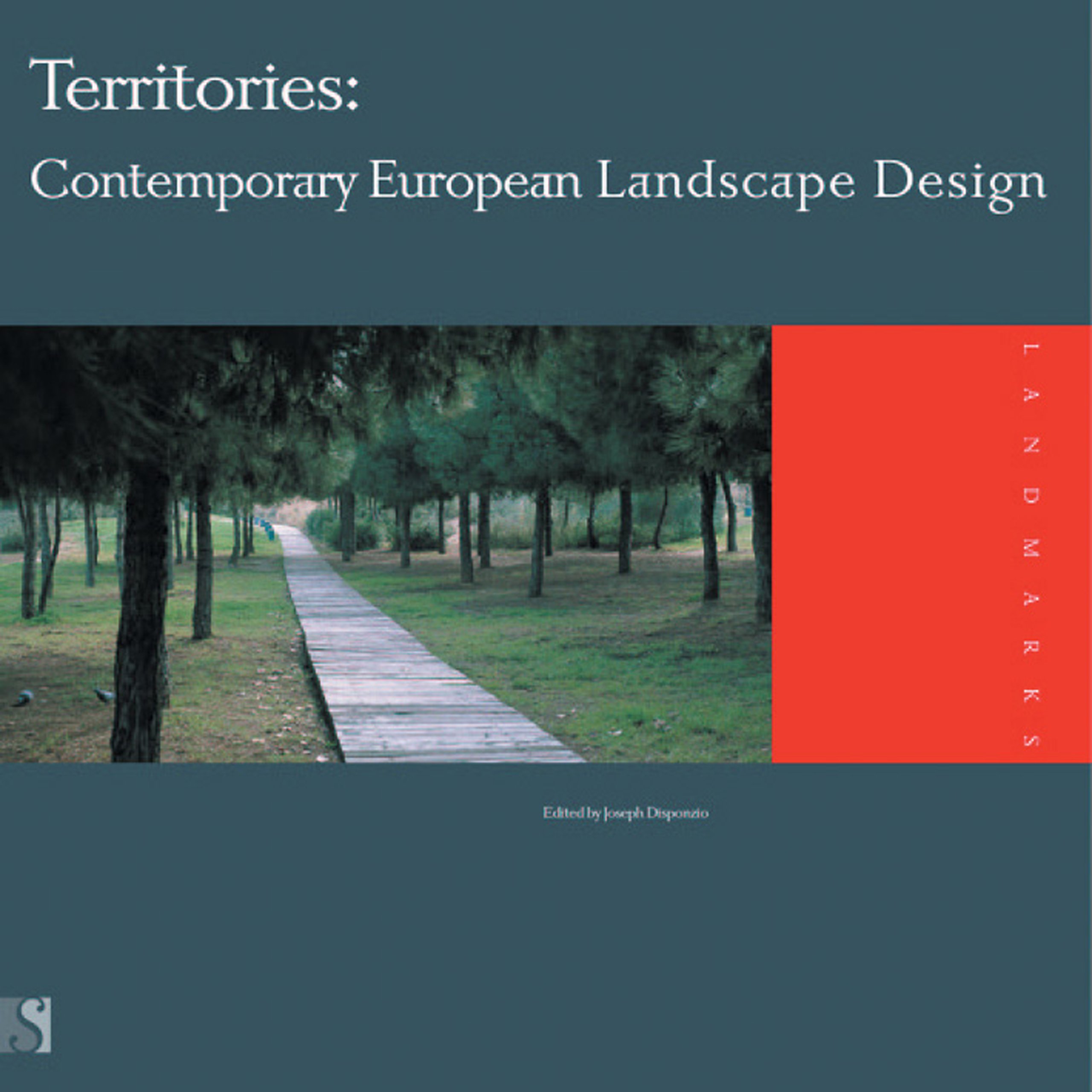
Contemporary European Landscape Design is based on an exhibition and conference of the same name held at the Harvard University Graduate School of Design. The book is based on the landscape design projects of more than 50 European designers from nine countries.
Spacemaker Press
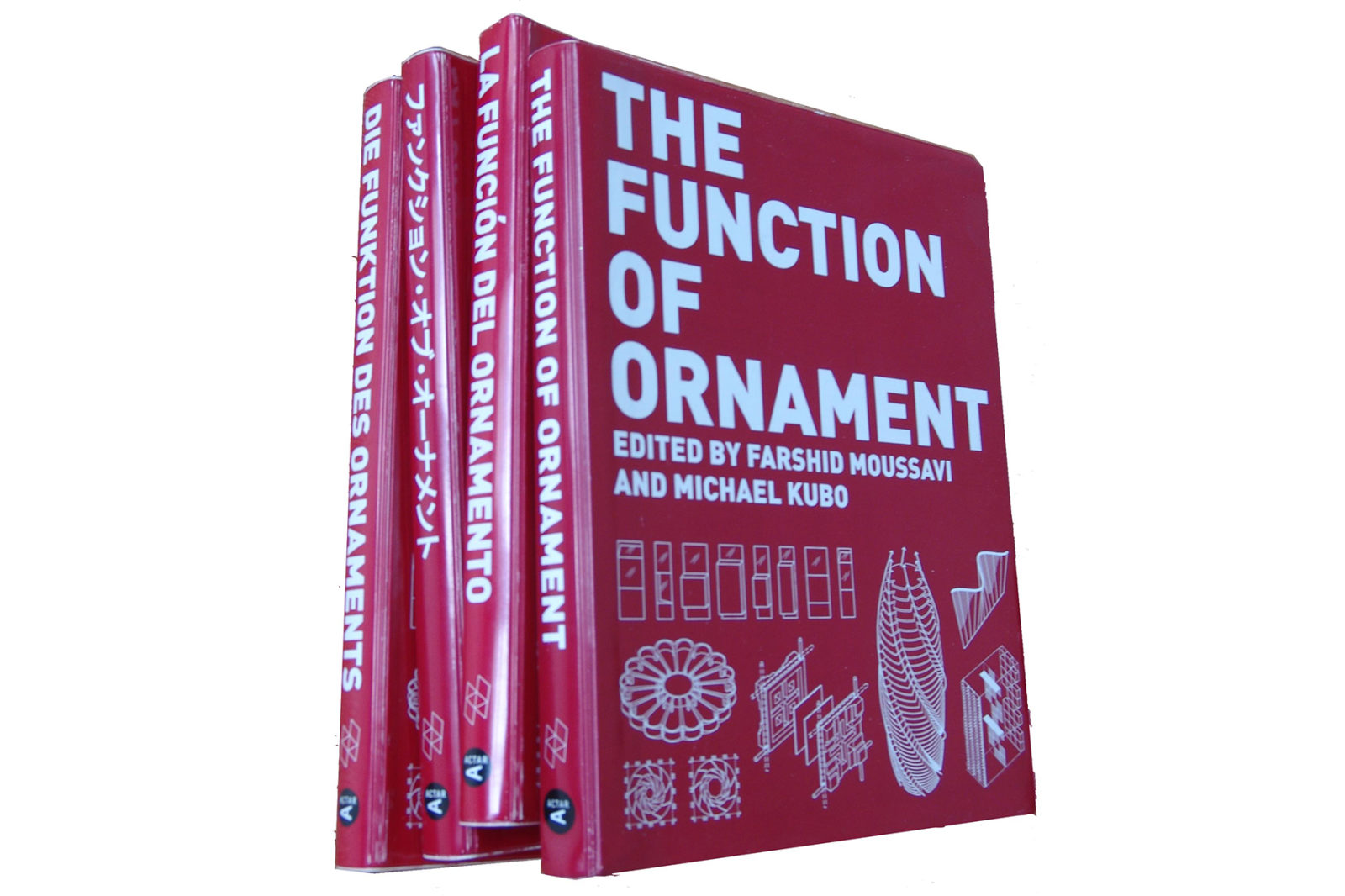
The Function of Ornament
Farshid Moussavi, edited with Michael Kubo
Architecture needs mechanisms that allow it to become connected to culture. It achieves this by continually capturing the forces that shape society as material to work with. Architecture’s materiality is therefore a composite one, made up of visible forces (structural, functional, physical) as well as invisible forces (cultural, political, temporal). Architecture progresses through new concepts that connect with these forces, manifesting itself in new aesthetic compositions and affects. Ornament is the by-product of this process, through which architectural material is organized to transmit unique affects. This book is a graphic guide to ornaments in the twentieth century. It unveils the function of ornament as the agent for specific affects, dismantling the idea that ornament is applied to buildings as a discrete or non-essential entity. Each case operates through greater or lesser depth to exploit specific synergies between the exterior and the interior, constructing an internal order between ornament and material. These internal orders produce expressions that are contemporary, yet whose affects are resilient in time.
Harvard Graduate School of Design/Actar
Introductions: Jorge Silvetti
Introductions: Jorge Silvetti

A collection of lecture introductions given by Jorge Silvetti during his tenure as Chair of the Architecture Department at the GSD.
Harvard Graduate School of Design