Nature is the Living Matter in our Systems
Gary Hilderbrand on the urban canopy, cultural landscapes, and community partnerships
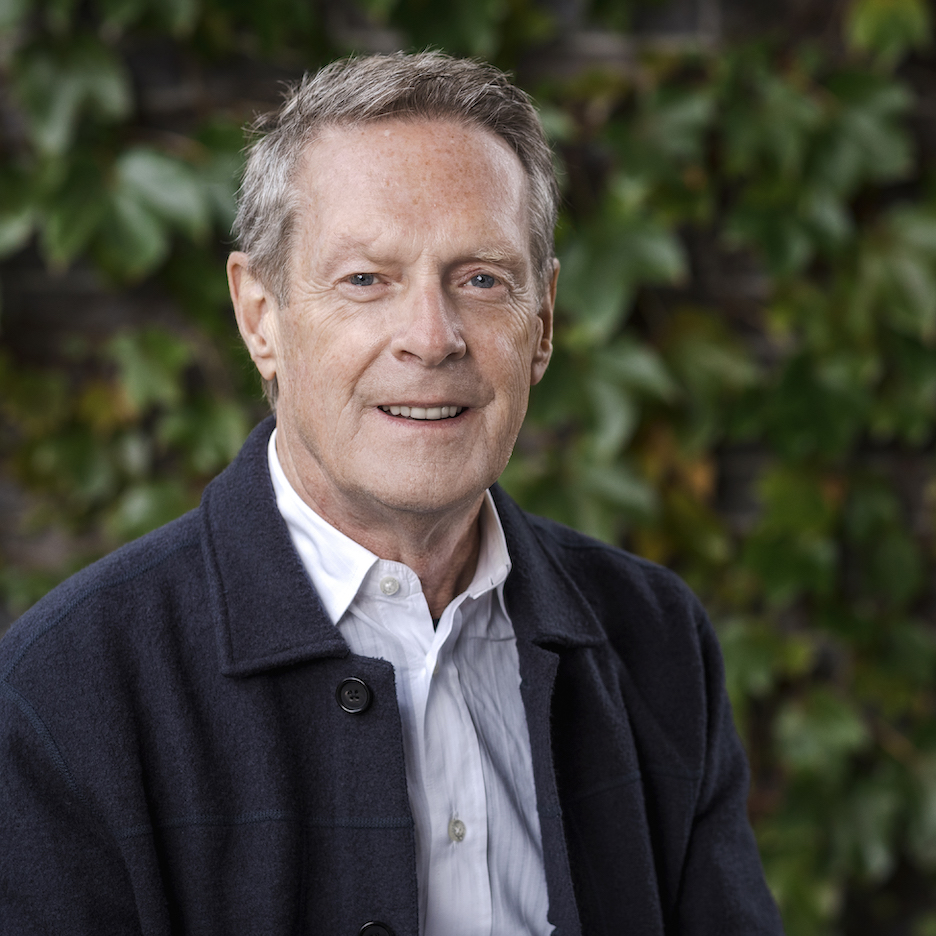
Gary Hilderbrand, GSD Peter Louis Hornbeck Professor in Practice of Landscape Architecture, served for four years as the chair of the Department of Landscape Architecture, and has taught at the GSD since 1990. He and his firm, Reed Hilderbrand, have designed landscape architecture for cultural icons such as The Sterling and Francine Clark Art Institute, Dumbarton Oaks, the Leventritt Garden at the Arnold Arboretum, MacDowell James Baldwin Library, Duke University, Harvard Business School, and dozens more college and university campuses, parks, urban districts, institutions, and private residences.
Focusing on the narratives within landscapes and the importance of community involvement, he and his firm have partnered with the Penobscot Nation in Maine to design the Tekαkαpimək Visitor Contact Station, and, in collaboration with community activists and stakeholders, created the Franklin Park Action Plan. The park, created by Frederick Law Olmsted in 1885, is the final stretch of 1,100 public acres that begin in Boston’s Fenway neighborhood to make up the Emerald Necklace, intended to give residents a respite from city life. After years of city disinvestment, the park was kept alive by the local community, and with the implementation of the action plan, will become more climate resilient, with new recreational and athletic facilities.
Ahead of his public lecture at the GSD, Hilderbrand speaks to the process by which he and his firm colleagues approached the design of the Franklin Park Action Plan, the Cambridge Urban Forest Master Plan, and Live Oak (a former plantation), as well as how he thinks about narratives and nature, his commitment to teaching and GSD students, and where his focus lies now that he’s stepped down as chair.
Where do you draw inspiration?
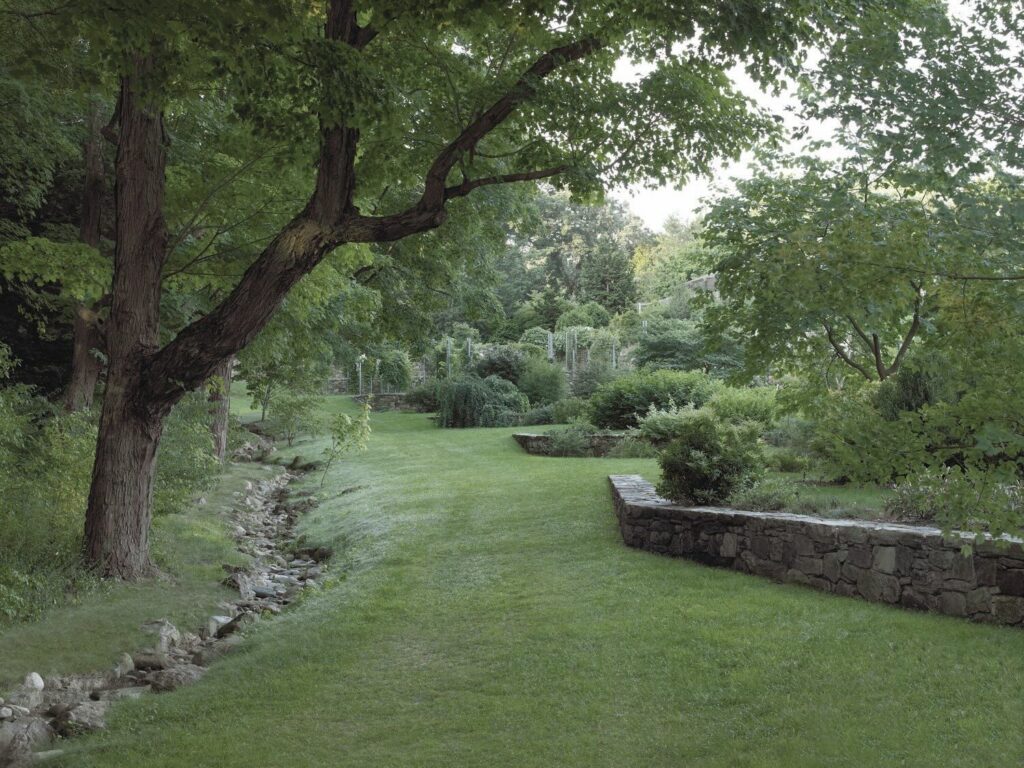
Our sources of inspiration come from many places, including works by others, visual arts references, and, most importantly, the site itself. We take seriously what it means to be analytical about a site, its surface geology, topographic history, the history of narratives on the site, its vegetative cover and how it’s changing, and whether it’s in a healthy and regenerative state. And, is it beautiful, and how?
The site comes first—and last, in a sense, because there are also things we do in design that come at the end of the work. When we’re planting, for example, we sometimes change our minds. So, the site is constantly in motion—metaphysically, climatically—and is always foremost in the design process.
You mentioned art references—who are some of the artists you turn to?
Doug Reed, principal emeritus, and I had many things in common when we were friends for 15 years before we started the firm, and one of those was a love of mid-century art in America. Just today, for a lecture, I was looking at some of my favorite oil crayon drawings by Richard Serra. I’m fortunate to own one, and I’m thinking about the earthwork at the first phase of The Clark Art Institute, in Williamstown, Massachusetts, which became an oscillating set of terraces. We had to build up a hillside with a long sweep because the gradient was very steep, and we had to go around the proposed building to get to the entrance. This caused us to think in curvilinear terms. We usually begin thinking orthogonally, unless the site dictates something else—and this site certainly did. So, the earthwork turned into about nine roughly concentric terraces, all curving around the building, just like one of those oil crayon paintings.
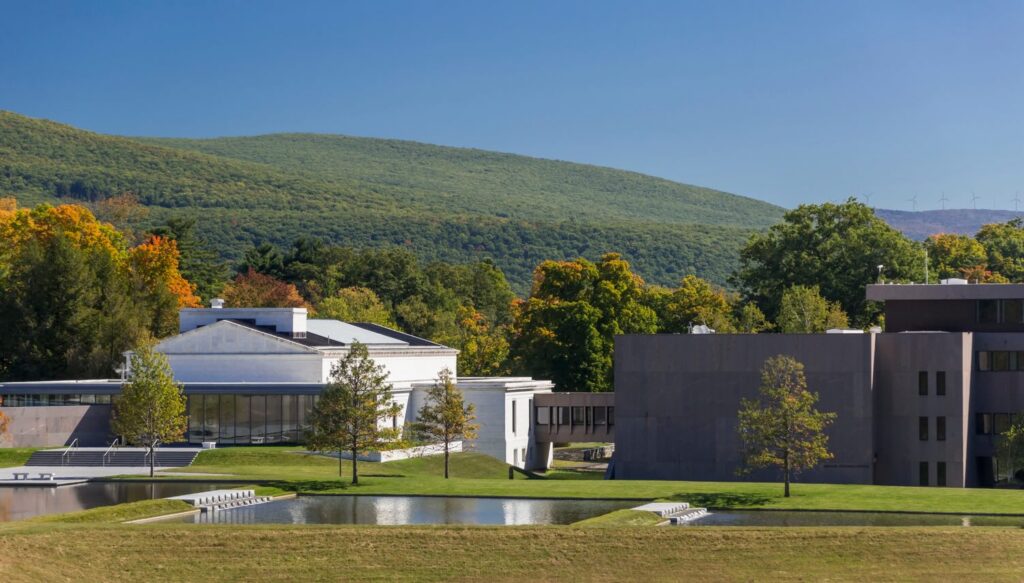
I was so inspired working at The Clark for nearly 25 years. When we started working there, I kept admiring paintings by my favorite 19th century American painter, George Inness. During the course of designing and building several phases of the project, a board member donated another 13 Innes paintings, so at that point they had an amazing series. They’re watery and mysterious; sometimes the Clark is like that, too.
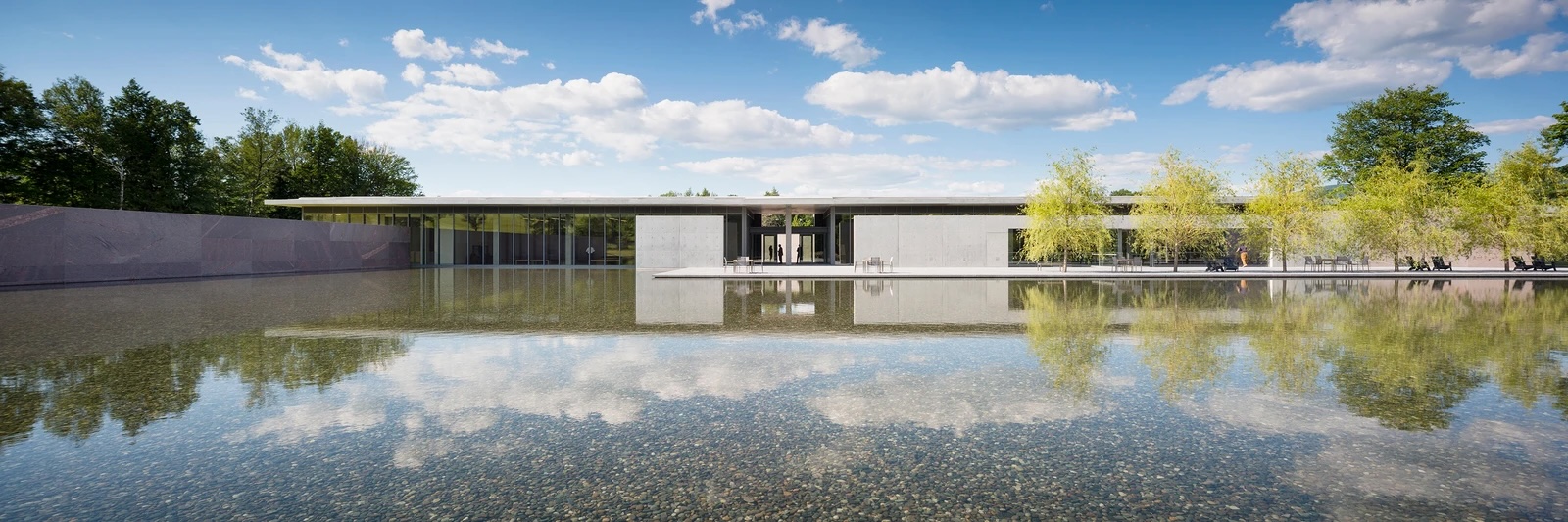
The narrative of the Clark project is that you have, quite unusually, this great collection of landscape paintings, including some by masters including Fra Angelico and Claude Lorraine, and when you step outside the museum, you are staring at a landscape that’s much like the ones you just saw in the paintings. Previously, you’d walk out into a parking lot. Now, there’s an amazing view framed by a long wall by Tadao Ando, and our massive pool of water reflecting the landscape up Stone Hill. We were reinscribing nature for the visitor. That felt like a real gift.
Reinscribing nature is a nice way to think about the connection between the museum and its site. How else do you think about narratives in your work?
Narrative is hugely important to us. For instance, the most compelling case at the moment is the work we’re doing on Live Oak Plantation, outside Baton Rouge, Louisiana. We discovered, by looking closely at that landscape, that a road once ran through the site, and soon realized that it was part of the road from the port of New Orleans, one of the largest ports for trading enslaved people in 19th century, to Angola, the massive prison that operated before the Civil War as a slave plantation before becoming a convict-leasing operation and, finally, a state prison in 1901. That had a big impact on how we thought about this land. We needed to tell the truth about it, and to expose that narrative to people who visit the site. Someday, when it’s open to the public, people will have to confront this dark and terrible existence that was visited on the land for probably 200 years.
We refer to that as a hidden narrative. We’re committed to bringing it forward.
That sounds like a big responsibility.
It is, yes. The former and current owners are both dear friends of the firm. The former owner is a well-known landscape architect and a leader in landscape preservation who grew up on the property. She built gardens around the house over her lifetime, and we all came to the difficult conclusion that those gardens did not fit the period of significance and had to be torn out. Not an easy call. The ecological restoration work we’ve done supports the historic narrative and includes removal of pine forests that were planted in the 1930s, in the aftermath of the agricultural work done by enslaved people for several hundred years.
How did you come to focus on narrative in your work? Did that focus develop alongside the ways that you partner with communities?
We live in a time when it’s not possible to work in a community without earning the trust of local stakeholders, to ensure that the community is heard.
As a student, I worked very closely with the great historian Albert Fein, who taught at the School for from the 1960s till the mid-1980s. He had an outsized influence on me. He really taught me how to conduct research, and researching history became my way into a site. When I began working on college campuses, I felt I needed to be an expert on the evolution of the campus—what each of the presidential administrations had done to expand or create new programs, what had been lost or revived, and seeing how those might be manifested in the landscape. It seemed natural to me to delve into those histories, and I found it was effective in building trust with the community.
Franklin Park is a really good test of that for a couple of reasons: the park is both a world treasure and a local park. It was one of Olmsted’s greatest works, and yet, the city abandoned it in the 1940s and 1950s because of white flight and demographic changes in the neighborhood, with Caribbean, African, and Canadian immigrants growing in numbers. For around 50 years, the city was guilty of disinvestment in this community, including in the infrastructure of the park, as well as the schools, transportation—the streetcars were removed, services declined. It was an extremely deprived neighborhood.
However, the park became a source of collective action. With the leadership of Elma Lewis, Richard Heath, and others, the community took ownership of this national and international treasure, forming the Franklin Park Coalition. They started the Elma Lewis Playhouse, and through hard work and sweat equity, they undertook management of the park, through an agreement with the city. That collective feeling about the park remains constant today, and Boston’s Mayor Wu has made the park a priority for management and stewardship.
At what point were you brought on to create the Franklin Park Action Plan?
We were commissioned in 2019, having teamed up with Agency and MASS, two firms who were national leaders in engagement, and developed a number of points of contact with the community and the coalition. Just two or three days before the world shut down with Covid in 2020, we had our first big public engagement meeting in the golf clubhouse at Franklin Park, with between 150 and 200 people in attendance. They played board games and talked about what they loved in the park, what they dreamed about; there was a lot of excitement. They were finally being heard. With the pandemic, we had to find other ways to make contact, via Zoom, and door to door with social distancing. We made many thousands of contacts, and built trust. When the plan came out, it was fully endorsed by the community.
Afterwards, there was the issue of the White Stadium project, where the soccer team Legacy FC will play. It was not part of the Action Plan, and that upset many people. But, we helped to resolve that, and I think we’ve gotten it to the best place it could be, though there are still quite a few Franklin Park Defenders who don’t agree with us.
As you’ve recently stepped down as chair of the Department of Landscape Architecture, can you speak to some of the accomplishments in that role of which you’re proudest?
There was a long period when I got to know 12 students at the GSD each year, as well as several advisees, and when I became chair, I was at the school four days a week year-round. I got to know many more students, spend time in the trays, work with student representatives. That was really gratifying work. Our students are amazing.
Second, through my design practice, I’d long ago learned the benefits of mentorship. My predecessors did this, too, of course, but for me, it was a new experience to be able to more deeply mentor faculty and help them find funding support for their research. Many of our visiting faculty are singular experts in their fields and we depend on them for our core and elective pedagogy. To find a little bit of money here and there for those teachers, and to get more of them on multi-year contracts with the school, has been affirming for the department and has strengthened our community.
Does a particular course you’ve taught over the years stand out for you?
My most memorable studios were a series of three I taught in New York City, about 10 years ago, looking at the likelihood that we were going to recapture significant public realm with narrower streets in the Manhattan grid. This came out of the important work of Janette Sadik-Khan, who was the traffic czar—Commissioner of the Department of Transportation—for the Bloomberg administration. The design changes in Times Square, where many lanes of vehicle traffic were removed permanently, were a big source of motivation for me. One of our three studios centered on the intersection of Columbus Avenue and Broadway, at 63rd Street, where Lincoln Center is. I proposed to the students that, if private philanthropy had already spent a billion dollars on Lincoln Center, we could do the same for the public realm and reduce the 16 lanes of traffic you cross to get to the Opera to only five.
We redesigned the configurations of the streets, the material consistency and quality, making the sidewalk suitable for drainage and planting. Highly detailed design work, like we do in practice. That was in the days leading up to a multitude of other efforts in urban forestry, and that was the genesis, for me, of projects like the Cambridge Urban Forest Master Plan.
Can the urban canopy really save us?
That was the question posed by the 2024 symposium we organized: “Forest Futures: Will the Forest Save Us All?” along with the concurrent exhibition curated by Professor Anita Berrizbeitia and her seminar students. The forest is a massive carbon sink. But can it sequester enough carbon to mitigate the climate crisis? And, if so, will its benefits be shared by all citizens and non-human life?
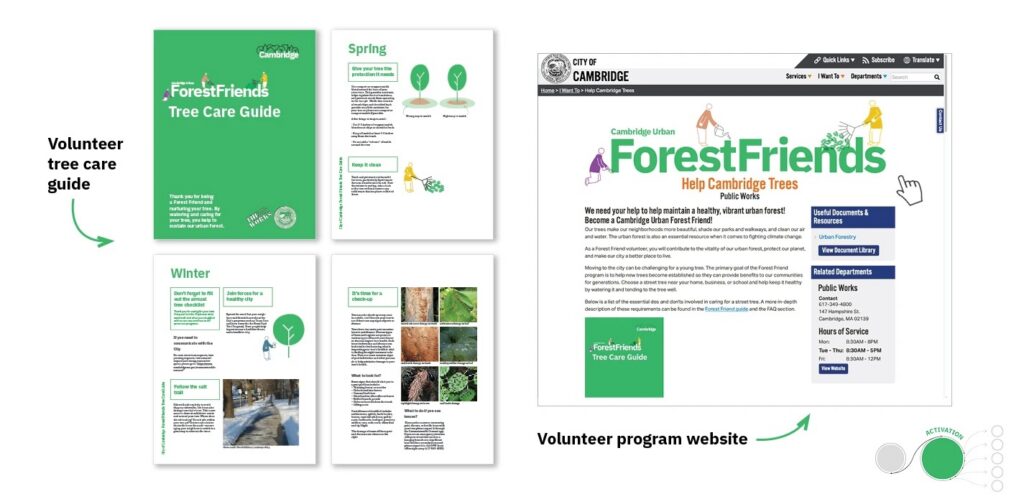
I hope so. But we need every measure possible, and currently the United States is clearly going in the wrong direction. We found, five years since the Cambridge plan, though, that progress is real. The city hired a forester, designated a corner of the public golf course as a tree nursery, built a composting facility, bought a microscope to analyze the quality of the liquid biological amendments that it generates, and built an electric-bicycle brigade with water bags and hoses to ensure the city’s trees will thrive. They doubled the number of trees they plant each year, and tightened the sanctions for tree removals. It’s gratifying that, with the scientific work of our project partners, the activist citizenry in Cambridge, and our ability to create a compelling narrative around this, we can see real change.
We know very clearly that not only is carbon sequestration important but that the urban canopy is not evenly distributed. We proved that with real data in the Cambridge Urban Forest Master Plan, and you can see it in practically every city worldwide. There is a direct correlation between a lack of tree canopy and urban density, along with factors that the state analyzes to determine environmental justice communities. Anita Berrizbeitia, Max Robert Louis Piana, and I have been continuing this work, and will present at a conference in Geneva this fall; Anita, Max, and Slide Kelly have taught a seminar and a studio on Geneva, Switzerland’s Urban Area Arborization Strategy.
Has your relationship to nature changed over time? Do you think about things differently when you walk in a forest today?
I grew up in the 1960s on the Hudson River, which had been destroyed by the manufacturing and utility industries. I was very aware of the Con Edison controversy, in which the company was trying to build a hydro-electric plant on Storm King Mountain, which would have caused massive thermal pollution, in addition to the PCBs and other poisons that had already ruined the river. I was kind of angry about that as a kid. You couldn’t put your feet in the water. This led me to want to be an environmentalist of some kind, so that’s where my relationship with nature starts. By 11th grade, I knew I wanted to be a landscape architect. From that point on, I thought of nature as process—something we work with to improve ecological health and the well-being of citizens, plant life, soil, and other creatures.
I don’t make much of a habit of walking in the wilderness, and I’ve seen only a few of the many great national parks out west. I think more about nature as systems—in rural and urban sites, or in our parks and campuses. The nature I’m speaking about is the living matter that we work with—whether the trees are healthy and regenerating, whether the soil provides enough nutrient exchange so trees can thrive, whether there are sufficient ways for management and retention of storm water. That’s where my mind is, all the time. That’s my nature.