Entre Futuros: Más Allá de Las Fronteras y Las Cicatrices del Río Bravo / In-Between Futures: Beyond Frontiers and Scars in the Rio Bravo
“Entre futuros” reimagines the fixed border on the Río Bravo between Ciudad Juárez, Chihuahua, and El Paso, Texas. As the river shifted course, land disputes led to its channelization, leaving, since the 1930s, hundreds of cut-off meanders as “hydroghosts”—scars in both landscape and lived experience. These traces become a lens to argue that violent and rigid border-making fix an inherently fluctuating river landscape while erasing centuries of shared histories, memories, and identities.
Against this, the project positions water as a site and agent of repair through shared culture. Centered on El Chamizal—an in-between, divided binational threshold shaped by memories of contest and the river’s echoes—it activates water as a spatial and symbolic force, reconnecting border pilgrims and surrounding communities to the river while embodying healing.
To materialize this vision, the project proposes reintroducing water into El Chamizal through an aqueduct supplied by the American Canal, which sits at a higher elevation than the Río Bravo and carries a greater flow. Today, the Río Bravo receives water through releases from the American Dam, located precisely at the United States–Mexico boundary; however, this discharge is insufficient. In response, the project calls for a framework of cross-border co-production with the United States to secure the necessary supply while acknowledging the shared character of both territory and water.
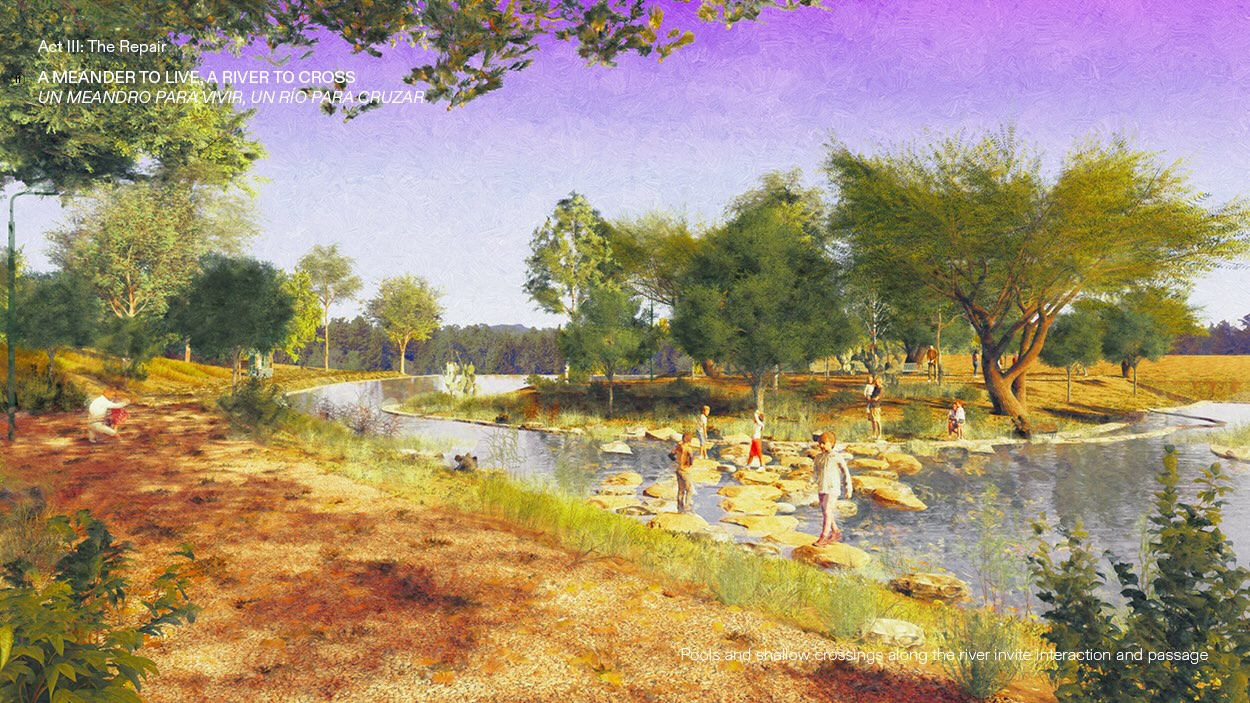
Once water is reintroduced into El Chamizal, its arrival is celebrated by filling the first designed stretch of surface water, conceived as a space for gathering, contemplation, and everyday ritual. From there, the water continues along an aqueduct that traverses the site, replenishing the projected meanders, which echo and mimic the morphologies of the existing “hydroghosts” in the area. In this way, the hydraulic layout not only recovers historical fluvial forms but also reactivates memories and cross-border connections.
Flowing beyond the frontier, this emergent water body enacts transboundary co-production, opening possibilities for ecological and social reclamation, nurturing belonging, and sustaining care and beauty across border landscapes.