Graduate School of Design (GSD) students were recognized in the 2026 World Landscape Architecture (WLA) Student Awards, an international competition that honors exemplary student work in landscape architecture. The competition included more than 130 entries from over 20 countries, with projects evaluated across several categories.
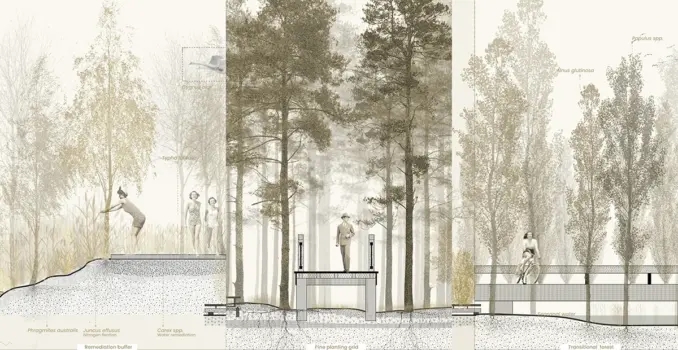
Hanrui (Freya) Fu (MLA II ’26) was recognized twice in the concept design category. Her project “Fluid Itineraries: Rewetting Hobrec” received the Award of Excellence, the category’s highest honor, while “Promenade Sylvatica” received an Outstanding Award. “The proposal demonstrates an extraordinary ability to translate complex ecological and hydrological systems into elegant spatial experiences,” the WLA jury wrote of “Fluid Itineraries.” Fu developed the project under GSD supervisors Chris Reed, professor in practice of landscape architecture, and Laila Seewang, former lecturer in landscape architecture. “Promenade Sylvatica” was developed under the supervision of Anita Berrizbeitia, professor of landscape architecture and chair of the Department of Landscape Architecture.
Chutong Liu (MLA II ’26) earned an Honorable Mention in concept design for “Water As Calendar,” designed under GSD supervisors Jungyoon Kim, associate professor in practice of landscape architecture, and Shunsaku Miyagi, visiting professor in landscape architecture. “Water as Calendar” investigates water as a temporal and spatial force, using landscape design to make environmental cycles and seasonal change legible through lived experience.
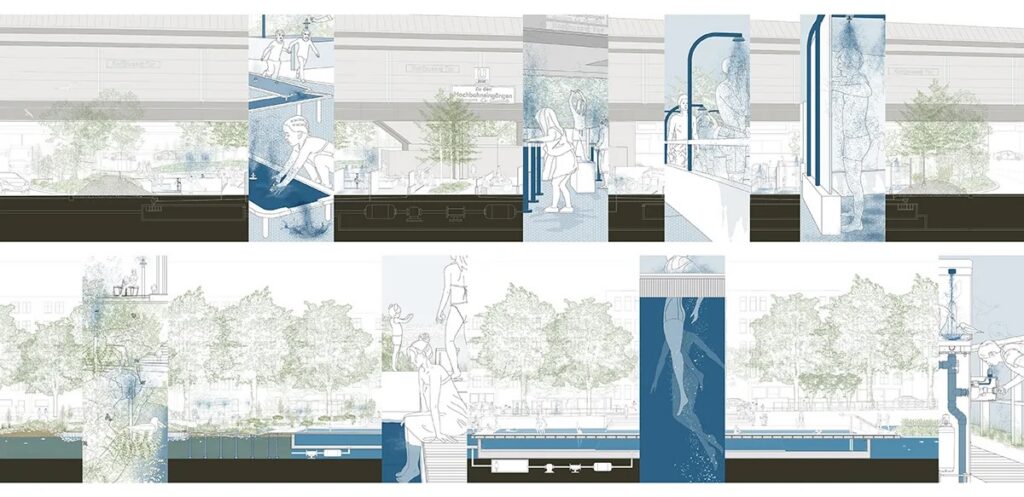
Finally, the Graduate Award for Excellence went to Mu He (MLA II ’26) and Zhiming (Zenith) Zhang (MLA II ’26), for “Cle(an/p)sydra: Civic Water Cycles,” which proposes an integrated approach to water infrastructure, ecological repair, and public life. Grounded in the social and environmental conditions of its site, the project connects processes of reviving, cultivating, and nourishing to envision water systems as active components of civic landscape. Designed under supervisors Reed and Seewang, the project was praised by the jury for its “sharp reading of the site’s social and ecological conditions” and its ability to link “water infrastructure, ecological repair, and public life” through a proposal that is both imaginative and grounded.