RumbleRims, a low-cost concussion screening system designed by Radhika Saran (MDE ’27), Cleo Pontone (MDE ’27), and Sophia DeVito (MDE ’27), has been named International Winner of the 2026 James Dyson Award. The award is one of the most prominent global competitions for student design and engineering. Global winners, chosen by Sir James Dyson, each receive a prize of £30,000.
RumbleRims is designed to kickstart concussion care on the sidelines of athletic competitions. The team’s three-part system includes a lightweight infrared headset for eye tracking, a display for coaches, and a recovery dashboard. In two to three minutes, the headset runs an oculomotor screening test that records how the eyes follow, fixate, and move. Those patterns can show neurological disruption after a head impact. Side-mounted infrared cameras and angled hot mirrors capture eye movement while leaving the athlete’s view clear. The coach display turns the data into plain guidance in real time, and the dashboard tracks recovery over the following weeks, giving athletes, families, and clinicians an objective record before return to play.
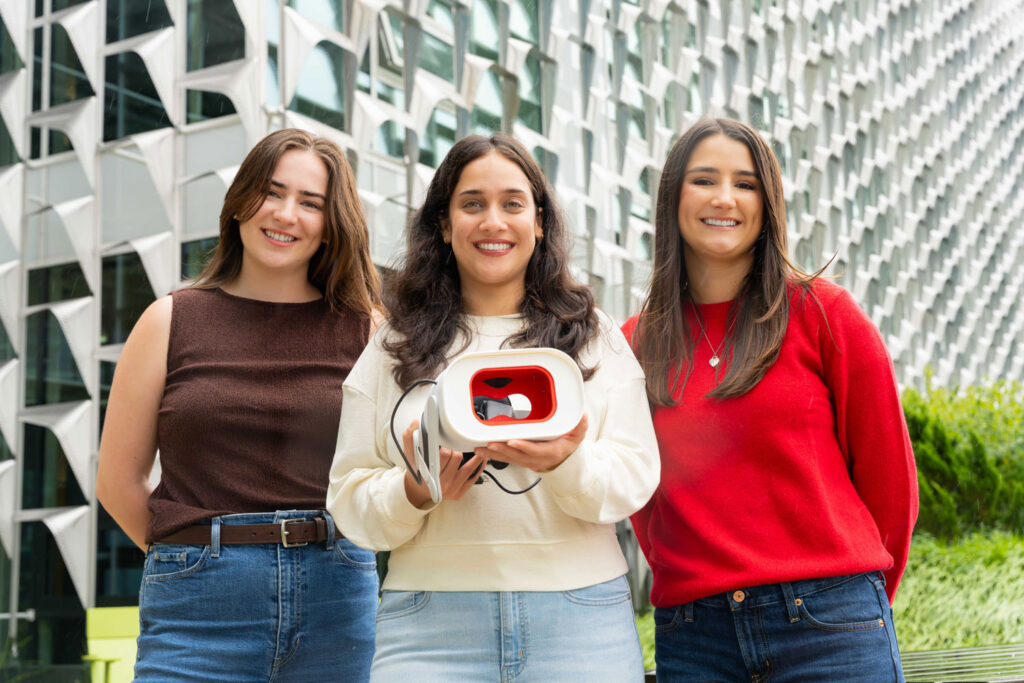
The system meets an urgent need: clinical eye-tracking tools can cost around $50,000, so young athletes are often assessed with quick, subjective checks.
The team members are all part of the Master in Design Engineering program, a collaborative degree program between the Harvard University Graduate School of Design and the Harvard John A. Paulson School of Engineering and Applied Sciences.
They arrived at the headset through repeated prototyping. Early versions included helmets, mouthguards, and enclosed viewing rooms. Testing showed that accuracy depended less on enclosing the athlete than on keeping the eyes and cameras in a fixed relationship. So the team built a headset that moves with the head.