In 1960, Jacqueline Kennedy wore a Marimekko dress on the cover of Sports Illustrated, instantly popularizing the Finnish textile and design company in the United States. The woman behind that moment was Jane Thompson, co-founder of the Design Research (D/R) store in Harvard Square, with her husband, Ben Thompson. The couple sold the dresses at D/R—along with kitchenware that Julia Child came in to buy—and became known for pioneering lifestyle retail in the United States.
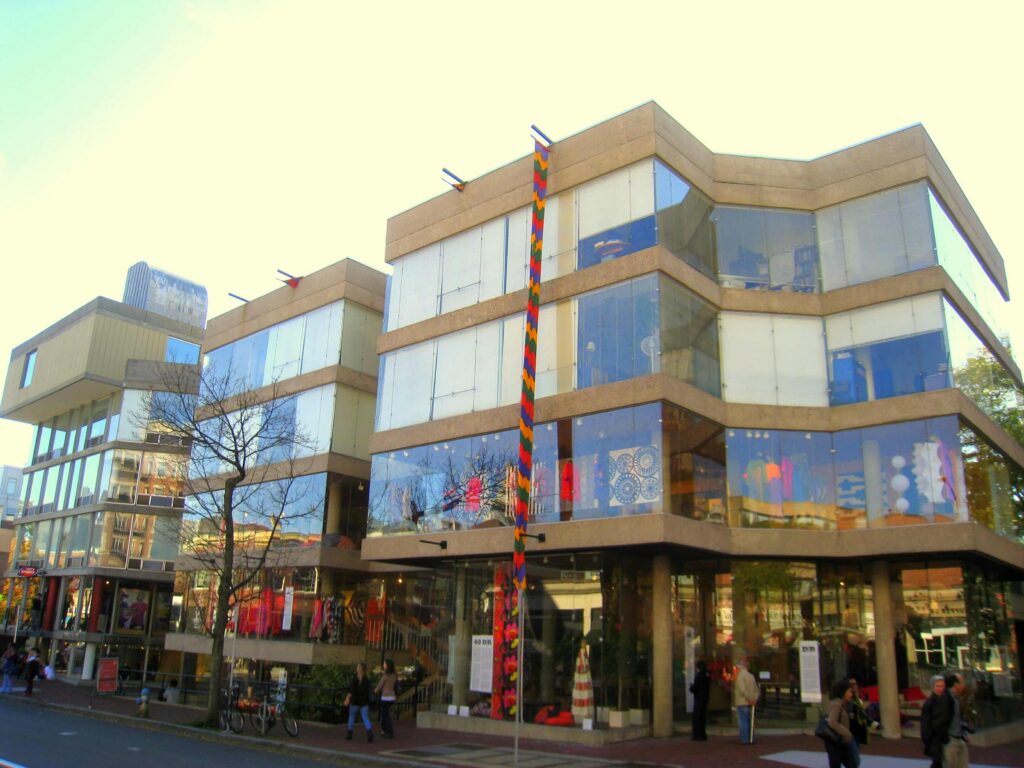
In 1969, the store moved into the iconic building in Harvard Square that the Thompsons designed at Ben Thompson & Associates, which Jane joined when she and Ben married that year. The building boasts four stories of glass walls and displayed modernist furniture alongside everything from pottery to clothing, inviting the public to feel a part of these spaces and imagine these objects in their own homes. The store inspired later retailers such as Crate & Barrel, Pottery Barn, and Design Within Reach.
Ben Thompson, who served as chair of the Department of Architecture at the Harvard Graduate School of Design (GSD), is known for his connections to Walter Gropius and Marcel Breuer, who joined the GSD faculty after they fled Nazi Germany. The Thompsons met through Gropius while Jane was working on a collection of interviews about the Bauhaus.
Those interviews, with Gropius, Mies van der Rohe, Hannes Meyer, Lucia Moholy-Nagly, and many other Bauhaus masters and students, were conducted in the 1950s and 1960s and remain unpublished. They include stories of the Bauhaus and their work, and anecdotes about courses and daily life. Werner Siedhoff, for example, speaks about his late wife Alma Siedhoff Buscher, who worked on children’s furniture and toy designs, despite Gropius’s convention of sending women into the weaving department. Siedhoff says his wife came to the Bauhaus because of her “talent and will to create,” and describes one of her pieces—a wardrobe with boxes that could be reconfigured. She was killed in an air raid in 1944. Thompson also took photographs of the Bauhaus masters and students, and the region, while she conducted these interviews.
Thompson was at work on a book about the Bauhaus that remained unfinished at the time of her death. The collection of research and documents, which spans five decades and includes the unpublished audio tapes of the interviews (all in German), are housed in the GSD’s Frances Loeb Library Special Collections. Thompson had also worked as an architectural writer and editor, first at Interiors magazine, and then as founding editor of the long-running Industrial Design (later I.D.), 1954–2009.
Working together at Ben Thompson & Associates from 1969, the couple co-designed public markets that transformed city neighborhoods, such as Boston’s Faneuil Hall Marketplace (which includes Quincy Market) and Chicago’s Navy Pier. Quincy Market had been used for wholesale produce sales and meatpacking for decades, but when those operations, as well as the factories on upper floors, were moved to Roxbury, the market neighborhood fell into neglect. The Thompsons reimagined the market as a space where restaurants sold prepared foods that people could eat on benches under the trees. This created a communal gathering space and helped transform the neighborhood into a bustling tourist destination and lunchtime hotspot for downtown workers, with access to the waterfront. In 1994, Thompson founded her own firm, Thompson Design Group, where she worked on projects including Houston’s Buffalo Bayou.
With Alexandra Lange (LF ’14), Thompson coauthored Design Research: The Store that Brought Modern Living to American Homes (2010), a history of the store and its significance in American design history. The Thompsons were both knighted by the president of Finland for their lifelong devotion to Finnish design. Jane Thompson received Institute Honors from the American Institute of Architects in 1994, a Personal Recognition Award of the Industrial Designers Society of America in 1998, and the Lifetime Achievement Award from the Cooper-Hewitt National Design Museum in 2010. She died in 2016, but her research and influence on design remains very much a part of our world today.