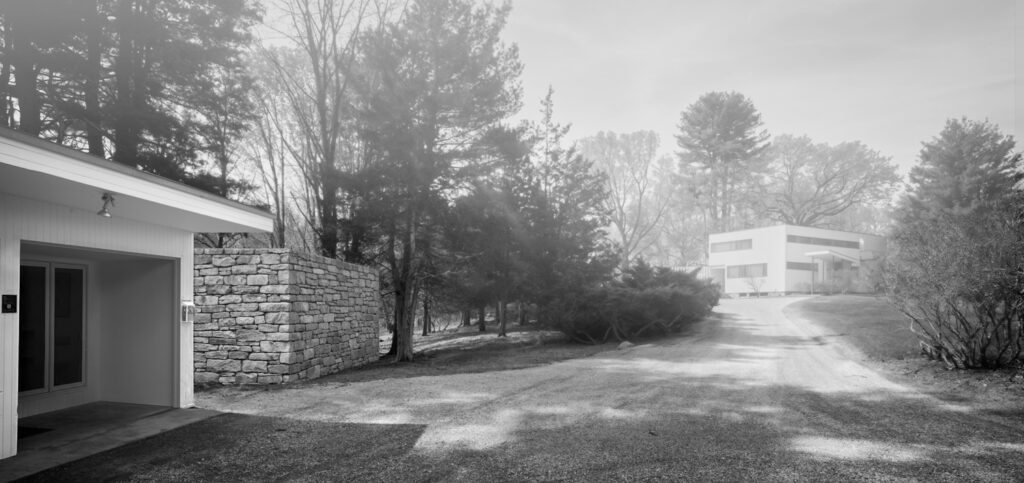
Joseph F. Hudnut, the GSD’s First Dean, 1936–1953

In 1935, American architect and educator Joseph F. Hudnut returned to Harvard University. Born in Big Rapids, Michigan, in 1886, he had studied architecture at Harvard before continuing his training at the University of Michigan and Columbia University.
As a practicing architect, Hudnut taught architectural design and history at Alabama Polytechnic Institute and the University of Virginia before turning his attention to academia fulltime in 1926 with a position at Columbia’s School of Architecture. Assuming the school’s deanship in the early 1930s, he dismantled its Beaux-Arts pedagogy in favor of an educational system based on philosopher John Dewey’s ideas of pragmatism and experience. While students under the Beaux-Arts mantle had competed on grand and often idealized schemes, under Hudnut’s new system they worked—at times collectively—on projects such as low-income housing, taking elements like budget and community needs into consideration.
Hudnut’s brand of modern pedagogy soon drew the attention of Harvard president John Conant, who in 1935 recruited him to modernize the university’s architectural education. Upon his arrival, Hudnut proposed uniting Harvard’s three professional design programs—Architecture, Landscape Architecture, and City Planning—into one entity called the Graduate School of Design (GSD), to be housed in neoclassical Robinson Hall (by McKim, Mead & White, 1900). He served from 1936 through 1953 as the GSD’s first dean.

During his time at Harvard, Hudnut emerged as a leading advocate of modern architecture in the United States. In 1937 he augmented the GSD faculty with Walter Gropius and Marcel Breuer, key figures of the German Bauhaus who had fled fascist Europe. The following year Hudnut was instrumental in bringing to Harvard the Swiss historian and secretary of CIAM Siegfried Giedion, who delivered the Charles Elliot Norton Lectures that comprised Space, Time and Architecture (1941), a history of modern architecture that dominated the narrative for decades to come. Hudnut thus shepherded these European modernists into American architectural consciousness.
In addition, Hudnut championed modernism in other ways, including his revamping of architectural education to emphasize a combination of theoretical and practical work. He furthermore supported modernism in his own writings, including Architecture and the Spirit of Man (1949), which positioned architecture as the unification of art and science, with the former never to be sacrificed to the latter—a criticism he would later ascribe to Gropius’s work.
Hudnut retired from the GSD in 1953 while finishing his term on the US Commission of Fine Arts, a five-year post he began 1950. Into the early 1960s he continued to teach a course in civic design at the Massachusetts Institute of Technology and publish essays in a variety of journals. Hudnut died of pneumonia in Norwood, MA, in 1968.
SUGGESTED RESOURCES
Jill Pearlman, Inventing American Modernism: Joseph Hudnut, Walter Gropius, and the Bauhaus Legacy (Charlottesville, VA: University of Virginia Press, 2007).
“Joseph Hudnut, Architect, Dead,” Obituary, New York Times, Jan. 17, 1968, https://timesmachine.nytimes.com/timesmachine/1968/01/17/88922263.html?pageNumber=47 .
Hanif Kara Receives the 2024 Soane Medal
Hanif Kara, Professor in Practice of Architectural Technology at the Harvard Graduate School of Design (GSD), is the recipient of the 2024 Soane Medal. Awarded by Sir John Soane’s Museum in London, the medal recognizes a distinguished practitioner who has advanced the public’s understanding of architecture.

On November 26, Kara will give the seventh Soane Medal Lecture at the museum. His talk will consider how the field of architecture can address the climate crisis. “As a scientist, I like to think that hope can turn into possibilities,” says Kara. Drawing on experiences over his distinguished career as an engineer and educator, Kara emphasizes the role of structural engineers at the forefront of sustainable practices.
“In the complex world that we live in today, it is impossible to solve the problems we face without interdisciplinary collaboration and thinking,” Kara says. “Only through curiosity and continual enquiry, questioning practices and norms, will we find the solutions that are so urgently required.”
In addition to his role at the GSD, Kara is creative director and co-founder of AKT II, a practice that has won over 350 design awards, including RIBA Stirling Prizes for four projects: the Peckham Library, London (2000); the Sainsbury Laboratory, Cambridge (2012); the Bloomberg European headquarters, London (2018); and Kingston University London–Town House (2021). The practice also received the RIBA Lubetkin Prize for the UK Pavilion at Shanghai Expo in 2010.
“Hanif Kara is the engineer to whom Sir John Soane would have turned to realize his most ambitious, exciting designs,” says Will Gompertz, Deborah Loeb Brice Director of Sir John Soane’s Museum. “They might be divided by two centuries, but they are united in the belief that innovative, sympathetic, beautiful architecture can make a lasting and positive impact on the world.”
Landscapes of the Overflow
A forthcoming book from Harvard Design Press, Thinking Through Soil: Wastewater Agriculture in the Mezquital Valley , by Montserrat Bonhevi Rosich and Seth Denizen, investigates a struggle that, the authors write, “will come to define an increasing number of environmental conflicts in the 21st century.” In 2018, farmers in Hidalgo protested because the Mexican government had implemented, at great expense, a new sewage processing system. The problem? The farmers say the new system stole from their crops the nutrients that enriched their soil when the sewage system overflowed into the Mezquital Valley. Rosich and Denizen say that their work arises “out of a deep sympathy for the position the farmers have taken,” and that, in exploring the history of soil use in the context of colonization, we can understand better the complexities that arise in what might otherwise seem like straightforward systems of sanitation and food production. “A central claim of this book,” they write, “is that over the next few decades, wastewater reuse will become a necessary and unavoidable part of addressing water scarcity in a warming world.” In addition to exploring irrigation and sanitation systems and the history of colonization, the book defines what they call the “arid abundance” of the Mezquital Valley and how traditional foods that were always grown together enrich the soil, as well as how to mitigate diseases that can arise from wastewater agriculture—lessons that can be applied in communities across the world.
Ahead of the book’s official release on June 10, support your local bookstore by pre-ordering a copy. Pre-orders can also be made through Harvard University Press or Amazon . Limited copies will be available at a book release event at the GSD on April 24, 2025. The following is an excerpt from part one of the book, titled “Part 1: The Profile.”

No other city in the world has tried to do as much to reuse the combined sewer as Mexico City. Consider, for example, some of the basic geographic assumptions that a combined sewer system typically makes. The idea of a combined sewer is to use fresh water to flush concentrated waste into a large water body. This assumes that there is a water body, like an ocean, that is large enough to dilute the waste indefinitely. It also assumes that if the sewer system is far away from this water body there is a river to convey the waste. The river should not be seasonal and should always maintain the minimum flow-rate necessary to convey the waste. Its flood stages should also never exceed the topographic level of the combined sewer pipes themselves, which implies a certain spatial relationship between river and city. In short, there is a vast imaginary landscape contained in the concept of a combined sewer system, and this landscape bears almost no resemblance to Mexico City.
From the perspective of a combined sewer system, Mexico City has no rivers. Topographically, it sits in the bottom of a bowl, or what geomorphologists call an “endorheic basin.” For the last seven hundred thousand years, this bowl has been accumulating water in a large lake system that has no outflow. In the 16th century, the city’s lakes stretched continuously over 2,000 square kilometers in the rainy season.[1] During the dry season the waters would partially recede, creating shallow marshes along its borders, revealing the blurry outlines of five separate lakes (from north to south: Zumpango, Xaltocan, Texcoco, Xochimilco, and Chalco). The towering volcanic mountain ranges to the south put the city in their rain shadow, capturing fresh water from storms that blow in from the Gulf. When the lakes existed, this rainfall differential created a salinity gradient in the lake water. The three northern lakes were brackish from the accumulation of soluble salts produced by the weathering of volcanic rocks for more than seven hundred thousand years. The southern lakes (Chalco and Xochimilco) were fresh, as the rainwater from these southern slopes pushed the saline waters north toward the bottom of the basin.
In the mid-15th century, the Mexica (Aztec) ruler Nezahualcoyotl built a dike through the middle of the lake system. Its primary function was flood control but, like all good infrastructure, it was multifunctional and also worked to preserve this salinity gradient, ensuring that the southern lakes could be used as a freshwater reservoir for crop production. The famous “chinampas” of Xochimilco took advantage of this and were, at one time, able to produce food for two hundred thousand people in Mexico City.[2] For centuries, these southern lakes were the most productive agricultural area in the basin, whose fish, corn, chili, beans, and squash were easily floated on boats to its bustling urban markets. The saline waters of Texcoco were also productive, and provided a nutritious algae (spirulina), salt harvesting (tequesquite), the “caviar” of the waterfly (axacayácatl), and abundant waterfowl.[3] As an important resting place on the Central Americas Flyway, the brackish wetlands of Texcoco were full of migratory birds.
These dynamic hydrologic cycles were precisely what colonial engineers struggled to disrupt in the 16th-century aftermath of colonization. The seasonal flooding that produced a perpetually blurry boundary between the city and its muddy wetland periphery was particularly appalling to the arid Iberian imagination.[4] Early European hydrologic efforts focused on draining Lake Zumpango, which is topographically the highest in the cascade of lakes that end in the bottom of the basin near the center of Lake Texcoco. By controlling water levels in Zumpango, the idea was to deprive Lake Texcoco of floodwater. To do this, colonial administrators decided to build a 20-kilometer-long, 60-meter-deep trench—El Tajo de Nochistongo (the Nochistongo Cut)—through the topographic walls of the basin. The project, which began in 1607 and continued, off and on, for two centuries, was notorious for its cruelty and completed mostly through forced Indigenous labor. The historian Vera Candiani notes that workers were lowered into the trench on ropes to dig out the walls in something called “the Indian-dangling” method, earning it the name El Tajo de las Desgracias (The Trench of Misfortunes).[5] The Mezquital Valley is what lies on the other side of this trench.
By the 19th century, it became apparent that El Tajo de las Desgracias would never be able to solve Mexico City’s flooding problem, and a new plan was formed. Instead of cutting a steep trench through the soft and erodible soils of the Basin, a tunnel would be constructed. This new tunnel would connect Mexico City’s San Lazaro neighborhood to the Mezquital Valley through the Gran Canal del Desagüe.[6] Inaugurated by Mexican president Porfirio Díaz in 1901, the drainage canal was a symbol of progress and modernity for Mexico City at the dawn of the new century.[7] After hundreds of years of failure, it was a marvel of engineering that finally broke through the basin walls whose topography had determined everything about life in the lacustrine city. However, what had started in the 17th century as a project to mitigate flooding had ended in 1901 as something very different. The Gran Canal would not only carry floodwater during the rainy season but it would also harness the power of Mexico City’s remaining freshwater lakes in the south (Chalco and Xochimilco) to flush Mexico City’s sewage north to the Mezquital Valley.[8] In this way, the Gran Canal was the origin of Mexico City’s combined sewer system, and it transformed the Mezquital Valley into a Combined Sewer Overflow (CSO).
The architect of this plan was a drainage engineer named Roberto Gayol, and his expertise was critical to the project. Without sufficient rainfall to move the sewage, Gayol needed to figure out how to use the lakes to create base-flow. For this reason, Gayol argued passionately in favor of a combined sewer system rather than a divided one. Without some kind of force pushing the waste out of the city, the system would stagnate, and a combined sewer maximized that force. According to Gayol’s calculations in 1892, Lakes Chalco and Xochimilco could provide 2,500 liters per second through the Canal de la Viga.[9] This effectively turned the lakes into a massive flush tank that sat above every urban toilet in Mexico City. The volume of wastewater Mexico City sent to the Mezquital was significant enough, and dilute enough, that in these early days the first idea for how to use Gayol’s 2,500 liters per second wasn’t even agriculture. The first wastewater canals to be built in the Mezquital were designed to find the Valley’s steepest topographic gradients for powering hydroelectric generators, and this historical anachronism explains much of the unusual complexity of the wastewater irrigation canal network today.
In hindsight, it is remarkable that nowhere in Gayol’s 156-page proposal does he consider the possibility that this water source might disappear. Those 2,500 liters per second were supposed to last forever in the plan he outlined. Today, what remains of Lake Xochimilco is less than 1 percent of what it was in 1892, and its waters have been fully converted into sewage infrastructure (also a World Heritage Site). Lake Chalco disappeared entirely, but has started to return: a battery of groundwater extraction wells caused enough subsidence for parts of the city to sink below the water table again, creating a ghostly and garbage-filled memorial to the former lake.[10] In other places, the water table has been lowered as much as 100 meters below levels recorded in the early 20th century, and it continues to fall to the profound disappointment of the twenty-two million people in the capital city who depend on the Basin’s subsurface aquifers for 70 percent of their drinking water, and who must live in the perpetual aftermath of the urban land subsidence caused by the groundwater extraction.
Over the next 150 years, Mexico City is expected to fall between 60 and 90 feet.[11] This rate of collapse is locked in from the desiccation of its upper aquitard; it cannot be reversed even if the city were to stop pumping, or pump water back into the ground. As different parts of the city fall at slightly different speeds, subsurface infrastructure will continue to break, making the city’s plumbing problems endless and unfixable. Lake Texcoco, which was once a biodiverse saltwater marsh, is now a barren plain capable of supporting only the most salt-tolerant plant species, such as Distichlis spicata (saltgrass) and Tamarix ramosissima (salt cedar).[12] Instead of threatening the city with floods during the rainy season between June and November, it threatens the city with dust storms in the dry winter months between January and May.[13]

The Mezquital Valley, by contrast, has become a verdant agricultural landscape that supports three crops a year.[14] Mexico City’s sewer system sends it more water than many of Mexico’s major rivers would provide—an average of about 60 cubic meters per second over the course of a year. This is more than the Río Baluarte (which forms the border between Durango and Sinaloa), and about a third as much as the Río Bravo (the Rio Grande), on the border with Texas.[15] New springs, lakes, and streams still regularly appear in the Mezquital Valley, and in this sense, we can see its 20th-century history as a long process of hydrologic transfer. The southern lake system that supported Mexico City’s agricultural production for thousands of years disappeared, only to reemerge as lakes, springs, and aquifers 100 kilometers away in the Mezquital Valley—the world’s largest wastewater agriculture system.
From this perspective, Mexico City’s combined sewer is unique. Where many cities produce only a small pause in the hydrologic journey of a raindrop from cloud to ocean, Mexico City is both journey and destination. Every drop of rain that falls in the Basin of Mexico stays there, unless it is managed by built infrastructure that moves that water some-where more convenient. For cities like Paris and London, whose physical geography closely resembles the imaginary landscape implied by a combined sewer system, this process is powered by the force of gravity. For Mexico City, the entire imaginary landscape assumed by a combined sewer system did not actually exist and had to be built according to its implicit geographical imperatives at great cost.
The infrastructure for containing water and moving it around the city during rainfall events is massive, but it’s only part of the system. Today, 30 percent of Mexico City’s water comes from pipelines beginning in the upper Lerma and Cutzamala Basins, which are topographically a kilometer below the city. Water flows from these basins through a 127-kilometer aqueduct before being pumped upward, 1.2 kilometers in altitude, to enter the Basin of Mexico. This involves a vast network of canals, 3 pipelines, 11 dams, 6 pumping plants, 10 reservoirs, and 6 storage tanks.[16] It then provides municipal water to residents before entering the combined sewer system and traveling another 80 kilometers to the Mezquital Valley in the drenaje profundo, or “deep drainage” system, 100 meters below ground. The other 70 percent of Mexico City’s water comes from groundwater pumps within the Basin of Mexico, which extract water from as deep as 2 kilometers below the city.[17] On an average day, the combined sewer system needs to move 60 cubic meters of water per second, and while some of this water is rain that just recently fell on the city or its adjacent basins, 70 percent of it is rain that fell hundreds of thousands of years ago.
To call the result a combined sewer system is therefore to risk underselling the immensity of what was actually built over the last five hundred years. The Mexican architect Iñaki Echeverria refers to the system as “a leviathan.” The city’s famous sewer line diver, Julio César Cu, describes it as something like “outer space.”[18] For the Mexican television drama Drenaje Profundo (Deep Drainage), it’s a vast underground laboratory where the government researches immortality drugs to test on students who disappeared in the 1968 Tlatelolco massacre. None of these descriptions should be read as hyperbole. In each case, they capture some-thing precise and accurate about the combined sewer, if we understand it as an inherently speculative project that spatially and temporally inverted the city’s physical geography in order to bury the evidence of an old colonial crime beneath cleaner and more sanitary streets. It would be science fiction if it hadn’t been built.
1 Sanders, William T., Jeffrey R. Parsons, and Robert S. Santley. The Basin of Mexico: The Ecological Processes in the Evolution of a Civilization. Studies in Archaeology. New York: Academic Press, 1979.
2 Chinampas are a network of agricultural plots of land formed by a process of placing dredged sediments from shallow canals on the land surface to cycle nutrients and maintain soil moisture. Parsons, Jeffrey R., Mary Parsons, Virginia Popper, and Mary Taft. “Chinampa Agriculture and Aztec Urbanization in the Valley of Mexico.” Prehistoric Intensive Agriculture in the Tropics 232 (1985): 49–96.
3 Parsons, Jeffrey R. “The Pastoral Niche in Pre- Hispanic Mesoamerica.”
In Pre-Columbian Foodways: Interdisciplinary Approaches to Food, Culture, and Markets in Ancient Mesoamerica, edited by John Staller and Michael Carrasco, 109–36. New York: Springer New York, 2010. https://doi.org/10.1007/978-1-4419 -0471-3_4; Ruiz de Velasco, Tomas. “Los Tequesquites Del Lago Texcoco.” Revista Mexicana de Ingeniería y Arquitectura 4, no. 5 (May 15, 1926).
4 On the European distaste for wetlands, see McLean, Stuart. “BLACK GOO: Forceful Encounters with Matter in Europe’s Muddy Margins.” Cultural Anthropology 26, no. 4 (2011): 589–619. https:// doi.org/10.1111/j.1548-1360 .2011.01113.x.
5 Candiani, Vera S. Dreaming of Dry Land: Environmental Transformation in Colonial Mexico City. Stanford, CA: Stanford University Press, 2014.
6 Graham, Johns Webb. “Environmental, Social, and Political Change in the Otomí Heartland: A Hydraulic History of the Ixmiquilpan Valley (Hidalgo State, Mexico).” PhD thesis, Yale University, 2018.
7 Agostoni, Claudia. Monuments of Progress: Modernization and Public Health in Mexico City, 1876–1910. Latin American and Caribbean Series, 4. Calgary: University of Calgary Press, 2003.
8 Graham, Johns Webb. “Environmental, Social, and Political Change in the Otomí Heartland: A Hydraulic History of the Ixmiquilpan Valley (Hidalgo State, Mexico).” PhD thesis, Yale University, 2018; Tortolero Villaseñor, Alejandro. Tierra, agua y bosques: historia y medio ambiente en el México central. 1. ed. Colección Ecología (Mexico City, Mexico). Ciudad de México: Centre Français d’Études mexicaines et centraméricaines and Instituto de Investigaciones Dr José María Luis Mora,1996.
9 Gayol, Roberto. Proyecto de desagüe y saneamiento para la Ciudad de México. México: Oficina Tip. de la Secretaría de Fomento, 1892. http://archive.org/details/63140180R.nlm. Nih.gov.
10 Alves, Maria Thereza. El Regreso de Un Lago / The Return of a Lake. Cologne, Germany: Verlag der Buchhandlung Walther König, 2012; Ortiz Zamora and Ortega Guerrero, “Origen y Evolución de Un Nuevo Lago En La Planicie de Chalco: Implicaciones de Peligro Por Subsidencia e Inundación de Áreas Urbanas En Valle de Chalco (Estado de México) y Tláhuac (Distrito Federal).” Investigaciones Geográficas 64 (2007): 26–42.
11 Chaussard, E., E. Havazli, H. Fattahi, E. Cabral-Cano, and D. Solano-Rojas.
“Over a Century of Sinking in Mexico City: No Hope for Significant Elevation and Storage Capacity Recovery.” Journal of Geophysical Research: Solid Earth 126, no. 4 (April 1, 2021): e2020JB020648. https://doi.org/10.1029 /2020JB020648.
12 Llerena V, FA. “Massive Propagation of Halophytes (Distichlis Spicata and Tamarix Spp.) on the Highly Saline-Alkaline Soils in the Ex-Lake Texcoco, Mexico.” Halophytes as a Resource for Livestock and for Rehabilitation of Degraded Lands, 1994, 289–92.
13 For an alternative and inspiring vision of how Lake Texcoco’s ecological future could be different, see the work of local activist group Manos a la Cuenca (Twitter: @manos_alacuenca).
14 British Geological Survey, and Comisión Nacional del Agua. “Impact of Wastewater Re-use on Groundwater in the Mezquital Valley, Hidalgo State, Mexico.” Technical Report. London: London School of Hygiene and Tropical Medicine, 1998.
15 Comisión Nacional del Agua, and Subdirección General de Planeación. “Dimensión y Volumen de Descarga En La Desembocadura de Ríos Principales 2016,” 2018. Contreras, Jesse D., Rafael Meza, Christina Siebe, Sandra Rodríguez- Dozal, Yolanda A. López-Vidal, Gonzalo Castillo-Rojas, Rosa I. Amieva, et al. “Health Risks from Exposure to Untreated Wastewater Used for Irrigation in the Mezquital Valley, Mexico: A 25-Year Update.” Water Research 123 (October 15, 2017): 834–50. https://doi.org/10.1016/j .watres.2017.06.058.
16 Comisión Nacional del Agua (CONAGUA). “Systema Cutzamala: Agua Para Milliones de Mexicanos.” México 2006 IV Foro Mundial del Agua. Mexico: CONAGUA, 2005. http://www.conagua .gob.mx/conagua07 /publicaciones /publicaciones/sistema -cutzamala.pdf.
17 González-Morán, T., R. Rodrı́guez, and S. A. Cortes. “The Basin of Mexico and Its Metropolitan Area: Water Abstraction and Related Environmental Problems.” Journal of South American Earth Sciences 12, no. 6 (November 1999): 607–13. https://doi.org /http://dx.doi.org/10.1016 /S0895-9811(99)00043-7.
18 Arrangoiz, Esteban. El buzo (The Diver). Documentary. Centro Universitario de Estudios Cinematográficos (CUEC), 2015. www .estebanarrangoiz.com.
The Grandest Form
The Fall 2024 Public Programs series at the Harvard Graduate School of Design (GSD) launched this month with the opening of Farshid Moussavi’s exhibition, “Architecture as an Instruction-Based Art.” The show features construction coordination drawings: visual instructions architects use throughout the building process. More than 75 studios and practitioners submitted examples of these drawings, and Moussavi invited several of the participants to speak about their contributions for the opening event at the GSD.
Moussavi contextualized the exhibition with the history of art, drawing connections between the practice of architecture and the work of Conceptual artists like Sol Lewitt. Early in his career, Lewitt worked as a graphic designer in architect I.M. Pei’s office. As Moussavi noted, “it is there that [Lewitt] drew inspiration from the architectural process and started to explore the notion that art could be a concept for creation.”
Because architects create instructions for the often hundreds of laborers, engineers, and other construction experts who will make the building, their authorship—like Lewitt’s in the conceptual drawings—rests “in their instructions and their drawings, and not in the actual physical building itself.” While Lewitt was interested in leaving space for interpretation, Moussavi notes that architects have a “moral and legal responsibility” to ensure that instructions are meticulously followed: “Every line in a drawing carries consequence.” Because of this level of precision and the complexity of the design and construction process, she argues that architecture is “perhaps the grandest form of instruction-based art.”
Moussavi defines her methodology in her most recent book, Architecture & Micropolitics (2022) , which engages with Deleuze and Guattari’s theories of assemblages and rhizomatic systems. With no beginning and no end, and the ability to grow from any section rather than a central root, the rhizomatic design process creates many examples of micropolitics at work. As in experimental literature, Moussavi argues in the book, assemblages, rather than hierarchical architecture, open opportunities for the design to change as the piece is created, and for users to alter the space to suit their needs. The complexity of construction coordination drawings, with each layer communicating a different aspect of a building, attests to the many specialists who contribute to a work of architecture. As Moussavi writes in the exhibition text, “the architecture of a building is a product of assemblage, or the way physical elements—forms, materials, textures, colors—are combined to create enclosed and open spaces that have a distinctive presence.”
Conversations throughout the event reflected back on the ways in which users were part of the design process, the level of control an architect maintains, and how mechanical systems could be rendered visible or hidden. Grace La, GSD Professor of Architecture and Chair of the Department of Architecture, noted that the exhibition offers the opportunity to cluster different sets of images together to “theorize a way in which the ‘instruction-based-ness’ of the architect’s project is part and parcel with a kind of design thinking.”
One of the most resonant notes of the evening was a rallying call from Moussavi to “claim our work as art. I cannot imagine any other practice that is more complex than the work of the architect. You have to be artful in the way you see, think, negotiate, and manage all the unpredictability thrown at you. How can anything be more exciting than architecture?”
In this spirit of instruction-based art and Moussavi’s assemblages, what follows is a nonlinear glimpse of the evening’s conversation, in images and excerpts from the speakers’ presentations, which have been edited for clarity and length.
Toyo Ito

The structure looks like thick columns consisting of slabs extending upwards from below, while the area where light that falls from above are tubes extending upwards from the slabs. As you see, the structure of this architecture is a combination of these two types of tubes and is very complex. Initially, this structure was created by interlacing two gridded panels with stretching fabric, forming three dimensional curved structures. This drawing was created to explain this structure more clearly for the contractor. Although floor plans for each floor were prepared, they were not sufficient on their own, so this colored drawing was added to distinguish between tubes growing upward and those extending downward. This is intended to clearly illustrate the directions of the interwoven tubes.
Angela Pang

This drawing looks absolutely oversaturated with information. In fact, it is—it’s an explosion of layers of coordinates and information that, along with the hundreds of people involved—structural engineers, building services engineers, landscape architects—enable us to decipher how the building comes together and should be built. In a city like Hong Kong that is all about verticality, it’s very unusual to push for flatness. But that’s what we’ve done here. The project is 150 meters long, or about 500 feet. Every inch of space was used. The drawing reveals the intensity that is required to create a very simple space.
Our concept for this drawing is to frame it like a human body. There’s a spine, out of which various components emerge. Headroom is very limited. We had to scrutinize every cross-section and every pipe and duct. A drawing like this speaks to the complexity and intensity that lie behind the scenes.
Pang is an assistant professor in practice of architecture at the GSD.
Sean Canty

The process of the project is developed through three layers: the landscape and plinth plan, the reflected ceiling plan, and the roof plan. The idea of the house and the yard, and the park’s reflection of that, was determined in workshops with community stakeholders. It was important to come up with a design that could withstand all the rounds of value engineering. It went through many different structural systems, but the formal conceit stayed the same. In some ways, the choice of project for the exhibition is interesting. I decided to choose two large-scale pavilions because the three layers that are turned on will be co-present in reality, after they’re constructed. That kind of coherence in the structural systems, the limited mechanical systems, are all present in the drawings—and they’re not hidden away in reality. So, when [Farshid Moussavi] gave the prompt, I went to find the least complex building, to show something with instructions that said: “Nothing is hidden.”
Canty is an assistant professor of architecture at the GSD.
Mack Scogin and Merrill Elam

The building is conceived as six levels of distinctive cascading forms. If you look on the right-hand side of the drawing, there’s a long list of dates in the upper right-hand corner, indicating the number of times this drawing was issued—first in September of 2002, and last in April of 2005. That’s 30 months of construction. The drawing was reissued to the contractor on average once a month. I can’t emphasize enough the intensity this client exhibited throughout the project in terms of their dedication to the education of these young women, and the idea that they were going to build something called a center for the campus—that was a huge change in something that they believe in fully, the idea that these young women should never think of themselves as centered, but always de-centered and always challenged by the things that they hold dear in their life. It was the most amazing three years of talking about their expectations for this project and what architecture can do.
Scogin is Kajima Professor in Practice of Architecture, Emeritus, at the GSD.
Philip Schmerbeck

The drawing that we selected for this presentation is, in a way, a limiting of information. We’ve extracted everything but the mechanical systems—the hidden, technical layers in our projects. By focusing only on these systems, we find clues to the instructions and the technical requirements that were handed to us by a whole constellation of technical know-how that had to be integrated into the core program, to generate a 2,100-seat concert hall at the center of this extruded trapezoid. Let’s call it the ghost of the concert hall, because we’re only seeing the large ductwork wrapping around the concert hall itself. By seeing the mechanical system, you also get a sense of what is invisible to the public from the outside. There was a choice not to make a building that was the formal embodiment of a concert hall. The mechanical system is the lens through which to understand all the complexities of that goal. The ductwork had to be acoustically isolated from the adjacent program, so the mechanical plant is positioned at the top of the hall where it can lend vertical presence volumetrically as seen from the harbor. The hall is a shell within a shell, serviced in-between by this octopus of low-velocity, high-volume air, all emanating from that very large plant at the top of the building.
Christian Kerez

The landscape and the topography lines are crucial for the understanding of the constant height changes within the slabs. The plans highlight the position of the connections between slabs given that, in reality, one should not be able to differentiate where they start and end. The project required 20 different scales of scaffolding towers in order to redraw the changing levels as close as possible; larger scaffolding towers were used for less inclined areas, while the smaller towers were assembled around the biggest changes in levels. While the floor plan is the key plan for understanding the overview and relationship between all elements within the slab, the sections were crucial for retracing the project on site. The sections were cut and drawn every 50 centimeters totaling more than 40,000 sections. They indicated the height of the towers and, more importantly, the small formwork beams which were customized on-site to achieve the different curvatures. All the drawings were developed on-site by Brazilian architect Caio Barboza, who studied at Harvard, and was the project manager with the local construction company.
Farshid Moussavi

These visualizations were made for the Ismaili Center Houston. One of the foundational layers of the drawing is a grid, which we have used to develop two key concepts for the building: simplicity and openness. Simplicity through repetition is inspired by Islamic and minimalist art. It’s about creating harmony and unity. This grid spans across the whole site. One of the main functions of the grid is to bring together the sacred and the profane, or the everyday aspects of the project. The sacred is to do with qibla, the orientation towards the Kaaba, which is significant for the Ismaili community. The other everyday aspects of the site have to do with the north-south orientation, the topography, and the floodplain.
As you see, the grid helps integrate the building with its garden and creates a sense of openness, which is vital for the Ismaili Center because it is meant to be not just for the Ismaili community, but for other communities in Houston and beyond. We’ve used the grid to create a form that opens out in all four cardinal directions—north, south, east, and west—so it is highly accessible from all its sides and integrated with its surroundings. This has also allowed us to introduce three verandas to the building, reinforcing our concept of openness. Inside, we used the triangular grid, together with the long span structure to create three atriums inside the building, which abut the verandas. This coupling of the atriums and the verandas connect the interior with the exterior, enhancing the sense of openness. To keep the prayer hall as a quiet, contemplative space, we’ve added a two-layer perforated aluminum suspended ceiling, which is shown in pink on the drawing, with a layer of diffused light underneath. This assembly of elements not only hides the M&E elements, but also creates a soft, infinite ceiling effect that will contribute to the serenity of the space. Without these carefully designed ceilings, we would see all of the ducts, pipes, and cables. By concealing them, we maintain a sense of lightness and serenity, which supports the building’s spiritual and contemplative atmosphere.
Moussavi is a professor in practice of architecture at the GSD.
The History of Gund Hall

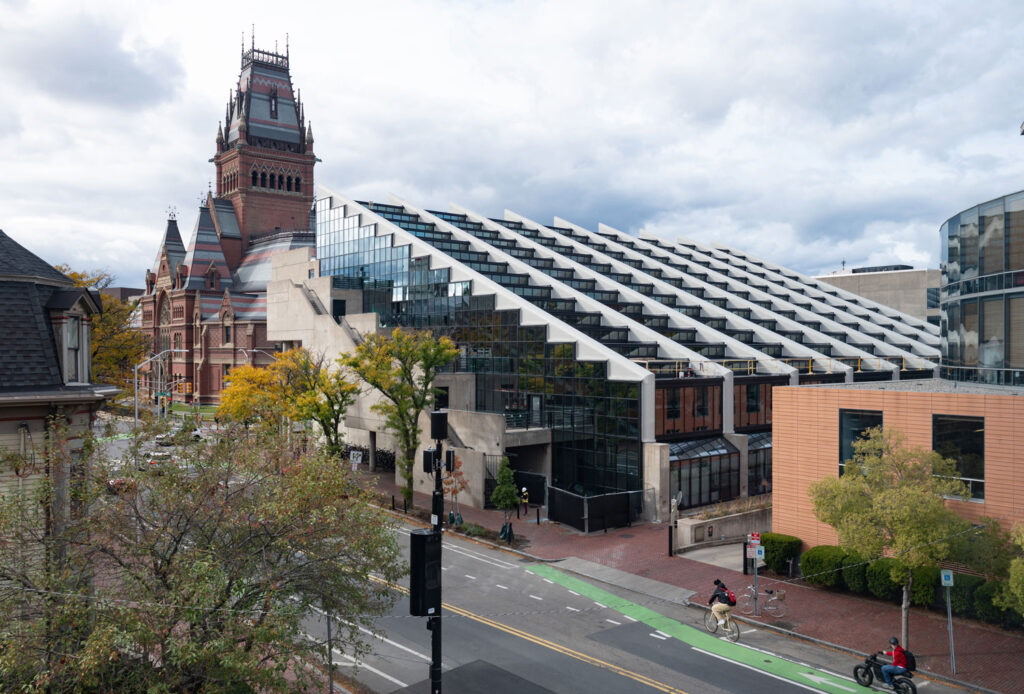
The Graduate School of Design (GSD) was established in 1936 to foster interdisciplinarity among the previously separate Schools of Architecture, Landscape Architecture, and City Planning. Within a few decades, though, the GSD had outgrown its home in Robinson and Hunt Halls, and the desired collaboration among the design departments proved difficult with offerings scattered throughout Harvard’s campus. Leadership recognized the need to unite the GSD’s programs under one roof to encourage cooperation among the school’s disciplines. In 1964, the GSD launched a capital campaign to fund the construction of the new building, to be named in honor of key benefactor George Gund II (1888–1966), a Harvard Business School graduate, banker, and real estate investor from Cleveland, Ohio.

THE ARCHITECT
Prior to earning his master of architecture at the GSD in 1958, Australian-born John Andrews had graduated with an architecture degree from the University of Sydney. By the early 1960s, Andrews had settled in Canada, where he developed a reputation as a strong architect and a thoughtful educator at the University of Toronto, for which he designed the well-feted Scarborough College, completed in 1966. The following year, likely on the urging of GSD dean Josep Lluís Sert (Andrews’s former professor), Harvard commissioned Andrews to design Gund Hall.
PROGRAM AND CONSTRUCTION
Issued in October 1967, the building’s brief called for studio space, an auditorium, an exhibition area, audiovisual and library facilities, workshops, and classrooms, to be located on a site at the intersection of Cambridge and Quincy Streets, just a block from Robinson and Hunt Halls. Andrews structured the parti around the design studio, which he viewed as the heart of architectural education, grouping the remaining programmatic elements alongside and below this dominant zone. Construction began in November 1969, and in fall 1972, the GSD moved into its new home.


THE DESIGN
Comprising exposed reinforced concrete and extensive glass, Gund Hall features at its core a shared multilevel studio block. A 125-foot clear-span steel-truss system soars above the four terraced studio “trays” that occupy this glass-enclosed expanse, traversed by open stairways and infused with light. Supporting spaces, including faculty offices and classrooms, wrap the studio block to the west and north.


Outside, Gund Hall’s main facade faces west, rising five stories with a deep overhang supported by a tall concrete colonnade that shelters the building’s primary entrance. The building’s recessed lower levels defer to the neighboring Memorial Hall while widening the brick-paved sidewalk along Quincy Street, thereby emphasizing the thoroughfare that Gund Hall shares with Le Corbusier’s Carpenter Center and the Fogg Art Museum to the south. Plentiful glass offers passersby a glimpse into Gund Hall’s exhibition and library spaces. From Quincy Street the building slopes down toward the east, echoing the tiered studio space within. At night, the illuminated trays outline Gund Hall’s dramatic stepped profile against the dark sky.

Upon Gund Hall’s opening, New York Times architecture critic Ada Louise Huxtable characterized Andrews’s creation as “a very powerful building,” citing “the remarkable architectural statement of the studio.” And despite the architect’s use of concrete and glass—a notable deviation from Harvard’s dominant use of brick—Huxtable described Gund Hall as a “handsome structure” that “sits well in the street and its surroundings.”1

RENOVATIONS
Since its completion more than 50 years ago, Gund Hall has undergone incremental renovations to address growing student numbers, evolving pedagogical needs, and facility maintenance. The most recent renovation, undertaken during summer 2024, rendered Gund Hall more sustainable through the installation in the studio trays of high efficiency glazing and shading systems to optimize interior climatic conditions and minimize energy use. Additional enhancements, such as updated lighting and widened exits, increased accessibility and well-being in studio spaces. David Fixler, lecturer in architecture at the GSD, characterized the renovated Gund Hall as a best-practices showcase for the rehabilitation and conservation of mid-twentieth-century buildings, emphasizing that the newest enhancements deliver “a significant upgrade in energy performance and occupant comfort.”2

- Ada Louise Huxtable, “New Harvard Hall: Drama and Questions,” NYT, Nov. 8, 1972. ↩︎
- David Fixler in Joshua Machat, “The Plan for a More Sustainable and Accessible Gund Hall,” GSD News, Dec. 18, 2023, https://www.gsd.harvard.edu/2023/12/the-plan-for-a-more-sustainable-and-accessible-gund-hall/. ↩︎
SUGGESTED RESOURCES
Anthony Alofsin, The Struggle for Modernism: Architecture, Landscape Architecture, and City Planning at Harvard (New York: WW Norton & Company, 2002)
Bainbridge Bunting, Harvard: An Architectural History (Cambridge, MA: Belnap Press of Harvard University Press, 1985)
Morton and Phyllis Keller, Making Harvard Modern: The Rise of America’s University (New York: Oxford University Press, 2001)
Joshua Machat, “The Plan for a More Sustainable and Accessible Gund Hall,” News, Harvard Graduate School of Design, Dec. 18, 2023
Paul Walker, John Andrews: Architect of Uncommon Sense (Cambridge, MA: Harvard Design Press, 2023)
Contemporary Memorials: Spaces of Engagement, Calls to Action

As Christopher Columbus plunged into Baltimore’s Inner Harbor, and General Robert E. Lee dismounted his pedestal in Richmond, a distinctive kind of memorial has been gaining traction.1 While past debates centered on a memorial’s formal qualities—figurative or abstract?—attention has pivoted from aesthetic attributes to the ways in which a visitor interacts with a memorial. Rather than an object to be contemplated, today’s memorial is a space to be experienced. And with this shift from contemplation to experience, a focus driven in part by faculty and alumni of the Harvard Graduate School of Design (GSD), comes an emphasis on active engagement, now and in the future.

Take, for example, the Memorial to Enslaved Laborers (MEL), which swells from the lawn just east of the Rotunda on the University of Virginia’s (UVA’s) campus. Designed by Höweler + Yoon, a firm founded by GSD professor of architecture Eric Höweler and dean of Cornell University’s College of Architecture, Art, and Planning J. Meejin Yoon, who graduated from the GSD in 1997, this installation honors the 4,000 enslaved individuals who built and worked at the university from its inception in 1817 through the Civil War’s conclusion nearly 50 years later. Composed of concentric granite rings, the outermost cresting to 8 feet in height, the memorial beckons to passersby traversing campus and across the street in Charlottesville. On the larger ring’s smooth inner wall they find inscribed 578 names and 311 phrases of kinship or occupation, such as “daughter” or “mason,” along with more than 3000 “memory marks”—placeholders for the yet-unidentified enslaved individuals. Visitors also encounter a timeline, awash with water, that denotes the racial violence underlying Jefferson’s “Academical Village.” These features partially enclose a circle of grass, a public space for meeting and interaction, recalling clearings in the woods where enslaved people would secretly gather. Meanwhile, in certain light conditions an ethereal portrait of Isabella Gibbons—a former enslaved domestic worker at UVA who became a Charlottesville school teacher—materializes on the MEL’s outer wall, suggesting that the history of which the memorial speaks is ever present, even when unseen.
Dedicated in 2021, the MEL is a contemporary memorial in date and sensibility: it engages visitors in an active manner, through multiple and flexible means; it contains room for emergent information (new names can be inscribed); and it incorporates input from a range of stakeholders, including UVA students and descendants of the honored individuals, who took part in its conceptualization. The MEL aspires to more than the commemoration of a person, group, or event; it sheds light on a previously suppressed history—not as a closed episode, but rather as an ongoing collective conversation in the present and future. “Righting past wrongs is what we were asked to do,” noted Höweler, who with Brenda Tindal was recently appointed co-chair of Harvard’s Legacy of Slavery Memorial Project . “How do you begin repair in the present by starting with the past and being more truthful about it?”2

A reflection of changing attitudes toward memorialization, in 2016 the National Park Service, National Capital Planning Commission, and Van Alen Institute co-sponsored Memorials for the Future , “an ideas competition to reimagine how we think about, feel, and experience memorials.”3 After analyzing the 89 submissions drawn from around the world, the organizers issued Not Set in Stone , a document underscoring potential key aspects of memorial design moving forward. The overarching message highlights the heterogeneous audiences that today’s memorials address as well as the inherent complexity and multi-dimensionality memorials now embody. The report offers broad guidelines for thinking about new memorials, recommending that they engage with the present and future as much as the past; accommodate shifting narratives; harness public involvement for conceptualization; and explore mobile or temporary forms of expression.4 The winning submission for Memorials for the Future, Climate Chronograph by landscape architects Rebecca Sunter and Erik Jensen, exemplifies these ideas, repurposing a portion of East Potomac Park in Washington, DC, as a place for visitors to kayak among the dead cherry trees, left behind as persistent sea level rise subsumes the land.5

Throughout the past decade, elements espoused by Not Set in Stone have appeared with increasing frequency in new memorials, as evidenced through a brief survey of projects by Harvard GSD affiliates—including those responsible for the MEL. Höweler + Yoon also designed the Collier Memorial (2015), sited on Massachusetts Institute of Technology’s campus where Officer Sean Collier was shot and killed following the Boston Marathon bombings in 2013. Comprising 32 blocks of granite that create a five-way stone vault, the memorial serves as an iconic destination, mid-campus passageway, and dynamic sculptural presence, its form suggesting that strength derives from unity.
The notion that contemporary memorials are “more visitor-centric”—less about observation and more about interaction—aligns with the recent competition-winning design for the Fallen Journalists Memorial (FJM) by Chicago-based architect John Ronan, who graduated from the GSD in 1995.6 Located on the National Mall in Washington, DC, and slated for completion in 2028, the FJM serves a twofold purpose: to honor journalists who have died in the pursuit of truth, and to educate visitors about the First Amendment’s role in a democratic society. With the FJM still working its way through the federal approval process, images of the design have not been released. Yet it has been revealed that Ronan’s design employs an array of glass elements through which visitors navigate to reach a “place of remembrance,” echoing the investigative journalist’s “journey of discovery” as a story comes together.7 The FJM thus distinguishes itself within its monument-saturated landscape by demanding the visitor’s active engagement.

A prerequisite of active engagement likewise informs Penjing , the shortlisted project for the Memorial to the Victims of the Los Angeles Chinese Massacre of 1871 by GSD alumni J. Roc Jih, James Leng, and Jennifer Ly (who graduated in 2012, 2013, and 2014, respectively). Nearly 150 years ago, a racist mob terrorized and lynched 18 Chinese men. The incident, which precipitated anti-Asian laws that restricted Chinese immigration, remained largely unacknowledged until 2021, when Los Angeles and California allocated funds for the commemoration of the massacre. In response to a call for submissions, Jih (of Studio J. Jih in Boston) and Leng and Ly (of San Francisco-based Figure) crafted a design that unites the Chinese concepts of Pen (frame) and Jing (scene) in a series of multitextured limestone vessels that house miniature gardens and mark locations in downtown Los Angeles significant to the massacre. The designers envisioned the installations as living sculptures to be cultivated by residents, who encounter the gardens as they move through the neighborhood; inscriptions on the ground educate visitors, ensuring that the massacre remains part of the public discourse. As Jih noted, “We see remembrance as a constant and ongoing act rather than as something sacred and unchanging.” Through the incorporation of living elements, “the act of remembering also becomes one of care and maintenance, inviting tactile engagement.”8

Likewise, visitor engagement figured prominently in the conceptualization of the National Memorial for Peace and Justice (2018), created by the Equal Justice Initiative (EJI). Following years in-depth research on lynching and the lasting impacts of racial violence, EJI collaborated with an array of designers and artists to construct, across a six-acre site adjacent to the State Capitol in Montgomery, Alabama, a memorial that honors the more than 4,400 victims of racial terror lynchings that took place in the United States between 1877 and 1950. MASS Design Group, founded by Michael Murphy and Alan Ricks (GSD graduates from 2011 and 2010, respectively), worked with EJI on one of the memorial’s elements of the memorial: a pavilion that contains 800 suspended steel columns —one for each of the counties in which a lynching took place—engraved with victims’ names.

A passageway descends through the columns, with visitors journeying to a position below, gazing up as if part of the crowd at a public lynching. Surrounding the pavilion, matching columns wait for their respective counties to claim and transport them home. In this way, the National Memorial for Peace and Justice engages more than its immediate visitors, extending its reach to hundreds of counties that must choose to create local memorials, thereby acknowledging their past atrocities, or leave the columns in Montgomery, signaling their lack of remorse. The National Lynching Memorial thus acts as a tool for engagement, education, and public accountability.
In 2019, the Gun Violence Memorial Project , designed by MASS Design Group and Songha & Company, where artist Hank Willis Thomas is creative director, debuted at the Chicago Architecture Biennal before opening, in spring 2021, for a two-year run at the National Building Museum in Washington, DC. As explained by Jha D. Amazi, principal at MASS Design Group, the memorial aims “to communicate the enormity of the [gun violence] epidemic while also honoring the individuals whose lives have been taken.”9 The design features four houses composed of 700 transparent glass bricks, with each house signifying the weekly human cost—700 lives on average—of gun violence in this country.10 Families who have lost someone to gun violence have donated remembrance objects from drivers’ licenses to Double Dutch jump ropes, which are displayed within a glass brick along with the victim’s name, date of birth, and date of death. For visitors, these objects humanize the victim, transforming them from a statistic to a person. Additional engaging elements include audio and film clips about the effects of gun violence, which visitors experience as they enter the houses to view their contents.

For the families of victims, the remembrance objects act as visible tributes to their loved ones. Simultaneously, the objects encourage interaction between the families as well as society at large. This begins with the objects’ process of collection, which draws families to given places at designated times; indeed, since opening five years ago, representatives from the Gun Violence Memorial Project have traveled to 14 cities around the country, holding collection events to fill formerly empty glass bricks. At these events, families encounter, and ideally connect with, others in their area who suffer with gun-violence-related tragedies. Then, once the objects populate the glass bricks, the families by default join the memorial’s contributory community—not a formal designation, yet nonetheless meaningful. Finally, the objects connect families with people they may never meet yet who, by experiencing the memorial, will be touched by these individual stories. The Gun Violence Memorial Project, fortified by the assembled remembrance objects, underscores the vast reach of gun violence, a nationwide epidemic the United States has yet to sufficiently accept or address.
In late August 2024, the Gun Violence Memorial Project opened in Boston. As opposed to its tenures in Chicago and Washington, DC, the memorial’s current manifestation involves a citywide collaboration, with displays at the Institute of Contemporary Art, Boston City Hall, and the MASS Design Group’s gallery. With this shift from a single venue to multiple sites throughout a city, the memorial appears to have leapt in scale, taking a great stride toward its ambition to “foster a national healing process that begins with a recognition of the collective loss and its impact on society.”11 Unlike static monuments that were conceived to be seen, this contemporary memorial elicits interaction and active engagement. As the Gun Violence Memorial Project illustrates, such a memorial can even be transitory; what persists is the human experience it provides.
*This piece was updated to describe the Equal Justice Initiative as the originator of the National Memorial for Peace and Justice.
- Rachel Treisman, “Baltimore Protesters Topple Columbus Statue,” NPR, July 5, 2020; and Whittney Evans and David Streever, “Virginia’s Massive Robert E. Lee Statue Has Been Removed,” NPR, Sept. 8, 2021. ↩︎
- Eric Höweler, interview with author, June 27, 2024. ↩︎
- Not Set in Stone (National Park Service, National Capital Planning Commission, and Van Alen Institute, 2016), 2. ↩︎
- “Key Findings,” Memorials for the Future, Van Alen Institute. ↩︎
- “Competition Winner,” Memorials for the Future, Van Alen Institute. ↩︎
- John Ronan, interview with author, Mar. 25, 2024. ↩︎
- Ibid. ↩︎
- “Penjing,” Work, Studio J. Jih.. ↩︎
- Jha D. Amazi, “The Gun Violence Memorial Project,” Exhibitions, Institute of Contemporary Art. ↩︎
- This average number of 700 gun deaths per week in the United States is based on a statistic from 2018. As of May 2024, the average number of gun deaths per week for the year is 840. ↩︎
- “About,” The Gun Violence Memorial Project. ↩︎
Plug-In Pastoral
A vertical garden in the backyard of 40 Kirkland Street on the campus of the Harvard Graduate School of Design (GSD) promises sanctuary to insects, relief from the late-summer heat, and new insights for how cities around the world can mitigate the effects of climate change. More than 1400 local plants hang in grow bags from a cylindrical scaffolding tower that rises nearly as high as the surrounding buildings. Titled Polinature , the project is spearheaded by Belinda Tato, associate professor in practice of landscape architecture at the GSD. “Polinature has been designed as a low-cost, low-tech temporary solution to bring climatic comfort to urban areas that currently lack it,” Tato explains in a text about the work.


Funded by the Salata Institute for Climate and Sustainability at Harvard, Polinature is, on the one hand, harmonious with its immediate surroundings. Grown from seed in Massachusetts nurseries, the plants are similar to those found in yards and fields all over Cambridge, and the name refers to Tato’s aim of bolstering the local population of pollinating insects. On the other hand, Polinature has a singular aesthetic and self-sufficient function that sets it apart from its context. The steel tubes of the scaffolding and the counterweight system that keeps it stable attest to Polinature’s temporary status—the structure will be disassembled within a few weeks with minimal waste—while highlighting the project’s overall character, which is as much technological as pastoral.
Polinature is a machine for producing climate relief. Solar panels that cap the tower are capable of providing the project with its own source of off-the-grid electricity. In addition to powering digital displays with information about the project aims and data about Polinature’s climatic performance, the solar panels are adequate to support a set of twelve inflatable pods that ring the tower. Six of these pods are permanently inflated and embedded with LEDs to provide illumination. Another six are what Tato calls “climatic bubbles.” Apart from providing shade, these pods inflate and deflate in response to environmental conditions. Nozzles in the undersides of the climatic bubbles produce a cooling breeze for anyone below to enjoy.

For the past two decades, Tato has investigated how designers can address the deadly effects of heat in urban areas. Climate scientists have warned that cities are becoming hotter more quickly than rural areas, a divergence that is even more pronounced in megacities with populations over 10 million. “Urban greening” can play a role in mitigating these effects, though tree canopies dense enough to have a significant cooling function are often distributed unevenly, making excessive city heat a tangible index of social inequality.

Tato stresses that no single architectural intervention can compensate for the structural factors driving climate change. Still, Polinature has the potential to address acute dangers immediately while permanent solutions come to fruition. As a prototype, Polinature offers an opportunity to study “how the structure is creating a better climatic comfort in the space compared to the outside,” Tato says. Sensors placed inside and outside the structure provide comparative data, allowing Tato and her team to assess the project’s performance quantitatively and optimize it in future iterations. Polinature is the result of years of careful study, not only of the nature of the plants that are most suited to such a growing arrangement, but also of mechanisms that can modulate the airflow from the climatic bubbles, producing the perfect breeze.

Tato stresses that the Cambridge location, which was already verdant, is far from the end point for the project. “In an ideal world, this should have been placed on a parking lot,” she says. Polinature has the potential to provide instant urban greening and convert disused, asphalt-heavy areas into climatically comfortable public spaces. The designs for the project are open-source, shareable with urban planners, architects, and builders as well as policymakers and communities around the world. To Tato, the iteration of Polinature at the GSD represents a “kit of parts” that could be quickly and inexpensively mass produced.
Polinature extends Tato’s longstanding work investigating how landscape architecture can support efforts toward climate justice. With Jose Luis Vallejo, Tato is a founding member of Ecosistema Urbano , a group of architects and urban designers with offices in Madrid, Florida, and Massachusetts. Polinature refines and develops concepts at the heart of their Eco-Boulevard project for Madrid (2004–2008), described as an “urban recycling operation.” Tiers of trees arranged on a cylindrical tower provide both cooling through evapotranspiration and an inviting social space. While Eco-Boulevard became a permanent fixture in Madrid, Polinature is about providing immediate impact with zero waste. Tato designed it as what she calls a “plug-in” structure, easy to erect and dismantle in any context. That terminology evokes the work of avant-garde collective Archigram, whose members envisioned cities comprising flexible, mobile, high-tech structures that could respond to inhabitants’ changing needs.

While Archigram’s work channels the consumerist tendencies of postwar mass culture, Polinature is wholly sustainable and community oriented. When the tower comes down in mid-September, Tato and her team will give away all the plants that ring the structure to people in Cambridge. In that way, this temporary garden could have a long-term effect on the city’s urban ecology. Polinature will live on in other ways as well, especially as a learning and teaching opportunity about how we must contend with a changing climate. “The goal is that we pollinate Cambridge with the idea of the project,” says Tato.

GSD Announces Fall 2024 Public Programs and Exhibitions
The Harvard Graduate School of Design (GSD) announces its fall 2024 schedule of public programs and exhibitions, many of which offer interdisciplinary perspectives on conflict, power, and design as a means of communication.
In the series of events Democracy and Urban Form (October 9–10), Michael Sandel, Richard Sennett, and Diane Davis discuss how the design of our cities can empower citizens and facilitate modes of discourse essential to democratic societies. Senior Loeb Scholar Malkit Shoshan hosts “Reconstruction and Redestruction” (October 24), a discussion about the complexities of postwar reconstruction with Andrew Herscher and Daniel Serwer. In “Building with Care” (September 24), Shoshan develops similar ideas, speaking with Tatiana Bilbao and Elke Krasny about how a powerful shift in worldview can follow from displacing the use of the word “war.”
Foregrounding global perspectives on the power dynamics underlying design history and practice, on October 7, Germane Barnes presents “Where This Flower Blooms,” his Wheelwright Prize research that reinserts North African building practices that were critical to Italian architecture throughout antiquity but erased in Eurocentric histories of design. The talk coincides with Barnes’ first solo exhibition, which opens at the Art Institute of Chicago on September 21. In the 2024 Aga Khan Program Lecture, Iraqi landscape architect Jala Makhzoumi (October 22) searches for a grounded language for landscape architecture in the Middle East that captures the complexity of the English term “landscape.”
Fall programs explore the role of design in mitigating environmental degradation while bolstering social equity and deepening our connections with nature. Anne Whiston Spirn poses direct questions about the connection between climate change and urban landscapes in her lecture, “Restoring Nature, Rebuilding Community” (October 29), while Chelina Odbert (September 12) addresses 15 years of her “mission-driven,” community-engaged design. Surveying the practice of landscape architect Bas Smets, the exhibition Changing Climates (October 28–December 20) demonstrates the power of urban micro-climates in confronting ecological crisis. And Sean Godsell, the Kenzo Tange Visiting Critic, reflects on the Australian bush, a “mystical, mythical” place where water is a most precious commodity (October 17).
Focusing on the practice of design and the tools architects use to develop their work, the exhibition Architecture as an Instruction-Based Art (August 26–October 14), curated by Farshid Moussavi, features construction coordination drawings created by practitioners from around the world. These detailed composite drawings, which Moussavi and exhibition contributors discuss on September 3, are conceptual tools architects use to think through their buildings. Selections of the drawings are also featured in Harvard Design Magazine 52: Instruments of Service (launching October 16), guest edited by Elizabeth Bowie Christoforetti and Jacob Reidel.
The complete public program calendar appears below and can be viewed on the GSD’s events calendar.
Architecture as an Instruction-Based Art
Exhibition
Druker Design Gallery
August 26–October 14
Exhibition Opening: Architecture as an Instruction-Based Art
Farshid Moussavi and guests
September 3, 6:30pm
Eric Höweler, “Clay: Pedagogy and Practice”
Lecture
September 10, 6:30pm
Chelina Odbert, “Situating Justice: Reflections on Mission-Driven Practice”
Margaret McCurry Lectureship in the Design Arts
September 12, 6:30pm
Perfect Days (2023)
Film Screening
September 19, 6:30pm
GSD Comeback: Celebration of Alumni & Friends
September 20–22
Malkit Shoshan, Tatiana Bilbao, and Elke Krasny
“Building with Care: Feminist Perspectives on Design in Conflict”
Senior Loeb Scholar Conversation
September 24, 6:30pm
Signe Nielsen, “Parks and Monuments: A Cultural Evolution”
Lecture
September 26, 12:30pm
RealTimeNature
With opening remarks by Peter Galison and closing keynote by Daniel Barber
DDes Conference
September 27, 9am
Germane Barnes, “Where This Flower Blooms”
Wheelwright Prize Lecture
October 7, 6:30pm
Wheelwright Prize Jury with Germane Barnes
David Brown, David Hartt, Mark Lee, Megan Panzano, and Sumayya Vally
Conversation
October 8, 12:30pm
Democracy and Urban Form
Michael Sandel, “Democracy’s Discontent”
Lecture
October 9, 6:30pm
Democracy and Urban Form
Richard Sennett, Diane Davis, Claire Zimmerman, Markus Miessen, and Guests
Panel Discussion
October 10, 12:30pm
Theodore Spyropoulos, “Quantum”
Rachel Dorothy Tanur Memorial Lecture
October 15, 6:30pm
Harvard Design Magazine 52: Instruments of Service
Issue Launch
October 16, 12:30pm
Sean Godsell, “Your Feet Against My Feet: Upside-Down Architecture”
Kenzo Tange Visiting Critic Lecture
October 17, 6:30pm
Jala Makhzoumi, “Landscape, Garden, and a Colonial Legacy”
Aga Khan Program Lecture
October 22, 6:30pm
Malkit Shoshan, Andrew Herscher, and Daniel Serwer
“Reconstruction and Redestruction: Post-War Antinomies”
Senior Loeb Scholar Conversation
October 24, 6:30pm
The 2024 Ivory Prize Housing Innovation Summit
October 25, 12:30pm
Changing Climates
Exhibition
Druker Design Gallery
October 28–December 20
Anne Whiston Spirn, “Restoring Nature, Rebuilding Community”
Frederick Law Olmsted Lecture
October 29, 6:30pm
Exhibition Opening: Changing Climates
Bas Smets
October 31, 6:30pm
Laurie Olin, “First We Read, Then We Write”
Sylvester Baxter Lecture
November 7, 6:30pm
Sheila O’Donnell, “Conversations with Place”
Lecture
November 12, 6:30pm
A Round Table
Loeb Fellowship Symposium
November 15, 12pm
Symposium in Honor of Giuliana Bruno
With Keynotes by Isaac Julien and Emanuele Coccia
Gund Hall and Carpenter Center for the Visual Arts
November 21
All programs take place in Gund Hall, are open to the public, and will be simultaneously streamed to the GSD’s website, unless otherwise noted.
Contemporaries, Now and Then
Los Angeles’ Alameda Street cuts a north-south line through the city. Potholed by time, traffic, and freight trucks, the roadway stretches from Chinatown to the Port of Long Beach. At the northernmost end, the broad, commercial street marks a boundary between Little Tokyo, a pedestrian-scaled historic district of Japanese-American culture dating to the late nineteenth century, and the Arts District, a steadily gentrifying neighborhood where with each passing decade light industry gives way to artist studios, which are then replaced by galleries, restaurants, and new condo developments.

The two sides exist in a quiet equilibrium, connected by the Little Tokyo/Arts District metro station. In a metropolis often derided as traffic congested sprawl, this recently reopened underground hub for public transit links this corner of Los Angeles to the farther flung edges of the basin. For GSD associate professor of architecture John May, Alameda Street is a seam between two urban fabrics, each in states of considerable transformation.
This past spring, May led the option studio “The Temporary Contemporary: Assembling a Public in Downtown Los Angeles.” His course brief frames the stark, shadeless plaza around Little Tokyo/Arts District metro station as a “missed opportunity” for creating a space where folks might assemble—and that with such a gathering of bodies comes a vibrant connection of political and aesthetic life. “This does not imply that the content of aesthetic work must become explicitly political, but rather that ‘art’ (very broadly conceived) and the institutions where it is housed, can form spaces, arenas, and backgrounds for publics,” writes May in his introduction to the studio.

The Geffen Contemporary, a satellite of L.A.’s Museum of Contemporary Art, is located along Alameda Street and exemplifies the kind of institution May describes. On one side of the converted warehouse a message from Barbara Kruger— Untitled (Questions) (1990/2018)—queries passing drivers in all caps. “WHO IS BEYOND THE LAW? WHO IS BOUGHT AND SOLD?” her mural asks, demonstrating a necessary conflation of art, politics, and urban space.
Conditions of publicness are embedded in the museum’s history, as is its ambiguous relationship to Little Tokyo. Although The Geffen Contemporary shares the block with the Japanese American National Museum, it is located at the end of a long pedestrian plaza, which serves both institutions, and is set back from the street. One of the challenges posed to students was to address the urban connection between the museum and the metro station, where they were to develop a mixed-use building designed to support a residency for performance artists. The program grew out of a very real necessity: Wonmi’s Warehouse is a 14,500-square-foot facility that is part of the Geffen Contemporary but only occasionally used for exhibitions.

Connected to MOCA, but originally a separate industrial structure, it was never outfitted for any specific program. Inflexible in its raw flexibility, the space lacks facilities, such as dressing rooms, showers, and rehearsal space. “[Associate curator Alex Sloane] described the warehouse as a space for bodies and the MOCA Geffen as a space for objects—in her view the warehouse is woefully inadequate for bodies,” notes May. As such, the bipartite brief reimagines two sites—the warehouse interior and the Metro station—to better accommodate invited artists, dancers, musicians and forge new understandings of audience.
May also suggests that performance art defies the financialization of the art market. As such, the art form itself is aligned with contestations in public space, be them aesthetic or political, both suggest a kind of urban choreography that manifests, draws people together, and then fleetingly dissipates. Artist Suzanne Lacy, writing in the 1995 collection Mapping the Terrain , outlines a trajectory of what was then termed “new genre public art”—artist and collectives like Judy Baca, Martha Rosler, and Ant Farm (Lacy’s examples) to Postcommodity, Crenshaw Dairy Mart, and the The Los Angeles Urban Rangers (mine) that engage urban space as a call to action. “This construction of a history of new genre public art is not built on a typology of materials, spaces, or artist media, but rather on concepts audience, relationship, communication, and political intention.”[1]

MOCA Geffen was initially conceived as an exercise in temporality. In late 1983 when it first opened as a provisional outpost, some 1,500 architects and designers showed up for a preview party. Los Angeles Times urban design critic Sam Hall Kaplan reported the movement of attendees as a “parade.” It’s easy to imagine this creative murmuration flocking to what was then called the “Temporary Contemporary,” to mingle, network, and ogle the pair of old warehouses renovated by Frank O. Gehry, then, as now, LA’s homegrown star architect.
The architect’s rising fame, coupled with his penchant for bricolage made him a perfect choice to tackle the 55,000-square-foot retrofit. His scrappy, light touch approach to the industrial building (originally designed by AC Martin in 1947) contrasted the studied postmodern geometries of Arata Isozaki’s plans for MOCA , which was then under construction on Bunker Hill and wouldn’t open until 1986.

The convening was orchestrated by a short-lived nonprofit, the Architecture and Design Support Group, whose mission was to raise design consciousness in the city. Kaplan was skeptical, writing in the LA Times, “The question raised by the group’s stated intent is how relevant the architecture and design exhibits and programs will be under the aegis of the museum, whether they will be just another forum for the new cadre of avant-garde architects and designers who are self-consciously pretending to be artists, or whether they will indeed help redirect the profession toward fulfilling its obligation as a social art to enhance the quality of life.”[2]

His critique, however narrowly cast, points to a larger concern, one echoed by the themes of The Temporary Contemporary studio: What is the agency of museums, of architecture to serve a community? The necessity of an architecture of assembly was made urgent during the racial reckonings following Black Lives Matter protests in 2020. In the years since, performance has emerged as a tool of rapid response—a means to bring underrepresented bodies into the institution and unsettle staid relationships between viewer and art. The venues where these performances happen are potentially transformative places.

May recasts the role of the museum from passive to active. His sentiments echo ones made decades earlier by Bernard Tschumi. “There is no architecture without action, no architecture without events, no architecture without program,”[3] wrote Tschumi in 1981, prefiguring Gehry’s Temporary Contemporary. Revisiting these ideas again, the architect was part of the jury for the studio’s final review in late April.
By imagining that MOCA might cultivate a spectrum of places along the public-to-private spectrum as site of free expression and refuges for queer, transgender, and BIPOC people—people often excluded or policed in public, The Temporary Contemporary studio envisions an architecture of resistance. Says May, “If we’re losing the right to protest and enact certain kinds of behavior in our ‘public space’, which isn’t really public, then maybe museums are going to have to take on this role more emphatically going forward.”
[1] Suzanne Lacy, Mapping the Terrain: New Genre Public Art, Seattle: Bay Press, 1995, p. 28.
[2] Sam Hall Kaplan, “’Temporary Contemporary’ Agenda: Architects Tie Design Goals to L.A.” Los Angeles Times (1923-1995); Nov 25, 1983; ProQuest Historical Newspapers: Los Angeles Times, pg. OC_C23.
[3] Bernard Tschumi, “Violence of Architecture,” Artforum, 1981. Accessed June 6, 2024. https://www.artforum.com/features/violence-of-architecture-2-215475/
I.M. Pei’s Museum of Chinese Art, Shanghai: Modernism between East and West
In the immediate aftermath of the Second World War, I. M. Pei concluded his stellar progress through the Harvard Graduate School of Design (GSD) with a thesis project that marked an original position in debates of the period over the renewal of civic space and on the form of a modern museum. Pei’s choice of subject, a museum of Chinese art for Shanghai, made clear enough his ambition to take his new design training home to his native China and to contribute to debates on the appropriate form for a modern Chinese architecture. With this choice, he raised the fascinating question of cultural relativity: does Chinese art require a distinctive type of architectural frame for viewing? This question extended the then current debate among architects and museum curators over whether or not modern art was better shown in new types of spaces. In his complex, two-story frame of widely spaced reinforced-concrete piers, featureless so as to make reference neither to Western colonnades nor to Chinese timber traditions, Pei proposed a museum space that was as much community center as museum, and equally as much landscape, with its garden flowing through the building and interior tea pavilions. Pei’s remarkable design catapulted him onto the international stage—before he had ever built a building—when his thesis project was published in two of the leading architectural journals of the day: Progressive Architecture in New York and L’architecture d’aujourd’hui in Paris.¹

Courtesy of Bibliothèque d’architecture contemporaine – Cité de l’architecture et du patrimoine.
Pei had left China at a moment when Shanghai was in the throes of discussing the creation of a new civic center, of which a museum would be a key component. Throughout his studies in the United States, Pei had kept an eye on the situation at home, even during the height of the war. His undergraduate thesis project at the Massachusetts Institute of Technology (MIT), submitted in 1940 and titled “Standardized Propaganda Units for War Time and Peace Time China,” was in essence a design for an itinerant cultural center to be deployed by the “Ministry of Propaganda” in rural areas. The design paid homage in its tensile structures as well as in its conception of cultural propaganda, referring to both Soviet revolutionary architecture and Le Corbusier’s Pavillon des temps nouveaux at the Paris Exposition universelle of 1937.²
Early on, Pei viewed architecture as an impetus for cultural transformation and community-building, with a sense of the urgent need to contribute to a spirit of nationalism in a country resisting Japanese invasion. In the text accompanying his MIT thesis, he underscored the political and social basis of his design with technical descriptions of the system of lightweight bamboo construction uniting Chinese tradition and a burgeoning interest in prefabrication. Two aspects of this project are relevant for his decision six years later to design a museum for Shanghai: the fact that the space would be modifiable, with equal weight given to exhibitions and to theatrical events, and that bamboo could be used in a mixed assembly to become a modern structural material, locally available and relying on existing labor know-how. Pei proposed a largely open-plan space with flexible partitions, notably so that the space could be changed from a darkened theatre to a light-filled display.³
When Pei enrolled at the GSD in December 1942—only to interrupt his studies almost immediately to work for the National Defense Research Committee in Princeton—his young wife, Eileen, was already studying landscape design there. Art periodicals were filled with articles on the need for museums to respond to the challenges of modernist art and of a changing society. In New York, Alfred Barr Jr, founding director of the Museum of Modern Art (MoMA), conceived of an entirely different concept of a museum and of its architectural space, influenced by his first-hand experiences at the Bauhaus and with the experimental installations undertaken by Alexander Dorner in Hanover in the late 1920s. After Dorner’s emigration from Hitler’s Germany, Barr was instrumental in finding him a position as director of the Museum of the Rhode Island School of Design. With his concept of the “living museum,” Dorner promoted museums as active parts of a community. Walter Gropius, likewise newly installed in the United States, would frequently assign museums and cultural facilities as studio assignments at Harvard.
In 1939, MoMA opened in its permanent home—a building designed by Philip Goodwin and Edward Durell Stone that represented a radical departure from the neoclassical temple type most recently promoted for a new national gallery of art in Washington DC. At MoMA, Goodwin and Stone discarded the conventions of classical columns in favor of a translucent curtain-wall facade, transparent on the ground floor to allow views from the street. Visitors entered at ground-floor level rather than ascending a flight of ceremonial stairs; they also had immediate access to an outdoor sculpture garden behind the museum that could be seen from the street through the glazed vestibule. Transparency and flexibility were to be hallmarks of a new generation of museums, qualities that were soon seen as echoing the stakes of national cultural politics. In his radio broadcast on the opening of MoMA’s building, President Franklin D. Roosevelt declared: “As the Museum of Modern Art is a living museum, not a collection of curious and interesting objects, it can, therefore, become an integral part of our democratic institutions—it can be woven into the very warp and woof of our democracy.”⁴
In 1943, two radically new, if diametrically opposed, visions of a future art museum were proffered by Frank Lloyd Wright and Mies van der Rohe. Wright had drawn up a variety of schemes for the future Solomon R. Guggenheim Museum’s famous spiralling ramp suspended above an open ground floor penetrable from the street by both pedestrians and vehicles. In September 1945, as Pei was returning to complete his graduate work at the GSD, Wright’s model was unveiled at the Plaza Hotel and heralded in the New York Times: ‘Museum Building to Rise as Spiral, New Guggenheim Structure Designed by F. L. Wright Is Called First of Kind’.⁵ Few knew that Le Corbusier had been working on a similar concept since 1929, although it is likely that, given Pei’s enthusiasm for Le Corbusier, he was familiar with the project, titled Musée à croissance illimitée, which had been published in 1937 in the first volume of the architect’s OEuvre complète.
In 1943, Architectural Forum published a special issue of designs by leading American architects that posited the form and institutions of a post-war city under the rubric “194X,” since no one knew when the Second World War would come to an end. Together with its parent publication, Fortune, the magazine modeled all aspects of a medium-sized post-war city, choosing Syracuse, New York, imagined as if it had been bombed. Fortune proposed the economic and social dimensions of the city and Forum its architecture and urban layout, including a civic center where city hall and museum would be brought into a taut composition at the core, something with echoes of the Greater Shanghai Plan debated during Pei’s high-school days in China.⁶ The future museum was entrusted to Mies van der Rohe, whom Architectural Forum called the nation’s chief “exponent of the ‘open’ plan.”⁷ Ironically, Syracuse would be remodeled in the 1950s and 1960s by bulldozers in the name of urban renewal, rather than by German or Japanese bombs. Syracuse’s new Everson Museum of Art would be designed not by the elder statesman Mies—then at work on a new museum for West Berlin—but by the virtually untried Pei.⁸

To represent new display conditions for modern art, which had discarded all the perspectival traditions of painting, Mies used collage, a method that had become his standard teaching technique for the courtyard house projects with students at Illinois Institute of Technology, and which Pei would emulate in his GSD thesis. Mies collaged photographs of works of art that might be displayed—poignantly Picasso’s Guernica, which depicts the horror of the Spanish Civil War—and enlarged color details of nature, cut to represent the uninterrupted view of the landscape from his glazed box. All is held in place in the collage by thin ruled pencil lines, which represent the delicate steel frame of the future structure. Most importantly, Mies’s building would be a new frame for looking at art from different vantage points. He writes: “A work such as Picasso’s Guernica has been difficult to place in the usual museum gallery. Here it can be shown to greatest advantage and become an element in space against a changing background.”⁹
Mies captured the larger ethos of the future city: “The first problem is to establish the museum as a center for the enjoyment, not the interment of art. In this project the barrier between the artwork and the living community is erased by a garden approach for the display of sculpture.” (This element of the project corresponds interestingly with the sculpture garden in Goodwin and Stone’s 1939 design for MoMA.) Mies concludes: “The entire building space would be available for larger groups, encouraging a more representative use of the museum than is customary today, and creating a noble background for the civic and cultural life of the whole community.”¹⁰
Both Mies’s design approach and his rhetoric would find echoes—emulation and critique—in Pei’s design for Shanghai. Pei’s project was published in Progressive Architecture in February 1948 together with a number of short texts, the editors noting that “This remarkable graduate-school project strikes us as an excellent synthesis of progressive design in addition to providing a much-needed architectural statement of a proper character for a museum today.” As background, they add: “Planned to replace an inadequate structure that occupies a site within the city’s new Civic Center, plans for which were completed in 1933, this design for a museum “befitting the dignity of the city of Shanghai” is developed as an integral part of the civic plan.”¹¹
Published under Gropius’s guidance, the project is accompanied in both Progressive Architecture and L’architecture d’au jour d’hui by a statement from the former Bauhaus director that reflects some of his concerns in the 1940s, even if they perhaps overlook the extent to which Pei has taken on the museum debate that I am sketching in here. As Gropius explains:
[The project] clearly illustrates that an able designer can very well hold on to basic traditional features—which he has found are still alive—without sacrificing a progressive conception of design. We have today sufficiently clarified our minds to know that respect for tradition does not mean complacent toleration of elements which have been a matter of fortuitous chance or a simple imitation of bygone esthetic forms. We have become aware that tradition in design has always meant the preservation of essential characteristics which have resulted from eternal habits of the people.¹²
This text could apply as easily to Gropius’s relationship to New England clapboard houses as to Pei’s evolving vision of a relationship between Chinese tradition and modernity. “When Mr. Pei and I discussed the problems of Chinese architecture,” Gropius continues,
he told me that he was anxious to avoid having Chinese motifs of former periods added to public buildings in a rather superficial way as was done for many public buildings in Shanghai … We tried then to find out how the character of Chinese architecture could be expressed without imitating … former periods. We decided that the bare Chinese wall, so evident in various periods of Chinese architecture, and the small individual garden patio were two eternal features which are well understood by every Chinese living. Mr Pei built up his scheme entirely on a variation of these two themes.¹³

Pei designed a two-story concrete frame, entered by means of a dramatic ramp, cutting into it as needed to create sectional richness. The frame is clad in marble, an honorific befitting Shanghai’s civic center. The expansive roof is pierced with many more openings than those programmed by Mies in his steel frame and would be visible from taller buildings nearby, since the building is embedded in the ground by half a level. Influenced by both his wife’s study of landscape architecture and his own memories of the gardens of Suzhou, Pei weaves a garden through the open courts of the lower level. Gardens could be enjoyed both at eye level and from above, where the section of the building is opened to the sky. In place of Mies’s pictorialized landscape in the distance, Pei interweaves a commemoration of the garden as one of the high forms of Chinese art-making and considers it for use, labelling it a tea pavilion on the plan. He notes of the landscaped courtyards: “All forms of Chinese art are directly or indirectly results of a sensitive observation of nature. Such objects, consequently, are best displayed in surroundings which are in tune with them, surroundings which incorporate as much as possible the constituting elements of natural beauty.”¹⁴ As is clear from photographs of the model, now lost, Pei set out to capture the essence of Chinese domestic architecture using the courtyards, gardens, and semi-enclosed rooms that are present at every scale, from the hutong to the palace. “This section looks toward the entrance garden court, at right of which is a modern translation of the traditional Chinese Tea Garden,” the editors note. “Usually located in the market place, or near the temple grounds, to serve men of all classes as a social center and place for intellectual exchange, its inclusion here in a museum is with the hope that it will help make the institution a living organism in the life of the people, rather than a cold depository of masterpieces.”¹⁵ The incorporation of a Chinese-style garden, which fragments experience towards greater enjoyment, enlightenment, and discovery of multiple facets of reality, makes it clear that Pei was conscious of the ways in which Chinese pictorial traditions with nature or ink and brush often incorporate multiple perspectives, rather than the unified construct of linear perspective.

As Pei was designing a museum to take home, the civil war between Nationalists and Communists made an immediate return impossible. In the next few years, he would teach at Harvard instead, notably a foundation course, Architecture 2b: Architectural and Landscape Design, which clearly underscored the interdependence of building and site, construction and nature, and which also, according to the 1946 course bulletin, assured that “the social and economic factors underlying the design are constantly considered.” In 1947, Dorner was invited as a guest to work with students at the GSD on the design of a living museum. He took it as the occasion to pen a veritable manifesto on the role of the museum in relation to the specific spiritual state of mankind in modernity. The classroom brief was even reprinted in its entirety in Dorner’s influential The Living Museum: Experiences of an Art Historian and Museum Director, published in 1958, a year after his death. The brief also served as the point of departure for his 1947 book The Way Beyond Art. “The new type of museum,” he wrote,
would begin to partake of that energy [of the modern movement in art and architecture]. It would not only be more alive and stimulating but also much more easy to establish, for it would depend much less than the current type on quantitative accumulation, i.e. wealth. It would not require any gorgeous palaces of absolutistic ideal art but would be constructed functionally and flexibly of light modern materials … Like all new movements this new type of museum would then be an important factor in the urgently needed integration of life and in the unification of mankind on a dynamic basis.¹⁶

In his Museum of Chinese Art for Shanghai, Pei synthesized a series of concerns: his ongoing desire to intervene in the civic center in Shanghai, his commitment to imagining a cultural politics for his home country, and his attentiveness to the debate in the United States on the spaces and functions of an art museum. With its emphasis on landscape, the design possibly shows the influence of his wife, Eileen, who was at the time fully immersed in landscape architecture at the GSD. The first product of what would prove to be a lifetime engagement with museum design stood at the intersection of Pei’s memories of the cultural needs of pre-war China and the debates about the appearance of a post-war United States. When he was suddenly catapulted to national attention with an innovative built design for the Everson Museum of Art in Syracuse, his interest in changing perspectives on space was largely internalized. He created a building that could take its place not in dialogue with the larger liberated landscape but in the hard realities of an American city being reconceived for urban renewal. It was the first sketch in many ways of the East Building of the National Gallery of Art in Washington DC, where the Chinese émigré architect would be one of the first to bring a modernist vision of exhibition space to the landscapes of the American National Mall.
I.M. Pei: Life is Architecture (2024) is published by Thames & Hudson.
- “Museum for Chinese Art, Shanghai, China,” Progressive Architecture 29 (February 1948): 50–52; and “Chinese Art Museum in Shanghai”, L’architecture d’aujourd’hui 20 (February 1950): 76–77.
- Le Corbusier’s 1935 trip to the United States had an enormous impact on Pei, who recalled the Swiss architect’s visit to Cambridge as “the two most important days in my professional life.” See Gero von Boehm, Conversations with I. M. Pei: Light Is the Key (Munich: Prestel, 2000), 36.
- I. M. Pei, “Standardized Propaganda Units for War Time and Peace Time China,” BArch diss., Massachusetts Institute of Technology, 1940.
- Franklin D. Roosevelt’s speech was reprinted in full in the Herald Tribune (New York) on 11 May 1939, and can be found on the website of the Museum of Modern Art: https://www.moma.org/research-and-learning/archives/archives-highlights-04-1939, accessed 7 September 2021.
- New York Times, 10 July 1945, quoted in Hilary Ballon et al., The Guggenheim: Frank Lloyd Wright and the Making of the Modern Museum (New York: Guggenheim Museum, 2009), 156.
- “New Buildings for 194X,” Architectural Forum (May 1943): 69–189. See also Andrew M. Shanken, 194X: Architecture, Planning, and Consumer Culture on the American Home Front (Minneapolis: University of Minnesota Press, 2000); and Barry Bergdoll, “Architecture of 194X,” in Mark Robbins, ed., American City “X”: Syracuse after the Master Plan (New York: Princeton Architectural Press with Syracuse Univeristy School of Architecture, 2014), 18–25.
- “Index of Projects and Contributing Architects,” Architectural Forum (May 1943): 72.
- On the Everson Museum of Art, see Barry Bergdoll, “I. M. Pei, Marcel Breuer, Edward Larrabee Barnes, and the New American Museum Design of the 1960s,” in Anthony Alofsin, ed., A Modernist Museum in Perspective: The East Building, National Gallery of Art (Washington DC: National Gallery of Art, 2009), 106–123.
- Ludwig Mies van der Rohe, quoted in “Museum, Mies Van Der Rohe, Architect, Chicago, Ill.,” in ‘New Buildings for 194X”: 84.
- Mies van der Rohe, ‘New Buildings for 194X”: 84.
- “Museum for Chinese Art, Shanghai, China”: 50–51.
- “Museum for Chinese Art, Shanghai, China”: 52.
- “Museum for Chinese Art, Shanghai, China”: 50–51.
- I. M. Pei, quoted in “Museum for Chinese Art, Shanghai, China”: 51.
- “Museum for Chinese Art, Shanghai, China”: 52.
- The winning project responding to Dorner’s brief to the Harvard students was by Victor Lundy, for a “Living Art Museum,” a design that clearly drew on Pei’s earlier project in its interweaving of a landscape garden under and through the spaces of a museum and its development of a partially sunken section.