Expos as Great Urban Projects, Present and Future
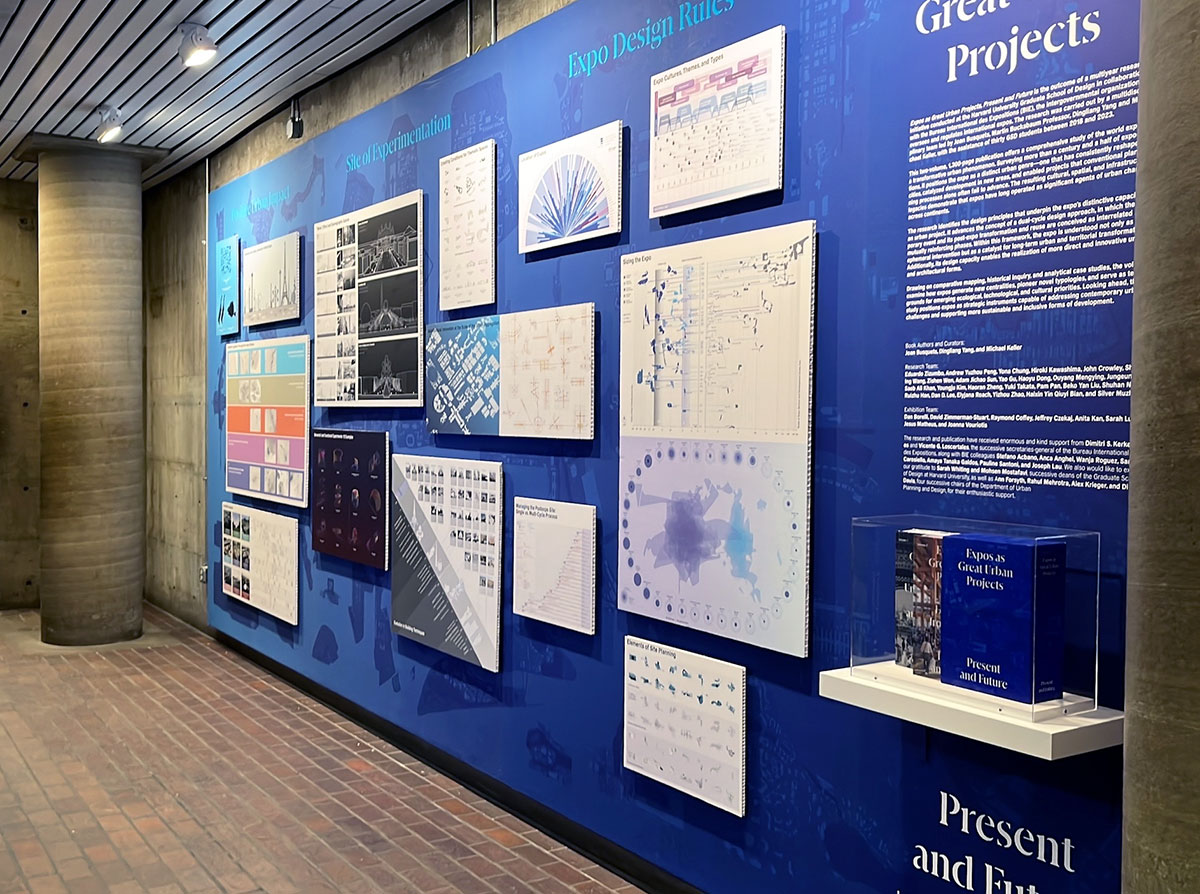
Expos as Great Urban Projects, Present and Future is the outcome of a multiyear research initiative conducted at the Harvard University Graduate School of Design in collaboration with the Bureau International des Expositions (BIE), the intergovernmental organization that oversees and regulates international expos. The research was carried out by a multidisciplinary team led by Joan Busquets, Martin Bucksbaum Professor, Dingliang Yang and Michael Keller, with the assistance of thirty GSD students between 2018 and 2023.
This two-volume, 1,300-page publication offers a comprehensive study of the world expo as a transformative urban phenomenon. Surveying more than a century and a half of expositions, it positions the expo as a distinct urban genre—one that has consistently reshaped cities, catalyzed development in new areas, and enabled projects that conventional planning processes alone often fail to advance. The resulting cultural, spatial, and infrastructural legacies demonstrate that expos have long operated as significant agents of urban change across continents.
The research identifies the design principles that underpin the expo’s distinctive capacity as an urban project. It advances the concept of a dual-cycle design approach, in which the temporary event and its post-expo transformation and reuse are conceived as interrelated and mutually reinforcing phases. Within this framework, the expo is understood not only as an ephemeral intervention but as a catalyst for long-term urban and territorial transformation. Additionally, its design capacity enables the realization of more direct and innovative urban and architectural forms.
Drawing on comparative mapping, historical inquiry, and analytical case studies, the volumes examine how expos generate new centralities, pioneer novel typologies, and serve as testing grounds for emerging ecological, technological, and cultural priorities. Looking ahead, the study positions expos as strategic instruments capable of addressing contemporary urban challenges and supporting more sustainable and inclusive forms of development.
Book Authors and Curators:
Joan Busquets, Dingliang Yang, and Michael Keller
Research Team:
Eduardo Zizumbo, Andrew Yuzhou Peng, Yona Chung, Hiroki Kawashima, John Crowley, Shenting Wang, Zishen Wen, Adam Jichao Sun, Yao Gu, Haoyu Dong, Ouyang Mengying, Jungeun Goo, Saeb Ali Khan, Youngju Kim, Haoran Zheng, Yuki Takata, Pam Pan, Beko Yan Liu, Shuhan Nie, Ruizhu Han, Dan D. Lee, Elyjana Roach, Yizhou Zhao, Haixin Yin Qiuyi Bian, and Silver Muzhe Li
Exhibition Team:
Dan Borelli, David Zimmerman-Stuart, Raymond Coffey, Jeffrey Czekaj, Anita Kan, Sarah Lubin, Jesus Matheus, and Joanna Vouriotis
The research and publication have received enormous and kind support from Dimitri S. Kerkentzes and Vicente G. Loscertales, the successive secretaries-general of the Bureau International des Expositions, along with BIE colleagues Stefano Acbano, Anca Anghel, Wanja Roguez, Sarah Carosiello, Amaya Tanaka Galdos, Pauline Santoni, and Joseph Lau. We also would like to extend our gratitude to Sarah Whiting and Mohsen Mostafavi, successive deans of the Graduate School of Design at Harvard University, as well as Ann Forsyth, Rahul Mehrotra, Alex Krieger, and Diane Davis, four successive chairs of the Department of Urban Planning and Design, for their enthusiastic support.
Looking for older event archives? Please contact Loeb Library or visit our YouTube channel.