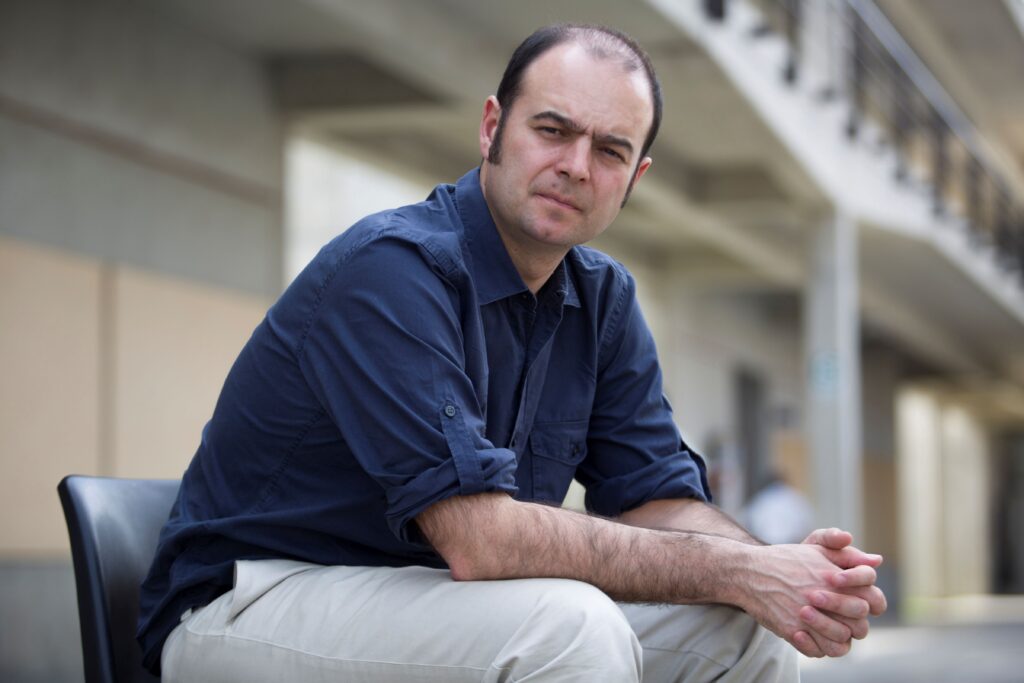
Javier Garcia-German
Design Critic in Architecture
Visiting Faculty
Gund 329
Professor Javier García-Germán is co-founder and principal of TAAs —totem arquitectos asociados— an award-winning practice based in Madrid which taps on the architectural opportunities embedded in this era of climate change. Its practice critically engages climatic adaptation through the use of core typological, spatial and material strategies, to provide pleasurable and intense atmospheres for everyday life. Climatic adaptation is complemented with an interest into the material flows involved in construction, understanding that material ecologies and the connected building tectonics need to be carefully designed.
TAAs has lately finished an office building and a 159-unit collective housing scheme in Madrid. It has recently won two competitions, one to build a music school in Badajoz and another to renovate a school in Madrid, and has been awarded second prize in a competition to design a 230-unit housing scheme in Valencia. In addition TAAs is devoloping the urban plan for an ecological suburban community for 700 dwellings in Cáceres.
TAAs’ work has been recently included in exhibitions such as DIAGRAMS, a project conceived by AMO/OMA for the Fondazione Prada in Venice, or HABITAR ESPAÑA, curated by Fernanda Canales for Casa de Arquitectura in Madrid. TAAs has been awarded Prize Winner for BAP! 2025, Biennale d’Architecture et de Paysage D’Ile de France, 4°C ENTRE TOI ET MOI co-curated by Philippe Rahm, Château de Versailles (France).
In parallel to the work unfolded in practice, Javier García-Germán has been a committed educator. He is Tenured Professor of Architectural Design at the Madrid School of Architecture (ETSAM), where he teaches since 2007. In addition he is Climate, Metabolism and Architecture director both in the Master in Collective Housing (MCH, ETH Zürich-UPM), and in the Master in Advanced Ecological Buildings Biocities (MAEBB, IAAC, Barcelona). He was Ruth & Norman Moore Visiting Professor in Washington University in St. Louis in 2023.
During the last years Javier García-Germán has lectured extensively including the following international institutions: Harvard Design School of Architecture (Cambridge, MA), Rice University School of Architecture (Houston, TX), City College New York (NY), Texas Tech University College of Architeture (Lubbock, TX), Syracuse University School of Architecture (Syracuse, NY), Sam Fox School of Design and Visual Arts (St. Louis, MO), Tongji University (Shanghai, China), Casa de Arquitectura (Querétaro, México), Tecnológico de Monterrey (Monterrey, México), Pontificia Universidad Católica del Perú (Lima, Perú), Universidad Torcuato di Tella (Buenos Aires, Argentina), CCEBA (Buenos Aires, Argentina).
Javier García-Germán has authored several articles in international periodicals (Quaderns, Bauwelt, 2G, etc.) and edited and authored several books on energy and architecture, among others Thermodynamic Interactions. An Architectural Exploration into Physiological, Material and Territorial Atmospheres (2017, ACTAR) —which has received both the Pensamiento y Crítica FAD Award 2018 and the XIII BEAU Spanish Architecture and Urbanism Biennial awards—, De lo Mecánico a lo Termodinámico (2010, Gustavo Gili) and Contextos 2008. Hacia un Nuevo Entorno Energético (2008, UCJC).
Javier García-Germán is currently the co-director of the magazine ARQUITECTURA. Edited by Colegio Oficial de Arquitectos de Madrid and with over 100 years of history, it was the first architectural review to be published in Spanish language. Recently published issues include territory, climate and inclusion which have been co-edited respectively with Stan Allen and Luis Rojo, Chris Reed and Pablo Pérez-Ramos, and Tatjana Schneider and Enrique Espinosa. Forthcoming ones include issues on body and beauty which will be co-edited respetively by Beatriz Colomina and Marina Otero, and by Philip Ursprung and Jesus Vassallo.
Javier García-Germán (1974) studied architecture at the ETSAM (Honors, Premio Extraordinario Fin de Carrera 2002), the Oxford School of Architecture and the Harvard University Graduate School of Design (Master in Design Studies 2004), where he was Fulbright Scholar. He received his Ph.D. in architecture —Thermodynamic Environments. A Critical Cartography on Energy, Architecture and Atmosphere— in ETSAM (2014).