Why Big Tech Real Estate Decisions Matter
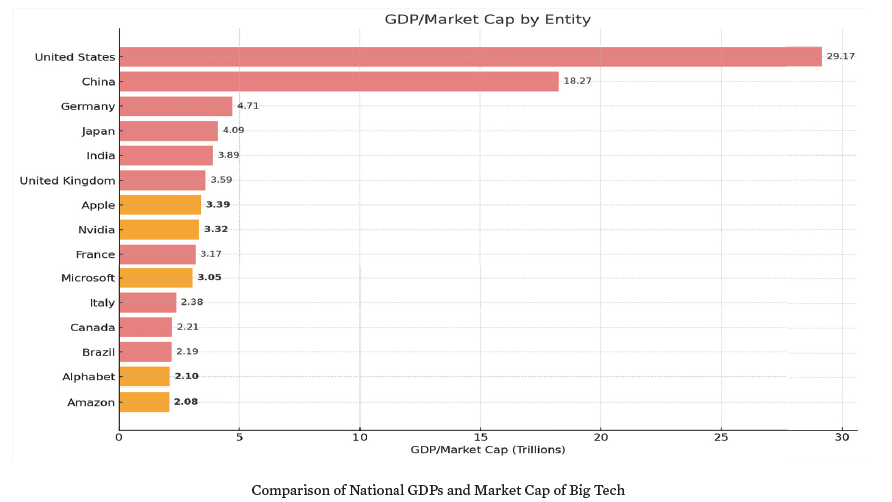
Big Tech companies—Amazon, Google, and Meta—are no longer just tech innovators; they are economic titans, weaving themselves into the very fabric of modern urban life. Their financial power is staggering, with market values that surpass the GDPs of entire nations. Consider Amazon: its market cap, towering at over $1.3 trillion, outstrips the economy of Mexico. Apple, meanwhile, is so vast that it eclipses the economic output of some continents.1 Yet these numbers tell only part of the story. Beneath the surface lies a quieter, equally transformative narrative—how these companies shape the places we live and work.
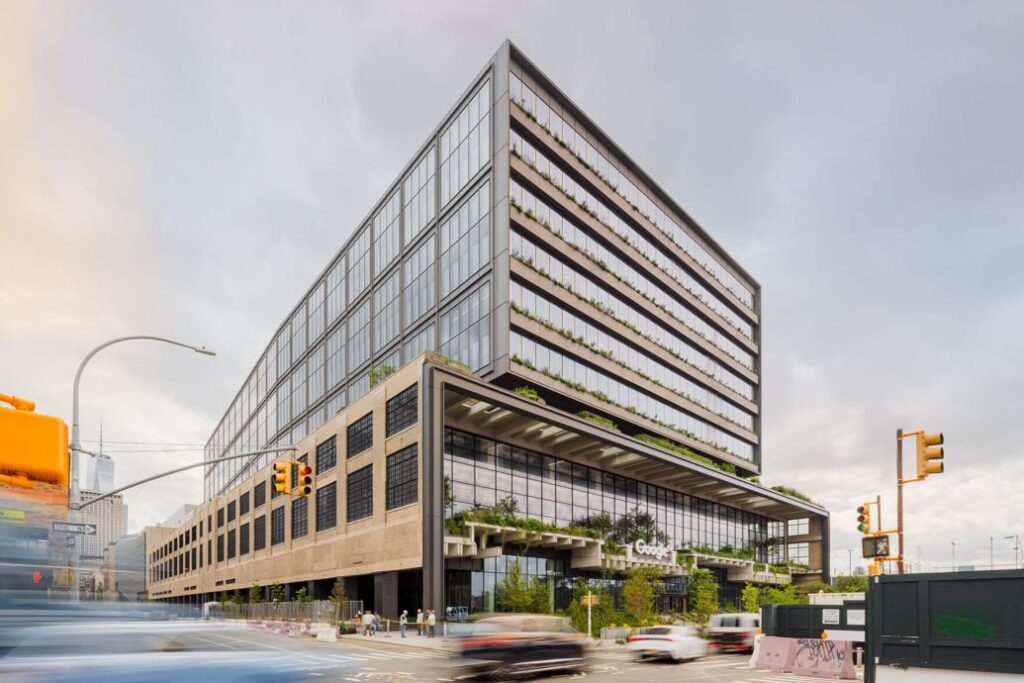
Over the past decade, Big Tech has fueled nearly a fifth of global leasing activity, but their influence stretches far beyond square footage.2 When Google purchased 111 Eighth Avenue in New York City for $1.8 billion in 2010, it wasn’t just a transaction—it was a declaration.3 This move anchored Google in the heart of Manhattan and signaled Chelsea’s transformation into a burgeoning tech hub. The purchase sent ripples through real estate markets, redefined the neighborhood’s character, and highlighted a broader truth: the tech industry has become a driving force behind urban evolution.
In San Jose, Google’s Downtown West project offers a vision of what these transformations can look like. The project promises to turn the city center into a dynamic, tech-driven urban core, complete with tens of thousands of jobs and a thoughtfully woven mix of residential and commercial spaces.4 Yet, the narrative here is not without tension. Projects like Downtown West embody a delicate balance—bringing prosperity to one group while stirring fears of displacement among another.
Amazon’s HQ2 in Arlington, Virginia, tells a similar story but with sharper contrasts. Announced with much fanfare, the project redefined the city’s real estate landscape almost overnight.5 Property prices soared, development surged, and local governments reveled in the promise of economic growth. But as Arlington’s skyline grew, so did concerns about housing affordability and community displacement.
These stories reveal the dual-edged impact of Big Tech’s real estate decisions. On one side, they offer cities a lifeline—a chance to thrive in a competitive global economy. On the other, they force communities to grapple with difficult questions: Who benefits from this growth? Who is left behind? These questions linger in the streets of Chelsea, the corridors of San Jose’s city hall, and the neighborhoods of Arlington.
How Big Tech Real Estate Decisions Are Made
Real estate decisions by Big Tech companies are anything but routine. These choices are blueprints for the future, influencing the flow of talent, the vitality of neighborhoods, and even the identity of entire cities. For these technology titans, selecting a location is not just about finding a physical space—it’s about crafting an ecosystem that aligns with their vision, values, and long-term strategies. These decisions are multifaceted, involving an intricate balance of economic considerations, workforce priorities, infrastructure needs, and community engagement. Each project, from Amazon’s HQ26 to Google’s Downtown West, tells a story.
Key Location Decision Factors
1. Economic Considerations
At the core of every location decision lies the promise of economic transformation. For Big Tech, selecting a location is rarely just about square footage—it’s about unlocking opportunities that align with their long-term ambitions. Tax incentives, subsidies, and land costs often tip the scales in favor of one city over another, driving fierce competition among governments eager to attract these corporate powerhouses. Amazon’s HQ2 search exemplifies this phenomenon. Cities across the United States launched an unprecedented bidding war, each hoping to host the tech giant’s ambitious expansion. Ultimately, Virginia triumphed by offering performance-based incentives worth $573 million and committing to infrastructure improvements that underscored the state’s readiness for innovation.7 Arlington’s proximity to the nation’s capital and its burgeoning tech ecosystem further cemented its appeal.
Yet the allure of tax breaks and subsidies is just one side of the equation. Real estate costs play an equally decisive role. While Silicon Valley continues to symbolize the zenith of tech innovation, escalating costs are prompting companies like Google and Apple to explore more affordable markets such as Austin, Texas. Here, a unique blend of reasonable land prices and an emerging tech culture offers fertile ground for expansion. However, the arrival of Big Tech often triggers unintended consequences. In cities like Seattle and San Francisco, the rapid rise of property values following tech expansions has exacerbated housing affordability crises and fueled displacement.8 This dual-edged impact illustrates the tension between growth and equity, a challenge cities must navigate as they vie for tech investment.
2. Workforce Considerations
Talent is the heartbeat of Big Tech, making workforce availability the lifeblood of their decision-making. These companies don’t just look for spaces to work—they seek environments that can sustain a perpetual flow of innovation. Silicon Valley, for instance, owes much of its magnetic appeal to institutions like Stanford and UC Berkeley, which churn out the engineers, programmers, and designers who fuel tech’s relentless progress.9 Google’s sprawling Mountain View headquarters and Apple’s state-of-the-art Cupertino campus are testaments to the importance of proximity to such talent pipelines.
But talent today demands more than a job—it demands a lifestyle. Big Tech campuses have evolved into ecosystems designed to attract and retain top-tier professionals. Apple Park, often called “the spaceship,” goes beyond functionality to inspire. Its green spaces, wellness centers, and environmentally conscious design reflect a deeper commitment to the values of its workforce. These workplaces are not just built for productivity; they are statements of identity, blurring the line between corporate strategy and cultural expression.
3. Infrastructure and Connectivity
Big Tech thrives in places where connections—both physical and digital—are seamless. Access to robust transportation networks, reliable energy grids, and cuttingedge digital infrastructure are non-negotiables. Amazon’s choice of Arlington for HQ2 underscores this priority. Proximity to Ronald Reagan Washington National Airport offered the convenience of global mobility, a crucial consideration for a company with a far-reaching workforce.
Public transit, too, plays a decisive role. Google’s Downtown West project in San Jose is a striking example of transit-oriented development. Designed to reduce car dependency, it prioritizes sustainability and accessibility, proving that innovation isn’t confined to technology—it extends to how we move. Similarly, Facebook’s Menlo Park campus incorporates bicycle-friendly infrastructure and improved public transport links, creating an integrated network for employees and the community alike. Equally vital is digital infrastructure. For tech companies, locations like Ashburn, Virginia—known as “Data Center Alley”—are gold mines. With unparalleled bandwidth and stable energy grids, these hubs serve as the backbone for data-heavy operations, ensuring that the gears of global tech dominance keep turning.10
4. Regulatory, Environmental, and Community Dynamics
Navigating the intricate web of regulations, environmental considerations, and community dynamics is a complex endeavor for Big Tech companies. These factors significantly influence real estate decisions, often dictating the feasibility and success of large-scale projects. Local zoning laws and building codes can either facilitate or hinder development. In San Francisco, for instance, stringent zoning regulations have posed challenges for tech expansions, prompting companies to explore suburban areas with more flexible policies. Google’s Downtown West project in San Jose exemplifies this, requiring extensive negotiations with local authorities to align corporate ambitions with community needs.
Environmental sustainability has become a cornerstone of Big Tech’s real estate strategies. Apple Park in Cupertino, California, is a prime example, operating entirely on renewable energy and incorporating green building practices. Such initiatives not only reflect corporate values but also respond to increasing regulatory incentives for environmentally friendly developments.11
Community engagement is equally crucial. Amazon’s HQ2 project in Arlington, Virginia, faced significant local opposition due to concerns over gentrification and housing affordability, ultimately leading to its cancellation. This underscores the importance of securing community support and addressing local concerns in the planning stages. In contrast, Google’s redevelopment of Chelsea Market in New York City demonstrates a more harmonious integration with the existing community, revitalizing the neighborhood while preserving its cultural identity.
Decision-Making in the Post-Pandemic World
The pandemic was a seismic event that upended traditional notions of office spaces, pushing Big Tech to reimagine the role of real estate in a rapidly changing world. No longer is sheer square footage the defining metric of success. Instead, flexibility, well-being, and purpose have emerged as the guiding principles of post-pandemic real estate strategies. The shift is evident in the growing preference for Class A properties, which boast advanced infrastructure, modern amenities, and sustainable features designed to foster creativity and collaboration.12
Big Tech campuses are increasingly being conceived as environments that inspire and support a hybrid workforce. These spaces balance the practicalities of productivity with the need to attract and retain top-tier talent.For instance, Microsoft’s updated campus in Redmond, Washington, integrates outdoor meeting spaces, green roofs, and state-of-the art technology to meet evolving workplace needs while promoting employee wellness.13 Similarly,Google’s commitment to high-quality office environments is reflected in its acquisition of St. John’s Terminal in Manhattan, a $2.1billion investment in a sustainable, future-ready campus.14
The pandemic also reshaped lease dynamics. Uncertainty in the economic landscape has made flexibility a critical requirement for occupiers. Companies are now demanding shorter lease terms, scalability options, and access to shared workspaces that can adapt to fluctuating needs. WeWork’s resurgence in the flexible office market highlights the growing demand for agile solutions, especially among Big Tech clients navigating hybrid work models.15
Furthermore, the digital revolution accelerated by the pandemic has influenced how companies approach real estate. The rise of remote and hybrid work models has challenged tech giants to rethink not only where work happens but how it happens. As physical and virtual spaces blend, investments in technology enabled environments—such as smart buildings equipped with IoT (Internet of Things) capabilities—are becoming a priority. This shift signals the broader evolution of workplaces into ecosystems of innovation, well-being, and adaptability. The post-pandemic world has redefined the parameters of success in real estate for Big Tech. Offices are no longer static assets; they are dynamic hubs that must respond to the demands of a workforce seeking flexibility, purpose, and inspiration. In this new paradigm, the emphasis on quality, adaptability, and employee-centric design will continue to shape the future of Big Tech’s real estate footprint.
Rethinking Workspaces through Sustainability in Big Tech
What makes a workplace truly sustainable? Is it just about minimizing energy consumption, or does it also reflect a company’s commitment to innovation, employee well-being, and long-term environmental goals? Businesses today increasingly recognize that their impact extends beyond products and services.16 Sustainability has become more than just a buzzword—it’s a lens through which companies evaluate their operations, and office design is at the heart of this transformation.17
Modern workplaces are no longer mere backdrops for productivity; they shape behavior, influence health, and act as physical embodiments of corporate values. For big tech firms like Google, Amazon, and Microsoft, sustainable offices are not only essential platforms for innovation but also benchmarks for the future of work environments.

Big Tech’s Path to Sustainable Workspaces
What does sustainability in office design truly entail, and why is it so vital? Big tech firms are answering this question by designing workspaces that integrate energy efficiency, renewable materials, biophilic design, and smart technologies.18 These initiatives not only reduce environmental footprints but also create spaces that inspire employees and redefine the possibilities of sustainable design.
Energy efficiency is at the forefront of these efforts. Google’s Bay View campus utilizes solar panels to generate clean energy, significantly reducing reliance on fossil fuels.19 Apple Park relies on an innovative natural ventilation system, enabling the building to remain functional without traditional HVAC systems for up to three-quarters of the year.20 Meanwhile, Microsoft’s AI-powered systems optimize heating, cooling, and lighting based on real-time occupancy and weather patterns.21 Can such forward-thinking solutions become the gold standard for offices everywhere?
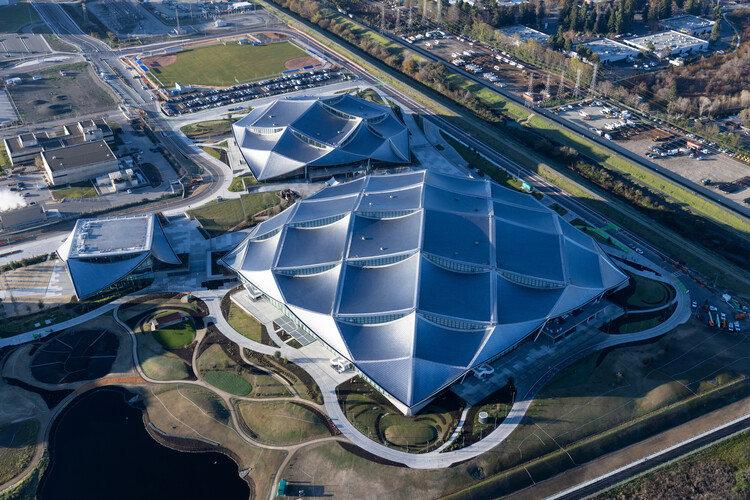
The use of renewable and recycled materials further elevates sustainability in these spaces. Amazon’s HQ2 and The Spheres feature cross-laminated timber to cut embodied carbon, while reclaimed wood, recycled steel, and eco-friendly interiors showcase a commitment to resource efficiency. Imagine walking into an office where every desk, chair, and wall embodies a story of environmental care—these designs make that vision a reality.
Nature plays a transformative role in these workplaces. Amazon’s Spheres houses over 40,000 plants, creating a vibrant indoor ecosystem that enhances employee well-being.22 At Apple Park, rooftop gardens and living walls not only beautify the space but also improve air quality and provide natural insulation.23
Water conservation is another pillar of big tech’s sustainability efforts. Google’s greywater recycling and rainwater harvesting systems aim to replenish 120% of the water consumed by 2030.24 Advanced low-flow fixtures and drought-resistant landscaping further reduce water usage, offering scalable solutions to address global water scarcity.
Finally, smart building technologies bring sustainability to life. IoT-enabled systems in offices like those of Microsoft and Google monitor energy, water, and waste in real time, enabling dynamic adjustments for maximum efficiency. Automated lighting, shading, and climate control ensure resources are used only when needed, turning these buildings into active contributors to sustainability.25
By adopting these strategies, big tech firms are setting a powerful example of how workplaces can be both sustainable and inspiring. Their innovations challenge industries to rethink traditional practices and explore the full potential of sustainable design.
The Value of Sustainability: Brand, Finances, and People
What makes a workplace truly invaluable? Sustainability in office design offers a triple advantage – enhancing brand reputation, reducing costs, and transforming employee experiences. Certifications like LEED (Leadership in Energy and Environmental Design) are not just badges of honor—they’re statements of purpose.26 For companies like Google and Amazon, earning LEED certification showcases their dedication to sustainability, boosting visibility and cementing their status as industry leaders. The financial advantages are just as compelling. Eco-friendly offices cut energy and water bills. LED lighting is far more energyefficient than conventional bulbs, requiring substantially less electricity to operate. Motion sensors turn off lights in empty rooms. Low-flow faucets and toilets reduce water waste. Take Apple Park, where natural ventilation drastically reduces the need for mechanical cooling and heating. This shows how an initial investment in green infrastructure can translate into long-term savings.
But the benefits don’t stop at finances—they extend to the very people who power these companies. What makes employees thrive in their workspaces? The answer lies in abundant natural light, low-emission materials, and biophilic design elements that foster a healthier, happier environment.27 Google’s Cambridge campus is a living example, where lush indoor greenery and thoughtfully designed layouts inspire creativity, focus, and satisfaction.
Sustainable office design doesn’t just balance environmental goals with business needs—it elevates both. By aligning brand identity, financial efficiency, and employee wellbeing, these spaces redefine what it means to work in a world where success and sustainability go hand in hand.
Navigating the Challenges of Sustainable Office Design
While the benefits of sustainable office design are undeniable, achieving them is no easy feat. High upfront costs often pose a significant challenge, as advanced technologies like renewable energy systems, smart building solutions, and biophilic design elements require substantial investment. For instance, installing solar panels or implementing greywater recycling systems demands considerable financial commitment, even though they promise long-term savings.28
Sourcing sustainable materials like recycled steel or cross-laminated timber adds further complexity, particularly in regions where such resources are less accessible. These challenges highlight the need for careful financial planning and a commitment to long-term sustainability over short-term savings.29
Maintenance and management present additional hurdles. Smart building technologies, such as IoT-enabled resource monitoring and AI-powered energy management, require ongoing technical expertise and regular optimization, which can increase operational costs. Older buildings add another layer of difficulty, as retrofitting them to meet modern sustainability standards is often more expensive and complicated than designing new ones from scratch.30
Regulatory inconsistencies further complicate matters. Sustainability standards and policies vary widely across regions, making it difficult for companies to implement globally consistent designs. Navigating these rules demands strategic foresight and adaptability, particularly for firms operating on an international scale.
Despite these complexities, big tech firms continue to lead the charge, demonstrating that innovation and perseverance can overcome even the toughest barriers. By addressing these challenges head-on, they not only set an example but also inspire other industries to follow suit, proving that sustainable office design is achievable with determination and ingenuity.
Future Trends in Sustainable Office Design
The future of sustainable office design in big tech is focused on achieving net-zero carbon campuses and integrating advanced technologies to optimize environmental performance. Companies are increasingly aiming for buildings that generate as much energy as they consume, leveraging renewable energy sources, efficient storage systems, and innovative building materials.31 Circular economy principles are also gaining traction, with an emphasis on using materials that can be endlessly recycled or repurposed, minimizing waste during construction and operations. Additionally, AI-driven sustainability is set to revolutionize office management, enabling real-time optimization of energy use, water conservation, and waste reduction through predictive analytics and smart systems. These advancements not only align with stricter environmental regulations but also reinforce big tech firms’ positions as leaders in global sustainability efforts.
Closing Reflections: Leading the Charge Toward a Sustainable Future
Big tech firms are redefining what it means to lead—showing the world that environmental responsibility, innovation, and business success are not only compatible but mutually reinforcing. Their sustainable office designs go beyond reducing carbon footprints; they serve as living testaments to the power of forward-thinking practices. By embracing energy efficiency, water conservation, renewable materials, and employee-centered design, these companies are shaping workplaces that inspire and innovate while setting new global benchmarks for corporate responsibility.
The ripple effects of these efforts stretch far beyond company walls. They influence urban sustainability, contribute to climate change mitigation, and demonstrate the potential of workplaces as catalysts for environmental transformation. As stricter environmental standards become the norm, big tech firms have paved a path that other industries must follow. The message is clear: sustainability isn’t just a choice – it’s a necessity for a thriving planet and economy.
In this pivotal moment, the challenge for industries is to match ambition with action. By scaling these innovations across sectors, we can create a future where environmental care and economic prosperity coexist, driving meaningful change for society and the planet. Big tech has shown what’s possible; now, it’s time for the rest of the world to step up.
The Evolution of Design in Office Spaces
The origin of office spaces can date back centuries, to the time of the ancient Romans gathering in buildings like the Pantheon or to the first Latin term, officium. An early example of an office space is the East India House, built in 1729 as the “HQ from which the East India Company administered its Indian interests”. Jumping forward a couple of centuries, the concept of modern offices emerged in the 20th century, “linking finance and work efficiency”. Inventions such as electric lighting, typewriters, and telephones greatly influenced office space designs, shaping ideal floorplans. The office skyscraper was born out of economic factors, including land prices, productivity demands, steel frame structures, and the invention of elevators.32
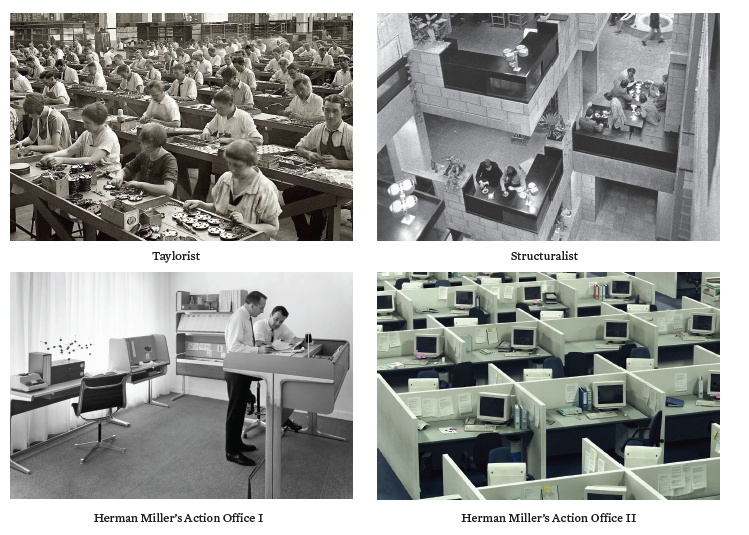
The early 1900s marked the beginning of the efficiency movement led by Frederick Winslow Taylor, introducing the Taylorist office design, which implemented a streamlined task system resembling a factory assembly line.33 In 1916, the zoning ordinance significantly impacted office spaces, particularly in New York City. In Form Follows Finance: Skyscrapers and Skylines in New York and Chicago, Carol Willis compiled a rule book of philosophies connecting office spaces to design and real estate. The zoning ordinance, initiated on July 25, 1916, established a new set of rules that reshaped the real estate landscape. Since the zoning envelope restricted building height and bulk, architects found creative ways to address “public safety, fresh air circulation, permanent shadow, and fire safety”.34
By the 1950s, office designs shifted toward more open floor plans. With the widespread use of advanced air-conditioning and fluorescent lighting, high-rise buildings became less reliant on natural light or ventilation through opening windows. An example of this trend was the Chase Manhattan Bank, completed in 1961. World War II not only plunged the world into a global crisis but also catalyzed a revolution in office design with the introduction of Bürolandschaft. Meaning “office landscape,” Bürolandschaft emerged from an egalitarian management approach that allowed staff of multiple levels to work together, improving collaboration and communication in the office environment. While well-received in parts of Europe, the Bürolandschaft design plan was largely ignored globally.35
The 1960s saw the introduction of Herman Miller’s Action Office, a concept of flexible office spaces with modular furniture to promote adaptability, “built on the post-war European Modernist principles”.36 Additionally, the growing influx of women into the workforce spurred significant changes. Herman Miller’s Action Office II emphasized privacy and personalization in workspaces, leading to a concept called “back-up”.37 Around the same time, Herman Herzberger introduced the structuralist office, which envisioned a “building housing several smaller buildings.” An example is the Centraal Beheer insurance building in Apeldoorn, Holland, featuring a labyrinth-like design of sixty tower-like cubes connected by overpasses on each floor. This layout encouraged smaller, familiar groups to work together in a relaxed environment.38 However, it proved ineffective for larger group gatherings, promoting collaboration only in smaller settings.39
The 1980s marked the rise of the infamous cubicle, which dominated the office industry for decades. Through Herman Miller’s Action Office II plan, cubicles were rebranded as a cheaper workplace solution. Financial incentives also fueled their adoption, as the treasury classified office furniture, including cubicles, as depreciable assets, allowing companies to “depreciate their furniture in seven years, while permanent structures like actual walls are given a 39.5-year rate”.40 This shift reflected a focus on profitability over employee well-being, as cubicles symbolized an approach prioritizing efficiency over workers’ needs.41
With the advent of the internet, offices began transitioning into the virtual world.42 Cubicles transformed into calling booths, individual desks became meeting rooms equipped with large screens for video conferencing, and there was a push for interdisciplinary collaboration. The global financial crisis and the COVID-19 pandemic brought significant shifts in the demand for office spaces. These evolving demands have influenced office space design, particularly in operational needs and layout preferences. Today’s office spaces, shaped by years of evolution and change, emphasize intentionality and adaptability.
Designing for a Community: Big Tech
When thinking about unique examples of office spaces, big tech firms often come to mind. In the Architectural Digest article “You Won’t Believe Work Gets Done at These Three Google Offices,” Katherine McLaughlin dives deep into Google’s intentional design expression decisions and employee lifestyle drivers. Google’s philosophy on user-driven product delivery has carried over into their conception of the built environment. Elements like the “jungle-gym,” which Google offices are known for, become as integral as a desk or a filing cabinet due to their ability to help employees disconnect and reconnect with their work. Some major architectural factors that define the majority of Google’s office spaces are “high ceilings, double-height space, access to daylight, long spans between columns, and exposed structure”. These components are integrated within three core strategic spaces: “those designed for deep focus work, for collaboration and meetings, and to build community and spark innovation”.43
Some offices take this a step further by creating “neighborhoods” within the space to foster a sense of comfort for employees. Pier 57, Google’s New York City office, has large windows with views of the Hudson River, cafés for informal gatherings, and nooks to “ignite curiosity”.44 Additionally, Google’s office in Cambridge sits in Kendall Square, the hub of research and development in the northeastern United States. The multi-building campus creates a network of infill development, public gardens, and interior lounge spaces for employees. The concept behind it is derived from the MBTA subway the building sits on top of: “assigning one colored subway line to each structure, every floor is inspired and guided by the geography and culture of its stops”.45
Another contributor in the world of extraordinary office spaces is Facebook’s new office, designed by Frank Gehry. Facebook brings its futuristic approach to its new office space by bridging the urban environment with its interiors. Special features include “two cafés, a burrito bar, a pizza window, a sit-down restaurant, a coffee shop, and several different kitchens”. Spanning 430,000 square feet, the office expresses the largest open-concept floor plan, “with Mark Zuckerberg himself sitting at one of the plain white desks that dot the floor”.46 This collaborative approach communicates the transparent and open culture of the company. Some other quirky additions to the list of creative design solutions are the headquarters of Tinder in West Hollywood, Los Angeles, and Shopify in Berlin. Through its design expression, Tinder conveys its core value: “building connections between people”47. Every floor is designed with a unique concept, with meeting rooms resembling libraries and art galleries. Not only do the spaces define physical boundaries, but they also categorize the level of interaction people will have based on their comfort levels.48
Shopify has taken a different approach, being at the forefront of design post the COVID-19 pandemic. The company developed an interior that, rather than targeting individual work, gives people what they can’t get at home: a base for collaboration and brainstorming fully reflective of company culture. Collaboration is emphasized through “experience rooms” with “color lounges,” or vibrant zones specifically intended for free-flowing conversations Encouraging workers to return to headquarters has been a challenge for many companies. One solution has been to introduce “domestic-inspired” features to the office, resembling homelike, cozy spaces.49
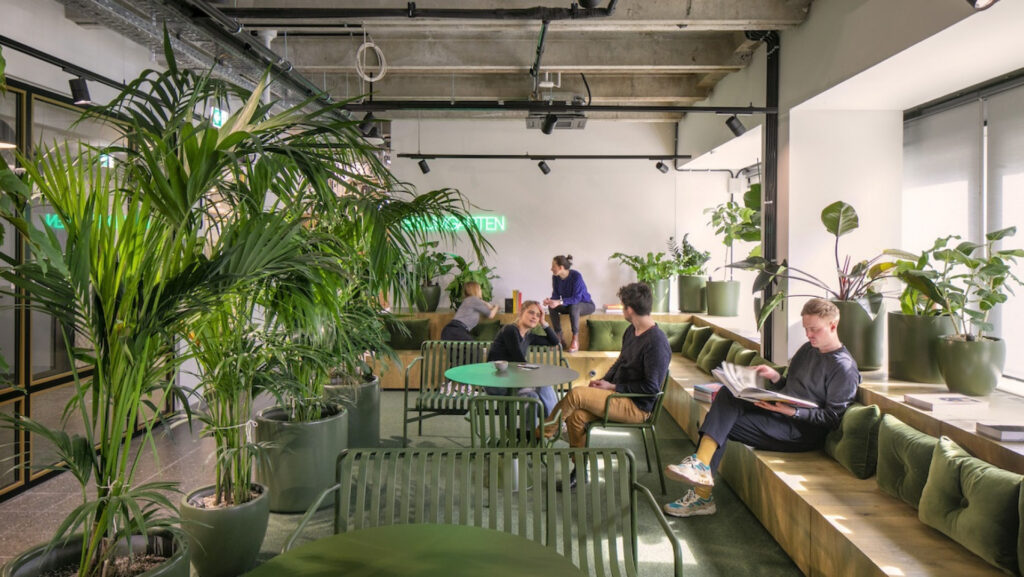
Along with the adapting conditions of the world, office design continues to evolve, creating unique spaces to increase employee productivity and satisfaction.
Interview Insights
Learning from Leaders in Real Estate, Design, and Sustainability
Interview 1: Mr. John T. Moran Director of Real Estate—Americas at Google
Question 1: How can real estate decisions balance short-term and long-term needs?
“COVID reshaped workforce preferences, making long-term predictions difficult. Flexibility became key, with companies adopting premium flexible leases, phased build-outs, and adaptable strategies to align decisions with market trends. Balancing requires confidence in forecasts and incremental space design to avoid overcommitment”.
Question 2: Will large tech companies pause campus investments due to hybrid work?
“Hybrid work has improved efficiency but hasn’t reduced the value of campus hubs. Companies focus on strategic markets, maintaining critical hubs in talent-rich regions. Flexibility allows adjustments, but vibrant hubs remain essential for collaboration and aligning with business needs”.
Question 3: Will remote and hybrid work shift tech campuses from suburban to urban areas?
“Urban locations dominate due to better accessibility and infrastructure. While suburban areas offer cost benefits, city centers connect with local economies and communities. Globally, regions like India may diverge slightly, but urban campuses remain preferred to meet workforce needs”.
Question 4: How are productivity and design linked, and how do amenities encourage office returns?
“Productivity relies on flexible spaces, advanced meeting rooms, and tools tailored to team needs. Amenities, like quality meals and event spaces, attract employees by enhancing collaboration and fostering team bonding. Data on attendance and space usage guides efficient resource allocation”.
Question 5: What is Google’s main focus in designing office spaces—innovation or employee experience?
“Google prioritizes enabling productivity, community, and cultural connection through functional, inclusive, and locally inspired designs. Innovation focuses on energy efficiency and advanced property management using Google Cloud. Balancing functionality and local identity is central to their strategy”.
Interview 2: Mr. David Briefel, LEED AP ID+C, BD+C Sustainability Director and Principal, Gensler—New York Office
Question 1: What are the latest trends in sustainable office design, and how is Gensler integrating them into their current practices?
“Key trends include focusing on materiality to minimize carbon emissions through low-carbon material selection, such as flooring and sealing materials. Additionally, circularity is gaining traction, where companies take back materials into their supply chain for refurbishment or reconstitution. On the softer side, biophilic design—integrating natural elements into workspaces—is also increasingly popular”.
Question 2: Is sustainability in office design for big tech spaces driven primarily by environmental responsibility, or do factors like brand image and employee well-being equally shape the approach?
“Certifications play a significant role, as they provide a framework and public validation for sustainability efforts. Big tech companies with strong internal sustainability teams may create bespoke frameworks, but most rely on certifications. Employee well-being is equally important, as metrics show improved productivity. However, well-being is often a subset of sustainability—addressing climate issues ultimately improves health and well-being at a broader scale”.
Interview 3: Erik Barth, AIA, LEED AP, WELL AP, CDT, CPHC Project Architect and Senior Associate, Gensler—Boston Office
Question 1: With Boston facing a high percentage of unleased office spaces, how can sustainability and high-performing, human-centric designs help attract tenants and encourage in-office work?
“Boston’s office market is shifting to retrofits and adaptive reuse, with new spaces needing to be highly sustainable and human-centric. Designing for comfort, wellness, and specific tenant needs, like tech companies, can attract leases and encourage in-office work, addressing the challenge of high vacancy rates”.
Question 2: What role do you see technology playing in the future of sustainability, and how might AI contribute to this shift?
“Technology is crucial for sustainability, particularly in areas like building operations, energy efficiency, and material decarbonization. Advanced building management systems can optimize energy use, while analytical tools help assess and retrofit existing buildings, such as measuring performance or facilitating office-to-residential conversions. Decarbonizing materials like steel and concrete is another area where innovation is key. Renewable energy advancements, like more efficient solar panels, are also critical. While AI may aid in specific tasks, like analyzing floor plates for conversions, technology overall will continue to enable new approaches and reshape the sustainability landscape”.
Bibliography
- Allamano, Cara Brennan. “What the Workplace Needs Right Now: A Paradigm Shift in Thinking around Wellbeing and Sustainability.” Forbes, April 24, 2023. https://www.forbes.com/sites/carabrennanallamano/2023/04/24/what-the-workplace-needs-right-nowa-paradigm-shift-in-thinking-aboutwellbeing-and-sustainability/
- “Amazon’s HQ2 Aimed to Show Tech Can Boost Cities. Now It’s on Pause.” Wired, April 2023. https://www.wired.com
- Bagli, Charles V. “Google Buys Big Building in New York.” The New York Times, December 23, 2010. https://www.nytimes.com./
- Bay, Cody. “Powering Microsoft Smart Buildings with Microsoft Azure Digital Twins.” Inside Track Blog, June 27, 2023. https://www.microsoft.com/insidetrack/blog/powering-microsoft-smart-buildingswith-microsoft-azure-digital-twins/
- Bliss, Laura. “How Big Tech’s Real Estate Boom Affects Housing.” Bloomberg CityLab, May 2021. https://www.bloomberg.com/citylab.
- “Big Tech Is Leading Workplace Design Innovation. See These 5 New-Age Offices.” Frameweb. Accessed November 26, 2024. https://frameweb.com/article/work/big-tech-is-leading-workplace-designinnovation-see-these-5-new-age-offices
- Chen, Stefanos. “Google Buys St. John’s Terminal for $2.1 Billion in Manhattan.” The New York Times, September 21, 2021. https://www.nytimes.com./
- “Centraal Beheer Offices, Apeldoorn.” AHH. Accessed November 26, 2024. https://www.ahh.nl/index.php/en/projects2/12-utiliteitsbouw/85-centraalbeheer-offices-apeldoorn
- Drake Baer. “A Brief History of How the Cubicle Took Over Offices Everywhere.” Business Insider, April 14, 2017. https://www.businessinsider.com/a-brief-historyof-how-the-cubicle-2014-4
- “Downtown West Development.” Real Estate with Google, November 2024. https://realestate.withgoogle.com./
- Frommer, Dan. “Apple Says Its New Office Is the ‘World’s Largest Naturally Ventilated Building.’” Vox, February 22, 2017. https://www.vox.com/2017/2/22/14696882/applepark-ventilation
- “Here’s What Makes Facebook’s HQ Design and Workplace So Attractive.” OfficeSpace Software, April 21, 2016. https:// https://www.officespacesoftware.com/blog/heres-what-makes-facebooks-hq-designand-workplace-so-attractive/
- Jim Tankersley and Ben Casselman. “Amazon Names Locations for New Headquarters.” The New York Times, November 13, 2018. https://www.nytimes.com./
- Kelly McLaughlin. “You Won’t Believe Work Gets Done at These Three Google Offices.” Architectural Digest, December 7, 2022. https://www.architecturaldigest.com/story/inside-google-offices
- Kushida, Kenji. “Silicon Valley and the Talent Ecosystem.” Stanford Research Papers, January 2024.
- Levy, Nat. “Microsoft’s Redmond Campus Reimagined for Post-Pandemic Work.” GeekWire, March 2023. https://www.geekwire.com./
- Michael Woolridge. “Ashburn’s Data Center Boom.” Tech Infrastructure Quarterly, November 2021.
- Murphy, Patrick. “Sustainable Architecture: An Overview of Challenges and Limitations.” Maket, n.d. https://www.maket.ai/post/sustainable-architecture-anoverview-of-challenges-and-limitations
- Parsi, Ramin. “Is LEED Certification Worth It?” ProENGC, September 26, 2023. https://www.proengc.com/blog/is-leedcertification-worth-it/
- Priest, Isabelle. “Google HQ Takes a Lead on Environmental Responsibility.” RIBAJ, July 22, 2022. https://www.ribaj.com/buildings/heatherwick-studio-big-googlehq-bay-view-california-united-statessustainable-workplace-campus-sustainablepv-canopy-geothermal
- Rafi, Talal. “Why Sustainability Is Crucial for Corporate Strategy.” World Economic Forum, June 9, 2022. https://www.weforum.org/stories/2022/06/why-sustainability-iscrucial-for-corporate-strategy/.
- Rogers, Robin. “Solaripedia | Green Architecture & Building | Projects in Green Architecture & Building.” Solaripedia, March 28, 2020. https://www.solaripedia.com/13/454/6995/amazon_spheres_construction.html.
- Searer, Steven. “Google Offices – Cambridge.” Office Snapshots, September 12, 2016. https://officesnapshots.com/2016/09/12/google-officescambridge/.
- Silverstein, Ken. “Is Sustainability More than a Corporate Buzzword?” Forbes, May 1, 2024. https://www.forbes.com/sites/kensilverstein/2024/05/01/is-sustainabilitymore-than-a-corporate-buzzword/
- Smeenk, Sebastian. “Sustainable Office Spaces: Shaping the Future of Modern Work Environments.” Edge Workspaces, August 30, 2024. https://www.edgeworkspaces.com/sustainable-office-spacesshaping-the-future-of-modern-workenvironments/#elementor-toc__headinganchor-4
- Teo. “Amazon HQ2 and Its Impact on Arlington.” The Washington Post, 2024. https://www.washingtonpost.com
- “The Evolution of Office Design.” Morgan Lovell. Accessed November 26, 2024. https://www.morganlovell.co.uk/insights/evolution-of-office-design.
- “Tinder Headquarters | Rapt Studio.” Rapt Studio, 2020. https://raptstudio.com/work/tinder-headquarters/
- Vargas, Ricardo Viana. “Barriers and Challenges of Smart Buildings Projects in the Context of Construction 4.0.” Ricardo Vargas Blog, August 22, 2022. https://ricardo-vargas.com/articles/barriers-and-challenges-of-smart-buildingsprojects-in-the-context-of-construction-4.0/
- Wallach. “The World’s Tech Giants, Compared to the Size of Economies.” Visual Capitalist, July 2021. https://www.visualcapitalist.com.
- Worford, David. “Unique Sustainability Features Open Google’s Bay View Campus.” Environment + Energy Leader, May 17, 2022. https://www.environmentenergyleader.com/stories/unique-sustainability-featuresopen-googles-bay-view-campus,2724
- Woolridge, Michael. “Ashburn’s Data Center Boom.” Tech Infrastructure Quarterly, November 2021.
- “Tech-30 2024 Measuring the Tech Industry’s Impact on U.S. & Canadian Office Markets.” CBRE Insights, November 2024. https://www.cbre.com.
- “Apple Park: A Model for Sustainability.” Green Architecture Digest, August 2024.
- “Google HQ Takes a Lead on Environmental Responsibility.” RIBAJ, July 22, 2022. https://www.ribaj.com/buildings/heatherwick-studio-big-google-hq-bayview-california-united-states-sustainableworkplace-campus-sustainable-pv-canopygeothermal 36. Willis, Carol. Form Follows Finance: Skyscrapers and Skylines in New York and Chicago. New York: Princeton Architectural Press, 1996.
- Wallach. “The World’s Tech Giants, Compared to the Size of Economies.” Visual Capitalist, July 2021. https://www.visualcapitalist.com. ↩︎
- “Tech-30 2024 Measuring the Tech Industry’s Impact on U.S. & Canadian Office Markets.” CBRE Insights, November 2024. https://www.cbre.com. ↩︎
- Bagli, Charles V. “Google Buys Big Building in New York.” The New York Times, December 23, 2010. https://www.nytimes.com. ↩︎
- “Downtown West Development.” Real Estate with Google, November 2024. https://realestate.withgoogle.com. ↩︎
- Teo. “Amazon HQ2 and Its Impact on Arlington.” The Washington Post, 2024. https://www.washingtonpost.com. ↩︎
- “Amazon’s HQ2 Aimed to Show Tech Can Boost Cities. Now It’s on Pause.” Wired, April 2023. https://www.wired.com. ↩︎
- Jim Tankersley and Ben Casselman. “Amazon Names Locations for New Headquarters.” The New York Times, November 13, 2018. https://www.nytimes.com. ↩︎
- Laura Bliss. “How Big Tech’s Real Estate Boom Affects Housing.” Bloomberg CityLab, May 2021. https://www.bloomberg.com/citylab. ↩︎
- Kenji Kushida. “Silicon Valley and the Talent Ecosystem.” Stanford Research Papers, January 2024. ↩︎
- Michael Woolridge. “Ashburn’s Data Center Boom.” Tech Infrastructure Quarterly, November 2021. ↩︎
- “Apple Park: A Model for Sustainability.” Green Architecture Digest, August 2024. ↩︎
- CBRE Research. “Post-Pandemic Trends in Office Real Estate.” CBRE Insights, August 2024. https://www.cbre.com. ↩︎
- Nat Levy. “Microsoft’s Redmond Campus Reimagined for Post-Pandemic Work.” GeekWire, March 2023. https://www.geekwire.com. ↩︎
- Stefanos Chen. “Google Buys St. John’s Terminal for $2.1 Billion in Manhattan.” The New York Times, September 21, 2021. https://www.nytimes.com. ↩︎
- Jonathan O’Connell. “WeWork’s Resurgence in the Hybrid Work Era.” The Washington Post, May 2023. https://www.washingtonpost.com. ↩︎
- Sebastian Smeenk, “Sustainable Office Spaces: Shaping the Future of Modern Work Environments,” Edge Workspaces, August 30, 2024, https://www.edgeworkspaces.com/sustainable-office-spaces-shapingthe-future-of-modern-work-environments/#elementortoc__heading-anchor-4. ↩︎
- Ken Silverstein, “Is Sustainability More than a Corporate Buzzword?,” Forbes, May 1, 2024, https://www.forbes.com/sites/kensilverstein/2024/05/01/is-sustainability-morethan-a-corporate-buzzword/. ↩︎
- Sebastian Smeenk, “Sustainable Office Spaces: Shaping the Future of Modern Work Environments,” Edge Workspaces, August 30, 2024, https://www.edgeworkspaces.com/sustainable-office-spaces-shapingthe-future-of-modern-work-environments/#elementortoc__heading-anchor-4. ↩︎
- Isabelle Priest, “Google HQ Takes a Lead on Environmental Responsibility,” www.ribaj.com, July 22, 2022, https://www.ribaj.com/buildings/heatherwickstudio-big-google-hq-bay-view-california-united-statessustainable-workplace-campus-sustainable-pv-canopygeothermal. ↩︎
- Dan Frommer, “Apple Says Its New Office Is the ‘World’s Largest Naturally Ventilated Building,’” Vox, February 22, 2017, https://www.vox.com/2017/2/22/14696882/applepark-ventilation. ↩︎
- Cody Bay, “Powering Microsoft Smart Buildings with Microsoft Azure Digital Twins,” Inside Track Blog, June 27, 2023, https://www.microsoft.com/insidetrack/blog/powering-microsoft-smart-buildings-with-microsoftazure-digital-twins/. ↩︎
- Robin Rogers, “Solaripedia | Green Architecture & Building | Projects in Green Architecture & Building,” www.solaripedia.com, March 28, 2020, https://www.solaripedia.com/13/454/6995/amazon_spheres_construction.html. ↩︎
- Dan Frommer, “Apple Says Its New Office Is the ‘World’s Largest Naturally Ventilated Building,’” Vox, February 22, 2017, https://www.vox.com/2017/2/22/14696882/apple-park-ventilation. ↩︎
- David Worford, “Unique Sustainability Features Open Google’s Bay View Campus,” May 17, 2022, https://www.environmentenergyleader.com/stories/unique-sustainability-features-open-googles-bay-viewcampus, 2724. ↩︎
- Cody Bay, “Powering Microsoft Smart Buildings with Microsoft Azure Digital Twins,” Inside Track Blog, June 27, 2023, https://www.microsoft.com/insidetrack/blog/powering-microsoft-smart-buildings-with-microsoftazure-digital-twins/. ↩︎
- Ramin Parsi, “Is LEED Certification Worth It?,” ProENGC, September 26, 2023, https://www.proengc.com/blog/is-leed-certification-worth-it/. ↩︎
- Sebastian Smeenk, “Sustainable Office Spaces: Shaping the Future of Modern Work Environments,” Edge Workspaces, August 30, 2024, https://www.edgeworkspaces.com/sustainable-office-spaces-shapingthe-future-of-modern-work-environments/#elementortoc__heading-anchor-4. ↩︎
- Usman, “Sustainable Construction Costs & ROI of Green Practices,” Construct Estimates, August 21, 2024, https://constructestimates.com/sustainable-construction-costsroi/. ↩︎
- Patrick Murphy, “Sustainable Architecture: An Overview of Challenges and Limitations | Maket,” www.maket.ai, n.d., https://www.maket.ai/post/sustainable-architecture-anoverview-of-challenges-and-limitations. ↩︎
- Ricardo Viana Vargas, “Barriers and Challenges of Smart Buildings Projects in the Context of Construction 4.0,” ricardo-vargas.com, August 22, 2022, https://ricardo-vargas.com/articles/barriers-and-challenges-of-smart-buildingsprojects-in-the-context-of-construction-4.0/. ↩︎
- Josh Henretig, “Building the First Net-Zero Water Campus in Silicon Valley – Microsoft Green Blog,” Microsoft Green Blog, December 5, 2017, https://blogs.microsoft.com/green/2017/12/05/building-first-net-zerowater-campus-silicon-valley/. ↩︎
- “The Evolution of Office Design,” Morgan Lovell, accessed November 26, 2024, https://www.morganlovell.co.uk/insights/evolution-of-office-design. ↩︎
- “The Evolution of Office Design,” Morgan Lovell, accessed November 26, 2024, https://www.morganlovell.co.uk/insights/evolution-of-office-design. ↩︎
- Carol Willis, Form Follows Finance: Skyscrapers and Skylines in New York and Chicago (New York: Princeton Architectural Press, 1996). ↩︎
- “The Evolution of Office Design,” Morgan Lovell, accessed November 26, 2024, https://www.morganlovell.co.uk/insights/evolution-of-office-design. ↩︎
- “The Evolution of Office Design,” Morgan Lovell, accessed November 26, 2024, https://www.morganlovell.co.uk/insights/evolution-of-office-design. ↩︎
- “The Evolution of Office Design,” Morgan Lovell, accessed November 26, 2024, https://www.morganlovell.co.uk/insights/evolution-of-office-design. ↩︎
- “Centraal Beheer Offices, Apeldoorn,” AHH, accessed November 26, 2024, https://www.ahh.nl/index.php/en/projects2/12-utiliteitsbouw/85-centraal-beheer-officesapeldoorn. ↩︎
- “The Evolution of Office Design,” Morgan Lovell, accessed November 26, 2024, https://www.morganlovell.co.uk/insights/evolution-of-office-design. ↩︎
- Drake Baer, “A Brief History of How the Cubicle Took Over Offices Everywhere,” Business Insider, April 14, 2017, https://www.businessinsider.com/a-brief-history-of-howthe-cubicle-2014-4. ↩︎
- “The Evolution of Office Design,” Morgan Lovell, accessed November 26, 2024, https://www.morganlovell.co.uk/insights/evolution-of-office-design. ↩︎
- “The Evolution of Office Design,” Morgan Lovell, accessed November 26, 2024, https://www.morganlovell.co.uk/insights/evolution-of-office-design. ↩︎
- Kelly McLaughlin, “You Won’t Believe Work Gets Done at These Three Google Offices,” Architectural Digest, December 7, 2022, https://www.architecturaldigest.com/story/inside-google-offices. ↩︎
- Kelly McLaughlin, “You Won’t Believe Work Gets Done at These Three Google Offices,” Architectural Digest, December 7, 2022, https://www.architecturaldigest.com/story/inside-google-offices. ↩︎
- Steven Searer, “Google Offices – Cambridge,” Office Snapshots, September 12, 2016, https://officesnapshots.com/2016/09/12/google-offices-cambridge/. ↩︎
- “Here’s What Makes Facebook’s HQ Design and Workplace So Attractive,” OfficeSpace Software, April 21, 2016, https://www.officespacesoftware.com/blog/heres-what-makes-facebooks-hq-design-and-workplaceso-attractive/. ↩︎
- “Big Tech Is Leading Workplace Design Innovation. See These 5 New-Age Offices,” Frameweb, accessed November 26, 2024, https://frameweb.com/article/work/big-tech-isleading-workplace-design-innovation-see-these-5-newage-offices. ↩︎
- “Tinder Headquarters | Rapt Studio,” Rapt Studio, 2020, https://raptstudio.com/work/tinder-headquarters/. ↩︎
- “Big Tech Is Leading Workplace Design Innovation. See These 5 New-Age Offices,” Frameweb, accessed November 26, 2024, https://frameweb.com/article/work/big-tech-isleading-workplace-design-innovation-see-these-5-newage-offices. ↩︎