Revisiting the Seokbinggo
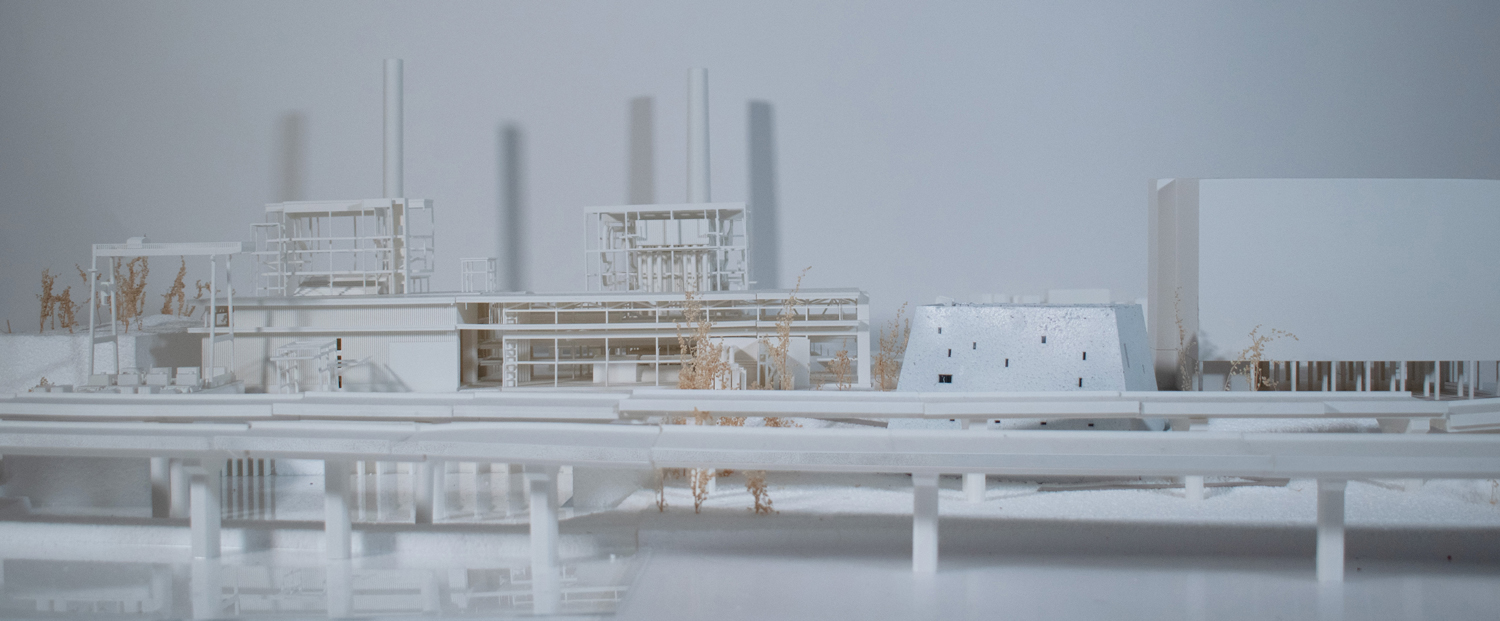
The Danginri Power Plant sits at a pivotal intersection between Seoul’s industrial past and ecological future. The project reflects the transformation of the Han River since the 1988 Summer Olympics, when efforts began to rehabilitate land damaged by decades of rapid industrialization. Historically, the river was shaped by a “living-with-the-water” mentality: seasonal flooding supported agriculture, while winter ice harvesting provided cooling resources through the summer. Ice was stored in Seokbinggo, ancient stone ice houses that used passive thermal venting to maintain sub-zero temperatures. As industrialization intensified, these traditions faded alongside declining water quality and rising river temperatures.
This proposal seeks to reclaim that lost relationship by embracing, rather than resisting, the seasonal flooding. Let the building flood! Furthermore, through this the building seeks to capture and filter floodwater, storing it for thermal cooling during the summer months as a contemporary reinterpretation of the Seokbinggo. The project positions climate as a framework to design within, exploring how industrial-scale systems can foster mutually beneficial relationships between land, infrastructure, and human comfort.
A post-tensioned stone shell forms the primary load-bearing system of the building, from which a suspended inner structure is hung. This tectonic relationship between the heavy, thermally massive outer shell and the lighter suspended interior was explored through both 1:50 and 1:100 models to test not only the structural dialogue between the two systems, but also the atmospheric conditions they facilitate. The stone shell acts simultaneously as structure, environmental moderator, and spatial enclosure—recalling the thermal mass and passive performance of historic stone infrastructures—and questions how far can we go by using a single material, like placing a rock along the Han River.
The project also responds to Seoul’s renewed engagement with the Han River as a public and recreational corridor. An extensive bike infrastructure now reconnects the city to the river, including the “rabbit hole” bike tunnels that appear at 1 kilometer intervals along the Han River, allowing cyclists and pedestrians to pass beneath roads and infrastructure connecting the city to the Han River. Building upon this network, the proposal reconnects the fragmented ground conditions of the Danginri site, acting as a civic “stitch” that echoes the Han River’s historical role in unifying the two halves of Seoul.
Special Thanks to Chloe Tsui, Jeya Wilson, and Brandon Soto for their guidance and help throughout the semester.