The Carbon Sink to Save the Planet
Hana Khurshid and Steffek Rainey’s Preta material promises to turn the consumer economy into a system for preempting emissions.

With a deceptively simple bathroom sink, Hana Khurshid and Steffek Rainey (both MDE ’26) have found a foothold in the fight against climate change. The appealing minimalist fixture they presented as part of “Preta,” their final project in the Master in Design Engineering program, appeared ready for installation in a high-end condo or elegant hotel. But Khurshid and Rainey’s concept image included a startling annotation. This sink potentially represented 41.5 kilograms of carbon dioxide that would otherwise be emitted into the atmosphere. Composed of a material derived from organic waste, Khurshid and Rainey’s literal carbon sink is one of many possible products they hope can channel the power of the consumer economy to halt the rise of global temperatures.
Their journey to carbon-negative products began with broad questions about waste systems and a sense of urgency about the looming climate emergency. With carbon emissions “reaching a point of no return,” as Rainey put it, they devoted much of their final year at Harvard, in a program jointly run by the Harvard Graduate School of Design (GSD) and the Harvard John A. Paulson School of Engineering and Applied Sciences (SEAS), to designing methods to sequester this carbon.

Studying existing carbon capture techniques, including Direct Air Capture (DAC), they were disappointed. Recent studies estimate that approximately 40 percent of the world’s power supply would be needed to provide enough electricity for DAC systems to make a meaningful difference. Existing technological methods for drawing down carbon from the atmosphere could never achieve a large enough scale to mitigate a planetary problem.
Seeking to address the unstable chemistry of the atmosphere, they found inspiration in an unlikely place: a massive landfill in Charlestown run by Casella Waste Systems. They learned that up to 40 percent of the material in a given landfill comprises discarded food and agricultural waste. When these organic items decompose, they emit carbon dioxide, methane, and nitrous oxide—gases that are driving climate change.
“What if we could capture those emissions before they go back into the atmosphere?” Rainey recalled thinking. He and Khurshid saw the potential to treat the landfill not as a dumping ground, but as a source of raw materials for new products. “We decided to think of a landfill as a mine,” said Khurshid. “We can take out the waste and start building things with it.”

Large-scale waste is inevitable within an economic system based on prolific consumption. Typically, materials are extracted to produce new products, which stimulates consumption. Once-new products are then discarded to make way for new consumer desires. Strategies for breaking this cycle often rely on appeals to individuals to curb their habits, or top-down regulations and policies. With Preta, Khurshid and Rainey essentially invert existing circuits of waste and consumption. They would harvest the massive streams of garbage that end up in landfills by harnessing the power of good design and the scale of the consumer economy.
“Preta adds another dimension to waste—it’s not just about reducing carbon and it’s not just about removing carbon, it’s about using carbon in a new way,” says Karen Reuther, design critic in architecture at the GSD and co-advisor on Preta, with Justin W. Cook, Pierce Anderson Design Critic in Design Engineering. Products created from carbon waste, such as a highly appealing sink, could turn the consumer economy from a waste-producing behemoth into the engine for a virtuous cycle—a transformation that would not rely on changes in individual behavior, unrealistic energy expenditure, or miraculous technological leaps.
One key challenge for Khurshid and Rainey was finding a way to stabilize the carbon from biomass waste, which they refined into a black, powdery form. In the labs at SEAS, Khurshid and Rainey conducted more than 100 experiments over an eight-month period. Much of their work involved experimentation to find an effective binder for the material: a glue-like substance to hold the carbon powder together. This binding agent had to be cost-effective and widely available so that the material could be produced with “infrastructure that exists right now,” said Khurshid. For the material to achieve their goals, it had to be capable of production “on a mass scale without changing the whole system.”
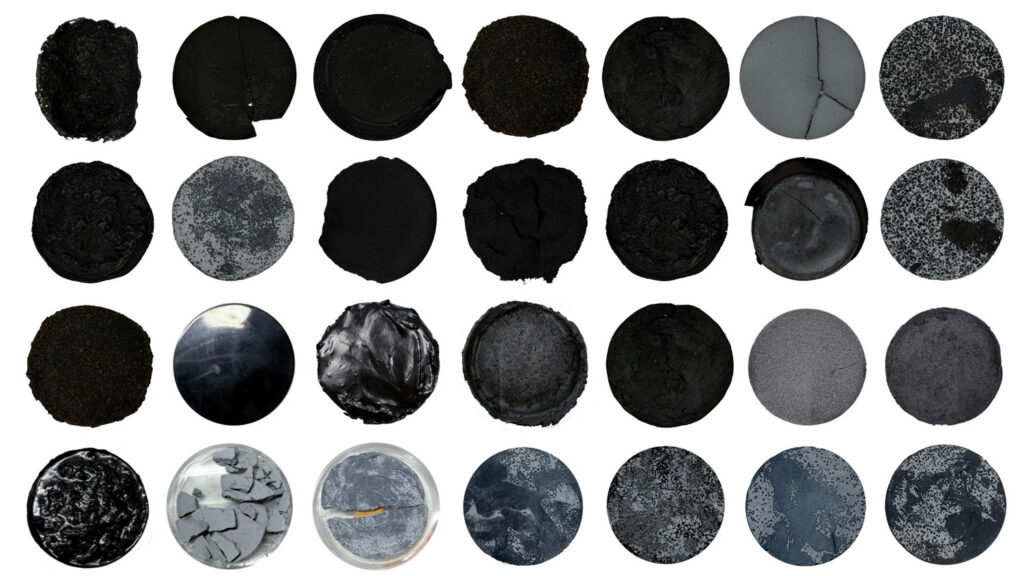
“Preta is a material innovation that has the potential to change core assumptions about sustainability,” said Cook. “Because the project leverages our consumerist instincts and throw-away culture, it has the capacity to achieve carbon drawdown at scale. This is a remarkable achievement.”
Rainey and Khurshid developed two formulas that cost about $3 per pound, a figure that could eventually drop significantly when produced at scale. One compound hardens into a sturdy material with high compressive strength while the other is a pliable material that resembles pleather. Their presentation included designs for a striking, brutalist lamp made from what they call Preta (core), and an elegant tote bag in Preta (flex). “Our theory is that if we can actually turn this stabilized solid carbon into materials, then those materials can be used to make products that go out into the economy, generate new value,” said Khurshid.

Preta’s economic viability as a material is matched by its potential to draw down carbon. With the biomass transformed into a pliable material “we’re able to turn that biomass into a stable, solid carbon form,” said Rainey. “The materials themselves become a carbon sink, and they can store it for hundreds to thousands of years.”
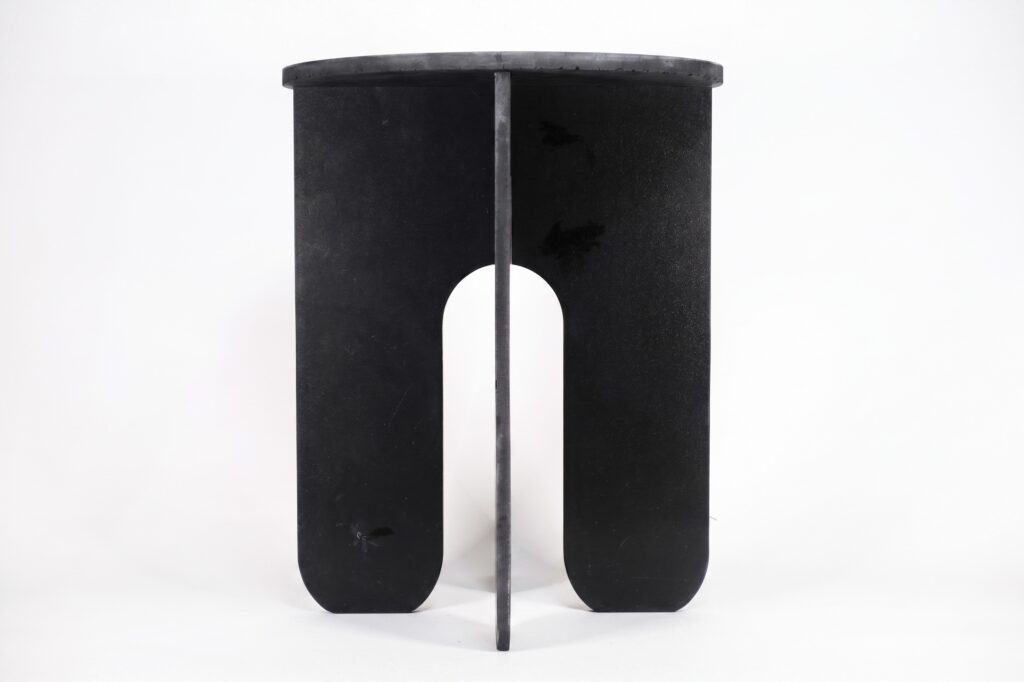
Khurshid and Rainey are already looking ahead to the next phase of Preta. They plan to establish a company based on their innovations and aim to partner with suppliers of waste biomass on the one hand, consumer products companies on the other. What they’ve created is a material, but what they have designed is a system for leveraging its potential. “We have material economies that operate on huge scale,” said Rainey. “We also have consumer markets that operate on a huge scale.” Preta brings these systems together, for the good of a planet. As Cook put it, “if their Life Cycle Analysis projections prove correct at scale, then Preta creates a novel incentive to consume more. This could mean that fast fashion, for instance, could be a be an important contributor to decarbonization.” The potential is theoretically endless, and it’s easy to imagine a version of Preta interwoven with everything we buy—the kitchen sink included.