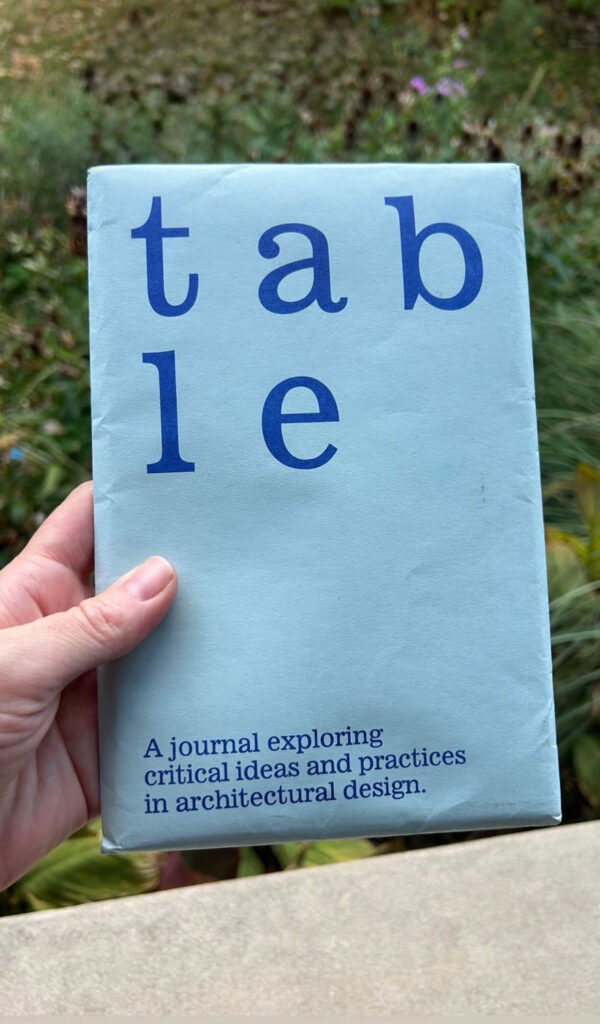
Architecture can seem to lack a shared sense of direction right now, and a new print journal is asking designers to argue with one another again. Table is co-edited by Iman Fayyad, assistant professor of architecture at the Harvard Graduate School of Design (GSD), and Kyle Miller, a professor at Syracuse University’s School of Architecture. It explores critical ideas and practices in architectural design through short essays by practitioners and educators based in the United States. The first issue launched in August at Pratt Institute in Brooklyn. It includes contributions from GSD professor of architecture Eric Höweler, 2021 Wheelwright Prize winner Germane Barnes, and Andrew Holder, former director of the MArch I program at the GSD.
Fayyad and Miller started the journal in response to what they see as a fragmented field. “We feel like the discipline is quite fractured,” Fayyad says. “One of the things we really wanted is to get people to engage in uncomfortable discourse and dialogue, which we haven’t really seen very much of in the last few years.”
She notes that this fragmentation has a positive side. “Our value systems have expanded a lot in the field,” she says. “It’s led, on the one hand, to so much more plurality in the work that people do and the things that people write. But on the other hand, I think it’s made it difficult for people to engage in more critical dialogue.”
Table‘s format is meant to make joining that conversation easier. Each contributor writes about 1,000 words, which is paired with an image of their choosing. Crucially, they write about work other than their own: Höweler’s text takes as its point of departure a distinctive window designed by Diller Scofidio + Renfro for the Met Warehouse at MIT. “Architects are often asked to write about their own work,” Fayyad says. “We want to engage designers to be critical of something that is not their own and to encourage dialogue across diverse practices.”

The journal is Risograph-printed on newsprint as loose 11-by-17-inch sheets, so each essay (or its accompanying image) can be pinned up as a poster. Fayyad names Log, the journal edited by Cynthia Davidson since 2003, as a touchstone that both she and Miller have valued for many years. Student publications, often produced on a shoestring budget, are another reference point. The 200 copies of the first issue of Table were given away free, and the editors aim to double the print run for the next one.
Fayyad and Miller plan for Table to be a limited series of 10 issues, published twice a year. The first issue “sets the table” by asking contributors to reflect on where the discipline of architecture stand today. The second, “Fundamentals,” is now being edited and includes a contribution from Jenny French. It asks contributors what remains unwavering in the design process even as the social, economic, and technological conditions around it change. Later issues will narrow their focus to a single detail, a plan, or a process.
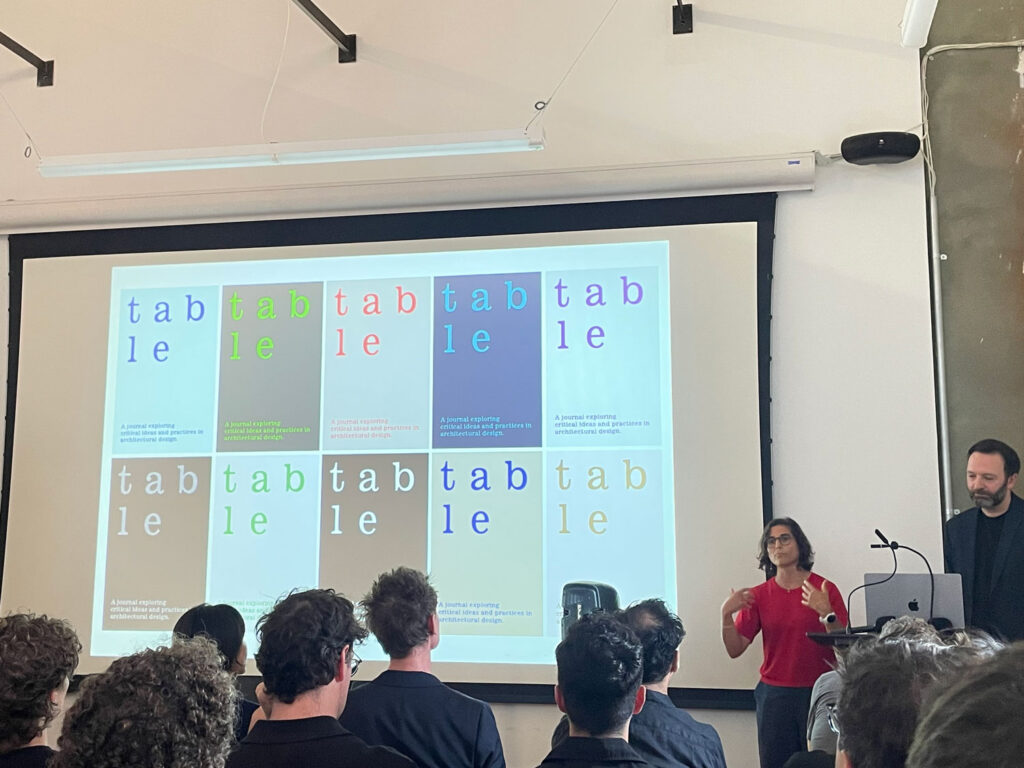
In-person launch events play a critical role in the journal’s editorial process by creating continuity. At Pratt, authors from the current issue were in conversation with authors from the next.
For Fayyad, the project of stimulating discourse within the field is urgent because architecture is so open to the world. “Architecture is so complex. It’s so socially implicated, culturally implicated,” she says. “It’s porous, which is a very good thing about it, but it also means that it’s very prone to being thrown into crisis.”