Meriem Chabani Designs Sacred Spaces within the Profane
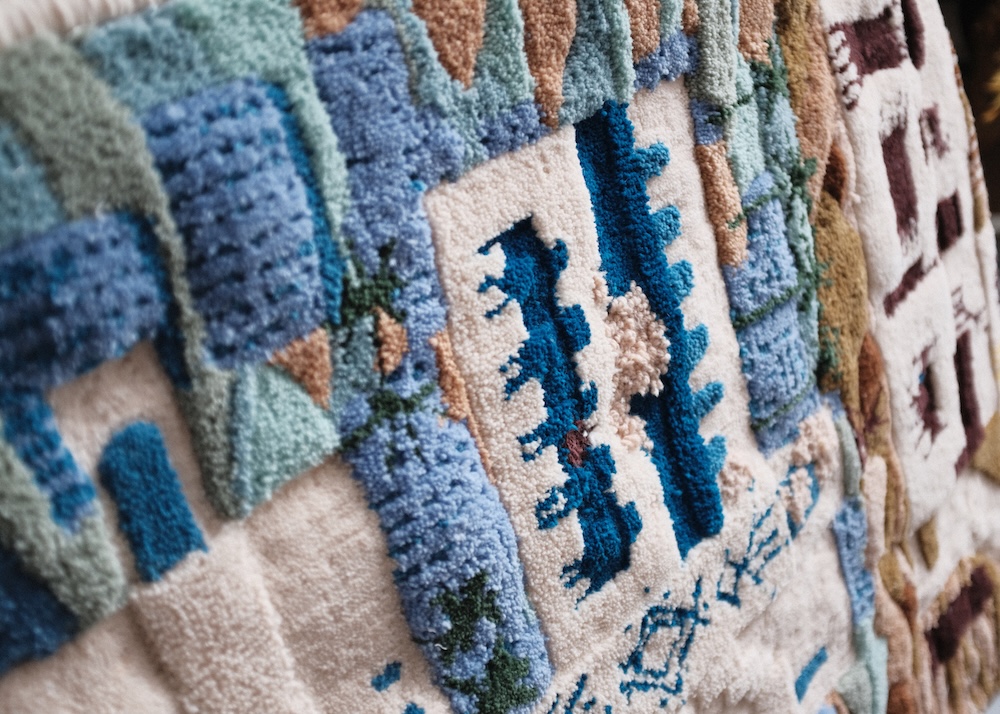
Several years ago, Meriem Chabani, Aga Khan Design Critic in Architecture at the Graduate School of Design (GSD), spent countless hours learning to hand-tuft wool rugs in the Berber tradition for which her homeland, Algeria, is globally renowned. The result, Mediterranean Queendoms, was exhibited in the 2023 Venice Architecture Biennale. A richly textured triptych in earthen hues, blues, yellows, and grays, the carpet tells the story of Chabani’s mother’s and two grandmothers’ homes in iconographic imagery that evokes animals, Berber patterns, and cityscapes, to chronicle her family’s diasporic journey and ability to bring home with them.

“In many different cultures, including my own,” explained Chabani, “textiles have historically been a way of meaning-making, of carrying stories and transmitting knowledge. I explored how we could use one form of textile crafts—carpets—to provide full representation for housing.”
As an Algerian who grew up in France and experienced the long-lasting effects of colonization and war, Chabani knows how it feels to “exist in the periphery,” even as she “deconstructed its existence.” She turns to the language of feminist theorist bell hooks to “put the margin at the center,” and grounds her designs in “spiritual and sacred practices with the built environment,” centering care and “acts of faith” that help us to more productively share space together.
The rug serves as a symbol of how women hold familial and cultural information in the diaspora, carrying it with them just as they roll up and transport the carpet “from one home to another, across the sea,” writes Chabani on her website. It is unrolled again in a new home where women “care for, maintain and transmit resources, values, presents, medical care, family objects, furniture.”
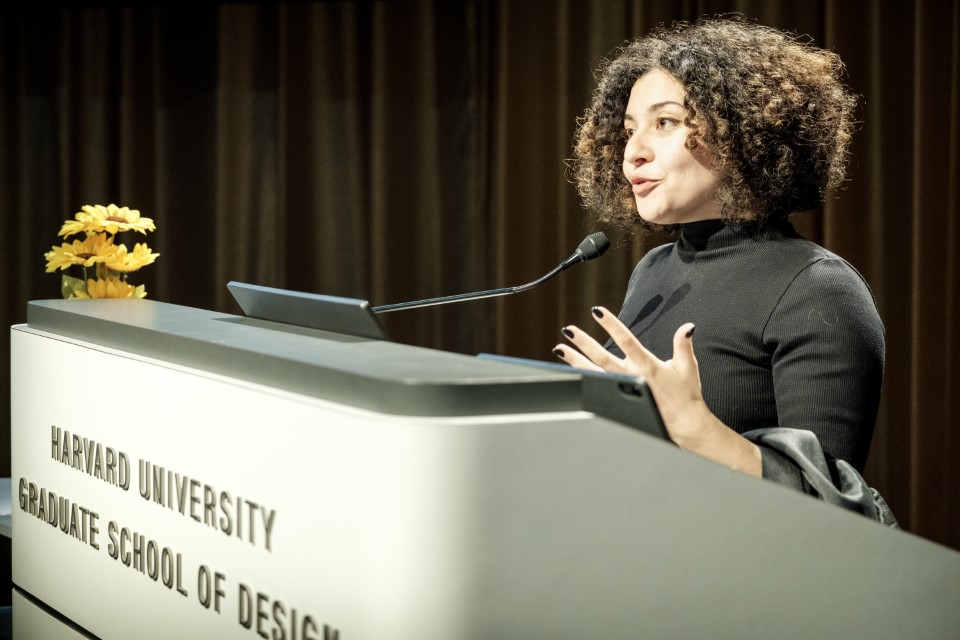
This fall, Chabani spoke at the GSD about the place the carpet holds in her practice and how her firm, New South, co-founded with John Edom, creates spaces for diasporic communities from the Global South and foregrounds their architectural heritage within the North. Citing theorist and writer Paul B. Preciado, she argued in her talk, “South South Cosmogonies,” that the South is a fiction created in contrast to the North, “shaped by subjugation and uneven power relations.”
“The South is the site of extraction,” she explained, “the North is the site of value-making. The South is the site of magic, feminine, queerness, gold, and coffee; the North is the site of science, masculinity, coordination.”
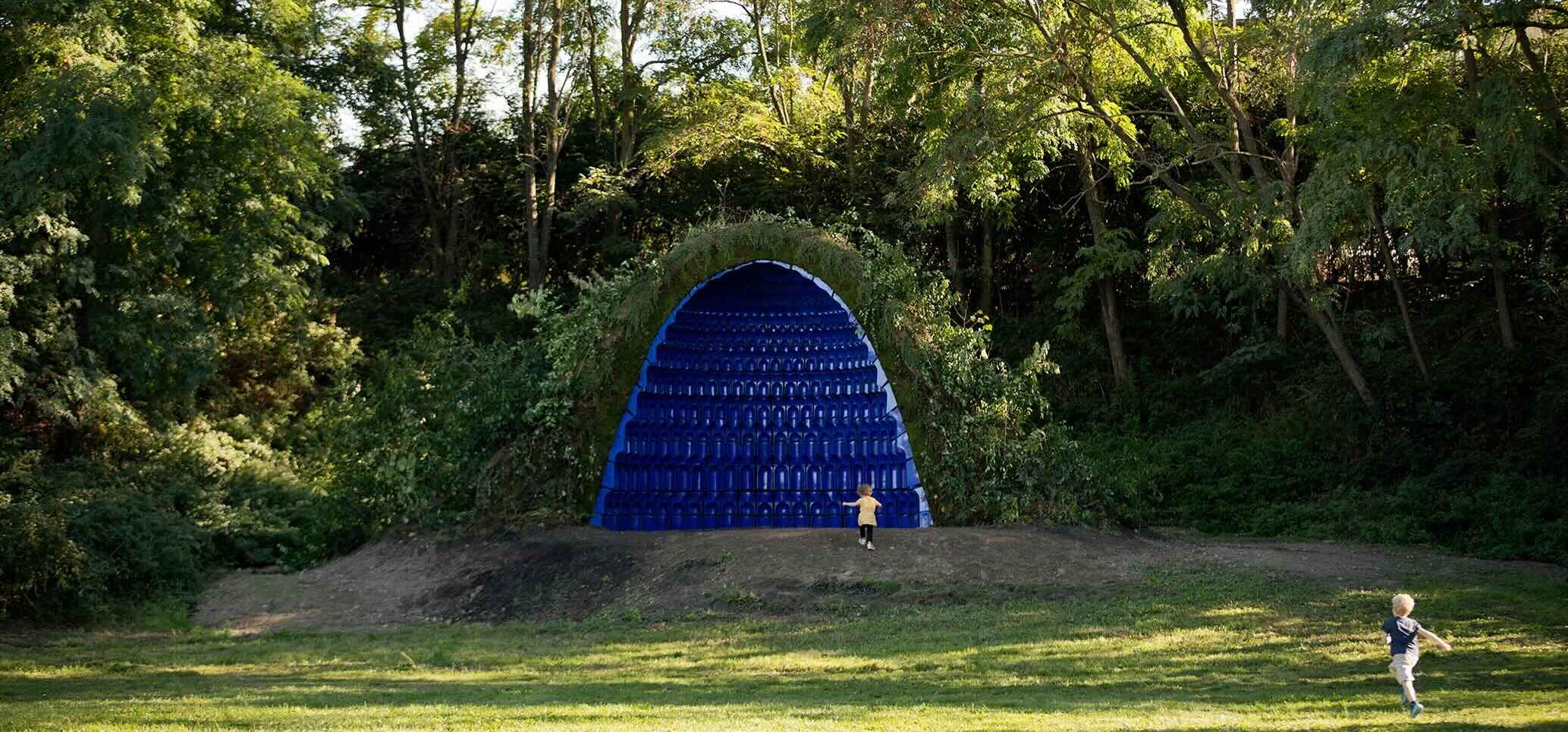
Her firm’s recent projects include a religious and cultural center in Paris and the Muqarnas Pavilion, the latter of which was inspired by the muqarnas used for centuries in Islamic architecture. “Muqarnas are a decorative molding,” Chabani explained in her talk at the GSD, “applied to ceiling vaults . . . across Islamic culture. At first glance, they appear to be intricate decorative ornamentation, but they also serve a practical purpose.”
She went on to explain that they may have evolved as a result of the shapes made when a brick structure transitions from an octagonal floor and walls to a domed ceiling, and that they reflect the Islamic “non-figurative approach to ornamentation.” The shape continued to evolve and is now made from plaster. She decided to use it in her design because it would allow her to explore a sacred space installed in a profane setting, and to “reassert constructive and construction innovation as central to contemporary Islamic architecture.”
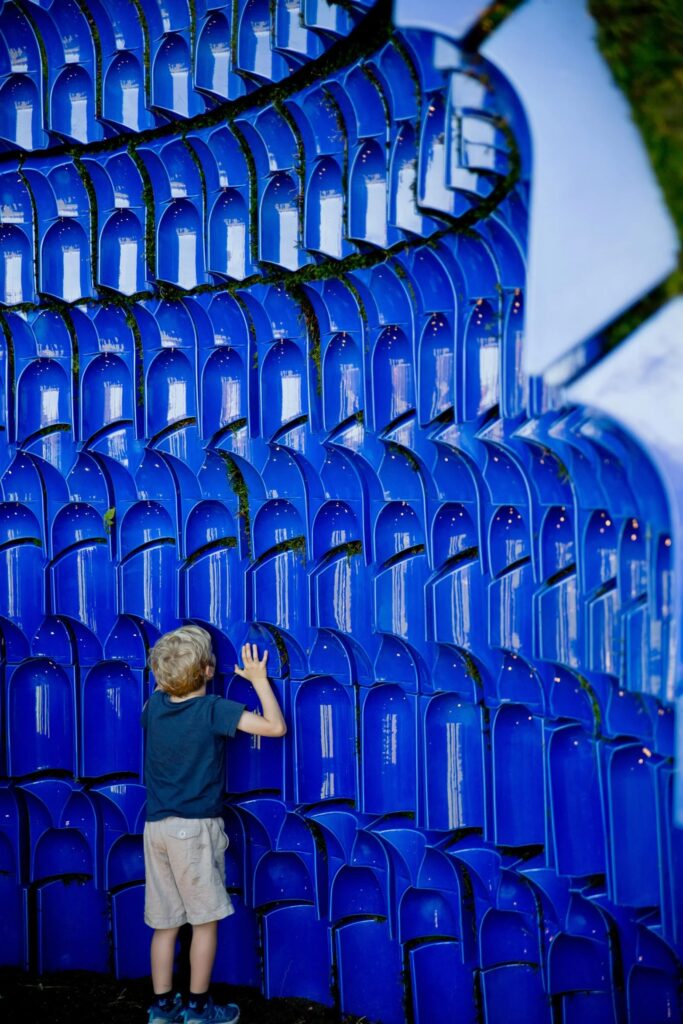
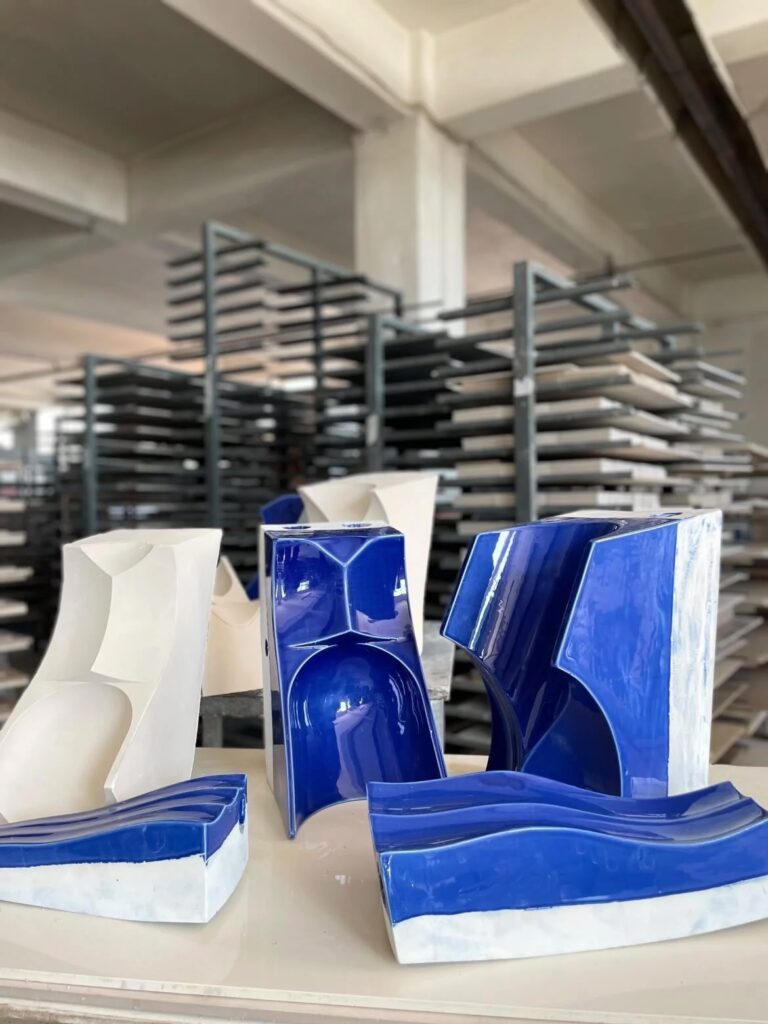
An outdoor installation that Chabani designed in collaboration with Radhi Ben Hadid, a structural engineer, and Gorbon Ceramics, the pavilion is made of many half-cupolas molded in industrial grade, vibrant blue ceramic. Muqarnas are typically installed in a dome or arch as a decorative element, but Chabani’s goal was to create a self-supporting half-dome of muqarnas. She found that, because ceramics change in the firing process, the molds could not be 3D-printed and were instead hand-crafted.
The installation is what she calls in French a courage perdue, or lost risk, as it required reinforcement with concrete that’s then covered with soil and planted with greenery. Installed in the grass with trees behind it at the École Nationale Supérieure d’Architecture de Saint-Étienne, in France, the pavilion looks like a bright blue shelter hidden within nature. Visitors can walk into the curved space that’s been used for performances and presentations; Chabani noted that it’s also enticing for curious children.
Another design that combines secular and religious spaces, the mosque and cultural center she has designed for the 11th arrondissement in Paris would replace the current mosque that the community uses, in a renovated paper factory. Chabani cited the building’s dilapidated facilities and insufficient space for the number of people who want to worship as some of the primary drivers for a new mosque. But, these issues are part of a systemic problem, she noted, explaining that Paris currently meets only about seven percent of the population’s needs for mosques, and that France is systematically eliminating worship spaces in immigrant communities. Government-run housing units for immigrants are currently being renovated, and the new spaces for worship are too small for communities to use together.
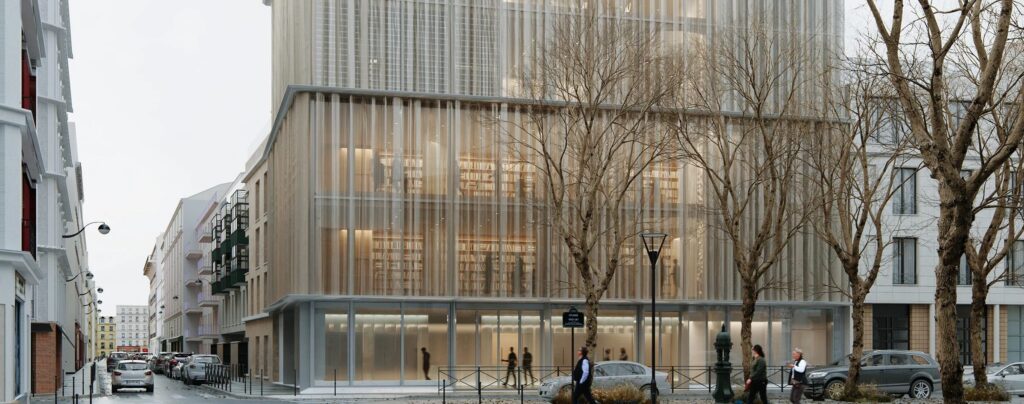
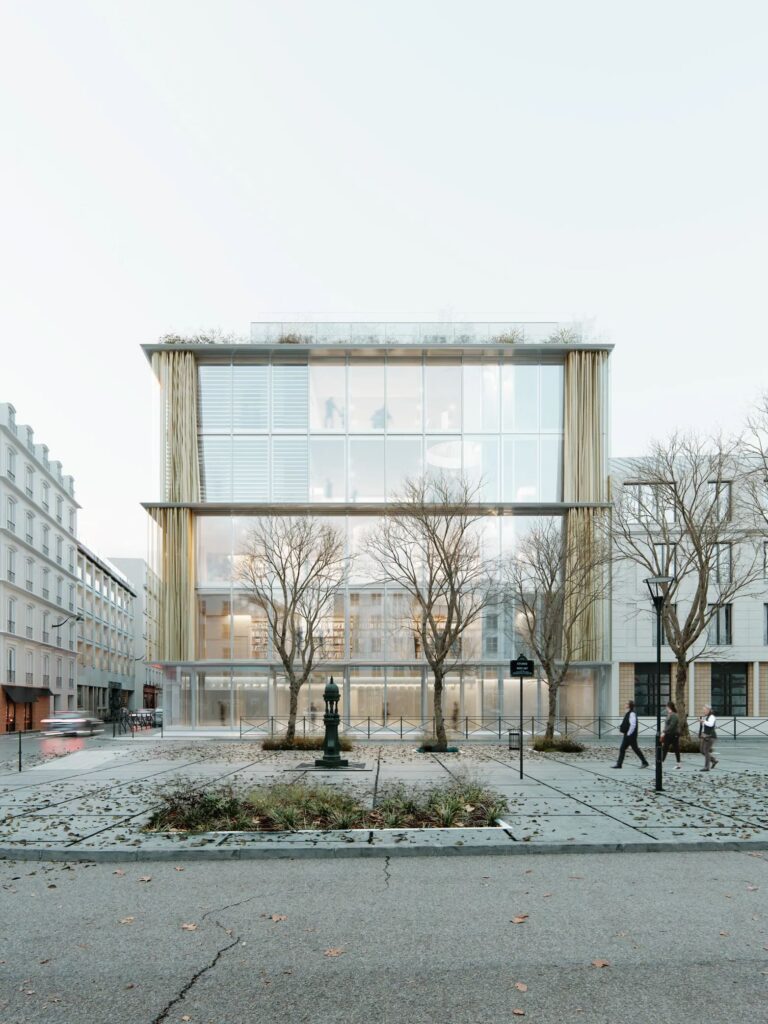
When the Muslim community in the 11th arrondissement asked Chabani to help them design a mosque, she thought about contemporary attempts to modernize mosques that only create caricatures without capturing their essence. So, she began with a fundamental question: What is a mosque? She determined that it must be “oriented toward Mecca, provide a clear distinction between sacred and profane spaces, and allow people to pray collectively.” Because the lot is just over 900,000 square feet, Chabani and her team deployed the vertical space, using a Chambord stair system to allow people to filter into the upper levels of the mosque without waiting until lower levels are full, eliminating the issue of overflow into the street as people wait in line to pray.
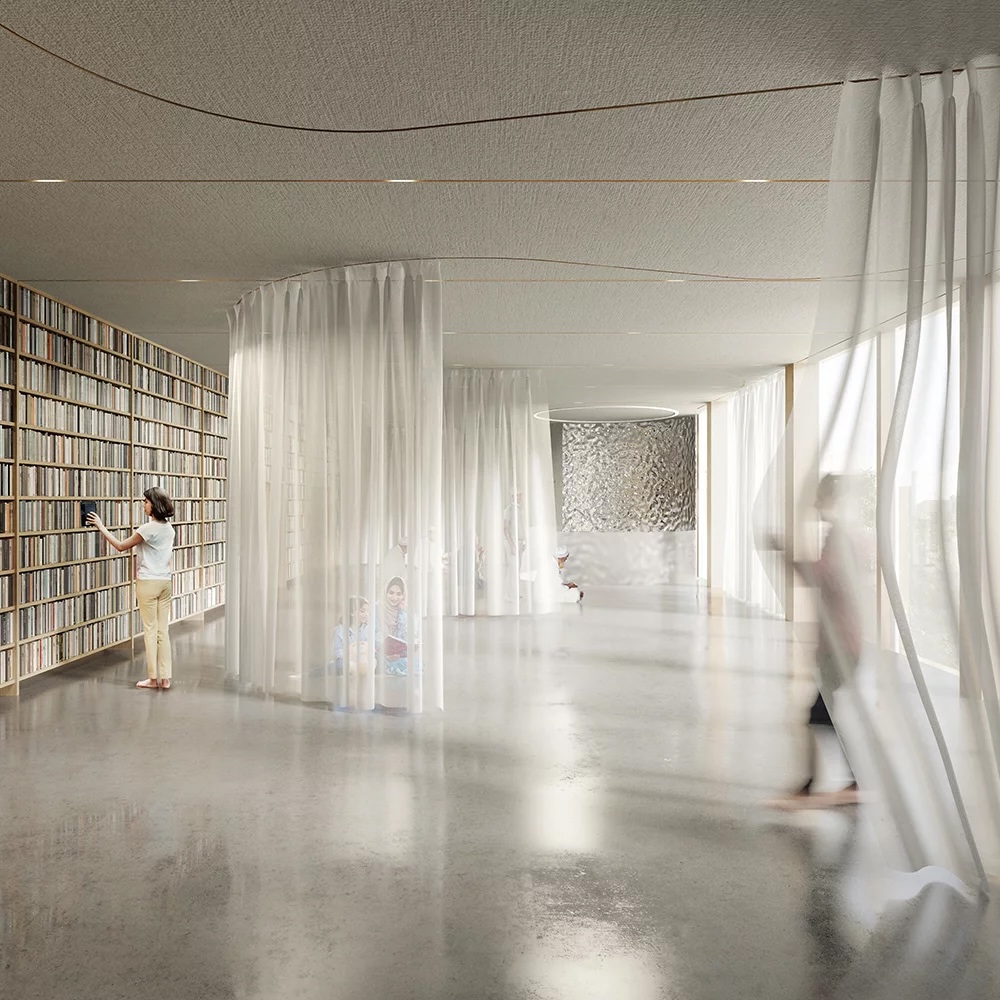
She went on to consider what might happen if the traditional architectural elements of a mosque—the minaret, dome, and pointed arches—were not prioritized. Instead, she found her way with the words, aya tonerre, which translates to “God is light upon light.” Her design prioritizes the movement in the space, as people pray five times a day, and challenges the idea of erasure of the community with chain-metal cladding—a nod to the metal working history of the neighborhood—that can be opened or closed around the “glass house.” Within the building, multifunctional rooms, including a library, exhibition space, and offices can be divided with floor-to-ceiling sheer curtains, adaptable for various sacred and secular purposes.
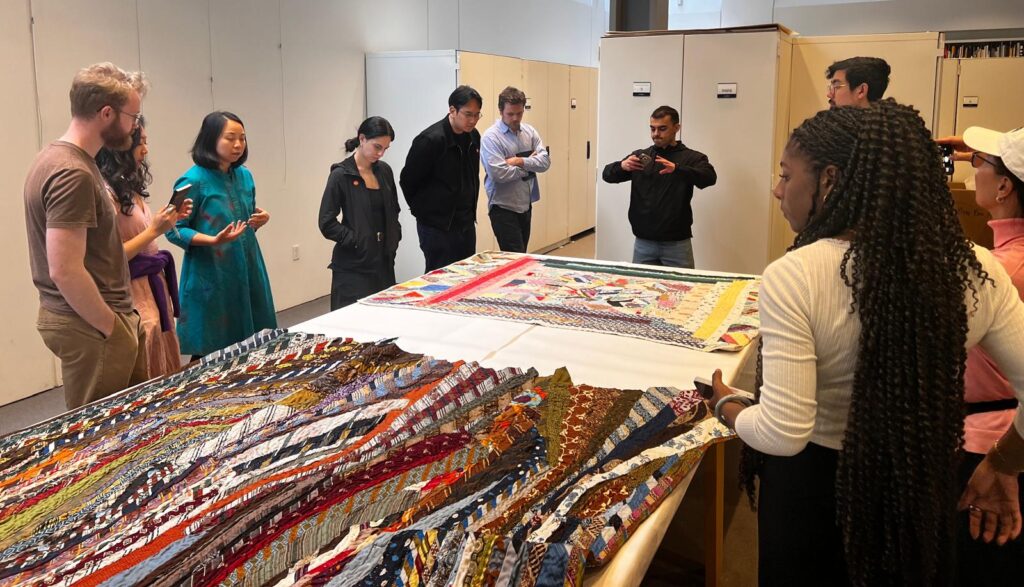
In her architecture studio course this semester at the GSD, “Anchoring Acts,” she continues to explore relationships between sacred and secular spaces. She led students through a study of New Orleans, urging them to consider “not only greener technologies” in the service of environmentalism and sustainability, but also “the affective and sacred dimensions of care.” An anchoring act, she explained, is a “ritual or relationship based on spiritual or sacred practice with the built environment.”
Similarly, Chabani sees an opportunity to learn from the traditions and rituals of the many diasporic communities in New Orleans—African, Caribbean, Indigenous, Arab, Spanish, French, Creole, Cajun, Pacific, and Vietnamese—elucidating how “place, memory, and belief shape the built environment.” She calls their overlapping cultures “entangled cosmologies.” To learn more about those intersecting communities and their influence on American culture, during the studio course’s trip to New Orleans, students visited iconic Congo Square, known as the musical center of the city.
It was there that, as Freddi Evans, author of Congo Square: African Roots in New Orleans, explained in a lecture to Chabani’s class, enslaved Africans who were taken from different regions of their home continent—Bight of Benin, Central Africa, Sierra Leone, and Senegal—would intermingle on Sundays, sharing instruments, songs, drumming, and other traditions from their homelands, leading to the creation of a range of musical instruments, dances, voodoo and other spiritual practices, and, of course, jazz.
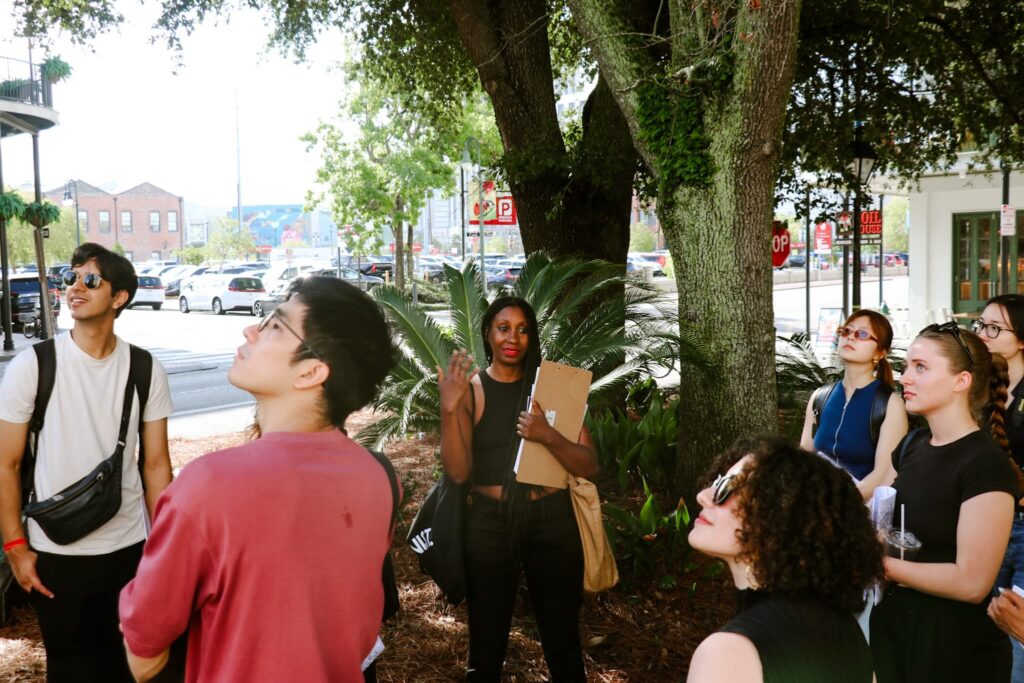
Together, the group also attended a Second Line, a ceremonial parade with music through the Tremé neighborhood, and took a tour of “Geographies of Displacement” with 2025 Loeb Fellow Shana M. griffin. griffin’s multimodal series DISPLACED “traces [New Orleans] geographies of Black displacement, dislocation, confinement, and disposability in land-use planning, housing policy, and urban development . . . highlighting moments of refusal, rupture, and protest.” She encouraged the students to “reimagine space-making and abolition strategies that value Black life.”
For examples of this kind of abolitionist work in the built environment, the group met with a variety of organizations focused on underserved communities in the city, including Tulane’s Albert Jr. and Tina Small Center for Collaborative Design, directed by 2013 Loeb Fellow Ann Yoachim.
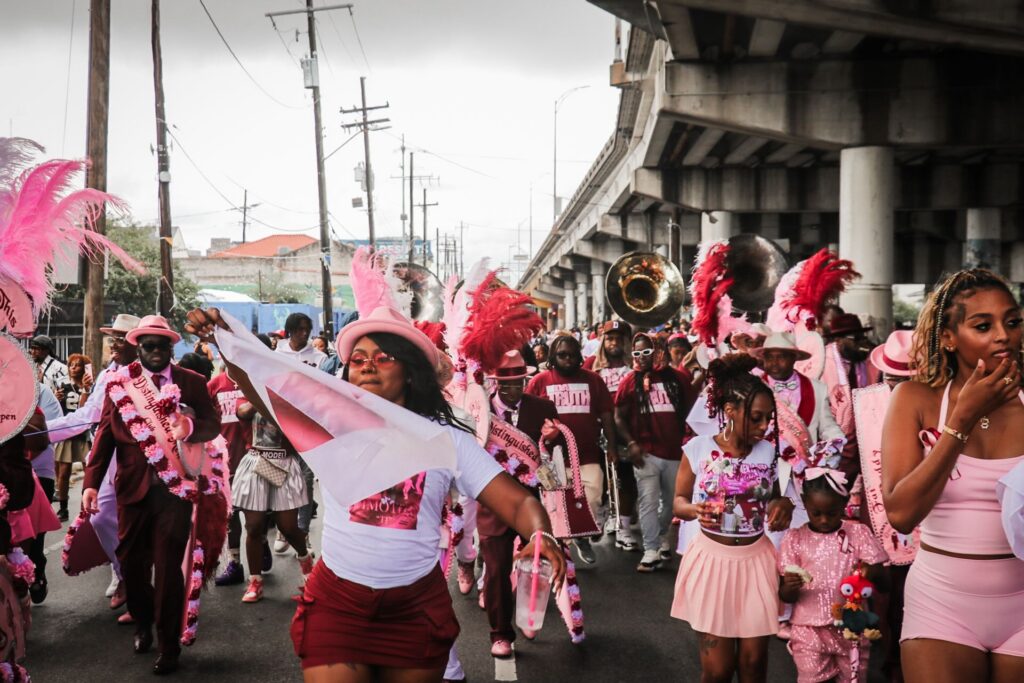
As students worked towards their final projects for the course, Chabani described the wide range of themes they explored, from “fire rituals and carbon capture, probing the tensions between sacrifice, material performance, and durability” to “rituals of rebuilding, where architecture becomes a medium for repair, knowledge transfer, and resilience in the face of climate catastrophe.” One student, for example, mapped people’s movement around Congo Square to design a gathering space that also functions as a parking garage and will eliminate the need for nearby parking lots, while another applied lessons from bamboo scaffolding experts in Hong Kong to create a building at the local technical school that can serve as a model and learning space for hybrid bamboo-and-wood buildings.
Moving ahead, Chabani continues to probe the connections between sacred and secular spaces, re-centering the Global South, and exploring how these threads can lead us to better care for our environments and each other.