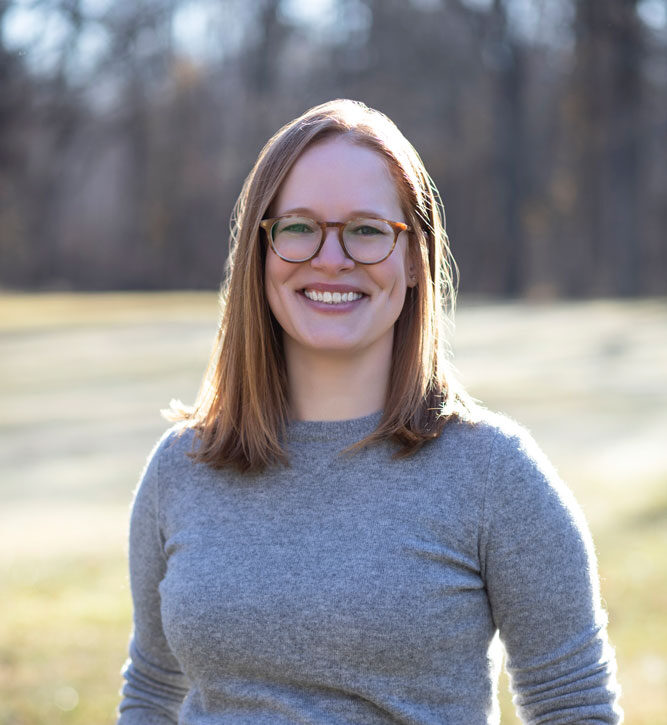
Ellie Sheild (MUP ’23, MRE ’24) didn’t set out to become a planner, much less a real estate developer. As an undergraduate at the University of North Carolina at Chapel Hill, she majored in political science and Spanish with a women’s studies minor, scanning the course catalog for a summer class that didn’t meet on Fridays. The one she chose—an introduction to city and regional planning—quietly rearranged her life.
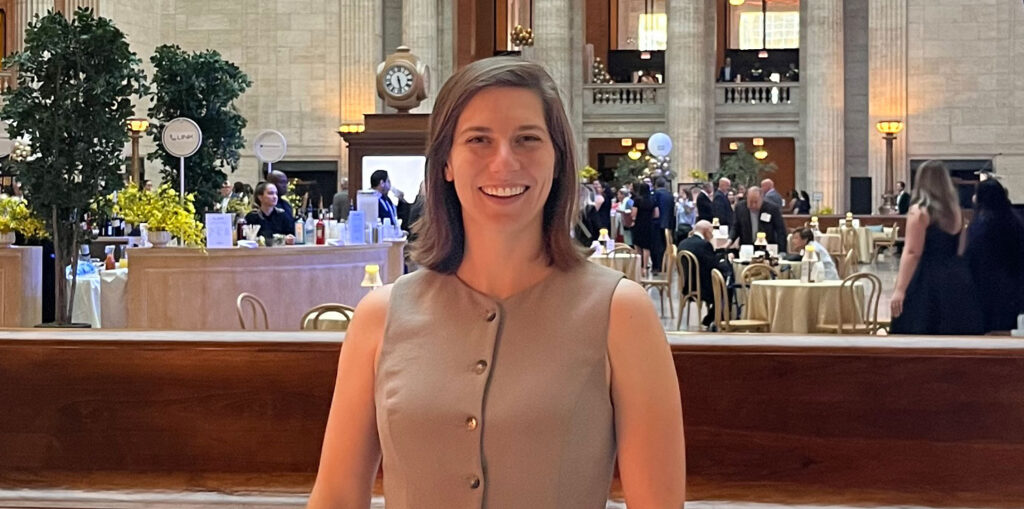
“That class was the first time I really understood the systems that shape everyday life,” she recalls. What began as a scheduling convenience became a new way of seeing the world: zoning codes and transportation plans as levers that determine where people live, work, shop, and gather. She sought out more planning courses, and by graduation she was pursuing planning positions in a smaller jurisdiction where she could help shape communities on the ground. “I had done internships in bigger cities like my hometown of Charlotte,” Sheild says, “but I really wanted to experience the breadth of what it takes to plan, design, and develop.”
Her first stop was Albemarle, a city of roughly 20,000 people nestled in central North Carolina. As a young planner there, Sheild found herself at the center of almost everything. “Nothing happened in that town that didn’t cross my desk at some point in the process,” she recalls fondly. Rezoning requests, downtown design decisions, small-business expansions, public hearings—she touched them all, eventually progressing into a senior planner position. Albemarle provided an intense, hands-on training in how policy, politics, and people collide at the local level. “It was an extremely rewarding endeavor,” she notes. “Because of the scale of the town, I really felt that I did have a positive impact.”
Amid the uncertainties of the pandemic, Sheild reflected on how graduate school could further her next career step. She explored the country’s top planning programs with the understanding that her education would be heavily shaped by the city in which she learned. For her and her fiancée, Boston emerged as a compelling possibility. The city’s architectural diversity—from Faneuil Hall to contemporary life sciences campuses—mirrored the kinds of tensions she was curious about: historic fabric and new growth, community needs and market pressures, local character and global capital.
The personalized experience of applying to Harvard’s Graduate School of Design cemented Sheild’s choice. Her contact with faculty and staff as a candidate for the Master of Urban Planning program provided crucial insight. “There was so much intentionality,” Sheilds recalls. “I could tell that they were curating our incoming class with a larger picture in mind, so our backgrounds and experiences fit together.” Seemingly small details made an equally strong impression, such as staff and faculty using her nickname, “Ellie,” instead of the formal “Elizabeth” on her application. “If they were putting that much effort into the admissions process,” Sheild states, “I knew they’d put that much effort into my education.”
The GSD transformed my life. I’m on a whole new path because of the people I met there, the projects I worked on, and the way the school encouraged me to think about cities.
Beginning at the GSD in 2021, Sheild dove headfirst into her MUP studies. Over the next two years, she worked as a research assistant for the Joint Center for Housing Studies, nursing a growing interest in affordable housing. She gravitated toward real estate courses as well, taking classes with Jerold Kayden, Frank Backus Williams Professor of Urban Planning and Design, and later serving as his teaching assistant. She also traveled to Portland, Oregon, for “Field Studies in Real Estate, Urban Planning, and Design,” a studio taught by Richard Peiser, Michael D. Spear Professor of Real Estate Development. The assignment involved the redevelopment of an aging 20-acre retail site, bringing together students with backgrounds in law, real estate, finance, and design.
Sheild’s experiences in the MUP program deepened her love for planning, but they also underscored its limits. From the public side of the table during her years at Albemarle, Sheild had often found herself negotiating with developers who ultimately controlled what did and didn’t get built. “For me, real estate was the tangible way to shape the community. And I realized that to be a successful steward for communities in the way I aspired, I needed more agency on the private side,” she explains. She began to imagine a career that would let her both write the “rules of the game” and help lead the team on the field.
That realization led Sheild to stay at the GSD for a second degree, joining the inaugural class of the school’s new Master in Real Estate program, established by Kayden. Being part of the first MRE cohort meant that she was surrounded by classmates from a wide range of backgrounds: architecture and planning, affordable housing, real estate investment, brokerage, and development. The mix of experiences among the students felt, to her, like a rehearsal for the real world. “In practice, you’re never in a room full of planners or a room full of designers,” she notes. “You’re working across disciplines all the time.”
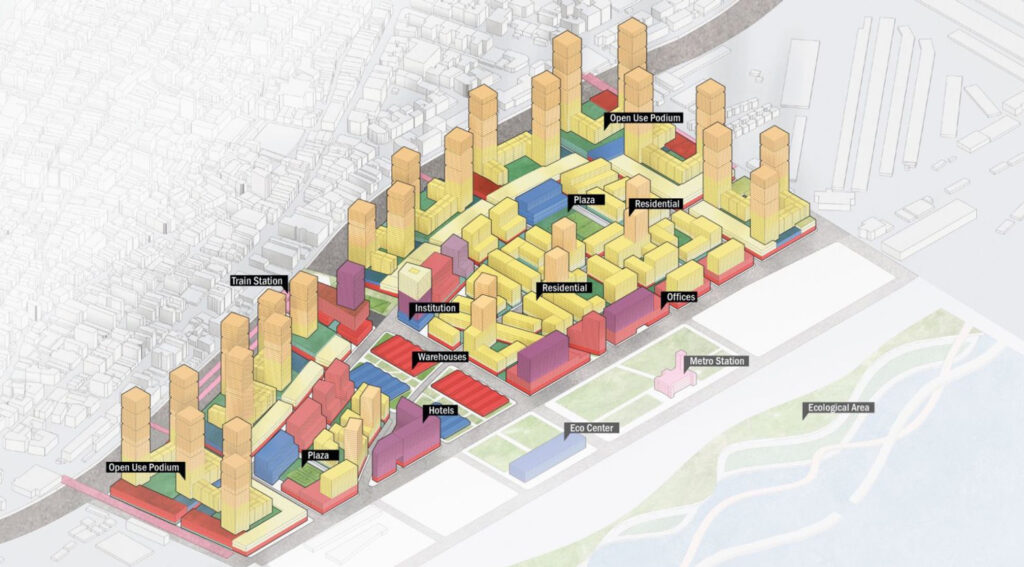
While in the MRE program, Sheild had the good fortune to travel to Mumbai, India, with an option studio led by Rahul Mehrotra, John T. Dunlop Professor in Housing and Urbanization. In small, multidisciplinary teams, the students undertook large, complex urban redevelopment projects. Called “Mumbai INformal,” her team’s project reconceptualized the city’s dense urban fabric, putting forth high-rise podiums as layered structures that house residential, commercial, and civic spaces for a mix of income groups. After Sheild’s MRE graduation in November 2024, the remaining GSD students continued working on “Mumbai INformal,” with the project ultimately winning the 2025 Plimpton-Poorvu Design Prize.
Today, as an associate project manager at New England Development (NED), Sheild is putting her dual training to work on some of the Boston area’s most visible mixed-use projects. She joined the company after meeting GSD alumna and senior project manager Risa Meyers (MDes ’20) on a Harvard Real Estate Alumni Board tour; the connection turned into a series of informational conversations, then a job. “It was absolutely a GSD connection that opened the door,” Sheild says.
At NED—a family-owned firm with roots in the region dating back to the 1970s—Sheild works on a lean development team managing projects from entitlement through construction. Among the firm’s flagship efforts is Allston Yards, a multi-phase redevelopment that is transforming a sea of asphalt and a suburban-style shopping center into a new urban district with housing, retail, and civic space. For Sheild, one of the most meaningful elements is Rita Hester Green, a new one-acre public space—the first in Boston to be named for a Black trans woman. The project also contributes to a community benefits fund that distributes grants to local organizations.
Beyond Allston, Sheild is involved in projects in communities where her firm has been present for decades—including in her vicinity of East Cambridge. “Like my time in Ablemarle, I’m contributing to my neighborhood; I have a stake and an expertise. Looking out my window, I can see one NED project on the other side of I-93 and then another, CambridgeSide, just a stone’s throw from where I live. There’s a localism in what I’m doing,” Sheild says, “and I really enjoy that.”
Straddling planning and real estate means constantly negotiating between community aspirations and pro forma realities, between long-range visions and near-term constraints. For Sheild, that tension is the point. Her training at the GSD gave her a language for both worlds—the policy frameworks of planning and the financial logic of development—enabling her to advance real-world outcomes in the built environment.
Looking back, Sheild is unequivocal about the impact of those years in Gund Hall. “The GSD transformed my life,” she says. “I’m on a whole new path because of the people I met there, the projects I worked on, and the way the school encouraged me to think about cities.” From small-town North Carolina to a Boston development office, her work now connects policy and projects, numbers and neighborhoods, in the evolving landscapes of the communities she now helps to shape.