A bathroom might not seem like an obvious subject for an architectural competition, but that is exactly the premise behind a recent design challenge at the Gropius House (1938) in Lincoln, Massachusetts. Designed by German émigré Walter Gropius while he was teaching at the Harvard University Graduate School of Design (GSD), the house—a National Historic Landmark stewarded by Historic New England—requires a new amenity for the steady stream of visitors it attracts.
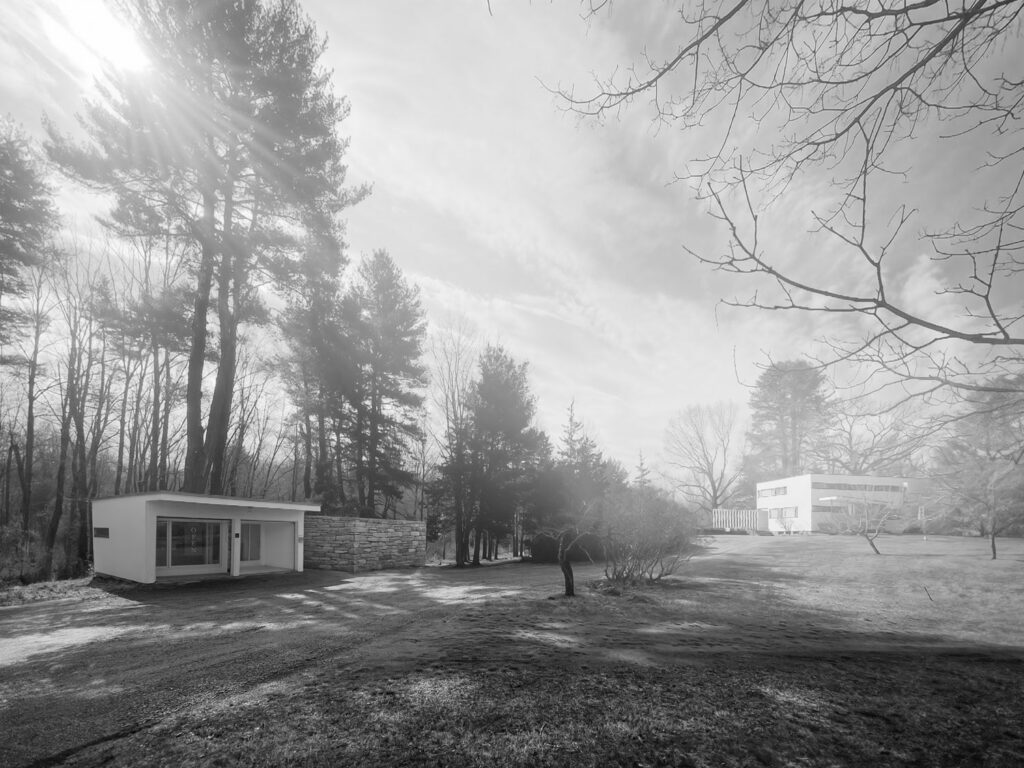
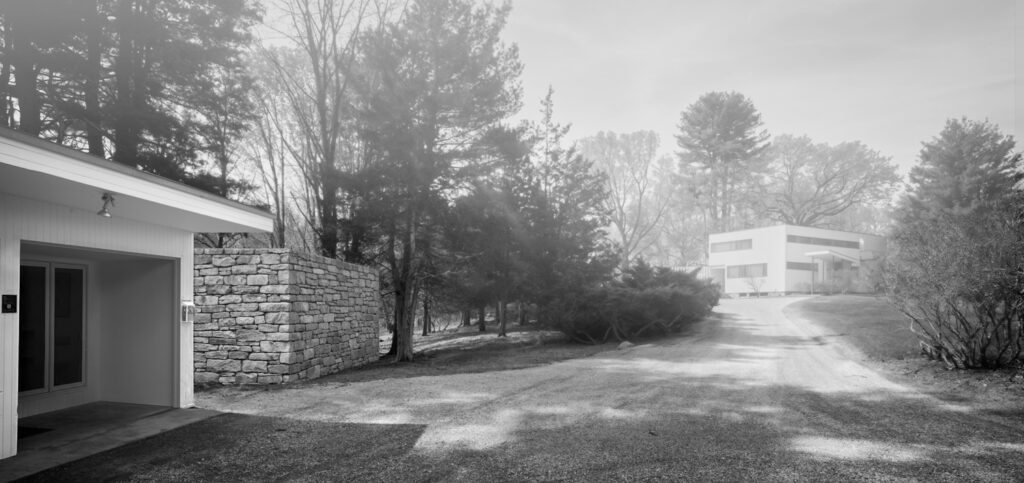
The winning proposal comes from Isabel Strauss (MArch ’21), an assistant professor at Smith College. Her design takes on a nuanced brief: how to introduce a freestanding bathroom for visitors at one of modernism’s canonical houses. In her proposal, Strauss incorporates Gropius’s garage into a broader spatial strategy, adding a new layer of infrastructure to a setting long associated with clarity and efficiency.
“I’m incredibly honored,” Strauss said of the opportunity as a GSD alumna to add to a Gropius-designed site. Her broader research, which connects architectural history and African American cultural history, has also been featured at the GSD, including an event last spring on J. Max Bond Jr.
At first glance, the commission might seem modest. Yet the bathroom—often overlooked in architectural discourse—has emerged as an increasingly important site of design inquiry. Here, questions of water, waste, privacy, and maintenance converge, linking everyday routines to larger environmental and civic systems.
This line of inquiry has been the focus of recent studios at the GSD, including Chris Reed and Leila Seewang’s “Post-FLUSH: Water, Waste, and Intimacy in Berlin’s Civic Realm.” The course takes Berlin’s 19th-century sewage systems as a point of departure, asking students to reconsider how infrastructures of sanitation continue to shape urban life, governance, and spatial experience. In this context, the bathroom is not just a utility but a lens through which to view the hidden systems that sustain the city.
Strauss’s proposal arrives, then, at a moment when the bathroom is being reconsidered across scales—from the individual facility to the urban system. At the Gropius House, this rethinking takes the form of a new structure for visitors, designed by a Harvard GSD graduate, bringing the story full circle—from Walter Gropius’s tenure at the GSD to a new generation reexamining even the most utilitarian spaces.