Alumni, faculty, and staff in the Harvard Graduate School of Design (GSD) community, whose work spans design practice, history, criticism, curation, and public scholarship, have received 2026 Graham Foundation Grants. This year’s GSD-affiliated recipients reflect the breadth of the community and its commitment to advancing design discourse across disciplines, geographies, and publics.
Established in 1956, the Graham Foundation supports individuals and organizations who develop and disseminate ideas about architecture and space through exhibitions, publications, films, research initiatives, and other public-facing formats. The Graham Foundation’s 2026 awards provide $506,000 in support of 54 projects that expand inquiry into architecture and the designed environment through research, publication, exhibition, public programming, and new forms of cultural production.
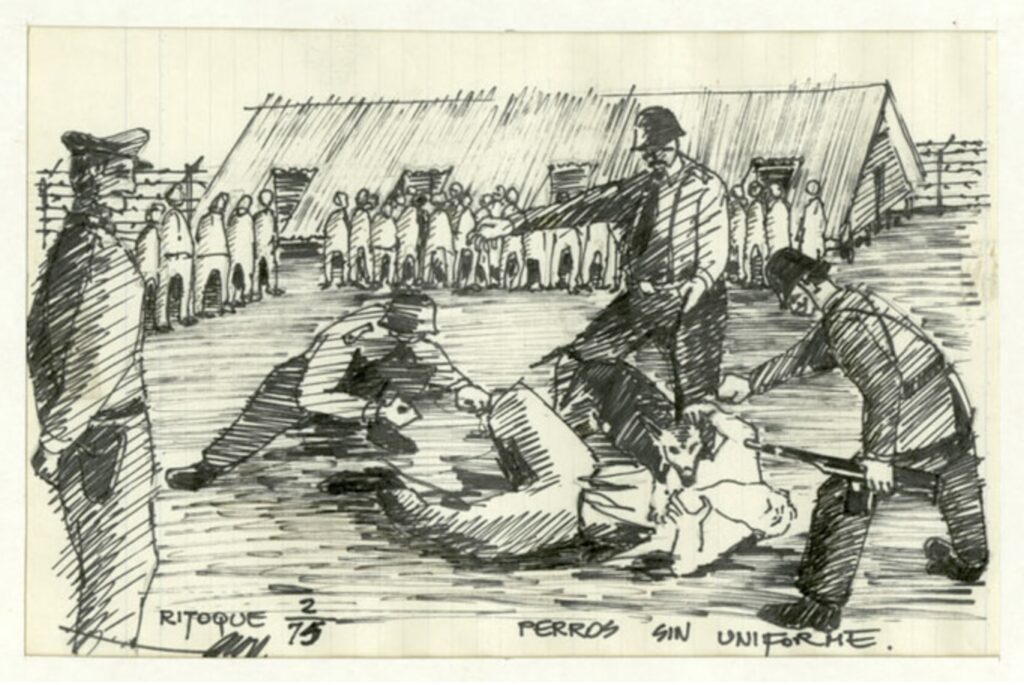
Ana María León (MDes ’01), GSD associate professor of architecture, was awarded a grant for Spatial Solidarities: Architecture and Resistance in 1970s Chile (University of Pittsburgh Press, 2026), which “traces the spatial practices enacted by architects, artists, activists, and other political agents in resistance to the violence of the Chilean military and civil dictatorship (1973–90).” Léon looks at the forms of resistance that imprisoned people took while held in detention and torture centers. She defines these acts as “spatial solidarity.”
In addition, GSD staff member Sarah Rafson, associate director of public programs, was selected for her co-authored book, with Lori A. Brown, Now What?! (Goldsmiths Press, 2027), which explores “grassroots advocacy and activism by architects to reveal the connections between the design community and larger social and political movements.”
Several alumni were also included in this year’s awardees. Jay Cephas (AM ’09, PhD ’14), receives a grant for his video series, “Brick by Brick: Black Builders and the American Landscape,” which “details a critical contribution made by the Black architects and builders who helped to shape the American built environment.” Christina E. Crawford (MArch ’03, AM ’13, PhD ’16) was recognized for Model Housing: Atlanta and the Foundation of American Public Housing Architecture, forthcoming from Yale University Press (2027), in which she argues that “Atlanta’s housing projects remind us that intelligent site planning, human-scaled shared green spaces, community amenities, and solid construction can, and should, drive contemporary affordable housing design.”
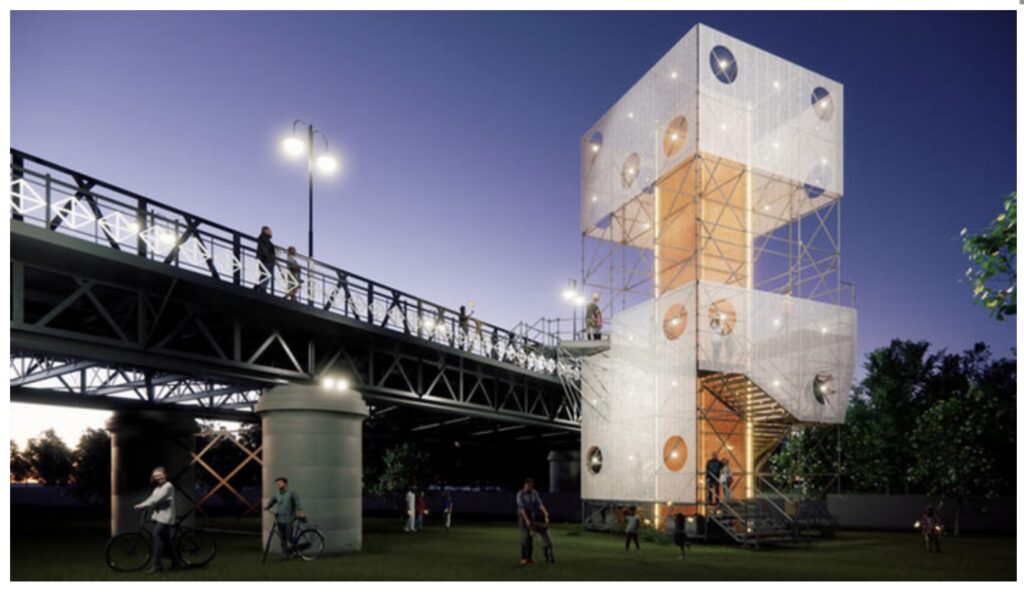
Craig Reschke (MLA ’15), together with Ann Lui, co-founders of Future Firm, were awarded a grant for their exhibition “The Stork’s Stair,” curated by Iker Gil in Logroño, Spain. The piece serves as a “vertical connector that links the park’s ground to the bridge above, turning a piece of pure transit infrastructure into a moment of occupation.” Michael Meredith (MArch ’00) and Hilary Sample, co-founders of MOS, were also awarded a grant to support an exhibition. “A Stop” is a shaded structure for gathering and reconnection with the landscape, curated by Julia van den Hout for Art Omi’s Sculpture and Architecture Park in the Hudson Valley, New York.
David Turturo (MDS ’11), with Lauren McQuistion and Alex Maymind, were awarded a grant for their research, “Skyline: Rereading an Architectural Tabloid,” which was “primarily edited by women” and published a “broad spectrum of voices and content,” serving as “an amplifier of pluralistic design culture…and an ephemeral landmark for the contemporary publishing landscape….” Shane Ah-Siong (MDS ’22) was also awarded a grant for research, for his project, “Military Architectures of Displacement: Documenting Spatial Erasure in the Indian Ocean,” which “documents how British and American military infrastructure built over the last century in the Chagos Archipelago in the Indian Ocean have systematically erased Indigenous settlements.”
Together, this year’s recipients demonstrate the range of inquiry emerging from the GSD community, and reflect the school’s continued engagement with architecture as a public and cultural project.
