The Harvard Graduate School of Design’s Maria Atuesta Ortiz (PhD ’21) and Longfeng Wu (MDes ’16, DDes ’20) are among this year’s five recipients of the Association of Collegiate Schools of Planning’s ACSP2021 Student Awards. Atuesta and Wu will each receive a formal award from ACSP and be invited to present their award-winning papers at the association’s annual conference.
Atuesta earned the ACSP/GPEIG Gill-Chin Lim Award for the Best Dissertation on International Planning for her dissertationForced Migration and Neighborhood Formation: How Communities of Internally Displaced Persons Find Residential Stability in an Unstable World. In the paper, Atuesta observes that the issue of residential stability—central to urban studies and planning—is especially urgent for groups who have experienced turmoil and displacement in their immediate past. In nation-states around the world, civil conflicts or climate change have increasingly displaced families to urban centers.
In particular, Atuesta examines the recent history of Colombia, where, she writes, a decades-long civil conflict has produced more than six million internally displaced persons who have migrated from rural areas to urban centers. Her study focused on Granada, a city of about 80,000 inhabitants that has absorbed tens of thousands of internally displaced persons over the last three decades. Ortiz examined different processes of neighborhood creation among migrants, concluding that these experiences affected the means available for displaced residents to make claims on the city.
Atuesta recently completed her PhD in Architecture, Landscape Architecture, and Urban Planning at the GSD. Her dissertation committee comprised Diane E. Davis, Charles Dyer Norton Professor of Regional Planning and Urbanism, alongside Mario Small, Sai Balakrishnan, and Lawrence Vale.
Wu was awarded the Karen R. Polenske Award for Outstanding Student Paper on a China-Related Topic for his paperPattern and Process: Exploring Socio-spatial (In)equality of Access to Urban Green Space in Beijing. As Wu observes in his paper’s abstract, green space is a vital component of urban systems, yet studies have confirmed that such spaces are not equally accessible among different socioeconomic groups, fueling social segregation, dislocation, and gentrification.
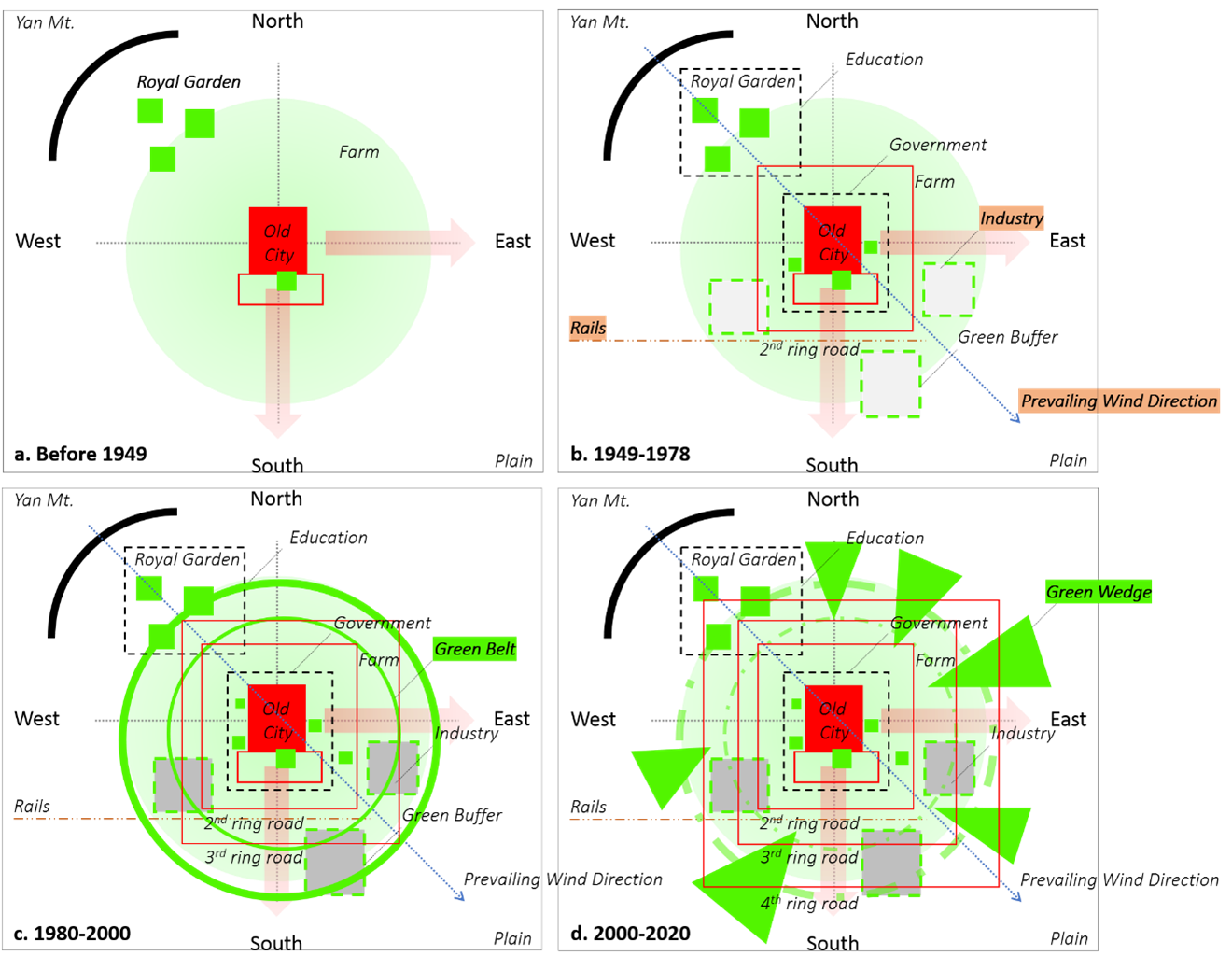
His paper focused on how the spatial distribution and formation of urban-rural green space have affected its ecological as well as socioeconomic contributions during rapid urban expansion in the Beijing metropolitan area. Relying on data construction and consumption from various sources with the support of GIS techniques and quantitative analysis tools, Wu targeted a planning approach that aims to improve the performance of the future urban-rural green spaces. The paper was supervised by his doctoral dissertation advisor, Peter Rowe, Raymond Garbe Professor of Architecture and Urban Design and Harvard University Distinguished Service Professor.
Conceptual diagram from Wu’s paper showing the distribution process of green space in Beijing.
Wu’s research during his time at the GSD has been supported by the Fairbank Center for Chinese Studies, the Harvard Asia Center, the Penny White Fund, the Geological Society of America, and the Harvard Center for Geographical Analysis. Beyond his studies, he has been involved in various scales of landscape design and planning projects, closely working with a number of renowned landscape architects in China.
Reexamining the Hidden Figures of Design: A Class on Belonging by Hansy Better Barraza
Reexamining the Hidden Figures of Design: A Class on Belonging by Hansy Better Barraza
“‘How many Black urbanists can you name? How many Latinx architects from the 20th century do you know? Maybe one? None?’ These are the questions we started with,” says Hansy Better Barraza, outlining the impetus for her spring class, “Hidden Figures: The City, Architecture and the Construction of Race and Gender.” “By the end of the course you should come away with at least 10,” she told her students, aiming to redirect focus to the field’s marginalized practitioners and give them space to shine.
The course turned out to be a particularly productive one: it generated Transforming the Timeline, a student-led initiative that features a diverse set of women who have shaped the world through their leadership in design, activism, and art. The students built an Instagram account and a website, and the class sparked a subsequent panel discussion—funded by a grant from the Harvard Graduate School of Design’s Racial Equity and Anti-Racism Fund—with the goal of investigating and reinstating authorship over histories of the built environment.
Let’s post our panel discussion online, let’s do a website, let’s make an IG page, let this knowledge be free and dispersed. It’s just so much more powerful when made public.
Hansy Better BarrazaOn sharing coursework beyond the classroom.
Better Barraza, a visiting professor, is both an architect and an activist. A cofounder of Studio Luz Architects in Boston, she also cofounded BR+A+CE: Building Research + Architecture + Community Exchange, a nonprofit that joins artists and designers with community members to create new spaces and events that benefit the communities in which they are located. Her communal design approach wove its way into the course: “A research paper is only read by the student and their instructor and is then stacked in a folder,” Better Barraza says. “I thought instead, Let’s post our panel discussion online, let’s do a website, let’s make an IG page, let this knowledge be free and dispersed. It’s just so much more powerful when made public.”
With Transforming the Timeline, the students have launched a website that reexamines the historical trajectory of design and architecture. They write, “Since its conception, the academy has convinced generations of architecture students to trust in the white male voice as a neutral, universal norm.” And they highlight the constructed nature of the historical narrative—a narrative with a position and a point of view that reflects canonized figures. But what, and who, lies beneath? The website marries the contemporary and the historical to document and “amplify women whose names are not included in architectural discourse, curriculum, syllabi, or survey text.”
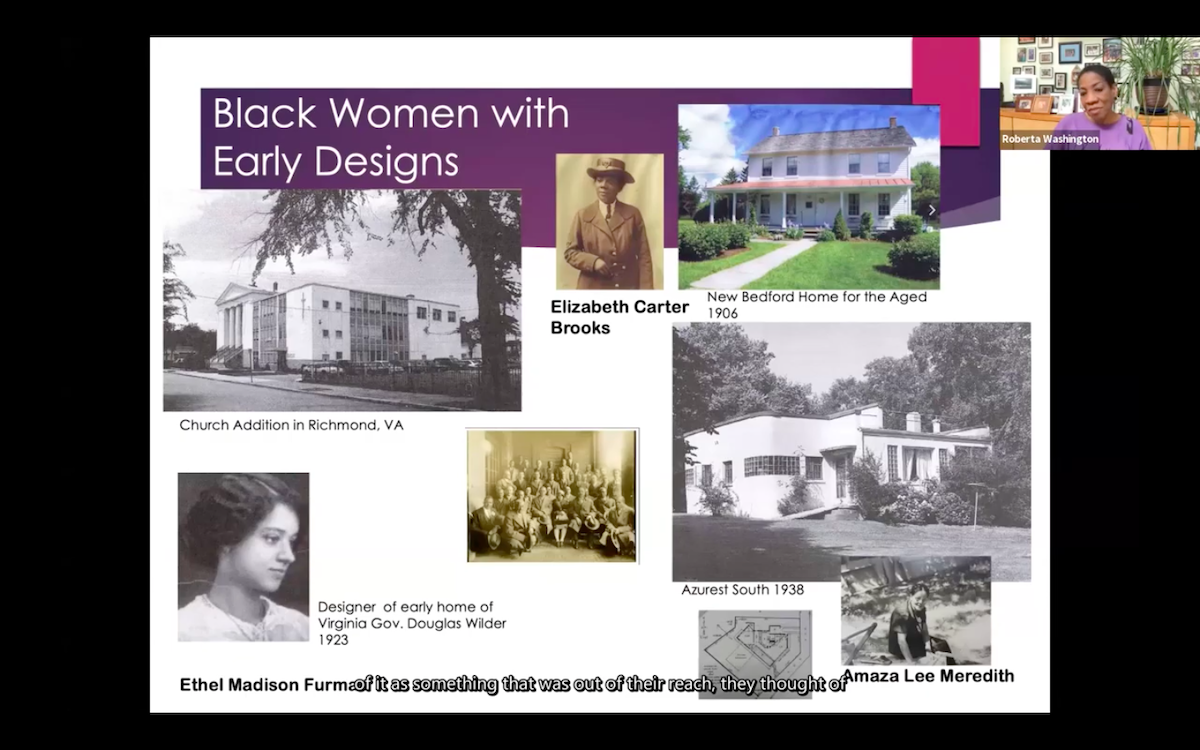
Looking back at the mid-19th century, the students have unearthed female, Black, queer, Latinx, and other marginalized architects that were present, engaged, and contributing to the development of the urban form. Likewise, the panel discussion included female and nonbinary powerhouses in touch with past and present. Architect Roberta Washington lectured on the history and contribution of Black architects, for example, and artist Marcela Pardo Ariza touched on artistic gestures that can infiltrate art and cultural institutions.
Roberta Washington presents during the Hidden Figures panel held on April 23, 2021.
While researching case studies for the course, the students used their own ethnic and geographical identities as touchstones. “You come from somewhere, those roots have shaped who you are,” Better Barraza says. She finds that contextualizing via personal background can be a compass to locate others that came before. “Belonging is key!” she emphasizes, for young designers and artists. To contribute to the discipline, “to find and acknowledge (one’s) culture. . . these are the histories that need to be talked about.” When students tie their own histories and origins to earlier working architects, it helps them to not only exist within the field, but to push it further. “Ultimately,” she explains, “these alternative bodies of knowledge will help transform the discipline.”
The @transformingthetimeline Instagram account includes a series of blurry photos and asks viewers to “swipe left to reveal the hidden figure.” Each caption tells the story of the featured woman. Click on the Instagram post above to learn more about Abra Lee, a horticulturist, writer, educator, and historian.
Alum-led Start-up Acelab Raises $3.5M in Seed Funding
Alum-led Start-up Acelab Raises $3.5M in Seed Funding
Acelab, an information marketplace of building products for architects, manufacturers, contractors, and clients founded in 2019 by Vardhan Mehta (MAUD ’21) and MIT alumnus Dries Carmeliet, recently announced it had raised $3.5 million in investment from institutional investors and industry angels. Among participating investors in its first round of funding were Pillar VC, Alpaca, Draper Associates, MIT MET fund, Emily Fairbairn, and Erik Jarnryd.
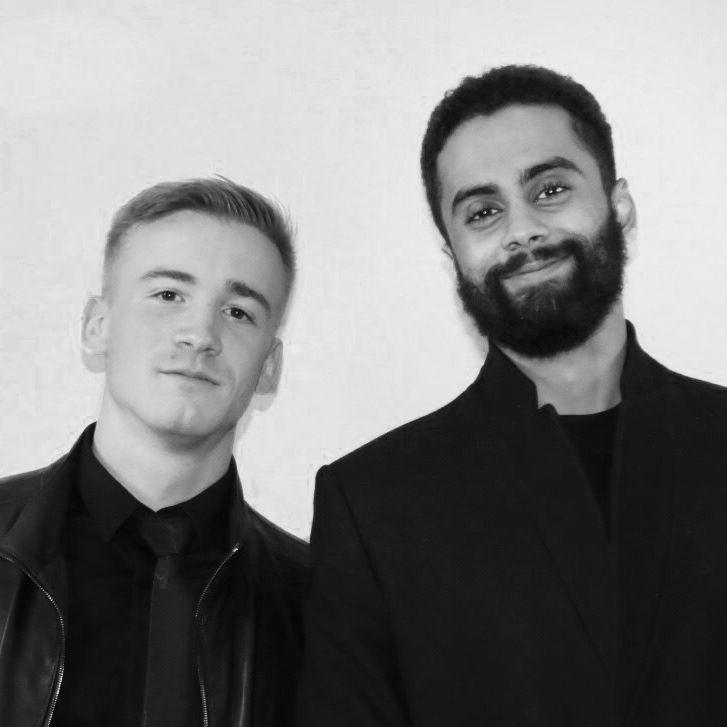
Co-founders of Acelab, Dries Carmeliet (left) and Vardhan Mehta.
As architectural designers, Mehta and Carmeliet recognized the vast numbers of hours architects spend gathering information on building products—“from sifting through manufacturing brochures and spec sheets to contacting salespeople with questions about product specs, pricing, and availability,” says Mehta. He notes that Acelab allows architects to “spend more time designing, and less time on the busy work involved in product sourcing and specifying” and manufacturers to “increase visibility and get in the spec.”
Acelab is currently running pilot partnerships with a select group of architecture and manufacturing firms in the US to prepare for its general availability launch.
Daniel Fetner, principal at investing firm Alpaca VC, explained the need for a tool like Acelab, describing it as a way to automate the “manual and time-consuming process of sourcing building materials and drafting spec sheets.” Pillar VC’s Russ Wilcox elaborated, saying, “It’s challenging for architects and building products manufacturers to coordinate, especially in this time of supply chain interruptions. Acelab’s platform makes it easy for everyone to stay on the same page. Architects can select and specify exactly the right products, manufacturers can sell more efficiently, and builders waste less time returning wrong orders.”
Last year, Acelab won the Harvard Real Estate Venture competition, received grants from MIT DesignX and MIT Sandbox, and was a finalist in Harvard Innovation Lab’s President’s Innovation Challenge. Currently, Acelab is running pilot partnerships with a select group of architecture and manufacturing firms in the US to prepare for its general availability launch.
Welcoming 2021–2022 Pollman Fellow Maximilian Buchholz
Welcoming 2021–2022 Pollman Fellow Maximilian Buchholz
A graduate of the University of Toronto with a PhD in geography, Buchholz researches urban and regional economic development. His work has primarily focused on how emerging patterns of migration and firms’ global economic linkages shape economic opportunities. Prior to earning his PhD, Buchholz completed a master of arts in Latin American studies from the University of California, Los Angeles, and a bachelor of arts from the University of California, Berkeley.
While at the GSD, Buchholz will begin a new research project focused on understanding why the wage and salary income advantages of living in a more urbanized area (a phenomenon known as “urban wage premium”) appear to be uneven across racial and gender categories.
One of the fellowships and prizes administered by the GSD’s Department of Urban Planning and Design, the Pollman Fellowship was established in 2002 through a gift from Harold A. Pollman. It is given yearly to an outstanding postdoctoral graduate in real estate, urban planning, and development, who spends one year in residence at the GSD as a visiting scholar.
GSD faculty participate in Venice Architecture Biennale’s 17th installation, “How Will We Live Together?”
GSD faculty participate in Venice Architecture Biennale’s 17th installation, “How Will We Live Together?”
The Venice Architecture Biennale has returned with its 17th installation, “How Will We Live Together?,” featuring 114 participants representing 46 countries and a variety of perspectives on the titular question from curator Hashim Sarkis—a prompt that he had established before the various events that marked 2020.
“The current global pandemic has no doubt made the question that this Biennale Architettura is asking all the more relevant and timely, even if somehow ironic, given the imposed isolation,” Sarkis observes. “It may indeed be a coincidence that the theme was proposed a few months before the pandemic. However, many of the reasons that initially led us to ask this question—the intensifying climate crisis, massive population displacements, political instabilities around the world, and growing racial, social, and economic inequalities, among others—have led us to this pandemic and have become all the more relevant.”
Broadly considered the world’s premier event of its kind, the Venice Biennale originated in 1895 as a set of art exhibitions, expanding to include biannual shows dedicated to other cultural production, including architecture. The Venice Architecture Biennale generally has been held every two years since 1980. This year’s Biennale of Architecture represents a reschedule from its original May 2020 start date, opening to the public on May 22, 2021.
On view until November 21, the 17th Venice Architecture Biennale’s main exhibition is organized into five scalar categories of work, exhibited across the Arsenale and the Central Pavilion: Among Diverse Beings, As New Households, As Emerging Communities, Across Borders, As One Planet. The main exhibition also includes a series of research stations that complement and enrich projects on display with in-depth analysis of related topics.
This year’s show commenced with an inaugural ceremony and presentation of the famed Golden Lion for Lifetime Achievement award, presented to Harvard GSD’s Rafael Moneo. In addition to Moneo’s honor, a variety of Harvard GSD faculty and students are participating throughout the 2021 Biennale’s programming; they include:
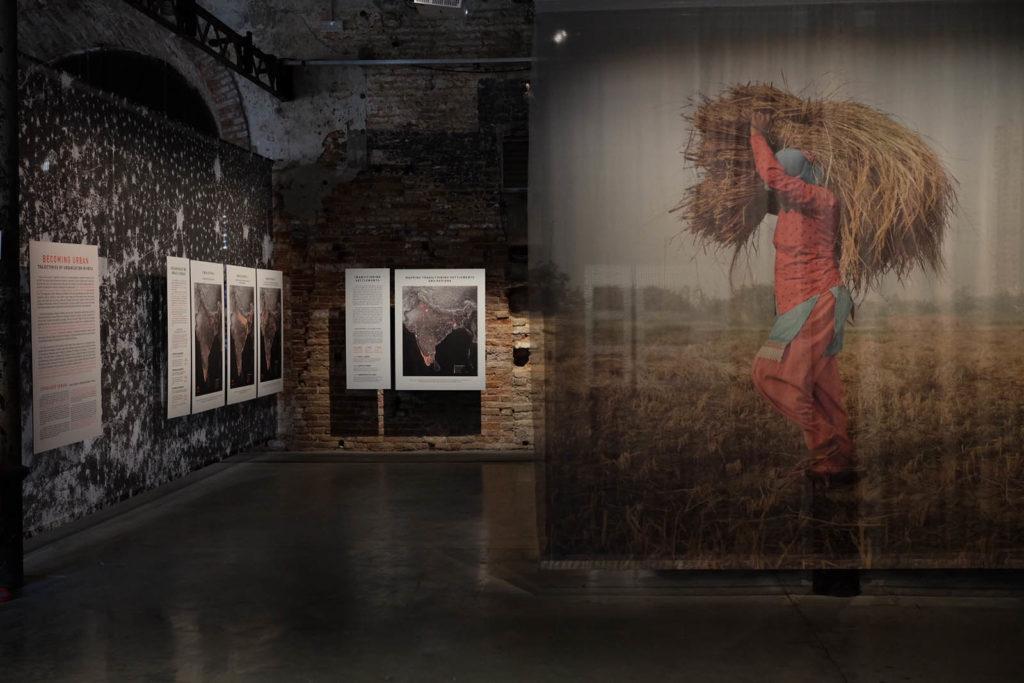
Rahul Mehrotra’s 12-minute video installation, “Becoming Urban: Trajectories of Urbanization in India.”
Rahul Mehrotra, Chair of the Department of Urban Planning and Design and the John T. Dunlop Professor in Housing and Urbanization, and his practice Rahul Mehrotra Architect are participating in the Arsenale-sited “Co-Habitats: India” installation. Mehrotra’s 12-minute video installation, “Becoming Urban: Trajectories of Urbanization in India” presents research on India’s emerging urban trajectory, as shaped by the proximity of cities to a densely populated hinterland, and as defined in the project as the urban-agrarian field. The installation hypothesizes that, in the future, low-rise and self-built typologies of informal settlements and urbanizing villages will house the majority of India’s urban population, not only within large metropolitan cities but across tens of thousands of transitioning settlements. The installation suggests that, invoking the Biennale’s guiding theme, living together in India’s cities will require architects and designers to acknowledge and empower the lived experiences of millions of households who traverse the imagined political and ideological borders of urban-rural and formal-informal that are reinforced by planning and policy.
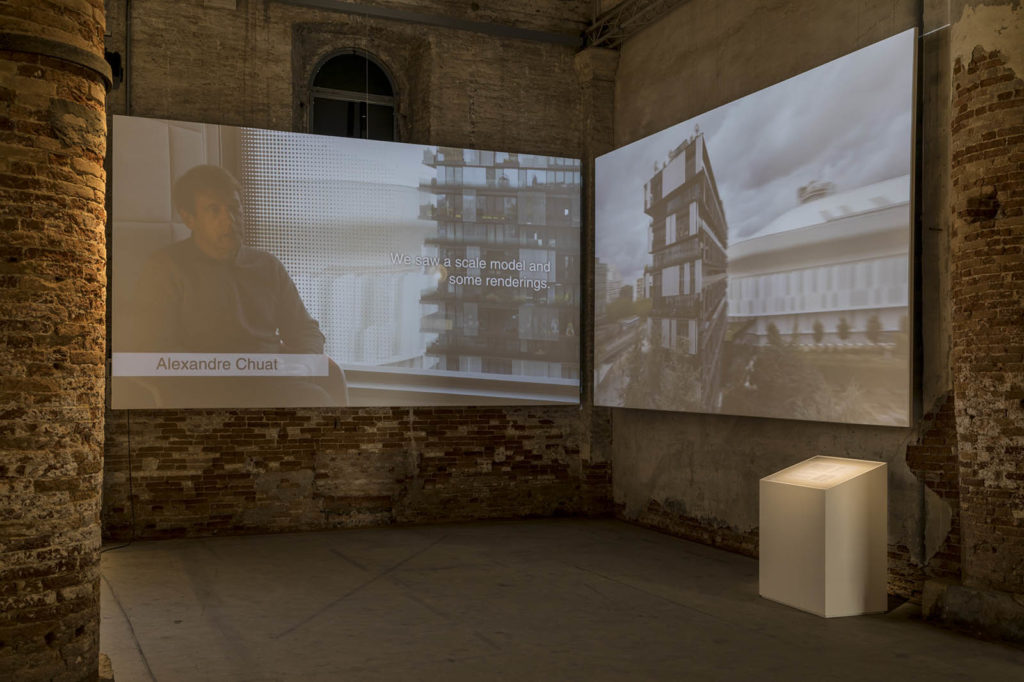
Installation view of Farshid Moussavi’s installation “Separation and Unity: Îlot 19 Residential Block, La Défense–Nanterre.”
Farshid Moussavi, Professor in Practice of Architecture, and her practice Farshid Moussavi Architecture (FMA) have installed “Separation and Unity: Îlot 19 Residential Block, La Défense–Nanterre” in the Biennale’s “As New Households” show within the Arsenale. Curated collaboratively with FMA’s Guillaume Choplain, Marco Ciancarella, and Yotam Ben-Hur, the installation presents interviews with residents of the FMA-designed, 11,500 square-meter Îlot 19 residential block in Paris’s La Défense-Nanterre, completed in 2017—the first new housing to have been built in La Défense for 30 years.
Projected on two large-scale screens, FMA’s films (produced by Tapio Snellman) present reflections from Îlot 19 residents on the connectedness they feel among neighbors, a connectedness enabled, they observe, by the housing’s architecture and Moussavi’s specific design decisions.
In designing Îlot 19, Moussavi drew inspiration from Roland Barthes’s 1977 lecture “How to live together,” which questioned the balance between collective sociability and individual freedom as shaped by physical distance and design, as well as from a 1979 project by Pierre Bourdieu: a stratified map of social space that suggested social capital is not uniformly and democratically inherent, but rather, dependent on an individual’s social status. As FMA describes, Îlot 19 combines private apartments, student lodging, and commercial and public spaces within a single project, striking toward social cohesion and inclusivity and absent of visual cues that suggest hierarchy. Apartments are arranged to be laterally accessed in pairs by an elevator and stair core, regardless of tenure type; both the student lodging and the private residences feature private outdoor spaces, and throughout, homes benefit from natural cross-ventilation as well as natural light and views of Paris.
Allen Sayegh, Associate Professor in Practice of Architectural Technology, has co-curated the Armenian pavilion “Hybridity: a machine for living together,” which opens in the Pallazzo Ca’Zenobio on August 28 and is on view through November 21.
“Hybridity: a machine for living together” presents three large-scale installations, interspersed among the Pallazzo’s grounds and designed by INVIVIA. Drawing upon elements of augmented reality and physical and digital manipulation, the installation seeks to evoke the connections among 80 different communities of Armenian descent, currently located across the world. The installation culminates in a hall of mirrors that generate an opulent baroque ballroom, filled with fresco paintings that, as Sayegh notes, play with the visitor’s perception of the architecture and the space in view, and how one’s body occupies the space. A large, floating reflective surface coupled with elements of augmented reality further provoke the viewer.
“We wanted to create the feeling of slight discomfort or unease but at the same time, through a combination of augmentation and physical installations, give the visitor an experience that allows them to see the spaces anew and more than the sum of the parts,” Sayegh says. These effects, in turn, evoke some of the global effects of the Aremenian diaspora, through which millions of Armenians have spread out all over the world, adapting to new socio-cultural contexts while keeping strong relationships to their Armenian identity and sharing share a rich culture community strengthened through intangible qualities, especially the senses.
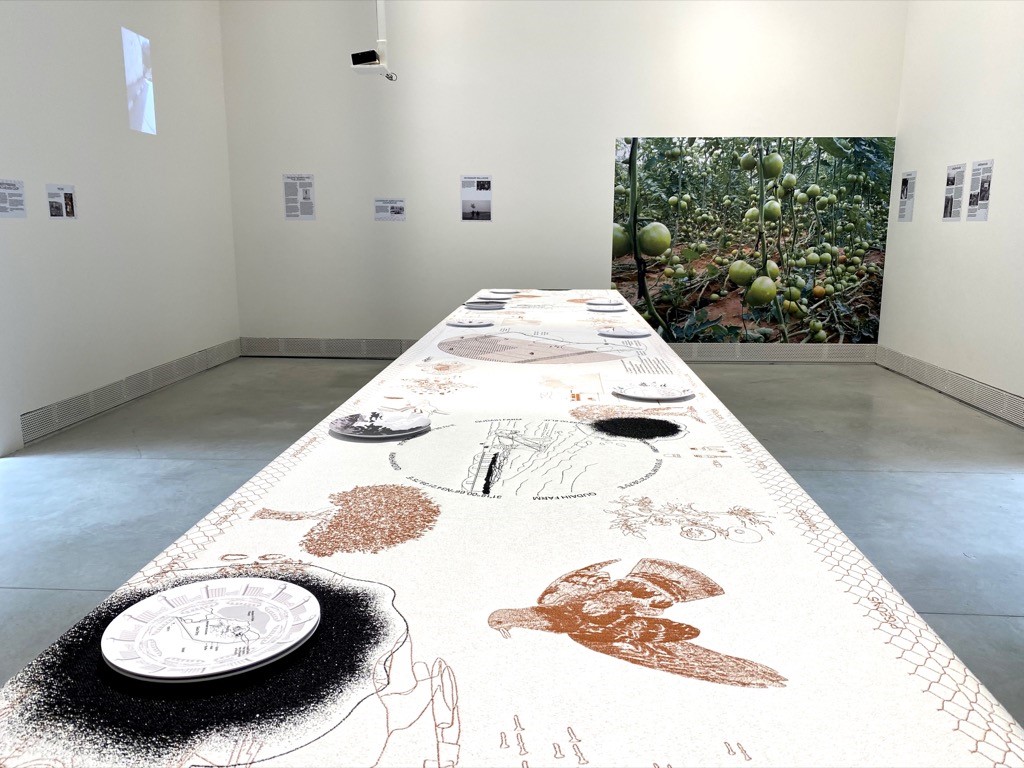
Installation view of Malkit Shoshan’s “Border Ecologies and the Gaza Strip: Watermelon, Sardines, Crabs, Sand, and Sediment.”
Malkit Shoshan, Lecturer in Architecture, and her practice FAST have installed “Border Ecologies and the Gaza Strip: Watermelon, Sardines, Crabs, Sand, and Sediment” in the Biennale’s Central Pavilion, one manifestation of FAST’s ongoing “Border Ecologies” project. Exploring the emergence of unexpected spaces in response to stresses and war at the Israeli-Palestinian border, Shoshan and FAST curated more than a dozen oral histories of daily life on a farm in Khuza’a, a Palestinian agricultural village in the Gaza Strip situated along one of the territory’s most militarized borders with Israel—a village that Israel has been attacked numerous times in recent decades. In particular, Shoshan and FAST engaged in ongoing conversations with 27-year-old Khuza’a resident Amir Qudaih about his family farm and the destruction it has endured. Collecting these and other stories, “Border Ecologies and the Gaza Strip” manifests as a dining table and a custom-made tablecloth, designed by Shoshan with Sandra Kassennaar and in collaboration with the Qudaih family. The physical installation narrates layers of stories about daily life and ongoing atrocities in the region, complemented by a pair of film projections link everyday farm life with footage of the perpetual violence the villagers face, as captured on mobile phones by Khuza’a farmers.
As Shoshan and FAST were preparing the Biennale installation in May, violence erupted anew at and around Khuza’a and the Gaza Strip, destroying the Qudaih family farm and forcing the family to shelter in their home. “It was emotionally challenging to install the show and present it to the world,” Shoshan observes, “as during the preview and opening of the Biennale, both the community of farmers I worked with in Gaza and my family in Tel Aviv were literally under fire and at the midst of war.” (“Border Ecologies and the Gaza Strip” was profiled by ABC News in May 2021, alongside select other Biennale moments.)
Sarah M. Whiting, Dean and Josep Lluís Sert Professor of Architecture, has authored an essay entitled “Linger, for a Moment, in the City” for the Biennale’s official publication, Expansions. Therein, Whiting meditates upon how, in an evermore public and urban world, people across societies may slacken the pace of life in order to truly live more publicly shared lives. “The chaotic exuberance of our growing density offers extraordinary opportunities to render urbanity public in its very gaps and uncertainties,” Whiting observes. “Opportunities lie between our front doors and the street, in lobbies, and between floors; they lie along streets and in the entrances to parks. Rather than succumb to the homogeneous efficiencies of Otis, Schindler, and JCDecaux, design can produce prospects for an ornery notion of exchange. … Contemporary public life might better be understood as a kind of discursive cigarette—without smoke or nicotine, but with plenty of metaphorical fire—over which one can linger while sharing the exotic air of so much new and intense urban life.”
Whiting is also Creative Director of the “Border Choreographies: Identity, Body, Personhood” film that is part of the “City x Venice: Italian Virtual Pavilion,” collaborating with Harvard GSD students Adriana David, Eva Lavranou, and María Gracia San Martín, and video editor Angela Sniezynski. “Border Choreographies” presents research initiated at Harvard GSD examining the experience of bodies crossing international borders, focusing on air and land and taking as case studies the US International Airports and the Caravana Migrante route from South America to the Mexico-US border. The project foregrounds a human-scale view amid broader geopolitical dialogue in order to connect personhood and identity with territory and nationhood.
Jungyoon Kim, Assistant Professor in Practice of Landscape Architecture, presented a publiclecture as part of the ongoing research and dialogue informing the Korean Pavilion’s “Future School” installation. As described by the Korean Pavilion’s curator Hae-Won Shin, “Future School” converts the pavilion site into a new sort of virtual academy: an “international incubator for radical thinking and the exchange of ideas and projects that actively explore the notion of building a better future.” The “Future School” installation offers more than 50 programs and lectures exploring issues that range from cooling urban environments and the futurology of schools to innovative spatial interventions and borders as spaces of integration. This series of programs forms the so-called first academic cycle of “Future School,” a cycle that launched in summer 2020 with several preliminary programs held in Seoul, including Kim’s lecture, “Border as Territory,” which was broadcast live to a global audience during its July 9, 2020 presentation. The various programs and interventions taking place during this year’s Biennale will then inform and compose a final “semester back” in Seoul, offering an exploration of the archive and dialogue being generated via the pavilion.
Marc Angélil, Kenzo Tange Visiting Professor in Architecture and Urban Planning and Design, is among the exhibitors participating in “Co-Habitats: Addis Ababa” in the Arsenale. The installation presents coexisting spatial layers that each representing a particular political regime whose traces remain in Addis Ababa’s socio-spatial fabric, gesturing toward the context upon which future urban and regional development for the city will depend.
Kersten Geers and David van Severen, each a Design Critic in Architecture, are exhibiting in the Bahrain pavilion entitled “In Muharraq: The Pearling Path.” As described in the official Biennale curatorial statement, the exhibition “presents both the results and the process of making, through models, objects, minutes of meetings, artefacts, drawings, and conversations, showing the project in its current state. It explores the challenges in reviving the memory of pearling, as a backdrop to a culturally-led development approach and as a binder between the physical makings of the city and its identity, and questions whether pearls, oysters, coral stones, cars, and humans can sustainably and generously cohabit in the city today.”
Charlotte Malterre-Barthes, Assistant Professor of Urban Design, is among the curatorial team behind the German pavilion “2038: The New Serenity.” The pavilion presents a series of original films that depict a world in the year 2038, fictional but based on current realities as well as idealized visions.
Reclaiming Asian-American Garden History: Yoni Angelo Carnice researches the work and legacy of Demetrio Braceros at San Francisco’s Cayuga Playground
Reclaiming Asian-American Garden History: Yoni Angelo Carnice researches the work and legacy of Demetrio Braceros at San Francisco’s Cayuga Playground
Yoni Angelo Carnice's "Sunlight Entered His Hands"
When Yoni Angelo Carnice (MLA ’20) first visited Cayuga Playground in San Francisco, he was struck by a wooden sculpture of a woman dressed in the traditional Filipino Maria Clara gown, with a graceful elegance that reminded him of his grandmother. The distinctively personal atmosphere of the park stayed with Carnice, and later became the basis of his year-long research project, “Eden of the Hinterlands: Reclaiming Asian-American Garden History,” under the Douglas Dockery Thomas Fellowship in Garden History and Design, sponsored by the Garden Club of America and the Landscape Architecture Foundation.
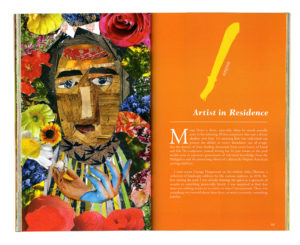
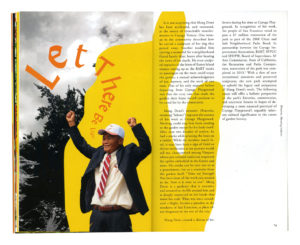
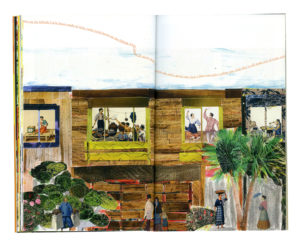
Spread from Yoni Angelo Carnice’s Sunlight Entered His Hands
Before coming to the Harvard Graduate School of Design, Carnice worked in ecological restoration and climate-based policy work. “I was doing very regimented invasive plant removal, and planting native plants, in a more binary way.” He sought a more fluid, holistic approach to landscape architecture. His time at the GSD and his experience at Cayuga Playground, which “weaves landscape narratives, plants, and architecture together in a beautiful way,” was a revelation. Located in the Outer Mission district, it is an unexpected, idiosyncratic gem in a city dominated by “mow and blow” parks. And it is largely the work of one man, Demetrio Braceros, a Filipino immigrant who became Cayuga’s gardener in 1986.
Spread from Yoni Angelo Carnice’s Sunlight Entered His Hands
Over 23 years, Braceros devoted himself to the park, often cultivating plants at home before bringing them to work. On lunch breaks, he carved hundreds of sculptures from cypress wood, acting as artist, craftsman, and gardener. “Because of Braceros’s care and attention,” Carnice says, “he shifted the park into something the community valued.”
The American immigrant dream is often defined as settling into one’s own house and garden. Cayuga Playground represents a different kind of dream, where an immigrant gardener can cultivate a community space that represents his own Filipino American heritage. A Virgin Mary sculpture evokes Filipino Catholic traditions; a sculpture of Barry Bonds, who played on the San Francisco Giants, celebrates San Francisco sports. “You can see that his joy of being an American, of being Filipino, of being a part of this community—it’s all physically represented in the landscape,” Carnice says.
Spread from Yoni Angelo Carnice’s Sunlight Entered His Hands
The park is also a testament to the potential for landscape architecture to activate and sustain community. Braceros’s sculptures included memorials for neighborhood friends (and dogs) who passed away. “His art,” Carnice writes, “comes out of a Filipino sense of duty to cultivate familial relationships with those around you.” Braceros’s generosity and care is reflected in the community’s love for the garden, which Carnice experienced firsthand when beginning his research. “The scale of the project was going to be very small,” Carnice reflects. “But as the work started to expand and more and more excitement was generated around it, I realized it was becoming a lot bigger.” Since Braceros’s retirement in 2008, community members have been active advocates of Cayuga Playground.
Sunlight Entered His Hands
00:00
00:00
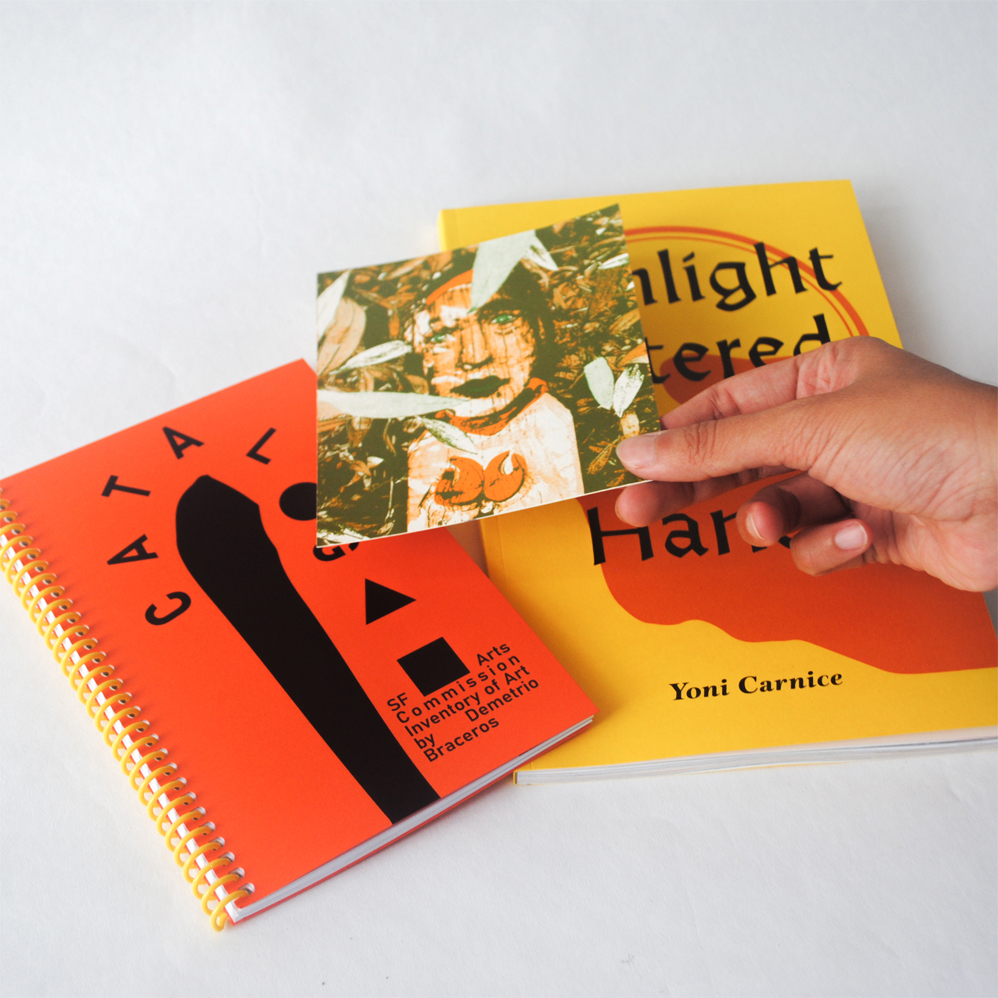
[Video Description: Hands open and flip through a package containing a postcard, catalog, and the book Sunlight Entered His Hands.]
Their stories are part of Carnice’s publication, Sunlight Entered His Hands, an exuberant and intimate history of the park and the community’s ongoing preservation efforts. The book is “for the community, first and foremost,” Carnice says. “Design work often feels very extractive: you go into a community, get something there, and present [it back] to a very small design audience.”
An extractive approach was inadequate here, where community members were as generous to Carnice’s work as Braceros was to them. Instead, Carnice printed copies of his book for a community event in early July, which brought the community together after a difficult, isolating year of COVID-19. It was both a joyful and difficult commemoration, as the garden has changed significantly since Braceros’s retirement.
“The horticultural paradox of the garden is fascinating to me,” Carnice says. Braceros’s ornamental horticulture approach brought together tropical and Mediterranean plants in a vivid, improvisational planting. But the use of water-intensive hydrangeas posed a problem. The hydrangeas are a living symbol of the community’s cultural memory: a beloved community member passed away while tending to them, and for Carnice, hydrangeas are particularly evocative of an older Asian community and their gardening practices. But nearly all of them have been removed by the park’s new gardener.
Carnice is sensitive to the difficulties of the city’s restoration efforts, having talked to both city employees and community members. But his research has convinced him of the need to fuse ecological and aesthetic concerns together. “These [sculptures], these landscapes, are a manifestation of the community,” he says. As the community and city consider preservation of objects and place (physically restoring Braceros’s wooden sculptures, questioning how to restore or depart from the original planting plan), Carnice thinks about how to preserve the cultural and institutional memory of Cayuga Playground. “I wanted the book to be a representation of different ways to look at preservation: through interpretation, memory, writing.”
Sunlight Entered His Hands reflects Carnice’s commitment to a deeply personal approach to landscape architecture, one that shifts between different scales and mediums. “Right now I’m designing a botanical garden—but then I might be making collages for another project, or planting someone’s garden, or writing about another person’s garden.” And Carnice’s next project involves a shift in geography: working with Soft Spot, a spatial design collective, in the Philippines. What ties these projects together is Carnice’s dedication to landscape expression, no matter the form, and to centering alternative garden histories, like the work—and legacy—of Demetrio Braceros at Cayuga Playground.
Small Institutions: On rediscovering the emotional conditions of architecture
Small Institutions: On rediscovering the emotional conditions of architecture
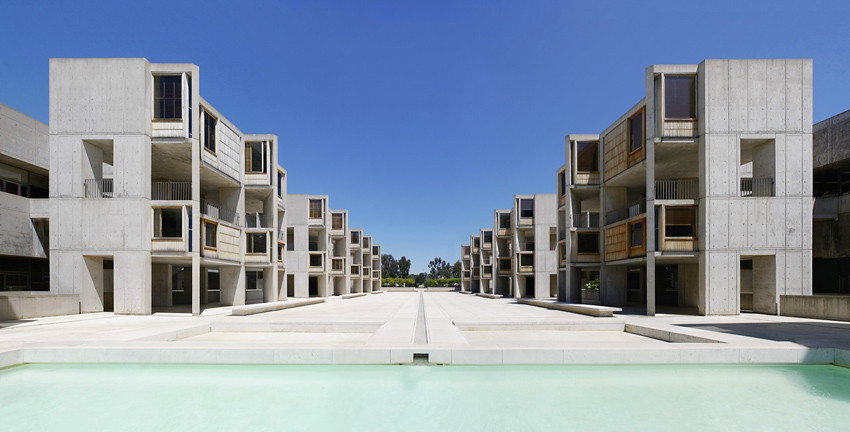
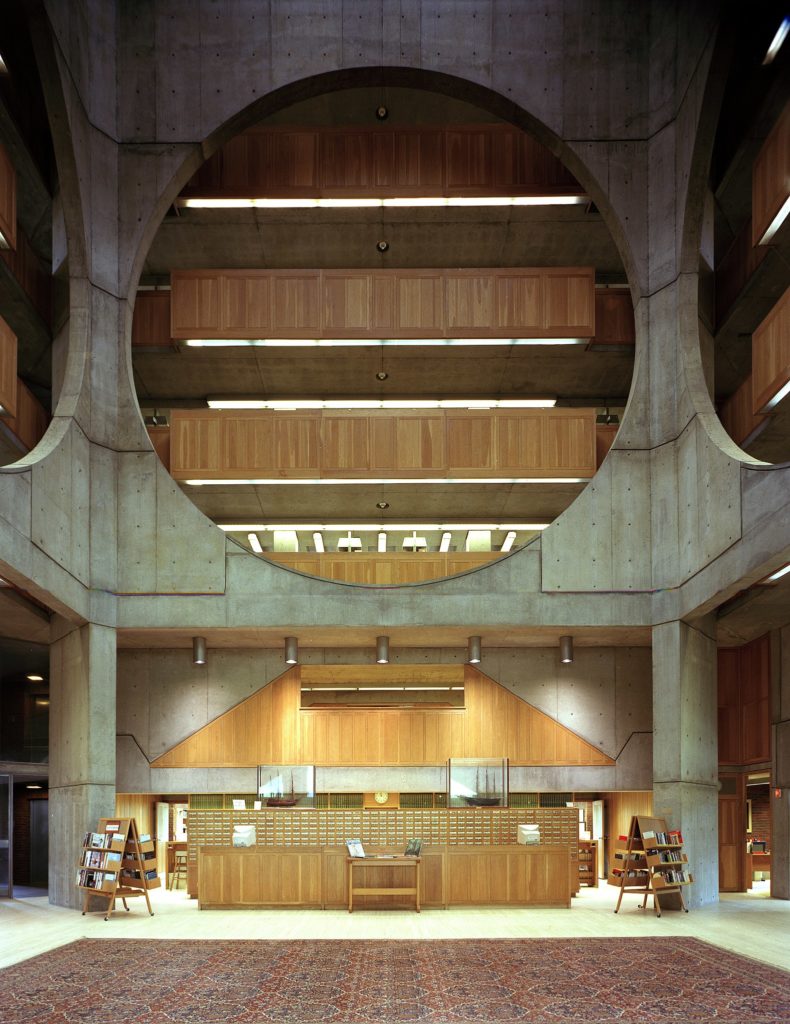
The city, according to Louis Kahn, arose through the establishment of institutions. By extension, he defined its “greatness” as “how sensitive [those institutions] are to renewed desire for new agreement.” Agreement, in this context, does not necessarily entail a declaration or even a conscious decision on behalf of any party. Instead, it may arise from a shared recognition of an ephemeral condition that creates “a center around which existential space is organized.” For example, Kahn believed “agreement. . . is what made the school a school, or what inspired the first room. It was an undeniable agreement that this man who seems to sense things which others don’t should be near the children so they can benefit from such a man.”
When held to this standard, most, if not all, cities lack greatness. As Foucault and others have observed, many of our institutions, from schools to hospitals, have become manifestations of and tools for power instead of sites of cooperation, dialogue, and exchange. Their architecture and design atomizes by intention, separating people into individual cells or precisely demarcated spaces where they are sequestered and observed, and thereby controlled. Our institutions, from Kahn’s perspective, have “lost their inspirational impact of their beginning and have become operational.”
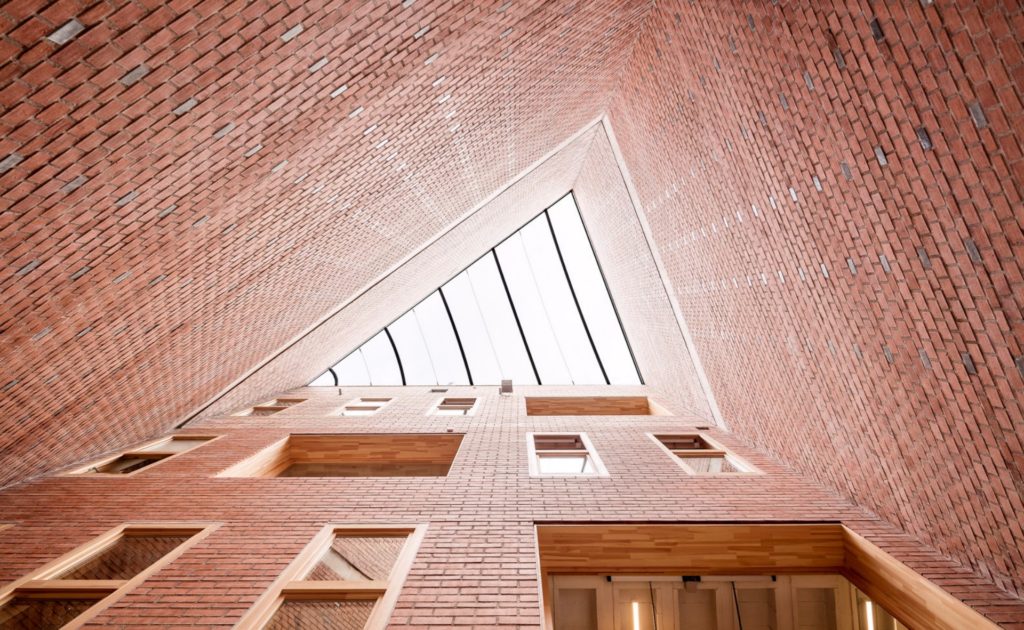
For the spring 2021 studio “Small Institutions,” Roger Tudó Galí, Josep Ricart Ulldemolins, and Xavier Ros Majó—three partners at HARQUITECTES in Sabadell, Spain who served as the John C. Portman Design Critics in Architecture at the Harvard Graduate School of Design for the semester—took Kahn as their inspiration and asked students to identify the primordial essences of various institutions: library, museum, school, temple, town hall, market, theater, hospital, swimming pool, and courthouse. By focusing students’ attention on determining and responding to the Kahnian agreement from which these institutions arose, the rituals inherent to these spaces become constitutive of their designs. In turn, this exercise illuminates how forms of communal interaction and public engagement have been lost and how they could be resuscitated. Moreover, it encourages a wholesale reconceptualization of architecture in which the plan begins with nothing, to which only the necessary is added.
“A lot of new institutions are losing the emotional conditions of architecture, becoming too functional and rational, and just working to avoid practical problems,” says Tudó Galí. “We are very much about going against these preestablished ideas and the pragmatic approach to building. Instead, we try to rediscover the platonic idea of a place and its activities.”
Centro Cívico Cristalleries Planell 1015 by HARQUITECTES. Photo: Adrià Goula
A novel methodological approach was fundamental to achieving these objectives, beginning with the non-architectonic meditation on agreement rather than a site-specific design problem like those typically given to students. “In general, from our experience teaching in Spain, we are always short on time in the projectural process when deciding what is really essential in architecture,” explains Ricart Ulldemolins. “We feel that students waste energy in terms of their approaches, whether academic, social, or personal. Here, we’re talking about institutions, not specifically about building, in order to put students into a very specific situation to come, from the very beginning, to the essential in architecture.”
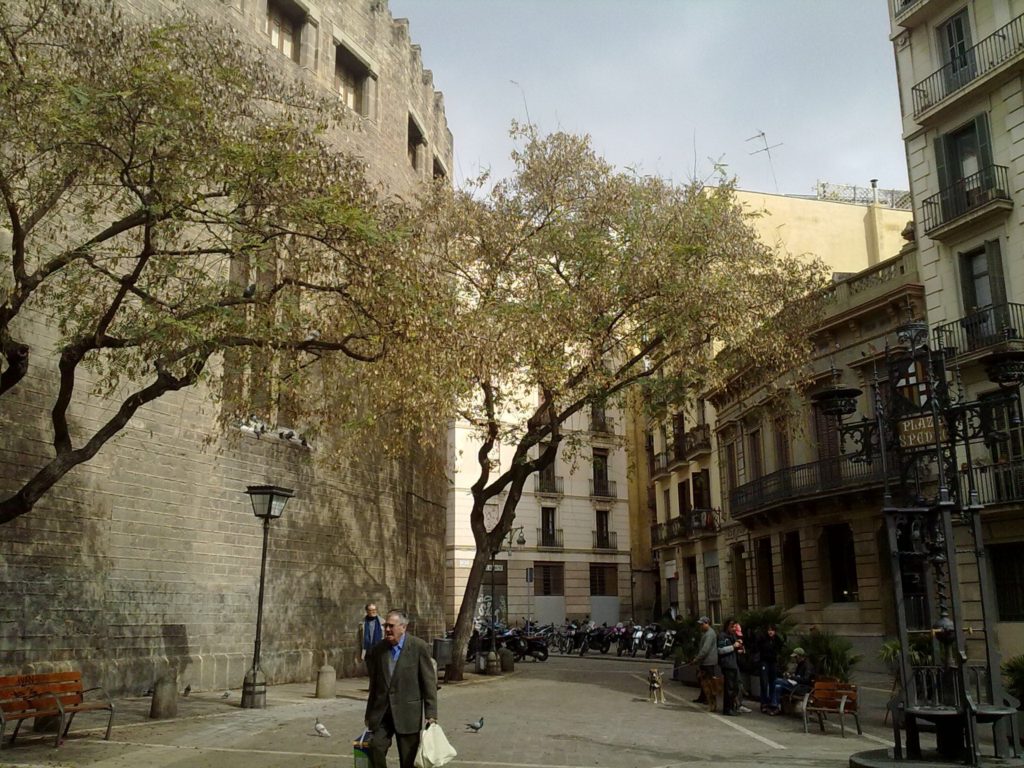
The site chosen by the trio aided their directive that the students eradicate any dependence on established forms. Located within a high-density block in the Sant Pere, Santa Caterina i la Ribera neighborhood in the oldest area of Barcelona, the long, narrow plot between party walls measures just 493 square meters. Connected to adjacent streets, it was created through the hypothetical demolition of existing buildings. Ros Majó describes their selection as “a kind of trap for the students,” as the size, especially when considered with its irregular geometry, is too small to accommodate a conventional-size institution.
Sant Pere, Santa Caterina i la Ribera neighborhood in the oldest area of Barcelona. Photo: Héctor Navarro Buil
More radical than its challenging dimensions, however, was that the site wasn’t disclosed until about halfway into the semester. Unbound by location or other restrictions, the students could first concern themselves solely with their unique institutions, the elemental aspects of which, the professors hoped, would become more definable with each task assigned.
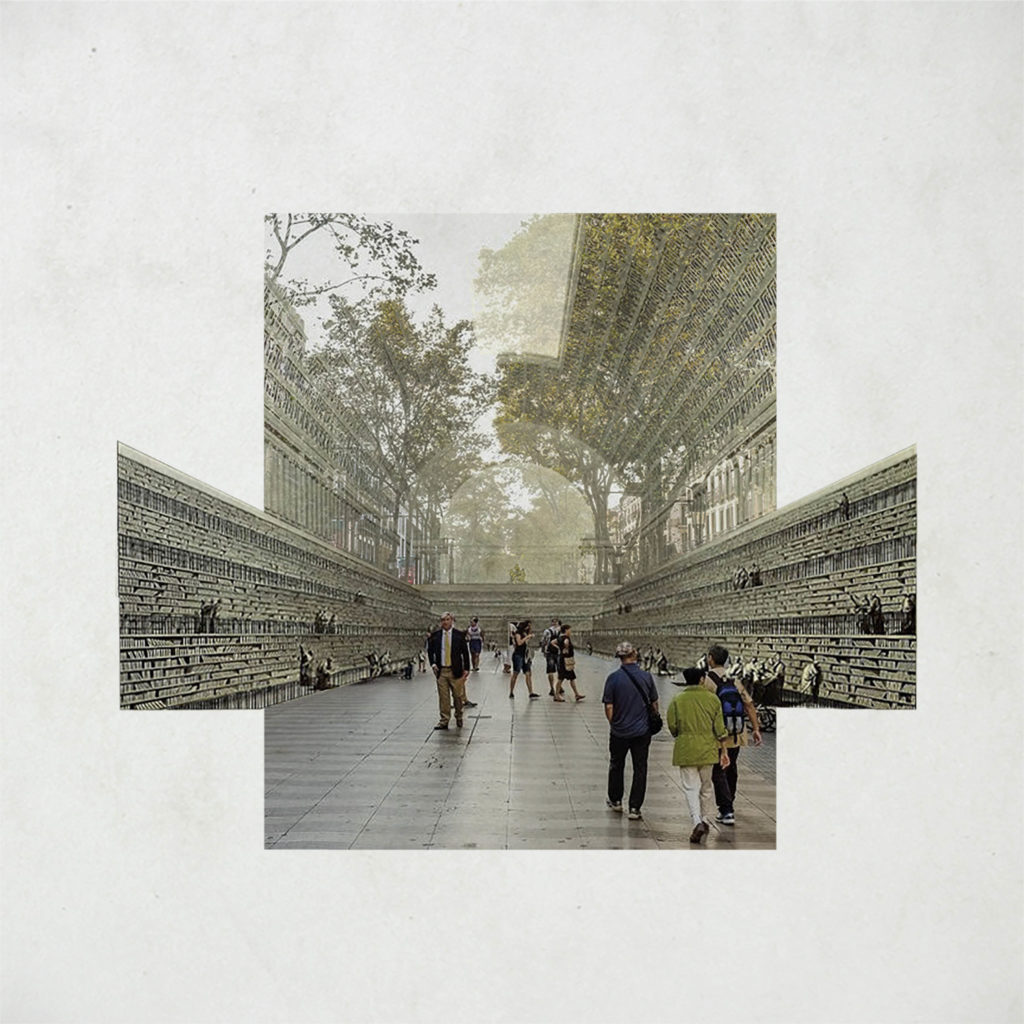
The first assignment foregrounded introspection. Each student chose four photographs and built a collage as a means of creating an individual and unexpected hypothetical institution. “We didn’t want the project to focus just on the visual, but this was the fastest way to produce a personal approach rather than one based in a very abstract, general, or ambitious concept,” says Ricart Ulldemolins. With the library, for instance, Alexis Boivin (MArch ’22) fused street images with Étienne-Louis Boullée’s epic proposal for the Bibliothèque nationale in Paris. Boullée’s vaulted ceilings are here made transparent, declaratively introducing the urban into the space. At the same time, perambulators heighten a sense of the library as a free and open public institution as they evoke those browsing or just walking by the bouquinistes stalls along the Seine.
Alexis Boivin’s collage of street images and Étienne-Louis Boullée’s Bibliothèque Nationale in Paris.
Following this warm-up exercise, the students began historical research in order to determine what parts of institutions had been retained over time, with an emphasis on typologies. “The delivery was not only to understand an evolution in history but to understand what is and is not important, and to propose what should be included in the next step of that evolution,” says Ricart Ulldemolins.
As well as providing a generative cultural-historical perspective on these institutions, the assignment, Tudó Galí explains, helped reveal the negative aspects of these spaces that have persisted. “The most boring part of the institutional idea is when it becomes a building that is repeated a lot and becomes part of an automatic system. The specificity of the design is lost,” he says. “The idea for the students was to stop this evolution and take a more open point of view, to try to produce something which defines a very specific solution and not a repetition of the same kind of buildings.” This in turn led to designing archetypes of their institutions inspired by this research—models that illustrate the main performance that takes place in each space and that define their need to exist (as opposed to site-specific concerns).
The emphasis on performance remained central in the subsequent assignment, when the site was revealed but not yet addressed as it typically would be. “We asked the students not to do a very conventional research process to understand the site but instead a short exercise that we call ‘the ephemeral project,’” says Ricart Ulldemolins. “It should be something that is not exactly a building but something that can be removed, to make the definition of the ritual stronger. It was quite a difficult moment for them, to try to expose them to the institution not as an object but as a happening,” says Tudó Galí. “Most of them work on buildings or objects but not on the activity,” adds Ros Majó.
Ricart Ulldemolins notes that not only graduate students but architects broadly have difficulty projecting the performatic part of the institution onto a site. “I think it’s a general misunderstanding of the profession to confuse the shape of the object and the object itself with the experience of people,” he says. “Our experience in a building is not exactly the design of the object. It’s the design of the experience produced by the object.”
The next step—“the primordial space,” as the professors referred to it—brought together the studies of archetype and ritual, with specific emphasis on the atmosphere of the space and haptic experiences related to temperature, materiality, natural light, and proportions. Tudó Galí believes it was the most important delivery, as it asked the students “to define what could be considered the most essential space in these institutions” and relate that to the site itself. It was the first time that the students’ assumptions of what was inherent to their institutions were brought into conversation with the material and geometrical realities of the constrained site. This confrontation stripped away additional notions of what is necessary, further distancing the designs of the institutions from the status quo.
As if this process were not surprising and confounding enough for many, the trio had a final twist—“the strategic detail”—that would further ask the students to rethink their approach to architecture in and beyond this studio. “The strategic detail is a combination of the main strategies and the smaller definition of a building,” explains Tudó Galí. “The detail cannot be understood without the general idea, and the general idea cannot be understood without the detail. In this holistic idea, everything is the same, just at a different scale or dimension. It’s not a fragment or a part that goes after the main decisions. It’s a detail that holds the possibility of changing everything.”
This directive required the students to determine an aspect of the total design from the previous assignment that was connected to the essence of the institution as developed throughout the semester. Once identified, that detail would then need to solve smaller problems through its incorporation into the space. “It started to shake everything for them a little bit, to determine if their previous ideas were a little naive,” Tudó Galí adds.
Alexis Boivin’s library for spring 2021 studio “Small Institutions.”
Boivin, with the library, and Diandra Rendradjaja (MArch ’22), who was assigned the market, both agreed that the methodology the professors developed forced them to question constantly how they approached their designs. “Normally in studios, you’re given a prompt at the start and work at your own pace, defining by yourself the small steps you’re taking,” says Boivin. “But the professors were precise in setting goals for us, which really helped throughout the process. Libraries are usually humongous spaces placed in flat, unbounded plots. The assignments, such as narrowing the task and focusing on the evolution of libraries throughout time, really forced the project to take a radical approach and refine what the essential qualities of a library are. The site made almost irrelevant the canonical libraries that I looked into because they wouldn’t accept or fit into this kind of space. Instead I had to achieve monumentality through small spaces or aspects of light that adjusted to those smaller spaces.”
At first, Boivin sought to play with movement, with a design that carried people throughout the library, and specifically around books, in a dynamic manner via stairways and ramps. But the process encouraged a more concentrated design, built across three levels. The ground floor resembles an agora, almost empty and fluid with low bookcases on which people can sit and that encourage communal engagement. The second floor—with individual reading and storage rooms—creates a more intimate relationship with the book. Openness returns in the third floor’s grander reading room. It features a table which follows the perimeter of the room and large windows that create a sense of suspension for occupants between the courtyard and the multistory surrounding buildings. In Boivin’s words, the plan emphasizes “circulating, browsing of books, and reading as a celebration of knowledge” as well as “the activity of encountering its physical form.”
Alexis Boivin’s library for spring 2021 studio “Small Institutions.”
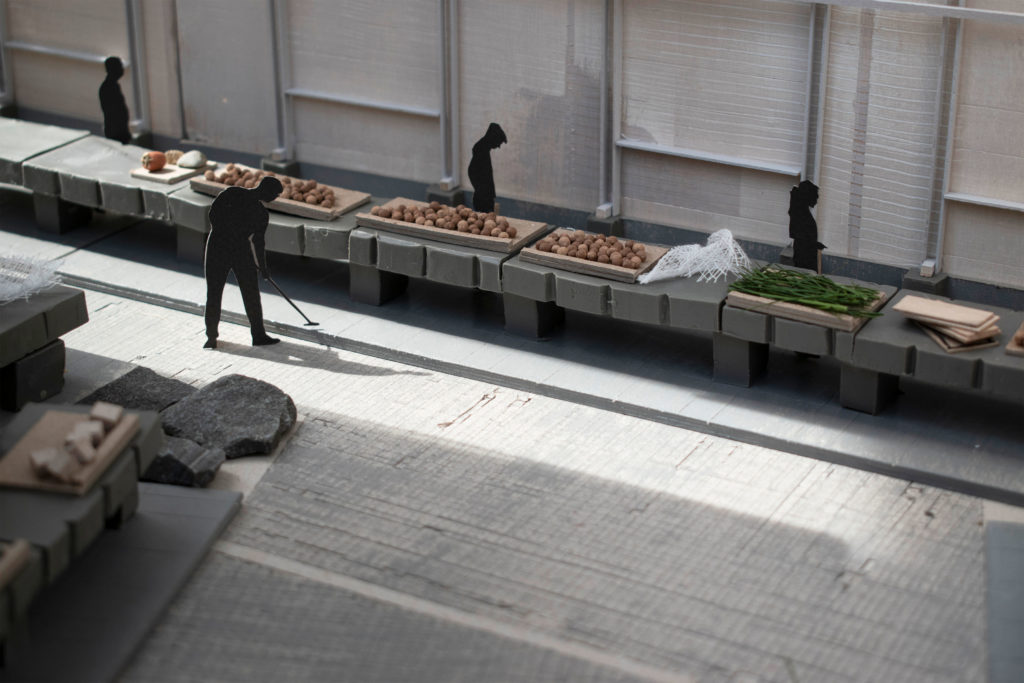
Rendradjaja also focused on public access and openness but further emphasized the site’s street-like nature. “In Barcelona, specifically in the context of the Old Town, the street is the only public ground,” she says. “Unlike the nearby Cerda blocks, which have courtyards, people here have less access to common space. The street-facing windows and balconies of neighbors are used as laundry-drying racks and plant hangers, as they are the only exterior space they have. The streets are the void between private properties. Because markets are public spaces, I felt the need to leave mine, which is almost the size of the streets around it, as empty as possible. It could be seen in multiple ways: the backyard to the surrounding buildings, a new plaza that’s half-covered, or a new courtyard that was missing from the neighborhood.”
Diandra Rendradjaja’s market for spring 2021 studio “Small Institutions.”
Just as Boivin’s historical research and the initial ideas for the library it prompted became largely irrelevant, Rendradjaja experienced significant shifts in her understanding of the market. “What I thought about at the beginning of the semester didn’t transfer at all,” she says, addressing how the methodology led to an understanding that the essence of the institution should dictate form and that the site should not restrict an architect from upholding that essence as primary. “Roger, Xavi, and Josep’s approach to the studio and in their work is always to try to find the most precise solution—not in the sense that there’s only one ultimate answer but finding one out of many possibilities to do something that’s simple, straightforward, and smart. It’s about doing something with very minimal effort but maximum effect,” she explains. “So the ephemeral exercise, which for me was the most eye-opening, was about discovering the ritual of an institution—the activity, not the building itself or its construction. In my case, that was market exchange and maintenance, and the minimum elements you need in order for that to happen. That was the moment I realized what the studio was about, and I thought it was very helpful throughout the semester.”
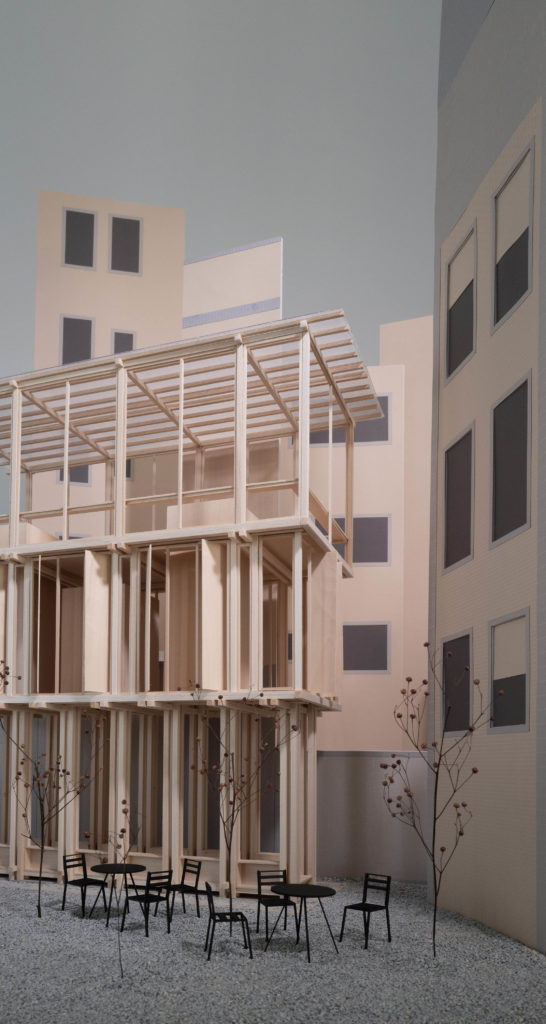
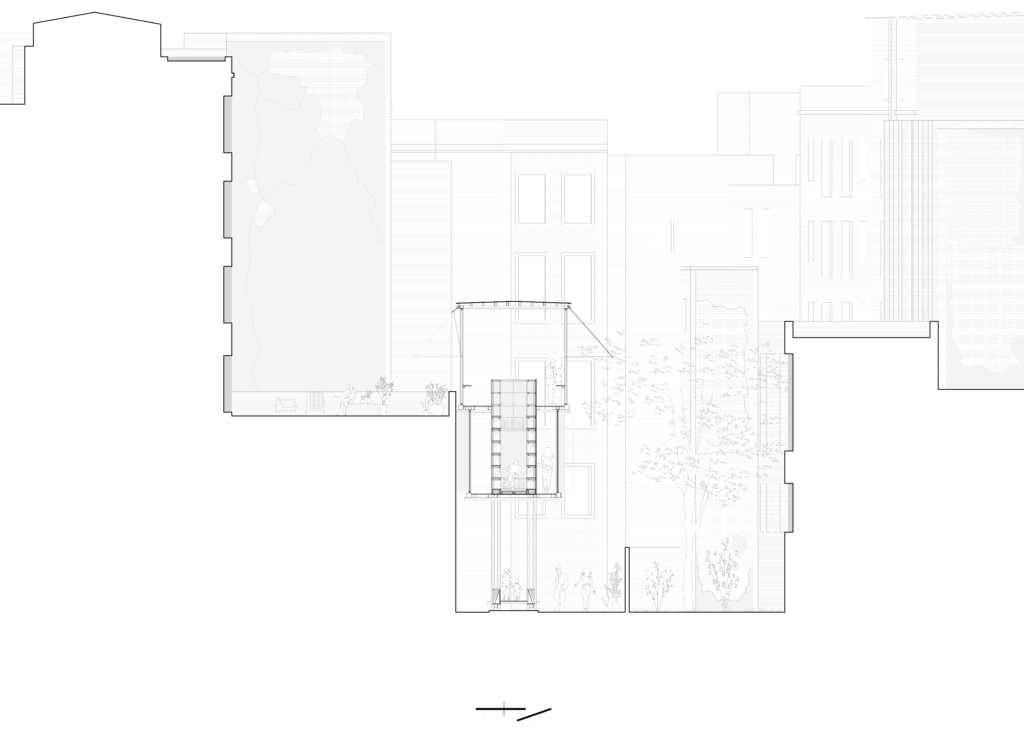
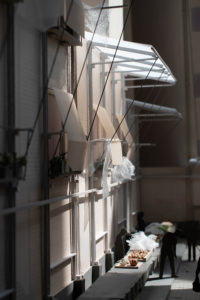
Rendradjaja’s design reclaims the market from the enclosed hall, which she characterizes as “selective of its merchants and detached from the public surroundings as it forms a private entity,” and returns it to the open-air street as a “universal public space.” The design’s central facet is “a series of roofs, held by engaged columns that are structurally supported by and dependent on the existing walls.” These hang over the rows of stone tables permanently installed on the ground. At different elevations, they enable palpable light and shadow changes. Situated much higher than in traditional markets, they also instill an awareness of being within the city rather than confined within a form of transplantable architecture.
Diandra Rendradjaja’s market for spring 2021 studio “Small Institutions.”
Arguably most crucial though, in terms of the studio and the professors’ hopes for its methodology, is how these roofs also fulfill the “strategic detail” assignment. “The strategic detail is meant to be a precise response to something that facilitates the performance of your institution,” Rendradjaja says. In her case, that performance concerns water, a required resource for a market. “The roofs evolved from being protection from rain and for shade to being water-collection devices. In the final assignment, the structure that holds them up in compression are at the same time pipes that move water down from the gutter to a collection tank. In order to separate rainwater from the used water of the market, two independent routes are installed, sectionally. Both routes culminate at the center point of the project, where a tank underground stores water throughout the year and reveals itself aboveground in the form of a resource fountain.” Thus the roofs, through their multifunctionality as infrastructure for a water system integral to the institution, bring balcony and market together in a holistic design.
Diandra Rendradjaja’s market for spring 2021 studio “Small Institutions.”
The surprises experienced by the students at each step in the studio somewhat echo the need for shocks, gentle or otherwise, in our large-scale understanding of institutions. What is conventionally considered “institutional” refers to material facets—often linked to power rather than style—that become unoriginal through their repeatability and which reduce the institution to these typological details. The essences of these institutions—their “invisible conditions” as framed by Tudó Galí, Ricart Ulldemolins, and Ros Majó—are ephemeral, however, and therefore resist codification.
To design with Kahn’s formulation of the agreement as one’s impetus is a rebuke against a society that has forgotten why our institutions exist and the rituals at their genesis. The only demand it makes is the continual questioning of the status quo and the stripping away of the superfluous. “It’s necessary to demolish the conventional building of the institution in order to understand what is essential to that institution,” says Ricart Ulldemolins. “The success of the course, for me, was that most students discovered this by themselves.
Students, faculty, and alumni honored with 2021 Boston Society of Landscape Architects Awards
Students, faculty, and alumni honored with 2021 Boston Society of Landscape Architects Awards
The Boston Society of Landscape Architects recently honored 21 projects by Harvard Graduate School of Design students, faculty, and alumni with its annual design awards. The program recognizes outstanding landscape architects, students, and projects based in Massachusetts or Maine.
This year the awards were presented to projects that merited recognition in one or more of the following areas:
Exemplary social, cultural, educational, or environmental significance.
Outstanding quality, craftmanship, creativity, or artistry.
Unique and innovative technologies, techniques, or concepts.
Advancement of the public’s awareness and perception of the field of landscape architecture.
The GSD student awardees are:
Echo Chen (MLA ’21), Kongyun He (MLA ’21), and Michele Chen’s (MLAUD ’23) “Local Forest Coalition”—Student Merit Award
Jury Comments: The jury appreciated the approach of treating this like a handbook that could be used by different communities to invest in the management, with unique and interesting graphics and compelling representation methods. The project demonstrates an exciting and interesting concept, investing local residents in the management and creation of the built environment in their communities.
Estello Raganit (MLA ’19) and Joan Chen’s (MLA ’19) “Slowlands: Making the Inter-Loughs Wilds”—Student Merit Award
Jury Comments: The jury appreciates the ambitiousness of taking on this polarizing topic, and doing so at a variety of scales—from global to national to microscopic. The jury was very impressed with the graphics, each of which feels like a work of art, and they were intrigued to see something that’s not a site intervention—rather more of a thought intervention.
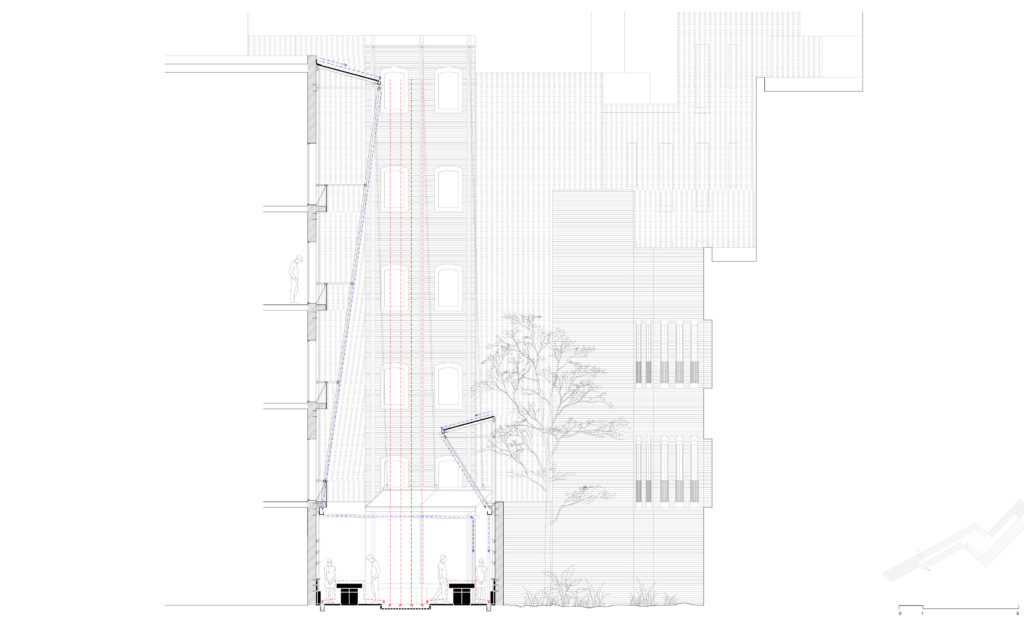
Estello Raganit and Joan Chen’s “Slowlands: Making the Inter-Loughs Wilds” Northwest City Region, Ireland & Northern Ireland
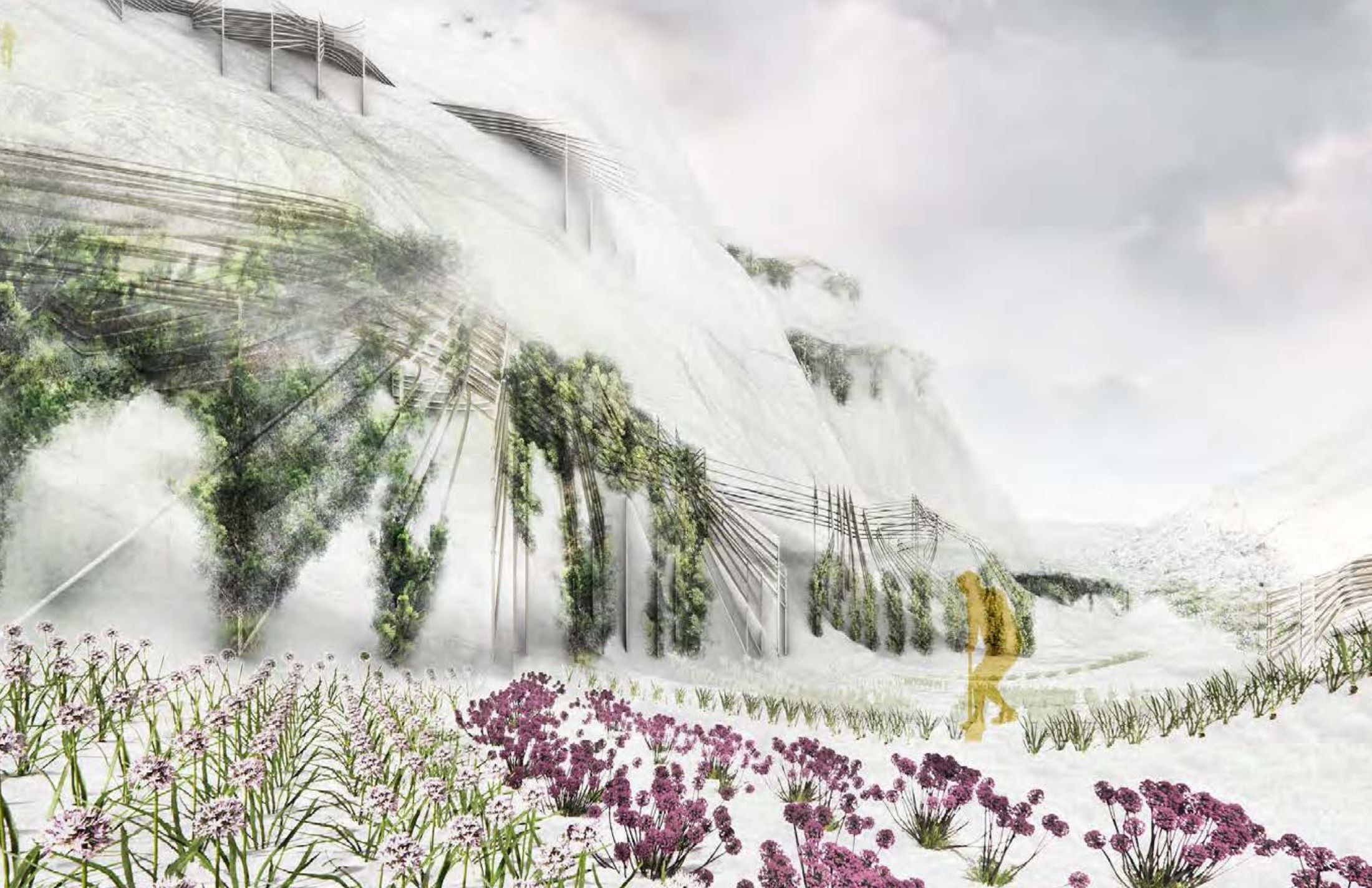
Andreea Vasile-Hoxha’s (MLA ’20) “After Plastics”—Honor Award
Jury Comments: The jury found this to be a brilliant piece of research, in which siloed concepts became integrated thinking within a futuristic framework. The jury appreciated the exploration of ecological and botanical interventions in dealing with the emergence and persistence of microplastics, and found the communication strategy compelling and rich. The range of scales in thinking and graphic communication make for an impressive package.
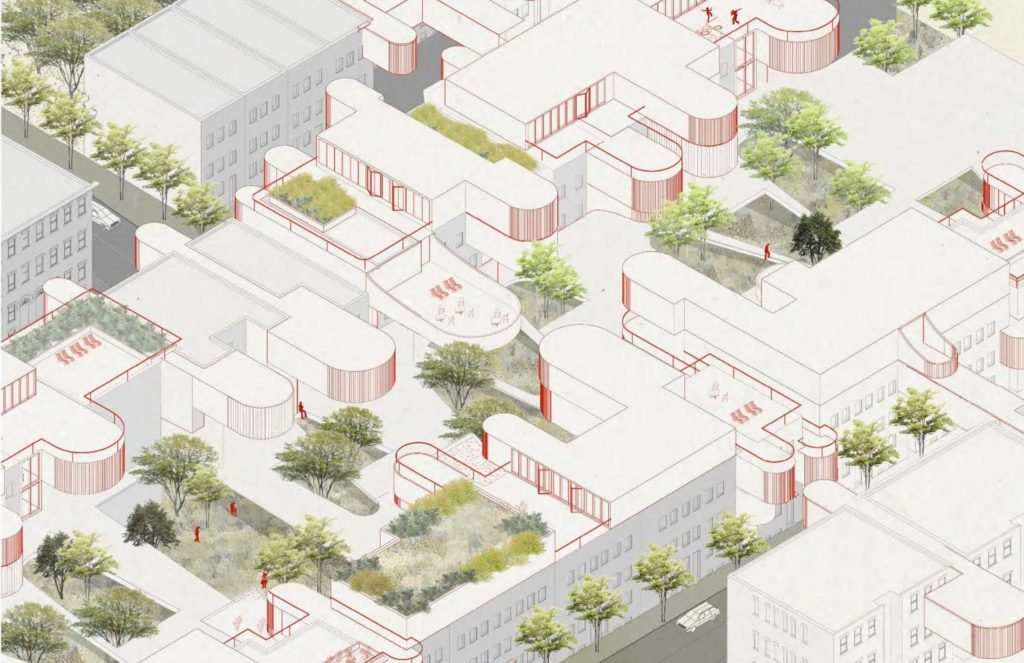
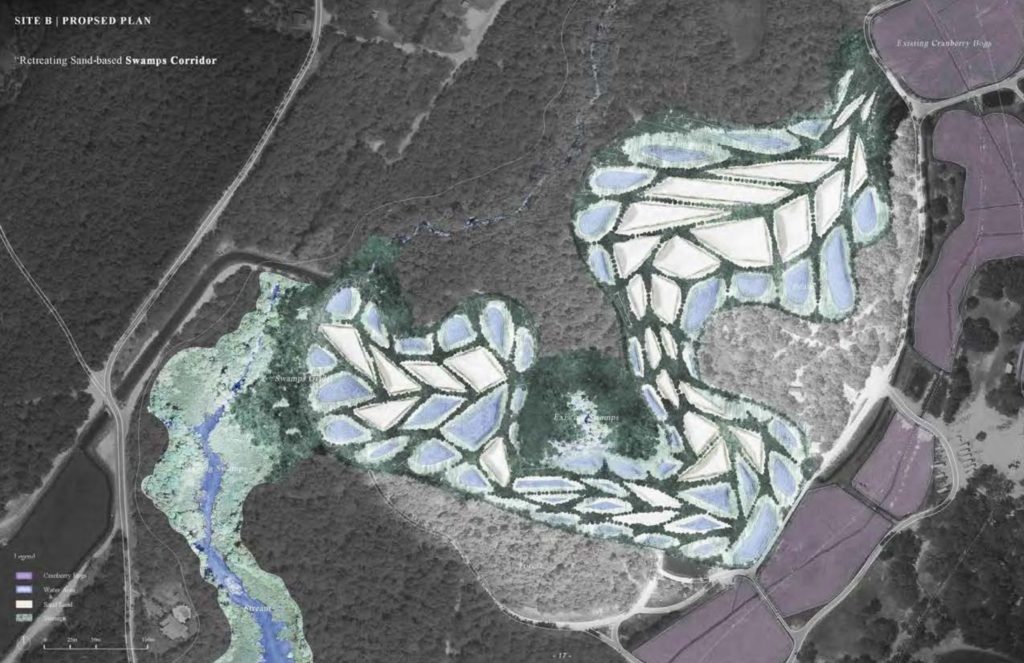
Minzhi Lin’s (MLA ’23) “Retreating Plan”—Excellence Award
Jury Comments: The jury deemed this project an ambitious plan demonstrating incredible restraint. They celebrated the submission for its thoughtful process and beautiful and nuanced graphics. The proposal focuses equally on ecology and humanity, celebrating the interaction between the two, and the designed forms are as beautifully articulated as they are justified by the research.
SASAKI, principal James N. Miner (MUP ’01) with other GSD affiliates
SCAPE, founder and principal Kate Orff (MLA ’97) with other GSD affiliates
ScenesLab, founder and director Wendy Yifei Wang (MLA ’14) with other GSD affiliates
Stoss Landscape Urbanism, founder and directorChris Reed, co-director of the Master of Landscape Architecture in Urban Design Degree Program and Professor in Practice of Landscape Architecture
If Earth’s biosphere is in crisis, it is a peculiar sort of crisis. To human eyes, it appears drawn out in slow motion over decades and spread almost invisibly across vast tracts of land. A difficult cognitive leap is required to grasp such a diffuse phenomenon. Landscape architects face a further complication: while disasters like hurricanes and wildfires can focus attention, our natural response begins with triage and mourning—far from the sort of visionary optimism that helps propel longer-term projects. And where does recovery figure into future decades of a warmer globe? To understand these issues in the field of landscape architecture, I spoke with three professors at the GSD who taught courses on the subject this spring.
Steven Apfelbaum, an ecologist and founder of the ecological restoration firm AES, began our conversation by noting the tendency in conservationist discourse to focus on charismatic megafauna—“big animals that we know and love for one reason or another, usually because we fear them.” We tend to notice megaflora as well, and major weather events like heat waves and floods likewise capture our attention. But this fascination with the large, the beautiful, and the fearful does not always translate into the sort of sustained engagement required to develop a deep ecological understanding, Apfelbaum says. This is a foundational conundrum of ecology: the majority of Americans have little experience with the land and its rhythms, and as a result we have insufficient understanding of ecological processes and principles.
Beaver Island habitat restoration in the Niagara River, Erie County, New York. Photo: EAS
“We are ecologically illiterate as a civilization,” as he bluntly puts it. Apfelbaum’s course at the GSD, “Altered Rural and Urban Landscape Restoration,” takes steps to address this lacuna. Like the conservationist Aldo Leopold before him, Apfelbaum encourages a land ethic that comes from engagement with the whole complex biotic pyramid encountered in a particular locale.[1] He says that “it really takes people that are more knowledgeable and connected to these ecological understandings to deploy ecological principles” in the right way.
The question of expertise arose repeatedly in my conversations. Silvia Benedito, a design critic at the GSD and founder of the multi-disciplinary design firm OFICINAA, emphasizes the need for community engagement and Indigenous knowledge rather than simply deferring to experts. This spring she taught “The Anatomy of (Wild)fire, a Design Quest?,” a course centered on rural communities in the Mediterranean. Benedito explains that a postwar exodus led to “rural areas becoming the back porch of cities—in many ways they became monocultures and sites of extraction.” The inter-generational transfer of ecological knowledge was interrupted and institutions stepped in to fill the void, often misunderstanding what they encountered.
The seasonal cycles of burning, hunting, and harvesting practiced by the Dakota tribal communities to care for their relatives, their nonhuman relations, and the lands of Mni Sota Makoce. By Julia Rice (MLA ’22), “The Anatomy of (Wild)fire, a Design Quest?”
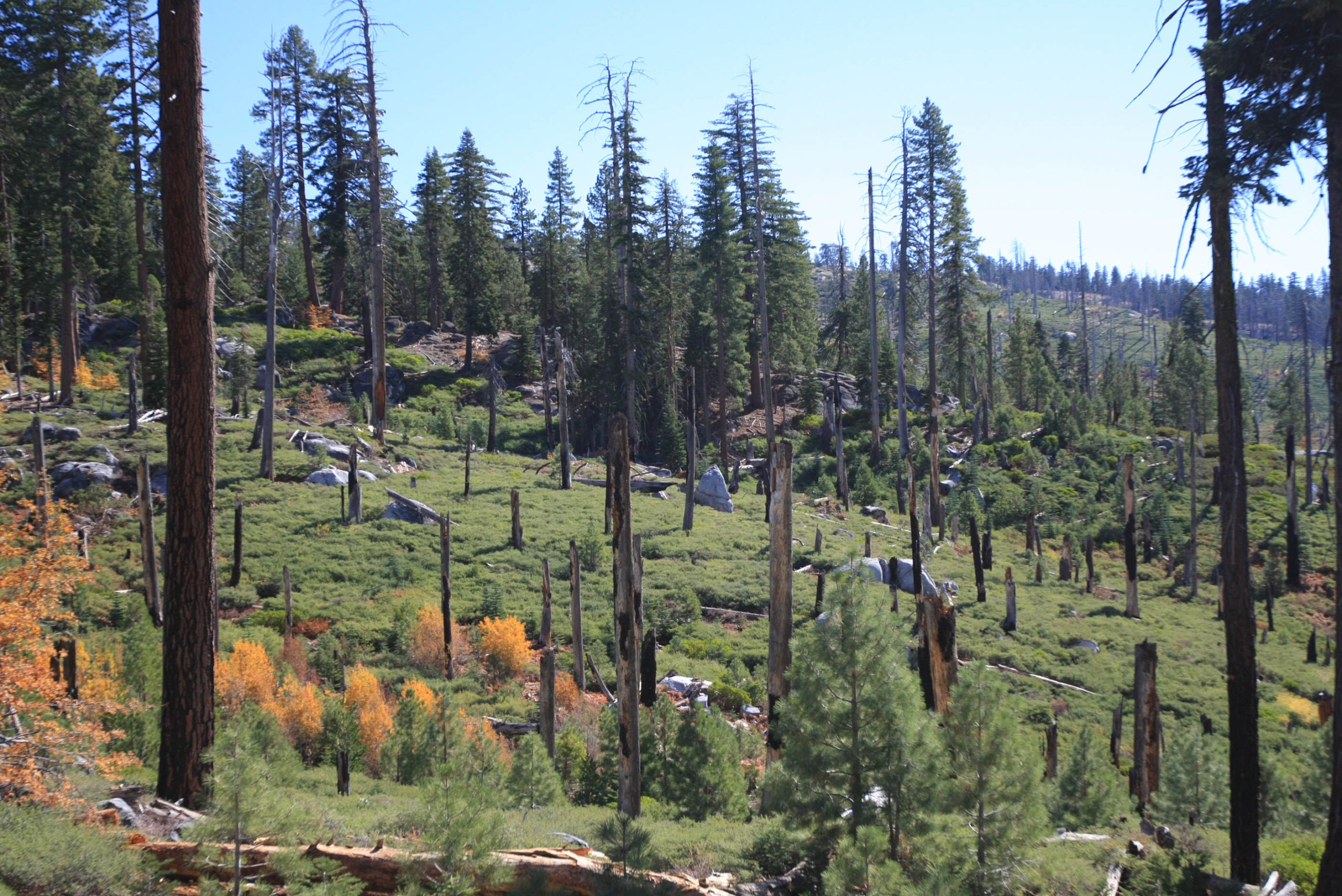
Benedito describes the case of one of America’s most beloved national parks: “There are reports that when John Muir arrived in the Yosemite Valley, he thought that what he was seeing was wild nature and that it should be controlled and maintained in the condition he found it. But it had actually been managed over many centuries by people indigenous to the area, who used it for food, for rituals, and—when it came to fire—they managed it for the safety of their communities.” Colonists brought with them their own ideas of fire as a destructive force to be managed from afar and eliminated from the valley when possible.
Designers, by the very nature of their profession, are usually outsiders to the geographical areas in which they work—and thus ongoing place-based education is crucial. Cultivating in-the-field knowledge was among the goals of a course taught by David Moreno Mateos, an ecologist and assistant professor at the GSD. “Ecosystem Restoration” focused on land in New England that had been cultivated by settlers, but which has been abandoned for several hundred years. This situation has created a sort of natural laboratory for understanding the recovery process. Due to the pandemic, students were offered a framework for self-guided field trips to document local ecosystems. Extrapolating from these observations and correlating with research by ecologists, Moreno Mateos identified “the specific tools—combinations of soil fungi, plant species composition, plant traits—that promote recovery by increasing the functionality and resilience of any ecosystem, which if brought to landscape architecture will help design more functional and resilient landscapes.”
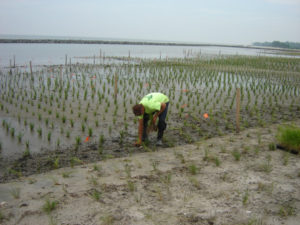
Revegetation of coastal wetlands in Eastern USA. Photo: Ecosystem Restoration and Management, Inc.
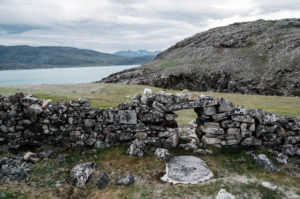
The course dovetails with Moreno Mateos’s primary research. His major project this summer takes place at the site of an ecological catastrophe that occurred long ago. Swaths of Greenland were transformed by Norse farmers from Iceland beginning around the year 1000, and, for reasons still under debate, these settlements were abandoned about 500 years later. For the past five centuries, many of these landscapes have been left to recover on their own. His scientific research aims to understand the details of how these former Norse settlements have recovered from ancient anthropogenic impacts—which ought to offer us clues about how humanity can deal with the ecological disasters caused by anthropogenic climate change. Landscape architects, Moreno Mateos says, should be “armed with the powerful tool of ecosystem restoration that could be used in any landscape architecture project, conservationist tragedies, or management activities.”
Norse ruins in Sissarluttoq, Greenland. Photo: Ciril Jazbec
Like Moreno Mateos, Apfelbaum emphasizes the importance of experiencing functioning ecosystems in person. His own restoration practice begins at home, on his 80-acre farm in Wisconsin, the transformation of which is documented in his book, Nature’s Second Chance. Readers follow along as Apfelbaum restores a patch of fallow and semiwild farmland, coming to understand and appreciate the relationship between species in a diverse ecosystem that includes wetland, prairie, savanna, and spring-fed brook. But reading this or any other book is no substitute for field courses, Apfelbaum says. “When I went to school, I took field courses every semester, and I was out in the woods learning about nature a couple of days a week. Now, it’s very challenging to go get that sort of field exposure.” This lack of exposure has affected the way designers conceptualize the land, he says: “The landscape architect has focused on parcels, oftentimes small, and the ecologist has become less focused on systems, and more focused on smaller scale thinking… How can we work in a systematic way across scale, across boundaries of ownership, and across disciplinary subject matters?”
Apfelbaum, Benedito, and Moreno Mateos all agree that landscape architects have a role to play as mediators in multi-scalar, multidisciplinary ecological discussions. Benedito points to invaluable lessons in the work of James Corner and his firm, Field Operations (where Benedito previously worked). Corner’s drawings focused on processes, helping landscape architects to see that narratives can be embedded in landscapes. Many of Benedito’s own projects conjure elusive sensory dimensions of landscapes. This sensitivity is crucial when dealing with phenomena such as fire, which are themselves fleeting but which leave traces on the land and in collective memory that can be rekindled in the course of design. Benedito emphasizes that “the potentials of landscape as a discipline of telling stories is fundamental when we have to interact with communities.”
Apfelbaum concurs, mentioning that, at his firm, “the first function of the landscape architects, on many projects, is translation—the ability to convert ideas, including often complex scientific ideas, into graphic communication that builds a conversation between stakeholders from myriad backgrounds and with different things they care about.” The next step after translation, he says, is “creative ideation: how do you take people that are locked in a frame of mind and begin a conversation where anything you say might trigger a knee-jerk negative reaction against any sort of change?” Participation in map-making can be a key step in overcoming NIMBYism. “Neighbors see neighbors. Neighbors participate with neighbors. Neighbors draw,” Apfelbaum says. “They might not be able to say exactly what they’re thinking, and they might not really be able to draw it very well, but if they can get something down—a few words and then a few little scribbles—we can begin playing off it.”
The importance of drawing communities into the decision-making process highlights a difficulty at the heart of many restoration projects: people may want to conserve what they have and to restore damaged areas to a previous state, but that is not always feasible. Events can push landscapes into new ecological states—a forest can become a grassland, or a coastal wetland environment can find itself under water. It can be difficult to gauge whether restoration is the best route to take. Fire, for instance, is a cyclical part of some ecosystems, but sometimes a burnt landscape doesn’t bounce back. Rising global temperatures are causing biomes to shift—and sometimes wildfires are “the last piece placed on top of a precarious wooden tower that unbalanced everything and topples it over,” as Benedito puts it. Moreno Mateos emphasizes the “need to have an open mind about restoration. Ecosystems are in a dynamic stable state—they are always adapting to the ever-existing environmental changes.” As a result, “restoration must be understood in a dynamic way, and that any restoration projects must be as adapted as possible to the current changing conditions, which may involve alternative states.” This is a frightening sort of openness. Moreno Mateos notes that we are experiencing a general biodiversity crisis; the United Nations has declared the current decade as the UN Decade on Ecosystem Restoration.
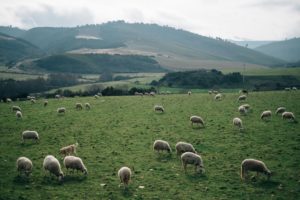
For Benedito, it is important to engage with landscape disasters as cultural phenomenon. She points out that while fire management practice belongs, for the most part, to the field of silviculture, much of the literature comes from anthropology and sociology. Stories abound of fire and the birth of humanity and the importance of hearths and sacred flames in domestic and religious architecture. “The cultural domain of fire,” she says, “has been suppressed in landscape management, but not lost.” Benedito gives the example of the herding of goats and sheep in Portugal, a practice which has been displaced by industrial farming. Livestock provide a few things: meat and wool, certainly, but also fertilizer and the clearing of undergrowth. “They were providing ecological service—they were actually mowing these territories, reducing the biomass fuel for the reduction of wildfires,” she explains. Such cultural practices often have a long history. Fire management today should involve, Benedito says, “recuperating a culture: the ceremonies, the meaning, the symbolism associated with rural practices.”
Sheep grazing the mountains of Serra da Estrela, Portugal. Photo: Nelson Carvalheiro
So while disasters—fires, floods—may appear limited in time, space, and in the factors involved, they really must be seen as only the most tangible moments of processes that occur across much broader scales. Landscape architecture may be among the best-equipped disciplines for engaging with such processes. Apfelbaum argues that engineering is too narrow. “Engineering solutions have done a great job for 150 or 200 years to help us with water quality and sanitation,” he says, “but they’re not addressing the larger, more complex solution sets that we need to address now. Engineering solutions are kind of single purpose—stop the flooding, you know. Whereas when you stop the flooding with the ecology, you get all sorts of secondary benefits: you get water quality improvements, biodiversity improvements, the replenishment of groundwater resources.” Apfelbaum makes a compelling case, supported by decades of successful projects: “With an ecological solution, the benefits are amplified. With an engineering approach, the benefits are usually narrow and the benefits are oftentimes short- lived—they’re best on the day the project is completed, and then they progressively deteriorate while the cost of maintenance increases. An ecological solution is weakest on the day of installation as a practice, and it improves over time while the cost of maintenance decreases.”
Wide recognition of these benefits may be leading to a shift in perspective, and enthusiasm for ecological restoration following landscape disasters may be translating into broad public enthusiasm for ecological thinking. We should hope so. Ecological literacy is a crucial force for good in a world facing a crisis of a magnitude that is difficult to fully comprehend.
[1] Aldo Leopold, A Sand County Almanac, and Sketches Here and There (Oxford: 1949)
Jessica Tang (MUP/MPP ’23) Awarded Rappaport Summer Public Policy Fellowship
Jessica Tang (MUP/MPP ’23) Awarded Rappaport Summer Public Policy Fellowship
Jessica Tang, a joint degree candidate in Urban Planning and Public Policy at the Harvard Graduate School of Design and the Harvard Kennedy School, is working with the Massachusetts government agency MassDevelopment this summer as a Rappaport Public Policy Fellow. Now in its 21st year, the Rappaport Public Policy Fellowship gives graduate students throughout Boston the opportunity to gain hands-on experience as they work with organizations on addressing vital public policy issues. It is funded and administered by Harvard’s Rappaport Institute for Greater Boston, which “strives to improve the governance of the region by strengthening connections between scholars, students, officials, and civic leaders.”
Working with communities, nonprofits, businesses, and banks, MassDevelopment helps create “jobs, increase the number of housing units, revitalize urban environments, and address factors limiting economic growth including transportation, energy, and infrastructure deficiencies.” Tang will be supporting MassDevelopment’s Transformative Development Initiative by adapting TDI economic growth strategies for other areas in Massachusetts, analyzing the implementation of current TDI projects, and researching peer learning opportunities for organizations in the public sector.
Tang is part of a cohort of 20 graduate students representing 14 schools from seven universities. Previous GSD students that were awarded the Rappaport Public Policy Fellowship include Marcus Mello (MArch I/MUP ’18) and Lindsay Woodson (MDes RR/MUP ’17) in 2015.




 For the spring 2021 studio “Small Institutions,” Roger Tudó Galí, Josep Ricart Ulldemolins, and Xavier Ros Majó—three partners at HARQUITECTES in Sabadell, Spain who served as the John C. Portman Design Critics in Architecture at the Harvard Graduate School of Design for the semester—took Kahn as their inspiration and asked students to identify the primordial essences of various institutions: library, museum, school, temple, town hall, market, theater, hospital, swimming pool, and courthouse. By focusing students’ attention on determining and responding to the Kahnian agreement from which these institutions arose, the rituals inherent to these spaces become constitutive of their designs. In turn, this exercise illuminates how forms of communal interaction and public engagement have been lost and how they could be resuscitated. Moreover, it encourages a wholesale reconceptualization of architecture in which the plan begins with nothing, to which only the necessary is added.
“A lot of new institutions are losing the emotional conditions of architecture, becoming too functional and rational, and just working to avoid practical problems,” says Tudó Galí. “We are very much about going against these preestablished ideas and the pragmatic approach to building. Instead, we try to rediscover the platonic idea of a place and its activities.”
For the spring 2021 studio “Small Institutions,” Roger Tudó Galí, Josep Ricart Ulldemolins, and Xavier Ros Majó—three partners at HARQUITECTES in Sabadell, Spain who served as the John C. Portman Design Critics in Architecture at the Harvard Graduate School of Design for the semester—took Kahn as their inspiration and asked students to identify the primordial essences of various institutions: library, museum, school, temple, town hall, market, theater, hospital, swimming pool, and courthouse. By focusing students’ attention on determining and responding to the Kahnian agreement from which these institutions arose, the rituals inherent to these spaces become constitutive of their designs. In turn, this exercise illuminates how forms of communal interaction and public engagement have been lost and how they could be resuscitated. Moreover, it encourages a wholesale reconceptualization of architecture in which the plan begins with nothing, to which only the necessary is added.
“A lot of new institutions are losing the emotional conditions of architecture, becoming too functional and rational, and just working to avoid practical problems,” says Tudó Galí. “We are very much about going against these preestablished ideas and the pragmatic approach to building. Instead, we try to rediscover the platonic idea of a place and its activities.”
 Jessica Tang, a joint degree candidate in Urban Planning and Public Policy at the Harvard Graduate School of Design and the Harvard Kennedy School, is working with the Massachusetts government agency MassDevelopment this summer as a Rappaport Public Policy Fellow. Now in its 21st year, the Rappaport Public Policy Fellowship gives graduate students throughout Boston the opportunity to gain hands-on experience as they work with organizations on addressing vital public policy issues. It is funded and administered by Harvard’s Rappaport Institute for Greater Boston, which “strives to improve the governance of the region by strengthening connections between scholars, students, officials, and civic leaders.”
Working with communities, nonprofits, businesses, and banks, MassDevelopment helps create “jobs, increase the number of housing units, revitalize urban environments, and address factors limiting economic growth including transportation, energy, and infrastructure deficiencies.” Tang will be supporting MassDevelopment’s Transformative Development Initiative by adapting TDI economic growth strategies for other areas in Massachusetts, analyzing the implementation of current TDI projects, and researching peer learning opportunities for organizations in the public sector.
Tang is part of a cohort of 20 graduate students representing 14 schools from seven universities. Previous GSD students that were awarded the Rappaport Public Policy Fellowship include Marcus Mello (MArch I/MUP ’18) and Lindsay Woodson (MDes RR/MUP ’17) in 2015.
Jessica Tang, a joint degree candidate in Urban Planning and Public Policy at the Harvard Graduate School of Design and the Harvard Kennedy School, is working with the Massachusetts government agency MassDevelopment this summer as a Rappaport Public Policy Fellow. Now in its 21st year, the Rappaport Public Policy Fellowship gives graduate students throughout Boston the opportunity to gain hands-on experience as they work with organizations on addressing vital public policy issues. It is funded and administered by Harvard’s Rappaport Institute for Greater Boston, which “strives to improve the governance of the region by strengthening connections between scholars, students, officials, and civic leaders.”
Working with communities, nonprofits, businesses, and banks, MassDevelopment helps create “jobs, increase the number of housing units, revitalize urban environments, and address factors limiting economic growth including transportation, energy, and infrastructure deficiencies.” Tang will be supporting MassDevelopment’s Transformative Development Initiative by adapting TDI economic growth strategies for other areas in Massachusetts, analyzing the implementation of current TDI projects, and researching peer learning opportunities for organizations in the public sector.
Tang is part of a cohort of 20 graduate students representing 14 schools from seven universities. Previous GSD students that were awarded the Rappaport Public Policy Fellowship include Marcus Mello (MArch I/MUP ’18) and Lindsay Woodson (MDes RR/MUP ’17) in 2015.