Surfacing
In his 1993 essay on “The Topology of Environmentalism,” anthropologist Timothy Ingold critiqued the concept of “the global environment.” The image of dwelling upon a solid globe, on the “surface of the earth,” he wrote, was predicated on a colonial idea of nature as fundamentally separate from human existence, and thus, implicitly, an object of intervention. In framing globe thinking as surface thinking, Ingold reminds us that the very notion of the “earth’s surface” is imbued with normative assumptions about how we relate to the world.
As students of the built environment, we revisit Ingold’s critique to call for the historicization of surface-making or surfacing. After all, the design disciplines are bound up in working upon the surface of the earth and in the physical and discursive production of surfaces more generally. From architectural cladding, street paving, and ground cover to the drawings, plans, and maps that represent them, surfaces mediate and condition our engagement with the world. What would it mean, then, to view surface-making as a unifying (albeit uneven) ground between architecture, landscape architecture, and urban planning? Thinking through the common ground of practice as surfacing may be a way of suturing the baggy concept of “environment” to its social and material dimensions.
Surfacing, as a methodological frame, entails a shift in focus from objects to processes. In the project of uncovering colonialism’s lasting legacies, historian Ann Laura Stoler has called for the study of ‘ruination’ rather than ‘ruins’; similarly, we are less interested in surfaces as such than in historical processes of surface-making and surface-breaking. We invite scholars, therefore, to consider the physical production of surfaces and their role in mediating our relationships with each other and with the environment. In historicizing surfaces as sites of intervention and management, we ask: How are surfaces physically produced? With what materials and what tools? What costs do these practices exact, socially or environmentally? Who builds surfaces, and to whose benefit or detriment? How are surfaces remade over time? What modes of maintenance or preservation are involved in doing so? And what happens when surfaces give way—to friction, mold, burst pipes, erosion, social unrest, or archival irruptions?
We welcome abstracts from doctoral students in architectural, landscape, urban, and environmental history, as well as in geography, the history of science and technology, art history, media studies, comparative literature, and related fields. Paper topics might address:
- Histories of landscape and architectural construction sites
- The geopolitics and/or environmental costs of sourcing and fabricating surface materials
- Histories of representational media as surfaces
- The use of surveying and mapping to document, produce, and manage surfaces
- Social, migration, or labor histories of making, breaking, or maintaining surfaces
- Histories of surface preservation (monuments, properties, landscapes, etc.)
- Alternative or counter-hegemonic practices and processes of surfacing
Keynote Speakers
The full conference schedule is forthcoming. Panelists for the keynote conversation include:
- Lucia Allais, Associate Professor of Architecture and Director of the Buell Center, Columbia University Graduate School of Architecture, Planning, and Preservation
- Deborah Coen, Professor of History & History of Science & Medicine, Yale University
- Gretchen Heefner, Chair and Professor of History, Northeastern University
Submissions
Please submit a 300-word paper abstract, paper title, and 2-page CV via this form (now closed). Please direct any questions to [email protected].
- The deadline for abstracts was extended to Friday, January 9, 2026.
- Authors of accepted papers will be notified by email by the end of January 2026.
- Participants will be asked to submit a final draft of their paper by April 10, 2026.
About Cambridge Talks
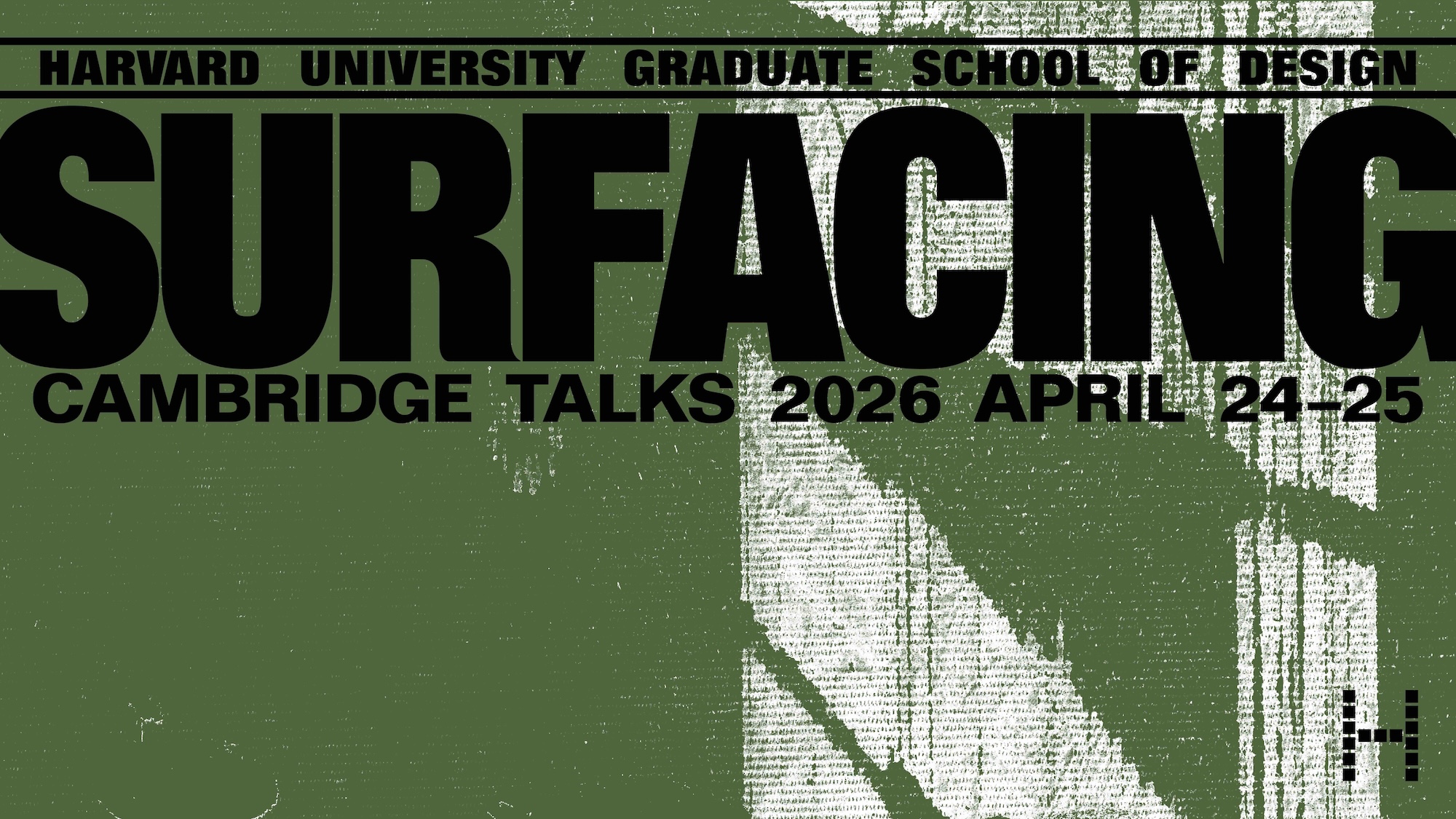
Cambridge Talks is an annual conference organized by students of the PhD Program in Architecture, Landscape Architecture, and Urban Planning at the Harvard University Graduate School of Design, and is generously funded by the GSD’s Advanced Studies programs, the GSD Dean’s Office, the GSAS Graduate Student Council, and the Weatherhead Center for International Affairs. Cambridge Talks 2026: Surfacing is organized by PhD students Charlie Gaillard, Anny Li, and Miranda Shugars and advised by Antoine Picon, G. Ware Travelstead Professor of the History of Architecture and Technology and Director of Doctoral Programs. The graphic identity for the conference was designed by Willis Kingery.
Harvard University welcomes individuals with disabilities to participate in its programs and activities. If you would like to request accommodations or have questions about the physical access provided, please contact the Public Programs Office at (617) 496-2414 or [email protected] in advance of your participation or visit. Requests for American Sign Language interpreters and/or CART providers should be made at least two weeks in advance. Please note that the University will make every effort to secure services, but that services are subject to availability.
#GSDEVENTS