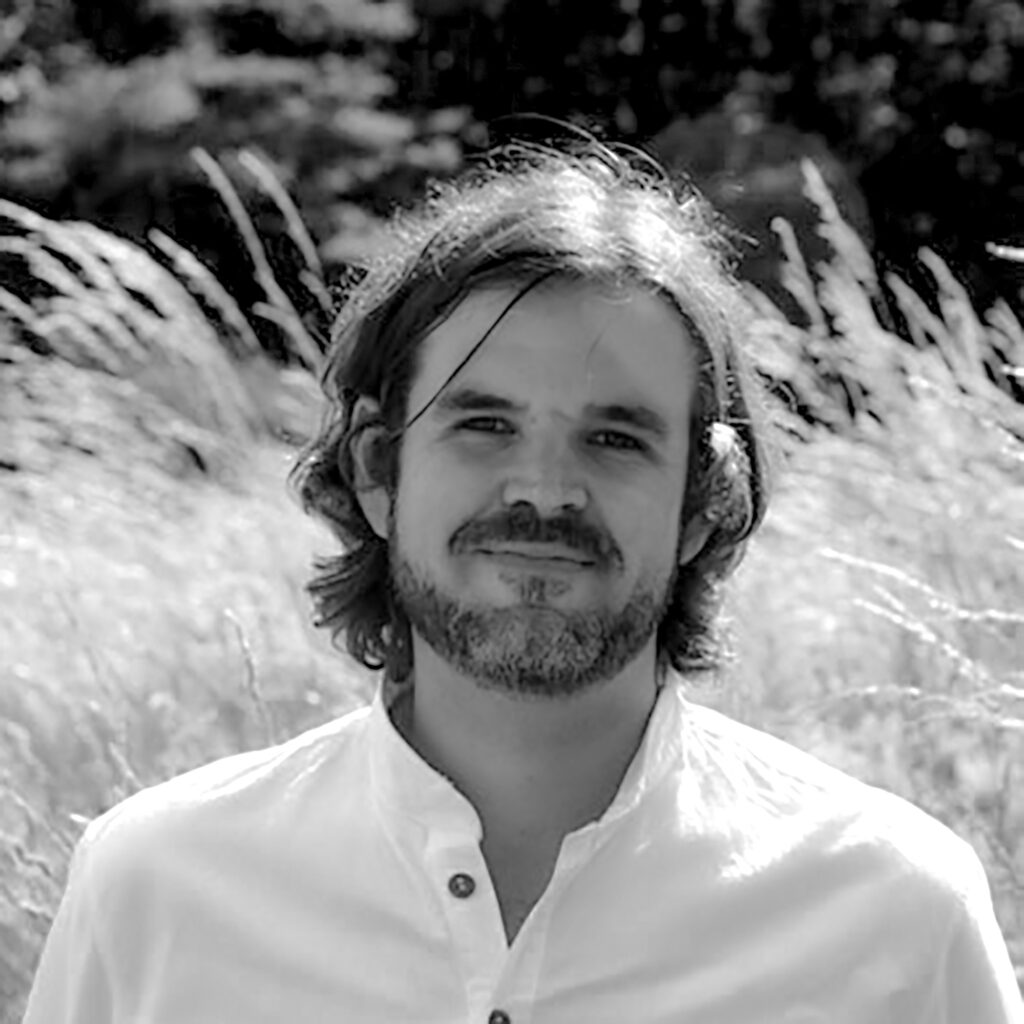
Leighton Beaman is a designer and educator exploring what counts but goes uncounted: authorless decisions, opinionated materials, and unattended atmospheres. He is less interested in resolving these inherent contradictions than in learning how they hold together. Trained as an architect, he has spent his practicing life with communities, and much of his teaching life, asking what form formless problems might take. He teaches in the Master in Design Engineering program at Harvard, where design and engineering share a table, a purpose, and, on good days, a vocabulary.
For fourteen years, as co-founder of General Architecture Collaborative, a nonprofit architecture firm in Rwanda and the United States, he has designed and built health, education, housing and civic projects with the communities who use them, learning along the way, somewhat against his training, that the people with the most at stake in a project are often the ones whose judgment it least reflects. The practice has employed hundreds of local residents and received honors including Small Practice of the Year (Northeast) from The Architect’s Newspaper, a Metropolis Game Changer award, and the Architizer A+ Award for Good. His work has appeared at the Venice Architecture Biennale and the Seoul Biennale of Architecture and Urbanism.
Beaman directs the Laboratory for Material Propositions, a research and design studio founded at Cornell and now based in Cambridge, with collaborators ranging from neuroscientists to choreographers. Its current work begins with a suspicion that we take the wrong things too seriously and asks what changes when we are serious about play instead. Working between design, philosophy, and the cognitive sciences, he studies why strangers, given a pile of blocks, nearly always build together, how we feel our way to what fits, and where intelligence lives outside the individual. The lab’s experiments in thinking with one’s hands take place in real and virtual environments, where it is not always clear whose hands, exactly, are doing the thinking: a person’s, a material’s, or a machine’s. He also writes about how design research and practice decide who and what is allowed to matter, usually before a project begins and mostly without knowing they have.
Before Harvard, he was Associate Professor of Practice at Cornell and Assistant Professor at the University of Texas at Austin and the University of Virginia, teaching across architecture, human-centered design, and industrial design. In MDE, his design studios examine human factors beyond humans, asking students to design for what current methods leave out. He holds a Master of Architecture from the Harvard Graduate School of Design and remains unconvinced that good design is ever a solitary act.