The Dual Demands of Urban Growth
The evolving nature of global cities brings to the fore an important question as they face such vast growth: how can construction projects provide greater benefits to the private sector while the public also stands to gain? Investors are looking for high returns, while municipalities and their residents require that the projects contribute and add value to the social, economic and ecological conditions. Negotiated entitlements—agreements granting developers flexibility, such as increased density or expedited approvals, in exchange for public benefits like affordable housing, parks, or transit infrastructure—have become critical tools to address this challenge.
Negotiated entitlements are dynamic agreements that shape the design, accessibility, and sustainability of urban spaces. By exploring case studies across scales—from the transformation of a single building like the Salesforce Transit Center in San Francisco to neighborhood-scale regeneration projects like King’s Cross in London and infrastructural developments like the Elizabeth line in London—this essay examines how negotiated entitlements can deliver public benefits while fostering win-win outcomes for all stakeholders. Through these case studies that we will explore, the potential of these agreements to create equitable, sustainable, and vibrant urban spaces is highlighted.
Negotiated Entitlements: A Shared Responsibility
At the heart of every negotiated entitlements is a tug-of-war between public and private interests. Cities provide developers with incentives for contributions such as exemption from zoning restrictions or increased height limits. David Harvey, in his work The New Imperialism (2003), terms this relation the “spatial fix” and portrays it as a redistribution of tensions between the expansion of capital and the movement of social progress within urban spaces, striking the right balance for urban vitality.
The public resources that municipalities need in order to fill critical voids such as high costs of housing, the deterioration of services or the lack of (and also the inadequate) provision of public services are provided through negotiated entitlements, with the aid of private developers who possess, at the same time, possibilities for highly lucrative investments. But such a system has its own problems. The late urban geographer Neil Smith, for example, sounded warnings in regards to ill-structured deals which will enhance stratification and sell it to base suburbs newcomers adjusted. The issues of negotiated entitlements are solved through the provision of community benefits which do not alienate private investors.
Negotiated Entitlements as a Mechanism
Beyond their technical functions, negotiated entitlements are becoming understood not only for their technical aspects but also as instruments of the governance of the city. Urban theorist Susan Fainstein argues in The Just City (2010) that urban planning should strive for equity, democracy and diversity. Negotiated entitlements are moral obligations towards the construction of cities that are inclusive rather than exclusive.
Similarly, Keller Easterling in Extrastatecraft: The Power of Infrastructure Space (2014) highlights how negotiated entitlements operate as part of broader systems of urban governance, where formal regulations intersect with informal negotiations and global capital flows. In her analysis she also emphasizes the need for adaptable frameworks that will allow cities to respond proactively to shifting economic, environmental, and social conditions.
To sum up, it is apparent that these perspectives underscore the role of benefits as instruments that reflect a city’s values and priorities. To understand their transformative potential, we will explore how negotiated entitlements play out across scales through case studies spanning—from individual buildings to city-wide redevelopments.
A Green Oasis: Salesforce Transit Center
In the heart of downtown San Francisco stands the Salesforce Transit Center, a project that illustrates how a single building can embody the promise of negotiated entitlements. Completed in 2018 at a cost of $2.26 billion, the center reimagines urban infrastructure by integrating public benefits into a transit hub. Originally conceived as the Transbay Transit Center, this multimodal facility connects 11 regional bus and rail systems and is crowned by a 5.4-acre rooftop park that has become a sanctuary amid the city’s dense skyline.
The Salesforce Transit Center exemplifies Harvey’s “spatial fix”, mediating tensions between capital investment and public benefit. The park encompasses much more than just a green area. It has areas for walking, gardens, and facilities for events and can be visited by around 25,000 people daily (pre-COVID), bringing environmental, recreational, and social benefits. Its layout also responds to ecological challenges by alleviating the urban heat island effect and enhancing biodiversity, showcasing the role of urban infrastructure in climate adaptation.
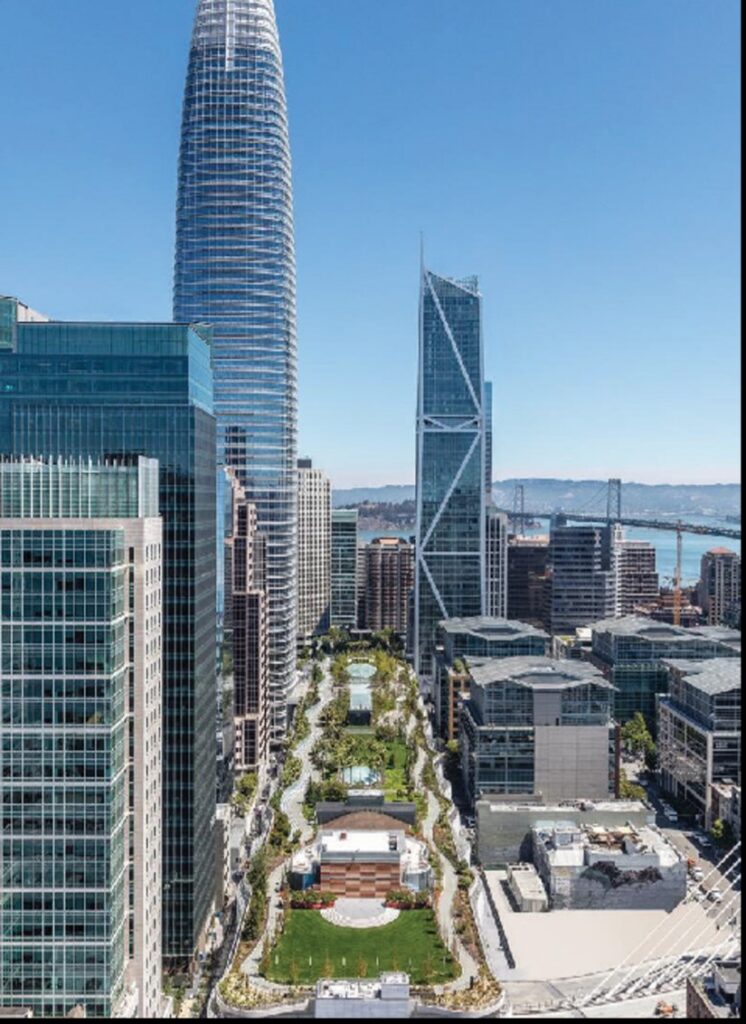
Financially, the center reflects the balancing act inherent in negotiated entitlements. A $110 million naming rights deal with Salesforce provided critical funding, while public-private partnerships helped close budget gaps. Beyond its direct impact, the center catalyzed $4.5 billion in private investment in nearby properties, including Salesforce Tower, San Francisco’s tallest building. This ripple effect1 brings to light how negotiated entitlements can be profitable for individuals while being supportive of society at large, designing areas that are advantageous to the investors and the public comprehensively. The case of the Salesforce Transit Center demonstrates how negotiated entitlements can offer considerable public and ecological dividends in building terms. But what happens when these principles are brought to larger dimensions? In order to respond to this, we look at transformations at the neighborhood level.
Win-Win Public Benefits as a Component of a Development Project
The public interest is important, but negotiated entitlements can bring together public and private actors to achieve economically justifiable win-win situations. In such agreements, developers will get return on investments, and municipalities will get physical assets that enhance the quality of the society for good.
Neighborhood Regeneration: Time gone, Time yet to come
When taken to the neighborhood level as demonstrated in the case of King’s Cross in London and Zuidas District Amsterdam, the entitlement of negotiation takes on different dimensions.
The details of both projects demonstrate how strategic partnerships between the public and private sectors can lead to the development of entire urban areas while also meeting the requirements that the public has. The regeneration of King’s Cross is an impressive case study showing that such concepts can bring historic districts back to life while balancing contemporary requirements.
King’s Cross, London: A Blueprint for Urban Revival
King’s Cross, which had its time in the late 20th century as a prominent hub of Victorian business and transport, has become synonymous with decline. Such downfall resulted from the drop in fortunes of the coal, rail, and canal industries leading to the degradation of the region. By the middle of the century, the area was characterized wholly by neglected warehouses, abandoned train depots, and infrastructure that was falling apart. King’s Cross with its legacy of crime, drugs, and sex work was left to fester along with other impoverished areas in London.
A Visionary Approach to Comprehensive Development
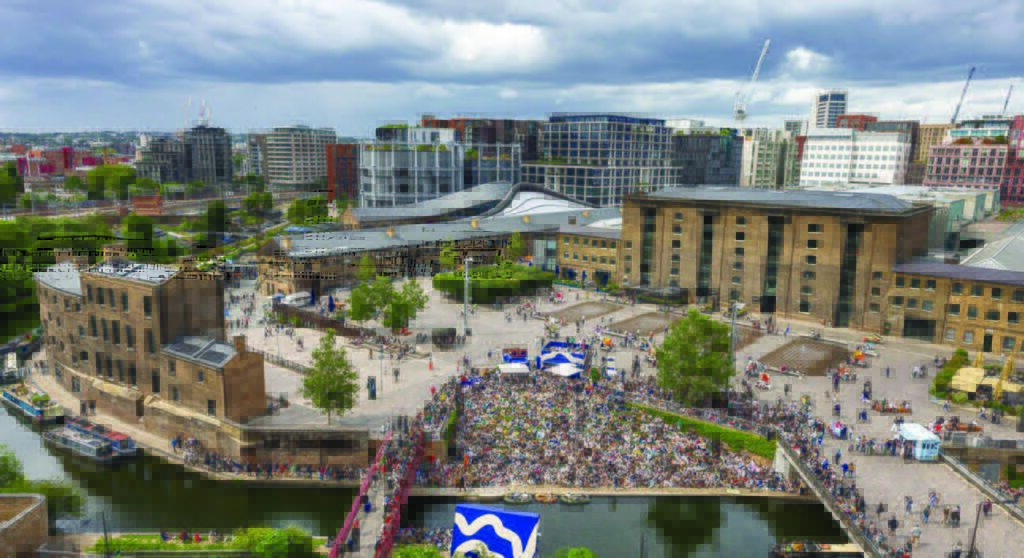
The redevelopment of King’s Cross, led by Argent LLP, aimed at creating a 67-acre mixed-use neighborhood blending residential, commercial, cultural, and public spaces that would honor the area’s industrial legacy while introducing modern design and infrastructure to the neighborhood and the surrounding context. A notable feature of this makeover is the Google headquarters embodying the district’s ethos of innovation and sustainability, seamlessly integrating with the urban fabric.
At the core of this renewal effort lay the principle of negotiated entitlements, allowing developers flexibility, such as increased building density, in exchange for providing public benefits like affordable housing, green spaces, and cultural amenities. Representative features embodying this philosophy include Granary Square and Coal Drops Yard.
- Granary Square: It was transformed from an industrial site into a vibrant plaza, that serves as a social and cultural focal point for the neighborhood residents and the surrounding amenities. It has over 1,000 interactive fountains amidst historic warehouses, that captivate visitors of all ages and enhance the ambiance and the recreational purposes of the space. At the same time, its open seating, tree-lined paths, and accessible design, they foster inclusivity while stimulating economic vibrancy by attracting foot traffic to neighboring establishments and cultural events.
- Coal Drops Yard: The restored Victorian coal yards designed by Heatherwick Studio now act as a sophisticated retail and leisure center. The large bending steel roof that contours and shapes the interior holds a mix of small stores, art galleries and restaurants while maintaining a contemporary style with an old industrial twist.
These areas are not just about function— they are about place. They are persistent concepts that allow people to create connections, inspire creativity and build a sense of community to achieve the goals of the dealt rights in a balanced manner that benefits both the society and private sector’s benefits.
Negotiated Entitlements in Practice
The success story of King’s Cross is explained to a very large extent by the practice of negotiated concepts which enabled developers to relax the usual zoning requirements in exchange for specific public gains. The developers, Argent LLP, were given permission to construct 50 new buildings which included offices, residential and other cultural centers. As such, they undertook to:
- Creating over 2,000 new homes, 40% designated as affordable housing.
- Delivering 20 new streets and 10 public squares, ensuring the neighborhood remains walkable and connected.
- Preserving and repurposing historic structures, such as the Granary Building (Central St. Martins School).
All these developments are recent histories of urban regeneration and the resorting to these areas shows an emerging policy approach which seeks to balance private investment opportunities with the need to deliver public goods. Lynne Sagalyn in Public/Private Development (2007), highlights the importance of aligning the interests of all stakeholders in public-private partnerships to achieve mutually beneficial outcomes. She notes that such collaborations are most effective when they “balance public objectives and private interests,” ensuring that both corporate goals and community needs are addressed. Similarly in Kings Cross case the agreements thrived as they harmonized the requirements of all stakeholders, yielding mutually advantageous outcomes that served both corporate interests and the broader community.
Engaging the Public
To achieve the above, King’s Cross was underpinned by robust public engagement methodologies. First step on the process was, acknowledging the pitfalls of past renewal ventures, which often displaced vulnerable communities due to top-down approaches, Argent LLP embraced stakeholder dialogues.
A series of community consultations, workshops and even exhibitions, invited local residents, businesses and cultural organizations to add their views, thus also triggering their anticipation and commitment to the outcome.
This inclusive engagement process ensured that community voices shaped the project’s trajectory. For instance, industrial icons like the Gas Holders and the Granary Building would have been destroyed as they were earmarked for demolition, had it not been for the public pressure to maintain them. Now they form important pieces in the history of the area.
But not all the interested parties were well heard. There are critics who claim that the people that were left behind in the engagement process were members of the low-income class, further raising concerns of inclusiveness in the case of large-scale regeneration.
Challenges and Critiques
Despite its successes, King’s Cross has faced its share of criticism.
- Gentrification and Affordability: The affordable units that have been supplied have quickly been overshadowed by increased property prices in the area that forced out older residents. The area has been gradually modified by an influx of wealthy workers and expensive businesses, which raises questions regarding the purpose of such revitalization projects in the first place.
- Privatized Public Spaces: Granary Square and other public areas are public but are in fact privately owned and developed which stirs controversy concerning the availability of such spaces. Limits for specific activities including demonstrations or mass gatherings bring out the conflict between order and the ideal democratic arena.
A Legacy of Transformation
In transforming the industrial landscape in England, King’s Cross has had both challenges and accomplishments. Before carrying out any alterations within the area, a careful policy planning approach was taken in order to involve social structures and cultural amenities that are favorable towards the environment, fostering a vibrant urban ecosystem.
Moreover, it can be noted that sustainability does not necessitate an additional cost for the reconstruction of the area; but instead, it can be viewed as a requirement for undertaking the project in the first place. In particular, the adaptive reuse of the three industrial structures, and constructing buildings that focus on environmental integration and urban crosstown connections further align the project with London’s climate goals rather than simply construction.
Lessons for Future Regeneration
Due to its achievements, the region appears to the world as a model:
- Placemaking Matters: Well-established and managed spaces can be a perfect edge for a community to thrive, encourage the functionality of the local economy, and become a beloved part of the culture of the area.
- Heritage as an Asset: Preserving industrial landmarks creates authenticity, offering a sense of place that is both historical and contemporary.
- Equity is Critical: Implementing measures that strengthen equity while allowing for regeneration of areas is critical to success.
Through the combination of innovative urban designs, respect of the historical character and inclusion of the people of the neighborhood, King’s Cross has re-established the trajectory of urban revitalization. Its triumphs and failures serve as a reminder that in terms of development, ideas might be ambitious; however, the ambition has to be implemented without compromising the inclusiveness over time.
Zuidas District, Amsterdam: From Business Hub to Urban Ecosystem
The Zuidas District is located south of the Old City of Amsterdam and constitutes an exemplary integration of a financial center development with social and environmental growth. It is referred to as a financial mile and home to many international corporations, law firms and banks including Deloitte and ABN AMRO.
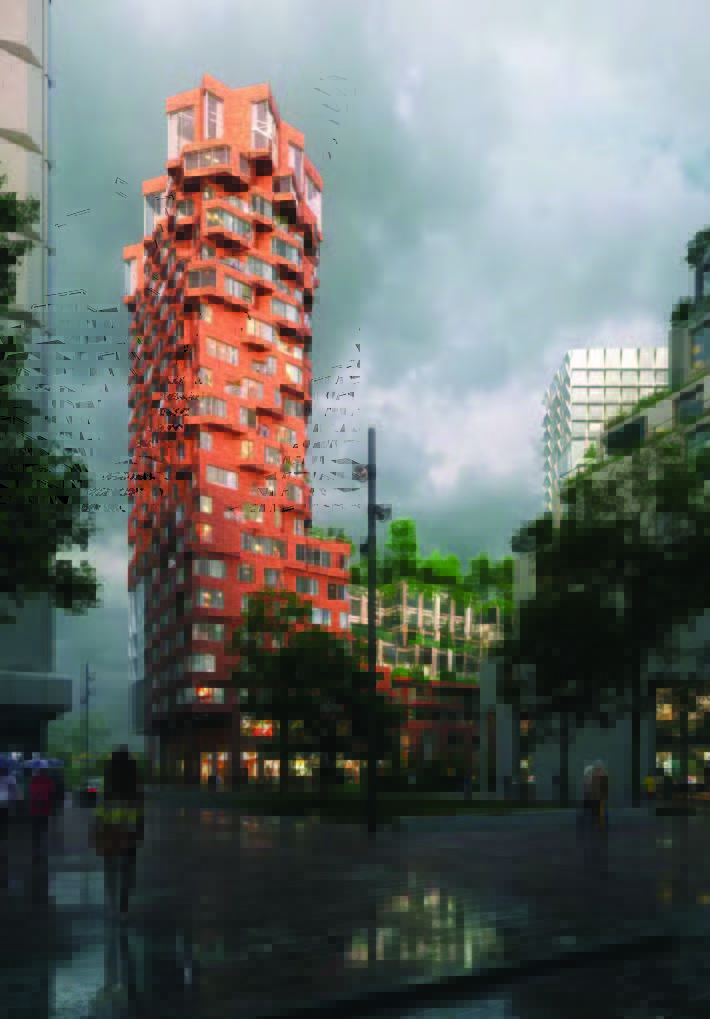
Zuidas, unlike the development of classic financial hubs, which integrate sheer economic activities to commercial spaces, aimed to become a mixed-use space where functional office spaces, apartment high-rises, cultural facilities, and outdoor extensions co-exist at the same time.
This change is accomplished through complex factored negotiated entitlements which provide developers with increased density and flexible site zoning opportunities in exchange for specified public advantages. These agreements are also aligned with the city of Amsterdam enhancing development of urban environment private investment to meet societal goals, thereby promoting a holistic approach to urban growth.
The Zuidasdok Project: Connectivity as a Catalyst
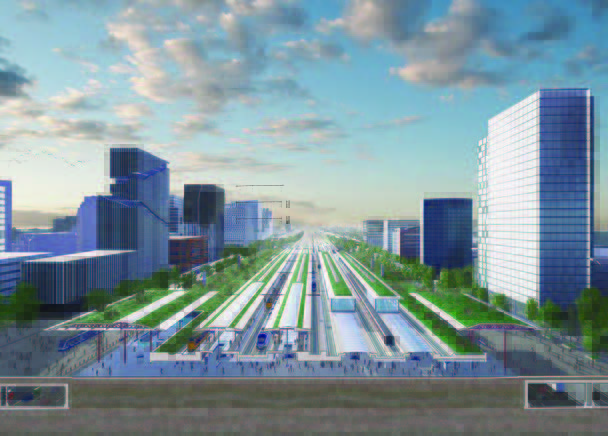
At the core of Zuidas’s growth is Zuidasdok project which has a budget of $1.9 billion and combines highways, railways, and bike paths into an integrated multi-faceted transportation system. The project, which addresses two of the major concerns: traffic delay and the regional connection, facilitates a more direct access route from the center of Amsterdam to the Schiphol airport and further out towards other neighboring regions.
The goal of designing the underground freeway passages and improving the rail system was to free the surface from highways and rail yards, which could then be used for parks, walking spaces, and new construction. This policy aligned with Amsterdam’s focus on active transport modes to decrease the need for cars and promote more cycling and walking.
The Zuidasdok project demonstrates how a piece of infrastructure can be the driver for the regeneration of the area and lead to wider social and environmental returns.
Affordable Housing in a Financial Hub
Another relative highlight of Zuidas is its low-income housing, which is rarely a consideration that is given priority in financial districts worldwide. This neighborhood follows Amsterdam’s broader housing policy, ensuring that 40% of its residential units are allocated as social rentals, 40% as mid-market rentals, and 20% as private housing, fostering a balanced mix of residents from diverse socioeconomic backgrounds. This inclusiveness was possible through means of negotiated entitlements, where the developers were provided with higher building heights and densities if these quotas were met.
This strategy reflects Amsterdam’s more radical housing strategies, which are aimed against speculative pressures, that invariably come with high-profile urban projects. Zuidas not only achieves such a differentiation by focusing on high wage specialists but also on the less wealthy residents of the community, thus striking a social balance within the area.
Public Spaces and Cultural Investments
Parks such as Beatrixpark and green areas surrounding the new developments create opportunities for leisure, improving the area’s quality of life. Furthermore, the inclusion of public arts, exhibitions, and outdoor events has turned Zuidas into a cultural zone for work, entertainment and life. These amenities were largely funded through developer contributions, in exchange for zoning adjustments and expedited approvals. This aligns with Sharon Zukin’s argument in Naked City (2010), which emphasizes that vibrant urban spaces must balance commercial success with cultural engagement.
Sustainability at the Core
Sustainability is central to Zuidas’s design. To meet the requirements, buildings within the district incorporate the use of green roofs, solar panels and energy installations that conform to the environmental standards. This is in line with the broader climate goals of Amsterdam, with the aim of being carbon zero by 2050. Zuidasdok project in addition assists the climate change challenges by improving public transport and cycling facilities; this reduces carbon emissions by promoting a change of habits of the residents and workers away from cars. By including sustainability in its legislated entitlements, Zuidas becomes a leading example of climate resilient urban form.
Challenges and Critiques
As successful as it might be, Zuidas still has other difficulties. For instance, some critics contend that the transformation of the area has favored corporate needs to local ones, with multinational companies dominating the area’s landscape, while others even doubt if the affordable housing quota is enough to counter rising property values in nearby areas, which have already experienced massive speculative pressure. So far, Zuidas has been able to strike a fair ratio between the public and private interests. However, to sustain that ratio, constant efforts are needed.
The Zuidas case study illustrates the challenges of incorporating public benefits in urban renewal projects in areas with high demand. However, how are negotiated entitlements applied in the provision of infrastructure on a metropolitan scale? In this regard, London’s Elizabeth Line is a telling case.
Elizabeth Line: Connecting Communities and Driving Prosperity
The Elizabeth Line, known also as Crossrail, is an example of the transformation in transportation and was launched in 2022. However, its birth goes back more than a hundred years. The idea first came into being in the 1880s but failed to be realized in practice, even though certain stations were actually completed in London. It was brought back, and this time with visionary zeal, by the Abercrombie Greater London Plan in 1944 as part of London’s plans for reconstruction after the Second World War. There was little debate about the project: it was simply named after the Queen in 2016 to commemorate her as well as her vision for the Crossrail and Central Core to securely join together the suburbs of London.

Negotiated Entitlements: A Mechanism for Balancing Public and Private Goals
The Elizabeth Line illustrates that negotiated entitlements have the potential to achieve public and private interests in major public infrastructure projects. The total cost of the project was £14.9 billion which was met by public funds, private investors and through innovative instruments, such as Business Rate Supplements, Section 106 agreements, and Community Infrastructure Levies.
Such instruments enabled and compelled developers to subsidize such expenses which served the purpose of improved design of stations and urban development, and building noise mitigation barriers for residents close to the stations.
To illustrate, the construction of the Canary Wharf Station consisted of financing that was undertaken by the Canary Wharf Group for the purpose of providing value to the project while also incorporating commercial districts within the development. Zoning agreements that incorporated mixed-use buildings also allowed for the establishment of housing in the peripheries and economic activities within the station regions. The employment Strategy of the project provided 55,000 jobs and apprenticeships, which contributed to the development of workforce goals. In addition, comprehensive stakeholder engagement made it possible to make the project even more local, and avoided conflicts by adding community value through the rehabilitation of urban landscapes, increased connectors and stimulation of economic activities.
Impact on Accessibility and Community Integration
The Elizabeth Line has significantly transformed the physical and social environments along its route in many ways:
- Affordable Housing and Land Value: Ever since the commencement of the project, it has been estimated that more than 30,000 housing units, approximately 10% of housing units in London, have been established. The new extensions have been built and better connection has encouraged housing developments, which have raised the level of the land and the properties around the recently constructed stations. Studies by CBRE as well as GVA suggest that the Elizabeth Line will bring a value of £13 billion to residential buildings by 2026 and £215 million to commercial real estate by 2026.
- Community Centers and Schools: Even though public facilities such as community centers and schools built as a result of the project are still in place, the rest of the areas were easier to access and created supply for education and community services as more families settled in these areas.
- Job Creation: The Elizabeth line has led to a rise in business and job employment opportunities of nearly 200,000 office jobs. Furthermore, it has also led to the establishment of 171 hotels, 2,666 food and beverage establishments and 12 museums, which further underline its economic benefits.
- Parks and Green Spaces: The project has enhanced the concern of public spaces. The construction of the facilities produced 6 million tons of soil which was used to construct a nature reserve in Essex, showing sustainable development. One particular environmental initiative associated with the project is the Wallasea Island Wild Coast Project. This initiative, which is under the management of the Royal Society for the Protection of Birds (RSPB), employed excavation soil to enhance the wetlands by creating salt marshes, mudflats, and lagoons. These areas not only improve biodiversity and flood management but also demonstrate how construction projects can integrate environmental solutions.
Private Investment and Economic Multiplier Effect
The designated Opportunity Area zone of Slough demonstrates the economic added value that comes together with the implementation of the Elizabeth Line. Redevelopment works positioned at the Slough Station saw the inclusion of extended platforms, an upgraded ticketing system, an extensive customer service improvement program, and electric overhead lines. These upgrades, as part of the £600 million Heart of Slough regeneration project done in partnership with Morgan Sindall, also included the construction of 1,300 housing units, provision of community and recreation facilities, and modernization of schools.
Moreover, Slough’s economic profile has also been strengthened by its geographic positioning along the M4 corridor and its active economic centers like the Slough Trading Estate zone hosting numerous global businesses including Mars and O2. Slough in 2018 recorded the highest Gross Value Added per worker in the whole of the UK. Slough’s youth and ethnically diverse inhabitants who are 55% of foreign birth and 31% less than 19 years are said to benefit the town in educational factors as well, 74% of the students also had high GCSE scores in 2019.
With the enhancement of Public Transport Accessibility Levels (PTAL), the Elizabeth Line integrates with Slough’s comprehensive economic and social infrastructure, and thus, serves its regeneration aims.
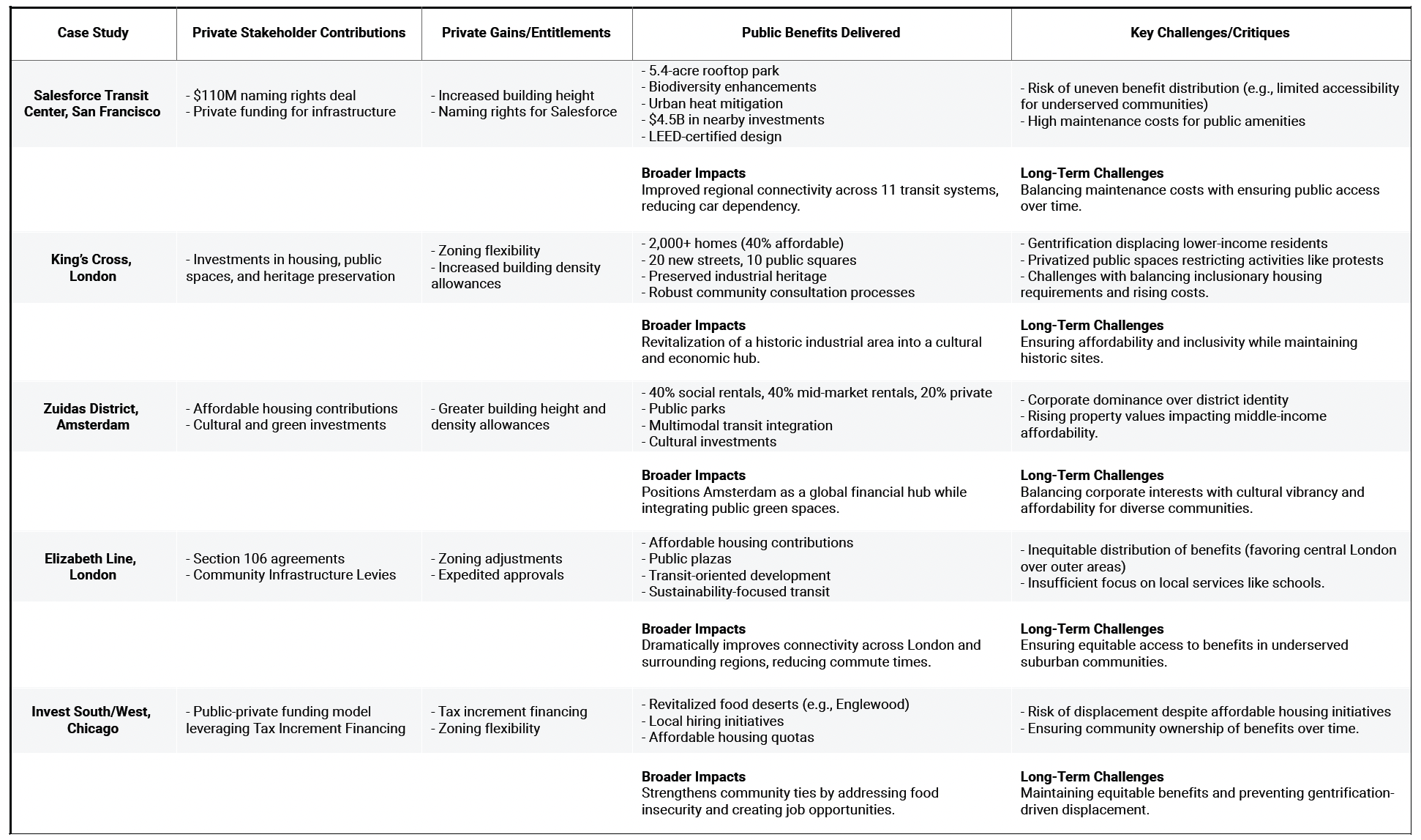
The matrix provides a comparative analysis of urban redevelopment projects, structured around six core dimensions. It illustrates
how private investments and public-private partnerships can drive transformative urban outcomes while addressing the complexities
of equity, sustainability, and long-term viability. Image and data compilation courtesy of the authors.
Financial Constraints and Trade-offs
There is no question that the Elizabeth line, for example, had to go through financial constraints and trade-offs. Initially cost at £14.8 billion in 2009, this figure went above £18.9 billion owing to time losses and extra costs. Meeting the expectations of stakeholders was yet another obstacle, as it called for businesses, travelers, and local communities to have common purposes.
The occurrence of Section 106 agreements and Community Infrastructure Levies had to include amendments to take care of cost overruns and the delay of project completion. For example, delays at Canary Wharf Station hurt the recovery of Anchor’s private investment which shows the kind of financial risks that the business incurred. In the same vein, the Heart of Slough project encountered contract changes designed to better tweak public and private requirements.
The high scale of tunneling within London’s urban area also brought numerous engineering difficulties and thus restrained the amount of operational disturbance caused to the existing goods. The building procedure also caused high quantities of carbon dioxide emissions and long-lasting disturbances for the commuters and businesses. In spite of all these challenges, some measures such as the Wallasea Island Wild Coast Project changed some disadvantages into advantages to the public, showing the necessary compromise to achieve such game changing infrastructure.
The Elizabeth Line can be seen as an achievement of urban imagination as well as a model of what negotiated entitlements may achieve in tandem between the public good and the private interest. In addition to transportation enhancement, the undertaking has fostered urban revitalization in the form of new construction, increased land values, employment creation and supply of social infrastructure and services. It has, in particular, emphasized the Walasea Island project, which prompts the need for further incorporation of green initiatives into large infrastructure projects. The implementation of the Elizabeth Line, however, has not come without difficulties and compromises. Nevertheless, the line achieved its goal of transforming the degree and nature of connectivity within, and economic activity across, London. This marks a step forward for what future expansion of cities would look like.
Equity in Action: Chicago’s Urban Renewal and Insights from Maurice Cox
Enter Invest South/West, an ambitious initiative spearheaded by Maurice Cox in overturning the urban renewal narrative in Chicago.2 Chicago has been a city of contrasts ever since: a center of global art and business yet exhibiting dismal income disparities between the rich North Side and the less financially affluent South and West Sides. By the time Cox took over as the Planning Commissioner of Chicago in 2019, the city’s disinvestment crisis was quite acute and there was the urgent need to not just revitalize these areas but to do so equitably.
At the core of the program, the goal is to reverse decades of neglect that has been suffered by communities on the city’s South and West Sides, and that is, developing the community through its own resources and making the best use of public funding to attract private investment. Unlike the urban renewal projects which occurred in the mid-20th century that frequently uprooted vulnerable communities, Cox’s vision is based on collaboration, inclusivity and equity.
Englewood Square, a $20 million mixeduse project targeting residents in a previously food deprived neighborhood, serves as a good illustration of the community focused strategy employed. The development features a Whole Foods supermarket that serves as an anchor for the project alongside other amenities like affordable housing, retail, and public arts created by local artists.
Building on this success, other initiatives like Englewood Connect—a hub for entrepreneurship and culinary programming—and the Englewood Agro-Eco District—a project promoting urban agriculture and sustainable practices—further illustrate the neighborhood’s transformation. Together, these projects embody mayor Lightfoot’s vision as stated in a 2020 press release,
“As we move into our second year, we’re going full steam ahead with new partnerships, RFPs, minority developer supports, and much, much more as we continue our shared mission to build the city where everyone has an equal shot at success and ability to live their dreams.”
Leveraging Public and Private Resources
The advantage of Invest South/West is its partnership between the private and public sectors, which deploys public resources to address the risks of private funding and encourage investment in underserved communities. Tools like tax increment financing (TIF) and zoning flexibility are important in terms of securing commitments of the developer toward public benefits while enticing other developers into the area.
To obtain financing and achieve the desired results, adaptive reuse along with creative financing mechanisms have also become critical tools for impact maximizing.Projects such as Englewood Square provide examples of how strategic reinvestment can transform vacant spaces into vibrant, mixed-use development and provide such spaces with vitality through a mixed-use approach while enhancing their cultural context.
To ensure long-term community benefits, Invest South/West incorporates safeguards such as:
- Affordable Housing Quotas: The policies which mandate developers to reserve a certain proportion of residential units for long-time residents to prevent displacement.
- Local Hiring Requirements: Choosing contractors and workers from within the community to foster local economic growth as the project progresses.
- Trust between the city and the residents/developers is also built through the complemented with strong monitoring frameworks such as periodic progress updates, community feedback and measures of transparency.
Insights from interview with Doug Manz
Doug Manz, Partner and CIO at HYM Investment Group, during our interview echoed the importance of public-private partnerships (PPPs) and flexible zoning frameworks as seen in Boston’s Suffolk Downs redevelopment. These strategies match the goals of Invest South/West.
Through his experience, Manz emphasized several key mechanisms that may assist in advancing urban regeneration in an equitable manner:
- Public-Private Partnerships (PPPs): As Manz pointed out, tax incentives, zero interest loans, and fast track approvals help bridge funding gaps, especially for affordable housing and sustainable development projects.
- Planned Development Areas (PDAs): Boston’s flexible zoning framework allows tailored agreements that align large-scale projects with community needs, mirroring the adaptability embedded in Chicago’s negotiated entitlements.
- Transit-Oriented Development (TOD): TOD helps not only in creating jobs and housing, but also in boosting the economy through provision of infrastructure improvement and density of urban development. Projects like Boston Landing emphasize on how such developments drive regeneration, a principle that is also reflected in Chicago’s focus on transit connectivity.
The thoughts of Manz also highlight the aspect of participation. At Suffolk Downs approximately 450 community meetings were held in order to ensure that the communities were considered in the main decisions and in pursuit of transparency.
Community-Driven Transformation
A significant feature of Invest South/West is its core idea of preserving culture and social identity. Adaptive reuse projects, such as public art installations in Englewood Square, provide economic value while creating a sense of place for long-time residents.
This approach is reinforced by Boston’s focus on integrating local businesses and mixed-use spaces, to make sure developments satisfy community needs. With all the lessons from the two cities, it is clear that there are many elements that make up successful urban renewal: robust public-private partnerships, flexible zoning mechanisms, community ownership, and consistent engagement.
As Doug Manz highlights, “The intersection of economic feasibility and community benefit is where true transformation happens.”3
Lessons Learned: Crafting a Framework for Success
Urban development has evolved beyond simply buildings or expanding infrastructure; it now actively contributes at creating urban sustainable, equitable, and economically viable cities. Negotiated entitlements which have evolved as a coverage between the common good and private profit have also become an essential mechanism in this development process.
However, for these strategies to be effective, a framework of negotiated entitlement principles must be developed, embodying transparency, flexibility, and community-focused planning. The case studies we presented in this article offer information on these key aspects necessary for success, as well as the issues that will have to be solved.
Core Principles of Successful Negotiated Entitlements
- Transparency and Accountability: Strong accountability mechanisms such as understanding formal agreements and evaluation frameworks are necessary to ensure that the public good will be delivered as promised. Trust relationships can be maintained by public dashboards and regular progress reports.
- Flexibility and Scalability: Customizing agreements based on the specific requirements and contexts, whether for a single building or an entire neighborhood, ensures relevance and efficacy.
- Sustainability and Equity: Public benefits should prioritize long-term aspirations, such as climate adaptability and social inclusivity, ensuring that developments cater to various communities.
Positive Feedback Loops: A Driver for Continuous Growth
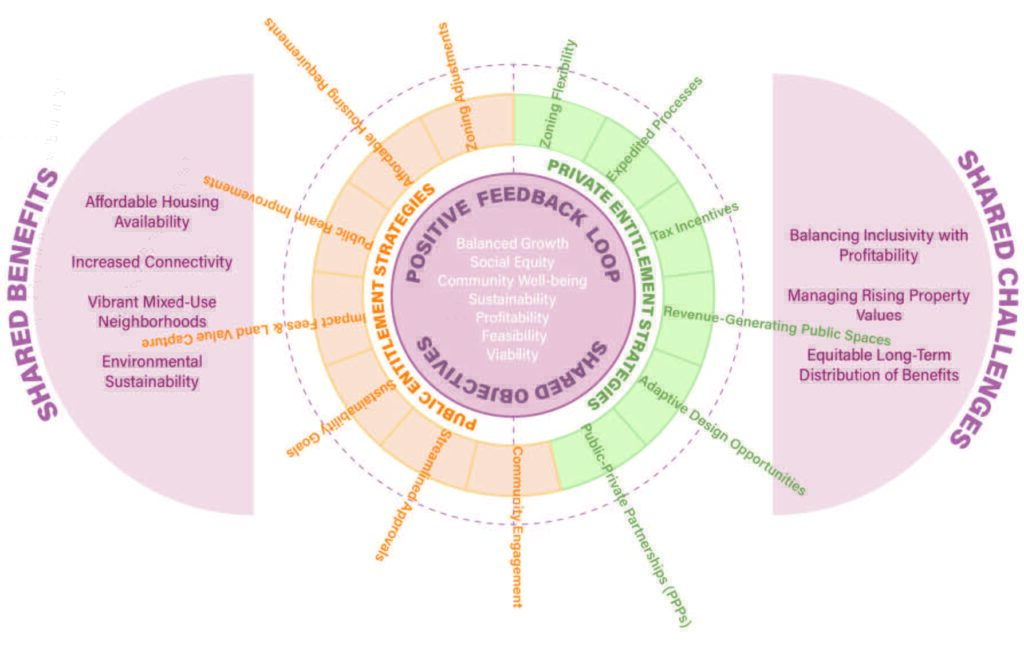
Entitlement strategies are built around one central idea-the positive feedback loop, a cycle that constantly reinforces itself where returns on public investment create private benefits which in turn provide returns for public goods. This approach enhances the alignment of public and private interests while driving persistent growth of economic, social as well as environmental parameters.
The Salesforce Transit Center in San Francisco provides an example of this constructive policy. The public investment led to $4.5 billion private development around it, generating tax revenue which could be utilized for local community and infrastructure development.
Likewise, King’s Crosswhich sought to invest in the area’s culture and economy—leveraged the necessity for public works such as a better cultural and economic landscape along with the promise of affordable housing and open space.
This kind of cyclical method ensures that cities can embed this strategy into the entitlement policies and enhance urban growth without compromising social equity and environmental sustainability.
Summary of Supportive Policies
Regulatory and policy frameworks such as Inclusionary zoning and density bonuses as well as community benefits agreements (CBAs) are equally fundamental in aligning private development with public goals. Some of these policies engage developers in building public facilities thus making sure urban growth is enjoyed by all members of a particular society through land value capture approaches.
Local Governments have an important function in the development and implementation of these policies, providing direction to developers and protecting the interests of the community. The tension between flexibility and rigidity in these policies is a crucial consideration, since if policies are too strict, then investment may not come and if they are too lenient, then public benefits may not be realized.
The development of the Elizabeth Line demonstrates how practical use of Section 106 agreements and Community Infrastructure Levies can be utilized to develop affordable housing and to enhance urban living standards.
Addressing Criticisms and Obstacles
Even with their potential, negotiated entitlements have faced scrutiny, particularly regarding issues of gentrification, displacement, and inadequate public benefits. Critics contend that these developments have the potential to displace certain low economic status residents, or develop an economic benefit which is not worth the adverse impacts to a community.
Withstanding these challenges calls for ethical planning and sound accountability mechanisms. Additionally, cities by actively engaging the neglected minorities and by routinely tracking adherence to the processes, they can create a developmental environment which is fair, just and inclusive. Ensuring that negotiated entitlements indeed meet people’s needs is both a great challenge to be met, but also a matter of ethics, for realizing lasting urban prosperity.
Building Cities for All
Concluding our research we recognize that such negotiated entitlements should not be considered an ultimate solution to all problems, but represent a vital tool in the planning arsenal. From the rooftop park at the Salesforce Transit Center to the cultural vibrancy of King’s Cross and the connectivity of the Elizabeth Line, all these case studies posit the idea of negotiated entitlements as the driver for delivering public benefits together with the economic imperatives. However, it is also evident that the challenge lies in maintaining transparency, ensuring accountability, and promoting community engagement at the forefront of the design and policy making actions.
In particular, Chicago and Boston’s experiences show that equitable urban renewal should not only be about financial resources and zoning changes or laws, but rather, a change in the culture of city-community partnerships. From Englewood Square to the Elizabeth Line, these cases underscore that appropriate partnerships between the public’s interest and private sector can and should avoid urban division and propel urban renewal for the common good.
In an era when cities’ vulnerability to rapid urbanization, climate change and social inequality continues to rise, it is apparent that negotiated entitlements present a pathway forward that balances ambition with responsibility and innovation with inclusion.
Bibliography
- Easterling, Keller. Extrastatecraft: The Power of Infrastructure Space. London: Verso, 2014.
- Fainstein, Susan S. The Just City. Ithaca, NY: Cornell University Press, 2010.
- Harvey, David. The New Imperialism. Oxford: Oxford University Press, 2003.
- Sagalyn, Lynne B. Public/Private Development: Lessons from History, Research, and Practice. New York: Routledge, 2007.
- Smith, Neil. New Globalism, New Urbanism: Gentrification as Global Urban Strategy. Antipode 34, no. 3 (2002): 427–450.
- Zukin, Sharon. Naked City: The Death and Life of Authentic Urban Places. Oxford: Oxford University Press, 2010.
- Centre for Cities. Learning from King’s Cross Regeneration. 2022. https://www.centreforcities.org/reader/making-places/learning-from-kings-cross-regeneration/.
- Urban Land Institute. King’s Cross: A Case Study in Urban Regeneration. Washington, D.C.: Urban Land Institute, 2014. https://database.dpa-etsam.com/wp-content/uploads/2021/03/kingscross_16pgs_v11.pdf.
- City of Chicago. Englewood Trail Land Use Plan. August 2024. https://www.chicago.gov/content/dam/city/depts/zlup/Planning_and_Policy/Agendas/cpc_materials/08_2024/231221_Englewood_Trail_Land_Use_Plan_Final_08.07.24_V2_Rdcd.pdf.
- Transbay Joint Powers Authority. Salesforce Transit Center & Salesforce Park Fact Sheet. October 2019. Accessed November 12, 2024. https://www.tjpa.org/files/2019/10/Fact-Sheet-Salesforce-Transit-Center.pdf.
- Gemeente Amsterdam. Vision Zuidas: Exploring the Future of the Zuidas District. June 2010. https://ecotectonics.wordpress.com/wp-content/uploads/2012/01/20100607_visionzuidas_100dpi.pdf.
- Zuidas Amsterdam. Preliminary Design for Beatrixpark Site Now Ready. Zuidas, February 13, 2024. https://zuidas.nl/en/blog/2024/02/13/preliminary-design-forbeatrixpark-site-now-ready/. Websites and Online Resources
- King’s Cross Central Limited Partnership. About the Development. Accessed November 04, 2024. https://www.kingscross.co.uk/about-the-development.
- Heatherwick Studio. Coal Drops Yard. Accessed November 06, 2024. https://heatherwick.com/project/coal-drops-yard/.
- Allies and Morrison. King’s Cross: A Work of Urban Repair. Accessed November 04, 2024. https://www.alliesandmorrison.com/projects/kings-cross.
- Pelli Clarke & Partners. Salesforce Transit Center. Accessed November 10, 2024. https://pcparch.com/work/salesforcetransit-center.
- Transbay Joint Powers Authority. Building the Salesforce Transit Center. Accessed November 12, 2024. https://www.tjpa.org/transbay-program/building-center.
- Peter Walker Partners Landscape Architecture. Salesforce Transit Center Park. https://www.pwpla.com/salesforcetransit-center-park.
- Zuidas Amsterdam. About Zuidas. Accessed November 14, 2024. https://zuidas.nl/en/about-zuidas/.
- Arup. Zuidasdok. Accessed November 14, 2024. https://www.arup.com/projects/zuidasdok/.
- Londontopia. A Brief History of the Elizabeth Line. Accessed November 29, 2024. https://londontopia.net/site-news/featured/a-brief-history-of-the-elizabethline-crossrail/.
- HYM Investment Group. About Suffolk Downs. https://atsuffolkdowns.com/about/.
- HYM Investment Group. Boston Landing. https://www.hyminvestments.com/bostonlanding/.
- The Pulse of Amsterdam. Iconic Zuidas Development ‘The Pulse of Amsterdam’ Sold to Union Investment. Accessed November 14, 2024. https://thepulse.amsterdam/news/10.
- ZJA. Zuidasdok, Amsterdam. Accessed November 15, 2024. https://www.zja.nl/en/zuidasdok-amsterdam. Reports and Policy Documents
- City of Chicago. Invest South/West: Two-Year Update. November 17, 2022. https://www.chicago.gov/content/dam/city/sites/invest_sw/ISW_TwoYear_Update_Nov17.pdf.
- City of Chicago. Invest South/West: Three-Year Update. 2023. https://www.chicago.gov/content/dam/city/sites/invest_sw/ISW_3Year_Update.pdf.
- City of Amsterdam. Policy on Climate Neutrality. https://www.amsterdam.nl/en/policy/sustainability/policy-climateneutrality/.
- Greater London Authority. Crossrail Business Rates Supplement 2018–19. March 14, 2018. Accessed November 13, 2024. https://www.london.gov.uk/decisions/md2225-crossrail-business-rates-supplement-2018-19.
- Natural History Museum. RSPB Wallasea Island: Turning Farmland into Wetland for Birds. Accessed November 29, 2024. https://www.nhm.ac.uk/discover/rspb-wallasea-island-turning-farmlandinto-wetland-for-birds.html.
- Transport for London. Crossrail Baseline Evaluation: Case Study Report. May 2022. Accessed November 29, 2024. https://content.tfl.gov.uk/case-study-report-acc.pdf. Real Estate Market and Development Analysis
- Knight Frank. King’s Cross Market Insight Report – 2020. https://content.knightfrank.com/research/1936/documents/en/kingscross-market-insight-report-2020-7034.pdf
- Crossrail Ltd. Crossrail Property Impact and Regeneration Study. July 2018. https://learninglegacy.crossrail.co.uk/wp-content/uploads/2018/07/4D-003-crossrail_property_impact_regeneration_study.pdf.
- CBRE. The Elizabeth Line: The Impact on London’s Housing Market. Accessed November 10, 2024. https://www.cbre.co.uk/insights/reports/the-elizabeth-line-the-impact-on-london-s-housing-market.
- London Property Alliance. Crossrail Effect Report. September 2023. Accessed November 13, 2024. https://www.londonpropertyalliance.com/wp-content/uploads/LPA-Crossrail-Effect-report-SEPTEMBER-2023.pdf.
- Zuidas Amsterdam. City Executive Opts for New Approach to City Development. Zuidas, February 1, 2024. https://zuidas.nl/en/blog/2024/02/01/city-executive-opts-for-new-approach-to-city-development/.
- Zuidas Amsterdam. Around 1,700 More New Homes in Zuidas by End of 2025. Zuidas, March 4, 2021. https://zuidas.nl/en/blog/2021/03/04/around-1700-morenew-homes-in-zuidas-by-end-of-2025/.
- United Nations Environment Programme. Land Value Capture: King’s Cross, London, UK. Accessed November 12, 2024. https://www.neighbourhoodguidelines.org/landvalue-capture-kings-cross-london-uk.
- Moore, Rowan. Nervous of Its Own Boldness’: The (Almost) Radical Rebirth of King’s Cross. The Guardian, April 28, 2024. https://www.theguardian.com/artanddesign/2024/apr/28/the-almost-radical-rebirth-of-kings-crosslondon-alison-brooks-architects-cadence.
- Regen X: the £3 billion making of King’s Cross. The Times, October 2023. https://www.thetimes.co.uk/article/regen-x-the-3-billion-making-of-kings-cross-mnm3bcqj0.
- Paris, Ellen. San Francisco’s New Salesforce Park Is Prime Real Estate. Forbes, September 17, 2018. Accessed November 12, 2024. https://www.forbes.com/sites/ellenparis/2018/09/17/san-franciscos-newsalesforce-park-is-prime-real-estate/.
- Transport for London. Property Development Above Elizabeth Line Stations to Create Jobs, Growth, and Revenue. Press release, March 2018. https://tfl.gov.uk/infofor/media/press-releases/2018/march/property-development-above-elizabethline-stations-to-create-jobs-growth-andrevenue.
- Sky News. Elizabeth Line: Years of Delays and Billions Over Budget, but Can Crossrail Transform the Capital’s Fortunes? Accessed November 29, 2024. https://news.sky.com/story/elizabeth-line-years-of-delays-andbillions-over-budget-but-can-crossrailtransform-the-capitals-fortunes-12619900.
- City of Chicago, Mayor Lightfoot Celebrates Accomplishments of Invest South/West on One-Year Anniversary, press release, October 2020, https://www.chicago.gov/content/dam/city/depts/mayor/Press%20Room/Press%20Releases/2020/October/Ivest-Sout-West-Anniversary.pdf.
- Reimagining the Civic Commons. Encouraging Innovation and Creativity in City Hall. Medium, February 15, 2018. https://medium.com/reimagining-the-civic-commons/encouraging-innovation-and-creativity-incity-hall-d1b52a7cdee3.
- Spielman, Fran. Lightfoot Celebrates Invest South/West with Englewood Culinary Hub and Firehouse Renovation. Chicago Sun-Times, September 27, 2022. https://chicago.suntimes.com/city-hall/2022/9/27/23375170/lightfootinvest-south-west-maurice-cox-englewoodfirehouse-culinary-hub-whole-foods. Sustainability Goals and Practices
- Buro Happold. King’s Cross Roadmap to Net Zero. Accessed November 10, 2024. https://www.burohappold.com/projects/kings-cross-roadmap-to-net-zero/.
- City of Amsterdam. Green Infrastructure Vision 2050. September 2020. http://carbonneutralcities.org/wp-content/uploads/2020/09/Amsterdam-Green-Infrastructure-Vision-2050_toegankelijk_02092020.pdf.
- Crossrail Ltd. Sustainability Report 2015. July 2018. Accessed November 14, 2024. https://learninglegacy.crossrail.co.uk/wp-content/uploads/2018/07/Sustainability-Report-2015.pdf.
- The ripple effect” refers to how initial investments stimulate further economic activity, attract additional investments, and elevate property values in surrounding areas. This concept aligns with broader discussions on ‘positive feedback loops,’ explored later in this document, where self-reinforcing cycles of urban transformation magnify the impacts of negotiated entitlements. ↩︎
- Maurice Cox, guest speaker for the course Design for Real Estate, delivered a lecture on November 13, 2024, at Harvard GSD. As the newly appointed Emma Bloomberg Professor in Residence of Urban Planning and Design, he discussed how design was foregrounded during several City of Chicago land disposition processes that he led in his former role as the Commissioner of Planning and Development under Mayor Lori Lightfoot. ↩︎
- This section draws on insights from an interview and discussion with Doug Manz, Partner and CIO at HYM Investment Group, conducted on November 18, 2024. ↩︎