Rigged New World
Hannah Gaengler (MLA I ’17)
Nearing the end of the 21st century, the accumulation of irreversible anthropogenic effects on the environment prompted a global fear of a soon-uninhabitable planet. Environmental policies and conservation activities at the time were publicly criticized for their anthropocentric allocation of value. Food and energy scarcity was already prevalent among those of lower social standing. Backed into a corner, humanity was desperate to find a solution that would declare the end of the anthropocene and restore ecological equilibrium. In this sociopolitical climate, an activist group of programmers and environmental extremists gained massive traction worldwide. They founded the Global Multiobjective Optimization Initiative (GMOI) to find an objective structural alternative.
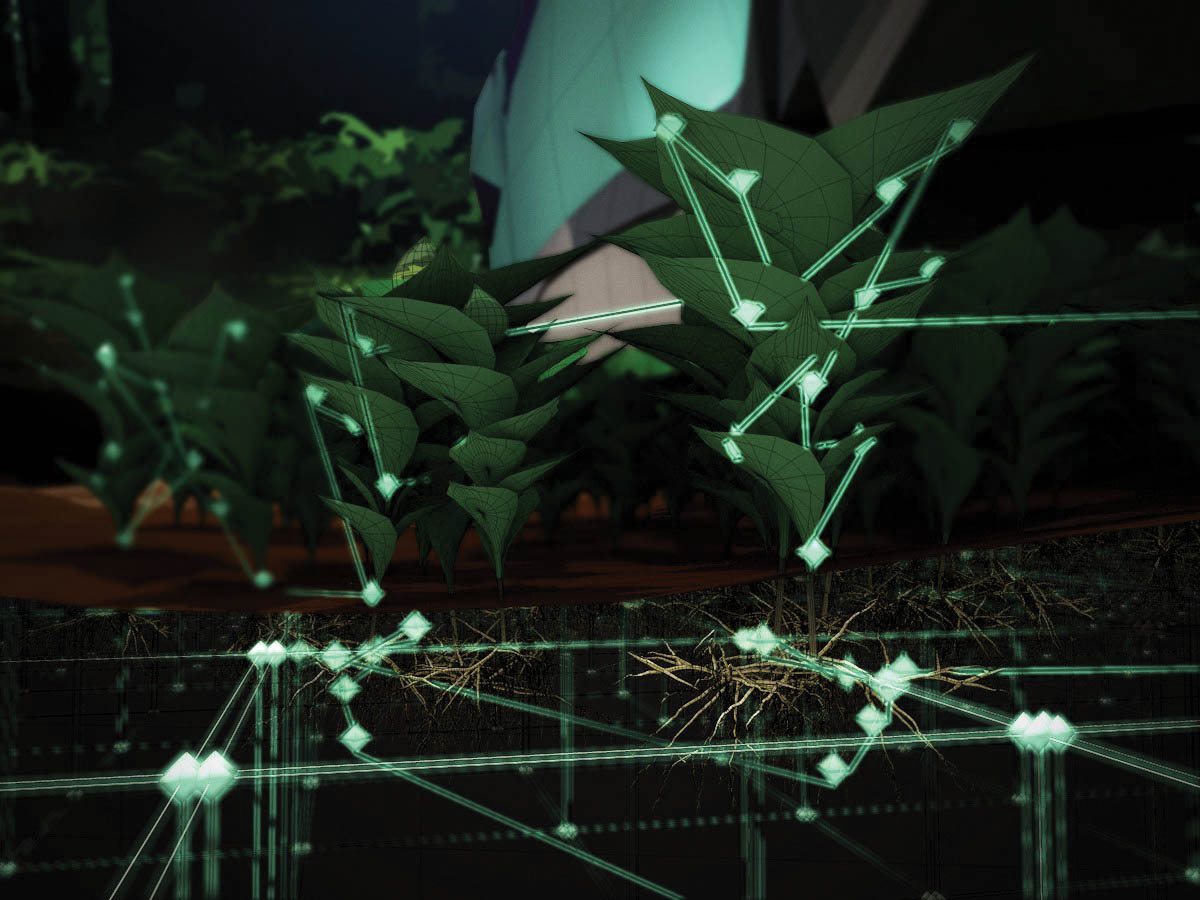
Based on evolutionary algorithms, GMOI created a mathematical model of nature that would provide the guidelines for the governance of all life on earth. They named it the “Mother Algorithm” and began using it to allocate resources to different lifeforms depending on their ecological fitness. The Mother Algorithm considers all ecosystems equally valuable. All life on earth, including humans, is ranked according to its contribution to the system it is a part of. To keep this process incorruptible, GMOI realized that humans needed to be removed from any activity enforcing the new principles. They thus began implementing their artificial intelligence models in sentient machinery, giving rise to the new “keepers” of the natural world obedient only to the Mother Algorithm.
A Frankensteined nature—helping with weed control to increase our biological and societal standing—the forest ground nerved by sensors—the worry of a mother to produce valuable offspring—a minuscule tracker between the antennae of a forage looper moth—robots harvesting crops to feed deserving individuals—our neighbor outcast from society because he hunted an endangered hare—a bypass on the stem of a rare, injured plant—a rigged new world.