Sonia Sobrino Ralston’s Data Ecosystems
Harvard’s Arnold Arboretum, known as a “museum of trees,” is a 281-acre preserve designed by Frederick Law Olmsted. Located in the heart of Boston, it has been the site of many regular visitors since its opening in 1872. These include Harvard students and faculty who conduct research on the trees and other plant life, but also members of the public who are able to enjoy it like any other local park—the Arboretum is open all the time and free of charge. In 1995, these visitors included young students from the Winsor School, a private school for girls, who climbed a large cork tree and caused it to fall under their weight. The tree, known as “Corky,” was removed from the Arboretum. Though the Arboretum no longer allows climbing, trees still fall due to storms and other natural phenomena, or succumb to pests and disease.
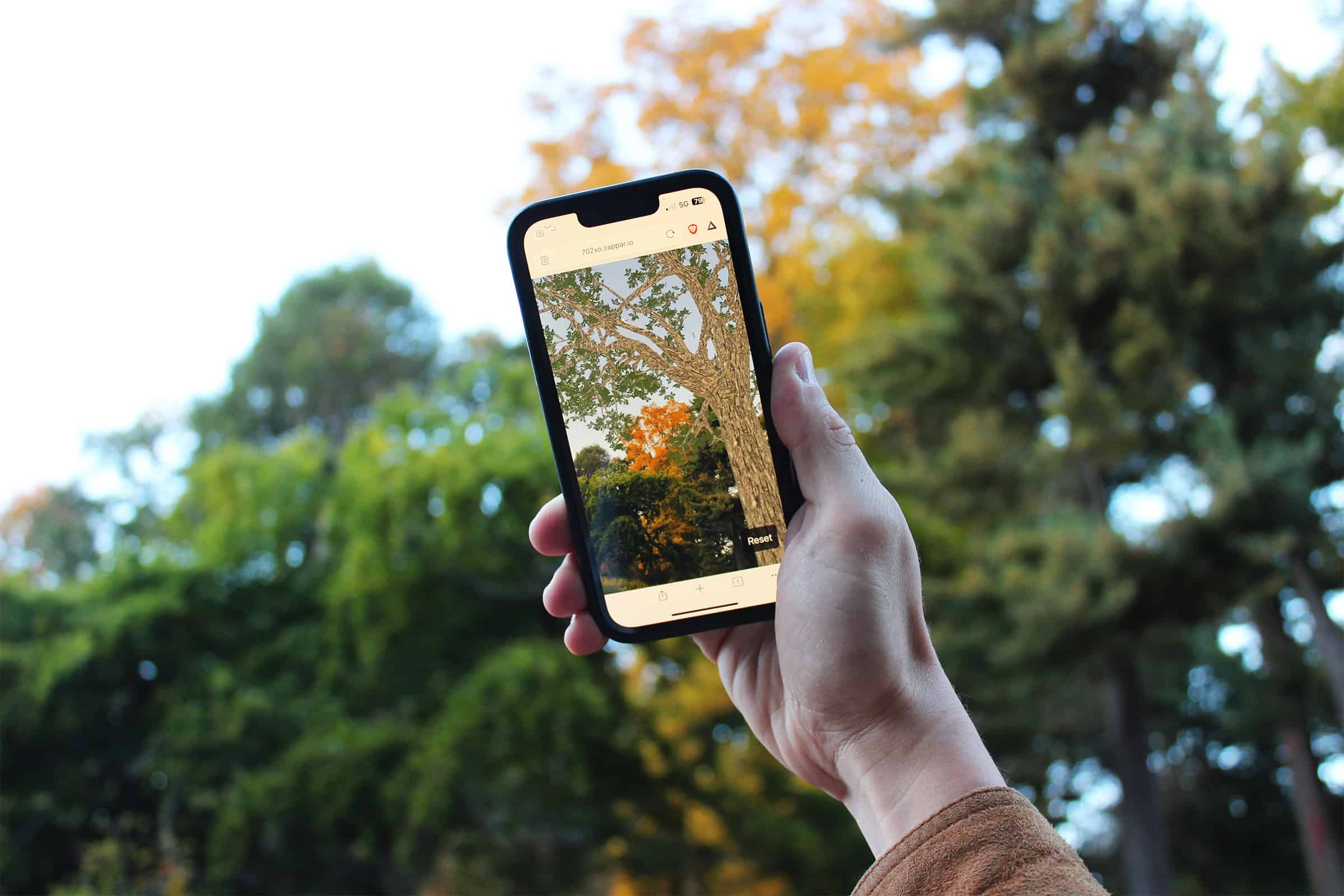
In conversations with Arboretum staff, Sonia Sobrino Ralston (MLA ’23), the Daniel Urban Kiley Teaching Fellow in Landscape Architecture at the Harvard Graduate School of Design (GSD), learned that some regular visitors had come to view certain trees as friends and companions, and were sad to see them disappear from the landscape. Using archival images, Ralston created Ghost Trees, an exhibition that featured augmented reality images of five trees that had once been in the collection. Visitors could use an app to pull up an AR image of the tree; signs placed at different locations identified where the original tree had stood.
One day, as Ralston helped an older man navigate the AR app on his phone, he remarked, “I really appreciate all this work that you’ve done—it’s so interesting to be able to see it, but it’s really not the same.”
“It was a helpful reflection,” said Ralston, “because we have data formats that are trying to capture and represent something, but the biggest file format that we have is an actual tree.” She began to question the relationship between digital preservation and organic growth: “What’s the lifetime of a tree, and what’s the lifetime of a digital file, and how do those mean different things to different people?”
Ralston is exploring similar themes during her Kiley Fellowship tenure. (The Daniel Urban Kiley Teaching Fellowship is awarded to an emerging designer who demonstrates a promising trajectory towards consequential work in the design of the urban public realm. The Kiley Fellow is appointed Lecturer in Landscape Architecture at the Graduate School of Design for the academic year.) In spring 2026, Ralston is teaching the seminar “Plant Remains: Representing Disturbance Through Digital Media.” In the course, Ralston examines landscapes depicted in digital programs commonly used by landscape architects, which are often full of vibrant details of life but neglect to show dead or decaying plants. Ralston is challenging students to represent the life cycle of plants native to the Northeast—including their mortality and decomposition—using Blender, an open-source 3D animation and modeling software program. The students visited the Harvard Herbarium, where staff prepared a collection of plant matter ranging from fossils used in paleobotanical studies to plants that had been collected in the field in the last year or two. Using Blender, students created 3D models of the dead plants.
The class also explored the famed Ware Collection of Blaschka Glass Models of Plants at the Harvard Museum of Natural History. The glass flowers, Ralston says, are “unbelievably beautiful, botanically accurate models that took many, many years to make,” a process that resonates with the digital techniques her class employs. The “intense work of digitally modeling a plant, and spending hours becoming really close to a plant in your screen,” she says, requires a slow investigation of botanical details similar to that undertaken by the craftsmen behind the glass models. “In a way,” says Ralston, “we’re making digital glass flowers.”
Ralston is hoping to continue the relationships with the Museum of Natural History and the Herbarium in her teaching next year. “I started making these plant models when I was at the GSD in part because I am a chronic overmodeler—I’m the kind of person who’s modeling doorknobs and stuff,” says Ralston. Having received a bachelor’s and a master’s degree in architecture, she found herself very comfortable modeling buildings and other human-made elements, but would incorporate the plant life only at the end of the process, often merely as abstract shapes. She taught herself to use Blender so she could more accurately depict details such as a plant’s root structure that are typically not included digital asset libraries, which are often optimized for game designers or filmmakers rather than landscape architects.
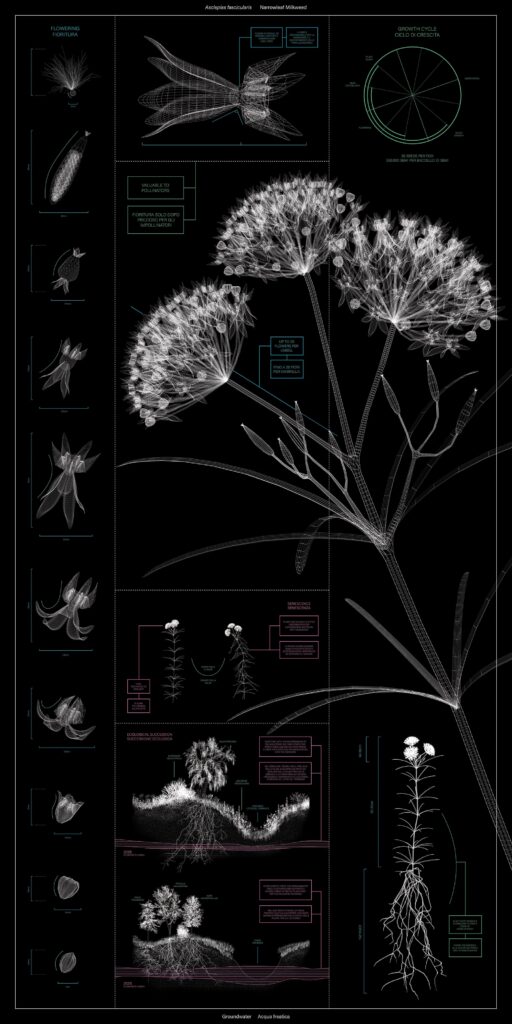
“The idea of using open source software became really important to me because so many of these plant asset libraries—someone owns them,” Ralson says. “As landscape architects, we should be able to be in control of our plant material.” As she modeled plants more and more intensely, Ralston began thinking about questions such as: how much detail do you need in order to represent a landscape? And how much computational energy does that take?
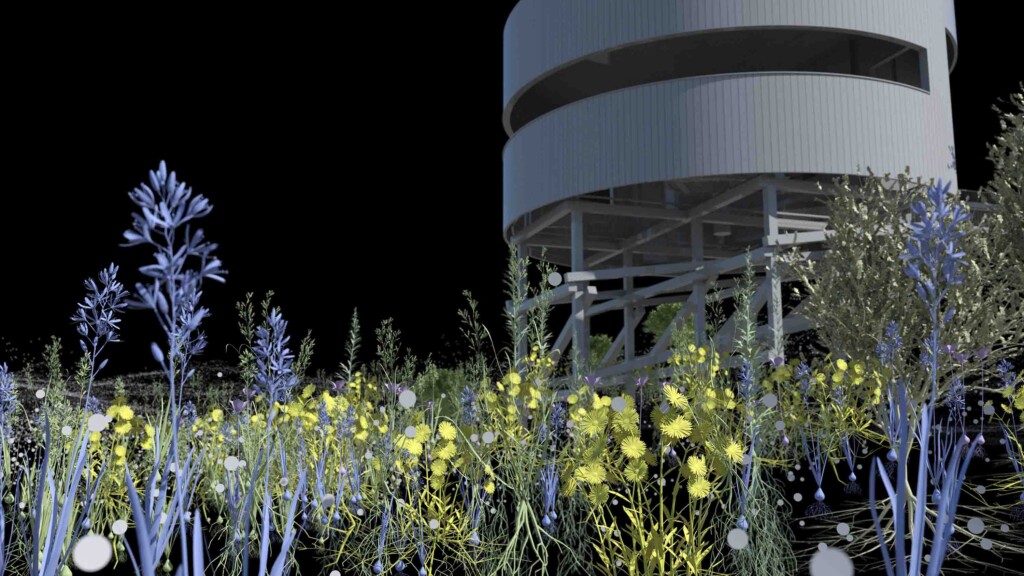
Ralston explored this question in her recent installation “Run Dry: Digital Infrastructure and Landscape Loss in Mesa, Arizona.” Created as a collaboration with Simon Lesina-Debiasi (MIT), “Run Dry” was part of the Information Plus Conference at the MIT Media Lab in early 2025, and addressed the decades-long conflict between residents of Mesa, who often faces water scarcity, and large tech companies, including Apple, that plan to build large data centers nearby—facilities that require substantial quantities of water to cool energy-intensive servers. Lesina-Debiasi had previously worked with zeer pots—ancient Middle Eastern devices made of two terracotta pots separated by a layer of sand. By watering the sand, users could evaporatively cool the contents inside—generally fruits, vegetables, and other perishable items. “We did the inverse,” explained Ralston. “We got these really old and, by today’s standard, obsolete computers that are not very good at rendering, and we put them inside of the zeer pots where they generated heat.” Visitors to the Media Lab (“another kind of harsh environment, like a desert”) encountered a desert landscape in which LCD monitors stood on stands. These monitors displayed the Blender interface rendering digital models of plants found in Mesa. But because the computers were nearing obsolescence, the process took days. “It wouldn’t be immediately apparent that the computational draw was killing these plants that I had modeled and rendered and animated to be gradually wilting and dying,” says Ralston.
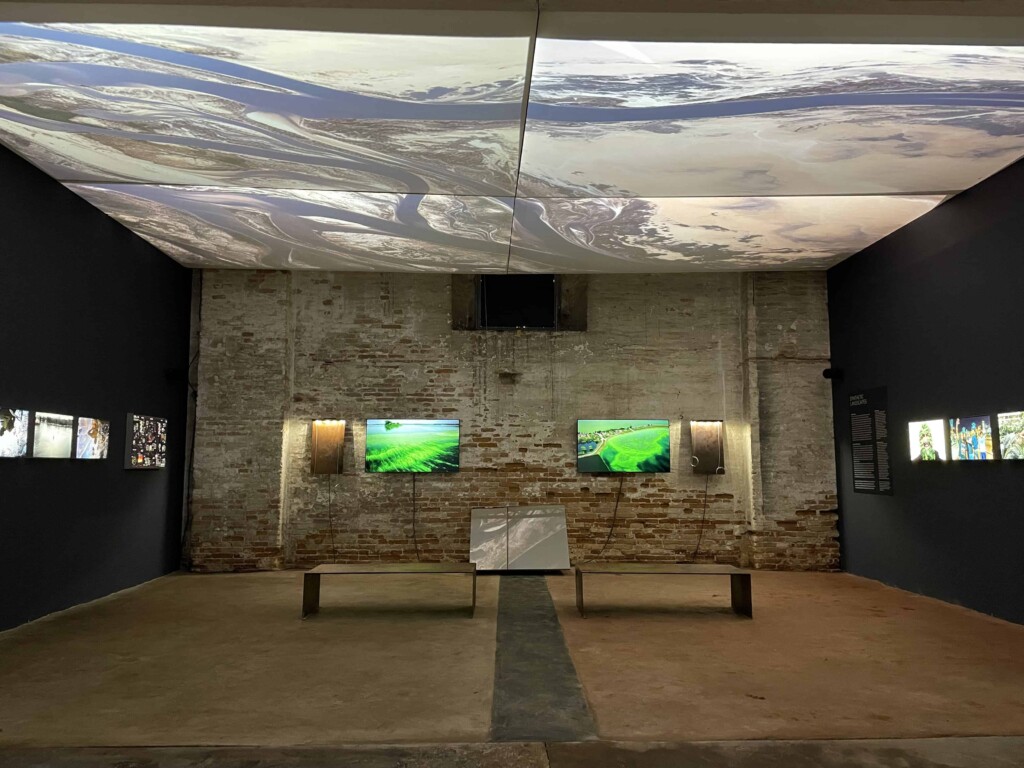
Images from “Run Dry” at the MIT Media Lab
Ralston connects “Run Dry” to other aspects of her practice through a shared concern with the politics of land use. She sees a “long history of extraction that’s embedded in an herbarium or in an arboretum. Many of [the items in collections such as these] come from imperial collecting missions.” The relationship between data processing and ecology, though long addressed by scholars, has been increasingly visible to the public in recent years due to the boom in AI data centers. As Ralston notes, many of these facilities are being located in “places that are socially, economically, and racially marginalized—and that’s all by design.”
Related
-
-
Uncommon Knowledge: Practices and Protocols for Environmental Information
Sonia Sobrino Ralston (MLA I AP '23), Rosalea Monacella