What should we call cities that develop as outposts for industrial agriculture? How can we describe the countryside when it becomes home to hyperscale data centers? A recent conference at the Graduate School of Design (GSD), organized by students in the Doctor of Design (DDes) program, examined the mixed condition of “rurbanity” emerging across the globe. “Carrots and Sticks: Incentives Shaping the ‘Rurban’ Interface” brought together speakers from a range of disciplines who considered the forces—economic, technological, and ecological—driving urban and rural elements together.
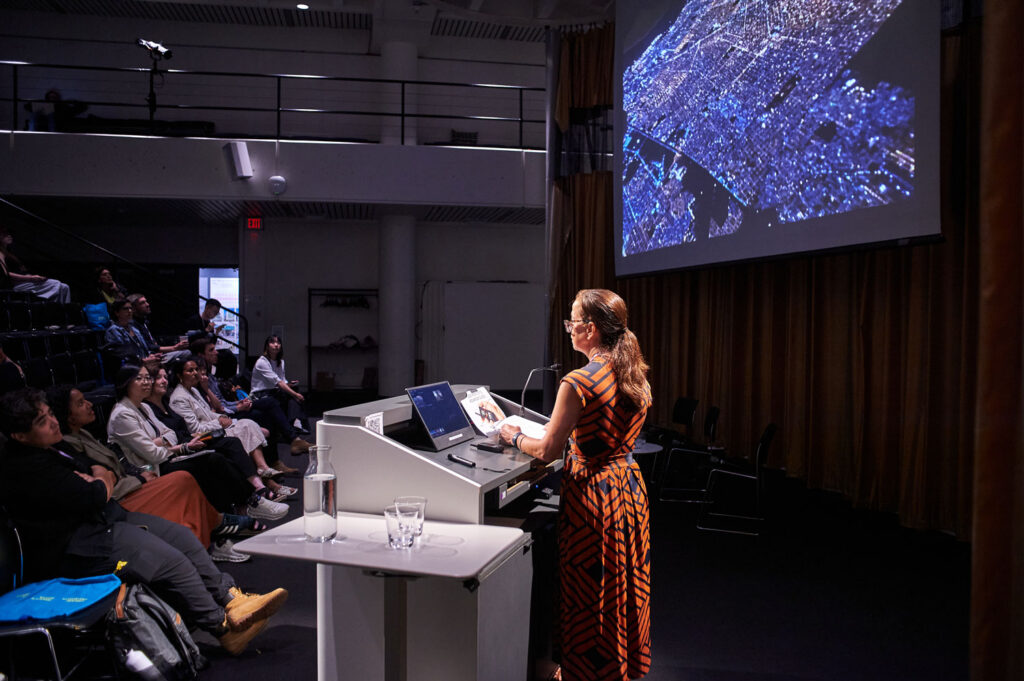
“Across the Global South, the boundary between cities and their surrounding countryside is dissolving,” said Ali Malkawi, professor of architectural technology and director of the DDes program, in his opening remarks. The conference framed this change as the product of specific incentives and directives—the “carrots and sticks” of its title—rather than as a natural stage in urban growth. “Subsidies, regulations, and land use changes are usually discussed as instruments of policy,” Malkawi continued. “This conference uniquely treats them as instruments of space.”
The speakers covered a wide range of places and histories, from the oyster farms of the Pearl River Delta to Egypt’s Sugar Belt to the dense informal settlements of Lima. Yet the conference organizers, DDes candidates Sophia Xiao, Yihao Wu, and Yunjie Zhang, saw structural similarities in how the researchers approached them. “We share common concerns about spatial governance: the unknown development capacities of AI technologies, the rapid expansion of data and energy infrastructures, the urgency of climate change, and the increasingly visible ways in which political relations shape ecological and social environments,” said Zhang, summarizing the proceedings. “On the path toward sustainability, we need alternatives, and the mechanisms of spatial governance offer an important point of entry.”

The first presentation showed what such mechanisms can do, and where their power runs out. It was given by Li Hou (DDes ’09), lecturer in urban planning and design at the GSD, and focused on the ecology of the border zone between Hong Kong and Shenzhen. The water in the shallow bay linking the two cities ignores the boundary between the former British colony and the People’s Republic of China. Hou argued that oyster farming in the bay shows how a shared environment meets diverging spatial politics, as aquaculture adapts to shifting regulations on both sides of the border.
Rawan Alsaffar (DDes ’24), research fellow at the Harvard Kennedy School, presented her research on the history of desalination in Kuwait, showing how water infrastructure has underwritten urban growth in the oil-rich monarchy. Alsaffar described desalination as a form of extraction that exists alongside, and supports, the better-known petroleum industry. She traced a feedback loop in which industrial water systems enabled oil exploration, which in turn drove urban demand for ever more water. The economic incentives behind this 50-year cycle, however, are now running up against ecological limits. As the by-products of desalination are discharged back into the sea, the growth of Kuwait’s cities is raising salinity in the Persian Gulf to dangerous levels.
Gabriella Carolini, associate professor of urban planning and international development at MIT, gave the keynote address, “Gradients in a Changing Landscape.” In a day of detailed case studies, she reminded attendees why research on the built environment matters, drawing on her career studying urban communities in South America and Africa. “Research is only as good as the action it enables,” she said. “We who are interested in cities, rural areas, and all the in-betweens, we engage in research because we hope ultimately to help improve our built environment, to help improve our natural environment, to help improve the situation of all people and living things therein.”
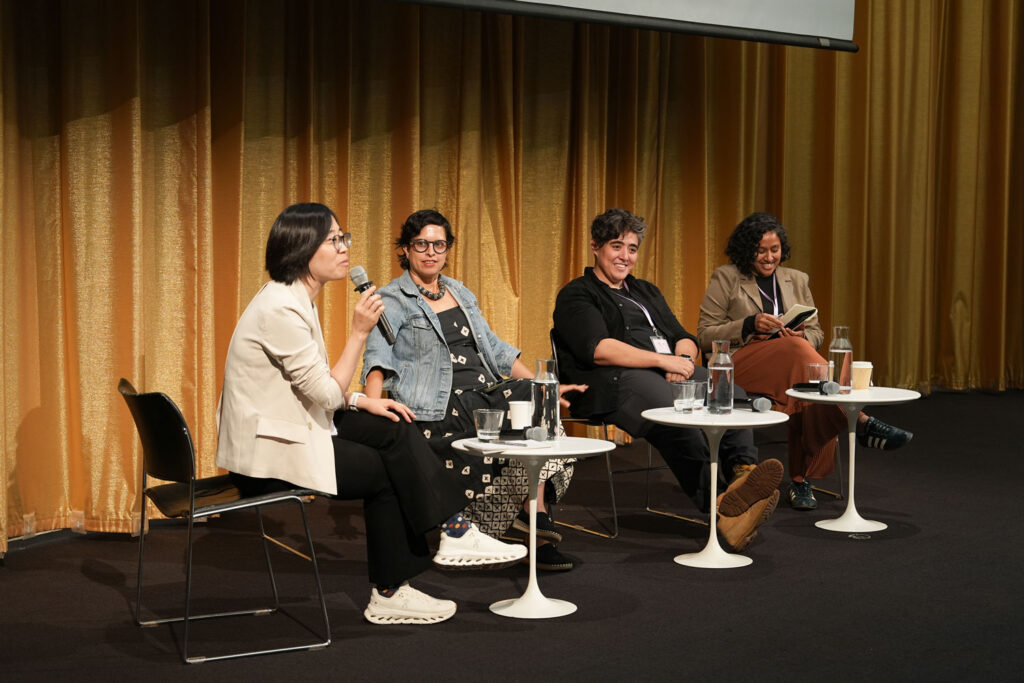
Several presentations took this activist approach, blurring the line between academic study and on-the-ground practice. Mariana Alegre Escorza, a lecturer in urban planning and design at the GSD, spoke about her work as both an academic and a practitioner in Peru. In “Care from Below: Community Resilience and Mutual Aid,” she described community efforts to respond to a devastating fire in Pamplona Alta, an area of 138 informal settlements in Lima that is home to more than 95,000 residents. Dení López, a doctoral student at MIT, presented “Risk and Resilience as Territorio: Un/Making Disaster Governance in the Isthmus of Tehuantepec,” about community engagement after earthquakes in southern Mexico. López described working as part of a collective that draws on the resources of academic institutions to support local efforts, so that the people inhabiting the areas being studied also act as collaborators.
How to name these new modes of research and new conditions of urbanity was a core topic of the conference. Carolini invoked George Steiner’s expansive definition of translation as an act of cross-cultural understanding. That was a fitting touchstone for a gathering devoted to conditions that blur physical boundaries and the language used to describe them. Diane Davis, Charles Dyer Norton Professor of Regional Planning and Urbanism and a faculty advisor for the conference, urged participants to adopt new ways of framing urban and rural situations. Rather than treating urban and rural territories as binaries, she suggested, “we think about relationalities across space and place.”
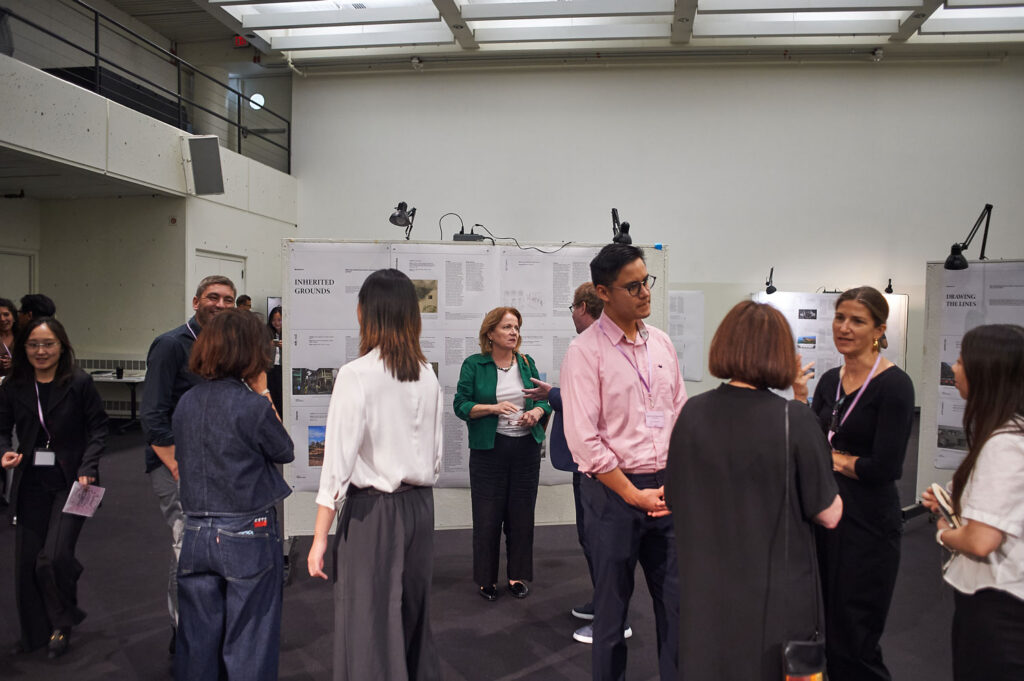
Because the vocabulary is still taking shape, the organizers launched the Glossary of Rurbanity, an open call inviting contributors to submit a keyword describing a specific rurban condition in their own language, along with short essays and images. The call drew about 300 submissions from around the world, and around 50 were selected for a printed booklet organized into six thematic movements. Contributions were pinned up in an exhibition at the conference, and some contributors presented at the afternoon Glossary of Rurbanity showcase. “We wanted to ground rurbanity before defining it, asking contributors to show what their words name in specific places and how design has responded,” Xiao said. “The range of contributions exceeded our expectations, but reading the selected entries together also revealed interesting parallels, including places treated as temporary for decades and design responses that arrive only after land and livelihoods have been reorganized, raising the question of how designers might work within these conditions.”
Finding these design and policy solutions has become urgent as AI infrastructure binds city and countryside together. Speaking on the “Digital Hinterlands” panel, Tyler Harlan, associate professor of urban and environmental studies at Loyola Marymount University, examined China’s “Eastern Data, Western Computing” strategy. The national policy places data centers and green energy projects in the country’s western interior, where land and energy are abundant, to serve the dense population centers of the east coast. In Harlan’s account, these “low-carbon frontiers” tie the future of remote regions to that of China’s largest cities. While heralding a sustainable future, such developments, Harlan argues, may also replicate familiar models of extractive economics, where regions that supply raw land and energy become subject to underdevelopment and environmental degradation.
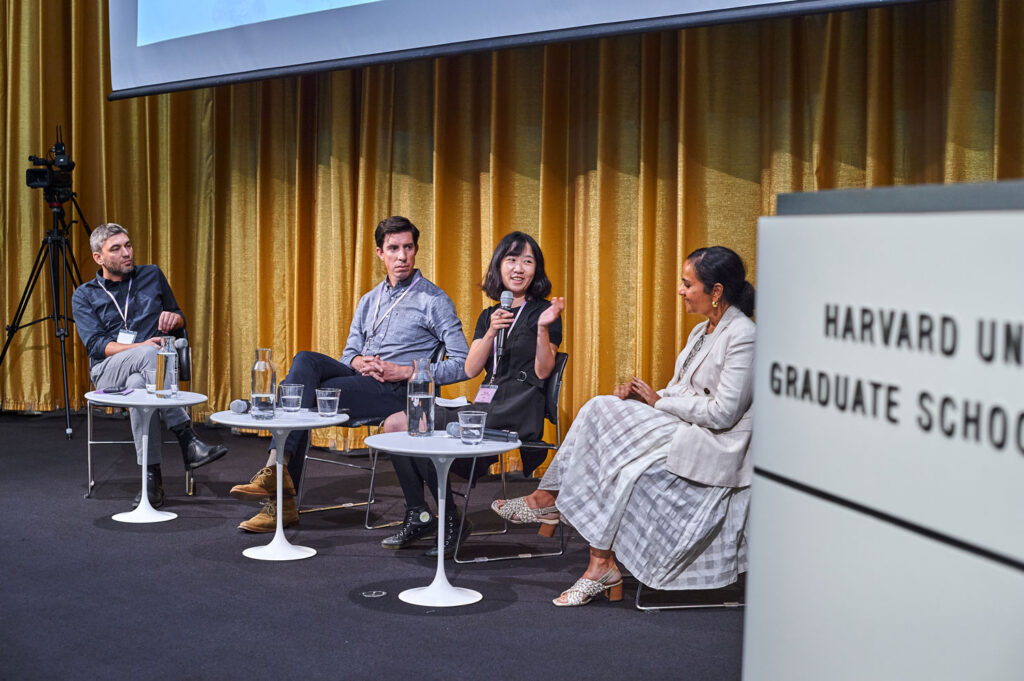
Xiao studies related developments in China, where digital platforms are “opening new possibilities for village life and livelihoods,” possibilities that “established urban–rural distinctions struggle to capture.” “Taking rurbanity seriously is urgent,” Xiao said, “because, in these places, development, governance, and ecological care are becoming inseparable. At the same time, decisions about land and infrastructure are already shaping what can be sustained and what may be lost.”
Taken together, the presentations made the case that we need to understand the mechanisms behind contemporary rurbanity and to find points where they can be changed. The questions Malkawi posed in his opening remarks remain open. “Whose sustainability is being promised, and at whose expense?” he asked. “And under what conditions can the rurban interface generate inclusive welfare without producing new forms of insecurity?” The conference offered no single answer. It did suggest that the answers will depend on seeing the mixed condition clearly, and on treating it as something that can still be redesigned rather than as a settled fact.