The Architecture of Listening: Nate Goore
How a GSD alumnus transformed lessons from behavioral economics, design, and jazz improvisation into a distinctive approach to complex problems.
Jazz improvisation may sound spontaneous, even accidental. But Nate Goore (MArch ’91), CEO of the strategic planning and design firm MKThink—and a skilled bassist—hears something more intentional: a musician listening intently, drawing on experience, working within the piece’s inherent structure, responding to his fellow players, and making choices that carry the music somewhere unexpected. It is a process Goore knows well. His career has taken him places he did not anticipate, while the work he does today depends on reading the whole situation, adapting on the fly, and discovering possibilities that others might miss.

That way of thinking has played out across an unusually wide professional terrain, from architecture to business strategy to rethinking how complex organizations function. Underlying these varied areas of work is a question that has guided him from the beginning. “Early on, I was interested in the relationship between human behavior and physical place, and in how each influences the other,” Goore explains. “This has remained a consistent thread throughout my career.”
Learning to Listen
Goore began exploring this concept as an undergraduate at Cornell University in the 1980s. After shifting from engineering to social psychology and probability, he encountered the emergent field of behavioral economics. One of its central insights—that people’s decisions are shaped not only by rational calculation but also by the conditions in which choices are made—deepened his interest in architecture and how physical space shapes the ways people move and interact. After earning his bachelor’s degree, Goore immediately pursued a master’s degree at the GSD.
There, Goore encountered an academic culture animated by different approaches to architecture, particularly its theories, materials, and methods of design. Among his most consequential lessons, however, was a way of thinking that extended beyond any particular architectural philosophy. In the first-year studio of the Italian architect, painter, and theorist Massimo Scolari, Goore learned to set aside preconceptions and attend closely to the conditions he encountered. Over time, that openness developed into a method of listening: observing behavior, gathering qualitative and quantitative information, identifying patterns and unknowns, and resisting the urge to arrive at an answer too quickly.
That perspective broadened through courses in law, engineering, history, and other fields, which exposed him to the full complexity of making buildings. In a course taught by the architect and construction lawyer Carl Sapers, Goore encountered the practical, financial, and institutional forces shaping structures meant to endure for decades. “It was the realization of just how dynamic buildings are as systems,” he recalls. He began to see a building not as an isolated object but as “an anchor for a very complicated system,” extending from its production through its far longer life in use.
Together, these experiences gave Goore a methodology he would carry into his practice: listen without imposing an answer, understand the larger system, and remain open to possibilities that emerge in the process. That mindset would soon lead him somewhere unexpected—into business consulting.
Working within the Structure
Goore graduated from the GSD in 1991 and joined CSC Index, a specialized consulting firm that helped businesses adapt to rapid technological change by rethinking jobs, organizations, and workflow. His charge was to extend this work to the physical environments in which these transformations unfolded. “All of these businesses existed in physical places,” Goore explains. “The primary goal wasn’t about design. It was: how do we optimize the way this business functions, and how does the physical place where these things happen support that?”
His first assignment, for the California State Automobile Association (CSAA—the California franchise of the American Automobile Association), made that question concrete. At the time, AAA locations operated much like Department of Motor Vehicles offices, with visitors moving from one counter to another for different services. New technology allowed AAA to rethink that model, enabling a single employee to assist a customer with everything from trip planning to accident insurance. But the shift required more than new software: it meant redesigning the employee’s role and creating a more personal setting for longer, more sustained interactions.
For Goore, the project put ideas he had begun developing at the GSD into practice. Space was one part of a larger system encompassing people, technology, operations, and business goals, and understanding how those elements worked together required looking beyond the boundaries of any single discipline. “You couldn’t just focus on any one thing,” Goore says. “That stuck, and that’s what turned into the way that we practice today.”
That method of working carried through subsequent projects at CSC Index and Wells Fargo, where Goore continued to operate at the intersection of design, organizational behavior, technology, and strategy. The settings changed, but the underlying challenge remained the same: understanding how space could adapt to the evolving ways people and institutions worked.
A larger pattern was also coming into view. Again and again, Goore found himself in what he calls “interesting moments”—situations in which different disciplines, ideas, and ways of thinking converged. As in an ensemble, the possibilities arose not from any one perspective but from the interplay among them. At Cornell, architecture had intersected with questions about human behavior; at the GSD, design expanded into a broader understanding of buildings as dynamic systems; in consulting, architecture came together with business and organizational strategy.
At first, Goore largely encountered these moments. Over time, he came to see that he could create them.
Creating the Conditions for Improvisation
Around 2001, Goore saw an opportunity to turn this hybrid way of working into a distinct practice. Through a mutual friend, he met architects Mark Miller and Steve Kelley, who had recently left a larger San Francisco architectural firm to strike out on their own. The three men shared an interest in working across conventional boundaries, and Goore soon joined them to form MKThink—part architecture firm, part consultancy—with a focus on how design and the built environment could advance broader organizational goals.
At the core of MKThink’s work is a research-driven process that deliberately expands what happens before design begins. Rather than treating predesign as a brief preliminary phase, the firm structures this period around discovery, assessment, and strategy. Discovery, Goore explains, puts into practice the lesson he associates with Scolari: gather information without rushing to judgment. The process combines interviews and focus groups with quantitative data, sensors that track how environments are actually used, and information drawn from clients’ operational, financial, and human resources systems. Together, these sources generate a fuller picture of how people, organizations, and places function—critical intelligence that MKThink uses to determine how clients can operate more effectively, align their physical environments with their broader objectives, and achieve their goals.
That emphasis on data eventually led to another venture. About a decade ago, Goore and his colleagues created RoundhouseOne to collate information ranging from real-time dynamic data, such as environmental readings, occupancy, and energy use, to relatively static building data like location, materials, and structural systems. Developed initially to support MKThink’s own work, the platform became a separate technology business and has since generated 28 patents. For Goore, its evolution reflects the broader conception of design that has shaped his career: innovation can reside in the tools, systems, and methods used to understand and improve a building as well as in the building itself.
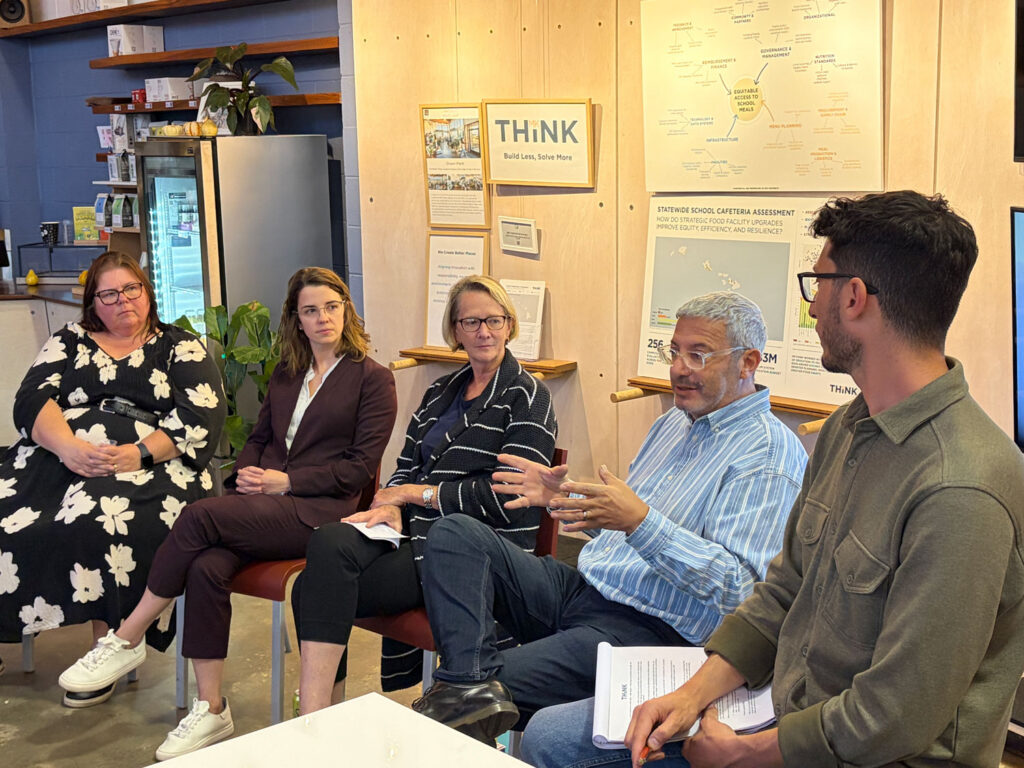
One of MKThink’s most expansive engagements has been with the State of Hawai‘i, beginning with the Department of Education’s efforts to feed students across 258 schools. Each school had long operated its own kitchen and procured its own food, an arrangement made especially precarious by aging facilities, remote locations, and Hawai‘i’s vulnerable supply chain. MKThink began with a comprehensive assessment of food production at every school, then reframed the problem at a larger scale: rather than treating 258 schools as 258 separate operations, how could the state build a more coordinated system? The project soon extended across the food supply chain, from farmers and procurement to central production and school retrofits, ultimately encompassing 100,000 meals a day. As Goore explains, it became an “end-to-end supply-chain-type project”—from farm to student.
That network’s potential has now expanded beyond feeding students to Hawai‘i’s emergency preparedness. Recent fires, floods, and hurricanes have underscored how slowly the islands’ infrastructure can recover from disruption, prompting MKThink and state leaders to ask whether the same food network could support communities during a crisis. The emerging model builds redundancy into every stage, with raw ingredients, prepared meals, and up to a week of food stored at individual schools.
What began as an effort to improve school meals has thus become a broader resilience strategy. For Goore, that evolution captures the essence of MKThink’s work: starting with a discrete problem, then asking, “How do we extend the understanding of the problem? What else are we solving for?”
The project also brings the jazz analogy back into view. The work begins with a framework—a client, a problem, a set of constraints—but new information and participants can change its direction. A problem about school kitchens becomes a question about statewide agriculture, procurement, logistics, and ultimately disaster resilience.
For Goore, that is not a departure from design but an expression of it. Like improvisation, the work requires preparation without predetermination: listening closely, drawing on the knowledge at hand, and creating the conditions for something better than the expected answer to emerge.