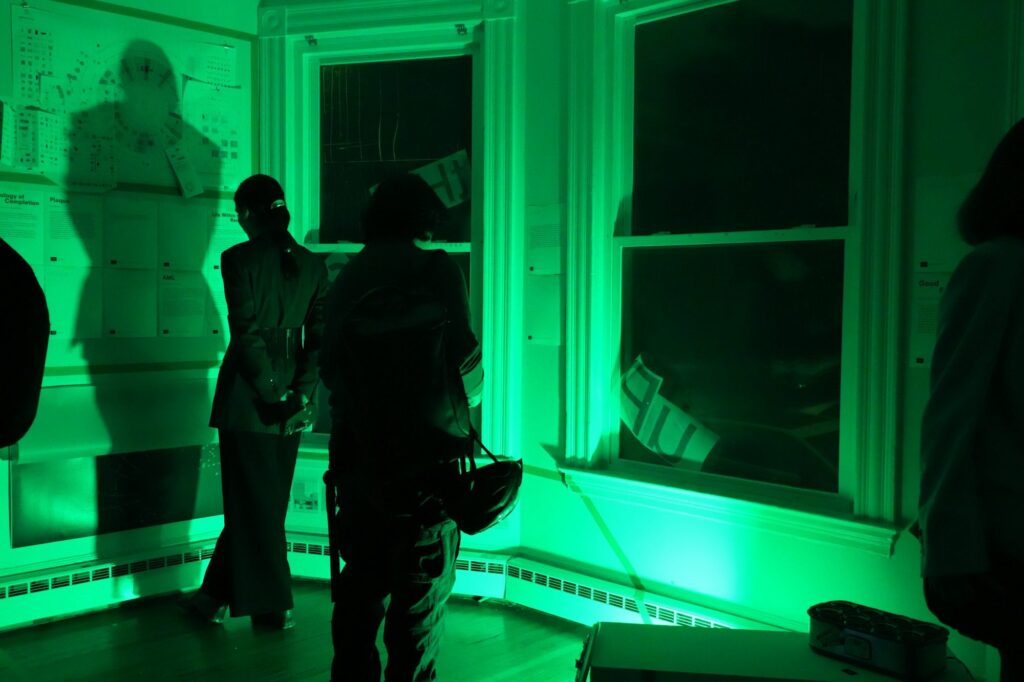
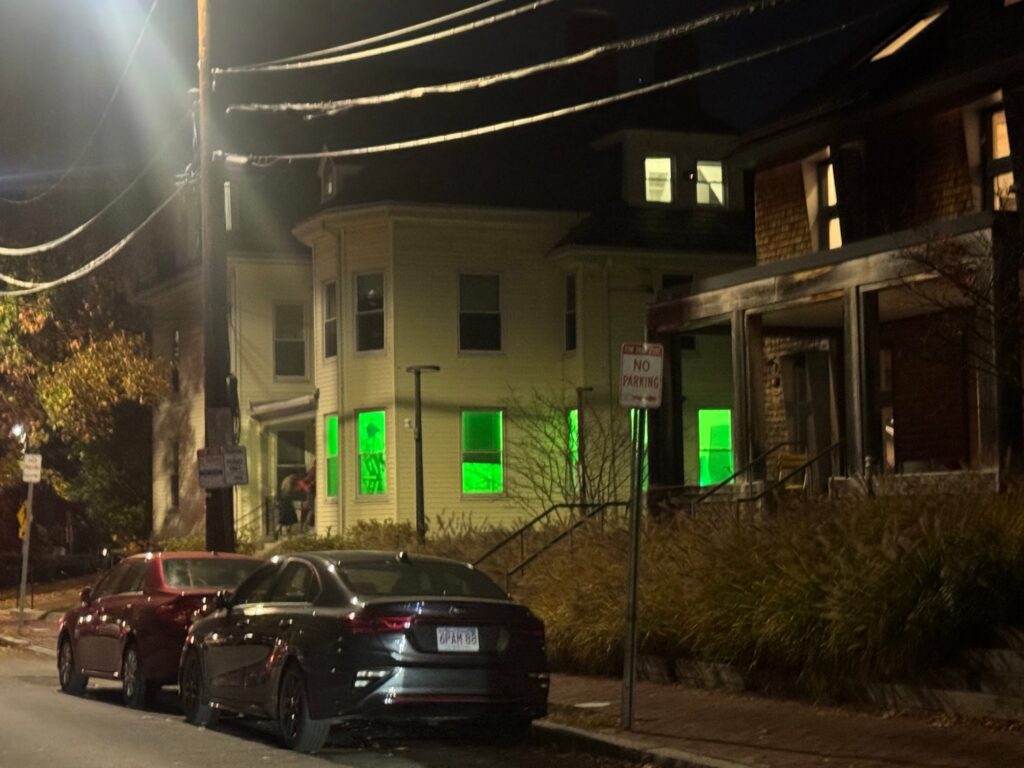
At night, the windows of the Kirkland Gallery, in a house at 40 Kirkland Street on the campus of the Harvard Graduate School of Design (GSD), glow an eerie green—part alluring beacon, part hazard warning. The tinted windows are part of the exhibition design for Clearing Up the Mess, a pop-up show of work by more than 40 GSD students, most of them in the Master in Design Studies (MDes) program, on view through November 16. During the day, the green light washes over a heterogeneous array of projects—some sculptural, some on video, some irreducible to any single medium—linked by diagrammatic lines of tape that crisscross the floor and climb the walls, an exhibition design conceived by Cecilia Portillo (MDes Publics ’27) and Emily Yan (MDes Narratives ’27). What holds the work together is a shared impulse to interrogate the premises of design and the foundations of design education.
Rather than focusing on designed spaces or finished objects, the exhibition looks to their margins. It “treats design’s externalities as the center of design practice and pedagogy, not an afterthought,” in the words of its curator, Malkit Shoshan, a lecturer in advanced studies and interim head of the MDes Publics domain. The mess of the title is another name for those externalities: in the exhibition’s opening statement, “the whole material and immaterial infrastructure that makes a designed thing possible and that the design never shows.” That means the communities living beside mine tailings, the data servers drinking rivers to stay cool, the permits and trade rules, and the labor that digs, hauls, and dismantles. “All of it was designed,” the statement continues.
The exhibition is one part of Clearing Up the Mess, this fall’s series of MDes Open Conversations, which Shoshan organized. An open call in October invited MDes students to respond to the theme, and on October 27 a public conversation brought several of them together with heads of the program’s domains, which are Ecologies, Mediums, Narratives, and Publics. In Shoshan’s framing, those domains “sit at one table and act as lenses on the mess: ways to poke into it, to show it, and to think about how else we could design.” The series, she writes, “asks how design can answer for the whole life of a thing, and how design education can treat clearing up the mess as a method rather than an elective.”
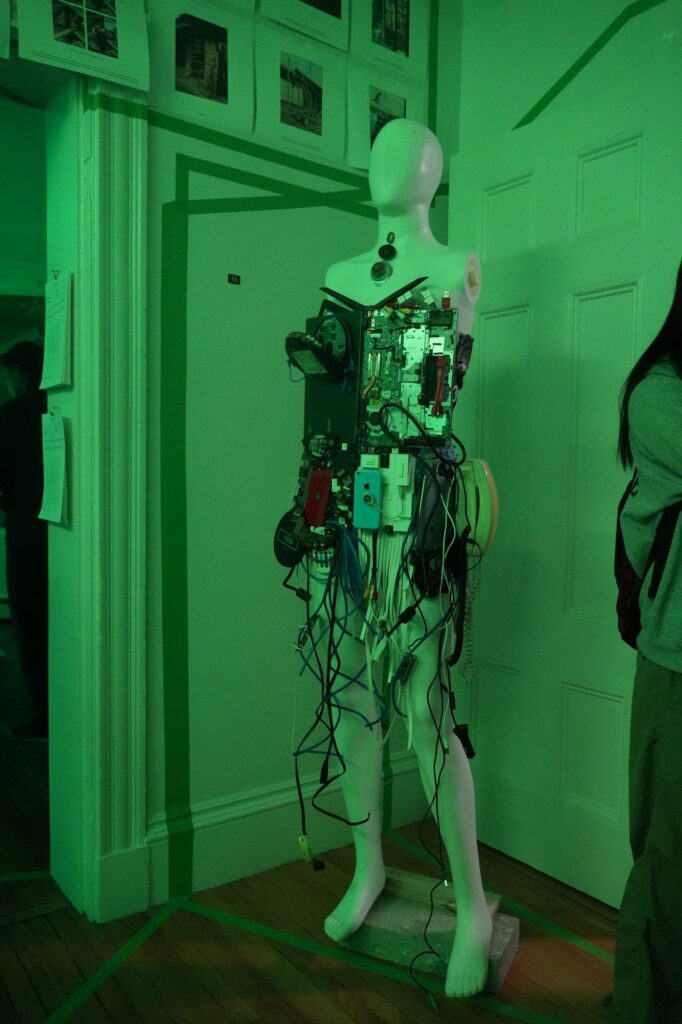
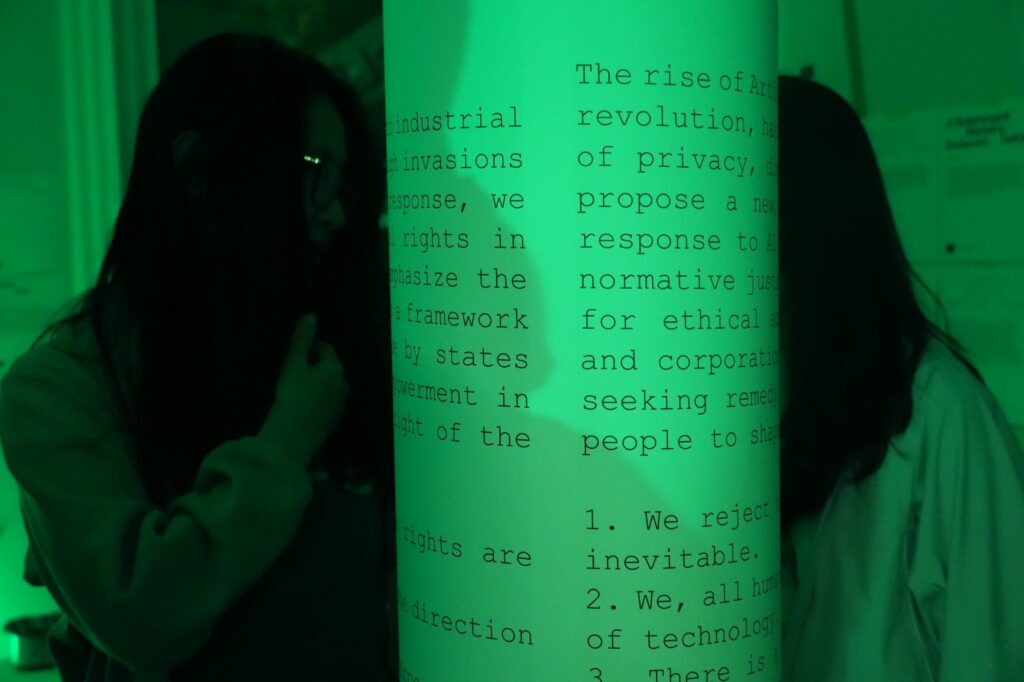
Some of the mess in the gallery is quite literal. Paola Ballesteros (MDes Mediums ’28) and Valeria Vilanova’s (MDes Narratives ’28) Worn (waste operates reality now), a costume displayed on a mannequin, is built from CD players and other obsolete electronics scavenged from the Cambridge Recycling Center and the MDes program’s shelves of reusable materials. Inspired by Frida Kahlo’s painting The Broken Column (1944), in which a crumbling Ionic column stands in for the artist’s chronic pain, the piece is a meditation on the proliferation of electronic waste that doubled as a Halloween costume—a pointed choice, given its makers’ critique of outfits bought to be worn for a single night. Other messes are harder to see. ± AI Futures, a manifesto by Kait Bell and Breanna Bonner (MDes Publics ’28) that is printed out and displayed like a monumental column, warns of the slow erosion of rights as artificial intelligence seeps into daily life. Inspired by Plutopia (2013) by Kate Brown, the authors propose new rights, among them “the right to imagine otherwise” and the “right to refusal.” “Our project addresses the mess through empowerment, re-affirming the rights of human beings to inform and shape our world,” they said.
One of the strongest threads in the exhibition is the invisible labor that sustains contemporary life and is routinely swept under the rug. Portillo’s The Cost and Risk of Getting Home: Movilidad de Mujeres Maquileras focuses on Ciudad Juárez, one of Mexico’s main maquiladora hubs, where more than 255,000 people work in export-oriented factories, most of them women. It is also a city marked by decades of violence against women. Getting home safely is left to the workers: bused to large parking lots, they still need rides from there, often paying for taxis out of their own pockets. Portillo proposes a free door-to-door ride service, requested through WhatsApp. Each ride is logged, the factory receives a monthly invoice, and the totals are published in a public registry. The invoice has no legal force; it is, in Portillo’s words, “a design instrument” for making visible a cost that the factories depend on but do not account for. A neighboring project by Yasmina ElGezeiry (MDes Publics ’28) , Mariam Khadr (MDes Publics ’28), and Ita Teta (MDes Publics ’28) follows a similar logic, designing a counter-label for jasmine perfume that discloses the working conditions and occupational hazards of the flower’s harvesters.
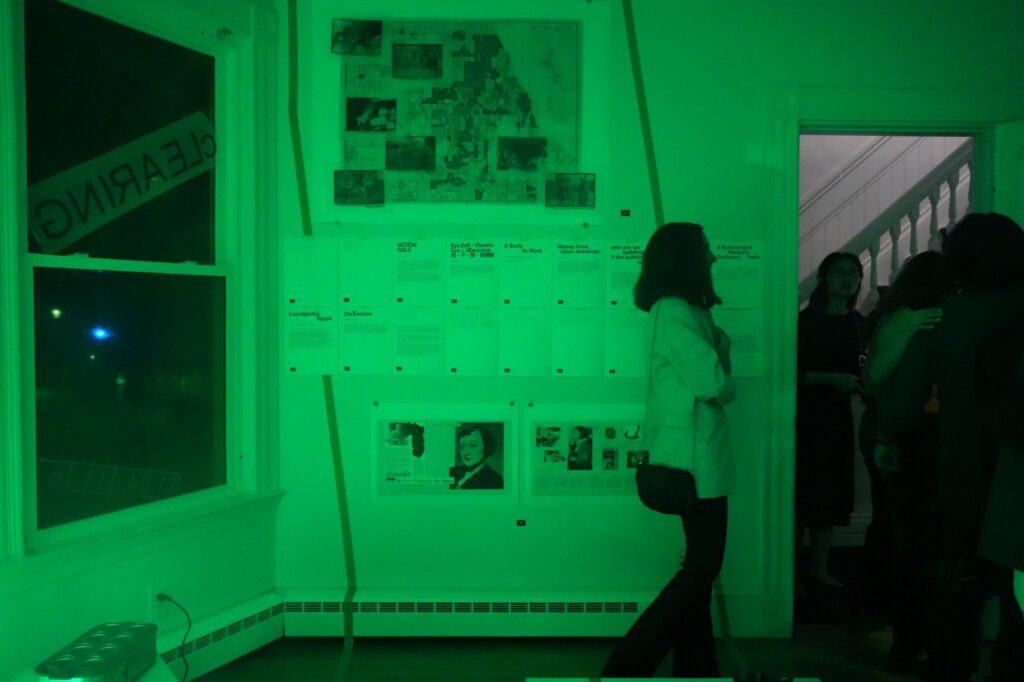
Ecological externalities form another major theme. Access//Absence: Aesthetics of Radiation in the Navajo Nation, by Harsimar Arora (MDes Narratives ’28) and Zachary S. Casey (MDes Publics ’27), traces the legacy of uranium mining and milling at Church Rock, on Navajo land. The pair describe radiation as a hyperobject, “dispersed across space, extended through time, and imperceptible in its totality.” Their sectional maps follow it across five orders of magnitude, from the mine site into groundwater, soil, foodways, and bodies, revealing “the infrastructures, ecologies, and communities entangled within radiation’s continuing presence.” They also chart a gap between contamination and recognition: federal compensation for radiation exposure does not automatically extend to the communities around the mine. Standing in the gallery’s green glow, it was hard not to sense an echo of that lingering, invisible presence.
Though many projects confront serious and painful themes, humor is central to the methodology evident in many projects. Morgan Grimm (MDes Publics ’28) and Aditya Shah’s Charge of Detachment is a machine that, at the press of a bright blue button, prints a fragment—a quote, an image, a question—drawn from a citation graph built out of core readings at the GSD, occasionally interrupted by a newspaper headline from the year a text was published or by a fortune. Spooling out on receipt paper, the result is a kind of digitized concrete poetry that represents design education not as a linear transmission of ideas but as a series of aleatory recombinations, missed connections, and surprisingly revealing juxtapositions. The joke has an edge: the machine depends on distant manufacturing, electricity, and paper of its own, so that, as its makers note, “our attempt to make the mess legible produces another.”
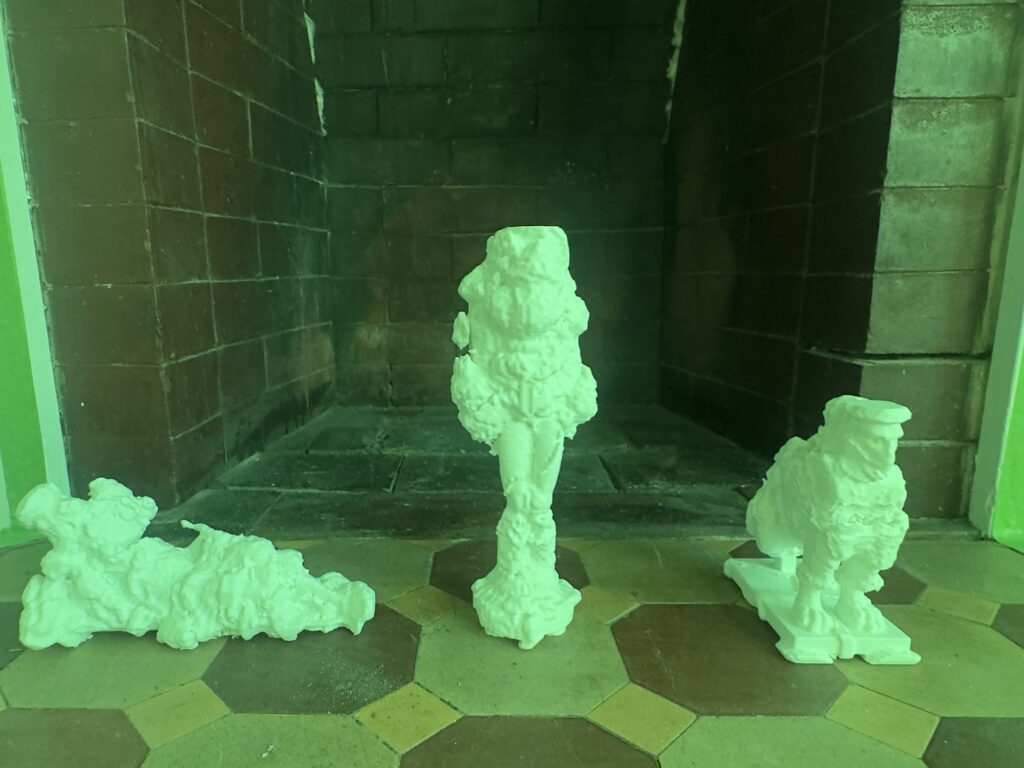
Elsewhere, the margins become a source of optimism, a way to approach new technologies on different terms. Digital fabrication is designed for certainty, Peiyan Zou (MDes Mediums ’28) and Ray Zhang (MDes Mediums ’28) observe; anything that deviates from the file becomes waste. Their Quantum Sculptor (Work in Progress) asks “what happens if we stop cleaning up.” Its forms are grown by an evolutionary algorithm modeled on nations at war, in which each voxel decides whether to attack, invade, absorb, or retreat from its neighbors, while live quantum measurements shift the odds of each choice. Because the results derive from true randomness, no one, including the designers, can predict or repeat them. The 3D-printed sculptures that result, including outputs that would normally be discarded, are technologically sophisticated objects of surreal beauty. In a similar spirit, Shlomi Wolman’s (MDes Narratives ’28) Contingency puts on view the failed and accidental results of his experiments with salt.
At the October conversation, Karen Lee Bar-Sinai, head of the MDes Ecologies domain, wondered whether clearing up the mess implies a return to a clean slate that never existed. The work in the Kirkland Gallery suggests not. Its makers are less interested in tidying up than in staying with the mess—counting it, mapping it, invoicing it, and finding in it the material for other ways of working. The exhibition statement calls the project “a rethinking of how design is made, and of the mess we have to attend to.” “This is where design starts to imagine otherwise,” it concludes, “and where its imagination is needed most.”