Between Grounds:
Repairing Vallcarca
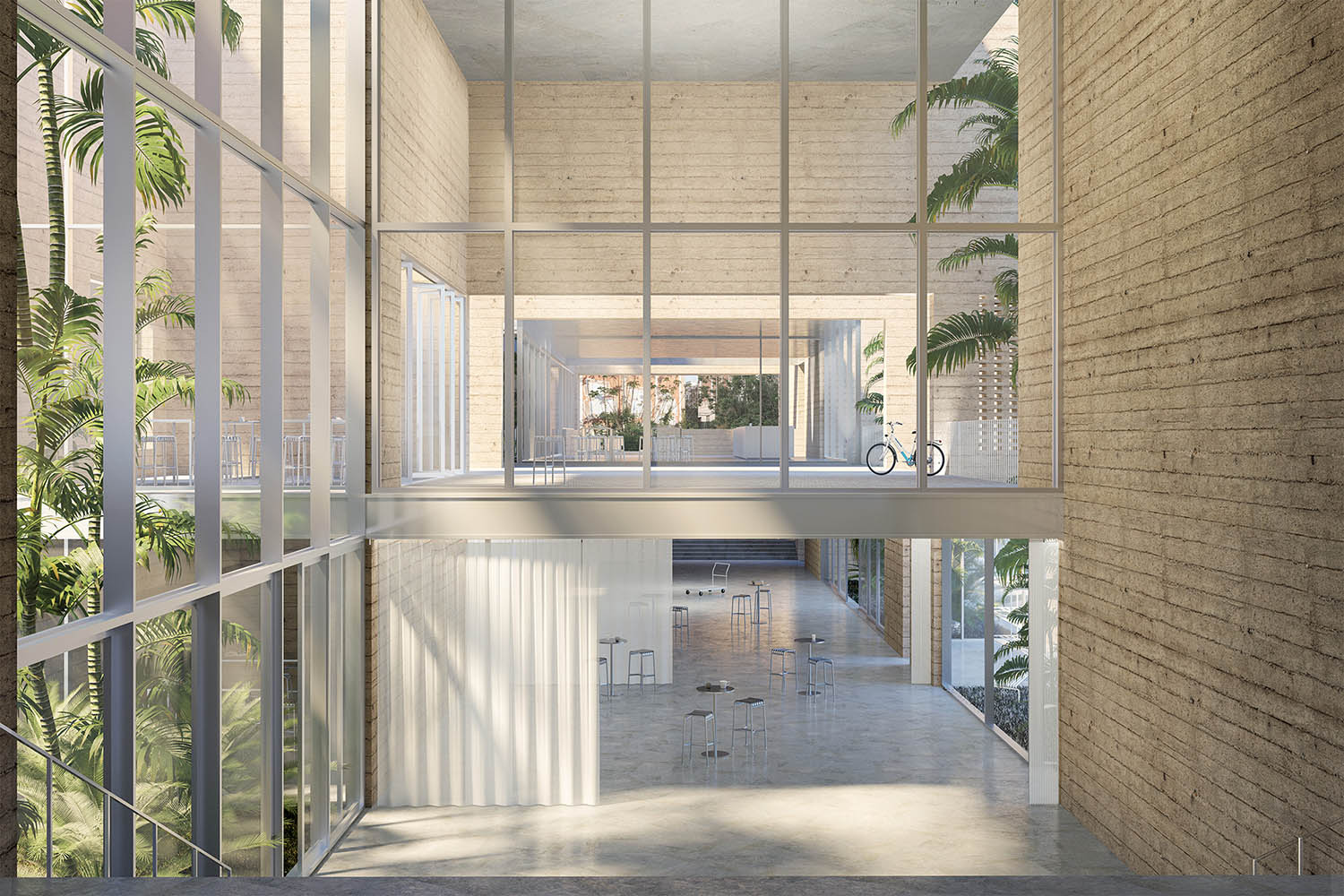
In the neighborhood of Vallcarca, architecture must confront the unfinished city. The Barcelona critic Ignasi de Solà-Morales describes this condition as “terrain vague:” a patchwork of urban voids charged with memory and expectation. In a place characterized by traces of the past and spaces hopeful of the future, how can architecture engage the existing fabric while asserting a new civic presence?
Emerging from this undulating urbanism is the concept of granularity. Referencing Agnes Martin’s blue Untitled (1965), the grid assimilates at the larger scale, while differences become increasingly perceptible as one moves closer, allowing individual forms to gain definition. Similarly, architecture here assimilates within the urban field while gaining autonomy through proximity.
The proposal reclaims two urban voids, bounded by blind walls and separated by a narrow street. Here, urban repair emerges from the city’s history: the Ateneu Barcelonès (historic cultural center from 1860), the public street, and the courtyard.
The Ateneu provides a model for collective life, where communal spaces extend into outdoor rooms and interior thresholds become places of dialogue. The project also draws from Barcelona’s streets, where everyday movement forms the basis for social interaction. These ideas inform the circulation strategy, which culminates underground as a street-like public space adaptable through a series of curtains. The courtyard acts as the primary organizing device, introducing visual permeability across levels while providing cross-ventilation and natural cooling.
Throughout the proposal, occupants remain aware of one another through views across courtyards and interior spaces. These moments of overlap between movement and occupation, interior and exterior, and collective and individual life transform the urban void into a civic space grounded in exchange.
Acknowledgements
This exhibition originates from Maggie Kroening’s work in the spring 2026 option studio, Civic Ground: The Architecture of Urban Repair. She would like to sincerely thank Fabrizio Barozzi and Alberto Veiga for their guidance throughout the semester and for sharing their extensive knowledge of Barcelona.
Special thanks to Diletta Trinari for her guidance and to invaluable peers at the GSD for their encouragement; Wendy Yu (MArch I ’27), Yiming Zhu (MArch II ’26), Zamen Lin (MArch II ’26), and Xuefei Gao (MArch I ’27).
Finally, appreciation goes to the GSD exhibition team for their assistance in bringing this exhibition to life and to Dean Sarah Whiting for her invitation.
Looking for older event archives? Please contact Loeb Library or visit our YouTube channel.