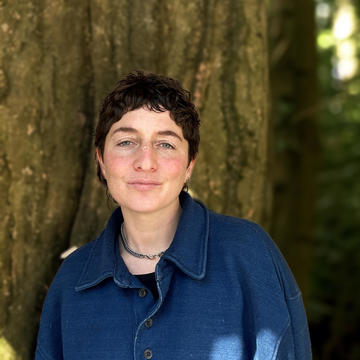
Caroline Filice Smith is a historian and urbanist focused on the political economy of urban design, counter-hegemonic histories of planning, and questions of care, democracy, and liberation in the contemporary practice of planning. They work for the City of Boston; currently as a senior urban designer within the Planning Department, and previously as the Director of Civic Design in the Mayor’s Office of New Urban Mechanics.
In their current role, Caroline works on a range of projects related to public education, the energy transformation, climate resiliency, and more. In 2026 they launched the City of Boston’s Planning Academy initiative; a people’s planning academy for Boston residents, which is now in its second run. In addition to their work for the City of Boston, Caroline is completing a book project on the history of participatory planning and its relationship to the Black Power movement, global urban rebellions in the 1960s, and cold war social engineering.
Prior to joining the City of Boston, Caroline led research initiatives and taught courses at the Harvard Graduate School of Design, working with the High Line Network on their Community First Toolkit, an open-space equity-planning toolkit done in collaboration with the Urban Institute. Caroline’s architectural career was predominantly spent at UNStudio in their Shanghai office, with shorter stints at Micheal Maltzan Architects and Ball Nogues Studio, focusing on computational design and complex geometries.
Caroline received their Ph.D. in Urban Planning from Harvard University GSAS, MAUD with Distinction from Harvard GSD, and BArch from Virginia Tech.
Their research, writing, and teaching has been supported and recognized by the Graham Foundation, the Knight Foundation, Harvard’s Ash Center for Democratic Governance and Innovation, the Urban Land Institute, the Canadian Center for Architecture, the Architectural League of NY, the American Society of Landscape Architects, and many more.