Marina Otero Verzier on the Struggle for Sustainable Data Centers

In a public lecture at the Harvard Graduated School of Design (GSD) titled “Feral Clouds,” Marina Otero Verzier, lecturer in architecture at the GSD, examined the “architectures and politics of data processing and storage.” To cool servers running 24/7, data centers require vast amounts of energy and produce harmful emissions. “The cloud is not weightless,” Otero Verzier argued. “It is a vast thermo-political infrastructure reshaping the planet’s climate.” As the AI race drives investment in “hyperscale” data centers, the social and environmental impacts of computing power have come into focus and sparked resistance movements around the world.
In 2022, Otero Verzier received the Wheelwright Prize, which funded two years of research on the future of data storage. She travelled the world studying different models for data storage. In her talk, she contended with the limits of creating “greener” data centers to sustain ever-increasing demand. Instead, she challenged us to more fundamentally rethink our relationship with the data, questioning the need to preserve everything indefinitely and suggesting it may be necessary to let some of it go—a process she calls data mourning.
Chatpong Chuenrudeemol on “Bangkok Bastards”
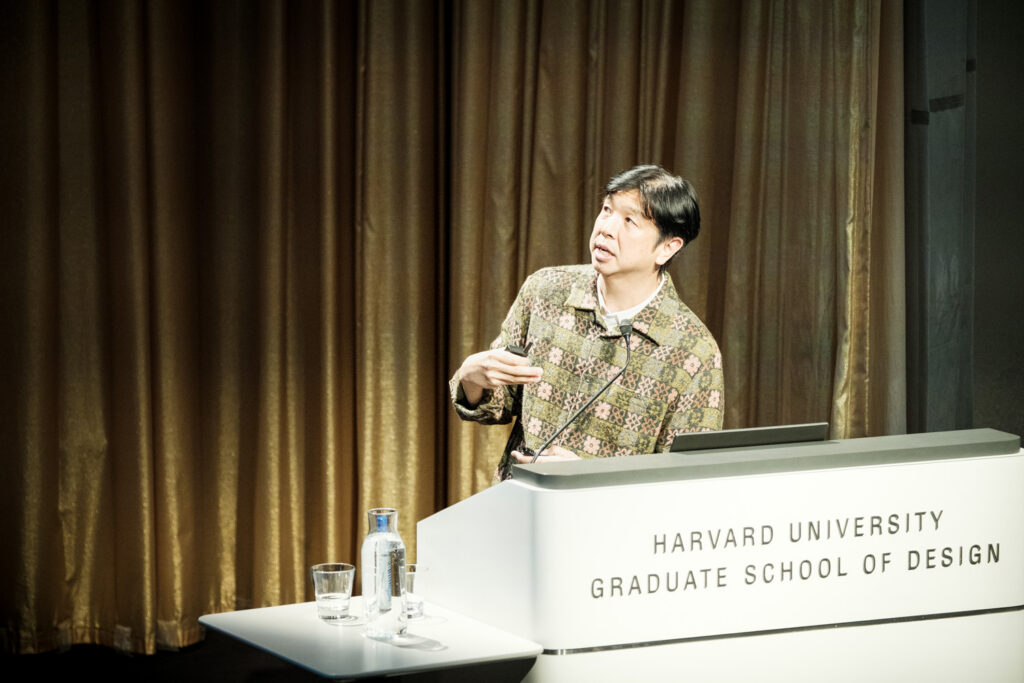
When architect Chatpong Chuenrudeemol spoke at the Harvard Graduate School of Design in spring 2026, he detailed his longstanding fascination with “Bangkok Bastards.” These improvised architectural forms, including improvised canal crossings made of long-tail boats to ad hoc structures of corrugated metal, define his home city’s urban landscape. Such “homegrown concoctions, created by everyday people to solve everyday problems in everyday life,” also inspire Chuenrudeemol’s practice.
Chuenrudeemol discussed projects by his firm Chat Architects in Thailand including Angsila Oyster Pavilion, Na-Eh Bamboo Market for the Indigenous Karen Pwo Community, Indigo Loom House, and Samsen STREET Hotel.
Chuenrudeemol taught a spring 2026 option studio at the GSD, “Shophouse Metropolis,” focused on re-imagining one of the most ubiquitous building types in Bangkok. Introducing Chat’s lecture, Department of Architecture Chair Grace La noted his “ingenuity in creating a living tradition of bottom-up architecture, shaped by necessity and culture.” These overlooked conditions reveal an alternative architectural intelligence rooted in necessity and adaptation. What might it mean to see these informal practices as central to how cities are made? For Chuenrudeemol, “this beautiful underbelly of Bangkok and Thailand” offers a new way to think about—and design—our physical environment.
Sarah M. Whiting on the Meaning of Architectural Education Today
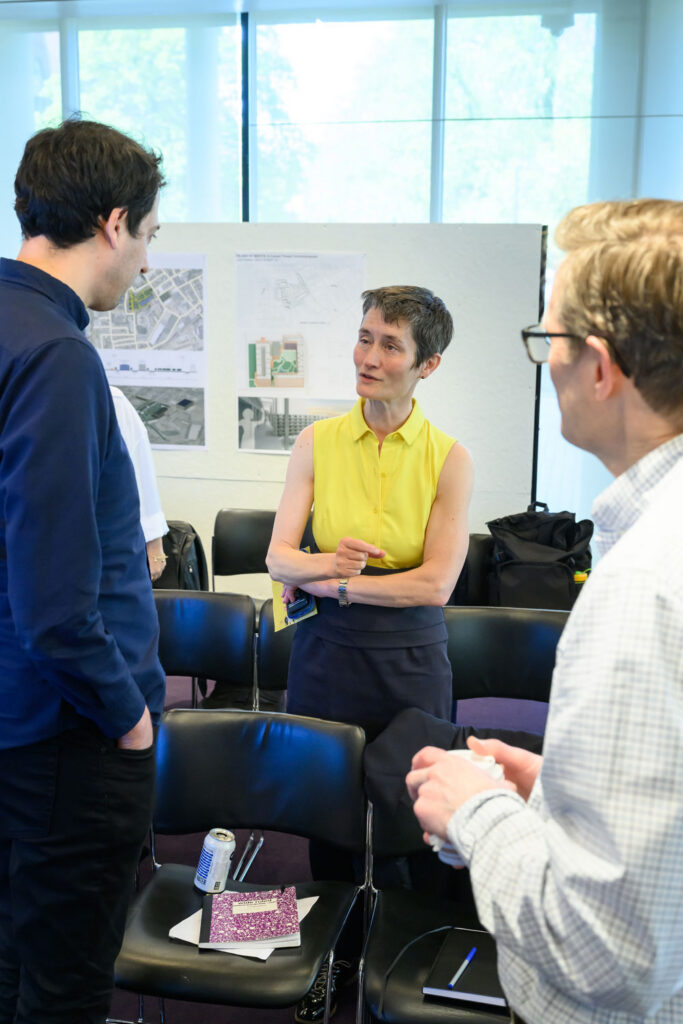
In a Chicago ceremony this spring, Sarah M. Whiting, dean and Josep Lluís Sert Professor of Architecture at Harvard GSD, accepted the 2026 AIA/ACSA Topaz Medallion for Excellence in Architectural Education.
The highest honor for an architectural educator in North America, the Topaz Medallion recognizes Whiting’s transformative leadership, scholarship, mentorship, and lasting impact on architectural education. In his support for her nomination, Michael Maltzan FAIA (MArch ’88) observed that Whiting has “made all of us better off in architectural education, and in architecture.”
Through her work as dean, educator, scholar, and practicing architect, Whiting has helped advance a more inclusive, interdisciplinary, and civically engaged vision for design—one that prepares future architects to address the complex challenges shaping our built environment.
Congratulations, Dean Whiting.
Deborah Archer on Transportation Infrastructure and Race

At the Harvard Graduate School of Design, legal scholar Deborah N. Archer delivered the lecture “Transportation Infrastructure and Race in American Cities,” reframing infrastructure as a central civil rights issue.
Archer argues that racism is enforced not only socially but spatially—through decisions about where people can live, move, and gather. Drawing on her recent book, Dividing Lines: How Transportation Infrastructure Reinforces Racial Inequality, Archer argued that transportation systems do more than connect A to B: they shape access to education, opportunity, and political life. “Transportation infrastructure determines who gets locked out, who gets left behind, who gets access,” she explains, “who lives with dignity and respect and who doesn’t.”
If infrastructure organizes everyday life at this scale, then its design becomes a question of justice. How might rethinking these systems begin to repair the inequities they have long produced?
Nancy Fraser Speaks against the Environmentalism of the Rich
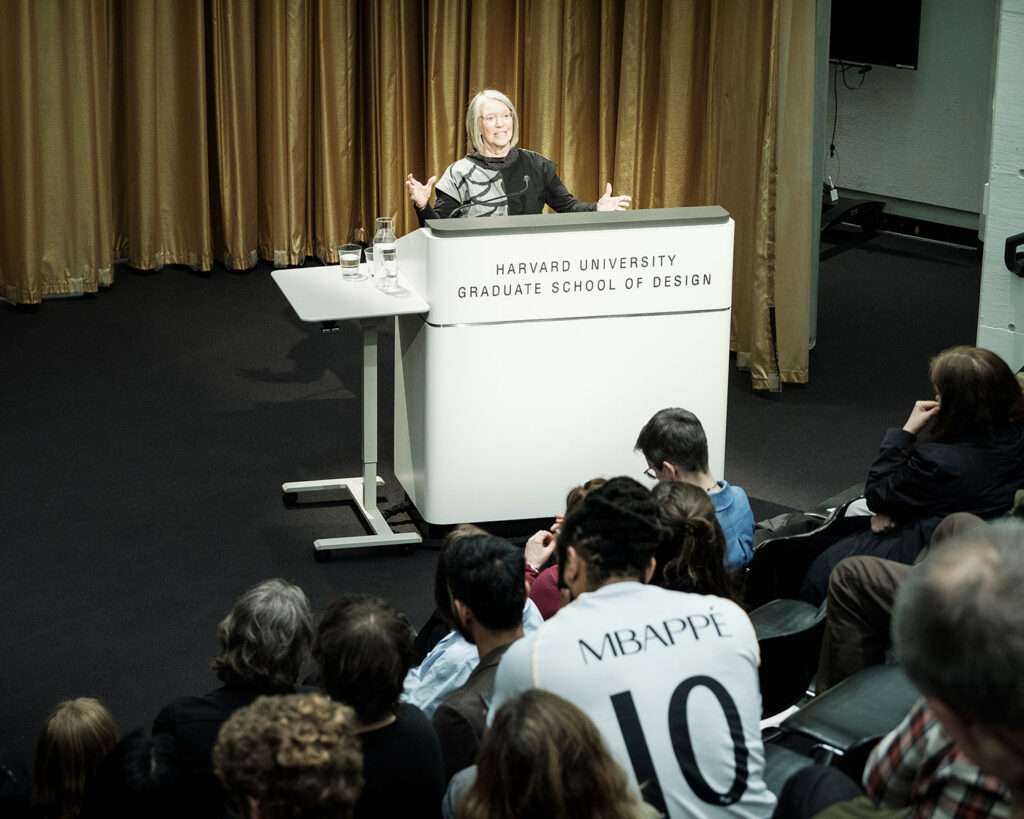
Political philosopher Nancy Fraser, 2026 Senior Loeb Scholar, recently delivered the lecture “Against the Environmentalism of the Rich” at the Harvard Graduate School of Design, challenging the foundations of climate discourse.
Fraser argues that capitalism does not just exploit nature—it entrusts its care to those most driven to extract from it, concentrating control over land, energy, and the conditions that sustain life. This is not a policy failure but a structural contradiction, Fraser asserts, “built into the [capitalist] system’s very design.” Those incentivized to degrade the planet are tasked with managing it.
To confront ecological crisis, Fraser insists, environmentalism must move beyond reform and reckon with capitalism’s core logic—its demand for endless growth. “An environmentalism that might actually save the planet has got to go after capitalism,” Fraser insists. What might it mean for designers—and all of us—to take that challenge seriously?
Barozzi Veiga on Finding a Architecture of Place
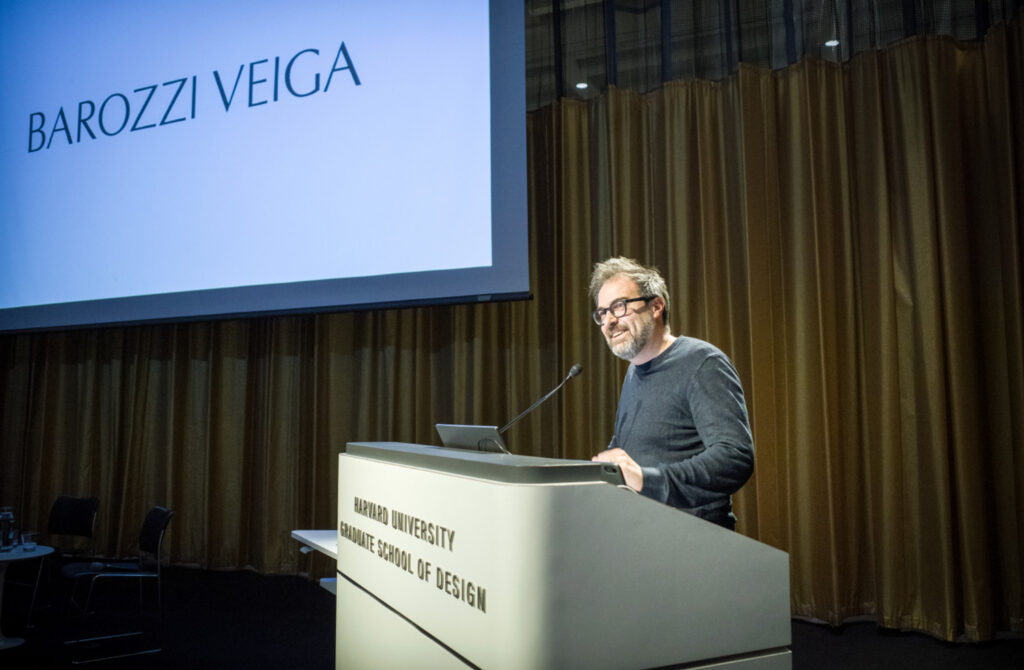
In the recent public program titled “Permanence and Transformation,” Fabrizio Barozzi and Alberto Veiga, founders of Barcelona-based practice Barozzi Veiga, presented their recent work and discussed how contemporary architecture can “grow from what already exists.”
Grace La, professor and chair of the Department of Architecture, introduced Barozzi and Veiga, who are both currently teaching at the GSD as John C. Portman Design Critics in Architecture. “In projects across Europe and beyond, their buildings respond precisely to specific places while retaining a robust and coherent sense of formal autonomy and identity,” said La.
Barozzi spoke from the podium about projects including Abby Kortrijk in Belgium and Villa AG in Dubai, before joining Veiga and La for a discussion. This video recap highlights Barozzi Veiga’s design for Oolite Arts in Miami, a project that aims to cultivate a community of artists.