Richard T.T. Forman’s Spatial Ecology of the Land
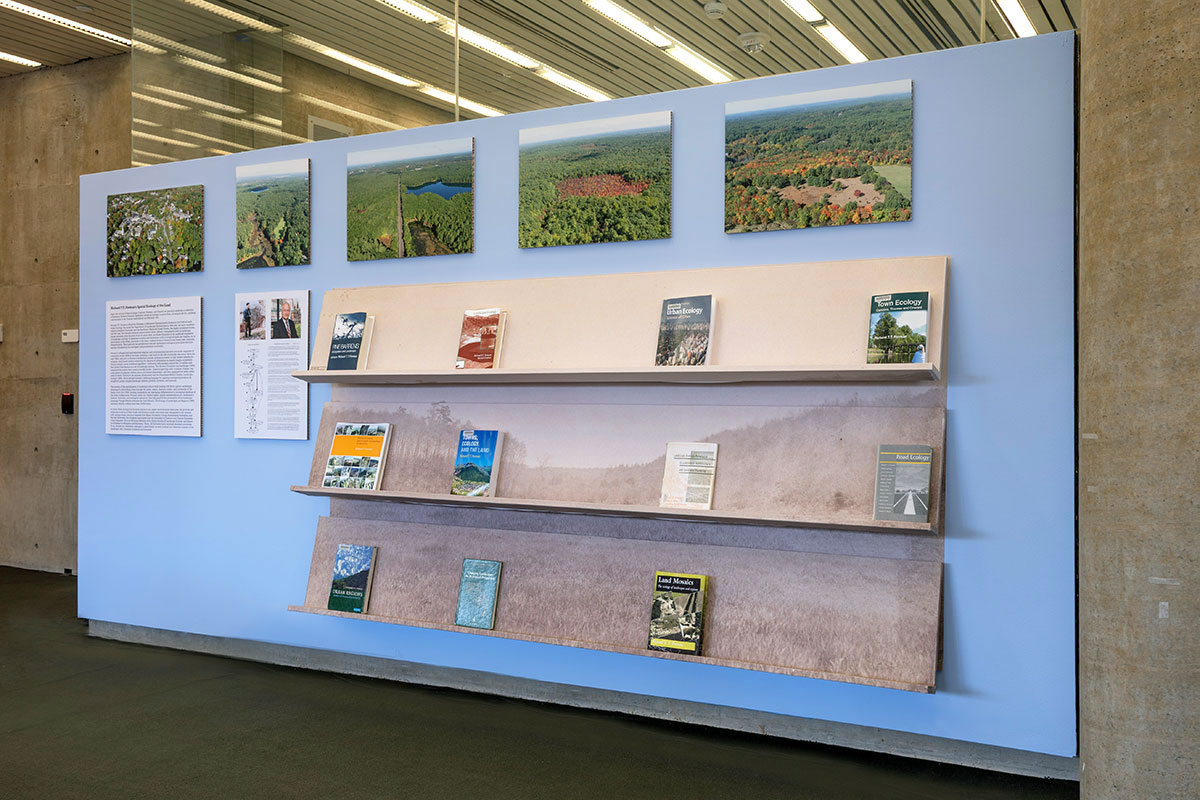
Upon the arrival of Town Ecology: Concord, Thoreau, and Onward, we proudly celebrate a collection of Professor Richard Forman’s definitive works on ecology in print form, accompanied by a probing conversation in the Frances Loeb Library on February 12th.
Richard T.T. Forman is Emeritus Professor of Advanced Environmental Studies in the Field of Landscape Ecology. He joined the Department of Landscape Architecture in 1984 after his early academic career at Rutgers University and the Hutcheson Memorial Forest Center. His highly acclaimed books, and the vast, five-decade research project behind them, delimit a remarkable orbit in landscape scope and scale, from his early focus on plant, bird, and forest dynamics to the profound origination of landscape ecology, to landscape mosaics and territories, to the ecology of roads and regions, on to the ecology of the urban, and back to the town—indeed, back to Forman’s own home town, Concord, Massachusetts. This trajectory has proliferated radically spatialized ecological principles that have become foundational for ecologists and practitioners worldwide.
Forman’s collaged and hand-sketched diagram and accompanying narrative reveal the sequence of cumulative scalar shifts in the work, evincing a rapt mind on the trail of scientific discovery. Since the mid 1960s, and prior to Forman’s intellectual journey, ecological science at GSD tended towards descriptive, field-based studies examining the impacts of urbanization on usually fragile ecosystems. Forman tacked a more ambitious expedition, confronting with multiple authors the 1.5 million acre New Jersey Pine Barrens as a set of landscape systems. Pine Barrens: Ecosystem and Landscape (1979), examined the subject from varied scientific lenses—historical geology, soils, moisture, climate, vascular plants, bryophytes, lichens, fauna, and human interactions—and thus equipped him with a wider cone of vision. This led to his seminal collaboration with the Frenchman Michel Godron, Landscape Ecology (1986), which brought forward a defining language for applying ecological principles descriptively across complex landscape systems: patches, corridors, and matrices.
The novelty of this spatialization of landscape science finds kinship with Kevin Lynch’s archetypal language for describing cities through the paths, edges, districts, nodes, and landmarks of his Image of the City (1960), lending imageability and perceptual differentiation to conceptual readings of the urban configuration. Forman’s work, too, fosters legible, spatial representations of a landscape’s systems, functions, and ecological dynamics. One tidy proof of the universality of his landscape language: Google Scholar indicates that Land Mosaics: The Ecology of Landscapes and Regions (1995) has been cited by authors more than 10,000 times.
In a time when ecology has become central to our urgent environmental discourse, the gravitas and enduring currency of these works and Forman’s career have been duly recognized in far corners: with, among others, honorary degrees from Miami University, Florida International University, and Harvard University; the European equivalents from the University of Florence and Charles University, Czech Republic. He is an Honorary Member of the Italian Society of Landscape Ecology and Honorary Professor in Mongolia and Shenyang, China. All the books have received abundant accolades. To us, Forman is a cherished colleague, a great friend, an ever-curious and observant student of the landscape, and a treasure in science and humanity.
–Gary R. Hilderbrand
Chair of the Department of Landscape Architecture, Peter Louis Hornbeck Professor in Practice of Landscape Architecture


Looking for older event archives? Please contact Loeb Library or visit our YouTube channel.